trunk LEXUS IS250 2016 Owner's Guide
[x] Cancel search | Manufacturer: LEXUS, Model Year: 2016, Model line: IS250, Model: LEXUS IS250 2016Pages: 542, PDF Size: 9.65 MB
Page 179 of 542

179
2-4. Using other driving systems
2
When driving
CAUTION
nConditions under which the vehicle-to-vehicle distance control may not function
correctly
Apply the brakes as necessary in the following conditions as the radar sensor may
not be able to correctly detect vehicles ahead, and an accident may result.
lWhen water or snow thrown up by the surrounding vehicles hinders the function-
ing of the sensor
lWhen your vehicle is pointing upwards (caused by a heavy load in the trunk, etc.)
lWhen the road curves or when the lanes are narrow
lWhen steering wheel operation or your position in the lane is unstable
lWhen the vehicle ahead of you decelerates suddenly
nHandling the radar sensor
Observe the following to ensure the cruise control system can function effectively:
lKeep the sensor and front grille clean at all times.
Clean the sensor and front grille with a soft cloth so you do not mark or damage
them.
lDo not subject the sensor or surrounding area to a strong impact.
If the sensor moves even slightly off position, the system may malfunction. If the
sensor or surrounding area is subject to a strong impact, always have the area
inspected and adjusted by a Lexus dealer.
lDo not disassemble the sensor.
lDo not attach accessories or stickers to the sensor, grille or surrounding area.
lDo not modify or paint the sensor and grille.
nTo ensure the radar sensor functions correctly
Do not do the following to the sensor or grille cover as doing so may cause the sen-
sor not to function correctly and could result in an accident.
lStick or attach anything to them
lLeave them dirty
lDisassemble, subject them to strong shocks
lModify or paint them
lReplace them with non-genuine parts
Page 196 of 542
196
2-5. Driving information
Cargo and luggage
Capacity and distribution
Cargo capacity depends on the total weight of the occupants.
(Cargo capacity) = (Total load capacity) — (Total weight of occupants)
Steps for Determining Correct Load Limit ⎯
(1) Locate the statement “The combined weight of occupants and cargo
should never exceed XXX kg or XXX lbs.” on your vehicle’s placard.
(2) Determine the combined weight of the driver and passengers that will
be riding in your vehicle.
(3)Subtract the combined weight of the driver and passengers from
XXX kg or XXX lbs.
(4)The resulting figure equals the available amount of cargo and luggage
load capacity.
For example, if the “XXX” amount equals 1400 lbs. and there will be
five 150 lb. passengers in your vehicle, the amount of available cargo
and luggage load capacity is 650 lbs. (1400 − 750 (5 × 150) = 650
lbs.)
(5)Determine the combined weight of luggage and cargo being loaded
on the vehicle. That weight may not safely exceed the available cargo
and luggage load capacity calculated in Step 4.
Take notice of the following information about storage precautions, cargo
capacity and load.
lStow cargo and luggage in the trunk whenever possible. Be sure
all items are secured in place.
lBe careful to keep the vehicle level. Placing the weight as far for-
ward as possible helps maintain vehicle balance.
lFor better fuel economy, do not carry unnecessary weight.
Page 198 of 542
198
2-5. Driving information
CAUTION
nThings that must not be carried in the trunk
The following things may cause a fire if loaded in the trunk.
lReceptacles containing gasoline
lAerosol cans
nStorage precautions
lDo not place anything on the package tray behind the rear seatback.
Such items may be thrown about and possibly injure people in the vehicle during
sudden braking or in an accident.
lDo not drive with objects on top of the instrument panel.
They may interfere with the driver’s field of view or move during sharp accelera-
tion or turning, thus impairing the driver’s control of the vehicle. In an accident
they may injure the vehicle occupants.
lSecure all items in the occupant compartment, as they may shift and injure some-
one during an accident or sudden braking.
nCapacity and distribution
lDo not exceed the maximum axle weight rating or the total vehicle weight rating.
lEven if the total load of occupant's weight and the cargo load is less than the total
load capacity, do not apply the load unevenly. Improper loading may cause dete-
rioration of steering or braking control which may cause death or serious injury.
Page 251 of 542
252
3-4. Using the storage features
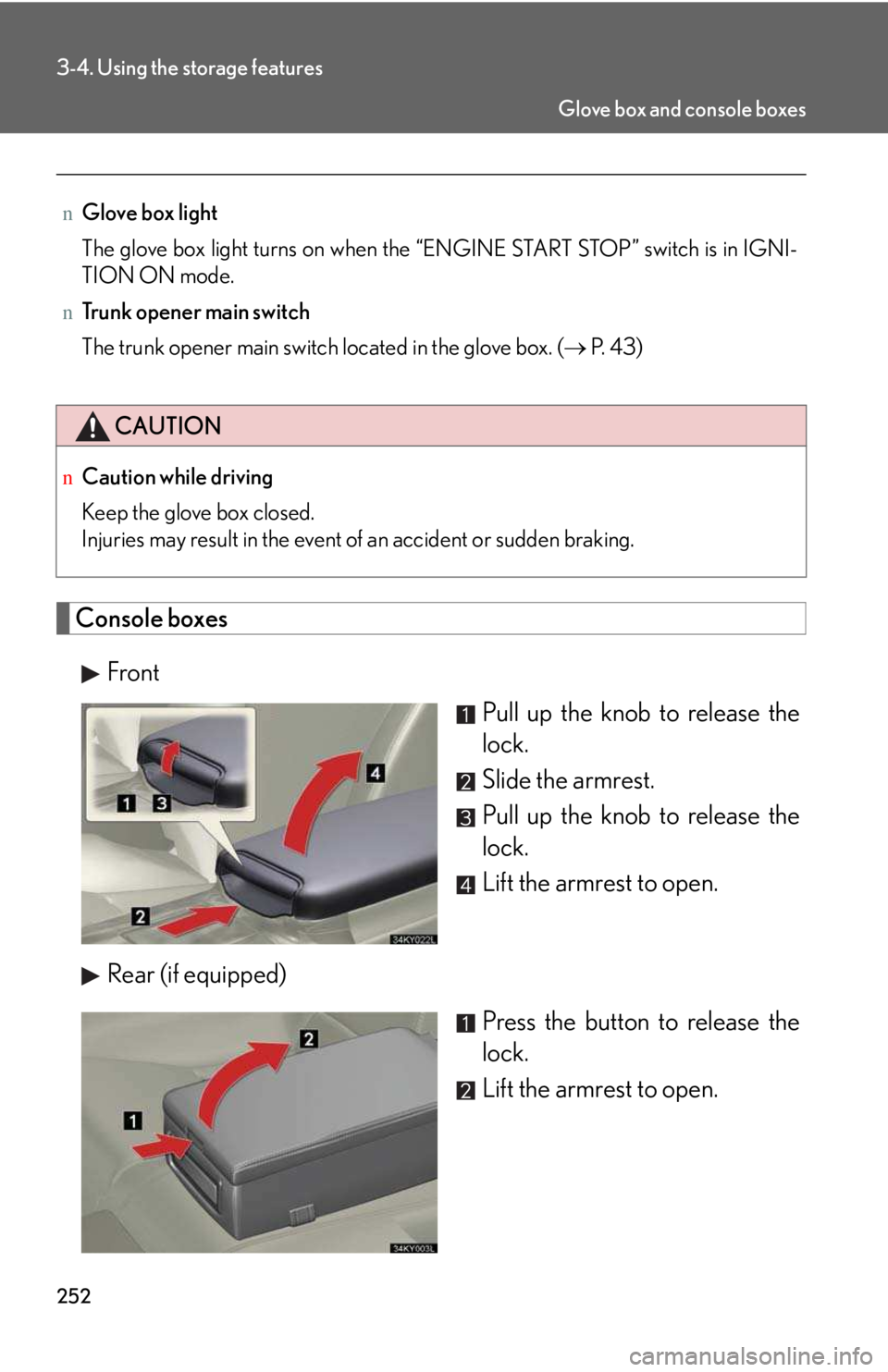
Console boxes
Front
Pull up the knob to release the
lock.
Slide the armrest.
Pull up the knob to release the
lock.
Lift the armrest to open.
Rear (if equipped)
Press the button to release the
lock.
Lift the armrest to open.
nGlove box light
The glove box light turns on when the “ENGINE START STOP” switch is in IGNI-
TION ON mode.
nTrunk opener main switch
The trunk opener main switch located in the glove box. (→ P. 4 3 )
CAUTION
nCaution while driving
Keep the glove box closed.
Injuries may result in the event of an accident or sudden braking.
Glove box and console boxes
Page 274 of 542
275
3-5. Other interior features
3
Interior features
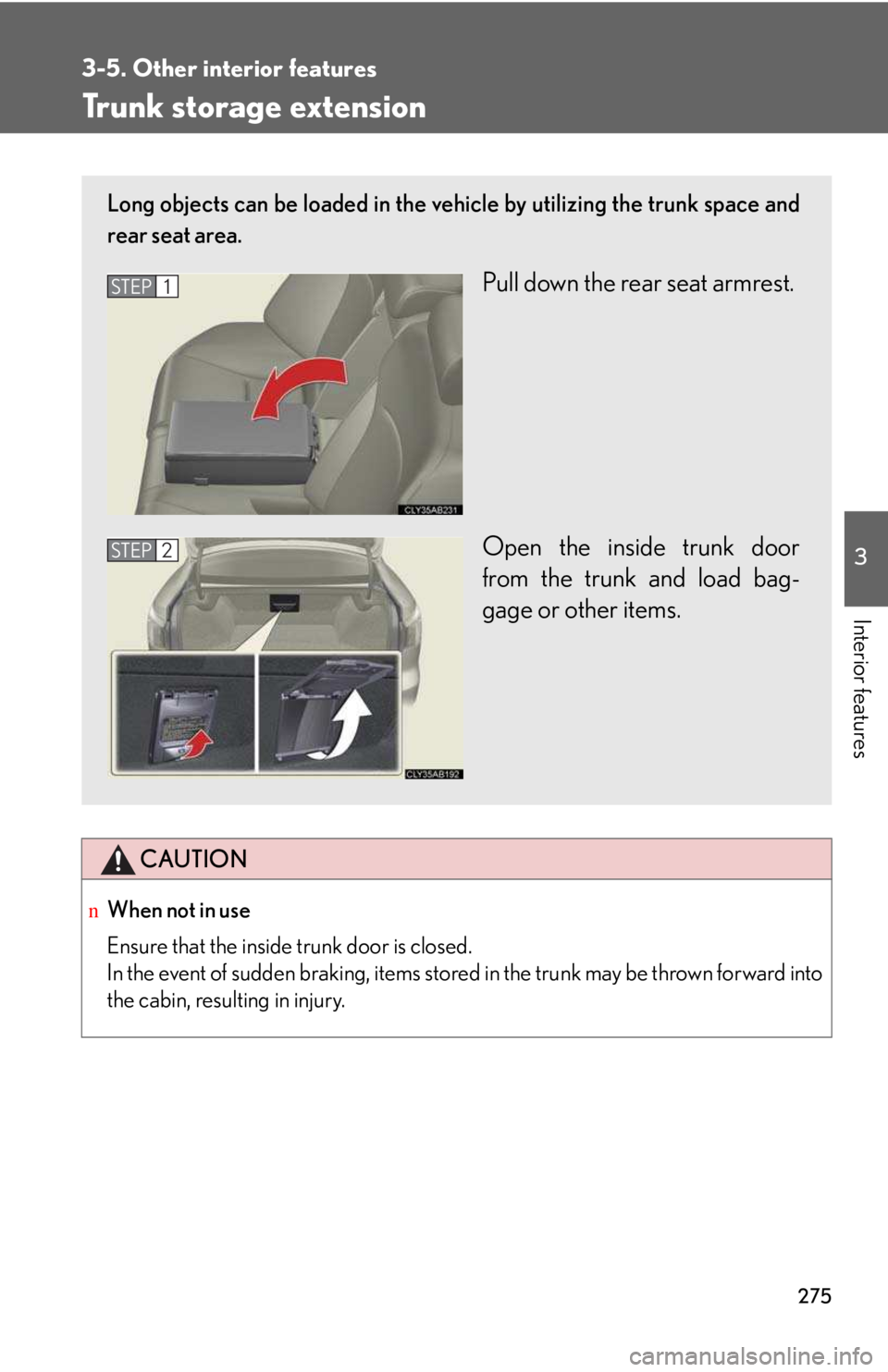
Trunk storage extension
CAUTION
nWhen not in use
Ensure that the inside trunk door is closed.
In the event of sudden braking, items stored in the trunk may be thrown forward into
the cabin, resulting in injury.
Long objects can be loaded in the vehicle by utilizing the trunk space and
rear seat area.
Pull down the rear seat armrest.
Open the inside trunk door
from the trunk and load bag-
gage or other items.
STEP1
STEP2
Page 277 of 542
278
3-5. Other interior features
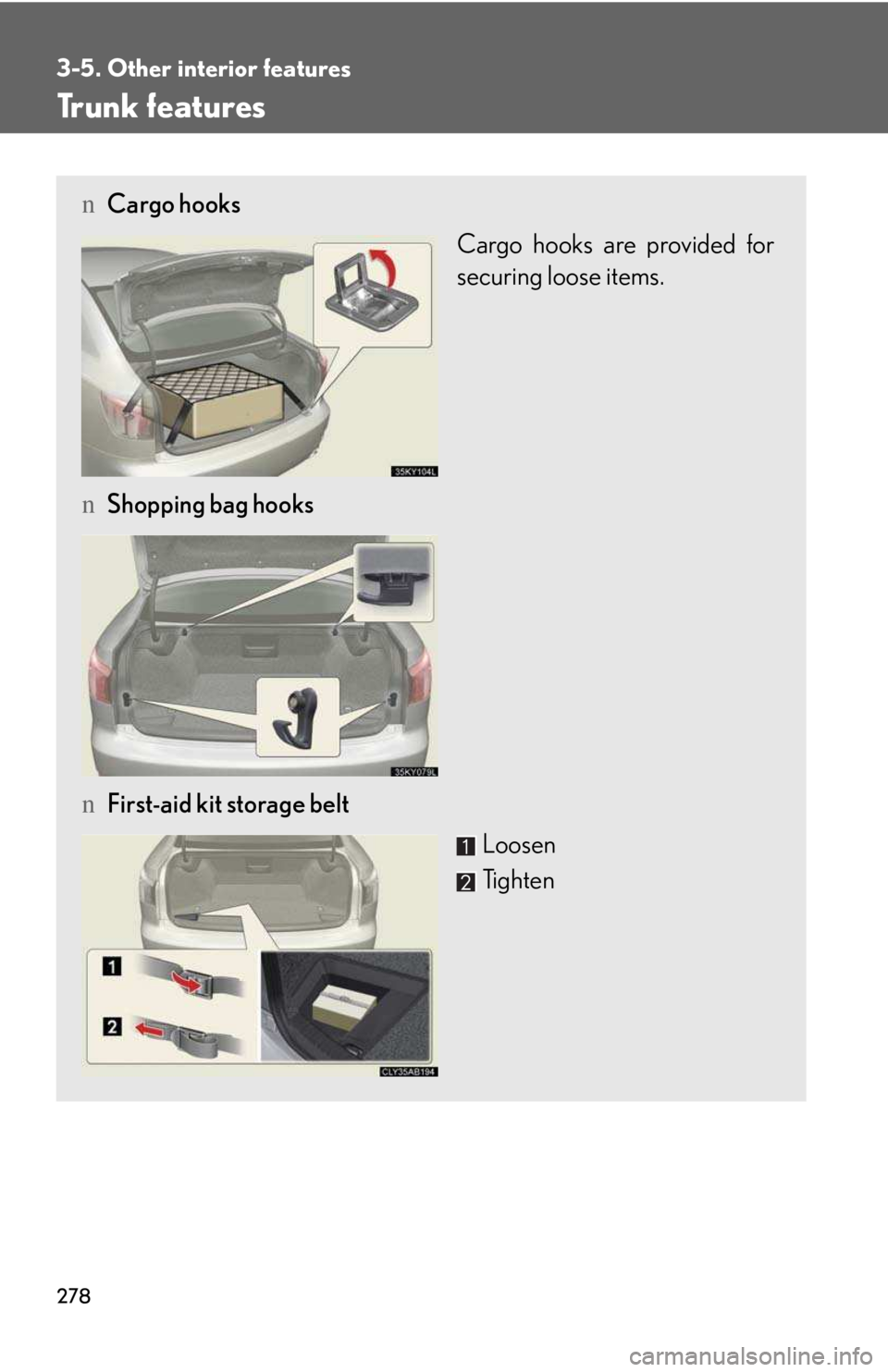
Trunk features
nCargo hooks
Cargo hooks are provided for
securing loose items.
nShopping bag hooks
nFirst-aid kit storage belt
Loosen
Tighten
Page 278 of 542
279
3-5. Other interior features
3
Interior features
CAUTION
nWhen the cargo hooks are not in use
To avoid injury, always return the cargo hooks to their positions when they are not in
use.
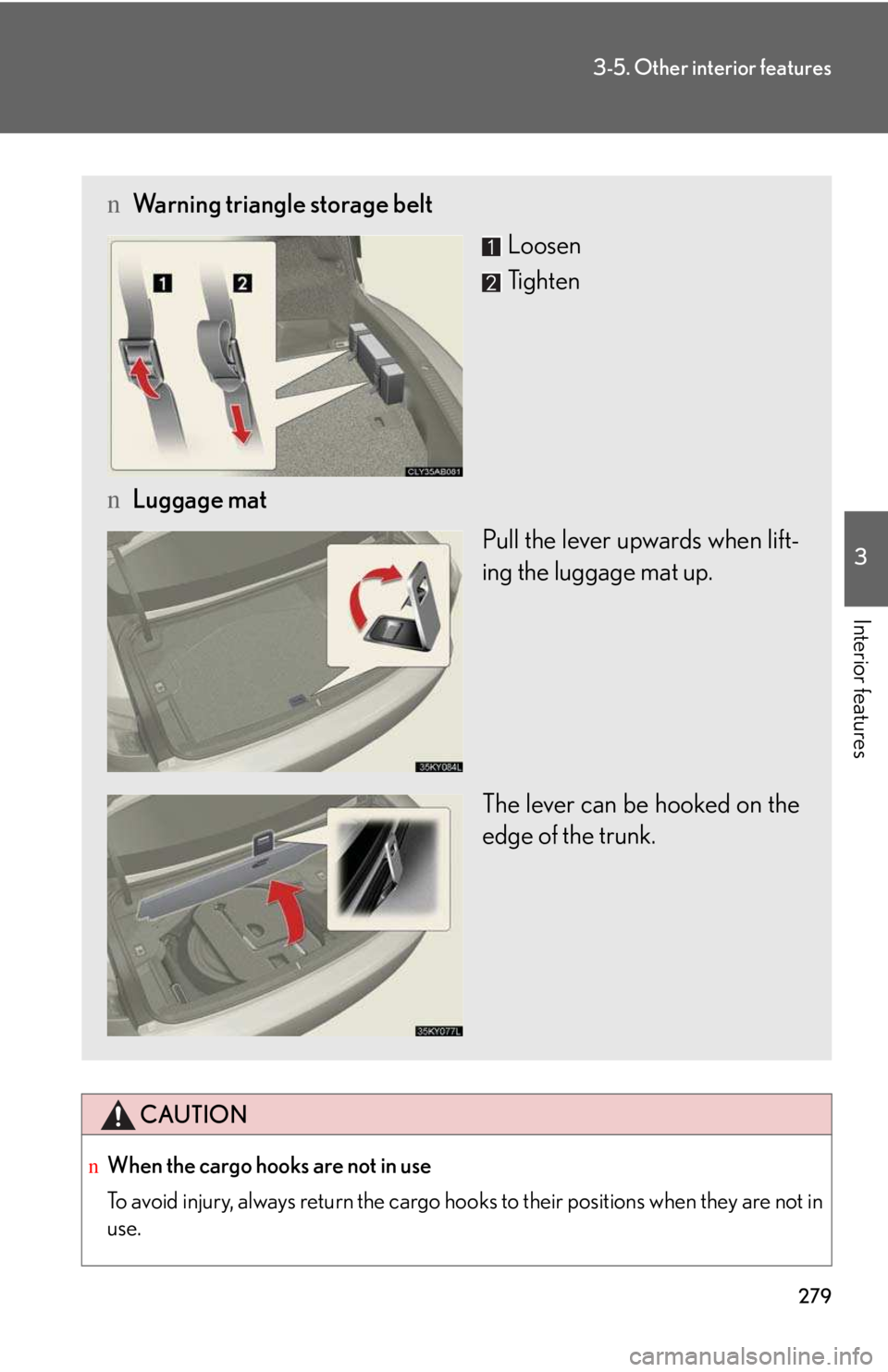
nWarning triangle storage belt
Loosen
Tighten
nLuggage mat
Pull the lever upwards when lift-
ing the luggage mat up.
The lever can be hooked on the
edge of the trunk.
Page 279 of 542

280
3-5. Other interior features
NOTICE
nWhen closing the trunk
Do not leave the luggage mat lever hooked on the edge of the trunk.
The luggage mat may get damaged.
Page 363 of 542
365
4-3. Do-it-yourself maintenance
4
Maintenance and care
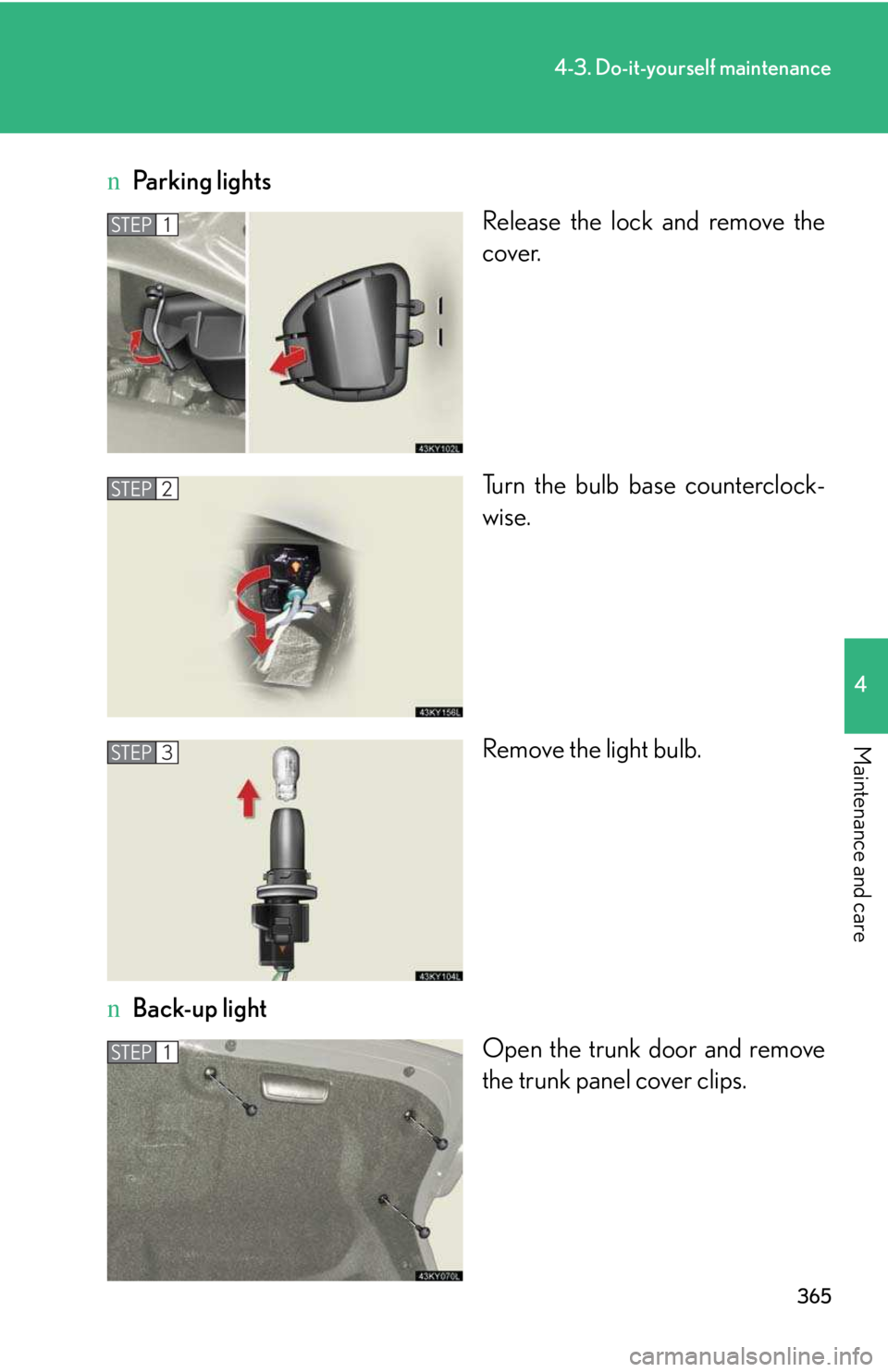
nParking lights
Release the lock and remove the
cover.
Turn the bulb base counterclock-
wise.
Remove the light bulb.
nBack-up light
Open the trunk door and remove
the trunk panel cover clips.
STEP1
STEP2
STEP3
STEP1
Page 364 of 542
366
4-3. Do-it-yourself maintenance
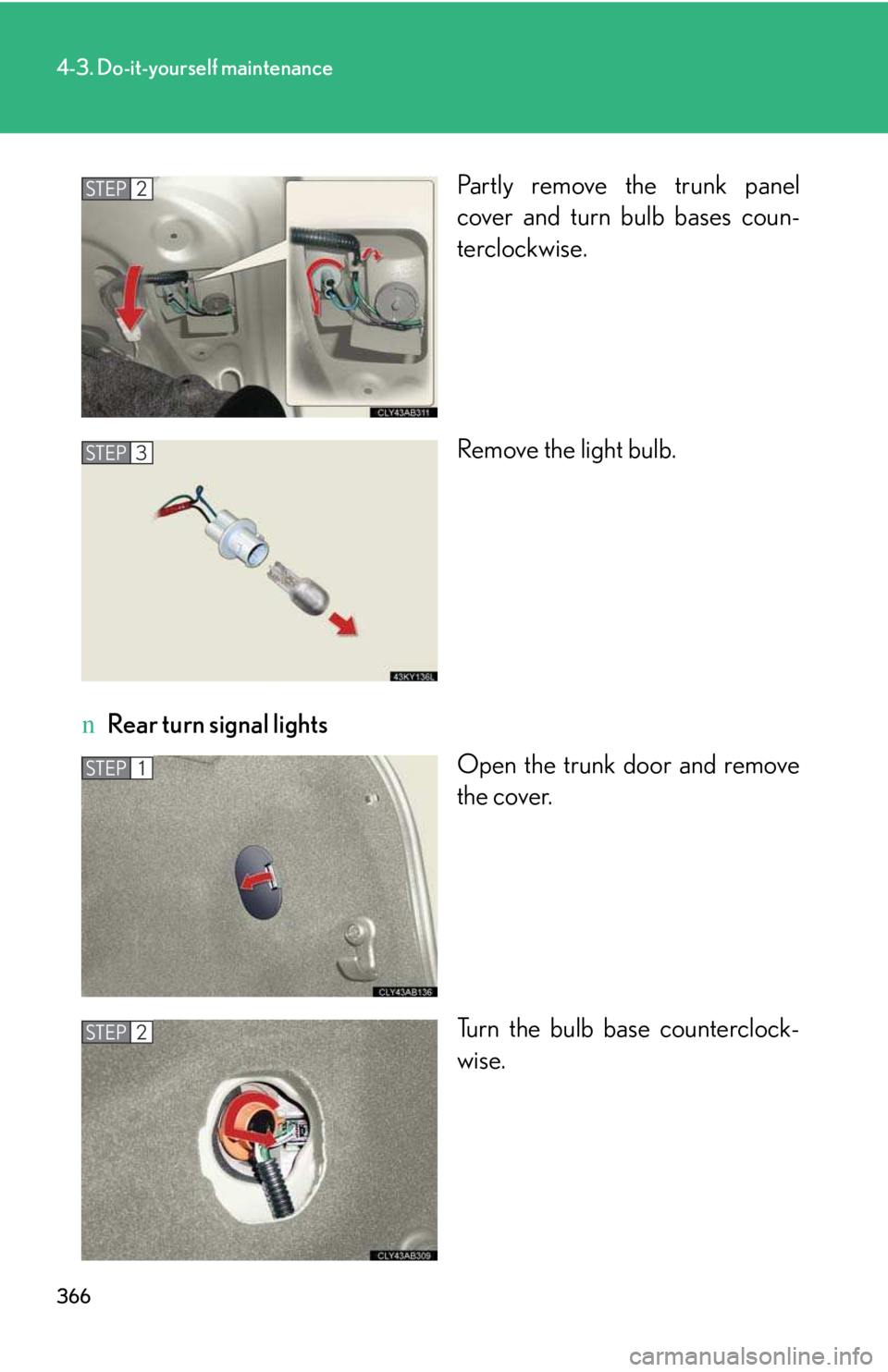
Partly remove the trunk panel
cover and turn bulb bases coun-
terclockwise.
Remove the light bulb.
nRear turn signal lights
Open the trunk door and remove
the cover.
Turn the bulb base counterclock-
wise.
STEP2
STEP3
STEP1
STEP2