steering LEXUS IS250 2016 Service Manual
[x] Cancel search | Manufacturer: LEXUS, Model Year: 2016, Model line: IS250, Model: LEXUS IS250 2016Pages: 542, PDF Size: 9.65 MB
Page 157 of 542
157
2-3. Operating the lights and windshield wipers
2
When driving
AFS (vehicles with discharge headlights)
AFS (Adaptive Front-lighting System) improves visibility at intersections
and on curves by automatically adjusting the level of the headlights
according to vehicle speed and the degree of the tire angle that are con-
trolled by steering input.
Operates at speeds of 6 mph (10 km/h) or higher.
nDeactivating AFS
How to switch: →P. 2 6 0
“AFS OFF” turns on when the AFS is deactivated.
nDaytime running light system
To make your vehicle more visible to other drivers, the headlights turn on automati-
cally (at a reduced intensity) whenever the engine is started and the parking brake
is released. Daytime running lights are not designed for use at night.
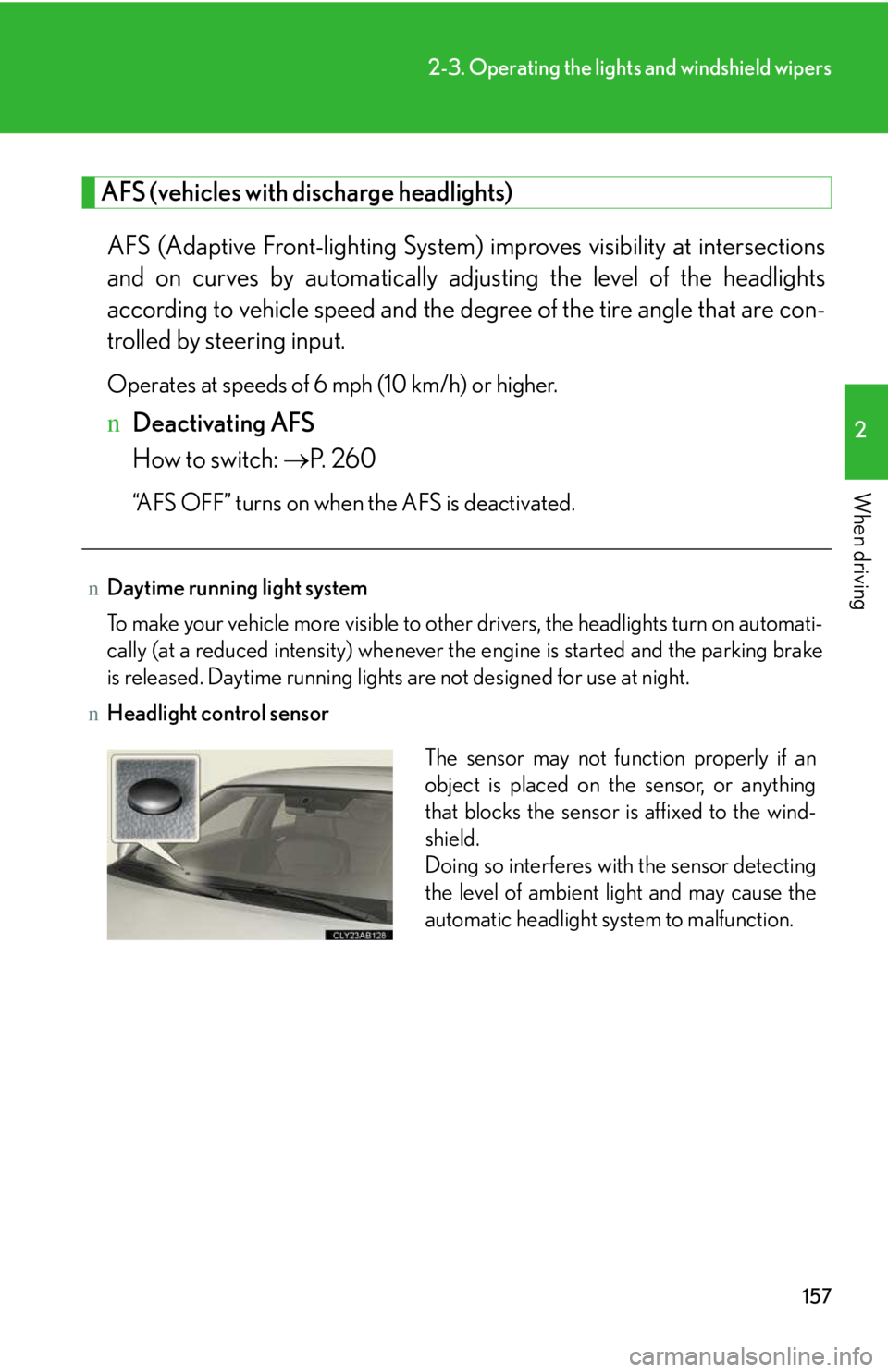
nHeadlight control sensor
The sensor may not function properly if an
object is placed on the sensor, or anything
that blocks the sensor is affixed to the wind-
shield.
Doing so interferes with the sensor detecting
the level of ambient light and may cause the
automatic headlight system to malfunction.
Page 179 of 542

179
2-4. Using other driving systems
2
When driving
CAUTION
nConditions under which the vehicle-to-vehicle distance control may not function
correctly
Apply the brakes as necessary in the following conditions as the radar sensor may
not be able to correctly detect vehicles ahead, and an accident may result.
lWhen water or snow thrown up by the surrounding vehicles hinders the function-
ing of the sensor
lWhen your vehicle is pointing upwards (caused by a heavy load in the trunk, etc.)
lWhen the road curves or when the lanes are narrow
lWhen steering wheel operation or your position in the lane is unstable
lWhen the vehicle ahead of you decelerates suddenly
nHandling the radar sensor
Observe the following to ensure the cruise control system can function effectively:
lKeep the sensor and front grille clean at all times.
Clean the sensor and front grille with a soft cloth so you do not mark or damage
them.
lDo not subject the sensor or surrounding area to a strong impact.
If the sensor moves even slightly off position, the system may malfunction. If the
sensor or surrounding area is subject to a strong impact, always have the area
inspected and adjusted by a Lexus dealer.
lDo not disassemble the sensor.
lDo not attach accessories or stickers to the sensor, grille or surrounding area.
lDo not modify or paint the sensor and grille.
nTo ensure the radar sensor functions correctly
Do not do the following to the sensor or grille cover as doing so may cause the sen-
sor not to function correctly and could result in an accident.
lStick or attach anything to them
lLeave them dirty
lDisassemble, subject them to strong shocks
lModify or paint them
lReplace them with non-genuine parts
Page 186 of 542
186
2-4. Using other driving systems
Driving assist systems
To help enhance driving safety and performance, the following systems
operate automatically in response to various driving situations. Be aware,
however, that these systems are supplementary and should not be relied
upon too heavily when operating the vehicle.
nABS (Anti-lock Brake System)
Helps to prevent wheel lock when the brakes are applied suddenly, or if
the brakes are applied while driving on a slippery road surface.
nBrake assist
Generates an increased level of braking force after the brake pedal is
depressed, when the system detects a panic stop situation.
nVSC (Vehicle Stability Control)
Helps the driver to control skidding when swerving suddenly or turning on
slippery road surfaces.
nTRAC (Traction Control)
Maintains drive power and prevents the rear wheels (2WD models) or all
wheels (AWD models) from spinning when starting the vehicle or acceler-
ating on slippery roads.
nHill-start assist control (vehicles with an automatic transmission)
Prevents the vehicle from rolling backwards when starting on an incline or
slippery slope.
nEPS (Electric Power Steering)
Employs an electric motor to reduce the amount of effort needed to turn
the steering wheel.
Page 190 of 542

190
2-4. Using other driving systems
nHill-start assist control is operational when
lThe shift lever is in the D or S position.
lThe brake pedal is not depressed.
nEPS operation sound
When the steering wheel operates, a motor sound (whirring sound) may be heard.
This does not indicate a malfunction.
nReduced effectiveness of EPS
The effectiveness of EPS is reduced to prevent the system from overheating when
there is frequent steering input over an extended period of time. The steering wheel
may feel heavy as a result. Should this occur, refrain from excessive steering input or
stop the vehicle and turn the engine OFF. The system should return to normal within
10 minutes.
CAUTION
nThe ABS does not operate effectively when
lThe limits of tire gripping performance have been exceeded.
lThe vehicle hydroplanes while driving at high speed on the wet or slick road.
nStopping distance when the ABS is operating will exceed that of normal condi-
tions
The ABS is not designed to shorten the vehicle’s stopping distance. Always main-
tain a safe distance from the vehicle in front of you in the following situations.
lWhen driving on dirt, gravel or snow-covered roads
lWhen driving with tire chains
lWhen driving over bumps in the road
lWhen driving over roads with potholes or roads with uneven roads
Page 198 of 542

198
2-5. Driving information
CAUTION
nThings that must not be carried in the trunk
The following things may cause a fire if loaded in the trunk.
lReceptacles containing gasoline
lAerosol cans
nStorage precautions
lDo not place anything on the package tray behind the rear seatback.
Such items may be thrown about and possibly injure people in the vehicle during
sudden braking or in an accident.
lDo not drive with objects on top of the instrument panel.
They may interfere with the driver’s field of view or move during sharp accelera-
tion or turning, thus impairing the driver’s control of the vehicle. In an accident
they may injure the vehicle occupants.
lSecure all items in the occupant compartment, as they may shift and injure some-
one during an accident or sudden braking.
nCapacity and distribution
lDo not exceed the maximum axle weight rating or the total vehicle weight rating.
lEven if the total load of occupant's weight and the cargo load is less than the total
load capacity, do not apply the load unevenly. Improper loading may cause dete-
rioration of steering or braking control which may cause death or serious injury.
Page 199 of 542
199
2-5. Driving information
2
When driving
Vehicle load limits
nTotal load capacity and seating capacity
These details are also described on the tire and loading information label.
(→P. 3 3 6 )
CAUTION
nOverloading the vehicle
Do not overload the vehicle.
It may not only cause damage to the tires, but also degrade steering and braking
ability, resulting in an accident.
Vehicle load limits include total load capacity, seating capacity, towing
capacity and cargo capacity.
nTotal load capacity: 825 lb. (375 kg)
Total load capacity means the combined weight of occupants, cargo and
luggage.
nSeating capacity: 5 occupants (Front 2, Rear 3)
Seating capacity means the maximum number of occupants whose esti-
mated average weight is 150 lb. (68 kg) per person.
nTowing capacity
Lexus does not recommend towing a trailer with your vehicle.
nCargo capacity
Cargo capacity may increase or decrease depending on the weight and
the number of occupants.
Page 207 of 542
207
2-5. Driving information
2
When driving
NOTICE
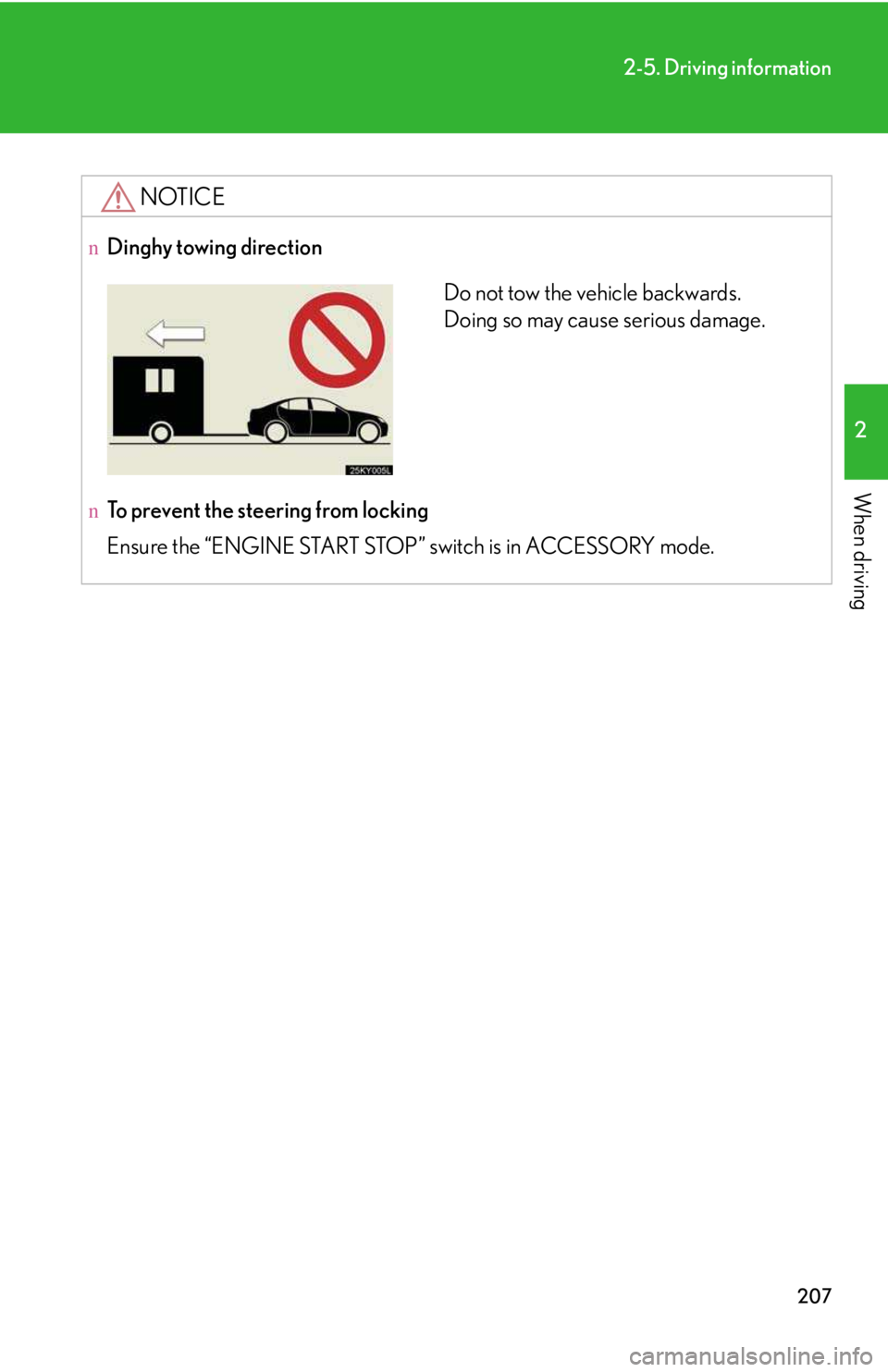
nDinghy towing direction
nTo prevent the steering from locking
Ensure the “ENGINE START STOP” switch is in ACCESSORY mode.
Do not tow the vehicle backwards.
Doing so may cause serious damage.
Page 244 of 542
245
3-2. Using the audio system
3
Interior features
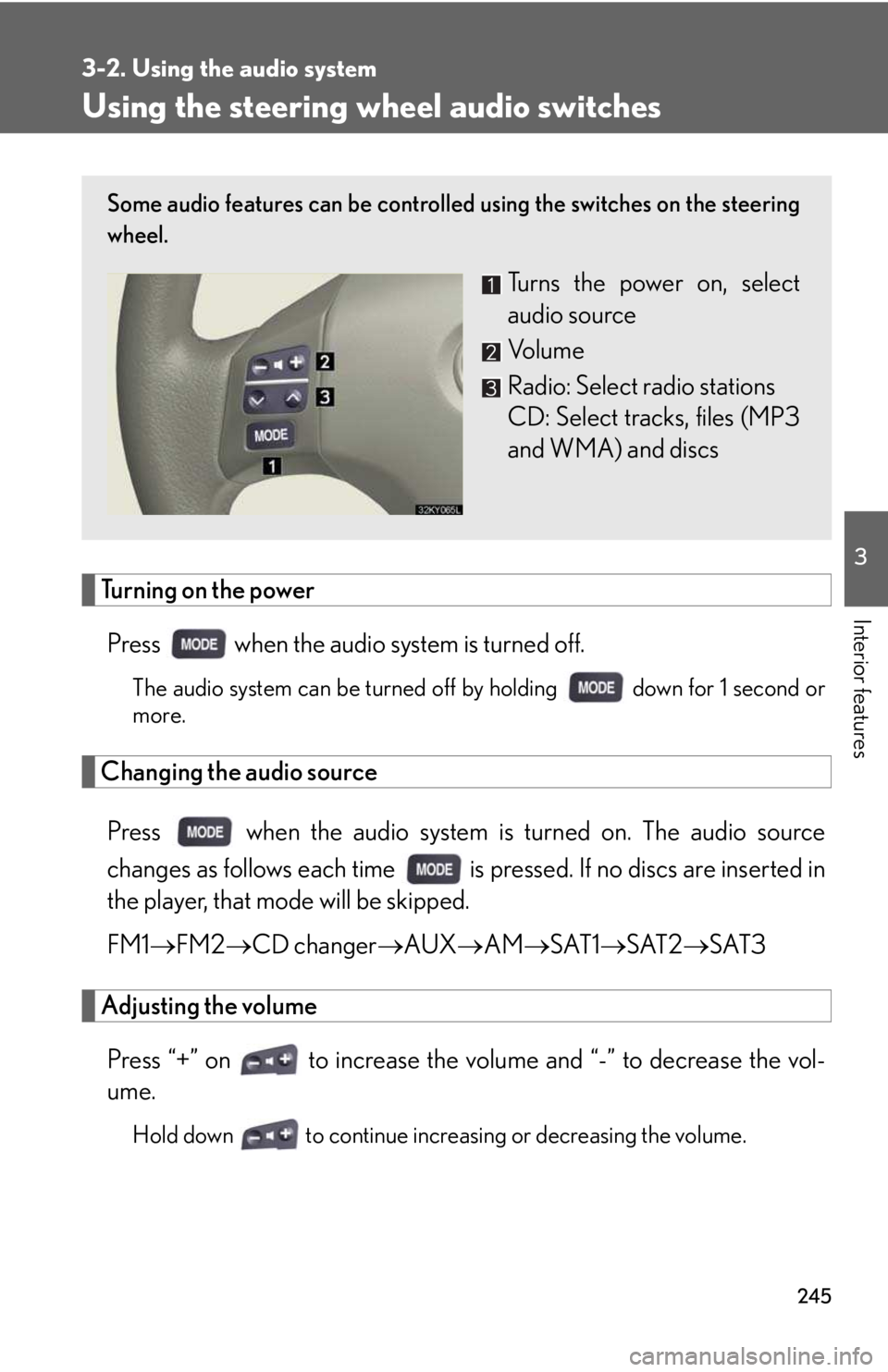
Using the steering wheel audio switches
Turning on the power
Press when the audio system is turned off.
The audio system can be turned off by holding down for 1 second or
more.
Changing the audio source
Press when the audio system is turned on. The audio source
changes as follows each time is pressed. If no discs are inserted in
the player, that mode will be skipped.
FM1→FM2→CD changer→AUX→AM→SAT1→SAT2→SAT3
Adjusting the volume
Press “+” on to increase the volume and “-” to decrease the vol-
ume.
Hold down to continue increasing or decreasing the volume.
Some audio features can be controlled using the switches on the steering
wheel.
Turns the power on, select
audio source
Vo l u m e
Radio: Select radio stations
CD: Select tracks, files (MP3
and WMA) and discs
Page 245 of 542
246
3-2. Using the audio system
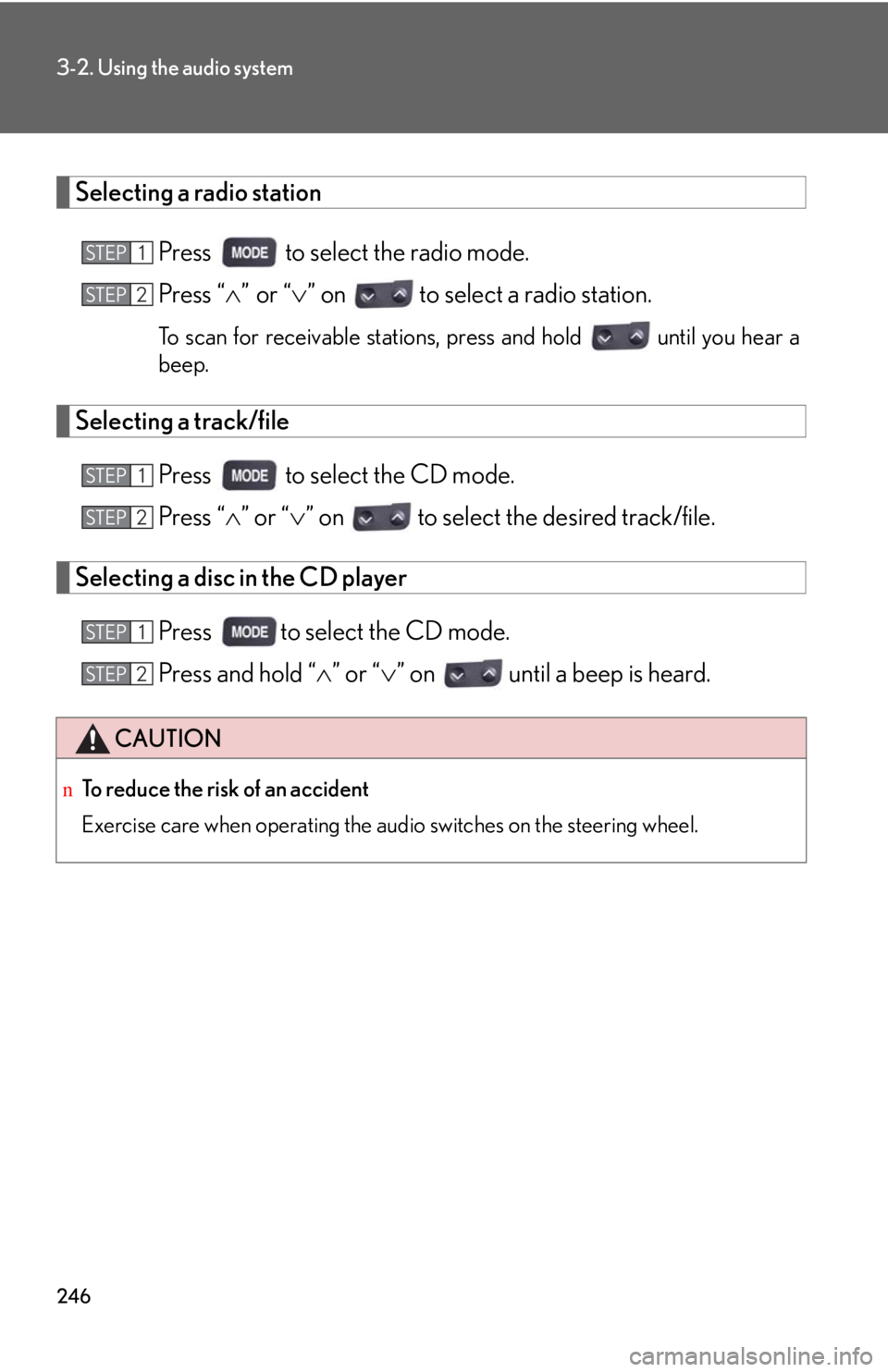
Selecting a radio station
Press to select the radio mode.
Press “∧” or “∨” on to select a radio station.
To scan for receivable stations, press and hold until you hear a
beep.
Selecting a track/file
Press to select the CD mode.
Press “∧” or “∨” on to select the desired track/file.
Selecting a disc in the CD player
Press to select the CD mode.
Press and hold “∧” or “∨” on until a beep is heard.
CAUTION
nTo reduce the risk of an accident
Exercise care when operating the audio switches on the steering wheel.
STEP1
STEP2
STEP1
STEP2
STEP1
STEP2
Page 261 of 542

262
3-5. Other interior features
nChanging the settings
Each item is displayed and its setting can be changed only in the following condi-
tions:
lIntuitive parking assist: When the “ENGINE START STOP” switch is in IGNI-
TION ON mode.
lItems other than the above: When the “ENGINE START STOP” switch is in
IGNITION ON mode and the vehicle is stopped.
nDisplay
The display will return to the original display if the satellite switches are not oper-
ated for an extended period.
Even if the display is in satellite switch mode, it will switch in the event of a warning
or when the radar cruise control (if equipped) is used. If this occurs, press any of the
satellite switches or “DISP” switch on the steering wheel to return the display to sat-
ellite switch mode.