brake LEXUS IS250 2016 Workshop Manual
[x] Cancel search | Manufacturer: LEXUS, Model Year: 2016, Model line: IS250, Model: LEXUS IS250 2016Pages: 542, PDF Size: 9.65 MB
Page 401 of 542
404
5-2. Steps to take in an emergency
If you have a flat tire
Remove the flat tire and replace it with the spare provided.
nBefore jacking up the vehicle
lStop the vehicle on a hard, flat surface.
lSet the parking brake.
lShift the shift lever to P (vehicles with an automatic transmission)
or R (vehicles with a manual transmission).
lStop the engine.
lTurn on the emergency flashers.
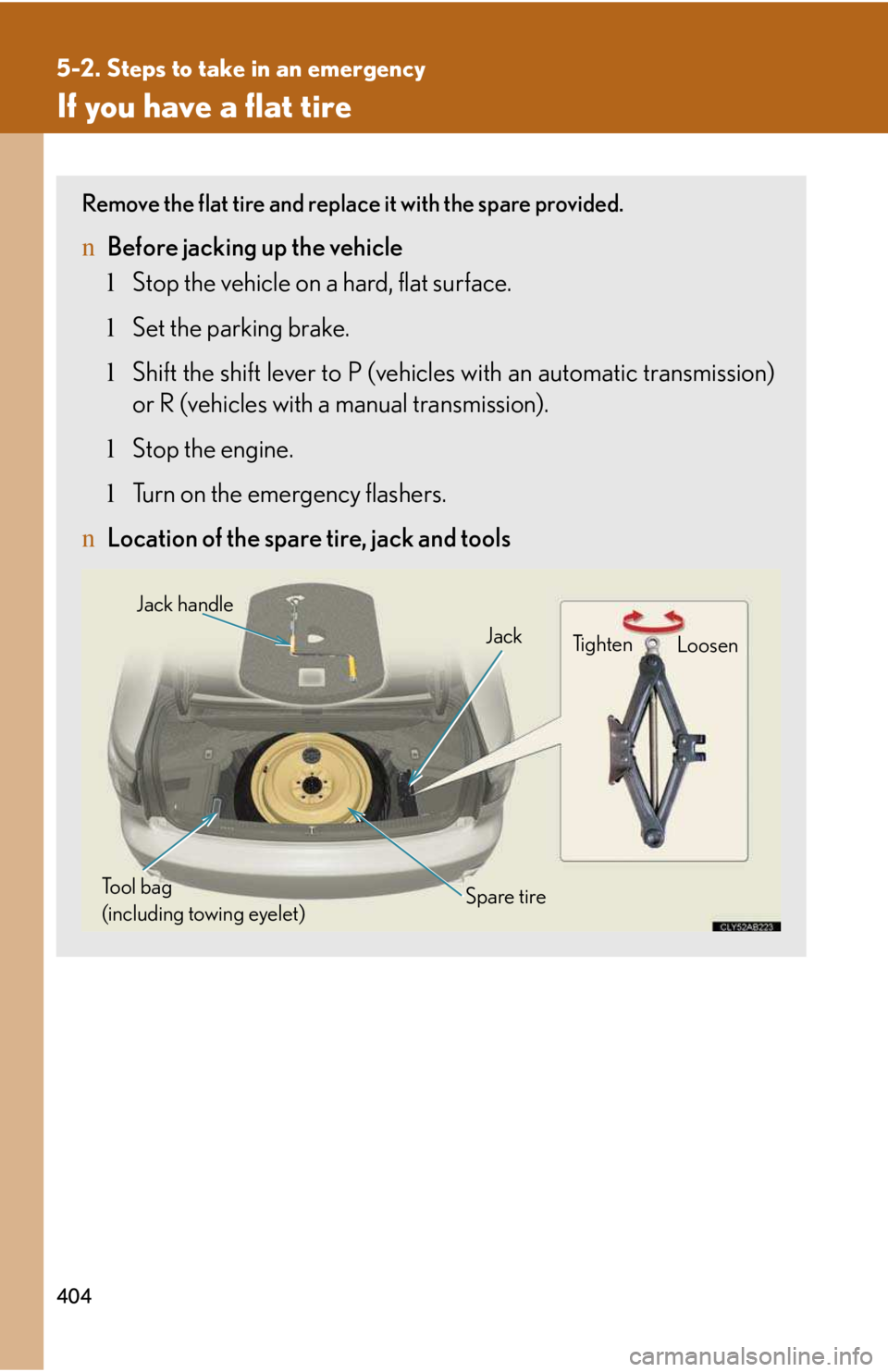
nLocation of the spare tire, jack and tools
Tool bag
(including towing eyelet)
Jack
Jack handle
Spare tire
Ti g h t e nLoosen
Page 408 of 542
5
When trouble arises
411
5-2. Steps to take in an emergency
CAUTION
nWhen using the spare tire
lRemember that your compact spare tire is specifically designed for use with your
vehicle. Do not use your compact spare tire on another vehicle.
lDo not use two compact spare tires simultaneously.
lReplace the compact spare tire with a standard tire as soon as possible.
lAvoid sudden acceleration, deceleration and braking, as well as sharp cornering.
nSpeed limit when using the spare tire
Do not drive at speeds in excess of 50 mph (80 km/h) when a compact spare tire is
installed on the vehicle.
The compact spare tire is not designed for driving at high speeds. Failing to observe
this precaution may lead to an accident causing death or serious injury.
nWhen the spare tire is attached
The vehicle speed may not be correctly detected, and the following systems may
not operate correctly:
lABS & brake assist
lVSC
lTRAC
lVDIM
lNavigation system (if equipped)
Also, not only can the following system not be utilized fully, it may actually negatively
effect the drive-train components:
lAWD system (if equipped)
Page 411 of 542
414
5-2. Steps to take in an emergency
Emergency start function
When the engine does not start, the following steps can be used as an
interim measure to start the engine if the “ENGINE START STOP” switch
is functioning normally.
Vehicles with an automatic transmission
Set the parking brake.
Put the shift lever in P.
Set the “ENGINE START STOP” switch to ACCESSORY mode.
Press and hold the “ENGINE START STOP” switch about 15 sec-
onds while depressing the brake pedal firmly.
Vehicles with a manual transmission
Set the parking brake.
Put the shift lever in N.
Set the “ENGINE START STOP” switch to the ACCESSORY
mode.
Push and hold the “ENGINE START STOP” switch about 15 sec-
onds while depressing the brake pedal and clutch pedal firmly.
Even if the engine can be started using the above steps, the system may
be malfunctioning. Have the vehicle checked by your Lexus dealer.
STEP1
STEP2
STEP3
STEP4
STEP1
STEP2
STEP3
STEP4
Page 412 of 542
5
When trouble arises
415
5-2. Steps to take in an emergency
If the shift lever cannot be shifted from P
If the shift lever cannot be shifted with your foot on the brake, there may be
a problem with the shift lock system (a system to prevent accidental opera-
tion of the shift lever). Have the vehicle inspected by your Lexus dealer
immediately.
The following steps may be used as an emergency measure to ensure that
the shift lever can be shifted.
Set the parking brake.
Turn the “ENGINE START STOP” switch to ACCESSORY
mode.
Depress the brake pedal.
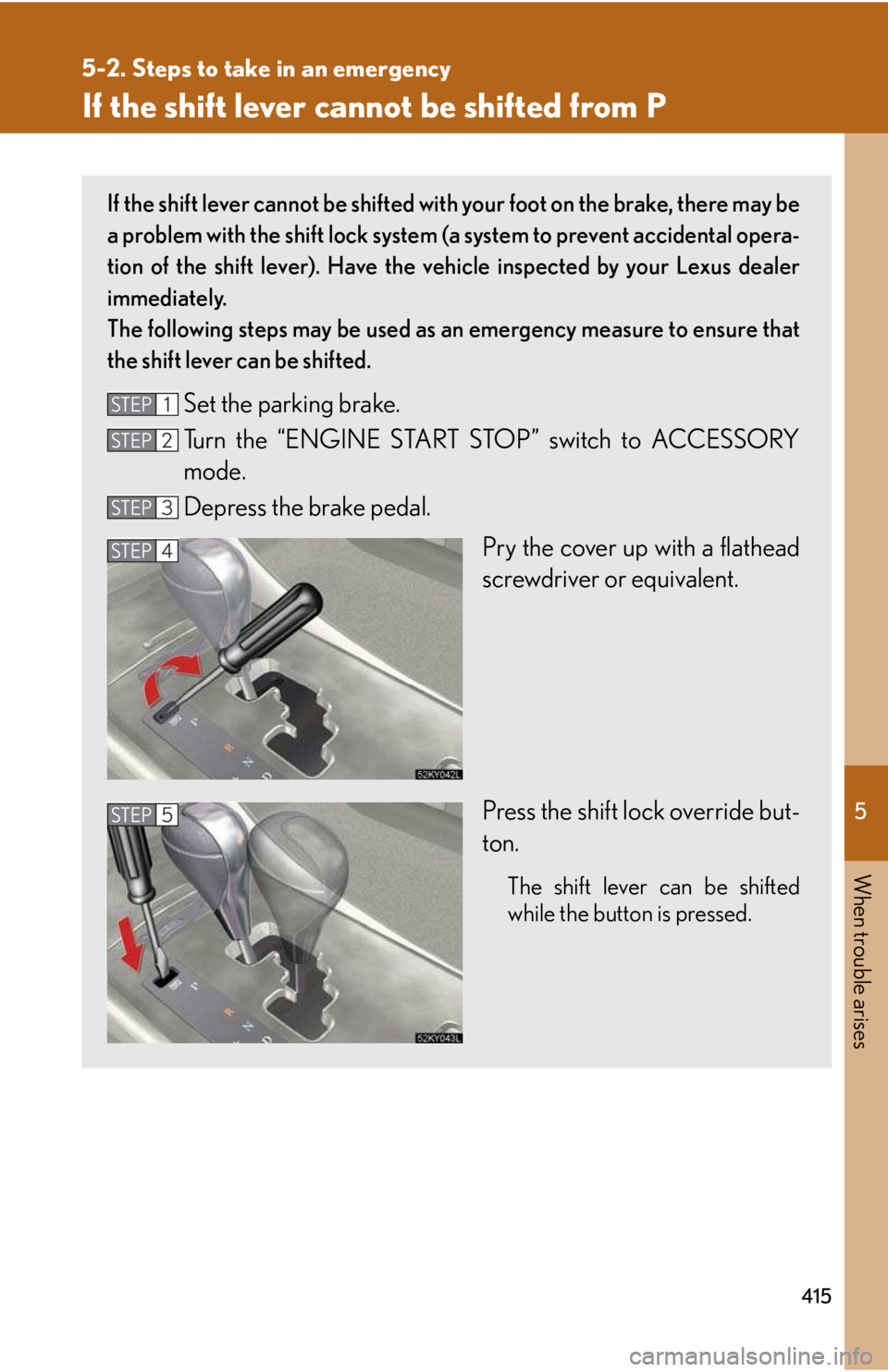
Pry the cover up with a flathead
screwdriver or equivalent.
Press the shift lock override but-
ton.
The shift lever can be shifted
while the button is pressed.
STEP1
STEP2
STEP3
STEP4
STEP5
Page 415 of 542
418
5-2. Steps to take in an emergency
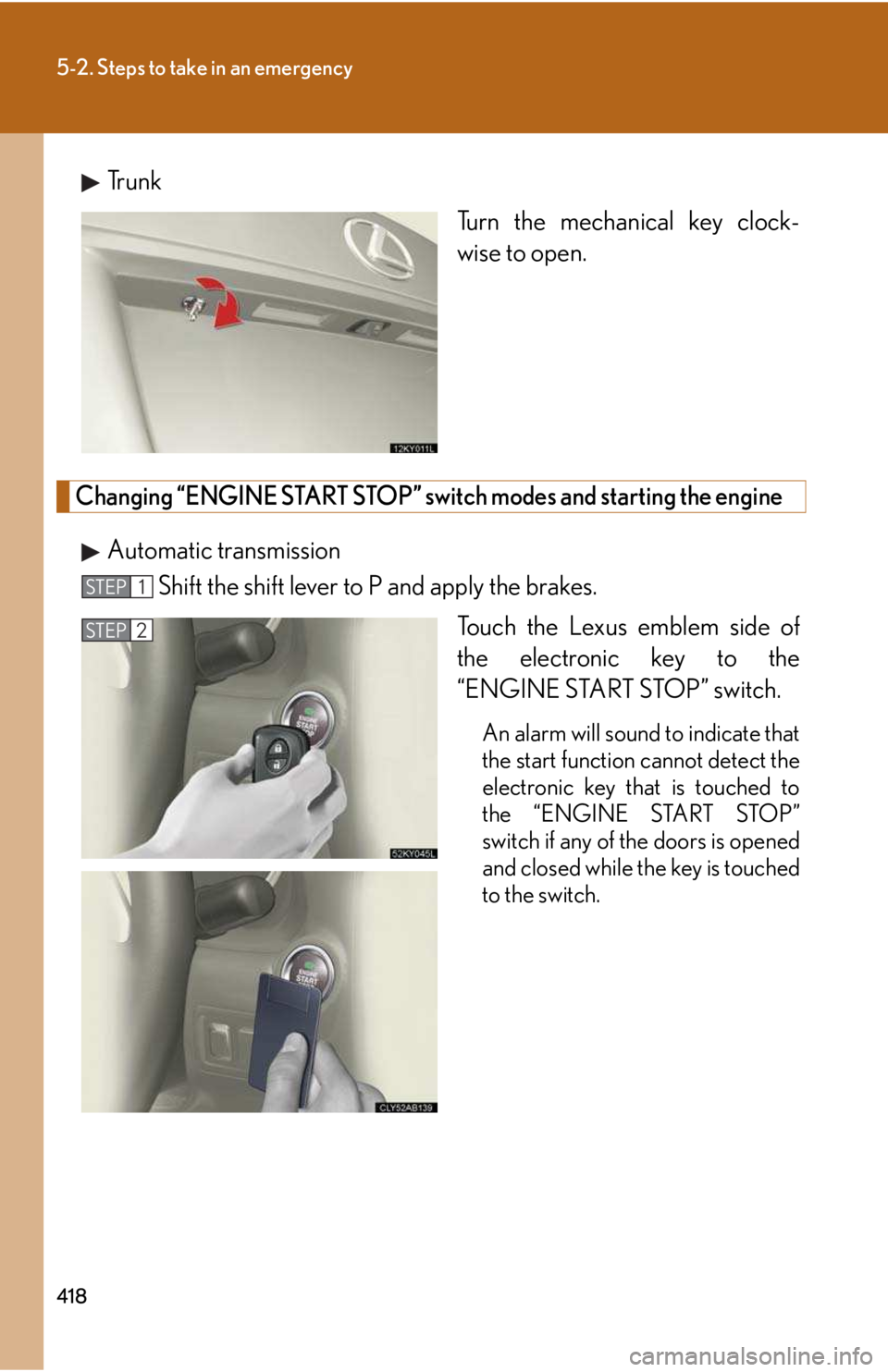
Tr u n k
Turn the mechanical key clock-
wise to open.
Changing “ENGINE START STOP” switch modes and starting the engine
Automatic transmission
Shift the shift lever to P and apply the brakes.
Touch the Lexus emblem side of
the electronic key to the
“ENGINE START STOP” switch.
An alarm will sound to indicate that
the start function cannot detect the
electronic key that is touched to
the “ENGINE START STOP”
switch if any of the doors is opened
and closed while the key is touched
to the switch.
STEP1
STEP2
Page 416 of 542
5
When trouble arises
419
5-2. Steps to take in an emergency
To change “ENGINE START STOP” switch modes: Within 10
seconds of the buzzer sounding, release the brake pedal and
press the “ENGINE START STOP” switch. Modes can be
changed each time the switch is pressed.
(→P. 1 2 6 )
To start the engine: Press the “ENGINE START STOP” switch
within 10 seconds after the buzzer sounds, keeping the brake
pedal depressed.
Manual transmission
Shift the shift lever to N and depress the clutch pedal.
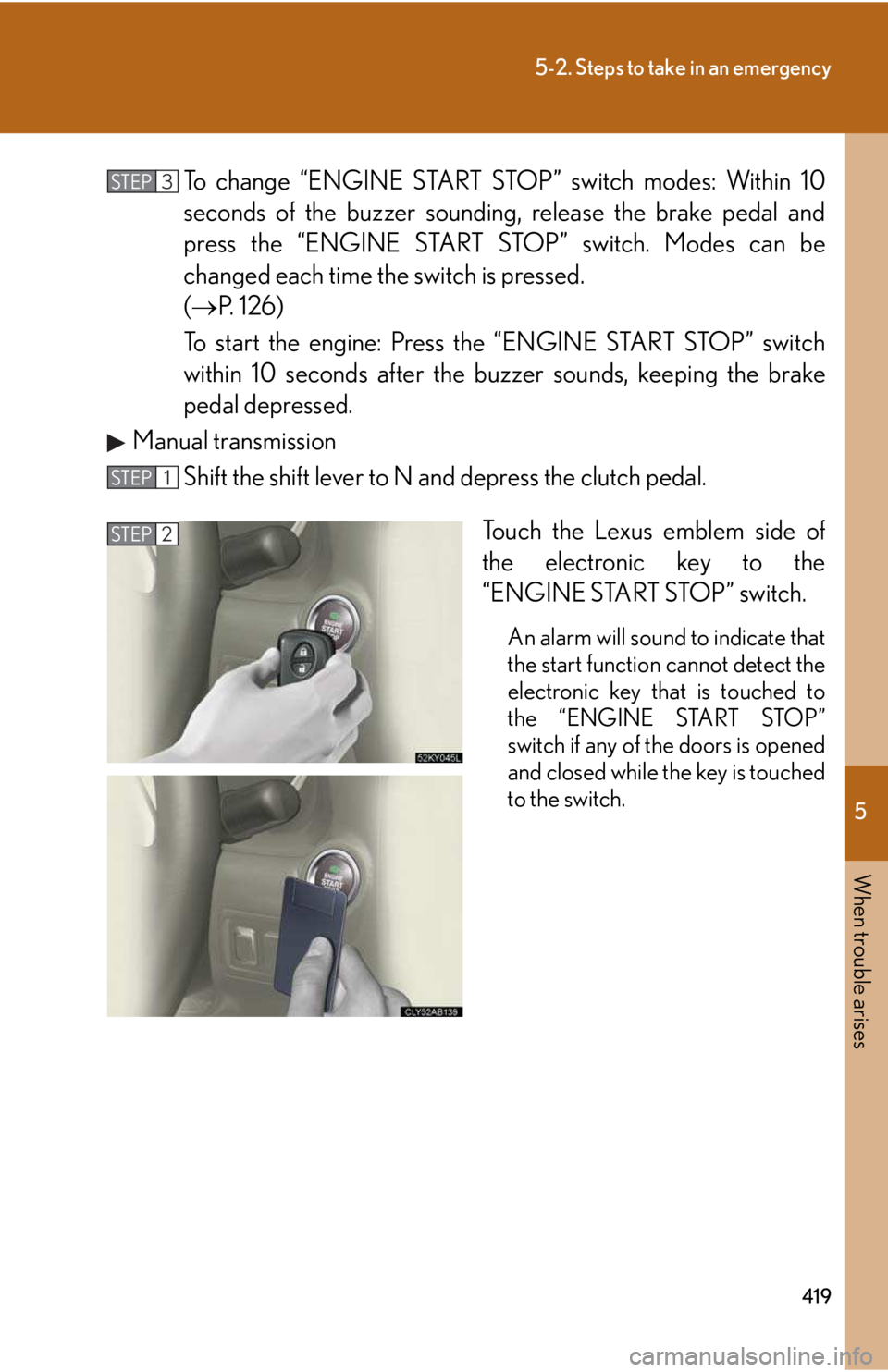
Touch the Lexus emblem side of
the electronic key to the
“ENGINE START STOP” switch.
An alarm will sound to indicate that
the start function cannot detect the
electronic key that is touched to
the “ENGINE START STOP”
switch if any of the doors is opened
and closed while the key is touched
to the switch.
STEP3
STEP1
STEP2
Page 424 of 542
5
When trouble arises
427
5-2. Steps to take in an emergency
If the vehicle becomes stuck
CAUTION
nWhen attempting to free a stuck vehicle
If you choose to rock the vehicle back and forth to free it, make sure the surround-
ing area is clear, to avoid striking other vehicles, objects or persons. The vehicle
may also lunge forward or lunge back suddenly as it becomes free. Use extreme
caution.
nWhen shifting the shift lever
With automatic transmission vehicles, be careful not to shift the shift lever with the
accelerator pedal depressed.
This may lead to unexpected rapid acceleration of the vehicle that may cause an
accident and result in death or serious injury.
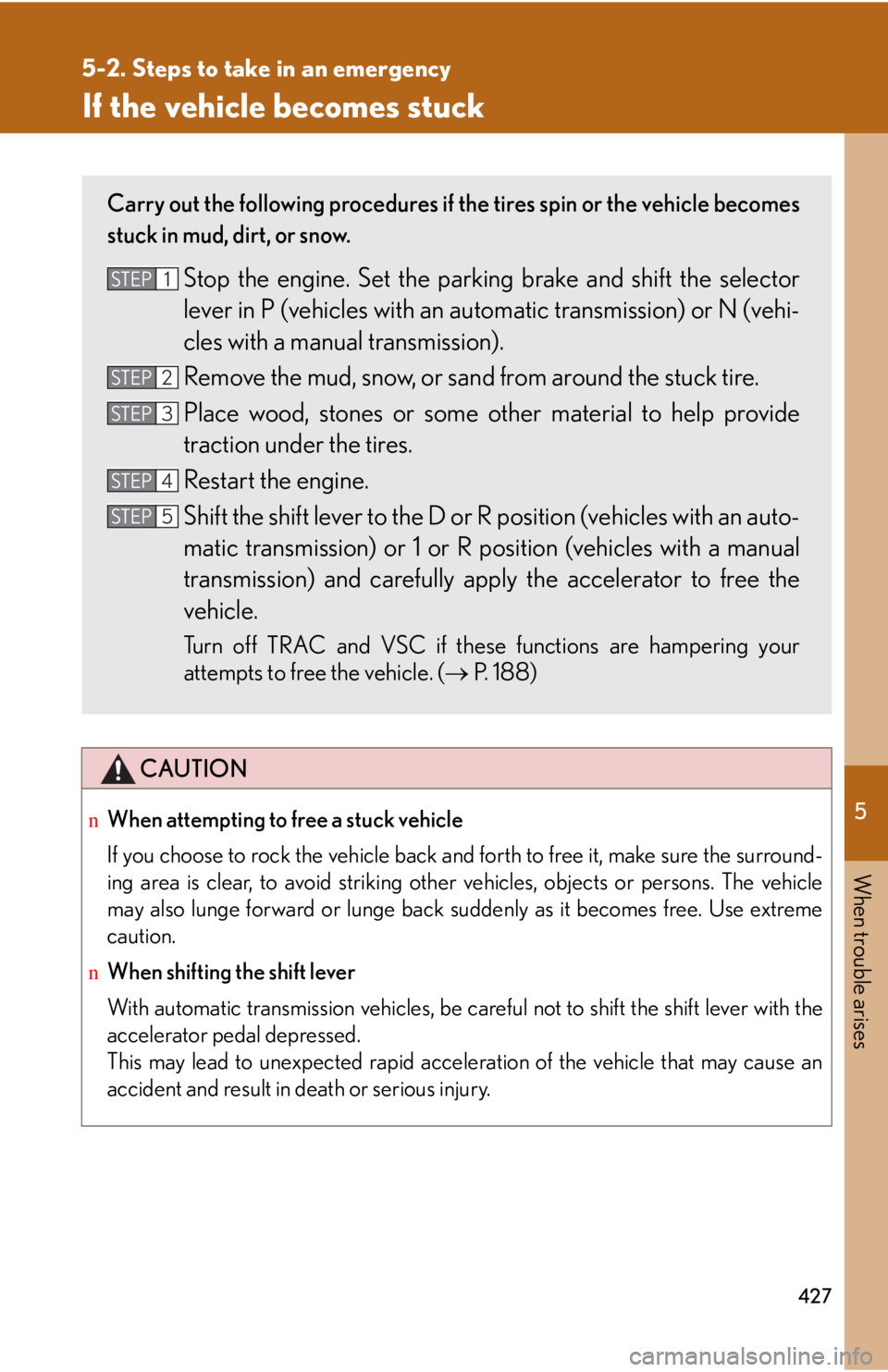
Carry out the following procedures if the tires spin or the vehicle becomes
stuck in mud, dirt, or snow.
Stop the engine. Set the parking brake and shift the selector
lever in P (vehicles with an automatic transmission) or N (vehi-
cles with a manual transmission).
Remove the mud, snow, or sand from around the stuck tire.
Place wood, stones or some other material to help provide
traction under the tires.
Restart the engine.
Shift the shift lever to the D or R position (vehicles with an auto-
matic transmission) or 1 or R position (vehicles with a manual
transmission) and carefully apply the accelerator to free the
vehicle.
Turn off TRAC and VSC if these functions are hampering your
attempts to free the vehicle. (→ P. 1 8 8 )
STEP1
STEP2
STEP3
STEP4
STEP5
Page 434 of 542
438
6-1. Specifications
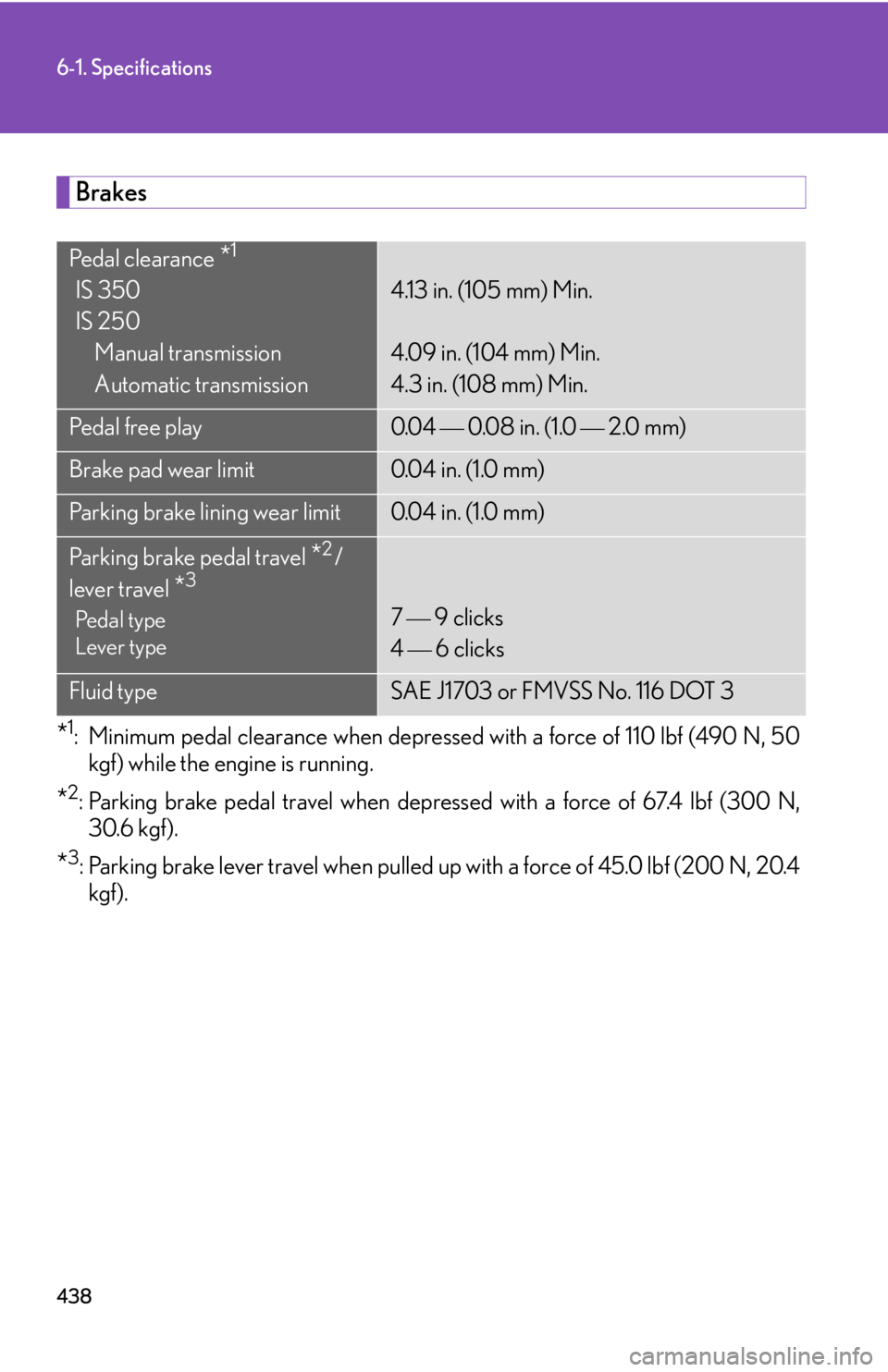
Brakes
*1: Minimum pedal clearance when depressed with a force of 110 lbf (490 N, 50
kgf) while the engine is running.
*2: Parking brake pedal travel when depressed with a force of 67.4 lbf (300 N,
30.6 kgf).
*3: Parking brake lever travel when pulled up with a force of 45.0 lbf (200 N, 20.4
kgf).
Pe d a l c l e a r a n c e *1
IS 350
IS 250
Manual transmission
Automatic transmission
4.13 in. (105 mm) Min.
4.09 in. (104 mm) Min.
4.3 in. (108 mm) Min.
Pedal free play0.04 ⎯ 0.08 in. (1.0 ⎯ 2.0 mm)
Brake pad wear limit0.04 in. (1.0 mm)
Parking brake lining wear limit0.04 in. (1.0 mm)
Parking brake pedal travel *2/
lever travel *3
Pedal type
Lever type
7 ⎯ 9 clicks
4 ⎯ 6 clicks
Fluid typeSAE J1703 or FMVSS No. 116 DOT 3
Page 450 of 542
454
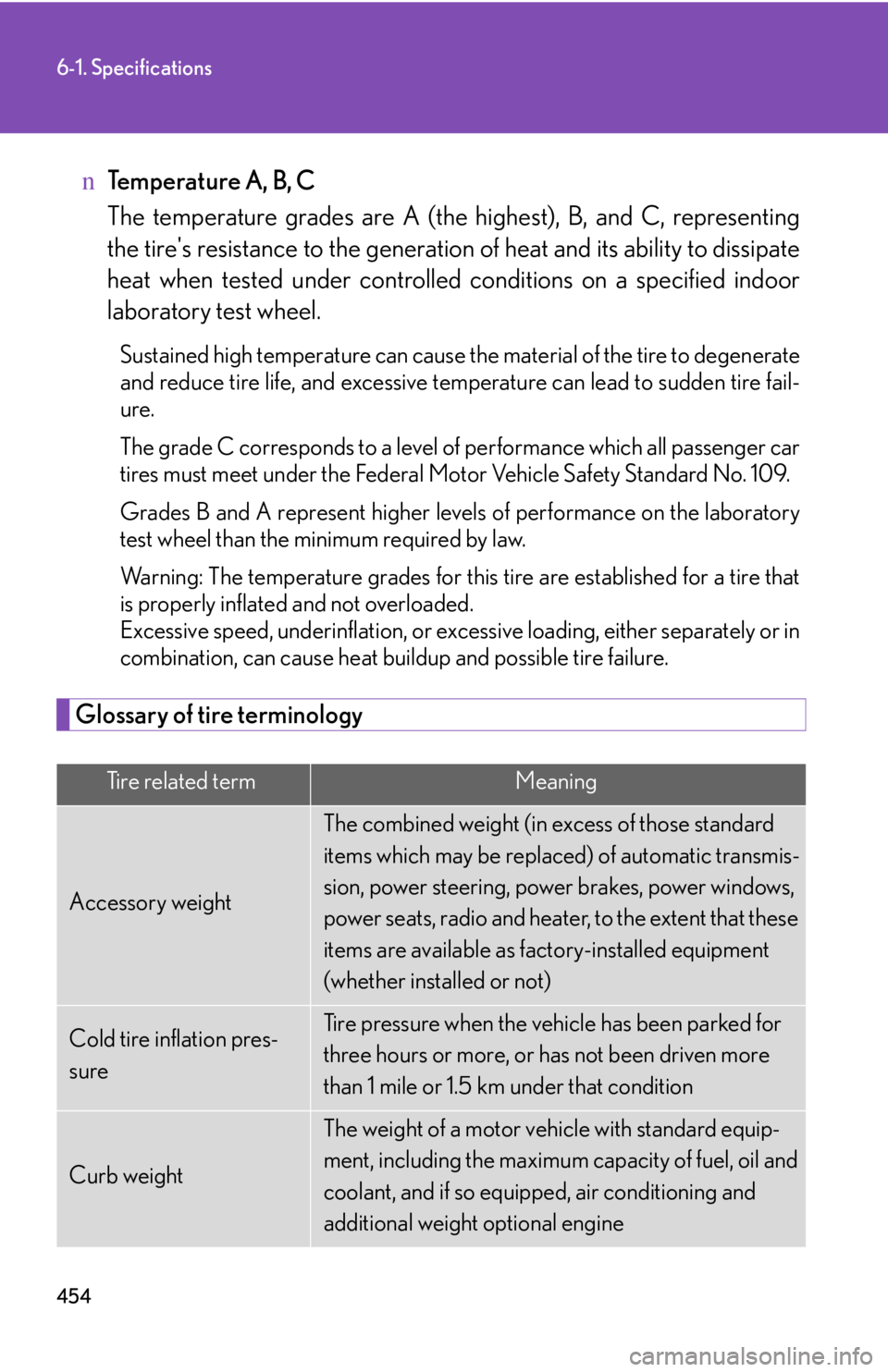
6-1. Specifications
nTemperature A, B, C
The temperature grades are A (the highest), B, and C, representing
the tire's resistance to the generation of heat and its ability to dissipate
heat when tested under controlled conditions on a specified indoor
laboratory test wheel.
Sustained high temperature can cause the material of the tire to degenerate
and reduce tire life, and excessive temperature can lead to sudden tire fail-
ure.
The grade C corresponds to a level of performance which all passenger car
tires must meet under the Federal Motor Vehicle Safety Standard No. 109.
Grades B and A represent higher levels of performance on the laboratory
test wheel than the minimum required by law.
Warning: The temperature grades for this tire are established for a tire that
is properly inflated and not overloaded.
Excessive speed, underinflation, or excessive loading, either separately or in
combination, can cause heat buildup and possible tire failure.
Glossary of tire terminology
Tire related termMeaning
Accessory weight
The combined weight (in excess of those standard
items which may be replaced) of automatic transmis-
sion, power steering, power brakes, power windows,
power seats, radio and heater, to the extent that these
items are available as factory-installed equipment
(whether installed or not)
Cold tire inflation pres-
sure
Tire pressure when the vehicle has been parked for
three hours or more, or has not been driven more
than 1 mile or 1.5 km under that condition
Curb weight
The weight of a motor vehicle with standard equip-
ment, including the maximum capacity of fuel, oil and
coolant, and if so equipped, air conditioning and
additional weight optional engine
Page 451 of 542

455
6-1. Specifications
6
Vehicle specifications
Maximum inflation pres-
sure
The maximum cold inflated pressure to which a tire
may be inflated, shown on the sidewall of the tire
Maximum loaded vehicle
weight
The sum of:
(a) Curb weight
(b) Accessory weight
(c) Vehicle capacity weight
(d) Production options weight
Normal occupant weight150 lb. (68 kg) times the number of occupants speci-
fied in the second column of Table 1* that follows
Production options
weight
The combined weight of installed regular production
options weighing over 5 lb. (2.3 kg) in excess of the
standard items which they replace, not previously
considered in curb weight or accessory weight,
including heavy duty brakes, ride levelers, roof rack,
heavy duty battery, and special trim
Vehicle capacity weight
(Total load capacity)
The rated cargo and luggage load plus 150 lb. (68
kg) times the vehicle's designated seating capacity
Occupant distributionDistribution of occupants in a vehicle as specified in
the third column of Table 1* below
Recommended inflation
pressure
Cold tire inflation pressure recommended by a man-
ufacturer.
RimA metal support for a tire or a tire and tube assembly
upon which the tire beads are seated
Rim diameter
(Wheel diameter)Nominal diameter of the bead seat
Rim size designationRim diameter and width
Rim type designationThe industry manufacturer's designation for a rim by
style or code
Tire related termMeaning