Rear seat Lexus IS250C 2010 User Guide
[x] Cancel search | Manufacturer: LEXUS, Model Year: 2010, Model line: IS250C, Model: Lexus IS250C 2010Pages: 586, PDF Size: 31.62 MB
Page 67 of 586
66
1-3. Adjustable components (seats, mirrors, steering wheel)
10_IS250C/350C_U
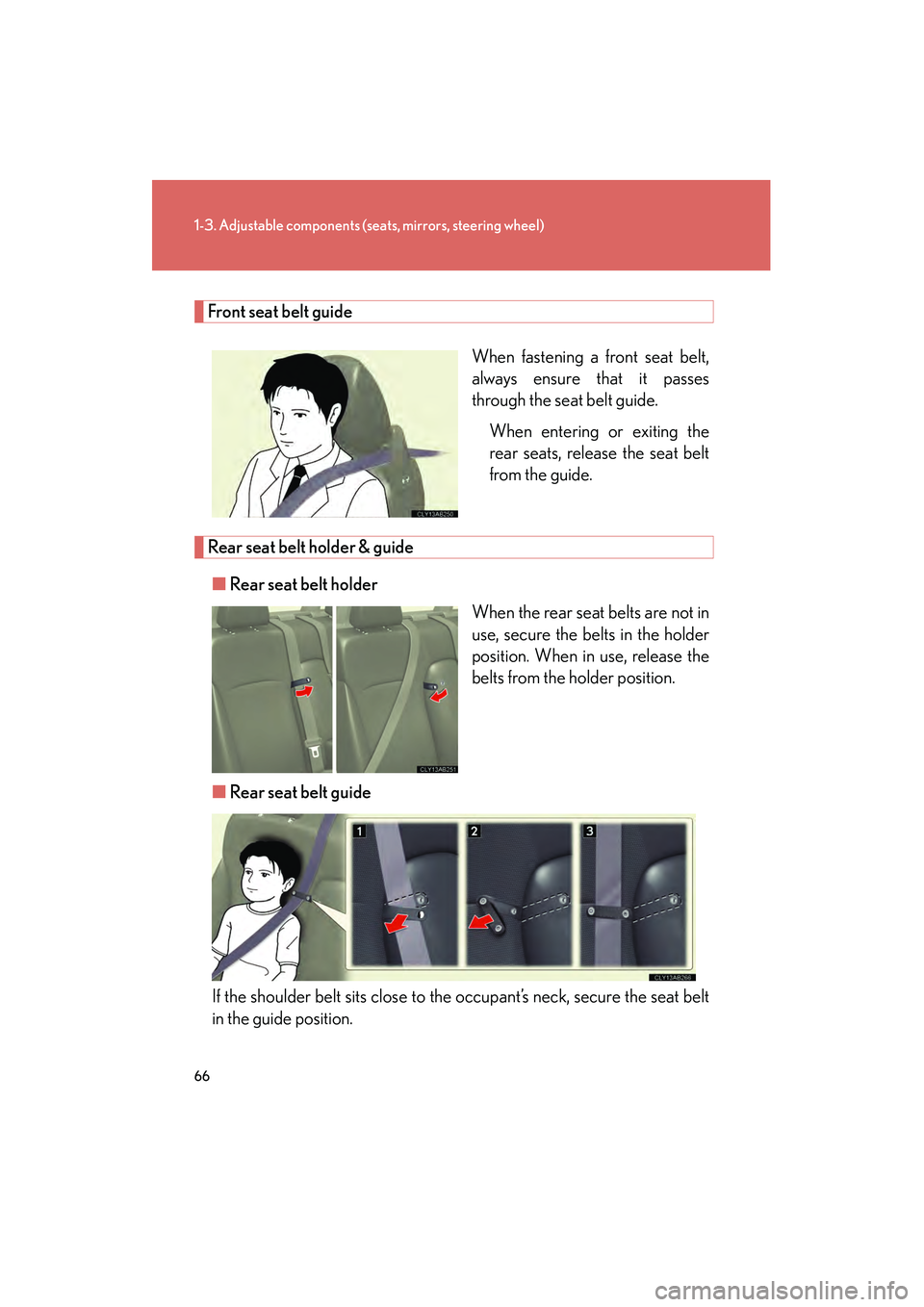
Front seat belt guide
When fastening a front seat belt,
always ensure that it passes
through the seat belt guide.When entering or exiting the
rear seats, release the seat belt
from the guide.
Rear seat belt holder & guide
■ Rear seat belt holder
When the rear seat belts are not in
use, secure the belts in the holder
position. When in use, release the
belts from the holder position.
■ Rear seat belt guide
If the shoulder belt sits close to the occupant’s neck, secure the seat belt
in the guide position.
Page 68 of 586

67
1-3. Adjustable components (seats, mirrors, steering wheel)
1
Before driving
10_IS250C/350C_U
Seat belt pretensioners (front seats)The pretensioner helps the seat
belt to quickly restrain the occu-
pant by retracting the seat belt
when the vehicle is subjected to
certain types of severe frontal colli-
sion.
The pretensioner may not activate
in the event of a minor frontal
impact, a side impact or a rear
impact.
Pre-collision seat belts (front seats of vehicles with pre-collision system)
If the pre-collision sensor detects that a collision is unavoidable, the pre-
collision system will retract the seat belt, thus enhancing the effectiveness
of the seat belt pretensioner in a crash.
The same will happen if the driver makes an emergency braking or loses con-
trol of the vehicle. ( →P. 212)
■Emergency locking retractor (ELR)
The retractor will lock the belt during a sudde n stop or on impact. It may also lock if
you lean forward too quickly. A slow, easy motion will allow the belt to extend so that
you can move around fully.
■Automatic locking retractor (ALR)
When a passenger's shoulder belt is completely extended and then retracted even
slightly, the belt is locked in that position and cannot be extended. This feature is
used to hold the child restraint system (CRS) firmly. To free the belt again, fully
retract the belt and then pull the belt out once more. ( →P. 1 2 0 )
Page 70 of 586
69
1-3. Adjustable components (seats, mirrors, steering wheel)
1
Before driving
10_IS250C/350C_U
CAUTION
Observe the following precautions to reduce the risk of injury in the event of sudden
braking or an accident.
Failing to do so may cause death or severe injury.
■Wearing a seat belt
●Ensure that all passengers wear a seat belt.
●Always wear a seat belt properly.
●Each seat belt should be used by one person only. Do not use a seat belt for more
than one person at once, including children.
●Lexus recommends that children be seated in the rear seat and always use a seat
belt and/or an appropriate child restraint system.
●Do not recline the seat any more than necessary to achieve a proper seating
position. The seat belt is most effective when the occupants are sitting up straight
and well back in the seats.
●Do not wear the shoulder belt under your arm.
●Always wear your seat belt low and snug across your hips.
■Child restraint lock function belt precaution
Do not allow children to play with the child restraint lock function belt. If the belt
becomes twisted around a child’s neck, it will not be possible to pull the belt out
leading to choking or other serious injuries that could result in death. If this occurs
and the buckle cannot be unfastened, scissors should be used to cut the belt.
■Seat belt pretensioners
●Do not place anything, such as a cushion, on the front passenger’s seat. Doing so
will disperse the passenger’s weight, which prevents the sensor from detecting
the passenger’s weight properly. As a result, the seat belt pretensioner for the
front passenger’s seat may not activate in the event of a collision.
●If the pretensioner has activated, the SRS warning light will come on. In that case,
the seat belt cannot be used again and must be replaced at your Lexus dealer.
Page 71 of 586
70
1-3. Adjustable components (seats, mirrors, steering wheel)
10_IS250C/350C_U
CAUTION
■Seat belt damage and wear
●Do not damage the seat belts by allowing the belt, plate, or buckle to be jammed
in the door.
●Inspect the seat belt system periodically. Check for cuts, fraying, and loose parts.
Do not use a damaged seat belt until it is replaced. Damaged seat belts cannot
protect an occupant from death or serious injury.
●Ensure that the belt and tab are locked and the belt is not twisted.
If the seat belt does not function correctly, immediately contact your Lexus
dealer.
●Replace the seat assembly, including the belts, if your vehicle has been involved in
a serious accident, even if there's no obvious damage.
●Do not attempt to install, remove, modify, disassemble or dispose of the seat belts.
Have any necessary repairs carried out by your Lexus dealer. Inappropriate han-
dling of the pretensioner may prevent it from operating properly resulting in
death or serious injury.
■Using a seat belt extender
●Do not wear the seat belt extender if you can fasten the seat belt without the
extender.
●Do not use the seat belt extender when installing a child restraint system because
the belt will not securely hold the child restraint system, increasing the risk of
death or serious injury in the event of an accident.
●The personalized extender may not be safe on another vehicle, when used by
another person, or at a different seatin g position other than the one originally
intended.
■When using the seat belt guide
Always make sure that the belt is not twisted, and runs freely through the guide.
■Before fastening the rear seat belt
Release the seat belt holder.
Page 75 of 586

74
1-3. Adjustable components (seats, mirrors, steering wheel)
10_IS250C/350C_U
Anti-glare inside rear view mirror
■To prevent sensor error
CAUTION
■Caution while driving
Do not adjust the position of the mirror while driving.
Doing so may lead to mishandling of the vehicle and an accident, resulting in death
or serious injury.
In automatic mode, sensors are used to detect the headlights of vehicles
behind and automatically reduce the reflected light.
Turns automatic mode on/off
The indicator comes on when
automatic mode is turned on.
The anti-glare mirror default
mode is automatic. The anti-
glare mirror is automatically set
to automatic whenever the
“ENGINE START STOP” switch
is turned to IGNITION ON
mode.
To ensure that the sensors operate properly,
do not touch or cover them.
Page 76 of 586
75
1
1-3. Adjustable components (seats, mirrors, steering wheel)
Before driving
10_IS250C/350C_U
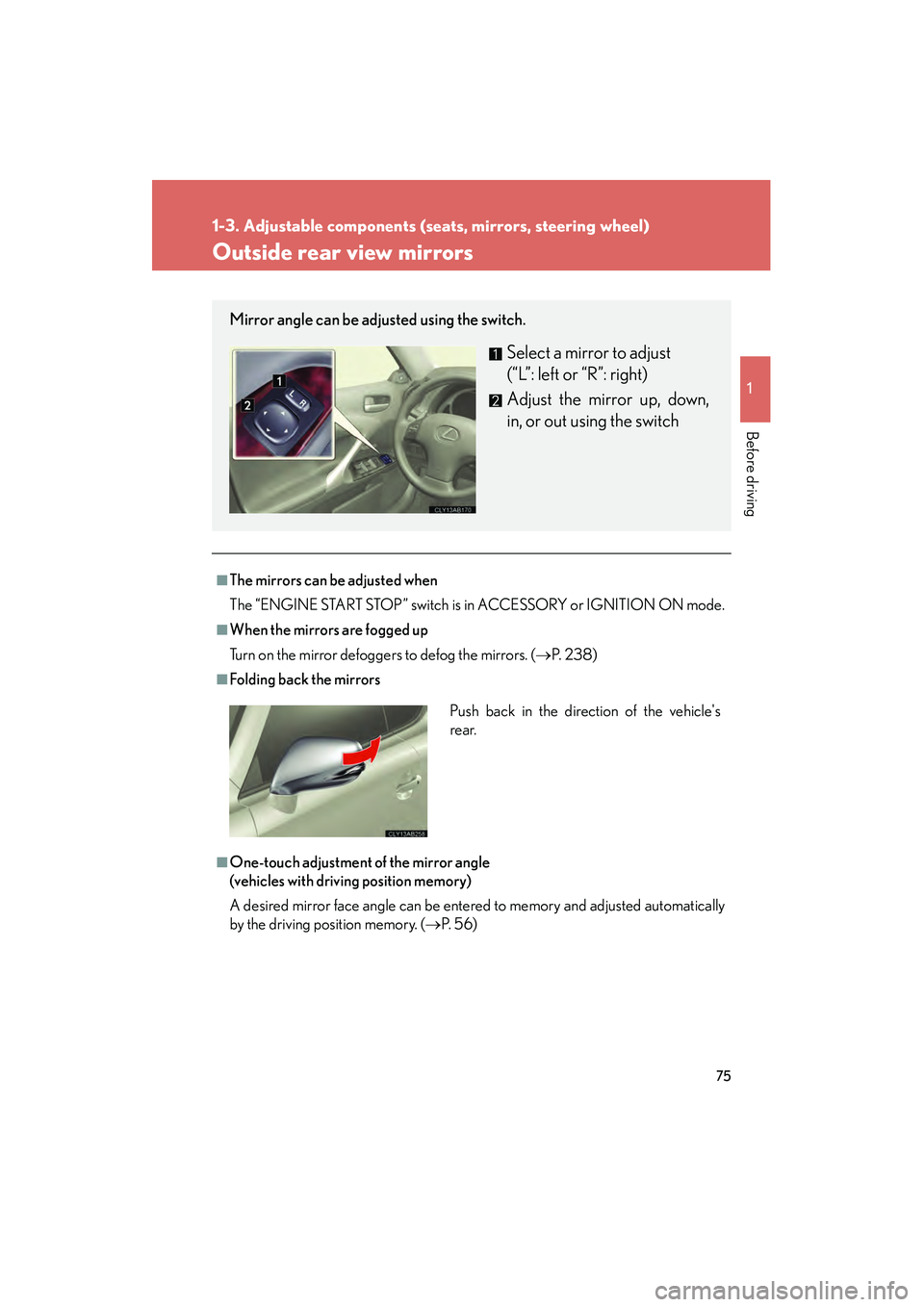
Outside rear view mirrors
■The mirrors can be adjusted when
The “ENGINE START STOP” switch is in ACCESSORY or IGNITION ON mode.
■When the mirrors are fogged up
Turn on the mirror defoggers to defog the mirrors. (→P. 2 3 8 )
■Folding back the mirrors
■One-touch adjustment of the mirror angle
(vehicles with driving position memory)
A desired mirror face angle can be entered to memory and adjusted automatically
by the driving position memory. (→P. 5 6 )
Mirror angle can be adjusted using the switch.
Select a mirror to adjust
(“L”: left or “R”: right)
Adjust the mirror up, down,
in, or out using the switch
Push back in the direction of the vehicle's
rear.
Page 77 of 586

76
1-3. Adjustable components (seats, mirrors, steering wheel)
10_IS250C/350C_U
■Linked mirror function when reversing (vehicles with driving position memory)
The outside rear view mirrors will automatically angle downwards when the vehicle
is reversing in order to give a better view of the ground. However, this function will
not operate when the mirror select switch is in the neutral position (between “L” and
“R”).
■Auto anti-glare function
When the anti-glare inside rear view mirror is set to automatic mode, the outside
rear view mirrors will activate in conjunction with the anti-glare inside rear view mir-
ror to reduce reflected light. ( →P. 74 )
■Rain-clearing mirrors (if equipped)
When water droplets collects on the mirror surface, for example when it rains, the
rain-clearing (hydrophilic) effect of the mirrors causes the droplets to be spread out
into a film making the rear view clearer.In the following cases, the rain-clearing
effect will be reduced temporarily, but will return after 1 or 2 days' exposure to
direct sunlight.
●After wiping dirt off the mirrors
●When the mirrors fog up
●After waxing your vehicle in an automatic car wash
●After your vehicle has been parked for a long period in underground parking
lots, etc. where there is no direct sunlight.
Page 78 of 586
77
1-3. Adjustable components (seats, mirrors, steering wheel)
1
Before driving
10_IS250C/350C_U
CAUTION
■When driving the vehicle
Observe the following precautions while driving.
Failing to do so may result in loss of control of the vehicle and cause an accident,
resulting in death or serious injury.
●Do not adjust the mirrors while driving.
●Do not drive with the mirrors folded back.
●Both the driver and passenger side mirrors must be extended and properly
adjusted before driving.
■When the mirror defoggers are operating
Do not touch the rear view mirror surfaces, as they can become very hot and burn
you.
NOTICE
■If the mirrors become iced up
In order to retain the rain-clearing properties of the mirror, do not attempt to scrape
the ice off. Instead, remove it by turning on the mirror defoggers or by applying
warm water.
Page 104 of 586

103
1-7. Safety information
1
Before driving
10_IS250C/350C_U
■SRS airbag deployment conditions (side airbags)
●The SRS side airbags will deploy in the event of an impact that exceeds the set
threshold level (the level of force corresponding to the impact force produced
by a 3300 lb. [1500 kg] vehicle colliding with the vehicle cabin from a direc-
tion perpendicular to the vehicle orientation at a speed of 12 - 18 mph [20 - 30
km/h]).
●The SRS side airbag on the passenger seat will not activate if there is no passen-
ger sitting in the front passenger seat. However, the side airbag on the passen-
ger seat may deploy if luggage is put in the seat, even if the seat is unoccupied.
(→ P. 111)
■Conditions under which the SRS airbags may deploy (inflate), other than a colli-
sion
The SRS front airbags may also deploy if a serious impact occurs to the underside of
your vehicle. Some examples are shown in the illustration.
■Types of collisions that may not deploy the SRS airbag (front airbags)
The SRS front airbags are generally not designed to inflate if the vehicle is involved
in a side or rear collision, if it rolls over, or if it is involved in a low-speed frontal colli-
sion. But, whenever a collision of any type causes sufficient forward deceleration of
the vehicle, deployment of the SRS front airbags may occur.
●Hitting a curb, edge of pavement or hard
surface
●Falling into or jumping over a deep hole
●Landing hard or vehicle falling
●Collision from the side
●Collision from the rear
●Vehicle rollover
Page 107 of 586

106
1-7. Safety information
10_IS250C/350C_U
CAUTION
■SRS airbag precautions
Observe the following precautions regarding the airbags.
Failure to do so may cause death or serious injury.
●The driver and all passengers in the vehicle must wear their seat belts properly.
The SRS airbags are supplemental devices to be used with the seat belts.
●The SRS driver airbag deploys with considerable force, and can cause death or
serious injury especially if the driver is very close to the airbag. The National
Highway Traffic Safety Administration (“NHTSA”) advises:
Since the risk zone for driver airbag is the first 2 - 3 in. (50 - 75 mm) of inflation,
placing yourself 10 in. (250 mm) from your driver airbag provides you with a
clear margin of safety. This distance is measured from the center of the steering
wheel to your breastbone. If you sit less than 10 in. (250 mm) away now, you can
change your driving position in several ways:
• Move your seat to the rear as far as you can while still reaching the pedalscomfortably.
• Slightly recline the back of the seat. Although vehicle designs vary, many drivers can achieve the 10 in. (250 mm)
distance, even with the driver seat all the way forward, simply by reclining the
back of the seat somewhat. If reclining the back of your seat makes it hard to
see the road, raise yourself by using a firm, non-slippery cushion, or raise the
seat if your vehicle has that feature.
• If your steering wheel is adjustable, tilt it downward. This points the airbag toward your chest instead of your head and neck.
The seat should be adjusted as recommended by NHTSA above, while still main-
taining control of the foot pedals, steering wheel, and your view of the instrument
panel controls.