lock Lexus IS300 2019 / 2019 IS300,IS350 (OM53E71U) User Guide
[x] Cancel search | Manufacturer: LEXUS, Model Year: 2019, Model line: IS300, Model: Lexus IS300 2019Pages: 660, PDF Size: 10.15 MB
Page 34 of 660
341-1. For safe use
IS350 AWD/IS350/IS300 AWD/IS300_U
WARNING
■People suffering illness
Obtain medical advice and wear the seat belt in the proper way. (P. 30)
■When children are in the vehicle
Do not allow children to play with the seat belt. If the seat belt becomes twisted around
a child’s neck, it may lead to choking or othe r serious injuries that could result in death.
If this occurs and the buckle cannot be unfastened, scissors should be used to cut the
belt.
■Seat belt pretensioners
●Do not place anything, such as a cushion, on the front passenger’s seat. Doing so will
disperse the passenger’s weight, which prevents the sensor from detecting the pas-
senger’s weight properly. As a result, the seat belt pretensioner for the front passen-
ger’s seat may not activate in the event of a collision.
●If the pretensioner has activated, the SRS wa rning light will come on. In that case, the
seat belt cannot be used again and must be replaced at your Lexus dealer.
■Adjustable shoulder anchor
Always make sure the shoulder belt is posi tioned across the center of your shoulder.
The belt should be kept away from your neck , but not falling off your shoulder. Failure to
do so could reduce the amount of protection in an accident and cause death or serious
injuries in the event of a sudden stop, sudden swerve or accident. ( P. 31)
■Seat belt damage and wear
●Do not damage the seat belts by allowing th e belt, plate, or buckle to be jammed in
the door.
●Inspect the seat belt system periodically. Check for cuts, fraying, and loose parts. Do
not use a damaged seat belt until it is replaced. Damaged seat belts cannot protect an
occupant from death or serious injury.
●Ensure that the belt and plate are locked and the belt is not twisted.
If the seat belt does not function correct ly, immediately contact your Lexus dealer.
●Replace the seat assembly, including the belts, if your vehicle has been involved in a
serious accident, even if there is no obvious damage.
●Do not attempt to install, remove, modify, disassemble or dispose of the seat belts.
Have any necessary repairs carried out by your Lexus dealer. Inappropriate handling
may lead to inco rrect operation.
Page 42 of 660
421-1. For safe use
IS350 AWD/IS350/IS300 AWD/IS300_U
■If the SRS airbags deploy (inflate)
●Slight abrasions, burns, bruising etc., may be sustained from SRS airbags, due to the
extremely high speed deployment (inflation) by hot gases.
●A loud noise and white powder will be emitted.
●Parts of the airbag module (steering wheel hub, airbag cover and inflator) as well as the
seats, parts of the front and rear pillars, an d roof side rails may be hot for several min-
utes. The airbag itself may also be hot.
●The windshield may crack.
●All of the doors will be unlocked. ( P. 129)
●Fuel supply to the engi ne will be stopped. (P. 524)
●For Lexus Enform Safety Connect subscribers, if any of the following situations occur,
the system is designed to send an emerge ncy call to the response center, notifying
them of the vehicle’s location (without needing to push the “SOS” button) and an agent
will attempt to speak with the occupants to ascertain the level of emergency and assis-
tance required. If the occupants are unable to communicate, the agent automatically
treats the call as an emergency and helps to dispatch the necessary emergency ser-
vices. ( P. 68)
• An SRS airbag is deployed.
• A seat belt pretensioner is activated.
• The vehicle is involved in a severe rear-end collision.
■SRS airbag deployment cond itions (SRS front airbags)
●The SRS front airbags will deploy in the event of an impact that exceeds the set thresh-
old level (the level of force corresponding to an approximately 12 - 18 mph [20 - 30
km/h] frontal collision with a fixed wa ll that does not move or deform).
However, this threshold velocity will be cons iderably higher in the following situations:
• If the vehicle strikes an object, such as a parked vehicle or sign pole, which can move
or deform on impact
• If the vehicle is involved in an underride collision, such as a collision in which the
front of the vehicle “underrides”, or goes under, the bed of a truck
●Depending on the type of collision, it is possi ble that only the seat belt pretensioners will
activate.
●The SRS front airbags for the fr ont passenger will not activate if there is no passenger
sitting in the front passenger seat. However, the SRS front airbags for the front passen-
ger may deploy if luggage is put in the seat, even if the seat is unoccupied. ( P. 46)
■SRS airbag deployment conditions (S RS side and curtain shield airbags)
●The SRS side and curtain shield airbags w ill deploy in the event of an impact that
exceeds the set threshold level (the level of force corresponding to the impact force
produced by an approximately 3300 lb. [15 00 kg] vehicle colliding with the vehicle
cabin from a direction perpendicular to the vehicle orientation at an approximate
speed of 12 - 18 mph [20 - 30 km/h]).
●Both SRS curtain shield airbags will de ploy in the event of vehicle rollover.
●Both SRS curtain shield airbags will deploy in the event of a severe frontal collision.
Page 52 of 660
521-1. For safe use
IS350 AWD/IS350/IS300 AWD/IS300_U
●It is recommended that children sit in the rear seats to avoid accidental con-
tact with the shift lever, wiper switch etc.
●Use the rear door child-protector lock or the window lock switch to avoid
children opening the door while driving or operating the power window acci-
dentally.
●Do not let small children operate equipment which may catch or pinch body
parts, such as the power window, hood, trunk, seats etc.
Safety information for children
Observe the following precautions wh en children are in the vehicle.
Use a child restraint system appropriate for the child, until the child becomes
large enough to properly wear the vehicle’s seat belt.
WARNING
Never leave children unattended in the vehicl e, and never allow children to have or use
the key.
Children may be able to start the vehicle or sh ift the vehicle into neutral. There is also a
danger that children may injure themselves by playing with the windows, the moon roof
or other features of the vehi cle. In addition, heat build-up or extremely cold tempera-
tures inside the vehicle can be fatal to children.
Page 57 of 660
571-1. For safe use
1
For safety and security
IS350 AWD/IS350/IS300 AWD/IS300_U
Child restraint LATCH anchors
LATCH anchors are provided for the
outboard rear seats, behind the anchor
covers. (Buttons displaying the location
of the anchors are attached to the
seats.)
Seat belts equipped with a child
restraint locking mechanism (ALR/
ELR belts except driver’s seat belt)
(P. 32)
Anchor brackets (for top tether strap)
An anchor bracket is provided for each
rear seat.
Installing child restraints
Follow the child restraint system manu facturer’s instructions. Firmly secure
child restraints to the seat s using the LATCH anchors or a seat belt. Attach the
top tether strap when installing a child restraint.
The lap/shoulder belt can be used if yo ur child restraint system is not compati-
ble with the LATCH (Lower Anchor s and Tethers for Children) system.
Page 60 of 660
601-1. For safe use
IS350 AWD/IS350/IS300 AWD/IS300_U
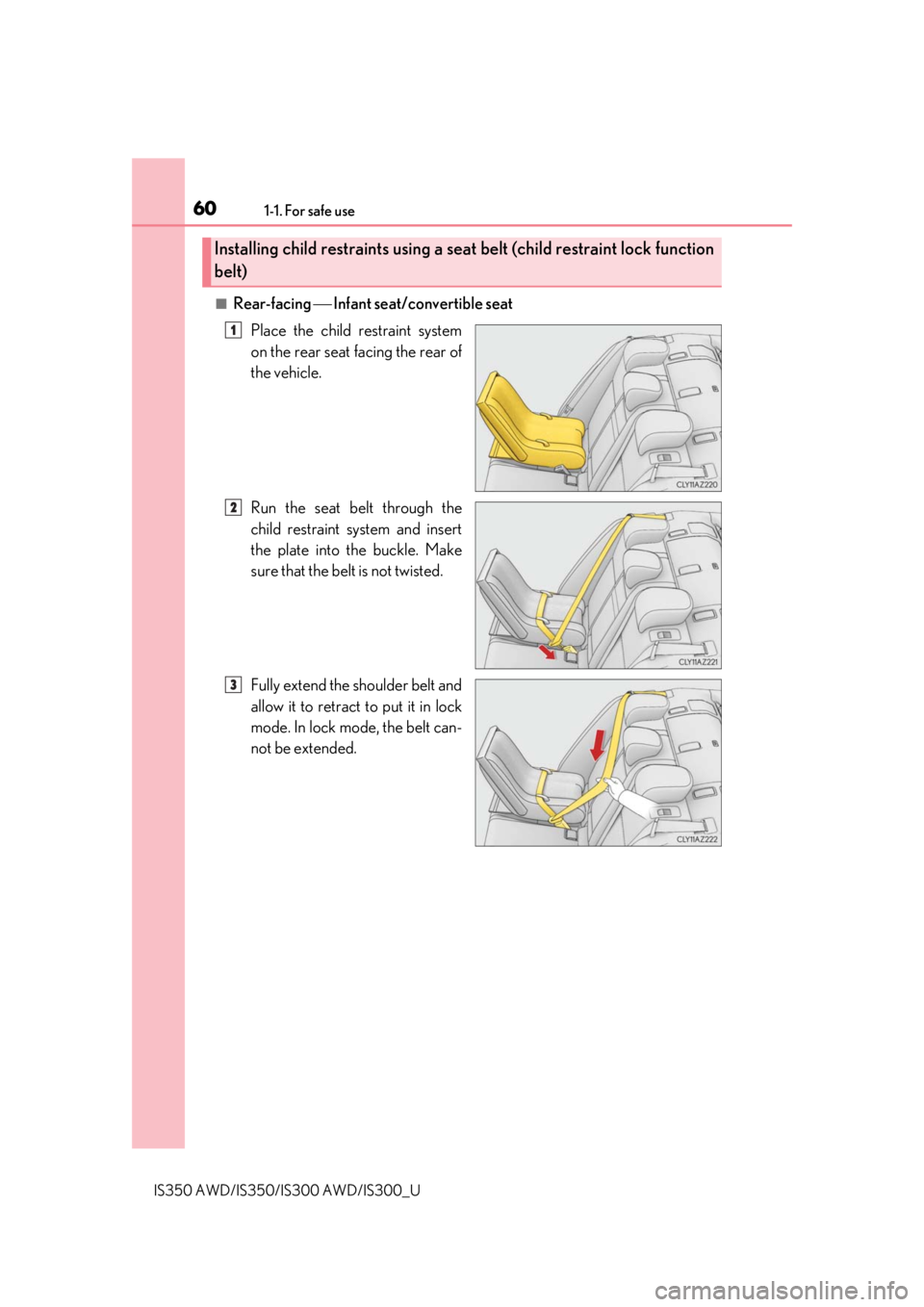
■Rear-facing Infant seat/convertible seat
Place the child restraint system
on the rear seat facing the rear of
the vehicle.
Run the seat belt through the
child restraint system and insert
the plate into the buckle. Make
sure that the belt is not twisted.
Fully extend the shoulder belt and
allow it to retract to put it in lock
mode. In lock mode, the belt can-
not be extended.
Installing child restraints using a seat belt (child restraint lock function
belt)
1
2
3
Page 62 of 660
621-1. For safe use
IS350 AWD/IS350/IS300 AWD/IS300_U
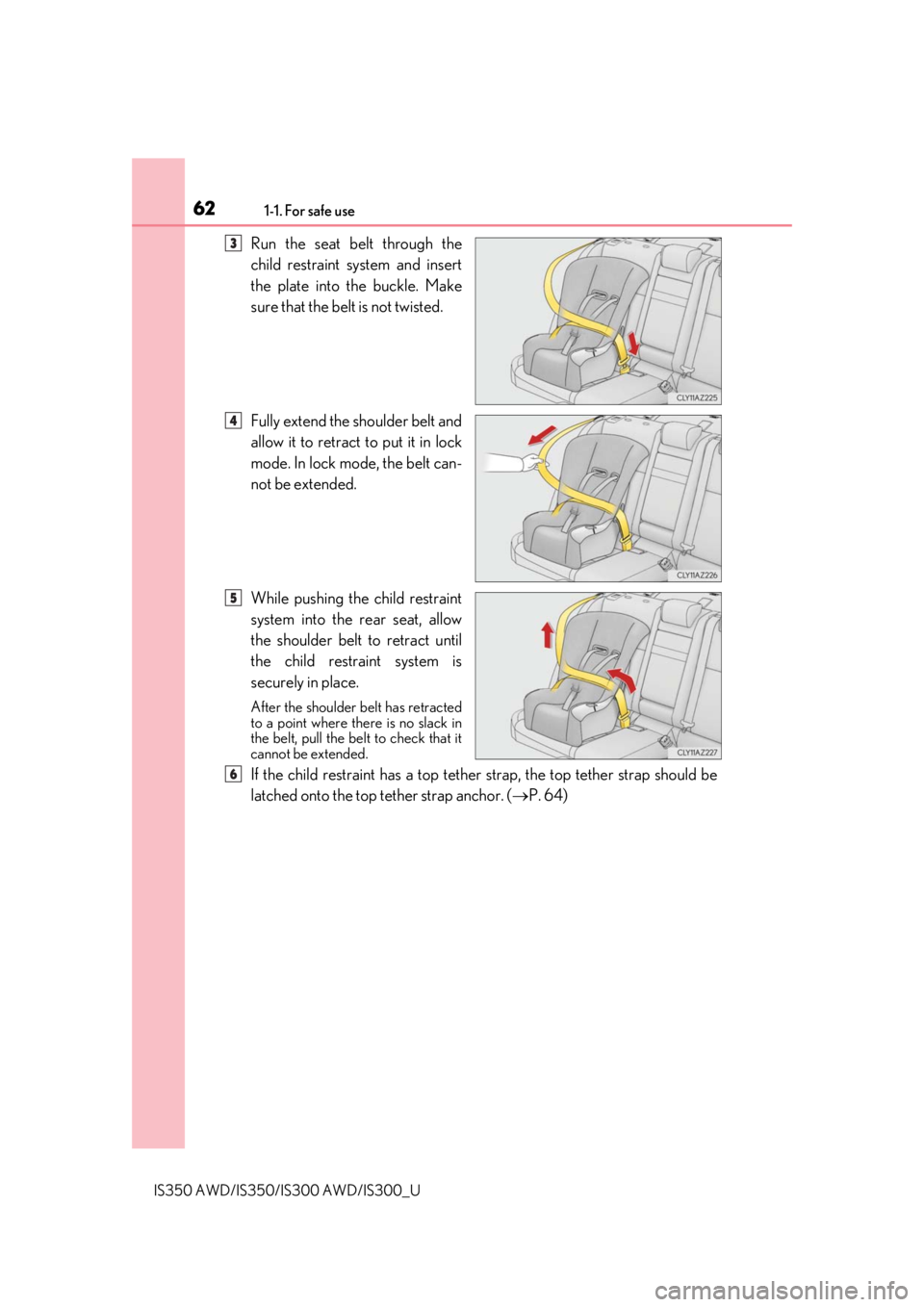
Run the seat belt through the
child restraint system and insert
the plate into the buckle. Make
sure that the belt is not twisted.
Fully extend the shoulder belt and
allow it to retract to put it in lock
mode. In lock mode, the belt can-
not be extended.
While pushing the child restraint
system into the rear seat, allow
the shoulder belt to retract until
the child restraint system is
securely in place.
After the shoulder belt has retracted
to a point where there is no slack in
the belt, pull the belt to check that it
cannot be extended.
If the child restraint has a top tether strap, the top tether strap should be
latched onto the top tether strap anchor. (P. 64)
3
4
5
6
Page 65 of 660
651-1. For safe use
1
For safety and security
IS350 AWD/IS350/IS300 AWD/IS300_U
WARNING
■When installing a booster seat
To prevent the belt from going into ALR lock mode, do not fully extend the shoulder
belt. ALR mode causes the belt to tighten only. This could cause injury or discomfort to
the child. (P. 32)
■When installing a child restraint system
Follow the directions given in the child rest raint system installation manual and fix the
child restraint system securely in place.
If the child restraint system is not correctly fixed in place, the child or other passengers
may be seriously injured or ev en killed in the event of a sudden braking or an accident.
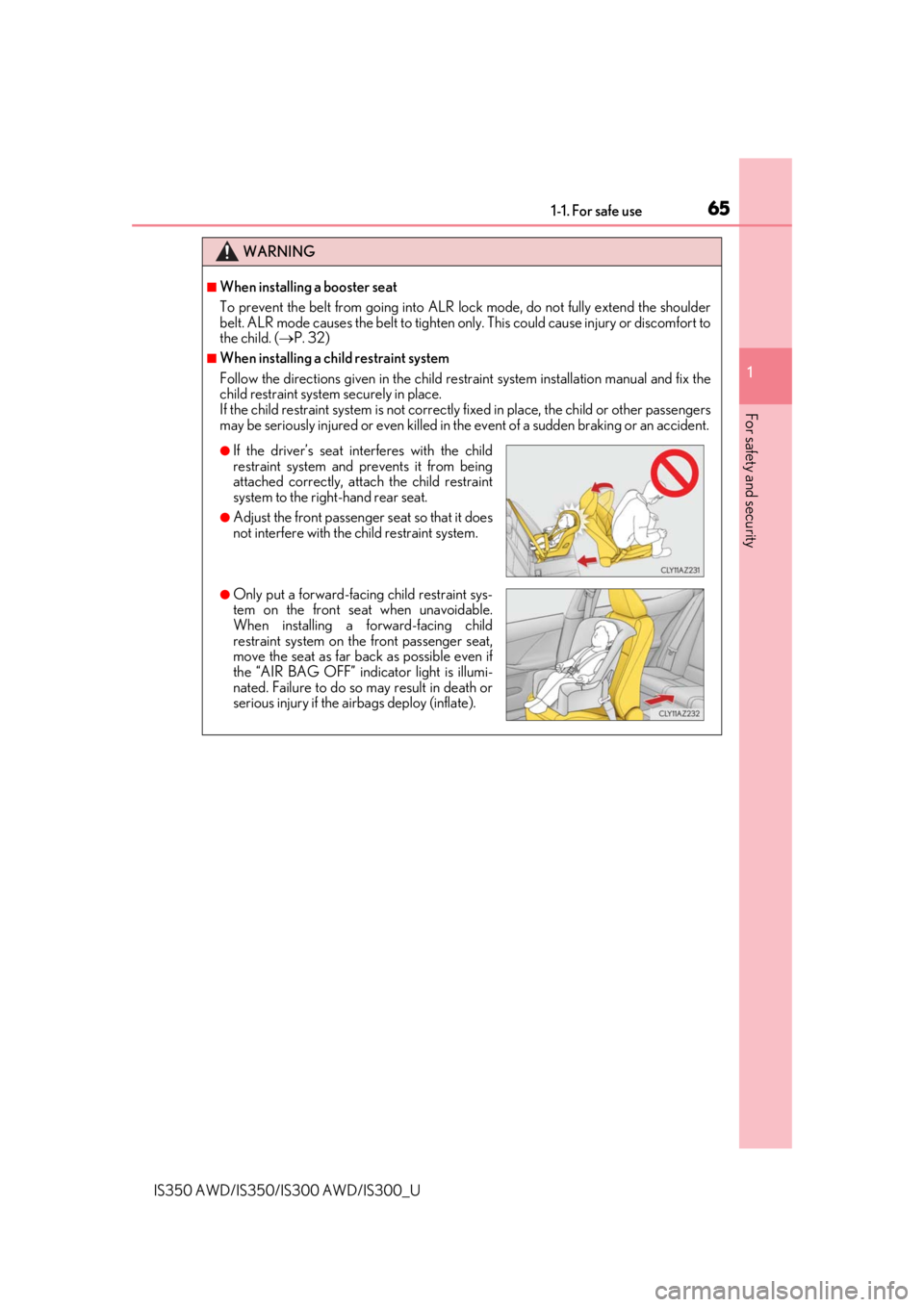
●If the driver’s seat interferes with the child
restraint system and prevents it from being
attached correctly, attach the child restraint
system to the right-hand rear seat.
●Adjust the front passenger seat so that it does
not interfere with the child restraint system.
●Only put a forward-faci ng child restraint sys-
tem on the front seat when unavoidable.
When installing a forward-facing child
restraint system on the front passenger seat,
move the seat as far back as possible even if
the “AIR BAG OFF” indicator light is illumi-
nated. Failure to do so may result in death or
serious injury if the airbags deploy (inflate).
Page 66 of 660
661-1. For safe use
IS350 AWD/IS350/IS300 AWD/IS300_U
WARNING
■When installing a child restraint system
●When using the LATCH anchors for a child restraint system, move the seat as far
back as possible, with the seatback close to the child restraint system.
●When a booster seat is installed, always en sure that the shoulder belt is positioned
across the center of the child’s shoulder. The belt should be kept away from the child’s
neck, but not so that it could fall off the ch ild’s shoulder. Failing to do so may result in
death or serious injury in the event of sudden braking, sudden swerving or an acci-
dent.
●Ensure that the belt and plate are securely locked and the seat belt is not twisted.
●Shake the child restraint system left and right, and forward and backward to ensure
that it has been securely installed.
●After securing a child restraint system, never adjust the seat.
●Follow all installation instructions provided by the child restraint system manufacturer.
●When securing some types of child restraint systems in rear seats, it may not be possi-
ble to properly use the seat belts in positions next to the child restraint without inter-
fering with it or affecting seat belt effectiveness. Be sure your seat belt fits snugly
across your shoulder and low on your hips. If it does not, or if it interferes with the child
restraint, move to a different position. Failure to do so ma y result in death or serious
injury.
■Do not use a seat belt extender
If a seat belt extender is used when insta lling a child restraint system, the seat belt will
not securely hold the child restraint system , which could cause death or serious injury
to the child or other passengers in the event of a sudden braking, sudden swerving or
an accident.
■To correctly attach a child re straint system to the anchors
When using the LATCH anchors, be sure that there are no foreign objects around the
anchors and that the seat belt is not caught behind the child restraint system. Make sure
the child restraint system is securely attached , or it may cause death or serious injury to
the child or other passengers in the event of a sudden braking, sudden swerve or an
accident.
Page 78 of 660
781-3. Theft deterrent system
IS350 AWD/IS350/IS300 AWD/IS300_U
The alarm uses light and sound to give an alert when an intrusion is detected.
The alarm is triggered in the following situations when the alarm is set:
●A locked door is unlocked or opened in any way other than using the entry
function, wireless remote control or mech anical key. (The doors will lock again
automatically.)
●The trunk is opened in any way other th an using the entry function or wireless
remote control.
●The hood is opened.
Close the doors, trunk and hood, and
lock all the doors. The system will be set
automatically after 30 seconds.
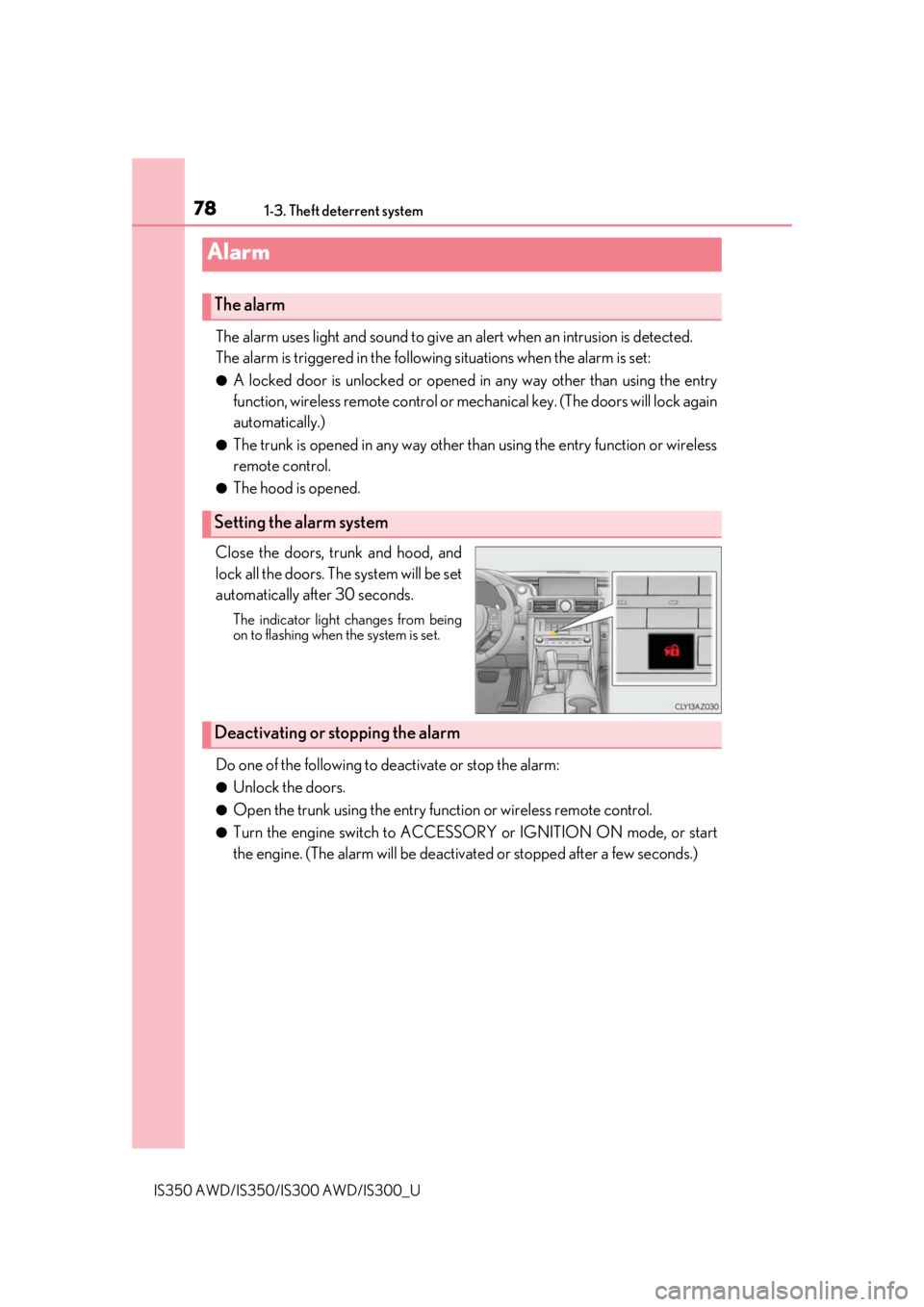
The indicator light changes from being
on to flashing when the system is set.
Do one of the following to de activate or stop the alarm:
●Unlock the doors.
●Open the trunk using the entry func tion or wireless remote control.
●Turn the engine switch to ACCESSOR Y or IGNITION ON mode, or start
the engine. (The alarm will be deactivat ed or stopped after a few seconds.)
Alarm
The alarm
Setting the alarm system
Deactivating or stopping the alarm
Page 79 of 660
791-3. Theft deterrent system
1
For safety and security
IS350 AWD/IS350/IS300 AWD/IS300_U
■System maintenance
The vehicle has a maintenance-free type alarm system.
■Items to check before locking the vehicle
To prevent unexpected triggering of the alarm and vehicle theft, make sure of the follow-
ing:
●Nobody is in the vehicle.
●The windows and moon roof are closed before the alarm is set.
●No valuables or other personal items are left in the vehicle.
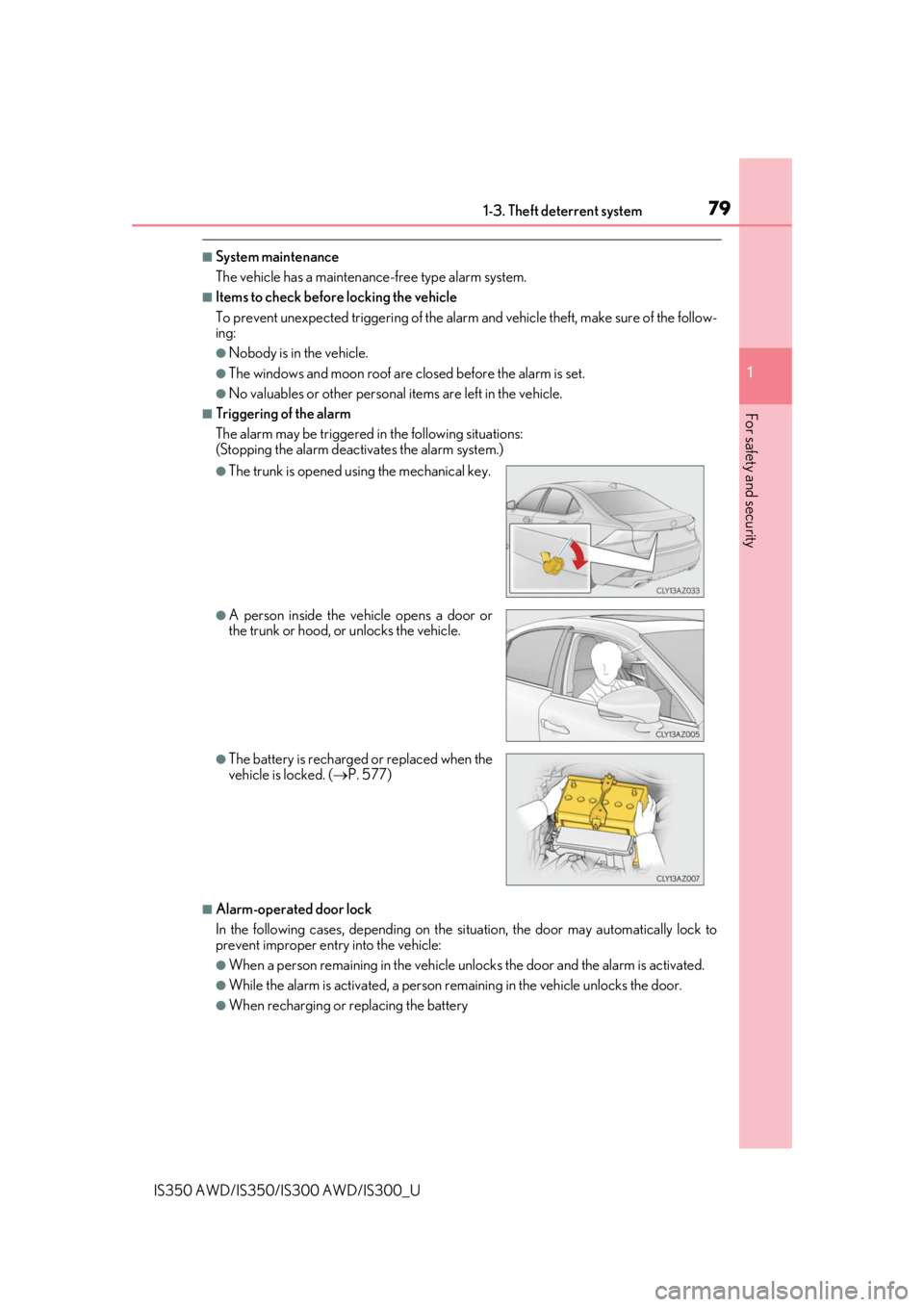
■Triggering of the alarm
The alarm may be triggered in the following situations:
(Stopping the alarm deactivates the alarm system.)
■Alarm-operated door lock
In the following cases, depending on the si tuation, the door may automatically lock to
prevent improper entry into the vehicle:
●When a person remaining in the vehicle un locks the door and the alarm is activated.
●While the alarm is activated, a person remaining in the vehicle unlocks the door.
●When recharging or replacing the battery
●The trunk is opened using the mechanical key.
●A person inside the vehicle opens a door or
the trunk or hood, or unlocks the vehicle.
●The battery is recharged or replaced when the
vehicle is locked. (P. 577)