load Lexus IS300 2019 Owner's Manual / 2019 IS300,IS350 OWNER'S MANUAL (OM53E71U)
[x] Cancel search | Manufacturer: LEXUS, Model Year: 2019, Model line: IS300, Model: Lexus IS300 2019Pages: 660, PDF Size: 10.15 MB
Page 3 of 660

3
1
9 8
7 5 4
3
2
10
IS350 AWD/IS350/IS300 AWD/IS300_U
6
3-5. Opening, closing the windows and moon roof
Power windows ............................162
Moon roof .......................................166
4-1. Before driving Driving the vehicle ...................... 172
Cargo and luggage ................... 180
Vehicle load limits ...................... 183
Trailer towing ............................... 184
Dinghy towing .............................. 185
4-2. Driving procedures Engine (ign ition) switch ............ 186
Automatic transmission ............. 191
Turn signal lever .......................... 198
Parking brake ..............................200
ASC (Active Sound Control) ........ 201
4-3. Operating the lights and wipers
Headlight switch ........................ 202
Automatic High Beam............. 206
Windshield wipers and washer .......................................... 210 4-4. Refueling
Opening the fuel tank cap ................................................. 218
4-5. Using the driving support systems
Lexus Safety System + ............. 222
PCS (Pre-Collision System) ......... 229
LDA (Lane Departure Alert with steering
control)........................................ 240
Dynamic radar cruise control ......................................... 248
Intuitive parking assist.............. 260
Lexus parking assist monitor........................................ 269
BSM (Blind Spot Monitor) ............. 285
• BSM function......................... 289
• RCTA function...................... 292
Driving mode select switch ........................................... 297
Driving assist systems ............... 301
4-6. Driving tips Winter driving tips..................... 306
4Driving
Page 50 of 660

501-1. For safe use
IS350 AWD/IS350/IS300 AWD/IS300_U
WARNING
■Front passenger occupant classification system precautions
Observe the following precautions regarding the front passenger occupant classifica-
tion system.
Failure to do so may cause death or serious injury.
●Wear the seat belt properly.
●Make sure the front passenger’s seat belt plate has not been left inserted into the
buckle before someone sits in the front passenger seat.
●Make sure the “AIR BAG OFF” indicator li ght is not illuminated when using the seat
belt extender for the front passenger seat. If the “AIR BAG OFF” indicator light is illu-
minated, disconnect the extender tongue from the seat belt buckle, and reconnect
the seat belt. Reconnect the seat belt extender after making sure the “AIR BAG ON”
indicator light is illuminated. If you use the seat belt extender while the “AIR BAG
OFF” indicator light is illuminated, the SRS airbags for the front passenger may not
activate, which could cause death or seri ous injury in the event of a collision.
●Do not apply a heavy load to the front passenger seat or equipment (e.g. seatback
pocket).
●Do not put weight on the front passenger seat by putting your hands or feet on the
front passenger seat seatback from the rear passenger seat.
●Do not let a rear passenger lift the front passenger seat with their feet or press on the
seatback with their legs.
●Do not put objects under the front passenger seat.
Page 74 of 660
741-2. Lexus Enform
IS350 AWD/IS350/IS300 AWD/IS300_U
After you sign the Telematics Subscription Service Agreement, download the
Lexus Enform Remote app from your cellular phone’s app store, and register
within the app (or enroll and complete registration at the dealer), you can begin
using these services. ( P. 68)
A variety of subscription terms are availa ble. Contact your Lexus dealer, or call 1-
800-25-LEXUS (1-800-255-3987) fo r further subscription details.
■Availability of service
Lexus Enform Remote is available in the contiguous United States, Washington D.C. and
Alaska.
Lexus Enform Remote is not available in some countries or areas.
■Lexus Enform Remo te Information
●Lexus Enform Remote should only be used by authorized users.
●Laws in some communities may require that th e vehicle be within view of the user when
operating Lexus Enform Remote.
In some states, use of Lexus Enform Remo te may violate state or local laws. Before
using Lexus Enform Remote, chec k your state and local laws.
●Any malfunction of the Lexus should be repaired by your Lexus dealer.
●Lexus Enform Remote is designed to work at temperatures above -22 F (-30 C). This
specification is related to the Lexus Enform Remote operation, but is dependent on the
vehicle’s operating temperature range which may be different.
●Content is subject to change without notice.
●Some features of the Lexus Enform Remote may not be available on some models.
●Additional information can be found at www.lexus.com/enform/.
●Availability of functions of the Lexus Enform service is dependent on network reception
level.
■Safety information for Lexus Enform Remote
Refer to the safety information for Safety Connect: P. 72
LEXUS Enform Remote
: If equipped
Lexus Enform Remote is a cellular phone application that lets you view and
remotely control certain aspects of your vehicle.
For details about the functions and serv ices of this application, refer to
http://www.lexus.com/enform/
.
Function of the Lexus Enform Remote is achieved by using an embedded cel-
lular device in the vehicle (DCM: Data Communication Module).
Subscription
Page 134 of 660
1343-2. Opening, closing and locking the doors and trunk
IS350 AWD/IS350/IS300 AWD/IS300_U
WARNING
■Using the trunk
Observe the following precautions.
Failure to do so may cause parts of the body to be caught, resulting in serious injury.
●Remove any heavy loads, such as snow and ice, from the trunk lid before opening it.
Failure to do so may cause the trunk lid to suddenly shut again after it is opened.
●When opening or closing the trunk lid, thoroughly check to make sure the surround-
ing area is safe.
●If anyone is in the vicinity, make sure they are safe and let them know that the trunk is
about to open or close.
●Use caution when opening or closing the tr unk lid in windy weather as it may move
abruptly in strong wind.
●Do not attach any accessories other than genuine Lexus parts to the trunk lid. Such
additional weight on the trunk lid may cause the lid to suddenly shut again after it is
opened.
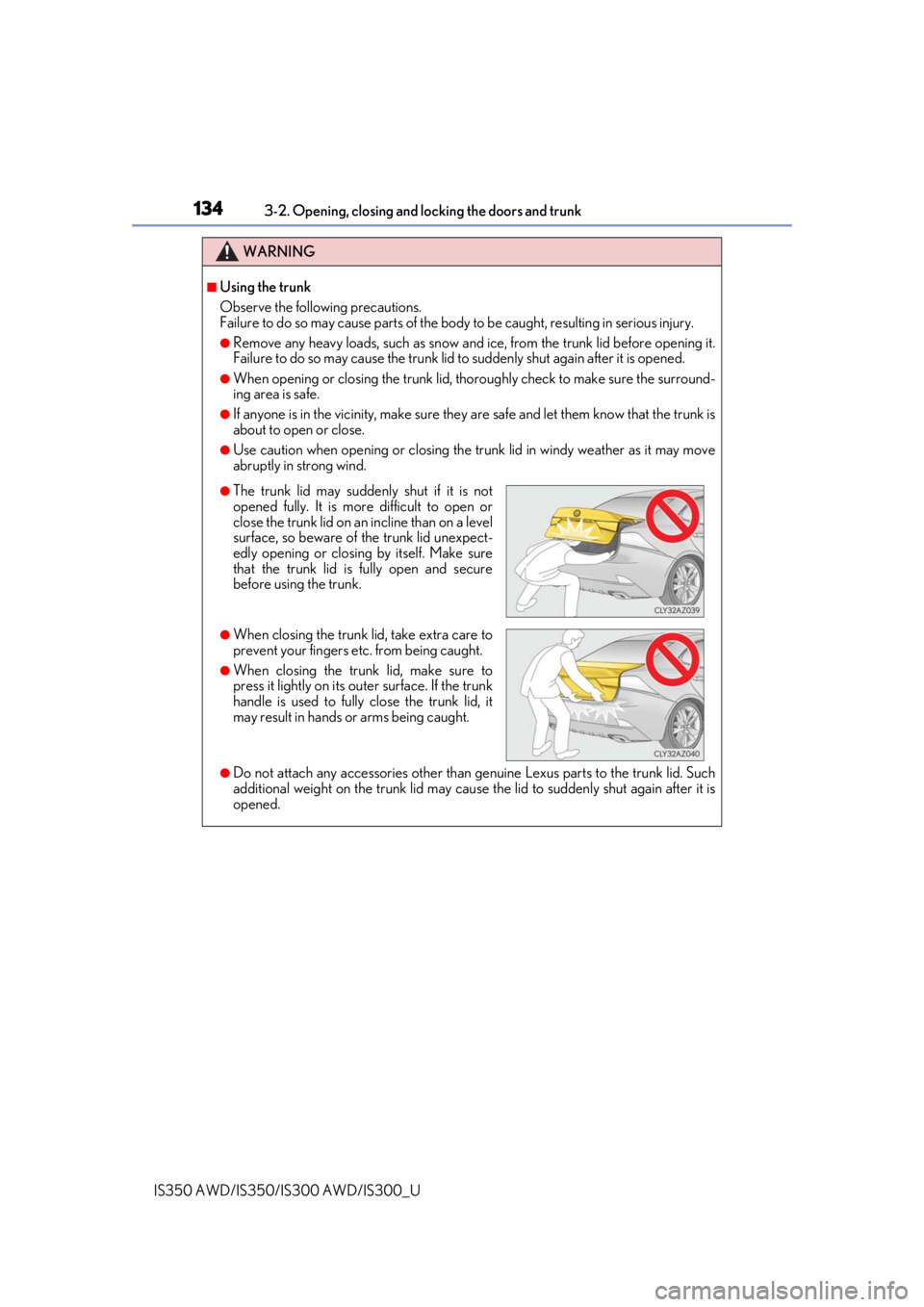
●The trunk lid may suddenly shut if it is not
opened fully. It is more difficult to open or
close the trunk lid on an incline than on a level
surface, so beware of the trunk lid unexpect-
edly opening or closin g by itself. Make sure
that the trunk lid is fully open and secure
before using the trunk.
●When closing the trunk li d, take extra care to
prevent your fingers etc. from being caught.
●When closing the trunk lid, make sure to
press it lightly on its outer surface. If the trunk
handle is used to fully close the trunk lid, it
may result in hands or arms being caught.
Page 171 of 660

171
Driving4
IS350 AWD/IS350/IS300 AWD/IS300_U
4-1. Before drivingDriving the vehicle ...................... 172
Cargo and luggage ....................180
Vehicle load limits ....................... 183
Trailer towing ................................ 184
Dinghy towing ..............................185
4-2. Driving procedures Engine (ignition) switch ............ 186
Automatic transm ission..............191
Turn signal lever........................... 198
Parking brake ............................. 200
ASC (Active Sound Control)......... 201
4-3. Operating the lights and wipers
Headlight switch .........................202
Automatic High Beam ............ 206
Windshield wipers and washer........................................... 210 4-4. Refueling
Opening the fuel tank cap ...... 218
4-5. Using the driving support systems
Lexus Safety System + ............. 222
PCS (Pre-Collision System) ......... 229
LDA (Lane Departure Alert with steering
control)........................................ 240
Dynamic radar cruise control ......................................... 248
Intuitive parking assist .............. 260
Lexus parking assist monitor ........................................ 269
BSM (Blind Spot Moni tor)..............285
• BSM function .........................289
• RCTA function...................... 292
Driving mode select switch ........................................... 297
Driving assist systems ............... 301
4-6. Driving tips Winter driving tips .....................306
Page 174 of 660

1744-1. Before driving
IS350 AWD/IS350/IS300 AWD/IS300_U
■Breaking in your new Lexus
To extend the life of the vehicle, observin g the following precautions is recommended:
●For the first 186 miles (300 km):
Avoid sudden stops.
●For the first 621 miles (1000 km):
• Do not drive at extremely high speeds.
• Avoid sudden acceleration.
• Do not drive continuously in low gears.
• Do not drive at a constant speed for extended periods.
■Drum-in-disc type parking brake system
Your vehicle has a drum-in-disc type parking brake system. This type of brake system
needs bedding-down of the brake shoes peri odically or whenever the parking brake
shoes and/or drum are replaced. Have your Lexus dealer perform the bedding down
operation.
■Operating your vehicle in a foreign country
Comply with the relevant vehicle registration laws and confirm the availability of the cor-
rect fuel. ( P. 598)
■Idling time before engine stop (IS300)
To prevent damage to the turbocharger, allow the engine to idle immediately after high-
load driving.
Driving conditionIdling time
Normal city driving or high-spe ed driving (at the highway speed
limit or recommended speed)
Not necessary
Steep hill driving, co ntinuous driving (race track driving etc.)
Approximately
1 minute
Page 177 of 660

1774-1. Before driving
4
Driving
IS350 AWD/IS350/IS300 AWD/IS300_U
WARNING
Observe the following precautions.
Failure to do so may result in death or serious injury.
■When the vehicle is stopped
●Do not race the engine.
If the shift lever is any position other than P or N, the vehicle may accelerate suddenly
and unexpectedly, causing an accident.
●In order to prevent accidents due to the ve hicle rolling away, always keep depressing
the brake pedal while the engine is running, and apply the parking brake as neces-
sary.
●If the vehicle is stopped on an incline, in order to prevent accidents caused by the
vehicle rolling forward or backward, alwa ys depress the brake pedal and securely
apply the parking brake as needed.
●Avoid revving or racing the engine.
Running the engine at high speed while the vehicle is stopped may cause the exhaust
system to overheat, which could result in a fire if combustible material is nearby.
■When the vehicle is parked
●Do not leave glasses, cigarette lighters, sp ray cans, or soft drink cans in the vehicle
when it is in the sun.
Doing so may result in the following:
• Gas may leak from a cigarette lighter or spray can, and may lead to a fire.
• The temperature inside the vehicle may cau se the plastic lenses and plastic mate-
rial of glasses to deform or crack.
• Soft drink cans may fracture, causing the contents to spray over the interior of the
vehicle, and may also cause a short circui t in the vehicle’s electrical components.
●Do not leave cigarette lighters in the vehicle. If a cigarette lighter is in a place such as
the glove box or on the floor, it may be lit accidentally when luggage is loaded or the
seat is adjusted, causing a fire.
●Do not attach adhesive discs to the windsh ield or windows. Do not place containers
such as air fresheners on th e instrument panel or dashboard. Adhesive discs or con-
tainers may act as lenses, ca using a fire in the vehicle.
●Do not leave a door or window open if th e curved glass is coated with a metallized
film such as a silver-colored one. Reflecte d sunlight may cause the glass to act as a
lens, causing a fire.
●Always apply the parking brake, shift the shift lever to P, stop the engine and lock the
vehicle.
Do not leave the vehicle unattend ed while the engine is running.
If the vehicle is parked with the shift leve r in P but the parking brake is not set, the
vehicle may start to move, possibly leading to an accident.
●Do not touch the exhaust pipes while the engine is running or immediately after turn-
ing the engine off.
Doing so may cause burns.
Page 179 of 660

1794-1. Before driving
4
Driving
IS350 AWD/IS350/IS300 AWD/IS300_U
NOTICE
■When driving the vehicle
●Do not depress the accelerator and brake pedals at the same time during driving, as
this may restrain the engine output.
●Do not use the accelerator pedal or depre ss the accelerator and brake pedals at the
same time to hold the vehicle on a hill.
■When parking the vehicle
Always set the parking brake, and shift the sh ift lever to P. Failure to do so may cause
the vehicle to move or the vehicle may acce lerate suddenly if the accelerator pedal is
accidentally depressed.
■Avoiding damage to vehicle parts
●Do not turn the steering wheel fully in either direction and hold it there for an
extended period of time.
Doing so may damage the power steering motor.
●When driving over bumps in the road, drive as slowly as possible to avoid damaging
the wheels, underside of the vehicle, etc.
●IS300: Make sure to idle the engine imme diately after high-load driving. Stop the
engine only after the turb ocharger has cooled down.
Failure to do so may cause damage to the turbocharger.
■If you get a flat tire while driving
A flat or damaged tire may cause the following situations . Hold the steering wheel
firmly and gradually depress the brake pedal to slow down the vehicle.
●It may be difficult to control your vehicle.
●The vehicle will make abnormal sounds or vibrations.
●The vehicle will lean abnormally.
Information on what to do in case of a flat tire ( P. 559)
■When encountering flooded roads
Do not drive on a road that has flooded af ter heavy rain etc. Doing so may cause the
following serious damage to the vehicle:
●Engine stalling
●Short in electrical components
●Engine damage caused by water immersion
In the event that you drive on a flooded road and the vehicle is flooded, be sure to have
your Lexus dealer check the following:
●Brake function
●Changes in quantity and quality of oil and fluid used for the engine, transmission,
transfer (AWD models), differentials, etc.
●Lubricant condition for the propeller shaft, bearings and suspension joints (where
possible), and the function of all joints, bearings, etc.
Page 180 of 660

1804-1. Before driving
IS350 AWD/IS350/IS300 AWD/IS300_U
Cargo capacity depends on the total weight of the occupants.
(Cargo capacity) = (Total load capac ity) — (Total weight of occupants)
Steps for Determining Correct Load Limit —
(1) Locate the statement “The combined weight of occupants and cargo should
never exceed XXX kg or XXX lbs. ” on your vehicle’s placard.
(2) Determine the combined weight of th e driver and passengers that will be rid-
ing in your vehicle.
(3) Subtract the combined weight of th e driver and passengers from XXX kg or
XXX lbs.
(4) The resulting figure equals the ava ilable amount of cargo and luggage load
capacity.
For example, if the “XXX” amount equals 1400 lbs. and there will be five 150
lb passengers in your vehicle, the amou nt of available cargo and luggage load
capacity is 650 lbs. (1400 750 (5 150) = 650 lbs.)
(5) Determine the combined weight of luggage and cargo being loaded on the
vehicle. That weight may not safely exceed the available cargo and luggage
load capacity calculated in Step 4.
(6) If your vehicle will be towing a trailer, load from your trailer will be transferred
to your vehicle. Consult this manual to determine how this reduces the avail-
able cargo and luggage load capacity of your vehicle.
( P. 183)
Lexus does not recommend towing a trailer with your vehicle. Your vehicle is not
designed for trailer towing.
Cargo and luggage
Take notice of the following informat ion about storage precautions, cargo
capacity and load:
Capacity and distribution
Page 181 of 660
1814-1. Before driving
4
Driving
IS350 AWD/IS350/IS300 AWD/IS300_U
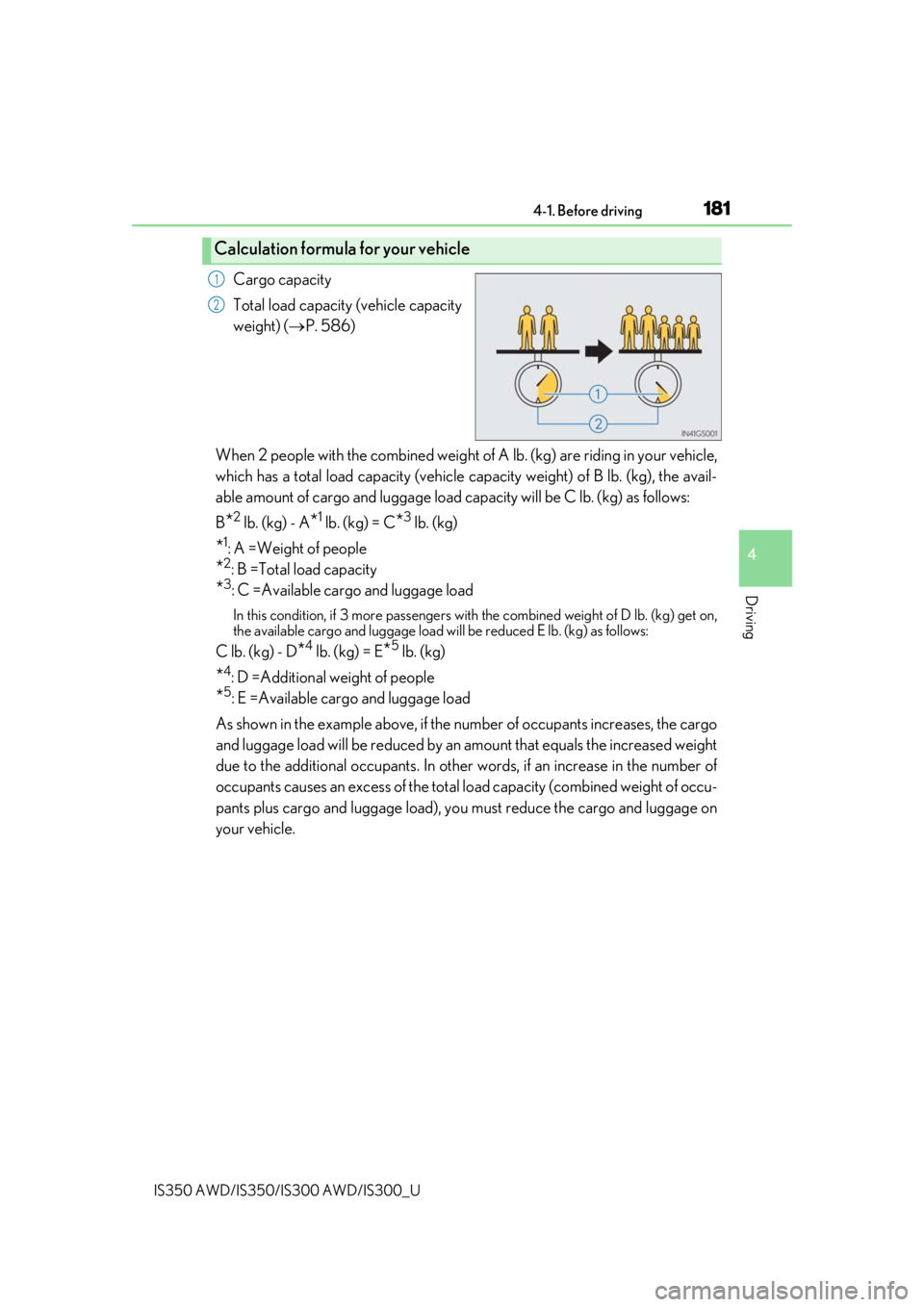
Cargo capacity
Total load capacity (vehicle capacity
weight) (P. 586)
When 2 people with the combined weight of A lb. (kg) are riding in your vehicle,
which has a total load capacity (vehicle capacity weight) of B lb. (kg), the avail-
able amount of cargo and luggage load capacity will be C lb. (kg) as follows:
B
*2 lb. (kg) - A*1 lb. (kg) = C*3 lb. (kg)
*1: A =Weight of people
*2: B =Total load capacity
*3: C =Available cargo and luggage load
In this condition, if 3 more passengers with the combined weight of D lb. (kg) get on,
the available cargo and luggage load w ill be reduced E lb. (kg) as follows:
C lb. (kg) - D*4 lb. (kg) = E*5 lb. (kg)
*4: D =Additional weight of people
*5: E =Available cargo and luggage load
As shown in the example above, if the nu mber of occupants increases, the cargo
and luggage load will be reduced by an amount that equals the increased weight
due to the additional occupants. In other words, if an increase in the number of
occupants causes an excess of the total load capacity (combined weight of occu-
pants plus cargo and luggage load), yo u must reduce the cargo and luggage on
your vehicle.
Calculation formula for your vehicle
1
2