inflation pressure LEXUS IS300 2021 Owner's Manual
[x] Cancel search | Manufacturer: LEXUS, Model Year: 2021, Model line: IS300, Model: LEXUS IS300 2021Pages: 436, PDF Size: 8.27 MB
Page 345 of 436

3457-2. Steps to take in an emergency
7
When trouble arises
WARNING
●Check and adjust the tire inflation
pressure immediately.
●If the tire pressure warning light comes
on even after tire inflation pressure
adjustment, it is probable that you have
a flat tire. Check the tires. If a tire is flat,
change it with the spare tire and have
the flat tire repaired by the nearest
Lexus dealer.
●Avoid abrupt maneuvering and brak-
ing.
If the vehicle tires deteriorate, you
could lose control of the steering
wheel or the brakes.
■If a blowout or sudden air leakage
should occur
The tire pressure warning system may
not activate immediately.
■Maintenance of the tires
Each tire, including the spare (if pro-
vided), should be checked monthly when
cold and inflated to the inflation pressure
recommended by the vehicle manufac-
turer on the vehicle placard or tire infla-
tion pressure label (tire and load
information label). (I f your vehicle has
tires of a different size than the size indi-
cated on the vehicle placard or tire infla-
tion pressure label [tire and load
information label], yo u should determine
the proper tire infl ation pressure for
those tires.)
As an added safety fe ature, your vehicle
has been equipped with a tire pressure
monitoring system (TPMS-tire pressure
warning system) that illuminates a low
tire pressure telltale (tire pressure warn-
ing light) when one or more of your tires
is significantly under-inflated. Accord-
ingly, when the low ti re pressure telltale
(tire pressure warning light) illuminates,
you should stop and check your tires as
soon as possible, and inflate them to the
proper pressure. Driving on a signifi-
cantly under-inflated tire causes the tire
to overheat and can lead to tire failure.
Under-inflation also reduces fuel effi-
ciency and tire tread life, and may affect
the vehicle’s handling and stopping abil-
ity.
Please note that the TPMS (tire pressure
warning system) is not a substitute for
proper tire maintenance, and it is the
driver’s responsibility to maintain correct
tire pressure, even if under-inflation has
not reached the level to trigger illumina-
tion of the TPMS low tire pressure telltale
(tire pressure warning light).
Your vehicle has also been equipped with
a TPMS (tire pressure warning system)
malfunction indicator to indicate when
the system is not operating properly. The
TPMS (tire pressure warning system)
malfunction indicator is combined with
the low tire pressure telltale (tire pres-
sure warning light) . When the system
detects a malfunction, the telltale will
flash for approximately one minute and
then remain continuously illuminated.
This sequence will continue upon subse-
quent vehicle start-ups as long as the
malfunction exists. When the malfunction
indicator is illuminated, the system may
not be able to detect or signal low tire
pressure as intended.
Page 354 of 436
3547-2. Steps to take in an emergency
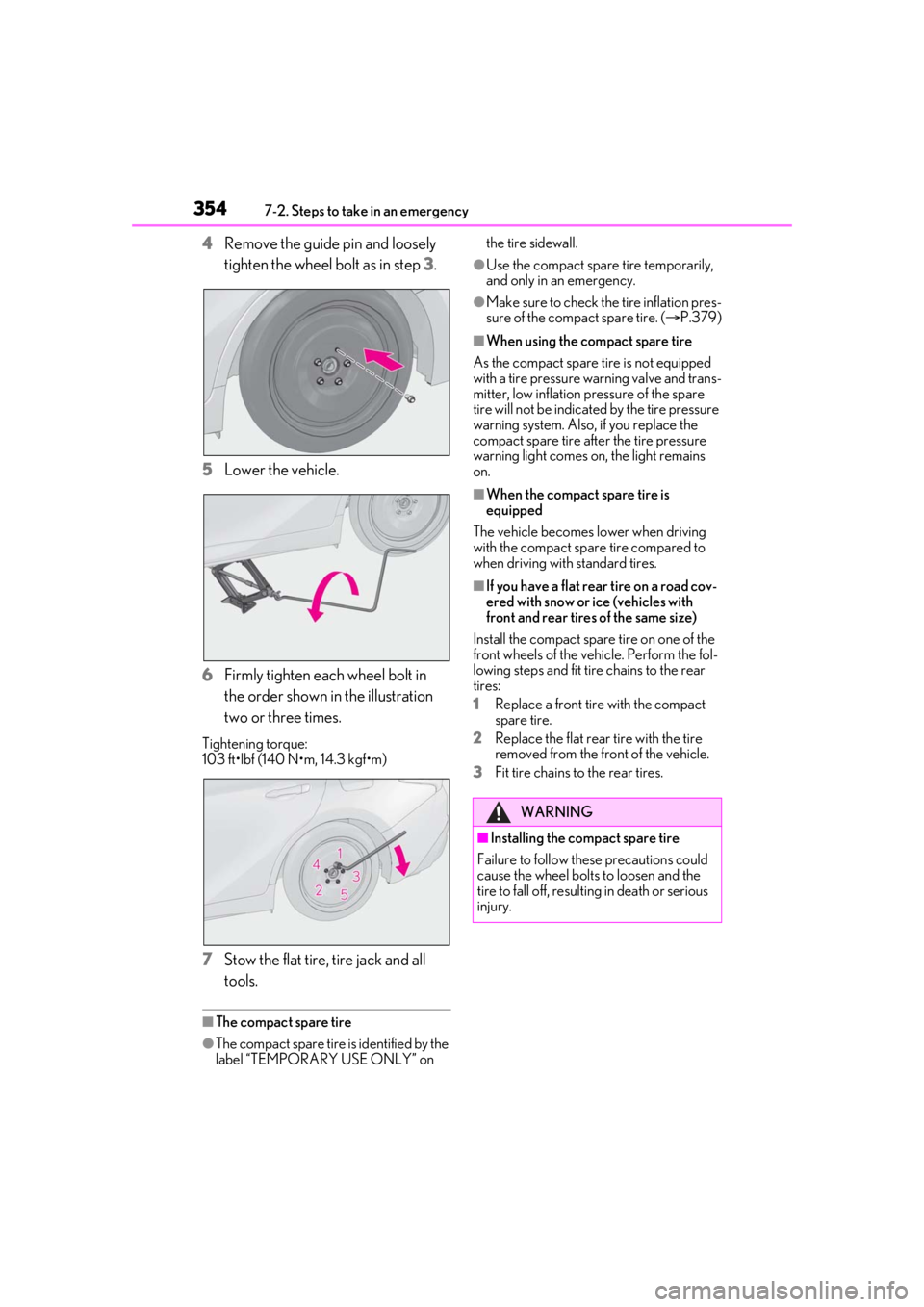
4Remove the guide pin and loosely
tighten the wheel bolt as in step 3.
5 Lower the vehicle.
6 Firmly tighten each wheel bolt in
the order shown in the illustration
two or three times.
Tightening torque:
103 ft•lbf (140 N•m, 14.3 kgf•m)
7Stow the flat tire, tire jack and all
tools.
■The compact spare tire
●The compact spare tire is identified by the
label “TEMPORARY USE ONLY” on the tire sidewall.
●Use the compact spar
e tire temporarily,
and only in an emergency.
●Make sure to check the tire inflation pres-
sure of the compact spare tire. ( P.379)
■When using the compact spare tire
As the compact spare tire is not equipped
with a tire pressure warning valve and trans-
mitter, low inflation pressure of the spare
tire will not be indicated by the tire pressure
warning system. Also, if you replace the
compact spare tire afte r the tire pressure
warning light comes on, the light remains
on.
■When the compact spare tire is
equipped
The vehicle becomes lower when driving
with the compact spare tire compared to
when driving with standard tires.
■If you have a flat rear tire on a road cov-
ered with snow or ice (vehicles with
front and rear tires of the same size)
Install the compact spare tire on one of the
front wheels of the vehicle. Perform the fol-
lowing steps and fit tire chains to the rear
tires:
1 Replace a front tire with the compact
spare tire.
2 Replace the flat rear tire with the tire
removed from the front of the vehicle.
3 Fit tire chains to the rear tires.
WARNING
■Installing the compact spare tire
Failure to follow these precautions could
cause the wheel bolts to loosen and the
tire to fall off, result ing in death or serious
injury.
Page 379 of 436
3798-1. Specifications
8
Vehicle specifications
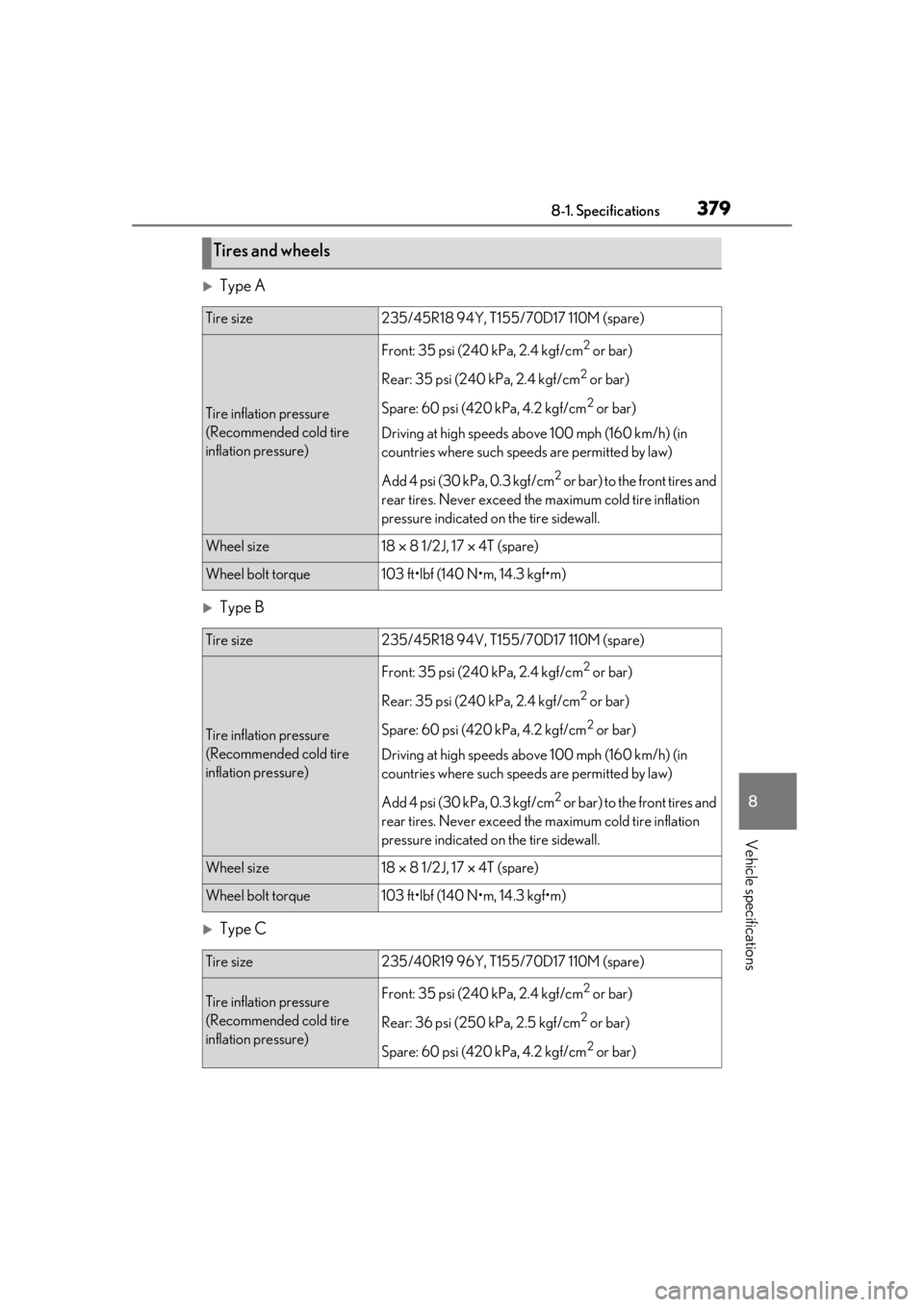
Type A
Type B
Type C
Tires and wheels
Tire size235/45R18 94Y, T155/70D17 110M (spare)
Tire inflation pressure
(Recommended cold tire
inflation pressure)
Front: 35 psi (240 kPa, 2.4 kgf/cm2 or bar)
Rear: 35 psi (240 kPa, 2.4 kgf/cm
2 or bar)
Spare: 60 psi (420 kPa, 4.2 kgf/cm
2 or bar)
Driving at high speeds above 100 mph (160 km/h) (in
countries where such speeds are permitted by law)
Add 4 psi (30 kPa, 0.3 kgf/cm
2 or bar) to the front tires and
rear tires. Never exceed the maximum cold tire inflation
pressure indicated on the tire sidewall.
Wheel size18 8 1/2J, 17 4T (spare)
Wheel bolt torque103 ft•lbf (140 N•m, 14.3 kgf•m)
Tire size235/45R18 94V, T155/70D17 110M (spare)
Tire inflation pressure
(Recommended cold tire
inflation pressure)
Front: 35 psi (240 kPa, 2.4 kgf/cm2 or bar)
Rear: 35 psi (240 kPa, 2.4 kgf/cm
2 or bar)
Spare: 60 psi (420 kPa, 4.2 kgf/cm
2 or bar)
Driving at high speeds above 100 mph (160 km/h) (in
countries where such speeds are permitted by law)
Add 4 psi (30 kPa, 0.3 kgf/cm
2 or bar) to the front tires and
rear tires. Never exceed the maximum cold tire inflation
pressure indicated on the tire sidewall.
Wheel size18 8 1/2J, 17 4T (spare)
Wheel bolt torque103 ft•lbf (140 N•m, 14.3 kgf•m)
Tire size235/40R19 96Y, T155/70D17 110M (spare)
Tire inflation pressure
(Recommended cold tire
inflation pressure)Front: 35 psi (240 kPa, 2.4 kgf/cm2 or bar)
Rear: 36 psi (250 kPa, 2.5 kgf/cm
2 or bar)
Spare: 60 psi (420 kPa, 4.2 kgf/cm
2 or bar)
Page 380 of 436
3808-1. Specifications
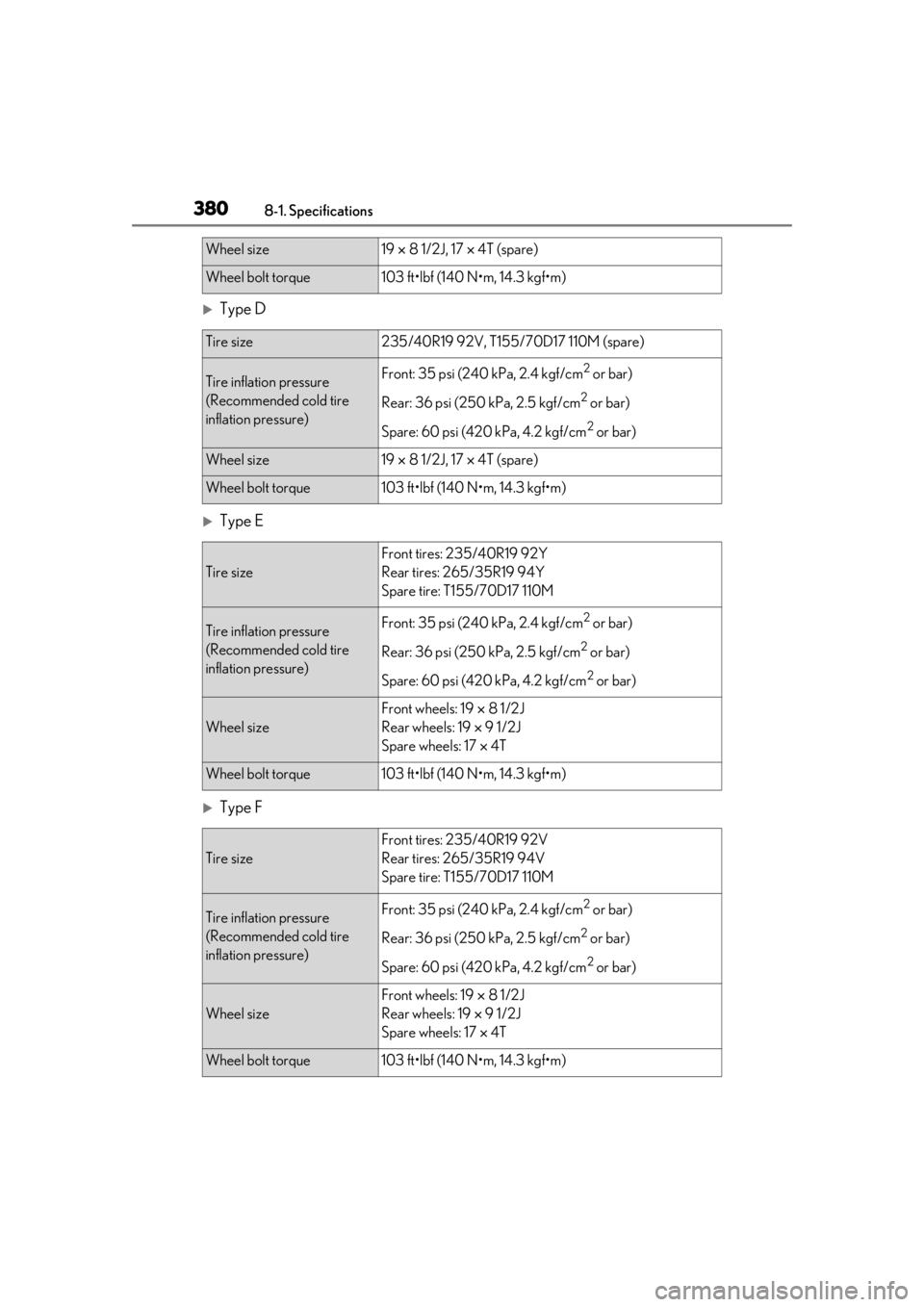
Type D
Type E
Type F
Wheel size19 8 1/2J, 17 4T (spare)
Wheel bolt torque103 ft•lbf (140 N•m, 14.3 kgf•m)
Tire size235/40R19 92V, T155/70D17 110M (spare)
Tire inflation pressure
(Recommended cold tire
inflation pressure)Front: 35 psi (240 kPa, 2.4 kgf/cm2 or bar)
Rear: 36 psi (250 kPa, 2.5 kgf/cm
2 or bar)
Spare: 60 psi (420 kPa, 4.2 kgf/cm
2 or bar)
Wheel size19 8 1/2J, 17 4T (spare)
Wheel bolt torque103 ft•lbf (140 N•m, 14.3 kgf•m)
Tire size
Front tires: 235/40R19 92Y
Rear tires: 265/35R19 94Y
Spare tire: T155/70D17 110M
Tire inflation pressure
(Recommended cold tire
inflation pressure)Front: 35 psi (240 kPa, 2.4 kgf/cm2 or bar)
Rear: 36 psi (250 kPa, 2.5 kgf/cm
2 or bar)
Spare: 60 psi (420 kPa, 4.2 kgf/cm
2 or bar)
Wheel size
Front wheels: 19 8 1/2J
Rear wheels: 19 9 1/2J
Spare wheels: 17 4T
Wheel bolt torque103 ft•lbf (140 N•m, 14.3 kgf•m)
Tire size
Front tires: 235/40R19 92V
Rear tires: 265/35R19 94V
Spare tire: T155/70D17 110M
Tire inflation pressure
(Recommended cold tire
inflation pressure)Front: 35 psi (240 kPa, 2.4 kgf/cm2 or bar)
Rear: 36 psi (250 kPa, 2.5 kgf/cm
2 or bar)
Spare: 60 psi (420 kPa, 4.2 kgf/cm
2 or bar)
Wheel size
Front wheels: 19 8 1/2J
Rear wheels: 19 9 1/2J
Spare wheels: 17 4T
Wheel bolt torque103 ft•lbf (140 N•m, 14.3 kgf•m)
Page 384 of 436
3848-1. Specifications
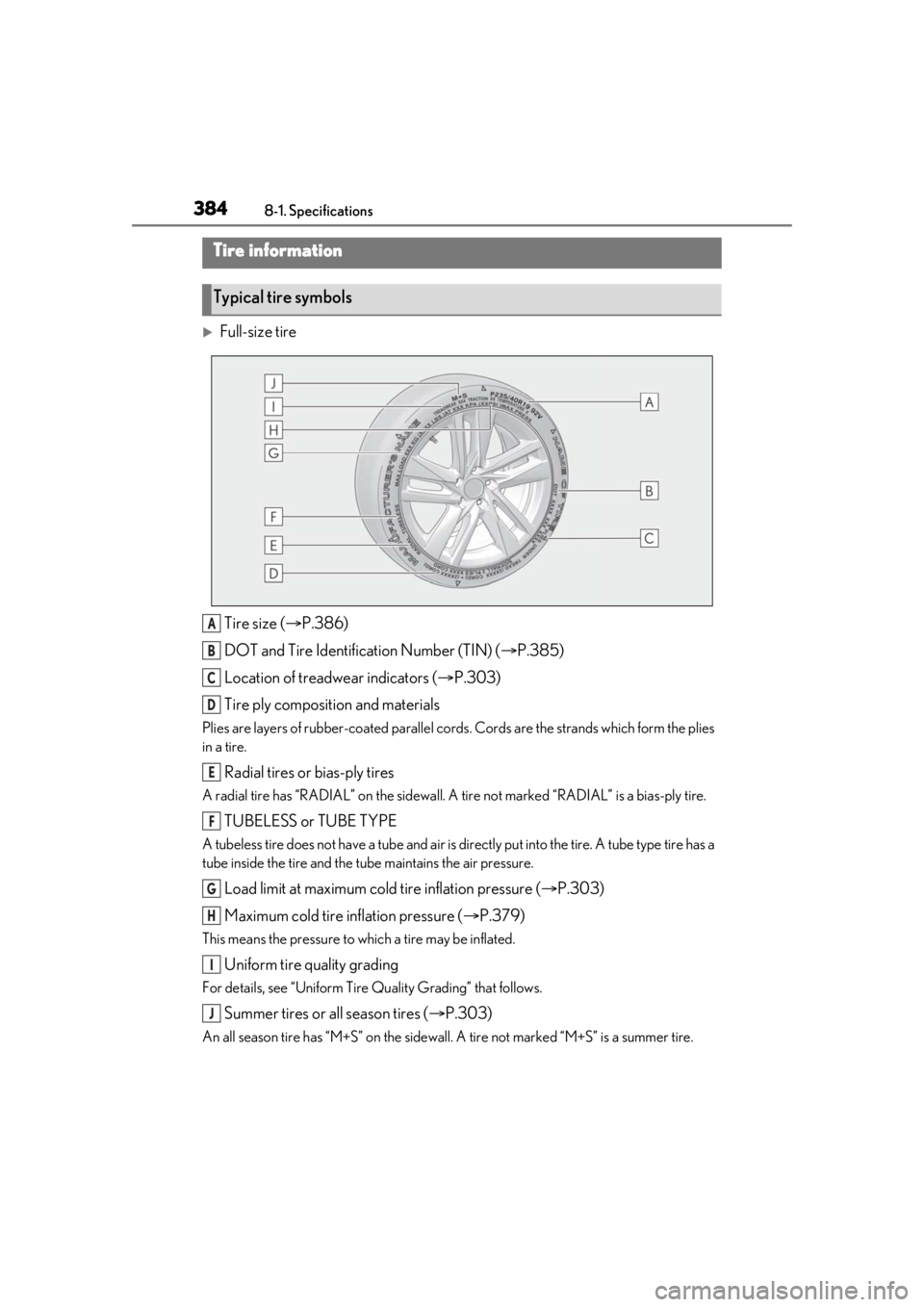
Full-size tireTire size ( P.386)
DOT and Tire Identification Number (TIN) ( P.385)
Location of treadwear indicators ( P.303)
Tire ply composition and materials
Plies are layers of rubber-coated parallel cords. Cords are the strands which form the plies
in a tire.
Radial tires or bias-ply tires
A radial tire has “RADIAL” on the sidewall. A tire not marked “RADIAL” is a bias-ply tire.
TUBELESS or TUBE TYPE
A tubeless tire does not have a tube and air is directly put into the tire. A tube type tire has a
tube inside the tire and the tube maintains the air pressure.
Load limit at maximum cold tire inflation pressure ( P.303)
Maximum cold tire inflation pressure ( P.379)
This means the pressure to which a tire may be inflated.
Uniform tire quality grading
For details, see “Uniform Tire Quality Grading” that follows.
Summer tires or all season tires ( P.303)
An all season tire has “M+S” on the sidewall. A tire not marked “M+S” is a summer tire.
Tire information
Typical tire symbols
A
B
C
D
E
F
G
H
I
J
Page 385 of 436
3858-1. Specifications
8
Vehicle specifications
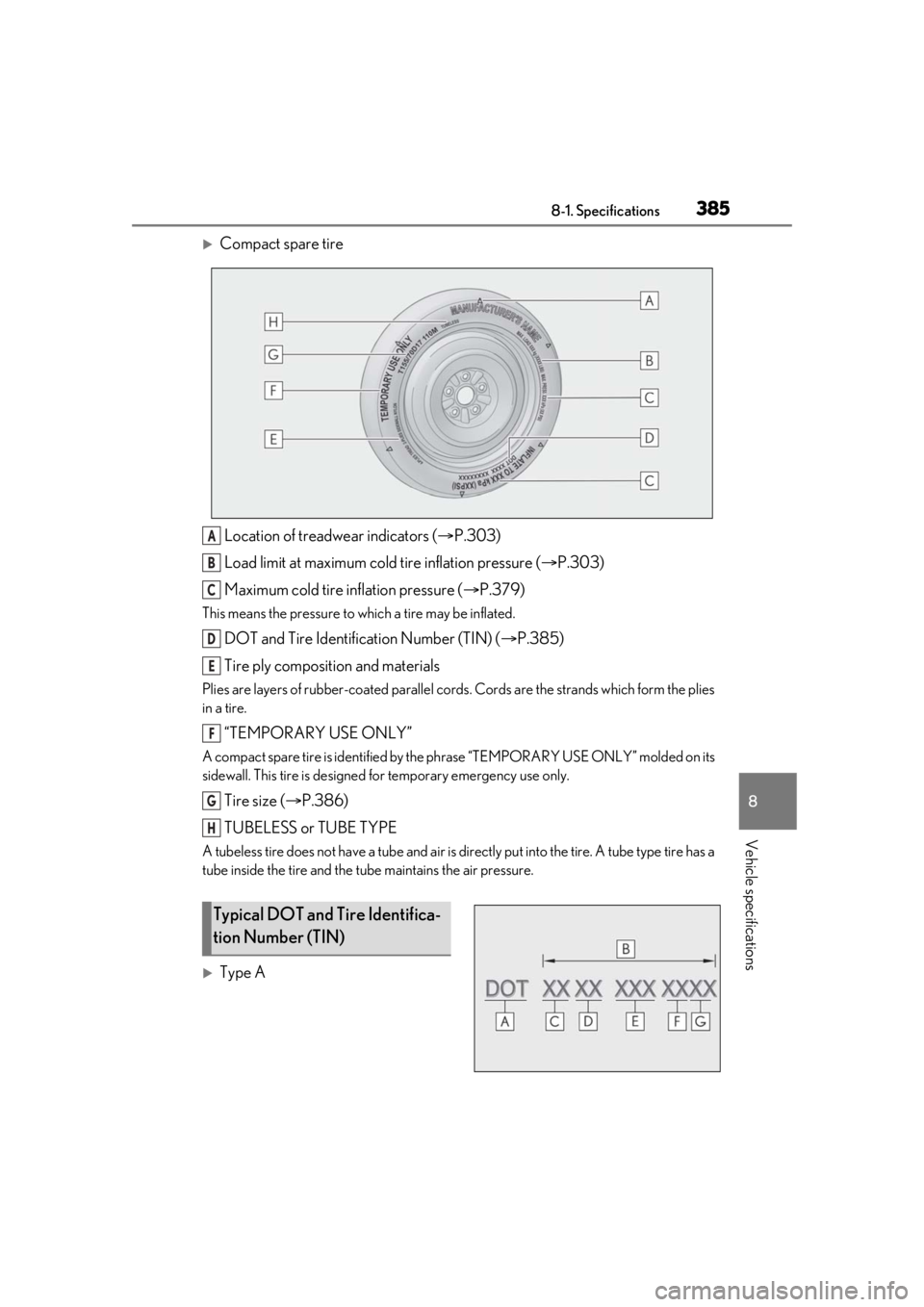
Compact spare tireLocation of treadwear indicators ( P.303)
Load limit at maximum cold tire inflation pressure ( P.303)
Maximum cold tire inflation pressure ( P.379)
This means the pressure to which a tire may be inflated.
DOT and Tire Identification Number (TIN) ( P.385)
Tire ply composition and materials
Plies are layers of rubber-coated parallel cords. Cords are the strands which form the plies
in a tire.
“TEMPORARY USE ONLY”
A compact spare tire is identified by the phrase “TEMPORARY USE ONLY” molded on its
sidewall. This tire is designed for temporary emergency use only.
Tire size ( P.386)
TUBELESS or TUBE TYPE
A tubeless tire does not have a tube and air is directly put into the tire. A tube type tire has a
tube inside the tire and the tube maintains the air pressure.
Type A
A
B
C
D
E
F
G
H
Typical DOT and Tire Identifica-
tion Number (TIN)
Page 388 of 436
3888-1. Specifications
cornering (turning) traction.
■Temperature A, B, C
The temperature grades are A (the
highest), B, and C, representing the
tire’s resistance to the generation of
heat and its ability to dissipate heat
when tested under controlled condi-
tions on a specified indoor laboratory
test wheel.
Sustained high temperature can cause the
material of the tire to degenerate and
reduce tire life, and excessive temperature
can lead to sudden tire failure. Grade C corresponds to
a level of perfor-
mance which all passenger car tires must
meet under the Fede ral Motor Vehicle
Safety Standard No. 109.
Grades B and A represent higher levels of
performance on the laboratory test wheel
than the minimum required by law.
Warning: The temperature grades of a tire
assume that it is properly inflated and not
overloaded.
Excessive speed, unde rinflation, or exces-
sive loading, either separately or in combi-
nation, can cause heat buildup and
possible tire failure.
Glossary of tire terminology
Tire related termMeaning
Cold tire inflation pressure
Tire pressure when the vehicle has been parked for
three hours or more, or has not been driven more
than 1 mile or 1.5 km under that condition
Maximum inflation pressureThe maximum cold inflated pressure to which a tire
may be inflated, shown on the sidewall of the tire
Recommended inflation pressureCold tire inflation pressure recommended by a
manufacturer
Accessory weight
The combined weight (in excess of those standard
items which may be replaced) of automatic trans-
mission, power steering, power brakes, power win-
dows, power seats, radio and heater, to the extent
that these items are available as factory-installed
equipment (whether installed or not)
Curb weight
The weight of a motor vehicle with standard equip-
ment, including the maximum capacity of fuel, oil
and coolant, and if so equipped, air conditioning
and additional weight optional engine
Page 390 of 436
3908-1. Specifications
Bead
The part of the tire that is made of steel wires,
wrapped or reinforced by ply cords and that is
shaped to fit the rim
Bead separationA breakdown of the bond between components in
the bead
Bias ply tire
A pneumatic tire in which the ply cords that extend
to the beads are laid at alternate angles substan-
tially less than 90 degrees to the centerline of the
tread
CarcassThe tire structure, except tread and sidewall rubber
which, when inflated, bears the load
ChunkingThe breaking away of pieces of the tread or sidewall
CordThe strands forming the plies in the tire
Cord separationThe parting of cords from adjacent rubber com-
pounds
CrackingAny parting within the tread, sidewall, or innerliner
of the tire extending to cord material
CT
A pneumatic tire with an inverted flange tire and rim
system in which the rim is designed with rim flanges
pointed radially inward and the tire is designed to fit
on the underside of the rim in a manner that
encloses the rim flanges inside the air cavity of the
tire
Extra load tire
A tire designed to operat e at higher loads and at
higher inflation pressures than the corresponding
standard tire
GrooveThe space between two adjacent tread ribs
InnerlinerThe layer(s) forming the in side surface of a tubeless
tire that contains the inflating medium within the tire
Innerliner separationThe parting of the innerliner from cord material in
the carcass
Tire related termMeaning
Page 391 of 436
3918-1. Specifications
8
Vehicle specifications
Intended outboard sidewall
(a) The sidewall that contains a whitewall, bears
white lettering, or bears manufacturer, brand,
and/or model name molding that is higher or
deeper than the same molding on the other sidewall
of the tire, or
(b) The outward facing sidewall of an asymmetrical
tire that has a particular side that must always face
outward when mounted on a vehicle
Light truck (LT) tire
A tire designated by its manufacturer as primarily
intended for use on lightwe ight trucks or multipur-
pose passenger vehicles
Load ratingThe maximum load that a tire is rated to carry for a
given inflation pressure
Maximum load ratingThe load rating for a tire at the maximum permissi-
ble inflation pressure for that tire
Maximum permissible inflation pres-
sureThe maximum cold inflation pressure to which a tire
may be inflated
Measuring rimThe rim on which a tire is fitted for physical dimen-
sion requirements
Open spliceAny parting at any junction of tread, sidewall, or
innerliner that extends to cord material
Outer diameterThe overall diameter of an inflated new tire
Overall width
The linear distance between the exteriors of the
sidewalls of an inflated tire, including elevations due
to labeling, decorations, or protective bands or ribs
Passenger car tire
A tire intended for use on passenger cars, multipur-
pose passenger vehicles, and trucks, that have a
gross vehicle weight rating (GVWR) of 10,000 lb.
or less.
PlyA layer of rubber-c oated parallel cords
Ply separationA parting of rubber compound between adjacent
plies
Pneumatic tire
A mechanical device made of rubber, chemicals,
fabric and steel or other materials, that, when
mounted on an automotive wheel, provides the
traction and contains the gas or fluid that sustains
the load
Tire related termMeaning
Page 392 of 436
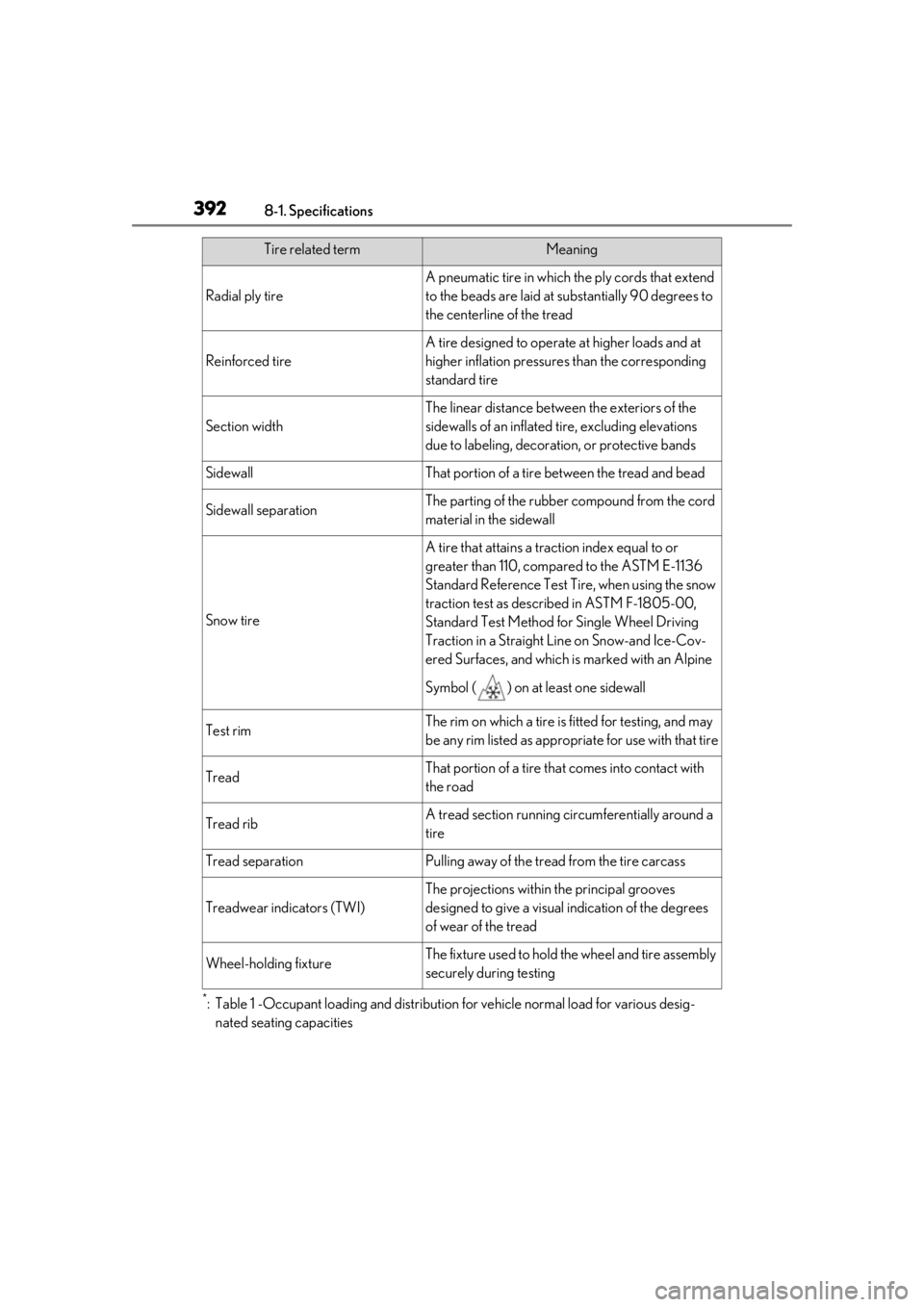
3928-1. Specifications
*: Table 1 -Occupant loading and distribution for vehicle normal load for various desig-nated seating capacities
Radial ply tire
A pneumatic tire in which the ply cords that extend
to the beads are laid at su bstantially 90 degrees to
the centerline of the tread
Reinforced tire
A tire designed to operat e at higher loads and at
higher inflation pressures than the corresponding
standard tire
Section width
The linear distance between the exteriors of the
sidewalls of an inflated tire, excluding elevations
due to labeling, decoration, or protective bands
SidewallThat portion of a tire between the tread and bead
Sidewall separationThe parting of the rubber compound from the cord
material in the sidewall
Snow tire
A tire that attains a traction index equal to or
greater than 110, compared to the ASTM E-1136
Standard Referenc e Test Tire, when using the snow
traction test as described in ASTM F-1805-00,
Standard Test Method fo r Single Wheel Driving
Traction in a Straight Line on Snow-and Ice-Cov-
ered Surfaces, and which is marked with an Alpine
Symbol ( ) on at least one sidewall
Test rimThe rim on which a tire is fitted for testing, and may
be any rim listed as appropriate for use with that tire
TreadThat portion of a tire that comes into contact with
the road
Tread ribA tread section running ci rcumferentially around a
tire
Tread separationPulling away of the tread from the tire carcass
Treadwear indicators (TWI)
The projections within the principal grooves
designed to give a visual indication of the degrees
of wear of the tread
Wheel-holding fixtureThe fixture used to hold the wheel and tire assembly
securely during testing
Tire related termMeaning