flat LEXUS IS300 2021 Owners Manual
[x] Cancel search | Manufacturer: LEXUS, Model Year: 2021, Model line: IS300, Model: LEXUS IS300 2021Pages: 436, PDF Size: 8.27 MB
Page 1 of 436

IS350AWD-IS350-IS300AWD-IS300_U
1
2
3
4
5
6
7
8
9
Pictorial indexSearch by illustration
For safety
and securityMake sure to read through them
(Main topics: Child seat, theft deterrent system)
Vehicle status
information and
indicatorsReading driving-related information
(Main topics: Meters, multi-information display)
Before drivingOpening and closing the doors and windows,
adjustment before driving
(Main topics: Keys, doors, seats)
DrivingOperations and advice which are necessary for driving
(Main topics: Starting engine, refueling)
Interior featuresUsage of the interior features
(Main topics: Air conditioner, storage features)
Maintenance
and careCaring for your vehicle and maintenance procedures
(Main topics: Interior and exterior, light bulbs)
When trouble
arisesWhat to do in case of malfunction and emergency
(Main topics: Battery discharge, flat tire)
Vehicle
specificationsVehicle specifications, customizable features
(Main topics: Fuel, oil, tire inflation pressure)
For ownersReporting safety defects for U.S. owners, and seat belt,
SRS airbag and headlight aim instructions for Canadian
owners
IndexSearch by symptom
Search alphabetically
Page 4 of 436
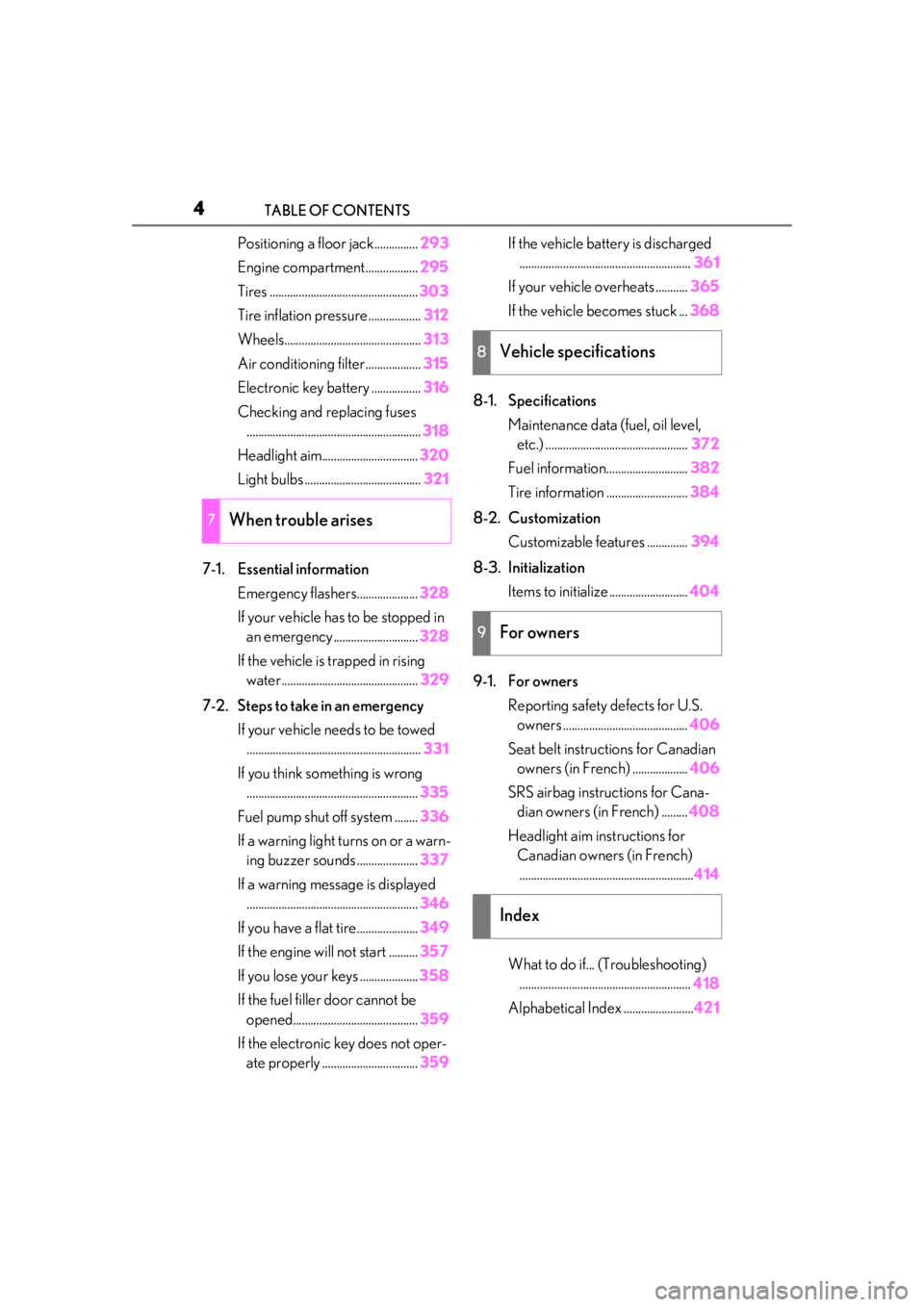
4TABLE OF CONTENTS
Positioning a floor jack...............293
Engine compartment.................. 295
Tires ................................................... 303
Tire inflation pressure .................. 312
Wheels............................................... 313
Air conditioning filter...................315
Electronic key battery ................. 316
Checking and replacing fuses ............................................................ 318
Headlight aim................................. 320
Light bulbs ........................................ 321
7-1. Essential information Emergency flashers..................... 328
If your vehicle has to be stopped in an emergency ............................. 328
If the vehicle is trapped in rising water............................................... 329
7-2. Steps to take in an emergency If your vehicle needs to be towed............................................................ 331
If you think something is wrong ........................................................... 335
Fuel pump shut off system ........ 336
If a warning light turns on or a warn- ing buzzer sounds ..................... 337
If a warning message is displayed ........................................................... 346
If you have a flat tire..................... 349
If the engine wi ll not start .......... 357
If you lose your keys .................... 358
If the fuel filler door cannot be opened........................................... 359
If the electronic key does not oper- ate properly ................................. 359If the vehicle battery is discharged
........................................................... 361
If your vehicle overheats ........... 365
If the vehicle becomes stuck ... 368
8-1. Specifications Maintenance data (fuel, oil level, etc.) ................................................. 372
Fuel information............................ 382
Tire information ............................ 384
8-2. Customization Customizable features .............. 394
8-3. Initialization Items to initialize ........................... 404
9-1. For owners Reporting safety defects for U.S. owners ........................................... 406
Seat belt instructions for Canadian owners (in French) ................... 406
SRS airbag instructions for Cana- dian owners (in French) ......... 408
Headlight aim instructions for Canadian owners (in French)............................................................ 414
What to do if... (Troubleshooting) ........................................................... 418
Alphabetical Index ........................ 421
7When trouble arises
8Vehicle specifications
9For owners
Index
Page 12 of 436
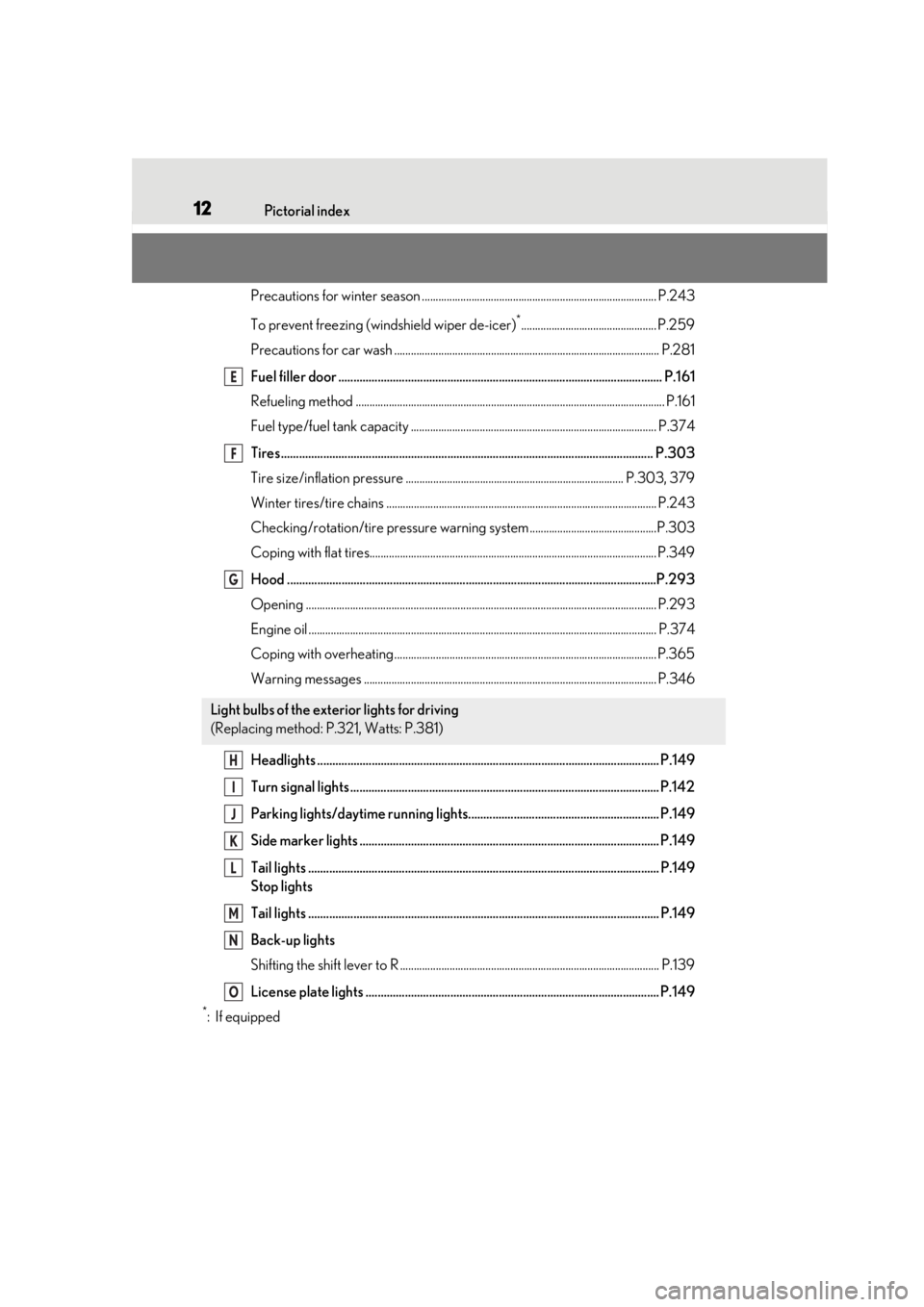
12Pictorial index
Precautions for winter season ..................................................................................... P.243
To prevent freezing (windshield wiper de-icer)
*................................................. P.259
Precautions for car wash ................................................................................................ P.281
Fuel filler door ........................................................................................................... P.16 1
Refueling method ............................................................................................................... .P.161
Fuel type/fuel tank capacity ...... ................................................................................... P.374
Tires.......................................................................................................................... .P.303
Tire size/inflation pressure ............................................................................... P.303, 379
Winter tires/tire chains .................................................................................................. P.243
Checking/rotation/tire pressure warning system..............................................P.303
Coping with flat tires........................................................................................................ P .349
Hood ..........................................................................................................................P.293
Opening ........................................................................................................................ ....... P.293
Engine oil ..................................................................................................................... ......... P.374
Coping with overheating ............................................................................................... P.365
Warning messages .......................................................................................................... P.346
Headlights ................................................................................................................. P.14 9
Turn signal lights ...................................................................................................... P.142
Parking lights/daytime running lights............................................................... P.149
Side marker lights ................................................................................................... P.149
Tail lights .................................................................................................................... P.149
Stop lights
Tail lights .................................................................................................................... P.149
Back-up lights
Shifting the shift lever to R .............................................................................................. P.13 9
License plate lights ................................................................................................. P.149
*:If equipped
Light bulbs of the exterior lights for driving
(Replacing method: P.321, Watts: P.381)
E
F
G
H
I
J
K
L
M
N
O
Page 28 of 436
281-1. For safe use
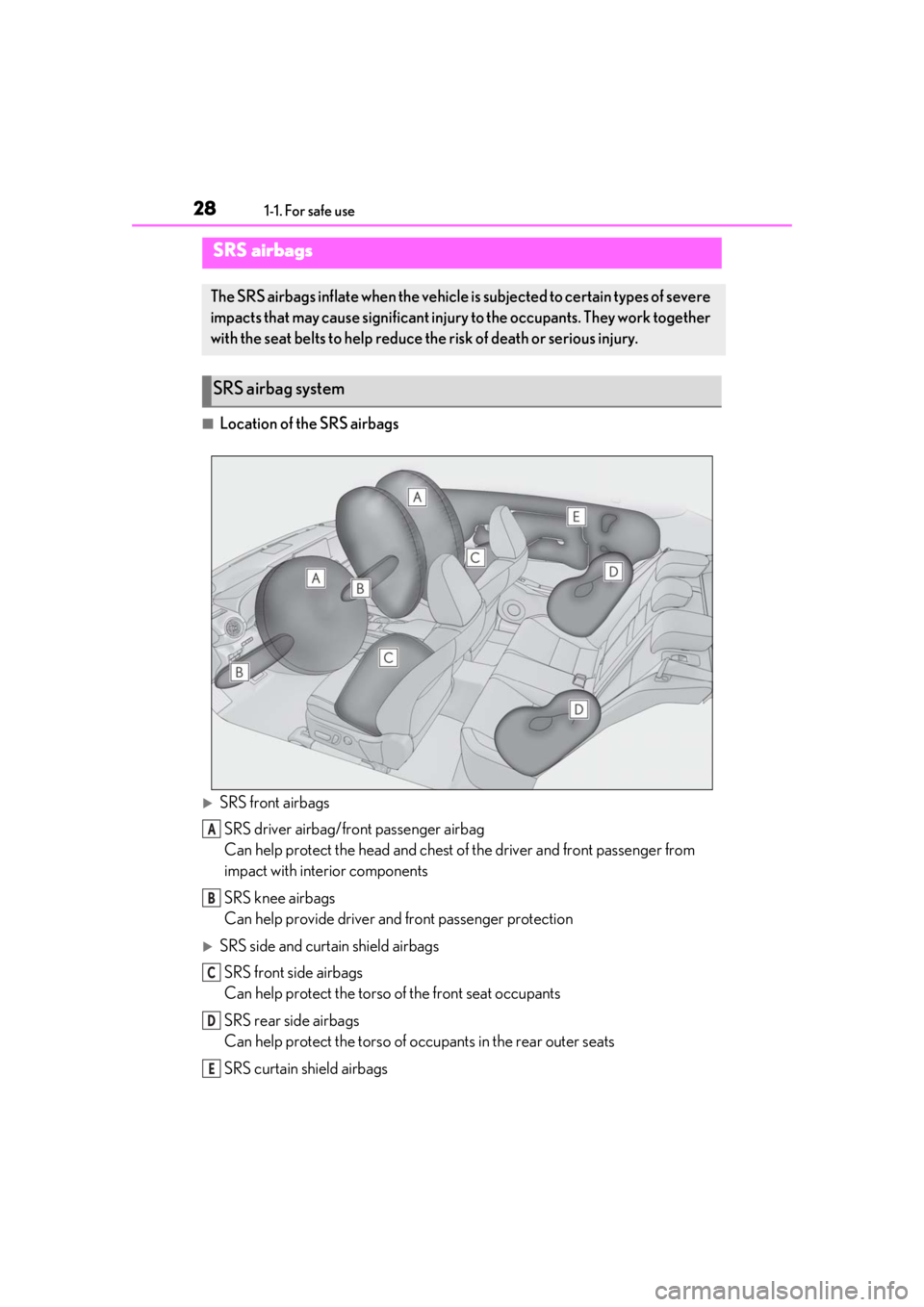
■Location of the SRS airbags
SRS front airbagsSRS driver airbag/front passenger airbag
Can help protect the head and chest of the driver and front passenger from
impact with interior components
SRS knee airbags
Can help provide driver and front passenger protection
SRS side and curtain shield airbags
SRS front side airbags
Can help protect the torso of the front seat occupants
SRS rear side airbags
Can help protect the torso of o ccupants in the rear outer seats
SRS curtain shield airbags
SRS airbags
The SRS airbags inflate when the vehicle is subjected to certain types of severe
impacts that may cause significant injury to the occupants. They work together
with the seat belts to help reduce the risk of death or serious injury.
SRS airbag system
A
B
C
D
E
Page 30 of 436

301-1. For safe use
Your vehicle is equipped with ADVANCED AIRBAGS designed based on the US
motor vehicle safety standards (FMVSS208). The airbag sensor assembly (ECU)
controls airbag deployment based on information obtained from the sensors etc.
shown in the system components diagram above. This information includes crash
severity and occupant information. As the airbags deploy, a chemical reaction in
the inflators quickly fills the airbags with no n-toxic gas to help restrain the motion of
the occupants.
■If the SRS airbags deploy (inflate)
●Slight abrasions, burns, bruising etc., may
be sustained from SRS airbags, due to the
extremely high speed deployment (infla-
tion) by hot gases.
●A loud noise and white powder will be
emitted.
●Parts of the airbag module (steering
wheel hub, airbag cover and inflator) as
well as the seats, parts of the front and
rear pillars, and roof side rails may be hot
for several minutes. The airbag itself may
also be hot.
●The windshield may crack.
●All of the doors will be unlocked.
( P.93)
●The brakes and stop lights will be con-
trolled automatically. ( P.239)
●The interior lights will turn on automati-
cally. ( P.264)
●The emergency flashers will turn on auto-
matically. ( P.328)
●Fuel supply to the engine will be stopped.
( P.336)
●For Lexus Enform Safety Connect sub-
scribers, if any of the following situations
occur, the system is designed to send an
emergency call to the response center,
notifying them of the vehicle’s location
(without needing to push the “SOS” but-
ton) and an agent will attempt to speak
with the occupants to ascertain the level
of emergency and assi stance required. If
the occupants are unable to communi-
cate, the agent automatically treats the
call as an emergency and helps to dis-
patch the necessary emergency services.
( P.54)
• An SRS airbag is deployed. • A seat belt pretensioner is activated.
• The vehicle is involved in a severe
rear-end collision.
■SRS airbag deployment conditions (SRS
front airbags)
●The SRS front airbags will deploy in the
event of an impact that exceeds the set
threshold level (the level of force corre-
sponding to an approximately 12 - 18
mph [20 - 30 km/h] frontal collision with
a fixed wall that does not move or
deform).
However, this threshol d velocity will be
considerably higher in the following situa-
tions:
• If the vehicle strikes an object, such as a parked vehicle or sign pole, which can
move or deform on impact
• If the vehicle is involved in an underride collision, such as a collision in which the
front of the vehicle “underrides”, or goes
under, the bed of a truck
●Depending on the type of collision, it is
possible that only the seat belt preten-
sioners will activate.
●The SRS front airbags for the front pas-
senger will not activate if there is no pas-
senger sitting in the front passenger seat.
However, the SRS front airbags for the
front passenger may deploy if luggage is
put in the seat, even if the seat is unoccu-
pied.
■SRS airbag deployment conditions (SRS
side and curtain shield airbags)
●The SRS side and curtain shield airbags
will deploy in the event of an impact that
exceeds the set threshold level (the level
of force corresponding to the impact
force produced by an approximately
3300 lb. [1500 kg] vehicle colliding with
Page 31 of 436
![LEXUS IS300 2021 Owners Manual 311-1. For safe use
1
For safety and security
the vehicle cabin from a direction per-
pendicular to the vehicle orientation at an
approximate speed of 12 - 18 mph [20 -
30 km/h]).
●Both SRS curtai](/img/36/58922/w960_58922-30.png "LEXUS IS300 2021 Owners Manual 311-1. For safe use
1
For safety and security
the vehicle cabin from a direction per-
pendicular to the vehicle orientation at an
approximate speed of 12 - 18 mph [20 -
30 km/h]).
●Both SRS curtai")
311-1. For safe use
1
For safety and security
the vehicle cabin from a direction per-
pendicular to the vehicle orientation at an
approximate speed of 12 - 18 mph [20 -
30 km/h]).
●Both SRS curtain shield airbags may
deploy in the event of a severe side colli-
sion.
●Both SRS curtain shield airbags will
deploy in the event of vehicle rollover.
●Both SRS curtain shield airbags will
deploy in the event of a severe frontal col-
lision.
■Conditions under which the SRS air-
bags may deploy (inf late), other than a
collision
The SRS front airbags and SRS curtain
shield airbags may also deploy if a serious
impact occurs to the underside of your
vehicle. Some examples are shown in the
illustration.
●Hitting a curb, edge of pavement or hard
surface
●Falling into or jumping over a deep hole
●Landing hard or falling
The SRS curtain shield airbags may also
deploy under the situations shown in the
illustration.
●The angle of vehicle tip-up is marginal.
●The vehicle skids and hits a curb stone.
■Types of collisions that may not deploy
the SRS airbags (SRS front airbags)
The SRS front airbags do not generally
inflate if the vehicle is involved in a side or
rear collision, if it rolls over, or if it is involved
in a low-speed frontal collision. But, when-
ever a collision of any type causes sufficient
forward deceleration of the vehicle, deploy-
ment of the SRS fron t airbags may occur.
●Collision from the side
●Collision from the rear
●Vehicle rollover
■Types of collisions that may not deploy
the SRS airbags (SRS side and curtain
shield airbags)
The SRS side and curtain shield airbags
may not activate if the vehicle is subjected
to a collision from the side at certain angles,
or a collision to the side of the vehicle body
other than the passenger compartment.
●Collision from the side to the vehicle
body other than the passenger compart-
ment
●Collision from the side at an angle
The SRS side airbags do not generally
inflate if the vehicle is involved in a frontal or
rear collision, if it rolls over, or if it is involved
in a low-speed side collision.
●Collision from the front
●Collision from the rear
●Vehicle rollover
Page 32 of 436
321-1. For safe use
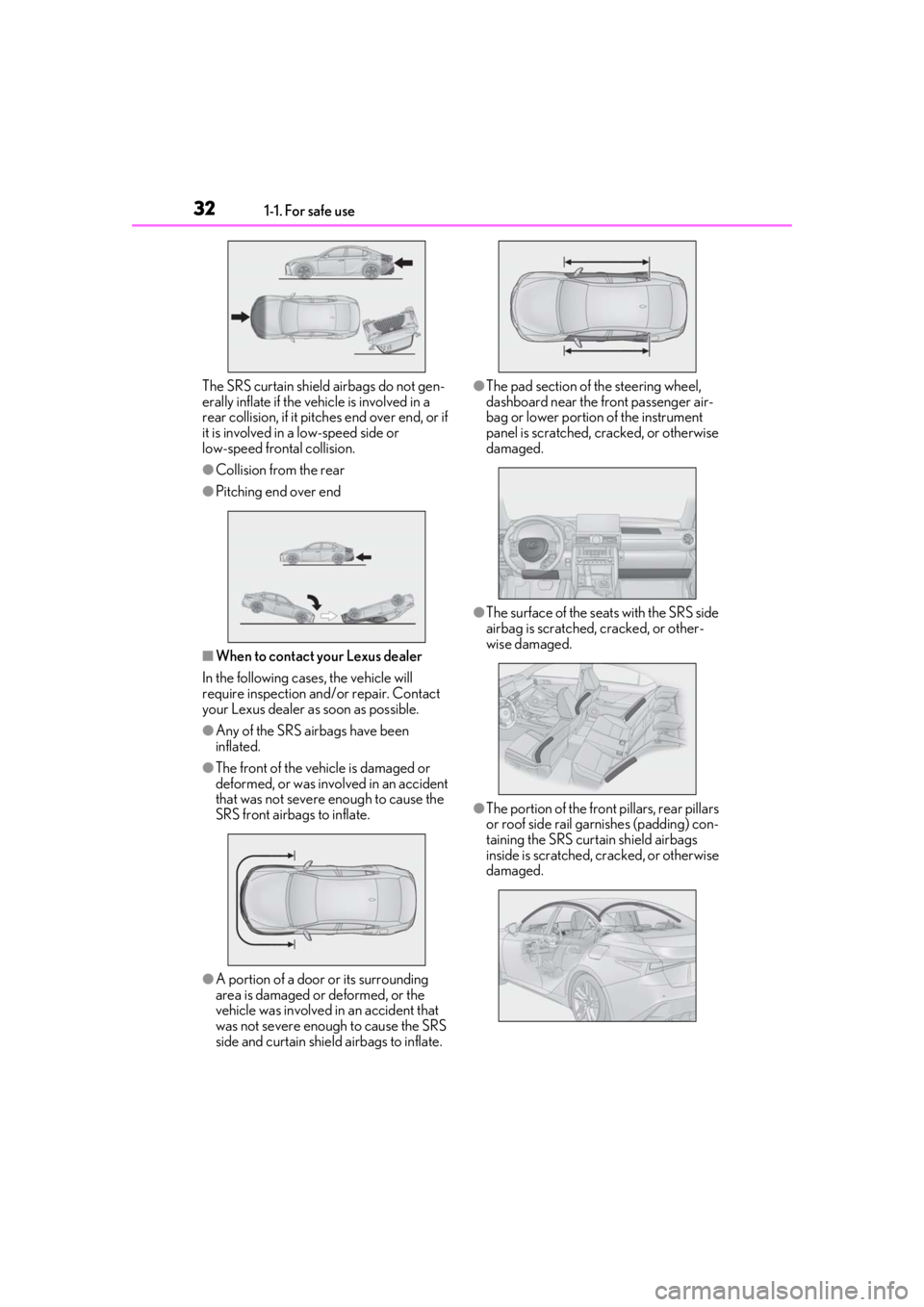
The SRS curtain shield airbags do not gen-
erally inflate if the vehicle is involved in a
rear collision, if it pitches end over end, or if
it is involved in a low-speed side or
low-speed frontal collision.
●Collision from the rear
●Pitching end over end
■When to contact your Lexus dealer
In the following cases, the vehicle will
require inspection and/or repair. Contact
your Lexus dealer as soon as possible.
●Any of the SRS airbags have been
inflated.
●The front of the vehicle is damaged or
deformed, or was involved in an accident
that was not severe enough to cause the
SRS front airbags to inflate.
●A portion of a door or its surrounding
area is damaged or deformed, or the
vehicle was involved in an accident that
was not severe enough to cause the SRS
side and curtain shield airbags to inflate.
●The pad section of the steering wheel,
dashboard near the front passenger air-
bag or lower portion of the instrument
panel is scratched, cracked, or otherwise
damaged.
●The surface of the seats with the SRS side
airbag is scratched, cracked, or other-
wise damaged.
●The portion of the front pillars, rear pillars
or roof side rail ga rnishes (padding) con-
taining the SRS curtain shield airbags
inside is scratched, cracked, or otherwise
damaged.
Page 33 of 436
331-1. For safe use
1
For safety and security
WARNING
■SRS airbag precautions
Observe the following precautions
regarding the SRS airbags.
Failure to do so may cause death or seri-
ous injury.
●The driver and all passengers in the
vehicle must wear their seat belts
properly.
The SRS airbags are supplemental
devices to be used with the seat belts.
●The SRS driver airbag deploys with
considerable force, and can cause
death or serious injury especially if the
driver is very close to the airbag.
The National Highway Traffic Safety
Administration (NHT SA) advises: Since
the risk zone for the driver’s airbag is the
first 2 - 3 in. (50 - 75 mm) of inflation,
placing yourself 10 in. (250 mm) from
your driver airbag provides you with a
clear margin of safety. This distance is
measured from the center of the steering
wheel to your breastbone. If you sit less
than 10 in. (250 mm) away now, you can
change your driving position in several
ways:
• Move your seat to the rear as far as you can while still reaching the pedals
comfortably.
• Slightly recline the back of the seat. Although vehicle designs vary, many
drivers can achieve the 10 in. (250
mm) distance, even with the driver seat
all the way forward, simply by reclining
the back of the se at somewhat. If
reclining the back of your seat makes it
hard to see the road, raise yourself by
using a firm, non-slippery cushion, or
raise the seat if your vehicle has that
feature.
• If your steering wheel is adjustable, tilt it downward. This points the airbag
toward your chest instead of your head
and neck.
The seat should be adjusted as recom-
mended by NHTSA above, while still
maintaining control of the foot pedals,
steering wheel, and your view of the
instrument panel controls.
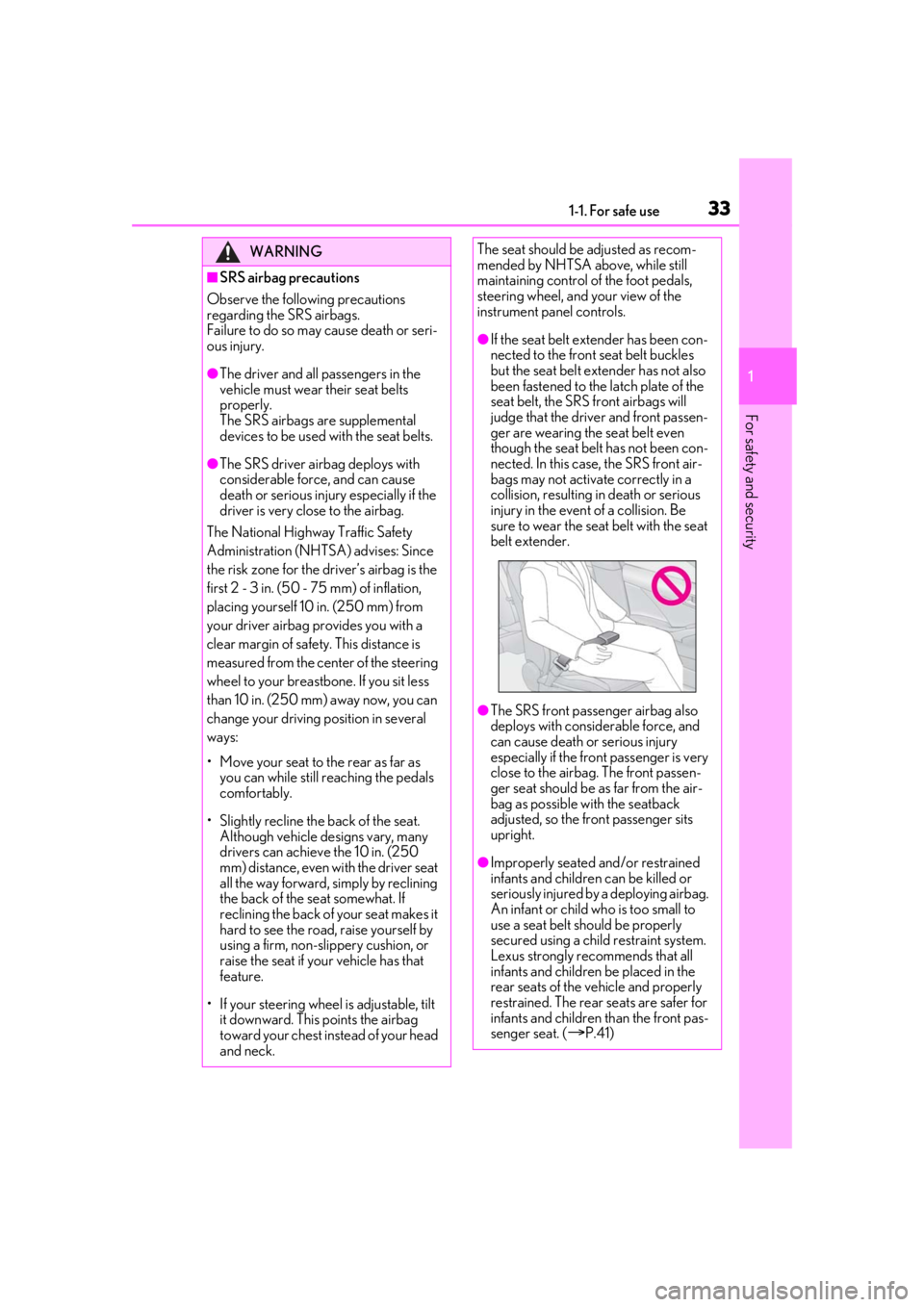
●If the seat belt extender has been con-
nected to the front seat belt buckles
but the seat belt extender has not also
been fastened to the latch plate of the
seat belt, the SRS front airbags will
judge that the driver and front passen-
ger are wearing the seat belt even
though the seat belt has not been con-
nected. In this case, the SRS front air-
bags may not activate correctly in a
collision, resulting in death or serious
injury in the event of a collision. Be
sure to wear the seat belt with the seat
belt extender.
●The SRS front passenger airbag also
deploys with considerable force, and
can cause death or serious injury
especially if the front passenger is very
close to the airbag. The front passen-
ger seat should be as far from the air-
bag as possible with the seatback
adjusted, so the front passenger sits
upright.
●Improperly seated and/or restrained
infants and children can be killed or
seriously injured by a deploying airbag.
An infant or child who is too small to
use a seat belt should be properly
secured using a child restraint system.
Lexus strongly recommends that all
infants and children be placed in the
rear seats of the vehicle and properly
restrained. The rear seats are safer for
infants and children than the front pas-
senger seat. (
P.41)
Page 35 of 436

351-1. For safe use
1
For safety and security
WARNING
●If a vinyl cover is put on the area where
the SRS knee airbag will deploy, be
sure to remove it.
●Do not use seat accessories which
cover the parts where the SRS side air-
bags inflate as they may interfere with
inflation of the SRS airbags. Such
accessories may prevent the side air-
bags from activating correctly, disable
the system or cause the side airbags to
inflate accidentally, resulting in death
or serious injury.
●Do not strike or apply significant levels
of force to the area of the SRS airbag
components. Doing so can cause the
SRS airbags to malfunction.
●Do not touch any of the component
parts immediately after the SRS air-
bags have deployed (inflated) as they
may be hot.
●If breathing becomes difficult after the
SRS airbags have deployed, open a
door or window to allow fresh air in, or
leave the vehicle if it is safe to do so.
Wash off any residue as soon as possi-
ble to prevent skin irritation.
●If the areas where the SRS airbags are
stored, such as the steering wheel pad
and front and rear pillar garnishes are
damaged or cracked, have them
replaced by your Lexus dealer.
●Do not place anything, such as a cush-
ion, on the front passenger’s seat.
Doing so will disperse the passenger’s
weight, which prevents the sensor
from detecting the passenger’s weight
properly. As a result, the SRS front air-
bags for the front passenger may not
deploy in the event of a collision.
■Modification and disposal of SRS air-
bag system components
Do not dispose of your vehicle or per-
form any of the following modifications
without consulting your Lexus dealer.
The SRS airbags may malfunction or
deploy (inflate) accidentally, causing
death or serious injury.
●Installation, remova l, disassembly and
repair of the SRS airbags
●Repairs, modifications, removal or
replacement of the steering wheel,
instrument panel, dashboard, seats or
seat upholstery, front, side and rear pil-
lars or roof side rails
●Repairs or modifications of the front
fender, front bumper, or side of the
occupant compartment
●Installation of a grille guard (bull bars,
kangaroo bar, etc. ), snow plows,
winches or roof luggage carrier
●Modifications to the vehicle’s suspen-
sion system
●Installation of elec tronic devices such
as mobile two-way radios and CD
players
●Modifications to your vehicle for a per-
son with a physical disability
Page 44 of 436
441-2. Child safety
remove the head restraint. Other-
wise, put the head restraint in the
upper most position.
WARNING
■When using a child restraint system
Observe the following precautions.
Failure to do so may result in death or
serious injury.
●Never install a re ar-facing child
restraint system on the front passenger
seat even if the “AIR BAG OFF” indi-
cator light is illuminated. In the event of
an accident, the force of the rapid infla-
tion of the front passenger airbag can
cause death or serious injury to the
child if the rear-facing child restraint
system is installed on the front passen-
ger seat.
●A forward-facing child restraint system
may be installed on the front passen-
ger seat only when it is unavoidable. A
child restraint system that requires a
top tether strap should not be used in
the front passenger seat since there is
no top tether strap anchor for the front
passenger seat.
●A forward-facing child restraint system
may be installed on the front passen-
ger seat only when it is unavoidable.
When installing a forward-facing child
restraint system on the front passenger
seat, adjust the seatback angle to the
most upright position, move the seat
fully rearward, and move the seat
height to the upper most position, even
if the “AIR BAG OFF” indicator light is
illuminated.
If the head restraint interferes with your
child restraint system, and the head
restraint can be re moved, remove the
head restraint. Othe rwise, put the head
restraint in the up per most position.
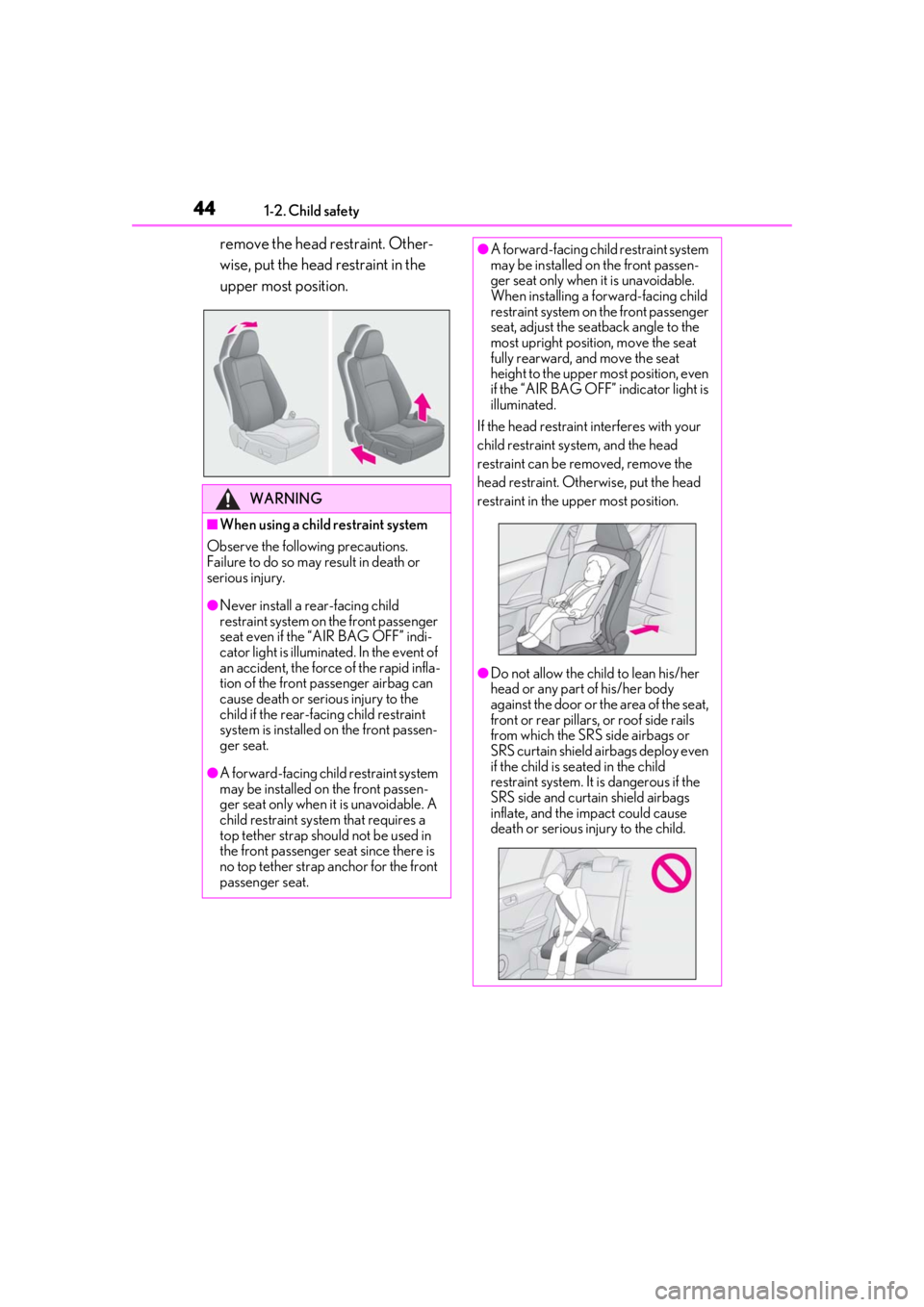
●Do not allow the child to lean his/her
head or any part of his/her body
against the door or th e area of the seat,
front or rear pillars, or roof side rails
from which the SRS side airbags or
SRS curtain shield airbags deploy even
if the child is seated in the child
restraint system. It is dangerous if the
SRS side and curtain shield airbags
inflate, and the impact could cause
death or serious injury to the child.