Child Lexus IS300h 2013 User Guide
[x] Cancel search | Manufacturer: LEXUS, Model Year: 2013, Model line: IS300h, Model: Lexus IS300h 2013Pages: 628, PDF Size: 20.23 MB
Page 54 of 628
541-1. For safe use
IS300h_EE(OM53B95E)
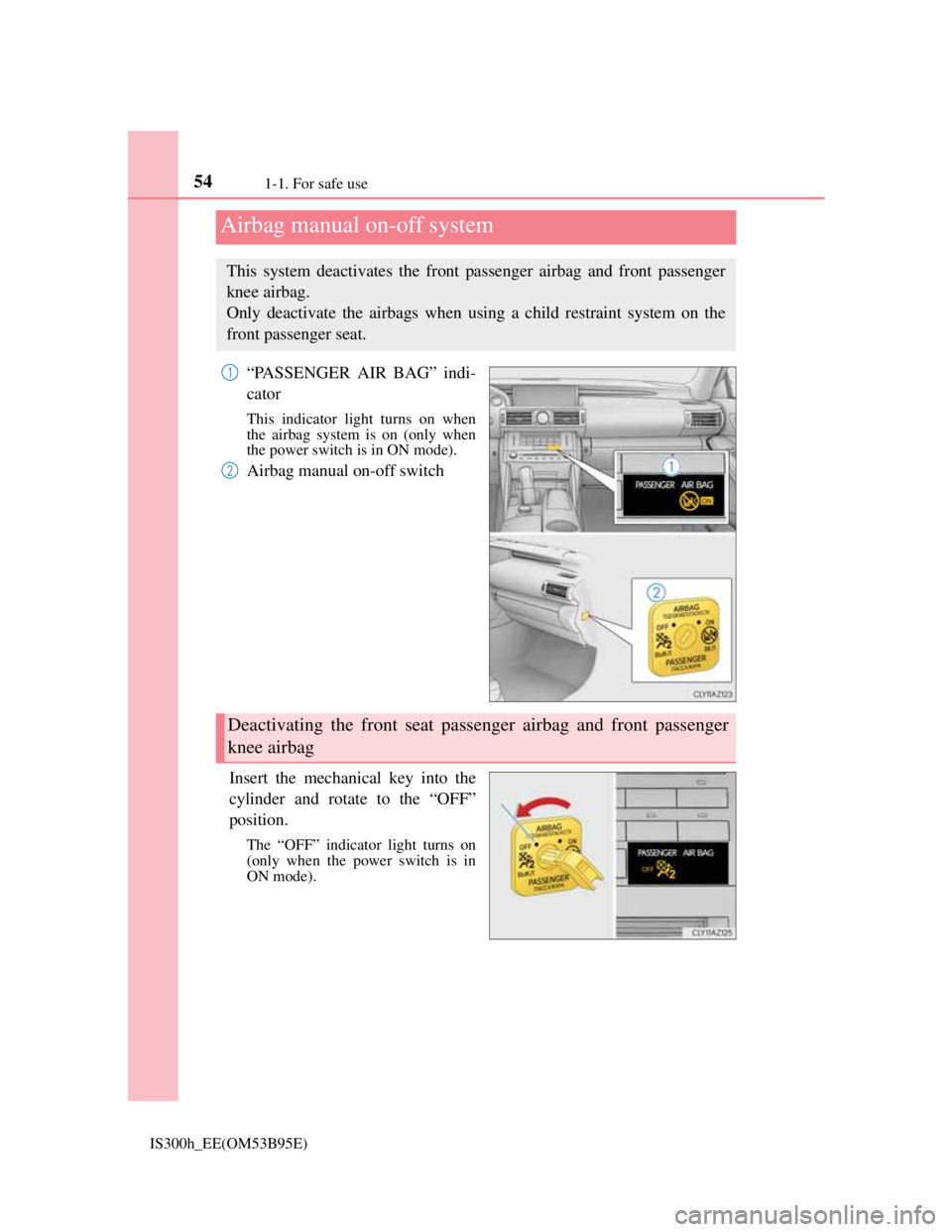
“PASSENGER AIR BAG” indi-
cator
This indicator light turns on when
the airbag system is on (only when
the power switch is in ON mode).
Airbag manual on-off switch
Insert the mechanical key into the
cylinder and rotate to the “OFF”
position.
The “OFF” indicator light turns on
(only when the power switch is in
ON mode).
Airbag manual on-off system
This system deactivates the front passenger airbag and front passenger
knee airbag.
Only deactivate the airbags when using a child restraint system on the
front passenger seat.
1
2
Deactivating the front seat passenger airbag and front passenger
knee airbag
Page 55 of 628
551-1. For safe use
1
For safety and security
IS300h_EE(OM53B95E)
“PASSENGER AIR BAG” indicator information
If any of the following problems occur, it is possible that there is a malfunction in
the system. Have the vehicle inspected by any authorized Lexus dealer or
repairer, or another duly qualified and equipped professional.
Neither “ON” nor “OFF” comes on.
The indicator light does not change when the airbag manual on-off switch is
switched to “ON” or “OFF”.
CAUTION
When installing a child restraint system
For safety reasons, always install a child restraint system in a rear seat. In the
event that the rear seat cannot be used, the front seat can be used as long as the
airbag manual on-off system is set to off.
If the airbag manual on-off system is left on, the strong impact of the airbag
deployment (inflation) may cause serious injury or even death.
When a child restraint system is not installed on the front passenger seat
Ensure that the airbag manual on-off system is set to on.
If it is left off, the airbag may not deploy in the event of an accident, which may
result in serious injury or even death.
Page 60 of 628
601-1. For safe use
IS300h_EE(OM53B95E)
It is recommended that children sit in the rear seats to avoid accidental
contact with the shift lever, wiper switch etc.
Use the rear door child-protector lock or the window lock switch to
avoid children opening the door while driving or operating the power
window accidentally.
Do not let small children operate equipment which may catch or pinch
body parts, such as the power window, hood, trunk, seats etc.
Safety information for children
Observe the following precautions when children are in the vehicle.
Use a child restraint system appropriate for the child, until the child
becomes large enough to properly wear the vehicle’s seat belt.
CAUTION
Never leave children unattended in the vehicle, and never allow children to
have or use the key.
Children may be able to start the vehicle or shift the vehicle into neutral. There
is also a danger that children may injure themselves by playing with the win-
dows, the moon roof or other features of the vehicle. In addition, heat build-up
or extremely cold temperatures inside the vehicle can be fatal to children.
Page 61 of 628
611-1. For safe use
1
For safety and security
IS300h_EE(OM53B95E)
Studies have shown that installing a child restraint on a rear seat is much
safer than installing one on the front passenger seat.
Choose a child restraint system that suits your vehicle and is appropri-
ate to the age and size of the child.
For installation details, follow the instructions provided with the child
restraint system.
General installation instructions are provided in this manual. (P. 7 0 )
If child restraint system regulations exist in the country where you
reside, please contact any authorized Lexus dealer or repairer, or
another duly qualified and equipped professional for the child restraint
system installation.
Lexus recommends that you use a child restraint system which con-
forms to the regulation ECE No.44.
Child restraint systems
Lexus strongly urges the use of child restraint systems.
Points to remember
Page 62 of 628
621-1. For safe use
IS300h_EE(OM53B95E)
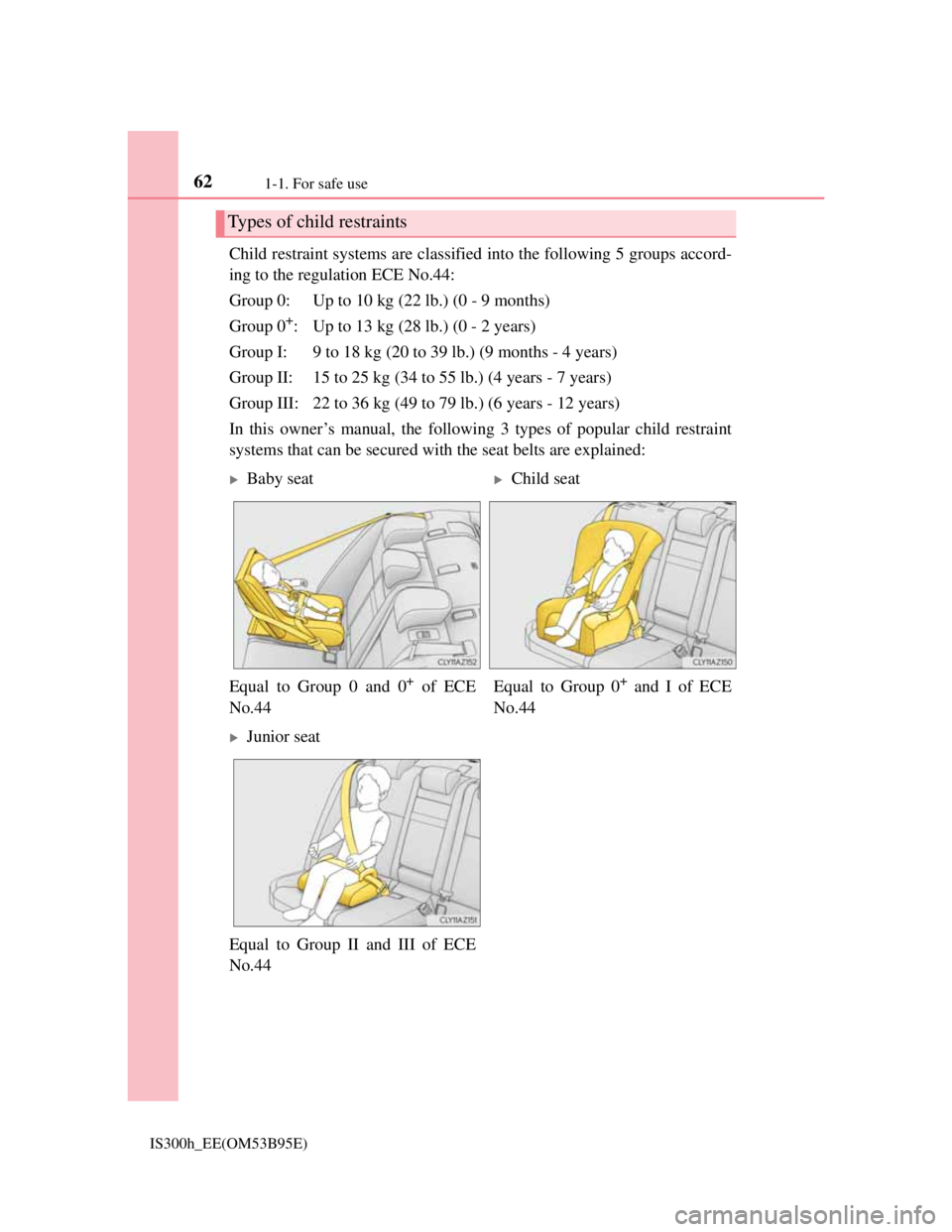
Child restraint systems are classified into the following 5 groups accord-
ing to the regulation ECE No.44:
Group 0: Up to 10 kg (22 lb.) (0 - 9 months)
Group 0
+: Up to 13 kg (28 lb.) (0 - 2 years)
Group I: 9 to 18 kg (20 to 39 lb.) (9 months - 4 years)
Group II: 15 to 25 kg (34 to 55 lb.) (4 years - 7 years)
Group III: 22 to 36 kg (49 to 79 lb.) (6 years - 12 years)
In this owner’s manual, the following 3 types of popular child restraint
systems that can be secured with the seat belts are explained:
Types of child restraints
Baby seat Child seat
Equal to Group 0 and 0
+ of ECE
No.44Equal to Group 0+ and I of ECE
No.44
Junior seat
Equal to Group II and III of ECE
No.44
Page 63 of 628
631-1. For safe use
1
For safety and security
IS300h_EE(OM53B95E)
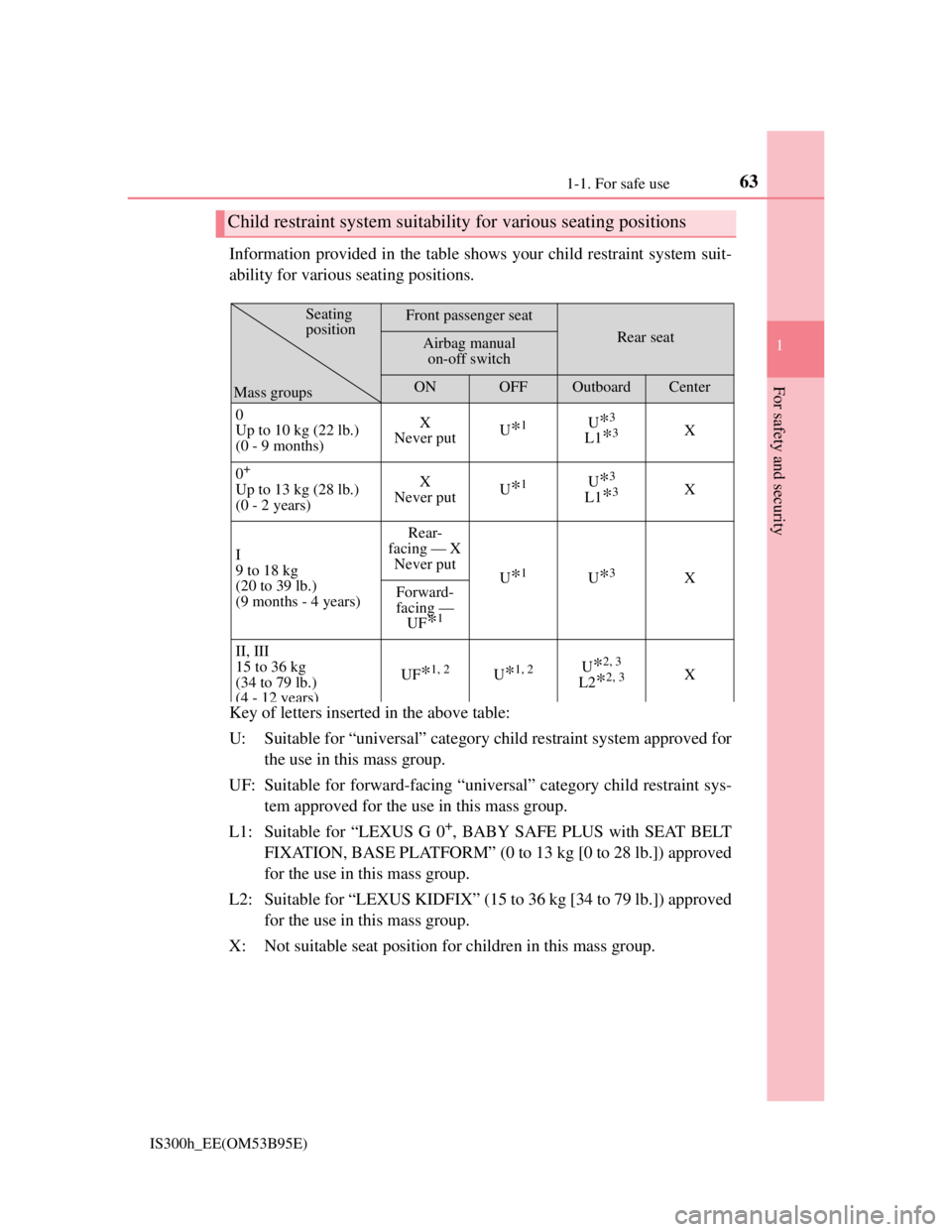
Information provided in the table shows your child restraint system suit-
ability for various seating positions.
Key of letters inserted in the above table:
U: Suitable for “universal” category child restraint system approved for
the use in this mass group.
UF: Suitable for forward-facing “universal” category child restraint sys-
tem approved for the use in this mass group.
L1: Suitable for “LEXUS G 0
+, BABY SAFE PLUS with SEAT BELT
FIXATION, BASE PLATFORM” (0 to 13 kg [0 to 28 lb.]) approved
for the use in this mass group.
L2: Suitable for “LEXUS KIDFIX” (15 to 36 kg [34 to 79 lb.]) approved
for the use in this mass group.
X: Not suitable seat position for children in this mass group.
Child restraint system suitability for various seating positions
Front passenger seat
Rear seatAirbag manual
on-off switch
ONOFFOutboardCenter
0
Up to 10 kg (22 lb.)
(0 - 9 months)X
Never putU
*1U*3
L1*3X
0
+
Up to 13 kg (28 lb.)
(0 - 2 years)X
Never putU*1U*3
L1*3X
I
9 to 18 kg
(20 to 39 lb.)
(9 months - 4 years)Rear-
facing — X
Never put
U
*1U*3X
Forward-
facing —
UF
*1
II, III
15 to 36 kg
(34 to 79 lb.)
(4 - 12 years)UF
*1, 2U*1, 2U*2, 3
L2*2, 3X
Mass groups
Seating
position
Page 64 of 628
641-1. For safe use
IS300h_EE(OM53B95E)NOTE:
*1: Adjust the front seatback to the most upright position. Move the front seat
cushion to the fully rearward.
Adjust the seat cushion to the highest position. When the child restraint sys-
tem touched the ceiling, lower the seat position.
Follow these procedures
• For installing a baby seat with support base
If the baby seat interferes with the seatback when latching the baby seat
into the support base, adjust the seatback rearward until there is no interfer-
ence.
• For installing a forward-facing child seat
If there is gap between the child seat and the seatback, tilt the seatback rear-
ward until good contact is achieved.
If the seatbelt shoulder anchor is ahead of the child seat belt guide, move
the seat cushion forward.
• For installing a junior seat
If the child in your child restraint system is in a very upright position,
adjust the seatback to the most comfortable position.
If the seat belt shoulder anchor is ahead of the child seat belt guide, move
the seat cushion forward.
*2: Remove the head restraint if it interferes with your child restraint system.
*3: When using the left side seat for the child restraint system, do not sit in the
center seat.
The child restraint system mentioned in the table may not be available
outside of the EU area.
Other child restraint systems which are different from the systems men-
tioned in the table can be used, but the suitability of the systems must be
carefully checked with the child restraint system manufacturer and
retailer.
Page 65 of 628
651-1. For safe use
1
For safety and security
IS300h_EE(OM53B95E)
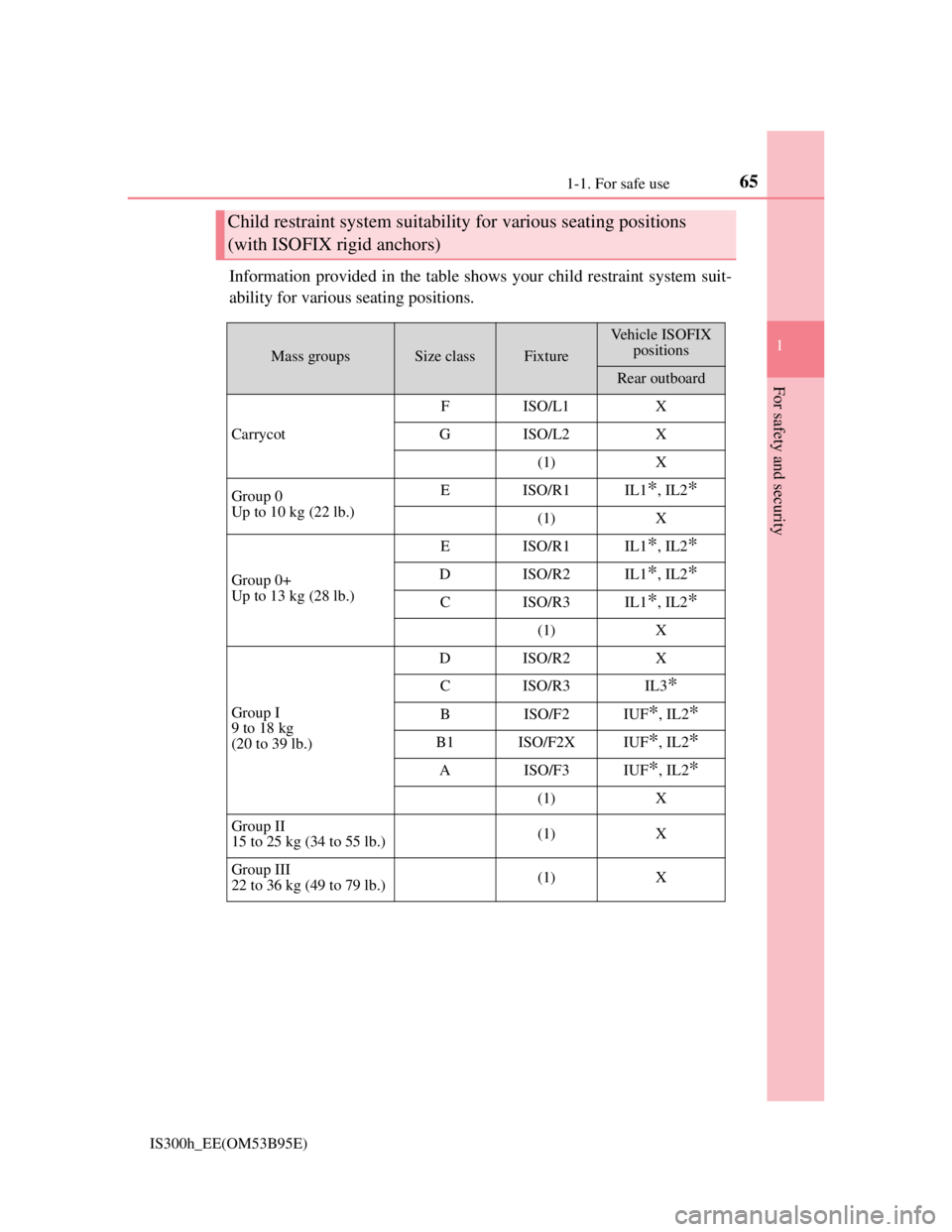
Information provided in the table shows your child restraint system suit-
ability for various seating positions.
Child restraint system suitability for various seating positions
(with ISOFIX rigid anchors)
Mass groupsSize classFixture
Vehicle ISOFIX
positions
Rear outboard
CarrycotFISO/L1 X
GISO/L2 X
(1) X
Group 0
Up to 10 kg (22 lb.)EISO/R1IL1
*, IL2*
(1) X
Group 0+
Up to 13 kg (28 lb.)EISO/R1IL1
*, IL2*
DISO/R2IL1*, IL2*
CISO/R3IL1*, IL2*
(1) X
Group I
9 to 18 kg
(20 to 39 lb.)DISO/R2 X
CISO/R3 IL3
*
BISO/F2IUF*, IL2*
B1 ISO/F2X IUF*, IL2*
AISO/F3IUF*, IL2*
(1) X
Group II
15 to 25 kg (34 to 55 lb.)(1) X
Group III
22 to 36 kg (49 to 79 lb.)(1) X
Page 66 of 628
661-1. For safe use
IS300h_EE(OM53B95E)
(1) For the child restraint system which do not carry the ISO/XX size
class identification (A to G), for the applicable mass group, the car
manufacturer shall indicate the vehicle specific ISOFIX child
restraint system(s) recommended for each position.
Key of letters inserted in the above table:
IUF: Suitable for ISOFIX forward-facing child restraint systems of uni-
versal category approved for use in this mass group.
IL1: Suitable for “LEXUS MINI” (0 to 13 kg [0 to 28 lb.]) approved for
the use in this mass group.
IL2: Suitable for “LEXUS MIDI” (0 to 18 kg [0 to 39 lb.]) approved for
the use in this mass group.
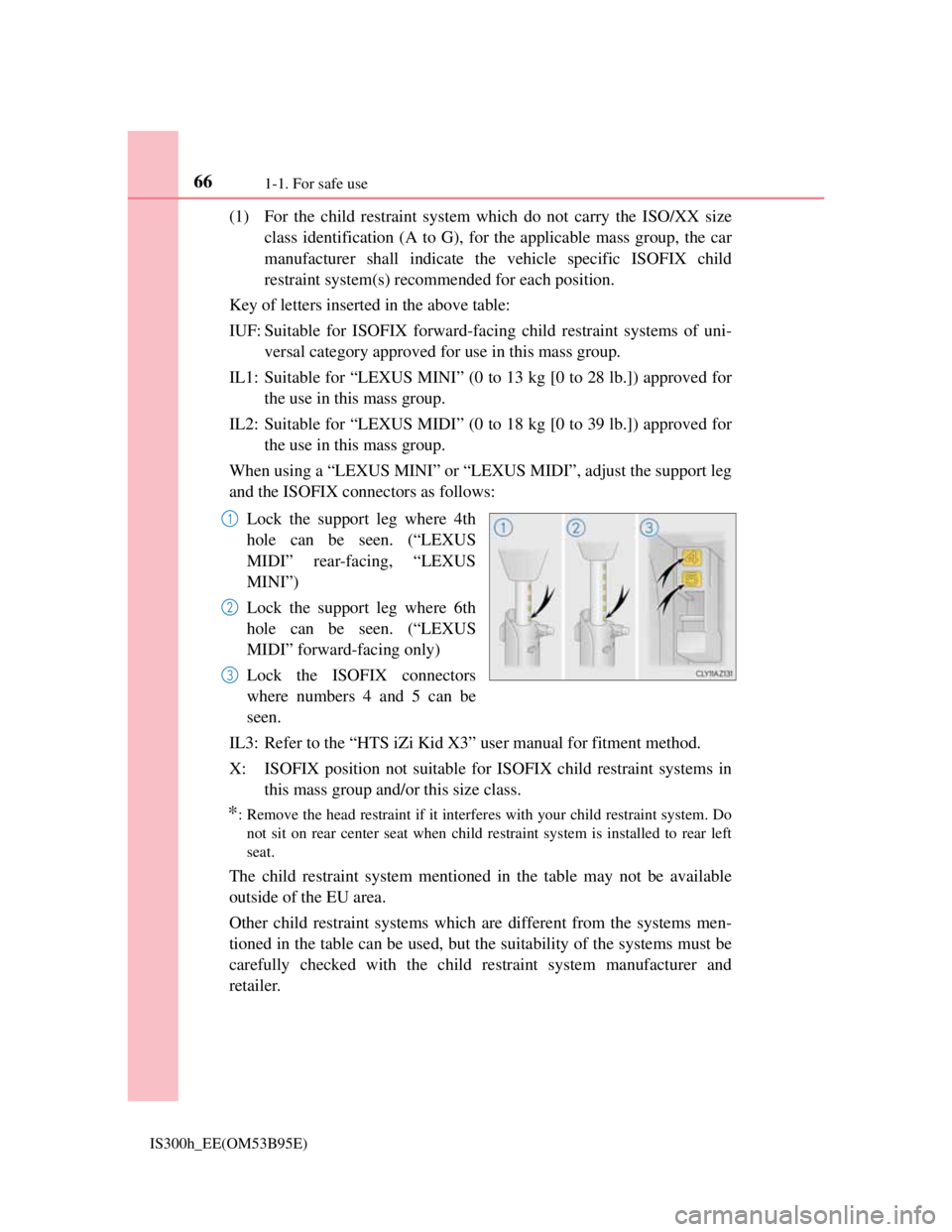
When using a “LEXUS MINI” or “LEXUS MIDI”, adjust the support leg
and the ISOFIX connectors as follows:
Lock the support leg where 4th
hole can be seen. (“LEXUS
MIDI” rear-facing, “LEXUS
MINI”)
Lock the support leg where 6th
hole can be seen. (“LEXUS
MIDI” forward-facing only)
Lock the ISOFIX connectors
where numbers 4 and 5 can be
seen.
IL3: Refer to the “HTS iZi Kid X3” user manual for fitment method.
X: ISOFIX position not suitable for ISOFIX child restraint systems in
this mass group and/or this size class.
*: Remove the head restraint if it interferes with your child restraint system. Do
not sit on rear center seat when child restraint system is installed to rear left
seat.
The child restraint system mentioned in the table may not be available
outside of the EU area.
Other child restraint systems which are different from the systems men-
tioned in the table can be used, but the suitability of the systems must be
carefully checked with the child restraint system manufacturer and
retailer.
1
2
3
Page 67 of 628
671-1. For safe use
1
For safety and security
IS300h_EE(OM53B95E)
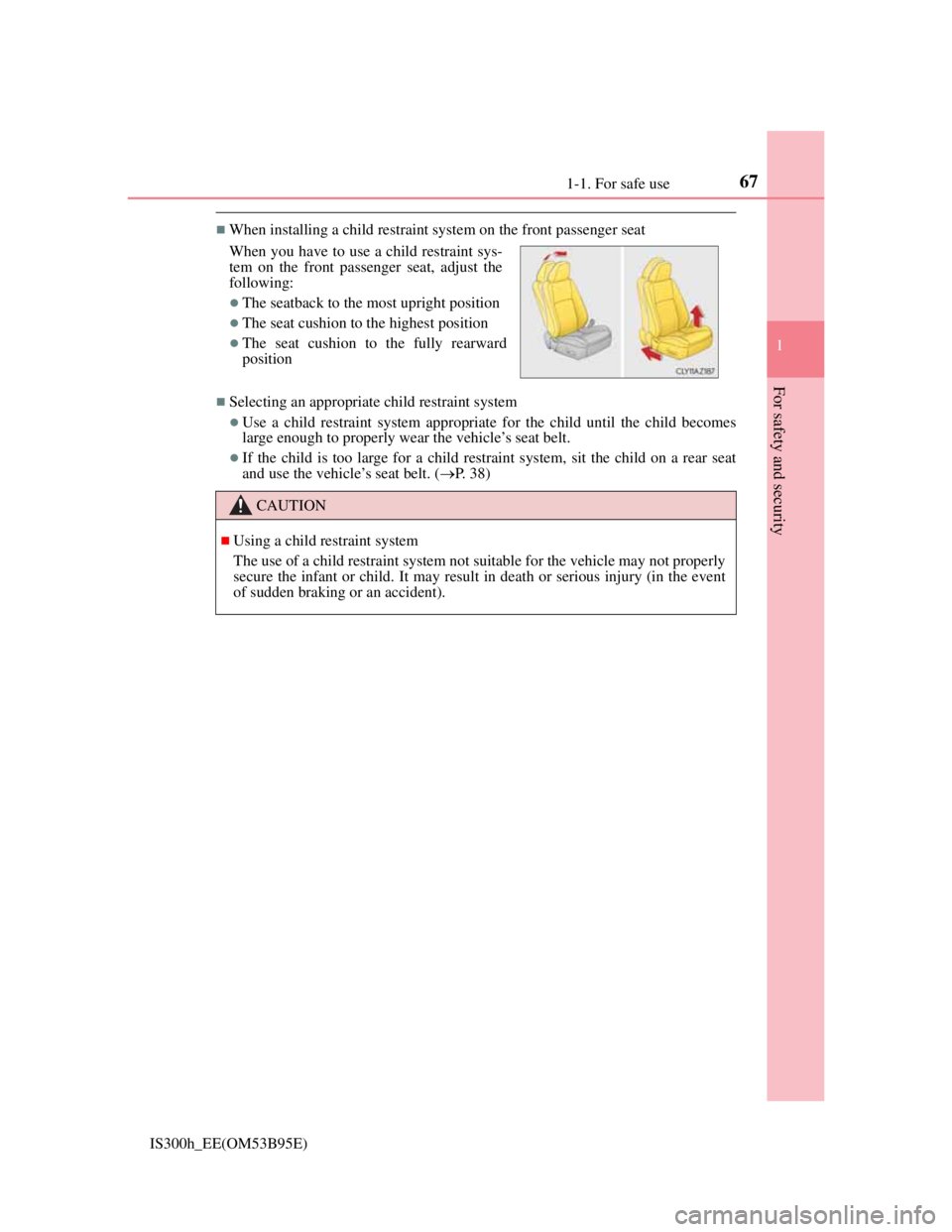
When installing a child restraint system on the front passenger seat
Selecting an appropriate child restraint system
Use a child restraint system appropriate for the child until the child becomes
large enough to properly wear the vehicle’s seat belt.
If the child is too large for a child restraint system, sit the child on a rear seat
and use the vehicle’s seat belt. (P. 38) When you have to use a child restraint sys-
tem on the front passenger seat, adjust the
following:
The seatback to the most upright position
The seat cushion to the highest position
The seat cushion to the fully rearward
position
CAUTION
Using a child restraint system
The use of a child restraint system not suitable for the vehicle may not properly
secure the infant or child. It may result in death or serious injury (in the event
of sudden braking or an accident).