warning light Lexus IS300h 2013 User Guide
[x] Cancel search | Manufacturer: LEXUS, Model Year: 2013, Model line: IS300h, Model: Lexus IS300h 2013Pages: 628, PDF Size: 20.23 MB
Page 44 of 628
441-1. For safe use
IS300h_EE(OM53B95E)
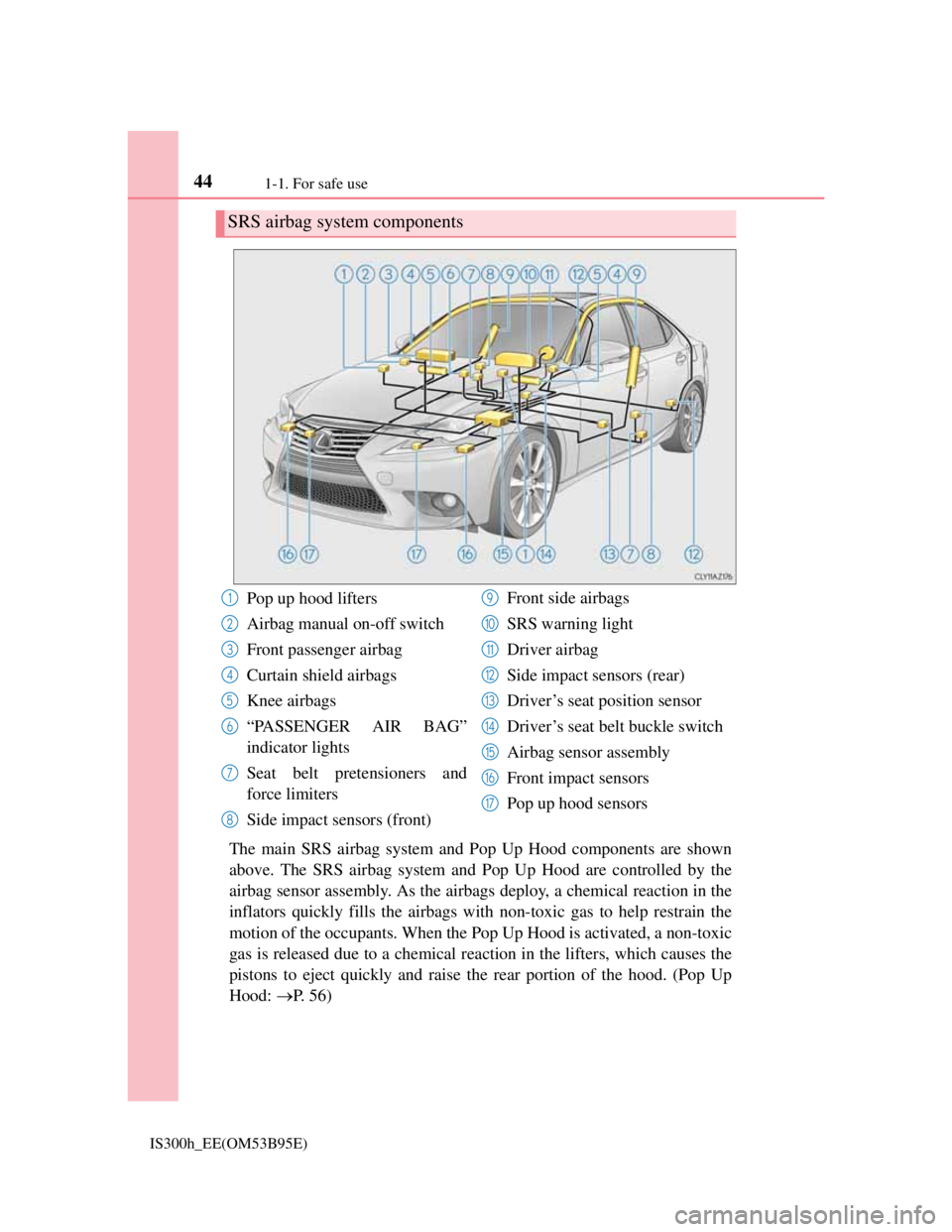
The main SRS airbag system and Pop Up Hood components are shown
above. The SRS airbag system and Pop Up Hood are controlled by the
airbag sensor assembly. As the airbags deploy, a chemical reaction in the
inflators quickly fills the airbags with non-toxic gas to help restrain the
motion of the occupants. When the Pop Up Hood is activated, a non-toxic
gas is released due to a chemical reaction in the lifters, which causes the
pistons to eject quickly and raise the rear portion of the hood. (Pop Up
Hood: P. 56)
SRS airbag system components
Pop up hood lifters
Airbag manual on-off switch
Front passenger airbag
Curtain shield airbags
Knee airbags
“PASSENGER AIR BAG”
indicator lights
Seat belt pretensioners and
force limiters
Side impact sensors (front)Front side airbags
SRS warning light
Driver airbag
Side impact sensors (rear)
Driver’s seat position sensor
Driver’s seat belt buckle switch
Airbag sensor assembly
Front impact sensors
Pop up hood sensors1
2
3
4
5
6
7
8
9
10
11
12
13
14
15
16
17
Page 86 of 628

851-2. Hybrid system
1
For safety and security
IS300h_EE(OM53B95E)
If a warning light comes on, a warning message is displayed, or the 12-volt bat-
tery is disconnected
The hybrid system may not start. In this case, try to start the system again. If the
“READY” indicator does not come on, contact any authorized Lexus dealer or
repairer, or another duly qualified and equipped professional.
Running out of fuel
When the vehicle has run out of fuel and the hybrid system cannot be started,
refuel the vehicle with at least enough gasoline to make the low fuel level warn-
ing light (P. 509) go off. If there is only a small amount of fuel, the hybrid sys-
tem may not be able to start. (The minimum amount of fuel to add to make the
low fuel level warning light go out is about 10 L [2.7 gal., 2.2 Imp. gal.], when
the vehicle is on a level surface. This value may vary when the vehicle is on a
slope.)
Electromagnetic waves
High voltage parts and cables on hybrid vehicles incorporate electromagnetic
shielding, and therefore emit approximately the same amount of electromag-
netic waves as conventional gasoline powered vehicles or home electronic
appliances.
Your vehicle may cause sound interference in some third party-produced radio
parts.
Hybrid battery (traction battery)
The hybrid battery (traction battery) has a limited service life. The lifespan of the
hybrid battery (traction battery) can change in accordance with driving style and
driving conditions.
Declaration of conformity
This model conforms to hydrogen emissions according to regulation ECE100
(Battery electric vehicle safety).
Page 104 of 628
103
2Instrument cluster
IS300h_EE(OM53B95E)
2. Instrument cluster
Warning lights and
indicators ........................ 104
Gauges and meters ............ 109
Multi-information display..115
Energy monitor/
consumption screen ........ 121
Page 105 of 628
104
IS300h_EE(OM53B95E)2. Instrument cluster
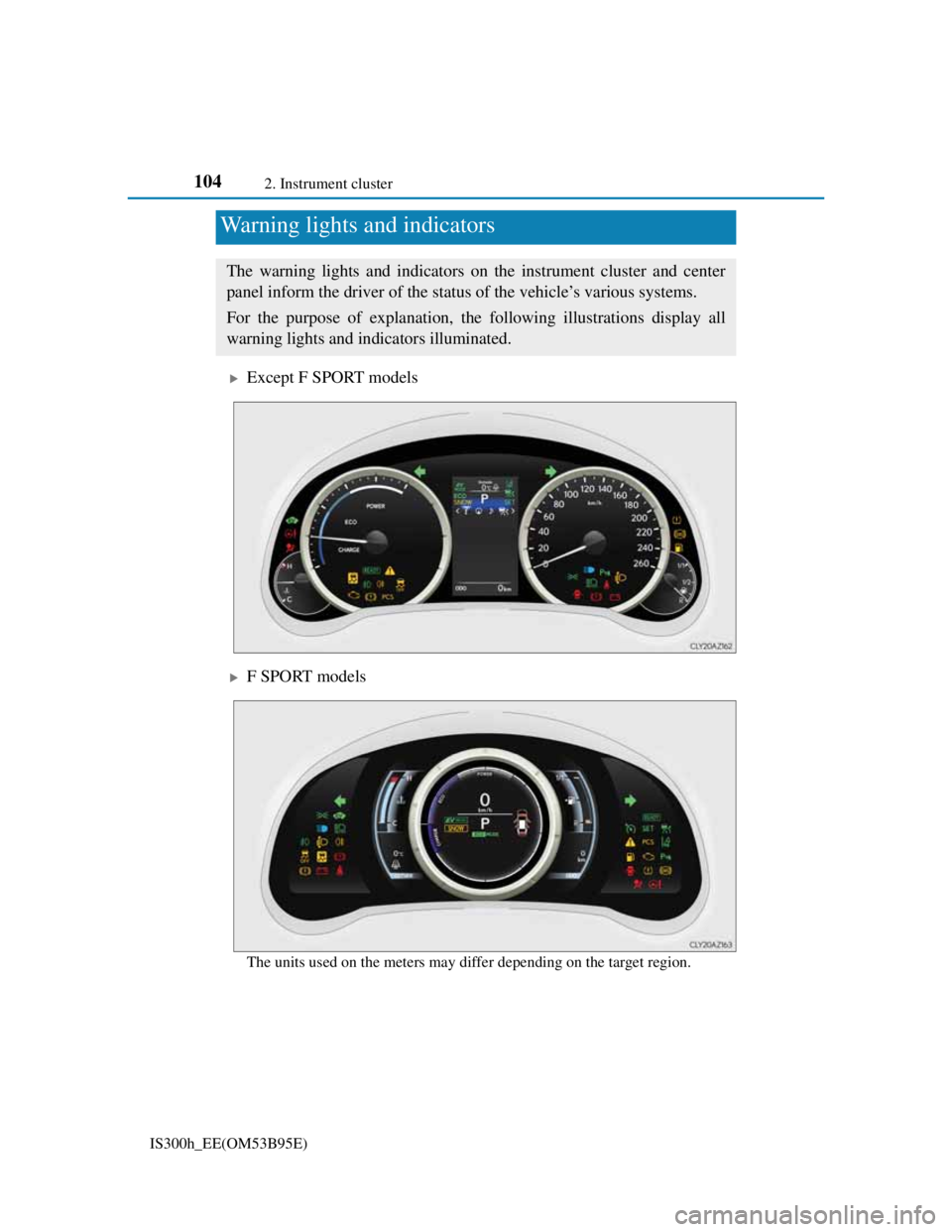
Except F SPORT models
F SPORT models
The units used on the meters may differ depending on the target region.
Warning lights and indicators
The warning lights and indicators on the instrument cluster and center
panel inform the driver of the status of the vehicle’s various systems.
For the purpose of explanation, the following illustrations display all
warning lights and indicators illuminated.
Page 106 of 628
1052. Instrument cluster
2
Instrument cluster
IS300h_EE(OM53B95E)
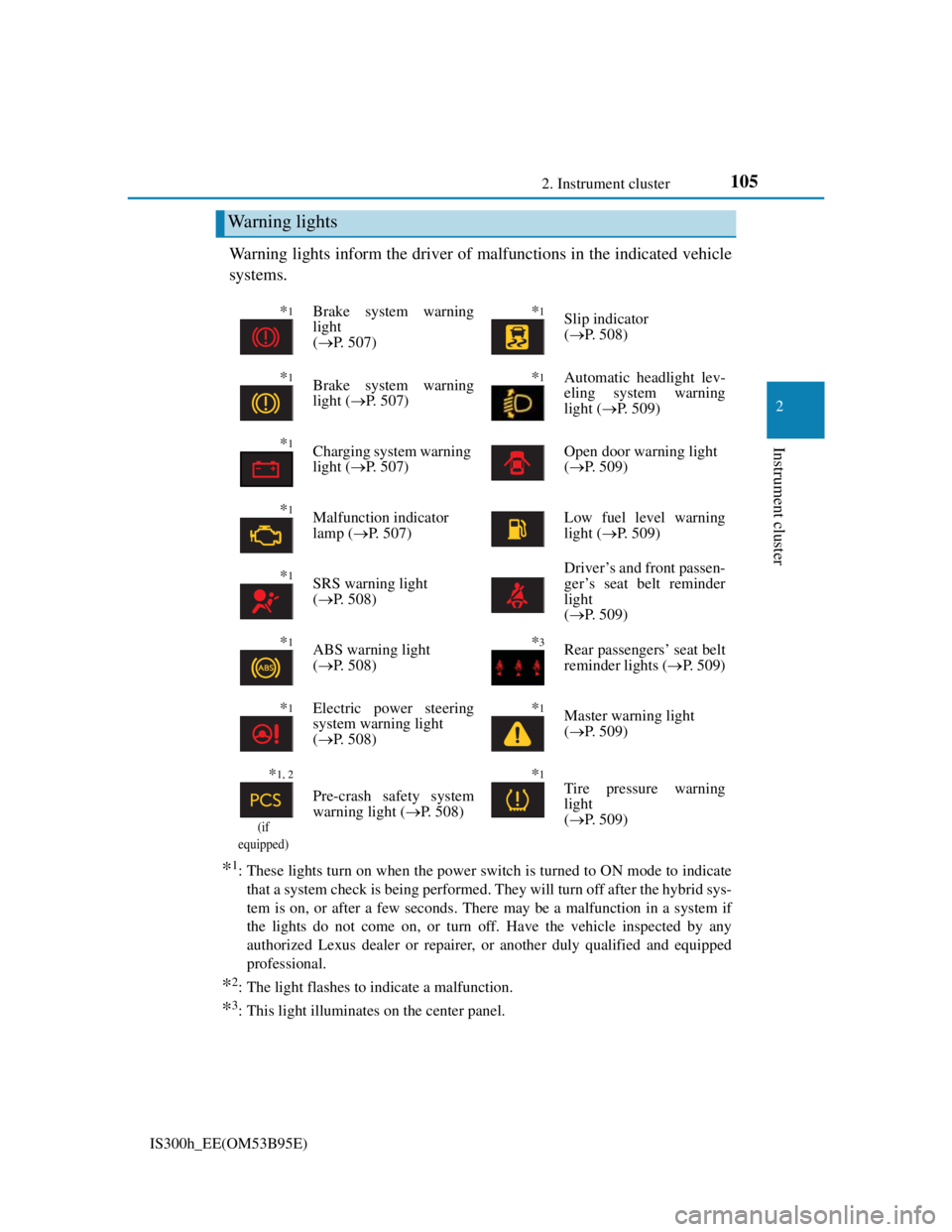
Warning lights inform the driver of malfunctions in the indicated vehicle
systems.
*1: These lights turn on when the power switch is turned to ON mode to indicate
that a system check is being performed. They will turn off after the hybrid sys-
tem is on, or after a few seconds. There may be a malfunction in a system if
the lights do not come on, or turn off. Have the vehicle inspected by any
authorized Lexus dealer or repairer, or another duly qualified and equipped
professional.
*2: The light flashes to indicate a malfunction.
*3: This light illuminates on the center panel.
Warning lights
*1Brake system warning
light
(P. 507)*1Slip indicator
(P. 508)
*1Brake system warning
light (P. 507)*1 Automatic headlight lev-
eling system warning
light (P. 509)
*1Charging system warning
light (P. 507)Open door warning light
(P. 509)
*1Malfunction indicator
lamp (P. 507)Low fuel level warning
light (P. 509)
*1SRS warning light
(P. 508)
Driver’s and front passen-
ger’s seat belt reminder
light
(P. 509)
*1ABS warning light
(P. 508)*3Rear passengers’ seat belt
reminder lights (P. 509)
*1Electric power steering
system warning light
(P. 508)*1Master warning light
(P. 509)
*1, 2
(if
equipped)
Pre-crash safety system
warning light (P. 508)
*1Tire pressure warning
light
(P. 509)
Page 107 of 628
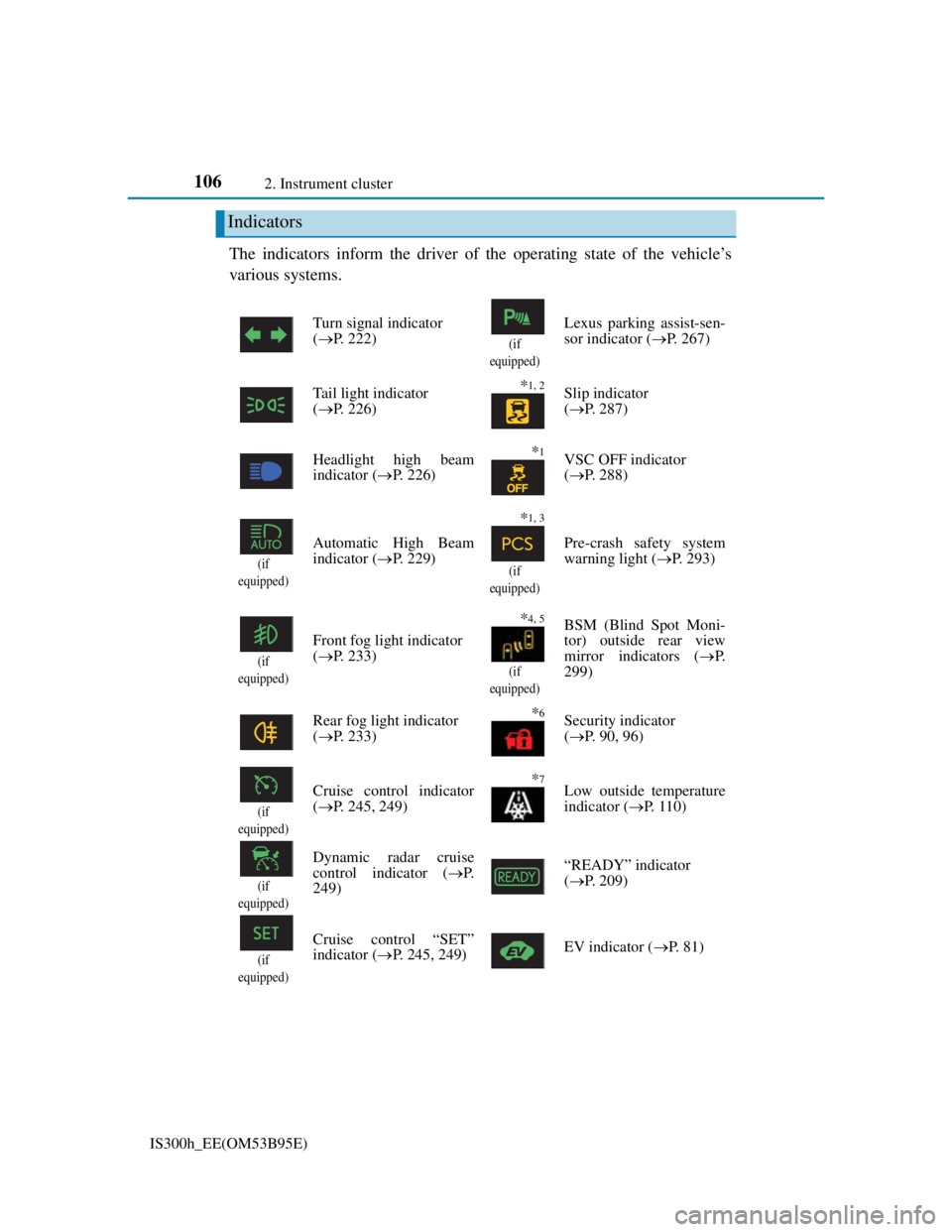
1062. Instrument cluster
IS300h_EE(OM53B95E)
The indicators inform the driver of the operating state of the vehicle’s
various systems.
Indicators
Turn signal indicator
(P. 222)
(if
equipped)
Lexus parking assist-sen-
sor indicator (P. 267)
Tail light indicator
(P. 226)
*1, 2 Slip indicator
(P. 287)
Headlight high beam
indicator (P. 226)
*1VSC OFF indicator
(P. 288)
(if
equipped)
Automatic High Beam
indicator (P. 229)
*1, 3
(if
equipped)
Pre-crash safety system
warning light (P. 293)
(if
equipped)
Front fog light indicator
(P. 233)
*4, 5
(if
equipped)
BSM (Blind Spot Moni-
tor) outside rear view
mirror indicators (P.
299)
Rear fog light indicator
(P. 233)
*6Security indicator
(P. 90, 96)
(if
equipped)
Cruise control indicator
(P. 245, 249)*7Low outside temperature
indicator (P. 1 1 0 )
(if
equipped)
Dynamic radar cruise
control indicator (P.
249)“READY” indicator
(P. 209)
(if
equipped)
Cruise control “SET”
indicator (P. 245, 249)EV indicator (P. 81)
Page 110 of 628

1092. Instrument cluster
2
Instrument cluster
IS300h_EE(OM53B95E)
*5: This light illuminates on the outside rear view mirrors.
*6: This light illuminates on the center panel.
*7: When the outside temperature is approximately 3°C (37°F) or lower, the indi-
cator will flash for approximately 10 seconds, then stay on.
*8: Except F SPORT models
*9: F SPORT models
CAUTION
If a safety system warning light does not come on
Should a safety system light such as the ABS and SRS warning light not come
on when you start the hybrid system, this could mean that these systems are not
available to help protect you in an accident, which could result in death or seri-
ous injury. Have the vehicle inspected by any authorized Lexus dealer or
repairer, or another duly qualified and equipped professional immediately if
this occurs.
Page 265 of 628

2634-5. Using the driving support systems
4
Driving
IS300h_EE(OM53B95E)
CAUTION
When the sensor may not be correctly detecting the vehicle ahead
Apply the brakes as necessary when any of the following types of vehicles are
in front of you.
As the sensor may not be able to correctly detect these types of vehicles, the
approach warning (P. 254) will not be activated, and a fatal or serious acci-
dent may result.
Vehicles that cut in suddenly
Vehicles traveling at low speeds
Vehicles that are not moving
Vehicles with small rear ends (trailers with no load on board etc.)
Motorcycles traveling in the same lane
Conditions under which the vehicle-to-vehicle distance control may not func-
tion correctly
Apply the brakes as necessary in the following conditions as the radar sensor
may not be able to correctly detect vehicles ahead, and a fatal or serious acci-
dent may result:
When water or snow thrown up by a the surrounding vehicles hinders the
functioning of the sensor
When your vehicle is pointing upwards (caused by a heavy load in the trunk
etc.)
When the road curves or when the lanes are narrow
When steering wheel operation or your position in the lane is unstable
When the vehicle ahead of you decelerates suddenly
Handling the radar sensor
Observe the following to ensure the cruise control system can function effec-
tively.
Otherwise, the system may not function correctly and could result in an acci-
dent.
Keep the sensor and grille cover clean at all times.
Clean the sensor and grille cover with a soft cloth so you do not mark or dam-
age them.
Do not subject the sensor or surrounding area to a strong impact.
If the sensor moves even slightly off position, the system may malfunction. If
the sensor or surrounding area is subject to a strong impact, always have the
area inspected and adjusted by any authorized Lexus dealer or repairer, or
another duly qualified and equipped professional.
Do not disassemble the sensor.
Do not attach accessories or stickers to the sensor, grille cover or surrounding
area.
Do not modify or paint the sensor and grille cover.
Do not replace them with non-genuine parts.
Page 270 of 628

2684-5. Using the driving support systems
IS300h_EE(OM53B95E)
When driving on a road surface that is bright due to reflected light
When driving in a location where the light level changes rapidly, such as the
entrance to or exit from a tunnel
When sunlight or the headlights of oncoming vehicles are shining directly into
the camera lens
When driving on roads that are branching or merging
When driving on a road surface that is wet due to rain, previous rainfall, stand-
ing water, etc.
When the vehicle experiences strong up-and-down motion such as when driv-
ing on an extremely rough road or on a seam in the pavement
When headlight brightness at nighttime is reduced due to dirt on the lenses, or
when the headlights are misaligned
When driving on winding roads or roads that are uneven
When driving on rough or unpaved roads
When changing the tires
Depending on the tires used, sufficient performance may not be maintainable.
Warning messages for the LDA system
Warning messages are used to indicate a system malfunction or to inform the
driver of the need for caution while driving. (P. 518)
Page 278 of 628

2764-5. Using the driving support systems
IS300h_EE(OM53B95E)
Sensor detection information
The sensor’s detection areas are limited to the areas around the vehicle’s front
corner and rear bumpers.
Certain vehicle conditions and the surrounding environment may affect the
ability of the sensor to correctly detect obstacles. Particular instances where this
may occur are listed below.
• There is dirt, snow or ice on the sensor. (Wiping the sensors will resolve this
problem.)
• The sensor is frozen. (Thawing the area will resolve this problem.)
In especially cold weather, if a sensor is frozen the screen may show an
abnormal display, or obstacles may not be detected.
• The sensor is covered in any way.
• The vehicle is leaning considerably to one side.
• On an extremely bumpy road, on an incline, on gravel, or on grass.
• The vicinity of the vehicle is noisy due to vehicle horns, motorcycle engines,
air brakes of large vehicles, or other loud noises producing ultrasonic waves.
• There is another vehicle equipped with parking assist sensors in the vicinity.
• The sensor is coated with a sheet of spray or heavy rain.
• The vehicle is equipped with a fender pole or wireless antenna.
• Towing eyelets are installed.
• The bumper or sensor receives a strong impact.
• The vehicle is approaching a tall or curved curb.
• In harsh sunlight or intense cold weather.
• The area directly under the bumpers is not detected.
• If obstacles draw too close to the sensor.
• A non-genuine Lexus suspension (lowered suspension etc.) is installed.
• People may not be detected if they are wearing certain types of clothing.
In addition to the examples above, there are instances in which, because of their
shape, signs and other objects may be judged by the sensor to be closer than they
are.
The shape of the obstacle may prevent the sensor from detecting it. Pay particu-
lar attention to the following obstacles:
• Wires, fences, ropes, etc.
• Cotton, snow and other materials that absorb sound waves
• Sharply-angled objects
• Low obstacles
• Tall obstacles with upper sections projecting outwards in the direction of
your vehicle
The following situations may occur during use.
• Depending on the shape of the obstacle and other factors, the detection dis-
tance may shorten, or detection may be impossible.
• Obstacles may not be detected if they are too close to the sensor.
• There will be a short delay between obstacle detection and display. Even at
slow speeds, there is a possibility that the obstacle will come within the sen-
sor’s detection areas before the display is shown and the warning beep
sounds.
• Thin posts or objects lower than the sensor may not be detected when
approached, even if they have been detected once.
• It might be difficult to hear beeps due to the volume of the audio system or
air flow noise of the air conditioning system.