ABS Lexus IS300h 2013 Owner's Manual
[x] Cancel search | Manufacturer: LEXUS, Model Year: 2013, Model line: IS300h, Model: Lexus IS300h 2013Pages: 628, PDF Size: 20.23 MB
Page 100 of 628
991-3. Theft deterrent system
1
For safety and security
IS300h_EE(OM53B95E)
The intrusion sensor detects intruders or movement in the vehicle.
The tilt sensor detects changes in vehicle inclination, such as when the
vehicle is towed away.
This system is designed to deter and prevent vehicle theft but does not
guarantee absolute security against all intrusions.
Setting the intrusion sensor and tilt sensor
The intrusion sensor and tilt sensor will be set automatically when the
alarm is set. (P. 9 6 )
Canceling the intrusion sensor and tilt sensor
If you are leaving pets or other moving things inside the vehicle, make
sure to disable the intrusion sensor and tilt sensor before setting the
alarm, as they will respond to movement inside the vehicle.
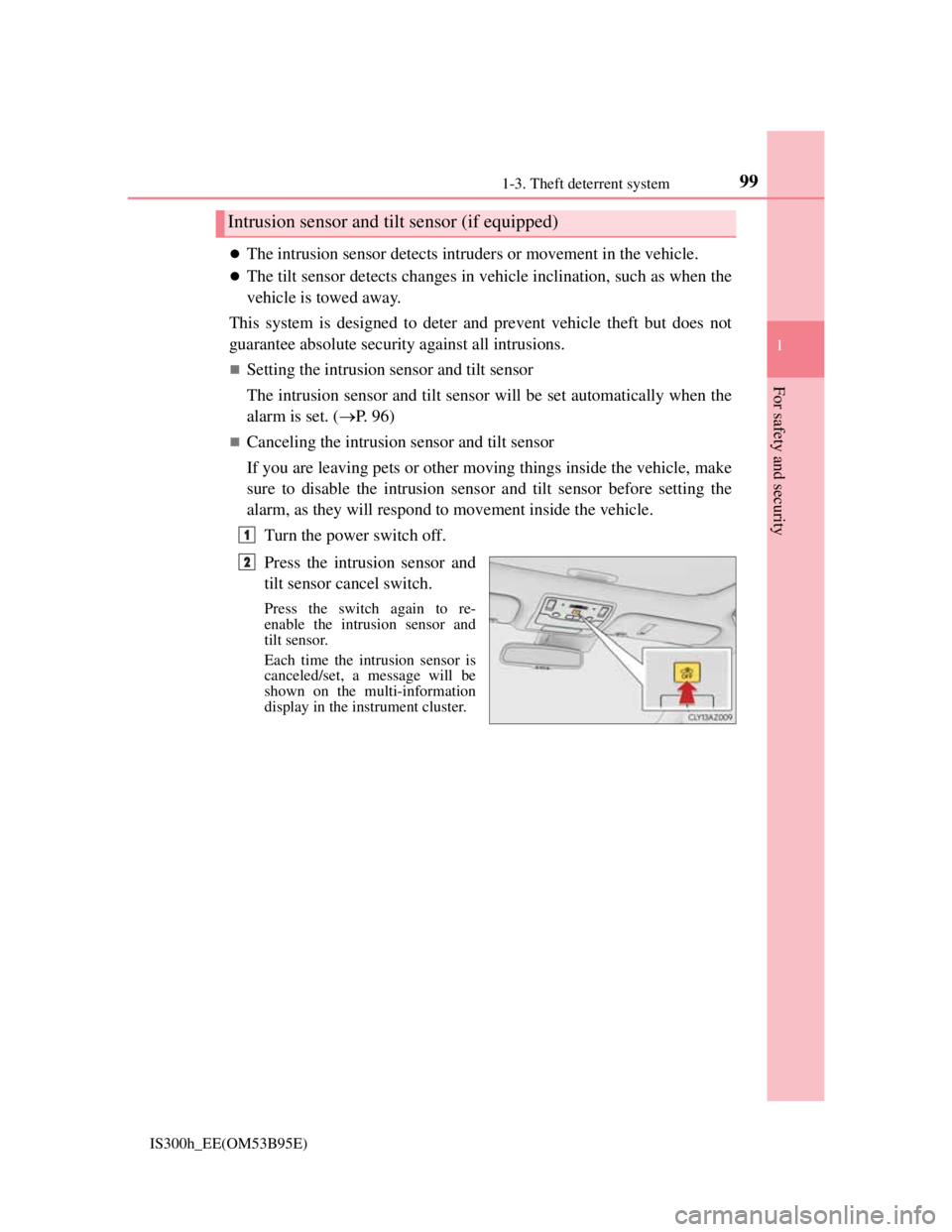
Turn the power switch off.
Press the intrusion sensor and
tilt sensor cancel switch.
Press the switch again to re-
enable the intrusion sensor and
tilt sensor.
Each time the intrusion sensor is
canceled/set, a message will be
shown on the multi-information
display in the instrument cluster.
Intrusion sensor and tilt sensor (if equipped)
1
2
Page 106 of 628
1052. Instrument cluster
2
Instrument cluster
IS300h_EE(OM53B95E)
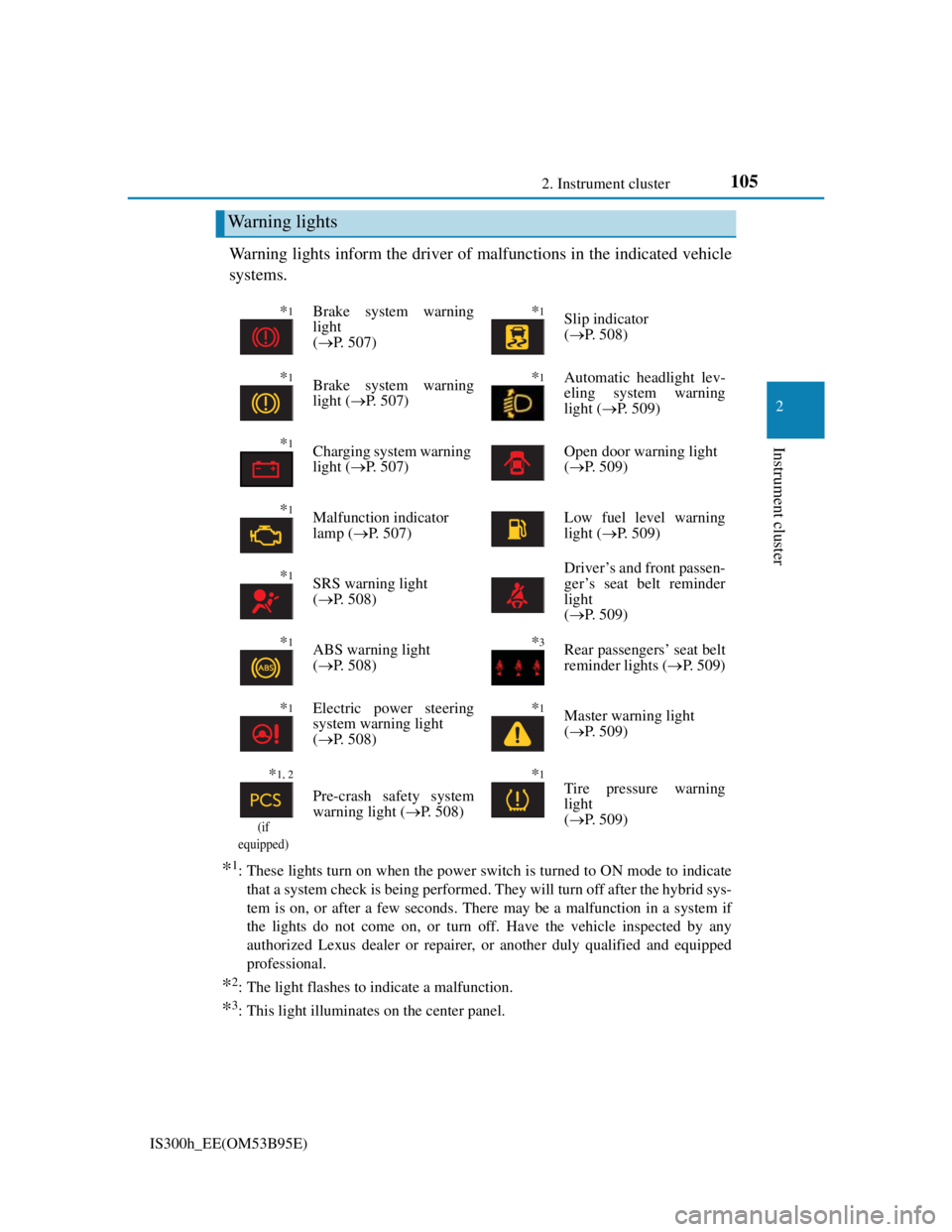
Warning lights inform the driver of malfunctions in the indicated vehicle
systems.
*1: These lights turn on when the power switch is turned to ON mode to indicate
that a system check is being performed. They will turn off after the hybrid sys-
tem is on, or after a few seconds. There may be a malfunction in a system if
the lights do not come on, or turn off. Have the vehicle inspected by any
authorized Lexus dealer or repairer, or another duly qualified and equipped
professional.
*2: The light flashes to indicate a malfunction.
*3: This light illuminates on the center panel.
Warning lights
*1Brake system warning
light
(P. 507)*1Slip indicator
(P. 508)
*1Brake system warning
light (P. 507)*1 Automatic headlight lev-
eling system warning
light (P. 509)
*1Charging system warning
light (P. 507)Open door warning light
(P. 509)
*1Malfunction indicator
lamp (P. 507)Low fuel level warning
light (P. 509)
*1SRS warning light
(P. 508)
Driver’s and front passen-
ger’s seat belt reminder
light
(P. 509)
*1ABS warning light
(P. 508)*3Rear passengers’ seat belt
reminder lights (P. 509)
*1Electric power steering
system warning light
(P. 508)*1Master warning light
(P. 509)
*1, 2
(if
equipped)
Pre-crash safety system
warning light (P. 508)
*1Tire pressure warning
light
(P. 509)
Page 110 of 628

1092. Instrument cluster
2
Instrument cluster
IS300h_EE(OM53B95E)
*5: This light illuminates on the outside rear view mirrors.
*6: This light illuminates on the center panel.
*7: When the outside temperature is approximately 3°C (37°F) or lower, the indi-
cator will flash for approximately 10 seconds, then stay on.
*8: Except F SPORT models
*9: F SPORT models
CAUTION
If a safety system warning light does not come on
Should a safety system light such as the ABS and SRS warning light not come
on when you start the hybrid system, this could mean that these systems are not
available to help protect you in an accident, which could result in death or seri-
ous injury. Have the vehicle inspected by any authorized Lexus dealer or
repairer, or another duly qualified and equipped professional immediately if
this occurs.
Page 264 of 628

2624-5. Using the driving support systems
IS300h_EE(OM53B95E)
Before using dynamic radar cruise control
Do not overly rely on vehicle-to-vehicle distance control.
Be aware of the set speed. If automatic deceleration/acceleration is not appro-
priate, adjust the vehicle speed, as well as the distance between your vehicle
and vehicles ahead by applying the brakes etc.
Cautions regarding the driving assist systems
Observe the following precautions.
Failure to do so may cause an accident resulting in death or serious injury.
Assisting the driver to measure following distance
The dynamic radar cruise control is only intended to help the driver in deter-
mining the following distance between the driver’s own vehicle and a desig-
nated vehicle traveling ahead. It is not a mechanism that allows careless or
inattentive driving, and it is not a system that can assist the driver in low-visi-
bility conditions. It is still necessary for driver to pay close attention to the
vehicle’s surroundings.
Assisting the driver to judge proper following distance
The dynamic radar cruise control determines whether the following distance
between the driver’s own vehicle and a designated vehicle traveling ahead is
appropriate or not. It is not capable of making any other type of judgement.
Therefore, it is absolutely necessary for the driver to remain vigilant and to
determine whether or not there is a possibility of danger in any given situa-
tion.
Assisting the driver to operate the vehicle
The dynamic radar cruise control has no capability to prevent or avoid a colli-
sion with a vehicle traveling ahead. Therefore, if there is ever any danger, the
driver must take immediate and direct control of the vehicle and act appropri-
ately in order to ensure the safety of all involved.
To avoid inadvertent cruise control activation
Switch the cruise control off using the “ON/OFF” button when not in use.
Situations unsuitable for dynamic radar cruise control
Do not use dynamic radar cruise control in any of the following situations.
Doing so may result in inappropriate speed control and could cause an accident
resulting in death or serious injury.
In heavy traffic
On roads with sharp bends
On winding roads
On slippery roads, such as those covered with rain, ice or snow
On steep downhills, or where there are sudden changes between sharp up and
down gradients
Vehicle speed may exceed the set speed when driving down a steep hill.
At entrances to expressways
When weather conditions are bad enough that they may prevent the sensors
from functioning correctly (fog, snow, sandstorm, heavy rain, etc.)
When an approach warning buzzer is heard often
When your vehicle is towing a trailer or during emergency towing
Page 278 of 628

2764-5. Using the driving support systems
IS300h_EE(OM53B95E)
Sensor detection information
The sensor’s detection areas are limited to the areas around the vehicle’s front
corner and rear bumpers.
Certain vehicle conditions and the surrounding environment may affect the
ability of the sensor to correctly detect obstacles. Particular instances where this
may occur are listed below.
• There is dirt, snow or ice on the sensor. (Wiping the sensors will resolve this
problem.)
• The sensor is frozen. (Thawing the area will resolve this problem.)
In especially cold weather, if a sensor is frozen the screen may show an
abnormal display, or obstacles may not be detected.
• The sensor is covered in any way.
• The vehicle is leaning considerably to one side.
• On an extremely bumpy road, on an incline, on gravel, or on grass.
• The vicinity of the vehicle is noisy due to vehicle horns, motorcycle engines,
air brakes of large vehicles, or other loud noises producing ultrasonic waves.
• There is another vehicle equipped with parking assist sensors in the vicinity.
• The sensor is coated with a sheet of spray or heavy rain.
• The vehicle is equipped with a fender pole or wireless antenna.
• Towing eyelets are installed.
• The bumper or sensor receives a strong impact.
• The vehicle is approaching a tall or curved curb.
• In harsh sunlight or intense cold weather.
• The area directly under the bumpers is not detected.
• If obstacles draw too close to the sensor.
• A non-genuine Lexus suspension (lowered suspension etc.) is installed.
• People may not be detected if they are wearing certain types of clothing.
In addition to the examples above, there are instances in which, because of their
shape, signs and other objects may be judged by the sensor to be closer than they
are.
The shape of the obstacle may prevent the sensor from detecting it. Pay particu-
lar attention to the following obstacles:
• Wires, fences, ropes, etc.
• Cotton, snow and other materials that absorb sound waves
• Sharply-angled objects
• Low obstacles
• Tall obstacles with upper sections projecting outwards in the direction of
your vehicle
The following situations may occur during use.
• Depending on the shape of the obstacle and other factors, the detection dis-
tance may shorten, or detection may be impossible.
• Obstacles may not be detected if they are too close to the sensor.
• There will be a short delay between obstacle detection and display. Even at
slow speeds, there is a possibility that the obstacle will come within the sen-
sor’s detection areas before the display is shown and the warning beep
sounds.
• Thin posts or objects lower than the sensor may not be detected when
approached, even if they have been detected once.
• It might be difficult to hear beeps due to the volume of the audio system or
air flow noise of the air conditioning system.
Page 295 of 628

2934-5. Using the driving support systems
4
Driving
IS300h_EE(OM53B95E)
ABS (Anti-lock Brake System)
Helps to prevent wheel lock when the brakes are applied suddenly, or if
the brakes are applied while driving on a slippery road surface
Brake assist
Generates an increased level of braking force after the brake pedal is
depressed when the system detects a panic stop situation
VSC (Vehicle Stability Control)
Helps the driver to control skidding when swerving suddenly or turn-
ing on slippery road surfaces
VSC+ (Vehicle Stability Control+)
Provides cooperative control of the ABS, TRC, VSC and EPS.
Helps to maintain directional stability when swerving on slippery road
surfaces by controlling steering performance.
TRC (Traction Control)
Helps to maintain drive power and prevent the drive wheels from spin-
ning when starting the vehicle or accelerating on slippery roads
Hill-start assist control
Prevents the vehicle from rolling backward when starting on an incline
or slippery slope
EPS (Electric Power Steering)
Employs an electric motor to reduce the amount of effort needed to
turn the steering wheel
Driving assist systems
To help enhance driving safety and performance, the following systems
operate automatically in response to various driving situations. Be aware,
however, that these systems are supplementary and should not be relied
upon too heavily when operating the vehicle.
Page 296 of 628
2944-5. Using the driving support systems
IS300h_EE(OM53B95E)
Adaptive Variable Suspension System (if equipped)
By independently controlling the damping force of the shock absorbers
for each of the 4 wheels according to the road and driving conditions,
this system helps riding comfort with superior steering stability, and
helps good vehicle posture (P. 291)
VDIM (Vehicle Dynamics Integrated Management)
Provides integrated control of the ABS, brake assist, TRC, VSC, hill-
start assist control, and EPS systems
Helps to maintain vehicle stability when swerving on slippery road sur-
faces by controlling the brakes and hybrid system output
PCS (Pre-Crash Safety system) (if equipped)
P. 2 9 9
Emergency brake signal
When the brakes are applied suddenly, the stop lights automatically
flash to alert the vehicle behind
BSM (Blind Spot Monitor) (if equipped)
P. 3 0 9
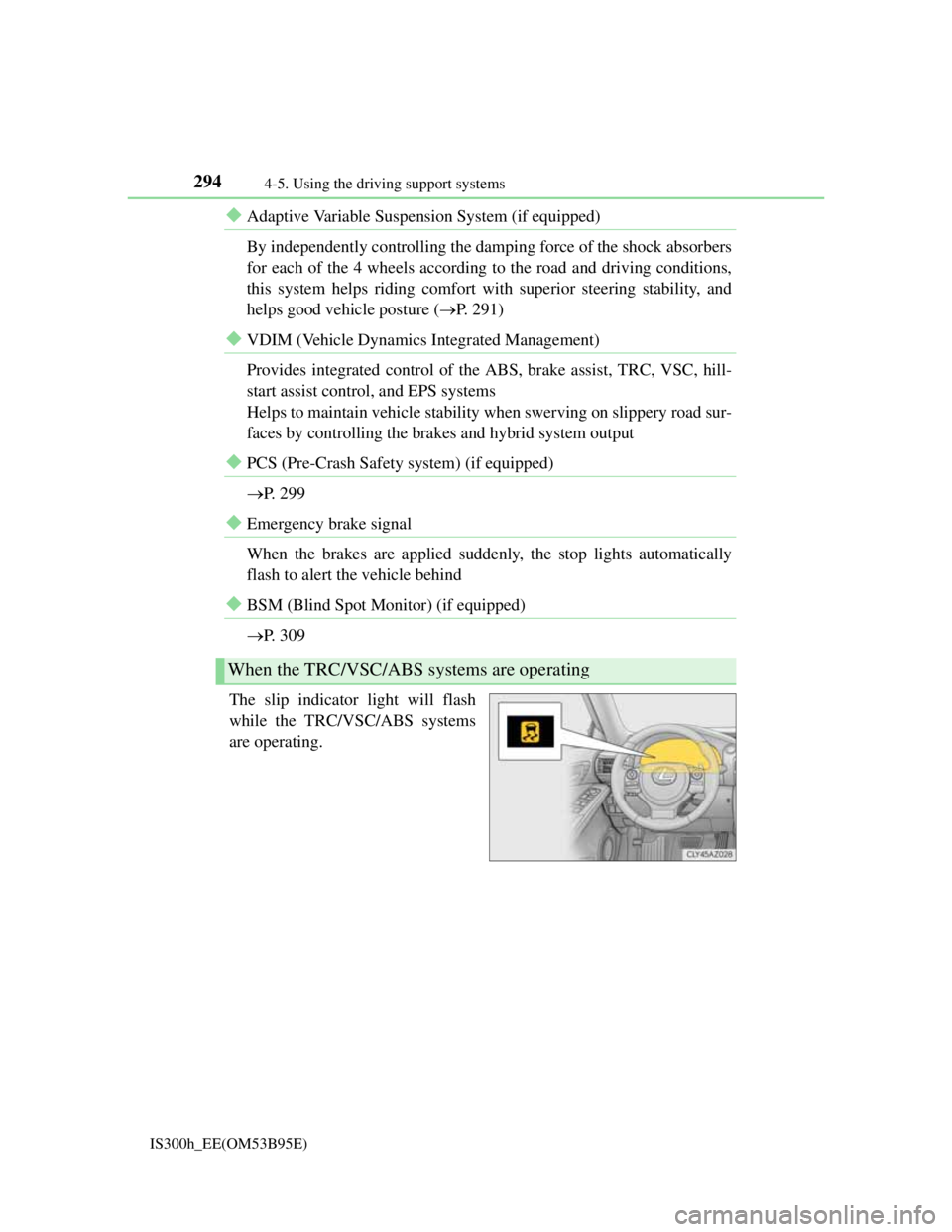
The slip indicator light will flash
while the TRC/VSC/ABS systems
are operating.
When the TRC/VSC/ABS systems are operating
Page 298 of 628

2964-5. Using the driving support systems
IS300h_EE(OM53B95E)
When the 12-volt battery is disconnected
The steering wheel may move from its straight forward position, but this will be
corrected automatically when driving.
Sounds and vibrations caused by the ABS, brake assist, TRC, VSC, hill-start
assist control systems
A sound may be heard from the engine compartment when the brake pedal is
depressed repeatedly, when the hybrid system is started or just after the vehicle
begins to move. This sound does not indicate that a malfunction has occurred in
any of these systems.
Any of the following conditions may occur when the above systems are operat-
ing. None of these indicates that a malfunction has occurred.
• Vibrations may be felt through the vehicle body and steering.
• A motor sound may be heard after the vehicle comes to a stop.
EPS operation sound
When the steering wheel is operated, a motor sound may be heard. This does not
indicate a malfunction.
Reactivation of the TRC/VSC systems
Even after the TRC/VSC systems have been turned off, turning the hybrid sys-
tem off and then on again will automatically reactivate the TRC/VSC systems.
Reactivation of the TRC system linked to vehicle speed
When only the TRC system is turned off, the TRC system will turn on when
vehicle speed increases. However, when both TRC and VSC systems are turned
off, the systems will not turn on even when vehicle speed increases.
Reduced effectiveness of the EPS system
The effectiveness of the EPS system is reduced to prevent the system from over-
heating when there is frequent steering input over an extended period of time.
The steering wheel may feel heavy as a result. Should this occur, refrain from
excessive steering input or stop the vehicle and turn the hybrid system off. The
EPS system should return to normal within 10 minutes.
Page 300 of 628

2984-5. Using the driving support systems
IS300h_EE(OM53B95E)
CAUTION
The ABS does not operate effectively when
The limits of tire gripping performance have been exceeded (such as exces-
sively worn tires on a snow covered road).
The vehicle hydroplanes while driving at high speed on wet or slick roads.
Stopping distance when the ABS is operating may exceed that of normal condi-
tions
The ABS is not designed to shorten the vehicle’s stopping distance. Always
maintain a safe distance from the vehicle in front of you, especially in the fol-
lowing situations:
When driving on dirt, gravel or snow-covered roads
When driving with tire chains
When driving over bumps in the road
When driving over roads with potholes or uneven surfaces
TRC may not operate effectively when
Directional control and power may not be achievable while driving on slippery
road surfaces, even if the TRC system is operating.
Drive the vehicle carefully in conditions where stability and power may be lost.
Hill- start assist control does not operate effectively when
Do not overly rely on hill-start assist control. Hill-start assist control may not
operate effectively on steep inclines and roads covered with ice.
Unlike the parking brake, hill-start assist control is not intended to hold the
vehicle stationary for an extended period of time. Do not attempt to use hill-
start assist control to hold the vehicle on an incline, as doing so may lead to an
accident.
When the VSC is activated
The slip indicator light flashes. Always drive carefully. Reckless driving may
cause an accident. Exercise particular care when the indicator light flashes.
When the TRC/VSC systems are turned off
Be especially careful and drive at a speed appropriate to the road conditions. As
these are the systems to ensure vehicle stability and driving force, do not turn
the TRC/VSC systems off unless necessary.
Replacing tires
Make sure that all tires are of the specified size, brand, tread pattern and total
load capacity. In addition, make sure that the tires are inflated to the recom-
mended tire inflation pressure level.
The ABS, TRC and VSC systems will not function correctly if different tires
are installed on the vehicle.
Contact any authorized Lexus dealer or repairer, or another duly qualified and
equipped professional for further information when replacing tires or wheels.
Handling of tires and the suspension
Using tires with any kind of problem or modifying the suspension will affect
the driving assist systems, and may cause a system to malfunction.
Page 302 of 628

3004-5. Using the driving support systems
IS300h_EE(OM53B95E)
When the system determines that there is a high possibility of a frontal
collision, the operation of Adaptive Variable Suspension System (P.
294) optimally controls the damping force of the shock absorber.