fuel cap Lexus IS350 2021 Owner's Manual / LEXUS 2021 IS 300, IS 350 OWNER'S MANUAL (OM53E98U)
[x] Cancel search | Manufacturer: LEXUS, Model Year: 2021, Model line: IS350, Model: Lexus IS350 2021Pages: 436, PDF Size: 13.46 MB
Page 3 of 436
3TABLE OF CONTENTS
1
2
3
4
5
6
7
8
9
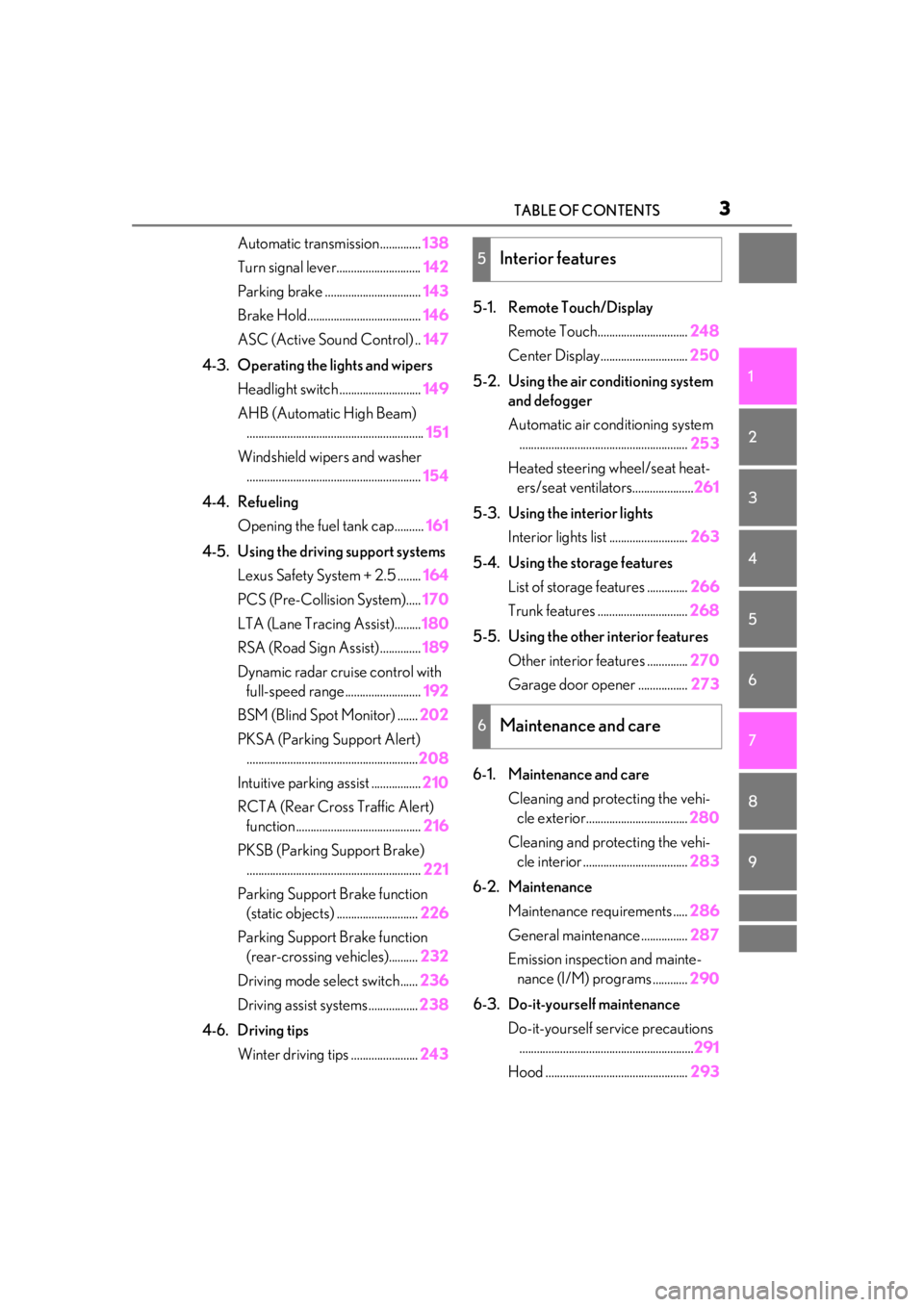
Automatic transmission..............138
Turn signal lever............................. 142
Parking brake ................................. 143
Brake Hold....................................... 146
ASC (Active Sound Control) .. 147
4-3. Operating the lights and wipers Headlight switch ............................ 149
AHB (Automatic High Beam) ............................................................. 151
Windshield wipers and washer ............................................................ 154
4-4. Refueling Opening the fuel tank cap.......... 161
4-5. Using the driving support systems Lexus Safety System + 2.5 ........ 164
PCS (Pre-Collision System)..... 170
LTA (Lane Tracing Assist)......... 180
RSA (Road Sign Assist) .............. 189
Dynamic radar crui se control with
full-speed range.......................... 192
BSM (Blind Spot Monitor) ....... 202
PKSA (Parking Support Alert) ........................................................... 208
Intuitive parking assist ................. 210
RCTA (Rear Cross Traffic Alert) function ........................................... 216
PKSB (Parking Support Brake) ............................................................ 221
Parking Support Brake function (static objects) ............................ 226
Parking Support Brake function (rear-crossing vehicles).......... 232
Driving mode select switch...... 236
Driving assist systems ................. 238
4-6. Driving tips Winter driving tips ....................... 2435-1. Remote Touch/Display
Remote Touch............................... 248
Center Display.............................. 250
5-2. Using the air conditioning system and defogger
Automatic air conditioning system.......................................................... 253
Heated steering wheel/seat heat- ers/seat ventilators..................... 261
5-3. Using the interior lights Interior lights list ........................... 263
5-4. Using the storage features List of storage features .............. 266
Trunk features ............................... 268
5-5. Using the other interior features Other interior features .............. 270
Garage door opener ................. 273
6-1. Maintenance and care Cleaning and protecting the vehi-cle exterior................................... 280
Cleaning and protecting the vehi- cle interior .................................... 283
6-2. Maintenance Maintenance re quirements .....286
General maintenance................ 287
Emission inspection and mainte- nance (I/M) program s
............290
6-3. Do-it-yourself maintenance Do-it-yourself service precautions............................................................ 291
Hood ................................................. 293
5Interior features
6Maintenance and care
Page 12 of 436
12Pictorial index
Precautions for winter season ..................................................................................... P.243
To prevent freezing (windshield wiper de-icer)
*................................................. P.259
Precautions for car wash ................................................................................................ P.281
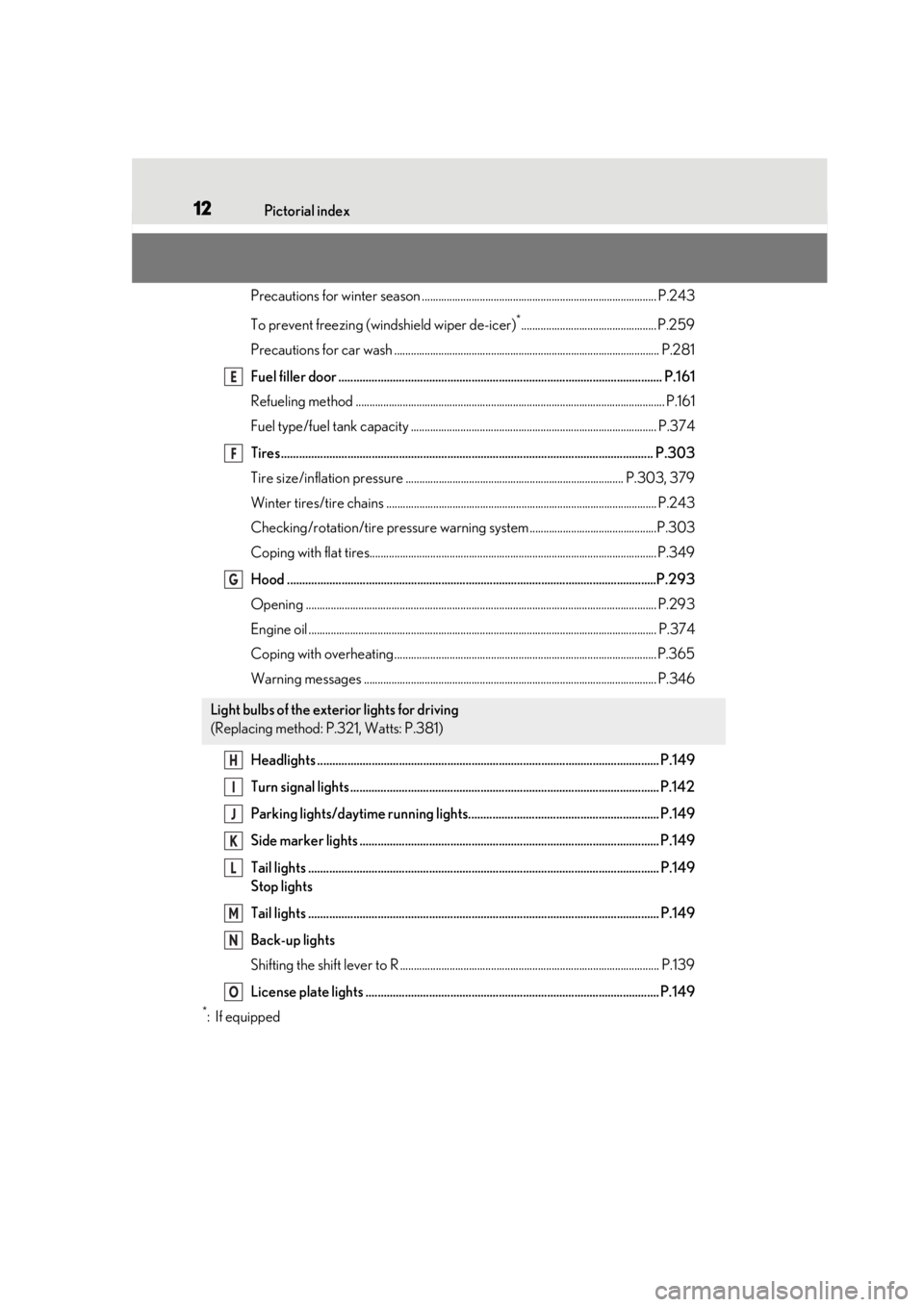
Fuel filler door ........................................................................................................... P.16 1
Refueling method ............................................................................................................... .P.161
Fuel type/fuel tank capacity ...... ................................................................................... P.374
Tires.......................................................................................................................... .P.303
Tire size/inflation pressure ............................................................................... P.303, 379
Winter tires/tire chains .................................................................................................. P.243
Checking/rotation/tire pressure warning system..............................................P.303
Coping with flat tires........................................................................................................ P .349
Hood ..........................................................................................................................P.293
Opening ........................................................................................................................ ....... P.293
Engine oil ..................................................................................................................... ......... P.374
Coping with overheating ............................................................................................... P.365
Warning messages .......................................................................................................... P.346
Headlights ................................................................................................................. P.14 9
Turn signal lights ...................................................................................................... P.142
Parking lights/daytime running lights............................................................... P.149
Side marker lights ................................................................................................... P.149
Tail lights .................................................................................................................... P.149
Stop lights
Tail lights .................................................................................................................... P.149
Back-up lights
Shifting the shift lever to R .............................................................................................. P.13 9
License plate lights ................................................................................................. P.149
*:If equipped
Light bulbs of the exterior lights for driving
(Replacing method: P.321, Watts: P.381)
E
F
G
H
I
J
K
L
M
N
O
Page 123 of 436
123
4
4
Driving
Driving
.4-1. Before drivingDriving the vehicle ..................... 124
Cargo and luggage ................... 130
Vehicle load limits ...................... 132
Trailer towing ............................... 132
Dinghy towing ............................. 133
4-2. Driving procedures Engine (ignition) switch ........... 134
Automatic transmission........... 138
Turn signal lever.......................... 142
Parking brake .............................. 143
Brake Hold.................................... 146
ASC (Active Sound Control) ......................................................... 147
4-3. Operating the lights and wipers Headlight switch ......................... 149
AHB (Automatic High Beam) .......................................................... 151
Windshield wipers and washer ......................................................... 154
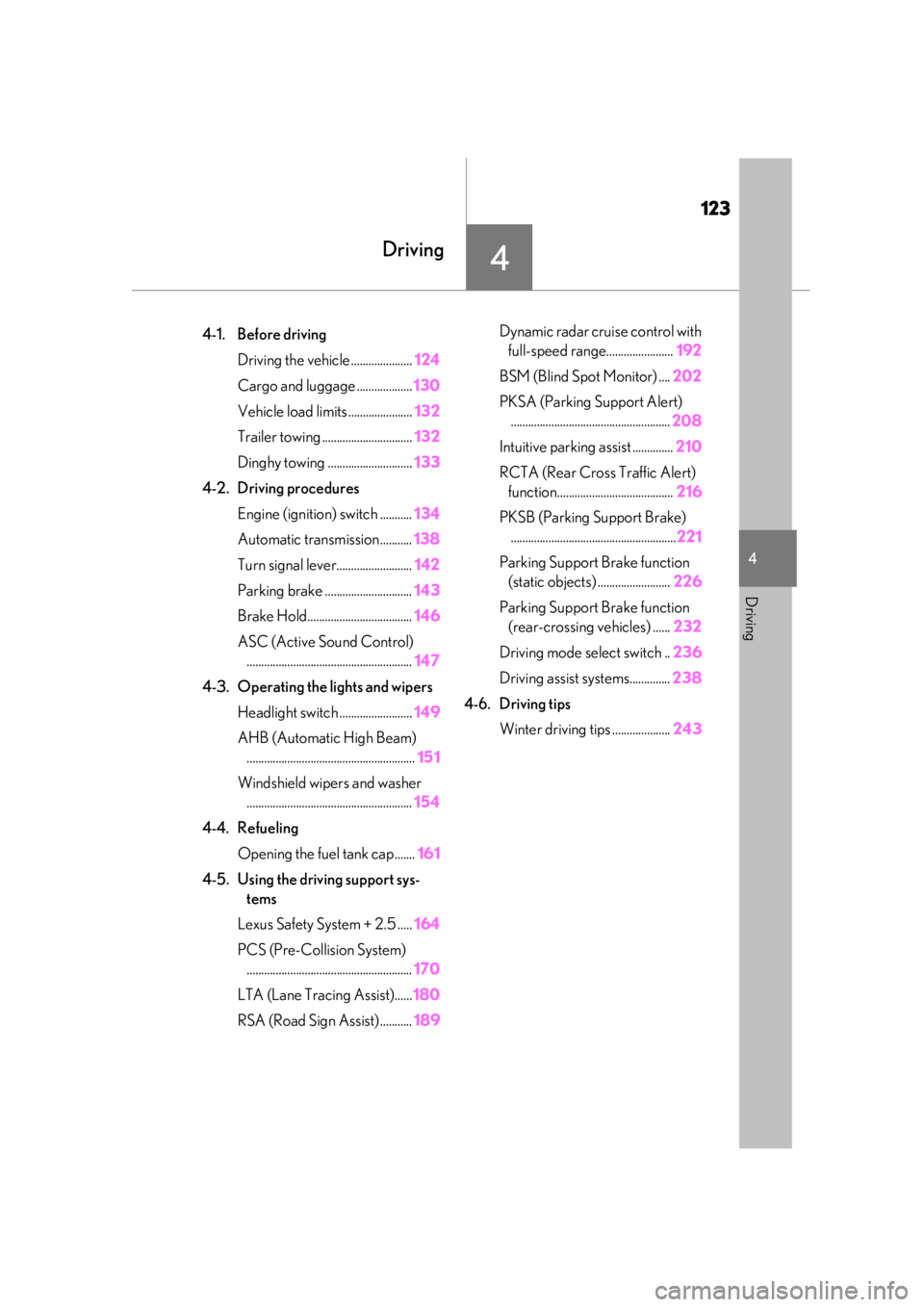
4-4. Refueling Opening the fuel tank cap....... 161
4-5. Using the driving support sys- tems
Lexus Safety System + 2.5 ..... 164
PCS (Pre-Collision System) ......................................................... 170
LTA (Lane Tracing Assist)...... 180
RSA (Road Sign Assist) ........... 189Dynamic radar cruise control with
full-speed range....................... 192
BSM (Blind Spot Monitor) .... 202
PKSA (Parking Support Alert) ....................................................... 208
Intuitive parking assist .............. 210
RCTA (Rear Cross Traffic Alert) function........................................ 216
PKSB (Parking Support Brake) ......................................................... 221
Parking Support Brake function (static objects) ......................... 226
Parking Support Brake function (rear-crossing vehicles) ...... 232
Driving mode select switch .. 236
Driving assist systems.............. 238
4-6. Driving tips Winter driving tips .................... 243
Page 161 of 436
1614-4. Refueling
4
Driving
4-4.Refueling
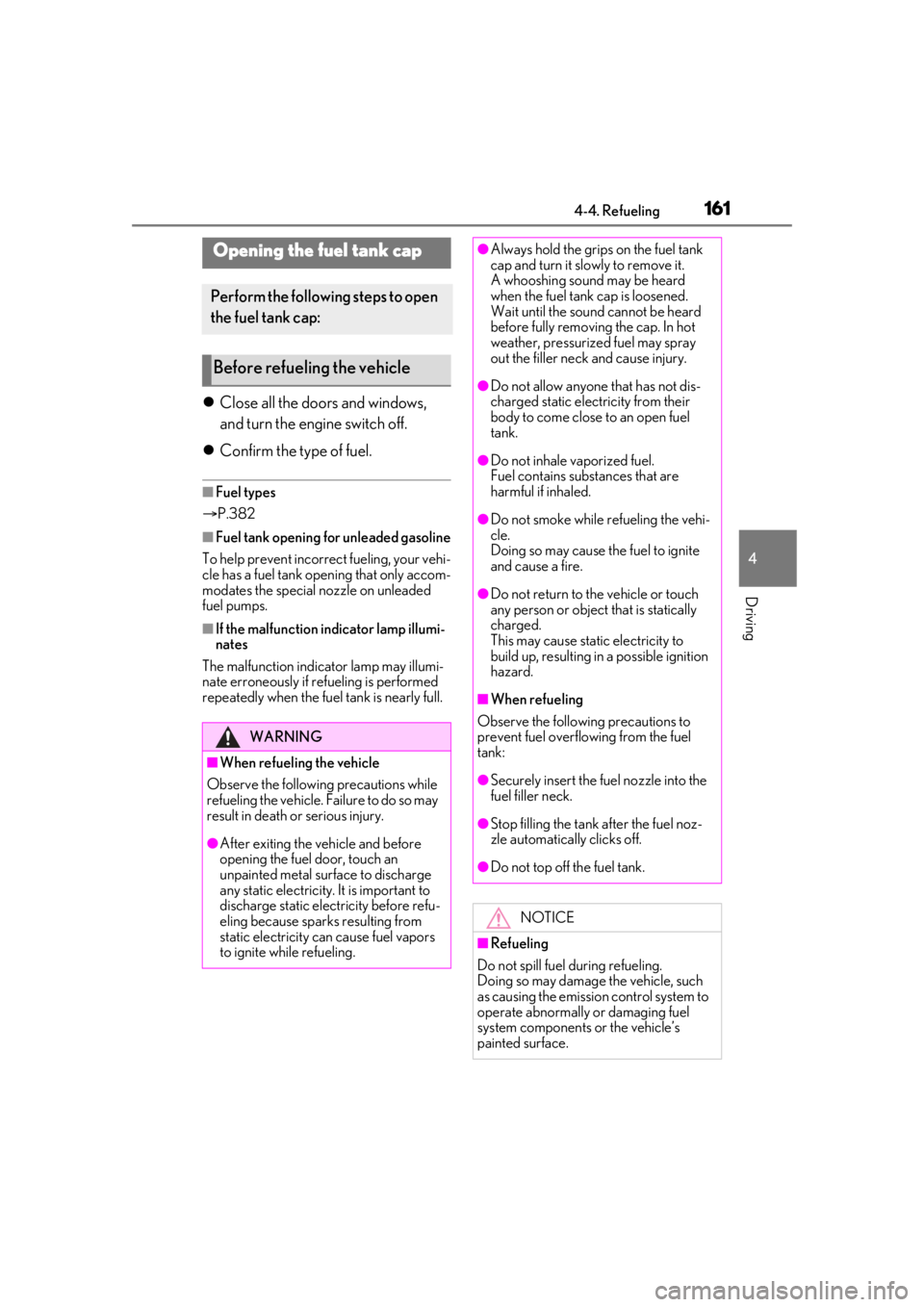
Close all the doors and windows,
and turn the engine switch off.
Confirm the type of fuel.
■Fuel types
P.382
■Fuel tank opening for unleaded gasoline
To help prevent incorrect fueling, your vehi-
cle has a fuel tank opening that only accom-
modates the special nozzle on unleaded
fuel pumps.
■If the malfunction indicator lamp illumi-
nates
The malfunction indicator lamp may illumi-
nate erroneously if refueling is performed
repeatedly when the fuel tank is nearly full.
Opening the fuel tank cap
Perform the following steps to open
the fuel tank cap:
Before refueling the vehicle
WARNING
■When refueling the vehicle
Observe the following precautions while
refueling the vehicle. Failure to do so may
result in death or serious injury.
●After exiting the vehicle and before
opening the fuel door, touch an
unpainted metal surface to discharge
any static electricity. It is important to
discharge static electricity before refu-
eling because sparks resulting from
static electricity can cause fuel vapors
to ignite while refueling.
●Always hold the grips on the fuel tank
cap and turn it slowly to remove it.
A whooshing sound may be heard
when the fuel tank cap is loosened.
Wait until the sound cannot be heard
before fully removing the cap. In hot
weather, pressurized fuel may spray
out the filler neck and cause injury.
●Do not allow anyone that has not dis-
charged static electricity from their
body to come close to an open fuel
tank.
●Do not inhale vaporized fuel.
Fuel contains substances that are
harmful if inhaled.
●Do not smoke while refueling the vehi-
cle.
Doing so may cause the fuel to ignite
and cause a fire.
●Do not return to the vehicle or touch
any person or object that is statically
charged.
This may cause static electricity to
build up, resulting in a possible ignition
hazard.
■When refueling
Observe the following precautions to
prevent fuel overflowing from the fuel
tank:
●Securely insert the fuel nozzle into the
fuel filler neck.
●Stop filling the tank after the fuel noz-
zle automatically clicks off.
●Do not top off the fuel tank.
NOTICE
■Refueling
Do not spill fuel during refueling.
Doing so may damage the vehicle, such
as causing the emission control system to
operate abnormally or damaging fuel
system components or the vehicle’s
painted surface.
Page 162 of 436
1624-4. Refueling
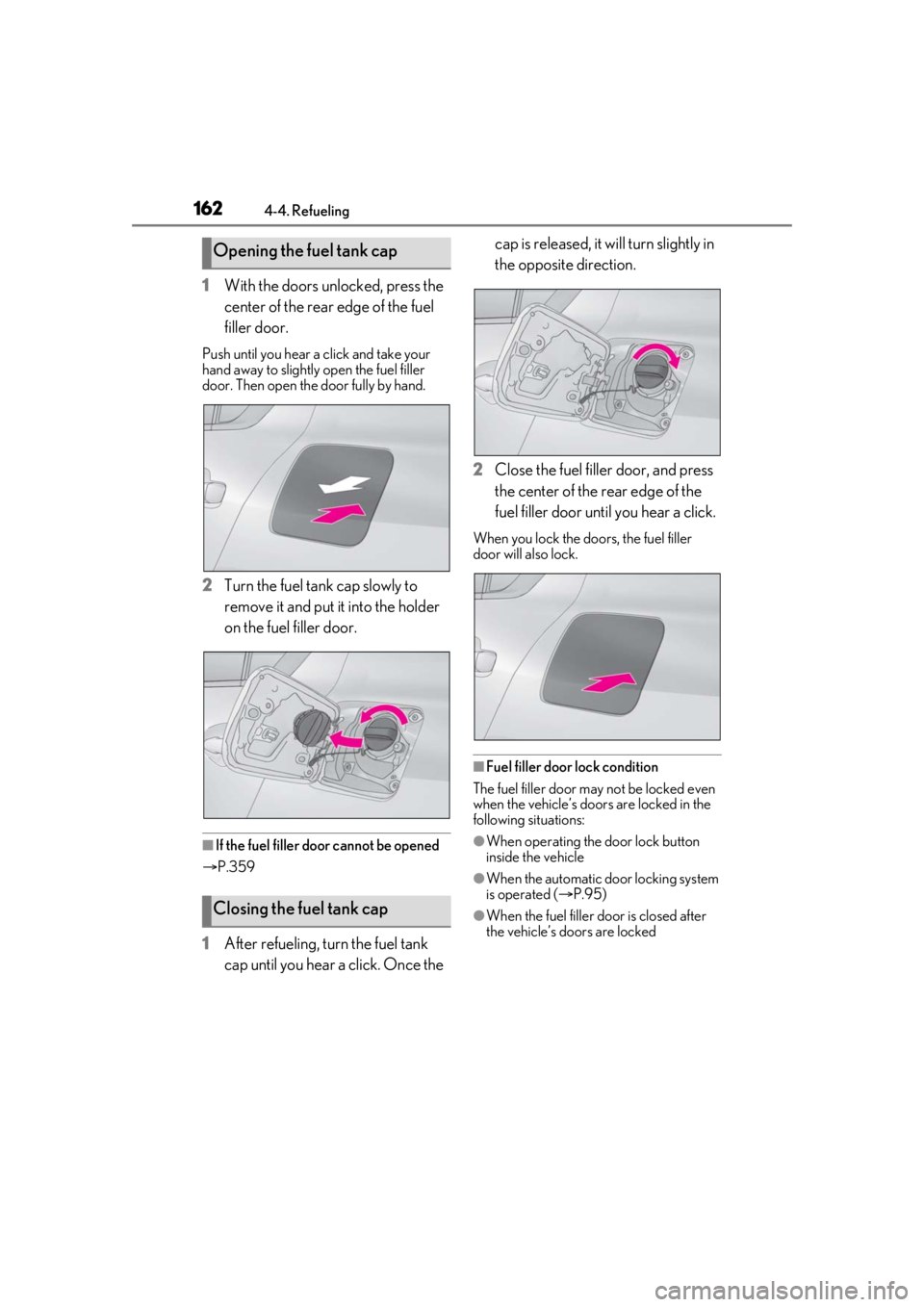
1With the doors unlocked, press the
center of the rear edge of the fuel
filler door.
Push until you hear a click and take your
hand away to slightly open the fuel filler
door. Then open the door fully by hand.
2Turn the fuel tank cap slowly to
remove it and put it into the holder
on the fuel filler door.
■If the fuel filler door cannot be opened
P.359
1 After refueling, turn the fuel tank
cap until you hear a click. Once the cap is released, it will turn slightly in
the opposite direction.
2 Close the fuel filler door, and press
the center of the rear edge of the
fuel filler door until you hear a click.
When you lock the doors, the fuel filler
door will also lock.
■Fuel filler door lock condition
The fuel filler door may not be locked even
when the vehicle’s doors are locked in the
following situations:
●When operating the door lock button
inside the vehicle
●When the automatic door locking system
is operated ( P.95)
●When the fuel filler door is closed after
the vehicle’s doors are locked
Opening the fuel tank cap
Closing the fuel tank cap
Page 163 of 436

1634-4. Refueling
4
Driving
WARNING
■When replacing the fuel tank cap
Do not use anything but a genuine Lexus
fuel tank cap designed for your vehicle.
Doing so may cause a fire or other inci-
dent which may result in death or serious
injury.
Page 256 of 436
2565-2. Using the air conditioning system and defogger
senger door.
●The doors that can recall the air condi-
tioning setting when unlocked using the
smart access system with push-button
start can be changed.
* For details, con-
tact your Lexus dealer.
*: The doors that can recall the driving
position memory are changed at the
same time.
■Operation of the air conditioning sys-
tem in Eco drive mode
In Eco drive mode, the air conditioning sys-
tem is controlled as follows to prioritize fuel
efficiency:
●Engine speed and compressor operation
controlled to restri ct heating/cooling
capacity
●Fan speed restricted when automatic
mode is selected
To improve air condit ioning performance,
perform the following operations:
●Adjust the fan speed
●Turn off Eco drive mode ( P.236)
■When the outside temperature falls to
nearly 32°F (0°C)
The dehumidification function may not
operate even when A/C is pressed or
“A/C” is selected.
■Ventilation and air conditioning odors
●To let fresh air in, set the air conditioning
system to the outside air mode.
●During use, various odors from inside and
outside the vehicle may enter into and
accumulate in the air conditioning sys-
tem. This may then cause odor to be
emitted from the vents.
●To reduce potential odors from occur-
ring:
• It is recommended that the air condition- ing system be set to outside air mode
prior to turning the vehicle off.
• The start timing of the blower may be delayed for a short period of time imme-
diately after the air conditioning system is
started in automatic mode or with the
micro dust and pollen filter on.
■Using the voice command system
Air conditioning system can be operated
using voice commands. For details, refer to
“NAVIGATION AND MULTIMEDIA
SYSTEM OWNER’S MANUAL”.
■Air conditioning filter
P.315
■Air conditioning system refrigerant
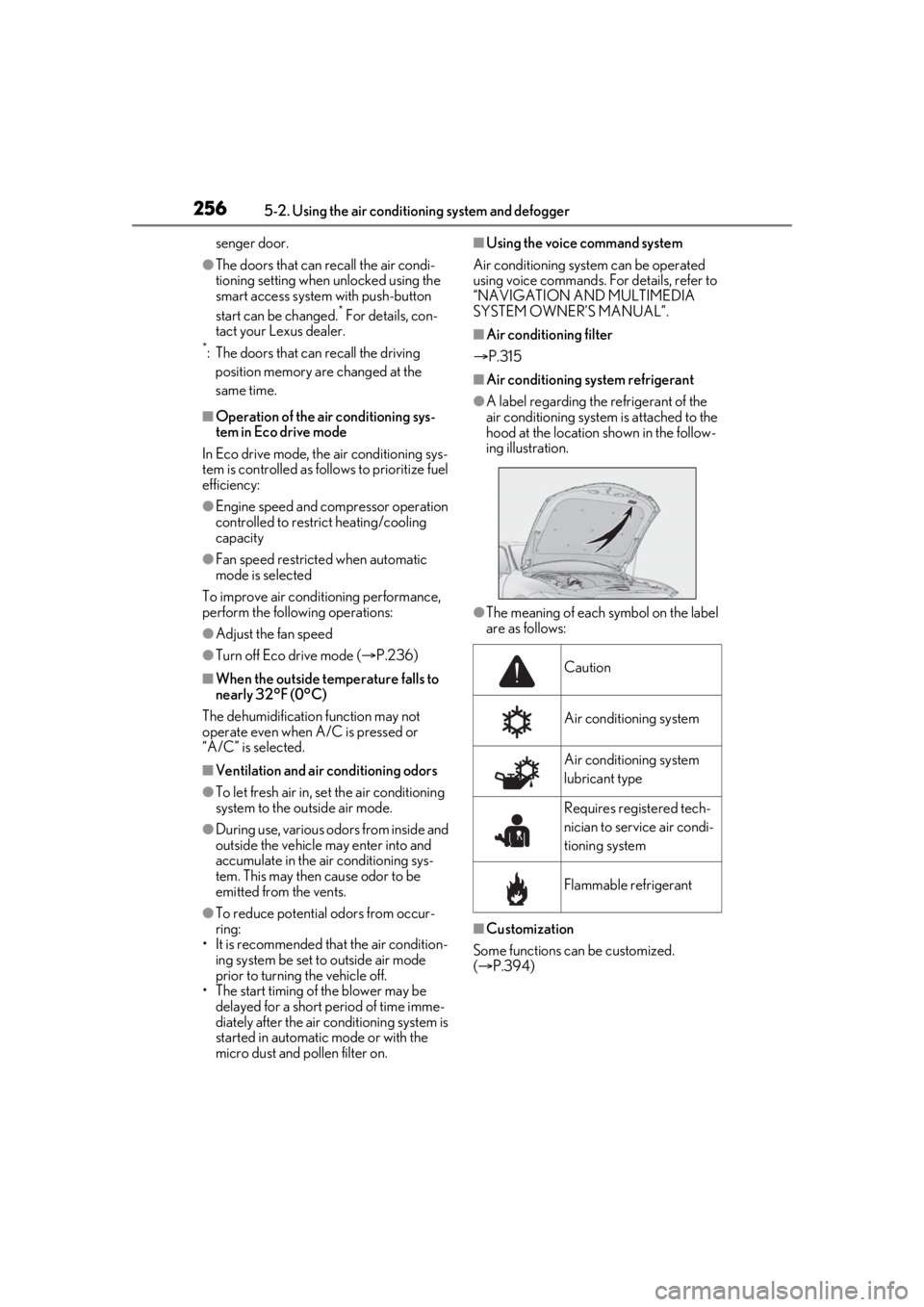
●A label regarding the refrigerant of the
air conditioning system is attached to the
hood at the location shown in the follow-
ing illustration.
●The meaning of each symbol on the label
are as follows:
■Customization
Some functions can be customized.
( P.394)
Caution
Air conditioning system
Air conditioning system
lubricant type
Requires registered tech-
nician to service air condi-
tioning system
Flammable refrigerant
Page 290 of 436
2906-2. Maintenance
The OBD system determines that a
problem exists somewhere in the emis-
sion control system. Your vehicle may
not pass the I/M test and may need to
be repaired. Contact your Lexus
dealer to service the vehicle.
When the battery is disconnected
or discharged
Readiness codes that are set during ordi-
nary driving are erased.
Also, depending on your driving habits, the
readiness codes may not be completely
set.
When the fuel tank cap is loose
The malfunction indicator lamp comes on
indicating a temporary malfunction and
your vehicle may not pass the I/M test.
The error code in the OBD system will
not be cleared unless the vehicle is
driven 40 or more times.
Contact your Lexus dealer to prepare
the vehicle for re-testing.
Emission inspection and
maintenance (I/M) pro-
grams
Some states have vehicle emission
inspection programs which include
OBD (On Board Diagnostics)
checks. The OBD system monitors
the operation of the emission con-
trol system.
If the malfunction indicator lamp
comes on
Your vehicle may not pass the
I/M test in the following situa-
tions:
When the malfunction indicator
lamp still remains on after sev-
eral driving trips
If your vehicle does not pass the
I/M test
Page 312 of 436
3126-3. Do-it-yourself maintenance
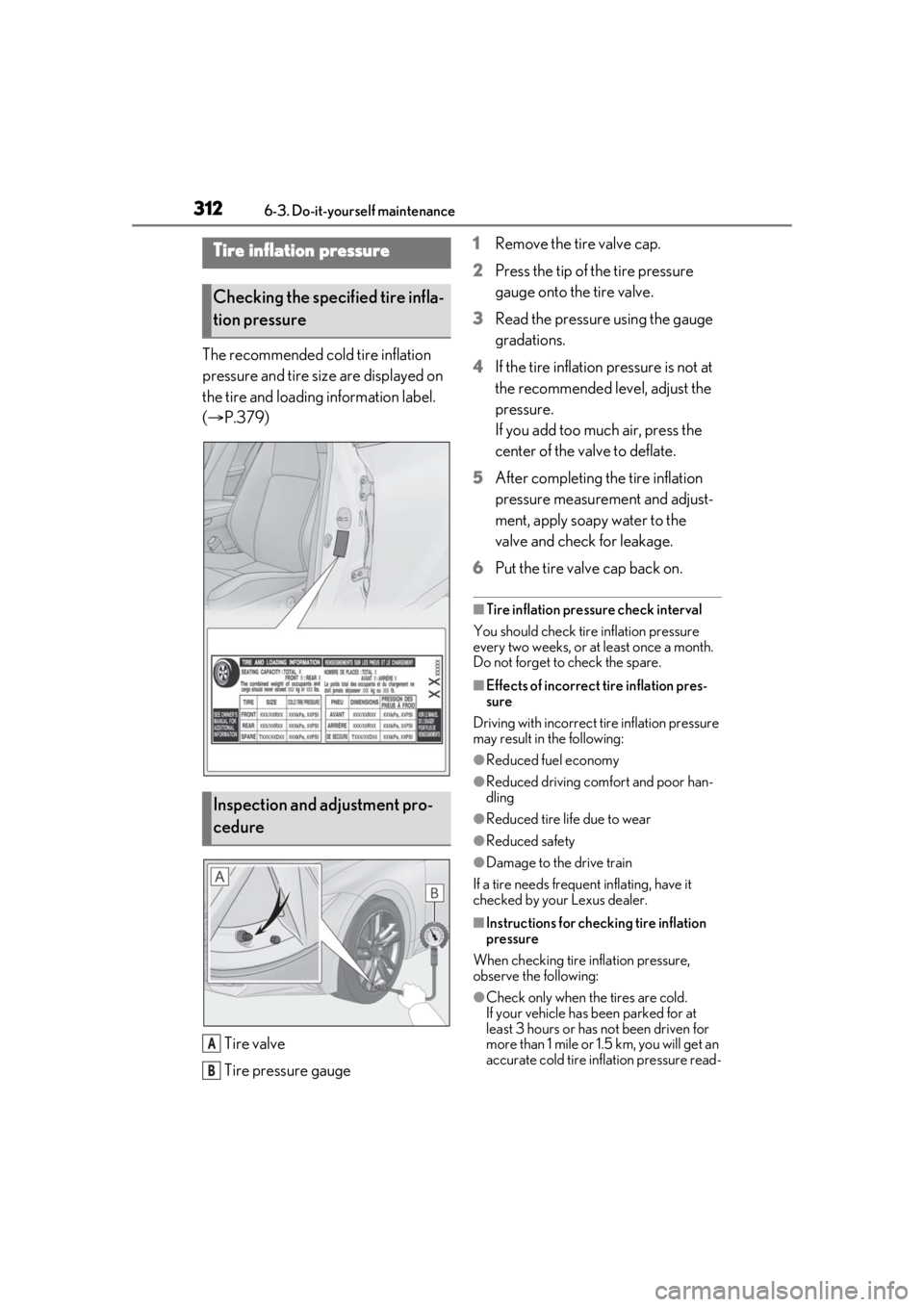
The recommended cold tire inflation
pressure and tire size are displayed on
the tire and loading information label.
( P.379)
Tire valve
Tire pressure gauge 1
Remove the tire valve cap.
2 Press the tip of the tire pressure
gauge onto the tire valve.
3 Read the pressure using the gauge
gradations.
4 If the tire inflation pressure is not at
the recommended level, adjust the
pressure.
If you add too much air, press the
center of the valve to deflate.
5 After completing the tire inflation
pressure measurement and adjust-
ment, apply soapy water to the
valve and check for leakage.
6 Put the tire valve cap back on.
■Tire inflation pressure check interval
You should check tire inflation pressure
every two weeks, or at least once a month.
Do not forget to check the spare.
■Effects of incorrect tire inflation pres-
sure
Driving with incorrect ti re inflation pressure
may result in the following:
●Reduced fuel economy
●Reduced driving comfort and poor han-
dling
●Reduced tire life due to wear
●Reduced safety
●Damage to the drive train
If a tire needs frequent inflating, have it
checked by your Lexus dealer.
■Instructions for checking tire inflation
pressure
When checking tire inflation pressure,
observe the following:
●Check only when the tires are cold.
If your vehicle has been parked for at
least 3 hours or has not been driven for
more than 1 mile or 1.5 km, you will get an
accurate cold tire inflation pressure read-
Tire inflation pressure
Checking the specified tire infla-
tion pressure
Inspection and adjustment pro-
cedure
A
B
Page 344 of 436
3447-2. Steps to take in an emergency
●Is the fuel tank empty?
If it is, fill the fuel tank immediately.
●Is the fuel tank cap loose?
If it is, tighten it securely.
The light will go off after several driving
trips.
If the light does not go off even after several
trips, contact your Lexus dealer as soon as
possible.
■Electric power steering system warning
light (warning buzzer)
When the battery charge becomes insuffi-
cient or the voltage temporarily drops, the
electric power steeri ng system warning
light may come on and the warning buzzer
may sound.
■When the tire pressure warning light
comes on
Inspect the tires to check if a tire is punc-
tured.
If a tire is punctured: P.349
If none of the tires are punctured:
Turn the engine switch off then turn it to
IGNITION ON mode. Check if the tire
pressure warning light comes on or blinks.
If the tire pressure wa rning light blinks for
approximately 1 minute then stays on
There may be a malfunction in the tire
pressure warning syst em. Have the vehicle
inspected by your Lexus dealer immedi-
ately.
If the tire pressure warning light comes
on
1 After the temperature of the tires has
lowered sufficiently, check the inflation
pressure of each tire and adjust them to
the specified level.
2 If the warning light does not turn off
even after several minutes have
elapsed, check that the inflation pres-
sure of each tire is at the specified level
and perform initialization. ( P.308)
■The tire pressure warning light may
come on due to natural causes
The tire pressure wa rning light may come
on due to natural causes such as natural air
leaks and tire inflation pressure changes
caused by temperature. In this case, adjust-ing the tire inflation pressure will turn off the
warning light (after a few minutes).
■When a tire is replaced with the spare
tire
The spare tire is not equipped with a tire
pressure warning valve and transmitter. If a
tire goes flat, the tire pressure warning light
will not turn off even though the flat tire has
been replaced with the spare tire.
■Conditions that the tire pressure warn-
ing system may not function properly
P.306
WARNING
■If both the ABS and the brake system
warning lights remain on
Stop your vehicle in a safe place immedi-
ately and contact your Lexus dealer.
The vehicle will become extremely
unstable during br aking, and the ABS
system may fail, which could cause an
accident resulting in death or serious
injury.
■When the electric power steering
system warning light comes on
When the light comes on yellow, the
assist to the power st eering is restricted.
When the light comes on red, the assist
to the power steering is lost and handling
operations of the steering wheel become
extremely heavy.
When steering wheel operations are
heavier than usual, grip the steering
wheel firmly and operate it using more
force than usual.
■If the tire pressure warning light
comes on
Be sure to observe the following precau-
tions.
Failure to do so could cause a loss of
vehicle control and result in death or
serious injury.
●Decelerate to the lowest appropriate
speed as soon as possible. Do not
drive over 50 mph (80 km/h).