wheel LEXUS IS350 2022 Owners Manual
[x] Cancel search | Manufacturer: LEXUS, Model Year: 2022, Model line: IS350, Model: LEXUS IS350 2022Pages: 440, PDF Size: 22.72 MB
Page 383 of 440

3818-1. Specifications
8
Vehicle specifications
Wheel diameter
Bead
Sidewall
Shoulder
Tread
Belt
Inner liner
Reinforcing rubber
Carcass
Rim lines
Bead wires
Chafer
This information has been prepared in
accordance with regulations issued by
the National Highway Traffic Safety
Administration of the U.S. Department
of Transportation.
It provides the purchasers and/or pro-
spective purchasers of Lexus vehicles
with information on uniform tire quality
grading.
Your Lexus dealer will help answer any questions you may have as you read this
information.
■DOT quality grades
All passenger vehicle tires must con-
form to Federal Safety Requirements in
addition to these grades. Quality
grades can be found where applicable
on the tire sidewall between tread
shoulder and maximum section width.
For example: Treadwear 200 Traction AA
Temperature A
■Treadwear
The treadwear grade is a comparative
rating based on the wear rate of the tire
when tested under controlled condi-
tions on a specified government test
course.
For example, a tire graded 150 would wear
one and a half (1 - 1/2) times as well on the
government course as a tire graded 100.
The relative performance of tires depends
upon the actual condit ions of their use.
Performance may differ significantly from
the norm due to variatio ns in driving habits,
service practices and differences in road
characteristics and climate.
■Traction AA, A, B, C
The traction grades, from highest to
lowest, are AA, A, B and C, and they
represent the tire’s ability to stop on
wet pavement as measured under con-
trolled conditions on specified govern-
ment test surfaces of asphalt and
concrete.
A tire marked C may have poor traction
performance.
Warning: The traction grade assigned to
this tire is based on braking (straight
ahead) traction tests and does not include
Tire section names
Uniform Tire Quality Grading
C
A
B
C
D
E
F
G
H
I
J
K
Page 384 of 440
3828-1. Specifications
cornering (turning) traction.
■Temperature A, B, C
The temperature grades are A (the
highest), B, and C, representing the
tire’s resistance to the generation of
heat and its ability to dissipate heat
when tested under controlled condi-
tions on a specified indoor laboratory
test wheel.
Sustained high temperature can cause the
material of the tire to degenerate and
reduce tire life, and excessive temperature
can lead to sudden tire failure. Grade C corresponds to
a level of perfor-
mance which all passenger car tires must
meet under the Federal Motor Vehicle
Safety Standard No. 109.
Grades B and A represent higher levels of
performance on the laboratory test wheel
than the minimum required by law.
Warning: The temperatur e grades of a tire
assume that it is properly inflated and not
overloaded.
Excessive speed, unde rinflation, or exces-
sive loading, either separately or in combi-
nation, can cause heat buildup and
possible tire failure.
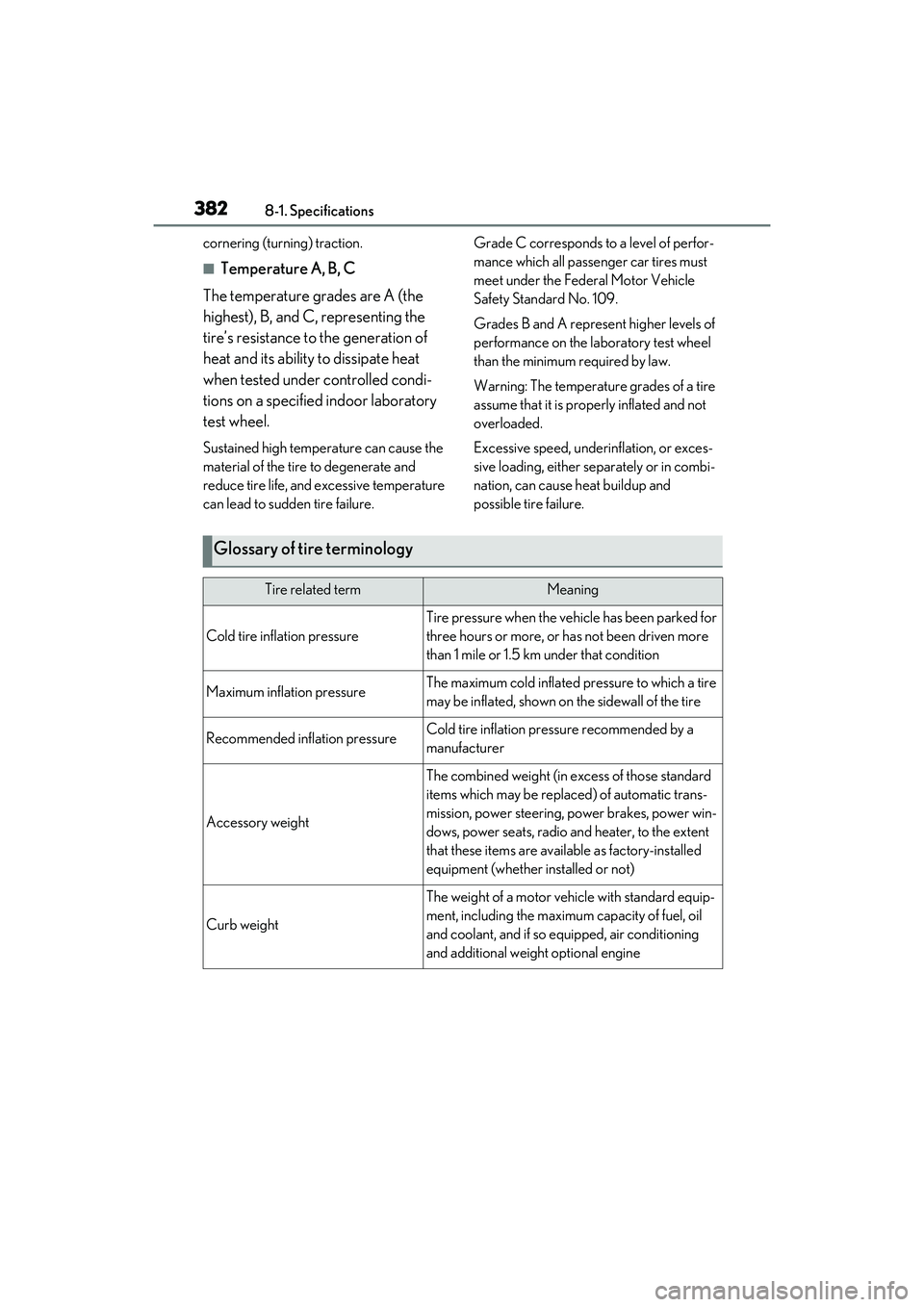
Glossary of tire terminology
Tire related termMeaning
Cold tire inflation pressure
Tire pressure when the vehicle has been parked for
three hours or more, or has not been driven more
than 1 mile or 1.5 km under that condition
Maximum inflation pressureThe maximum cold inflated pressure to which a tire
may be inflated, shown on the sidewall of the tire
Recommended inflation pressureCold tire inflation pressure recommended by a
manufacturer
Accessory weight
The combined weight (in excess of those standard
items which may be replaced) of automatic trans-
mission, power steering, power brakes, power win-
dows, power seats, radio and heater, to the extent
that these items are available as factory-installed
equipment (whether installed or not)
Curb weight
The weight of a motor vehicle with standard equip-
ment, including the maximum capacity of fuel, oil
and coolant, and if so equipped, air conditioning
and additional weight optional engine
Page 385 of 440

3838-1. Specifications
8
Vehicle specifications
Maximum loaded vehicle weight
The sum of:
(a) Curb weight
(b) Accessory weight
(c) Vehicle capacity weight
(d) Production options weight
Normal occupant weight
150 lb. (68 kg) times the number of occupants
specified in the second column of Table 1
* that fol-
lows
Occupant distributionDistribution of occupants in a vehicle as specified in
the third column of Table 1
* below
Production options weight
The combined weight of installed regular produc-
tion options weighing over 5 lb. (2.3 kg) in excess of
the standard items which they replace, not previ-
ously considered in curb weight or accessory
weight, including heavy duty brakes, ride levelers,
roof rack, heavy duty battery, and special trim
RimA metal support for a tire or a tire and tube assem-
bly upon which the tire beads are seated
Rim diameter (Wheel diameter)Nominal diameter of the bead seat
Rim size designationRim diameter and width
Rim type designationThe industry manufacturer’s designation for a rim
by style or code
Rim widthNominal distance between rim flanges
Vehicle capacity weight (Total load
capacity)The rated cargo and luggage load plus 150 lb. (68
kg) times the vehicle’s de signated seating capacity
Vehicle maximum load on the tire
The load on an individual ti re that is determined by
distributing to each axle its share of the maximum
loaded vehicle weight, and dividing by two
Vehicle normal load on the tire
The load on an individual ti re that is determined by
distributing to each axle its share of curb weight,
accessory weight, and normal occupant weight
(distributed in accordance with Table 1
* below), and
dividing by two
Weather sideThe surface area of the rim not covered by the
inflated tire
Tire related termMeaning
Page 387 of 440

3858-1. Specifications
8
Vehicle specifications
Intended outboard sidewall
(a) The sidewall that contains a whitewall, bears
white lettering, or bears manufacturer, brand,
and/or model name molding that is higher or
deeper than the same molding on the other sidewall
of the tire, or
(b) The outward facing sidewall of an asymmetrical
tire that has a particular side that must always face
outward when mounted on a vehicle
Light truck (LT) tire
A tire designated by its manufacturer as primarily
intended for use on lightwe ight trucks or multipur-
pose passenger vehicles
Load ratingThe maximum load that a tire is rated to carry for a
given inflation pressure
Maximum load ratingThe load rating for a tire at the maximum permissi-
ble inflation pressure for that tire
Maximum permissible inflation pres-
sureThe maximum cold inflation pressure to which a tire
may be inflated
Measuring rimThe rim on which a tire is fitted for physical dimen-
sion requirements
Open spliceAny parting at any junction of tread, sidewall, or
innerliner that extends to cord material
Outer diameterThe overall diameter of an inflated new tire
Overall width
The linear distance between the exteriors of the
sidewalls of an inflated tire, including elevations due
to labeling, decorations, or protective bands or ribs
Passenger car tire
A tire intended for use on passenger cars, multipur-
pose passenger vehicles, and trucks, that have a
gross vehicle weight rating (GVWR) of 10,000 lb.
or less.
PlyA layer of rubber-c oated parallel cords
Ply separationA parting of rubber comp ound between adjacent
plies
Pneumatic tire
A mechanical device made of rubber, chemicals,
fabric and steel or other materials, that, when
mounted on an automotive wheel, provides the
traction and contains the gas or fluid that sustains
the load
Tire related termMeaning
Page 388 of 440

3868-1. Specifications
*: Table 1 -Occupant loading and distribution for vehicle normal load for various desig-
nated seating capacities
Radial ply tire
A pneumatic tire in which the ply cords that extend
to the beads are laid at su bstantially 90 degrees to
the centerline of the tread
Reinforced tire
A tire designed to operat e at higher loads and at
higher inflation pressures than the corresponding
standard tire
Section width
The linear distance between the exteriors of the
sidewalls of an inflated tire, excluding elevations
due to labeling, decorati on, or protective bands
SidewallThat portion of a tire between the tread and bead
Sidewall separationThe parting of the rubber compound from the cord
material in the sidewall
Snow tire
A tire that attains a traction index equal to or
greater than 110, compared to the ASTM E-1136
Standard Referenc e Test Tire, when using the snow
traction test as described in ASTM F-1805-00,
Standard Test Method fo r Single Wheel Driving
Traction in a Straight Line on Snow-and Ice-Cov-
ered Surfaces, and which is marked with an Alpine
Symbol ( ) on at least one sidewall
Test rimThe rim on which a tire is fitted for testing, and may
be any rim listed as appropriate for use with that tire
TreadThat portion of a tire that comes into contact with
the road
Tread ribA tread section running ci rcumferentially around a
tire
Tread separationPulling away of the tread from the tire carcass
Treadwear indicators (TWI)
The projections within the principal grooves
designed to give a visual indication of the degrees
of wear of the tread
Wheel-holding fixtureThe fixture used to hold the wheel and tire assembly
securely during testing
Tire related termMeaning
Page 396 of 440
3948-2. Customization
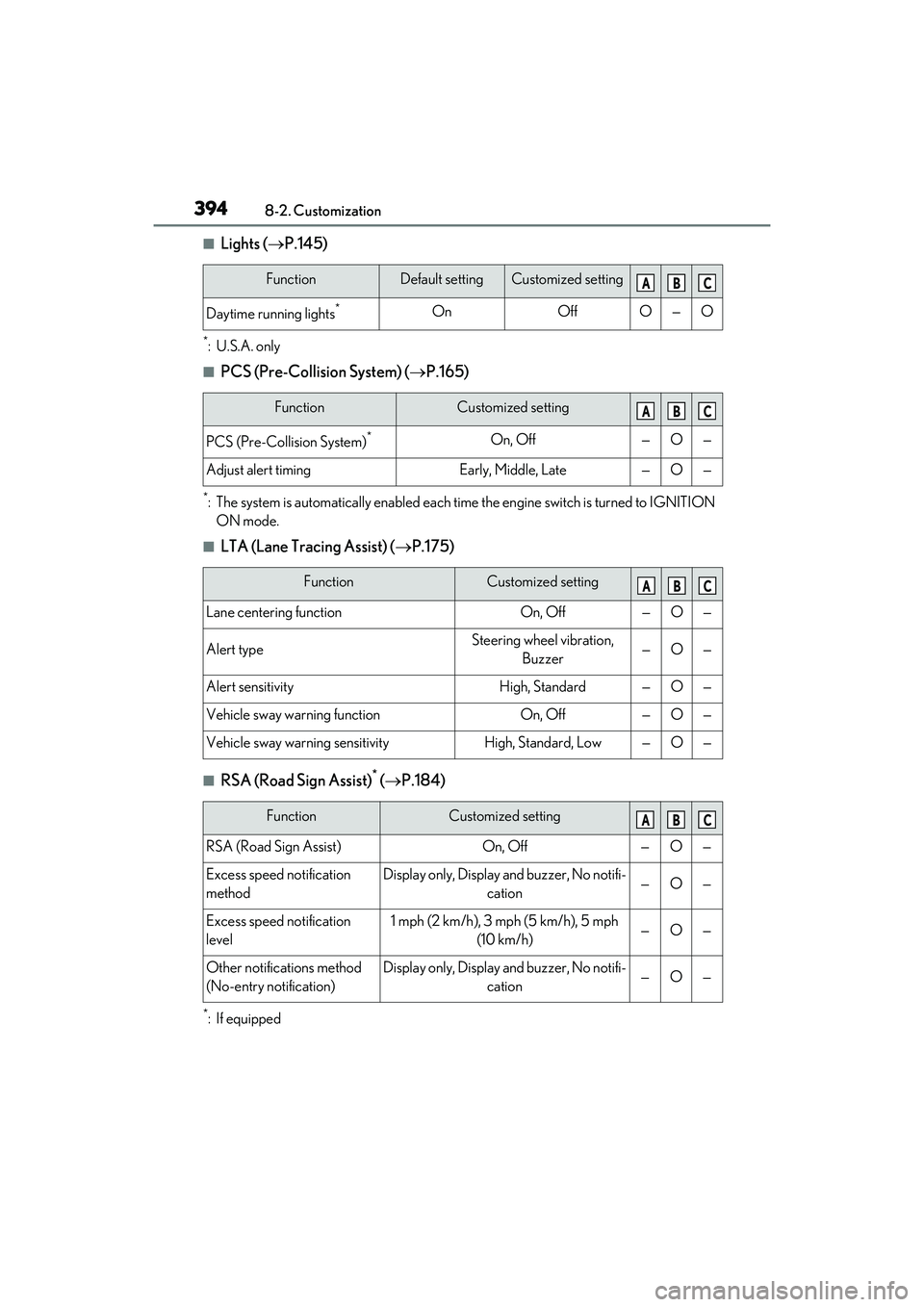
■Lights (P.145)
*: U.S.A. only
■PCS (Pre-Collision System) ( P.165)
*: The system is automatically enabled each time the engine switch is turned to IGNITION
ON mode.
■LTA (Lane Tracing Assist) ( P.175)
■RSA (Road Sign Assist)* ( P.184)
*:If equipped
FunctionDefault settingCustomized setting
Daytime running lights*OnOffO—O
FunctionCustomized setting
PCS (Pre-Collision System)*On, Off—O—
Adjust alert timingEarly, Middle, Late—O—
FunctionCustomized setting
Lane centering functionOn, Off—O—
Alert typeSteering wheel vibration,
Buzzer—O—
Alert sensitivityHigh, Standard—O—
Vehicle sway warning functionOn, Off—O—
Vehicle sway warning sensitivityHigh, Standard, Low—O—
FunctionCustomized setting
RSA (Road Sign Assist)On, Off—O—
Excess speed notification
methodDisplay only, Display and buzzer, No notifi- cation—O—
Excess speed notification
level1 mph (2 km/h), 3 mph (5 km/h), 5 mph (10 km/h)—O—
Other notifications method
(No-entry notification)Display only, Display and buzzer, No notifi- cation—O—
ABC
ABC
ABC
ABC
Page 400 of 440
3988-3. Initialization
8-3.Initialization
*:If equipped
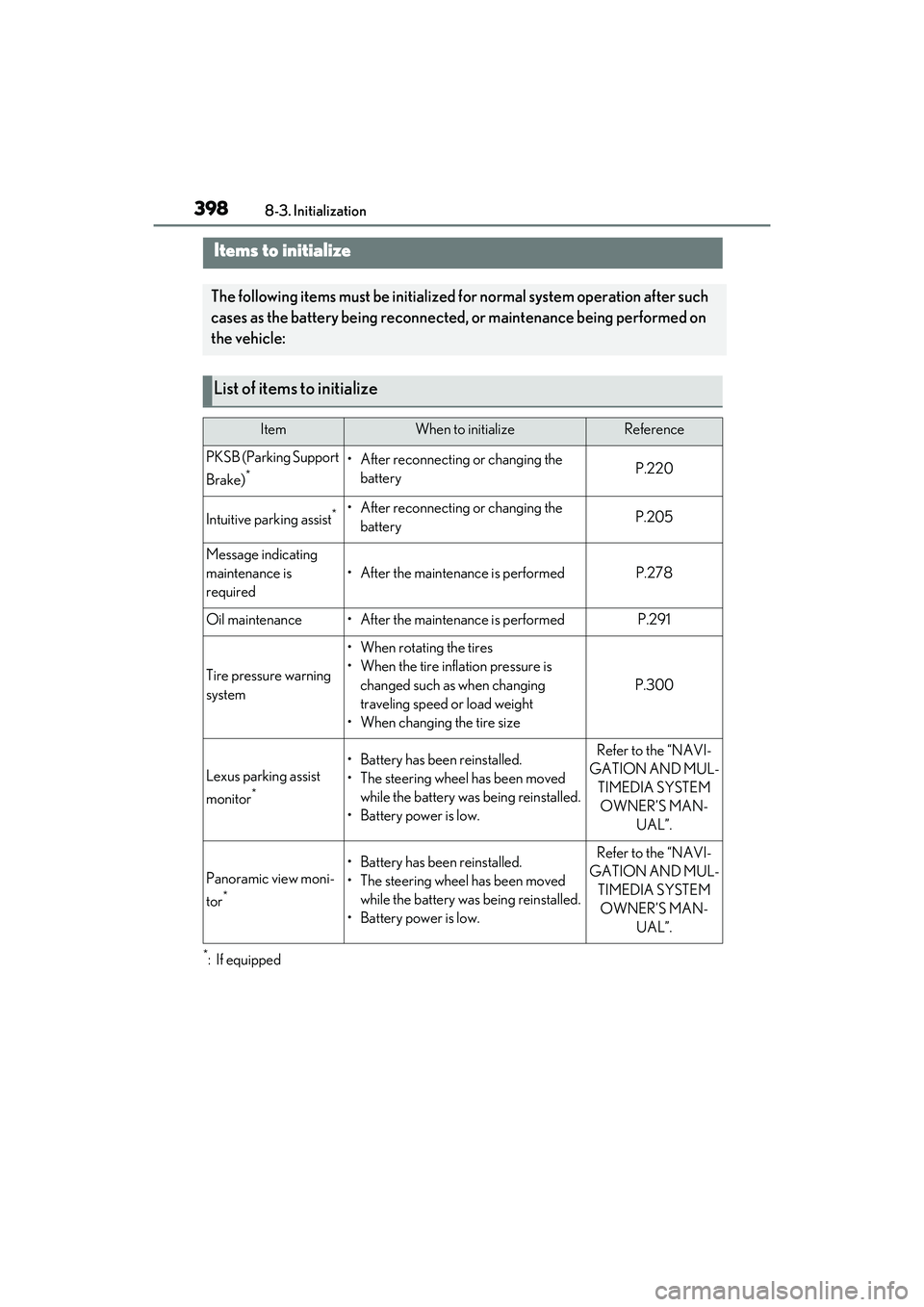
Items to initialize
The following items must be initialized for normal system operation after such
cases as the battery being reconnecte d, or maintenance being performed on
the vehicle:
List of items to initialize
ItemWhen to initializeReference
PKSB (Parking Support
Brake)
*• After reconnecting or changing the
batteryP.220
Intuitive parking assist*• After reconnecting or changing the
batteryP.205
Message indicating
maintenance is
required
• After the maintenance is performedP.278
Oil maintenance• After the maintenance is performedP.291
Tire pressure warning
system
• When rotating the tires
• When the tire inflation pressure is
changed such as when changing
traveling speed or load weight
• When changing the tire size
P.300
Lexus parking assist
monitor
*
• Battery has been reinstalled.
• The steering wheel has been moved while the battery was being reinstalled.
• Battery power is low.Refer to the “NAVI-
GATION AND MUL- TIMEDIA SYSTEM OWNER’S MAN- UAL”.
Panoramic view moni-
tor
*
• Battery has been reinstalled.
• The steering wheel has been moved while the battery was being reinstalled.
• Battery power is low.Refer to the “NAVI-
GATION AND MUL- TIMEDIA SYSTEM OWNER’S MAN- UAL”.
Page 414 of 440

412What to do if... (Troubleshooting)
1-1.What to do if... (Troubleshooting)What to do if... (Troubleshooting)
If you lose your mechanical keys,
new genuine mechanical keys can
be made by your Lexus dealer.
( P.350)
If you lose your electronic keys, the
risk of vehicle theft increases signifi-
cantly. Contact your Lexus dealer
immediately. ( P.350)
Is the electronic key battery weak or
depleted? ( P.308)
Is the engine switch in IGNITION
ON mode?
When locking the doors, turn the engine
switch off. ( P.132)
Is the electronic key left inside the
vehicle?
When locking the door s, make sure that
you have the electronic key on your per-
son.
The function may not operate prop-
erly due to the condition of the radio
wave. ( P.98)
Is the child-protector lock set?
The rear door cannot be opened from
inside the vehicle when the lock is set.
Open the rear door fr om outside and then
unlock the child-protector lock. ( P.93)
The function to prevent the elec-
tronic key from being left inside the
trunk will operate and you can open
the trunk as usual. Take the key out
from the trunk. ( P.95)
Did you press the engine switch
while firmly depressing the brake
pedal? ( P.130)
Is the shift lever in P? ( P.130)
Is the electronic key anywhere
detectable inside the vehicle?
( P.97)
Is the steering wheel unlocked?
( P.130)
Is the electronic key battery weak or
If you have a problem, check the
following before contacting your
Lexus dealer.
The doors cannot be locked,
unlocked, opened or closed
You lose your keys
The electronic key does not
operate properly
The doors cannot be locked or
unlocked
The rear door cannot be opened
The trunk lid is closed with the
electronic key left inside
If you think something is wrong
The engine does not start
Page 415 of 440

413What to do if... (Troubleshooting)
depleted?
In this case, the engine can be started in a
temporary way. (P.352)
Is the battery discharged?
( P.353)
Is the engine switch in IGNITION
ON mode?
If you cannot release the shift lever by
depressing the brake pedal with the engine
switch in IGNITION ON mode. ( P.135)
It is locked automatically to prevent
theft of the vehicle. ( P.130)
Is the window lock switch pressed?
The power window except for the one at
the driver’s seat cannot be operated if the
window lock switch is pressed. ( P.115)
The auto power off function will be
operated if the vehicle is left in
ACCESSORY or IGNITION ON
mode (the engine is not running) for
a period of time. ( P.132)
The seat belt reminder light is flash-
ing
Are the driver and the front passenger
wearing the seat belts? ( P.332)
The parking brake indicator is on
Is the parking brake released? ( P.139)
Depending on the situation, other
types of warning buzzer may also
sound. (P.329, 338)
Did anyone inside the vehicle open
a door during setting the alarm?
The sensor detects it and the alarm sounds.
(P.61)
Do one of the following to deactivate
or stop the alarm:
Unlock the doors.
Open the trunk.
Turn the engine switch to ACCES-
SORY or IGNITION ON mode, or
start the engine. (The alarm will be
deactivated or stopped after a few
seconds.)
Is the electronic key left inside the
vehicle or the moon roof opened?
Check the message on the multi-informa-
The shift lever cannot be shifted
from P even if you depress the
brake pedal
The steering wheel cannot be
turned after the engine is
stopped
The windows do not open or
close by operating the power
window switches
The engine switch is turned off
automatically
A warning buzzer sounds during
driving
An alarm is activated and the
horn sounds
A warning buzzer sounds when
leaving the vehicle
Page 418 of 440

416Alphabetical Index
BuzzerHands off steering wheel warning (LTA).......................................................................... 183
C
Card key ............................................................ 86
Care Exterior ........................................................... 270
Interior ............................................................. 274
Seat belts........................................................ 274
Wheels and wheel ornaments.. 270, 271
Cargo capacity...............................................128
Cargo net ....................................................... 258
Center Display ............................................. 240
Chains .............................................................. 235
Child restraint system Fixed with a LATCH system .................. 49
Fixed with a seat belt................................... 45
Front passenger occupa nt classification
system ............................................................. 36
Points to remember ...................................... 41
Riding with children ....................................... 41
Types of child restraint system installation method ............................................................42
Using an anchor bracket ............................ 51
Child safety Airbag precautions...................................... 33
Battery precautions ..................................356
Child restraint system..................................42
Heated steering wheel and seat heater precautions..................................................251
How your child should wear the seat belt ............................................................................ 25
Moon roof precautions ............................. 118
Power window lock switch...................... 115
Power window precautions .................... 115
Rear door child-protectors ..................... 93
Removed electronic key battery precau- tions ...............................................................309
Seat belt extender precautions ............. 25
Seat belt precautions .................................... 41
Trunk precautions ........................................ 94 Child-protectors............................................. 93
Cleaning
Exterior............................................................ 270
Interior ............................................................. 274
Radar sensor ................................................. 160
Seat belts ........................................................ 274
Wheels and wheel ornaments .. 270, 271
Clock ............................................... 69, 70, 260
Coat hooks..................................................... 260
Condenser ..................................................... 293
Console box .................................................. 257
Consumption screen .................................... 82
Cooling system............................................. 292 Engine overheating...................................357
Cruise control Dynamic radar cruise control with full-speed range ....................................... 187
Cup holders ................................................... 257
Current fuel consumption .......................... 78
Curtain shield airbags .................................. 28
Customizable features ..............................388
D
Daytime running light system ...................145
Defogger Outside rear view mirrors.....................245
Rear window ................................................245
Windshield ....................................................245
Differential Front differential oil......................................371
Rear differential oil.......................................371
Dimensions .................................................... 364
Dinghy towing.................................................129
Display Center Display ............................................240
Dynamic radar cruise control with full-speed range ....................................... 187
Intuitive parking assist ..............................203
LTA (Lane Tracing Assist) ..................... 180
Multi-information display .......................... 75
RCTA................................................................ 210
Warning message .................................... 338