wheel size LEXUS IS350 2022 User Guide
[x] Cancel search | Manufacturer: LEXUS, Model Year: 2022, Model line: IS350, Model: LEXUS IS350 2022Pages: 440, PDF Size: 22.72 MB
Page 307 of 440

3056-3. Do-it-yourself maintenance
6
Maintenance and care
ing.
●Always use a tire pressure gauge.
It is difficult to judge if a tire is properly
inflated based only on its appearance.
●It is normal for the tire inflation pressure
to be higher after driving as heat is gen-
erated in the tire. Do not reduce tire infla-
tion pressure after driving.
●Never exceed the vehicle capacity
weight.
Passengers and luggage weight should
be placed so that the vehicle is balanced.
When replacing wheels, care should
be taken to ensure that they are equiv-
alent to those removed in load capac-
ity, diameter, rim width and inset
*.
Replacement wheels are available at
your Lexus dealer.
*: Conventionally referred to as offset.
Lexus does not recommend using the
following:
Wheels of different sizes or types
Used wheels
Bent wheels that have been straight-
ened
■When replacing wheels
The wheels of your vehicle are equipped
with tire pressure wa rning valves and trans-
mitters that allow the tire pressure warning
system to provide advance warning in the
event of a loss in tire inflation pressure.
Whenever wheels are replaced, tire pres-
sure warning valves and transmitters must
be installed. ( P.300)
WARNING
■Proper inflation is critical to save tire
performance
Keep your tires properly inflated.
If the tires are not properly inflated, the
following conditions may occur which
could lead to an accident resulting in
death or serious injury:
●Excessive wear
●Uneven wear
●Poor handling
●Possibility of blowouts resulting from
overheated tires
●Air leaking from between tire and
wheel
●Wheel deformation and/or tire dam-
age
●Greater possibility of tire damage
while driving (due to road hazards,
expansion joints, sharp edges in the
road, etc.)
NOTICE
■When inspecting and adjusting tire
inflation pressure
Be sure to put the tire valve caps back on.
If a valve cap is not in stalled, dirt or mois-
ture may get into the valve and cause an
air leak, resulting in decreased tire infla-
tion pressure.
Wheels
If a wheel is bent, cracked or heavily
corroded, it should be replaced.
Otherwise, the tire may separate
from the wheel or cause a loss of
handling control.
Wheel selection
WARNING
■When replacing wheels
●Do not use wheels that are a different
size from those recommended in the
Owner’s Manual, as this may result in a
loss of handling control.
Page 339 of 440

3377-2. Steps to take in an emergency
7
When trouble arises
WARNING
●Check and adjust the tire inflation
pressure immediately.
●If the tire pressure warning light comes
on even after tire inflation pressure
adjustment, it is probable that you have
a flat tire. Check the tires. If a tire is flat,
change it with the spare tire and have
the flat tire repaired by the nearest
Lexus dealer.
●Avoid abrupt maneuvering and brak-
ing.
If the vehicle tires deteriorate, you
could lose control of the steering
wheel or the brakes.
■If a blowout or sudden air leakage
should occur
The tire pressure warning system may
not activate immediately.
■Maintenance of the tires
Each tire, including the spare (if pro-
vided), should be checked monthly when
cold and inflated to the inflation pressure
recommended by the vehicle manufac-
turer on the vehicle placard or tire infla-
tion pressure label (tire and load
information label). (If your vehicle has
tires of a different size than the size indi-
cated on the vehicle placard or tire infla-
tion pressure label [tire and load
information label], you should determine
the proper tire infl ation pressure for
those tires.)
As an added safety fe ature, your vehicle
has been equipped with a tire pressure
monitoring system (TPMS-tire pressure
warning system) that illuminates a low
tire pressure telltale (tire pressure warn-
ing light) when one or more of your tires
is significantly under-inflated. Accord-
ingly, when the low ti re pressure telltale
(tire pressure warnin g light) illuminates,
you should stop and check your tires as
soon as possible, and inflate them to the
proper pressure. Driving on a signifi-
cantly under-inflated tire causes the tire
to overheat and can lead to tire failure.
Under-inflation also reduces fuel effi-
ciency and tire tread life, and may affect
the vehicle’s handling and stopping abil-
ity.
Please note that the TPMS (tire pressure
warning system) is not a substitute for
proper tire maintena nce, and it is the
driver’s responsibility to maintain correct
tire pressure, even if under-inflation has
not reached the level to trigger illumina-
tion of the TPMS low tire pressure telltale
(tire pressure warning light).
Your vehicle has also been equipped with
a TPMS (tire pressure warning system)
malfunction indicator to indicate when
the system is not operating properly. The
TPMS (tire pressure warning system)
malfunction indicator is combined with
the low tire pressure telltale (tire pres-
sure warning light) . When the system
detects a malfunction, the telltale will
flash for approximately one minute and
then remain continuously illuminated.
This sequence will continue upon subse-
quent vehicle start-ups as long as the
malfunction exists. When the malfunction
indicator is illuminated, the system may
not be able to detect or signal low tire
pressure as intended.
Page 348 of 440

3467-2. Steps to take in an emergency
4Remove the guide pin and loosely
tighten the wheel bolt as in step 3.
5 Lower the vehicle.
6 Firmly tighten each wheel bolt in
the order shown in the illustration
two or three times.
Tightening torque:
103 ft•lbf (140 N•m, 14.3 kgf•m)
7Stow the flat tire, tire jack and all
tools.
■The compact spare tire
●The compact spare tire is identified by the
label “TEMPORARY USE ONLY” on the tire sidewall.
●Use the compact spare tire temporarily,
and only in an emergency.
●Make sure to check the tire inflation pres-
sure of the compact spare tire. (P.372)
■When using the compact spare tire
As the compact spare tire is not equipped
with a tire pressure warning valve and trans-
mitter, low inflation pressure of the spare
tire will not be indicated by the tire pressure
warning system. Also, if you replace the
compact spare tire after the tire pressure
warning light comes on, the light remains
on.
■When the compact spare tire is
equipped
The vehicle becomes lower when driving
with the compact spare tire compared to
when driving with standard tires.
■If you have a flat rear tire on a road cov-
ered with snow or ice (vehicles with
front and rear tires of the same size)
Install the compact spare tire on one of the
front wheels of the vehicle. Perform the fol-
lowing steps and fit tire chains to the rear
tires:
1 Replace a front tire with the compact
spare tire.
2 Replace the flat rear tire with the tire
removed from the front of the vehicle.
3 Fit tire chains to the rear tires.
WARNING
■Installing the compact spare tire
Failure to follow these precautions could
cause the wheel bolts to loosen and the
tire to fall off, result ing in death or serious
injury.
Page 374 of 440
3728-1. Specifications
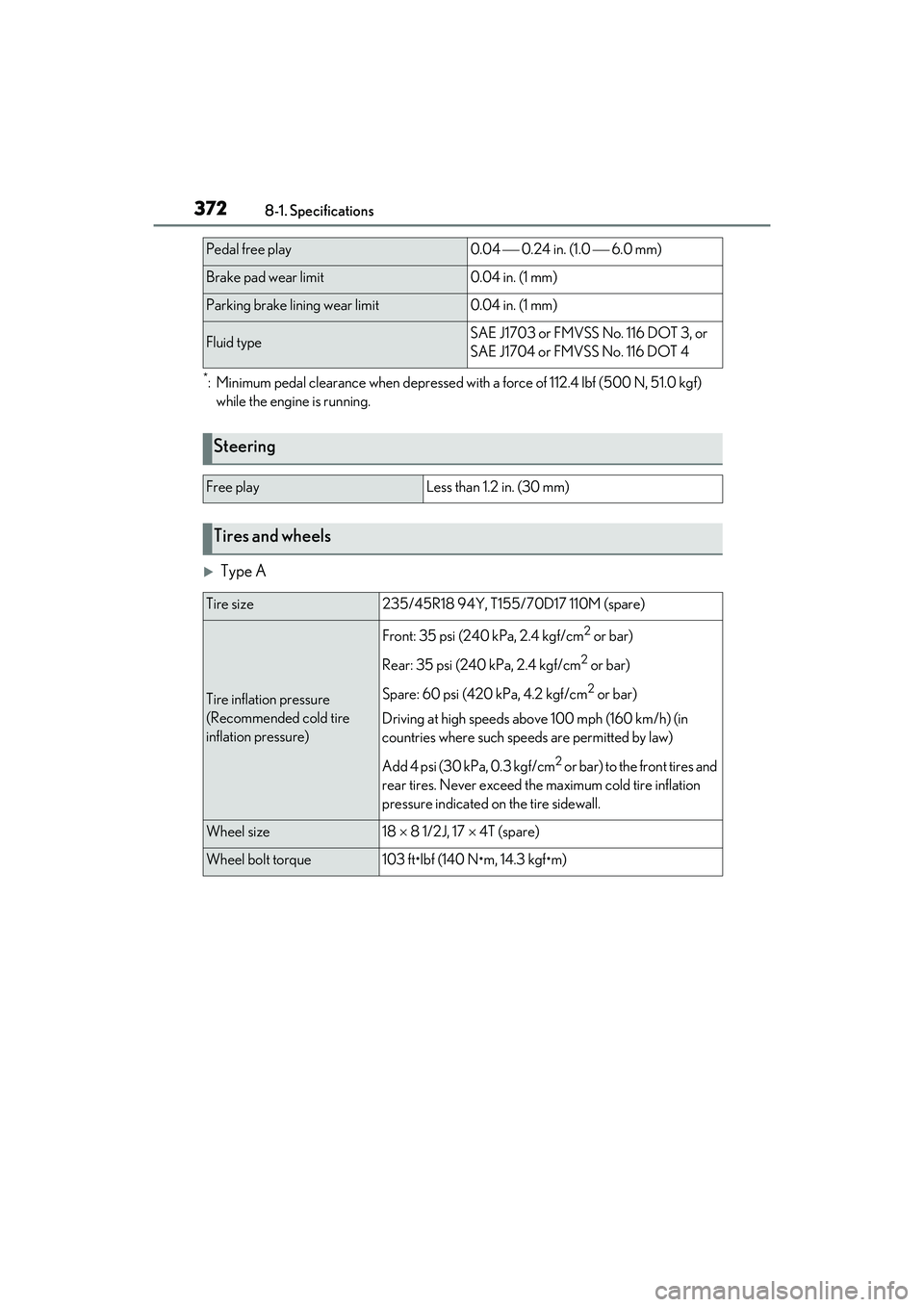
*: Minimum pedal clearance when depressed with a force of 112.4 lbf (500 N, 51.0 kgf)
while the engine is running.
Type A
Pedal free play0.04 0.24 in. (1.0 6.0 mm)
Brake pad wear limit0.04 in. (1 mm)
Parking brake lining wear limit0.04 in. (1 mm)
Fluid typeSAE J1703 or FMVSS No. 116 DOT 3, or
SAE J1704 or FMVSS No. 116 DOT 4
Steering
Free playLess than 1.2 in. (30 mm)
Tires and wheels
Tire size235/45R18 94Y, T155/70D17 110M (spare)
Tire inflation pressure
(Recommended cold tire
inflation pressure)
Front: 35 psi (240 kPa, 2.4 kgf/cm2 or bar)
Rear: 35 psi (240 kPa, 2.4 kgf/cm
2 or bar)
Spare: 60 psi (420 kPa, 4.2 kgf/cm
2 or bar)
Driving at high speeds above 100 mph (160 km/h) (in
countries where such speeds are permitted by law)
Add 4 psi (30 kPa, 0.3 kgf/cm
2 or bar) to the front tires and
rear tires. Never exceed the maximum cold tire inflation
pressure indicated on the tire sidewall.
Wheel size18 8 1/2J, 17 4T (spare)
Wheel bolt torque103 ft•lbf (140 N•m, 14.3 kgf•m)
Page 375 of 440
3738-1. Specifications
8
Vehicle specifications
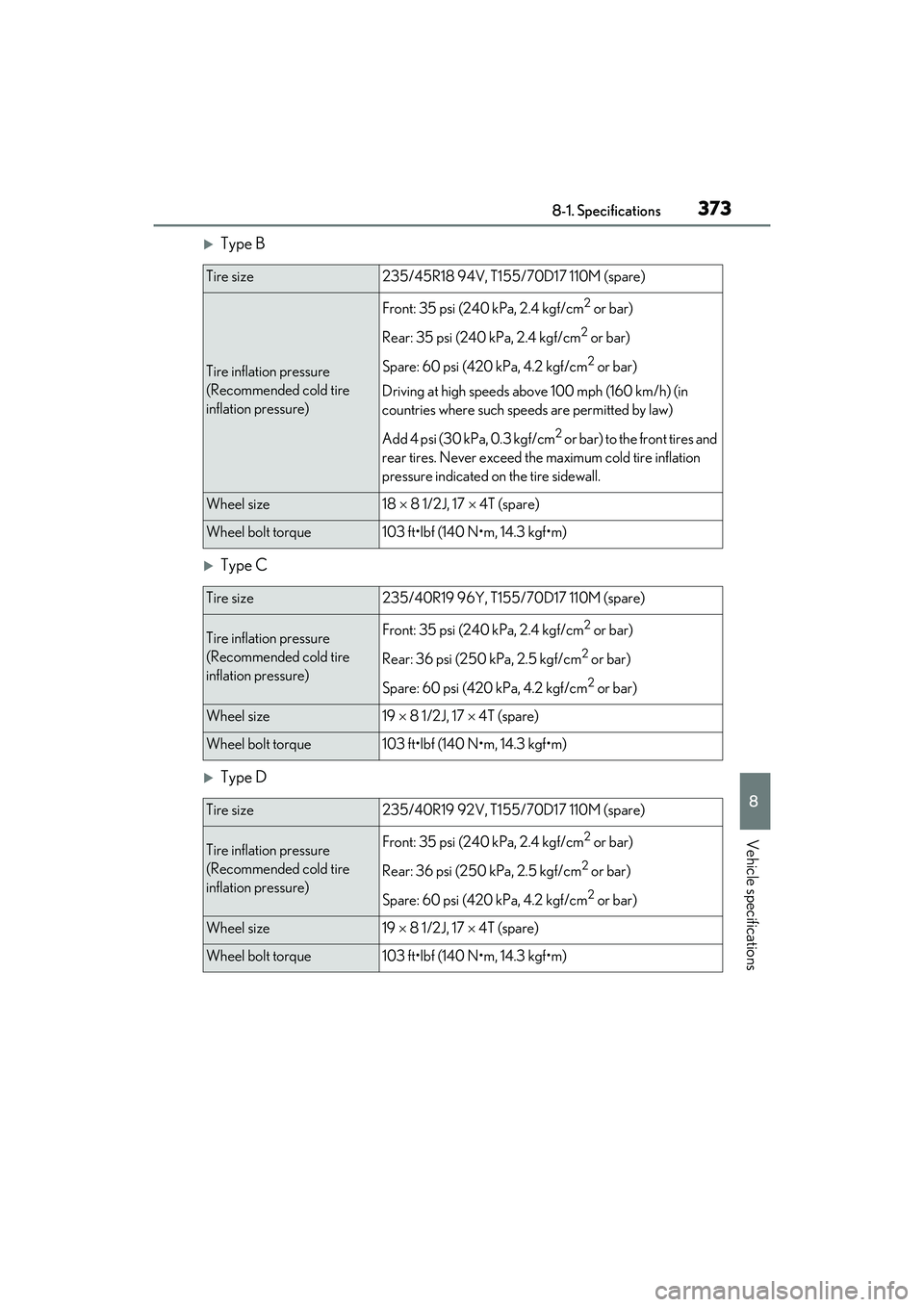
Type B
Type C
Type D
Tire size235/45R18 94V, T155/70D17 110M (spare)
Tire inflation pressure
(Recommended cold tire
inflation pressure)
Front: 35 psi (240 kPa, 2.4 kgf/cm2 or bar)
Rear: 35 psi (240 kPa, 2.4 kgf/cm
2 or bar)
Spare: 60 psi (420 kPa, 4.2 kgf/cm
2 or bar)
Driving at high speeds above 100 mph (160 km/h) (in
countries where such speeds are permitted by law)
Add 4 psi (30 kPa, 0.3 kgf/cm
2 or bar) to the front tires and
rear tires. Never exceed the maximum cold tire inflation
pressure indicated on the tire sidewall.
Wheel size18 8 1/2J, 17 4T (spare)
Wheel bolt torque103 ft•lbf (140 N•m, 14.3 kgf•m)
Tire size235/40R19 96Y, T155/70D17 110M (spare)
Tire inflation pressure
(Recommended cold tire
inflation pressure)Front: 35 psi (240 kPa, 2.4 kgf/cm2 or bar)
Rear: 36 psi (250 kPa, 2.5 kgf/cm
2 or bar)
Spare: 60 psi (420 kPa, 4.2 kgf/cm
2 or bar)
Wheel size19 8 1/2J, 17 4T (spare)
Wheel bolt torque103 ft•lbf (140 N•m, 14.3 kgf•m)
Tire size235/40R19 92V, T155/70D17 110M (spare)
Tire inflation pressure
(Recommended cold tire
inflation pressure)Front: 35 psi (240 kPa, 2.4 kgf/cm2 or bar)
Rear: 36 psi (250 kPa, 2.5 kgf/cm
2 or bar)
Spare: 60 psi (420 kPa, 4.2 kgf/cm
2 or bar)
Wheel size19 8 1/2J, 17 4T (spare)
Wheel bolt torque103 ft•lbf (140 N•m, 14.3 kgf•m)
Page 376 of 440
3748-1. Specifications
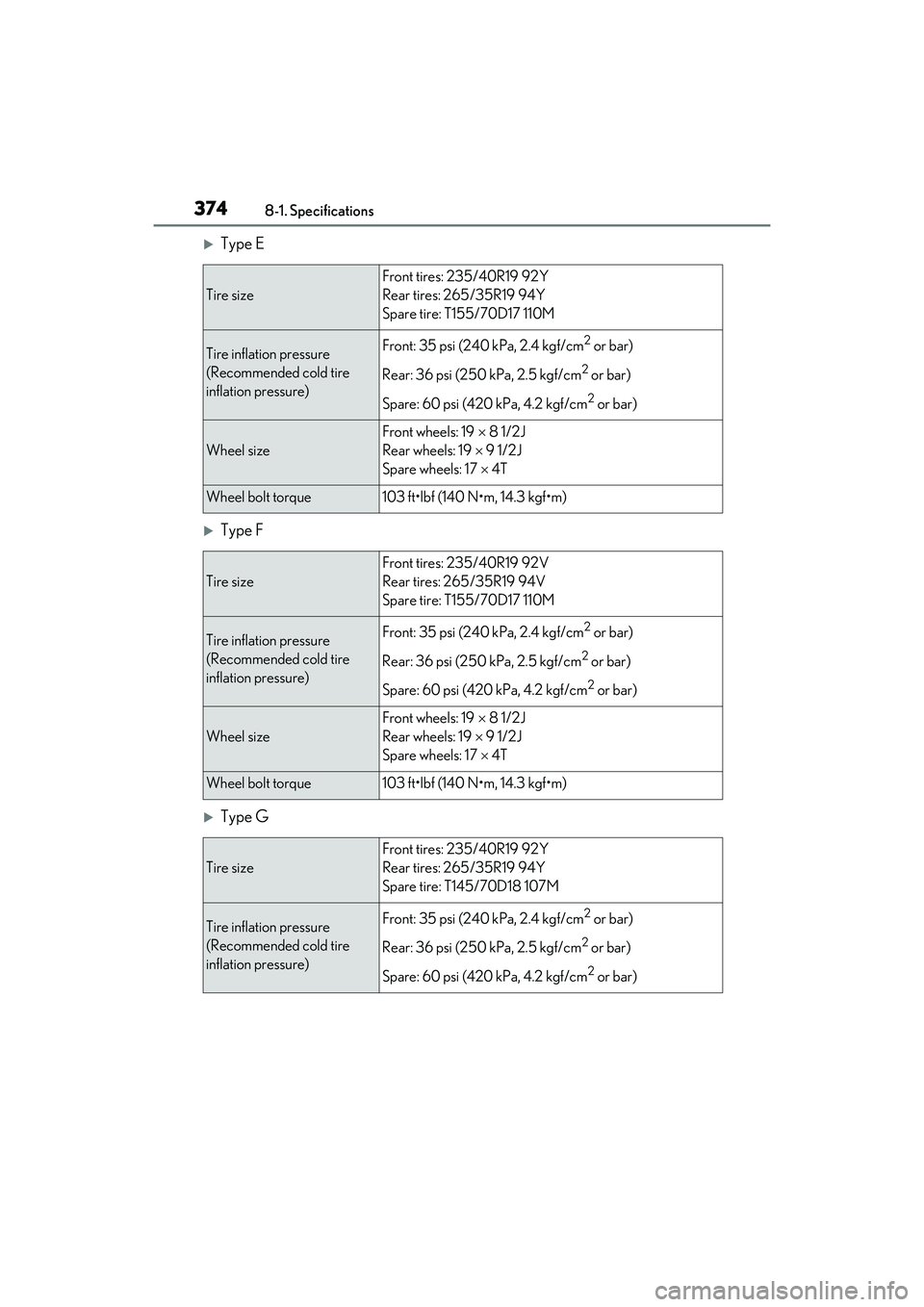
Type E
Type F
Type G
Tire size
Front tires: 235/40R19 92Y
Rear tires: 265/35R19 94Y
Spare tire: T155/70D17 110M
Tire inflation pressure
(Recommended cold tire
inflation pressure)Front: 35 psi (240 kPa, 2.4 kgf/cm2 or bar)
Rear: 36 psi (250 kPa, 2.5 kgf/cm
2 or bar)
Spare: 60 psi (420 kPa, 4.2 kgf/cm
2 or bar)
Wheel size
Front wheels: 19 8 1/2J
Rear wheels: 19 9 1/2J
Spare wheels: 17 4T
Wheel bolt torque103 ft•lbf (140 N•m, 14.3 kgf•m)
Tire size
Front tires: 235/40R19 92V
Rear tires: 265/35R19 94V
Spare tire: T155/70D17 110M
Tire inflation pressure
(Recommended cold tire
inflation pressure)Front: 35 psi (240 kPa, 2.4 kgf/cm2 or bar)
Rear: 36 psi (250 kPa, 2.5 kgf/cm
2 or bar)
Spare: 60 psi (420 kPa, 4.2 kgf/cm
2 or bar)
Wheel size
Front wheels: 19 8 1/2J
Rear wheels: 19 9 1/2J
Spare wheels: 17 4T
Wheel bolt torque103 ft•lbf (140 N•m, 14.3 kgf•m)
Tire size
Front tires: 235/40R19 92Y
Rear tires: 265/35R19 94Y
Spare tire: T145/70D18 107M
Tire inflation pressure
(Recommended cold tire
inflation pressure)Front: 35 psi (240 kPa, 2.4 kgf/cm2 or bar)
Rear: 36 psi (250 kPa, 2.5 kgf/cm
2 or bar)
Spare: 60 psi (420 kPa, 4.2 kgf/cm
2 or bar)
Page 377 of 440
3758-1. Specifications
8
Vehicle specifications
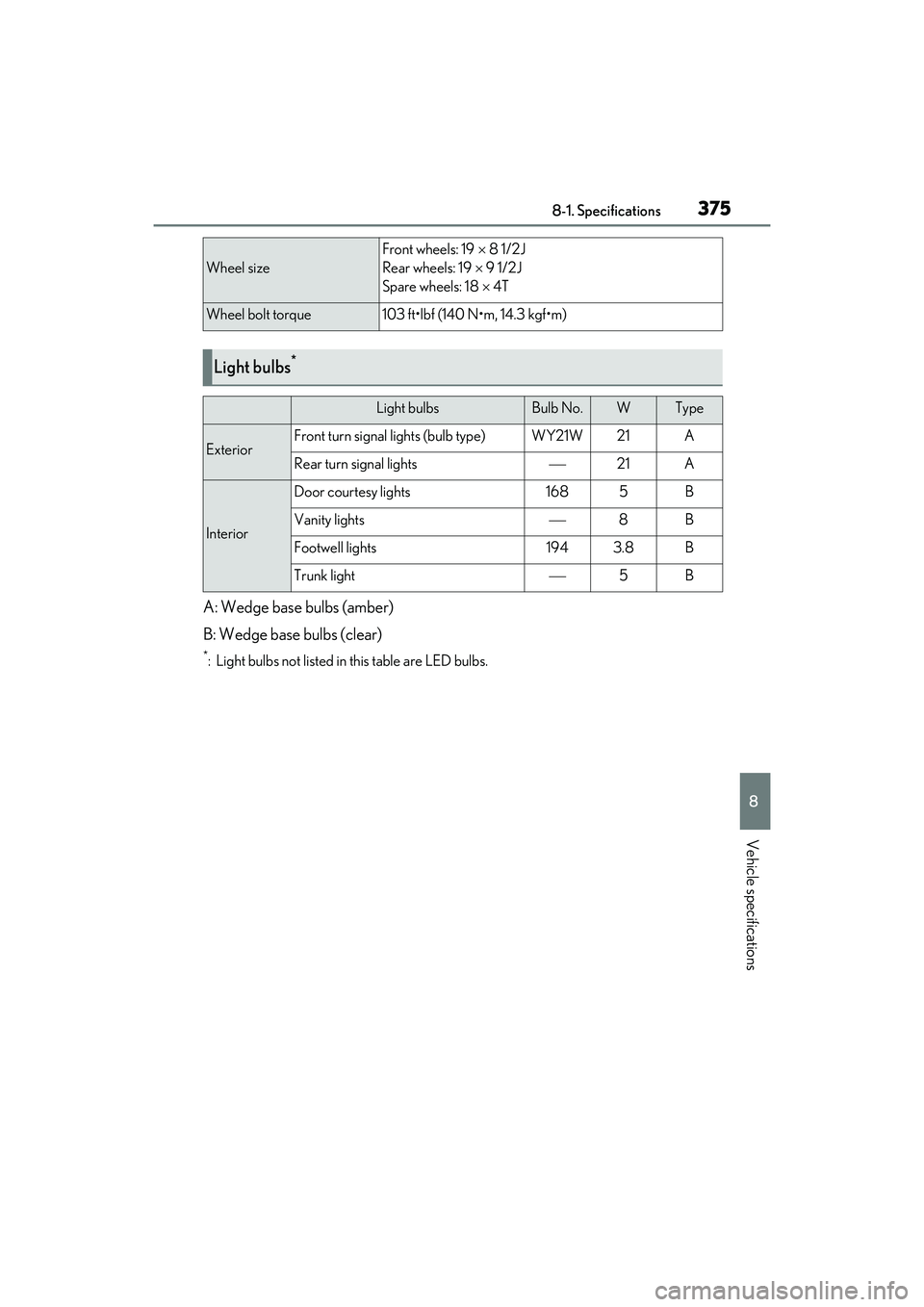
A: Wedge base bulbs (amber)
B: Wedge base bulbs (clear)
*: Light bulbs not listed in this table are LED bulbs.
Wheel size
Front wheels: 19 8 1/2J
Rear wheels: 19 9 1/2J
Spare wheels: 18 4T
Wheel bolt torque103 ft•lbf (140 N•m, 14.3 kgf•m)
Light bulbs*
Light bulbsBulb No.WType
ExteriorFront turn signal lights (bulb type)WY21W21A
Rear turn signal lights21A
Interior
Door courtesy lights1685B
Vanity lights8B
Footwell lights1943.8B
Trunk light5B
Page 382 of 440

3808-1. Specifications
DOT symbol*
Tire Identification Number (TIN)
Tire manufacturer’s identification
mark
Tire size code
Manufacturer’s optional tire type
code (3 or 4 letters)
Manufacturing week
Manufacturing year
*: The DOT symbol cert ifies that the tire
conforms to applic able Federal Motor
Vehicle Safety Standards.
Type B
DOT symbol
*
Tire Identification Number (TIN)
Tire manufacturer’s identification
mark
Manufacturer’s code
Manufacturing week
Manufacturing year
*: The DOT symbol cert ifies that the tire
conforms to applic able Federal Motor
Vehicle Safety Standards.
■Typical tire size information
The illustration indicates typical tire
size.
Tire use (P = Passenger car, T =
Temporary use)
Section width (millimeters)
Aspect ratio (tire height to section
width)
Tire construction code (R = Radial,
D = Diagonal)
Wheel diameter (inches)
Load index (2 digits or 3 digits)
Speed symbol (alphabet with one
letter)
■Tire dimensionsSection width
Tire height
A
B
C
D
E
F
G
A
B
C
D
E
F
Tire size
A
B
C
D
E
F
G
A
B
Page 385 of 440

3838-1. Specifications
8
Vehicle specifications
Maximum loaded vehicle weight
The sum of:
(a) Curb weight
(b) Accessory weight
(c) Vehicle capacity weight
(d) Production options weight
Normal occupant weight
150 lb. (68 kg) times the number of occupants
specified in the second column of Table 1
* that fol-
lows
Occupant distributionDistribution of occupants in a vehicle as specified in
the third column of Table 1
* below
Production options weight
The combined weight of installed regular produc-
tion options weighing over 5 lb. (2.3 kg) in excess of
the standard items which they replace, not previ-
ously considered in curb weight or accessory
weight, including heavy duty brakes, ride levelers,
roof rack, heavy duty battery, and special trim
RimA metal support for a tire or a tire and tube assem-
bly upon which the tire beads are seated
Rim diameter (Wheel diameter)Nominal diameter of the bead seat
Rim size designationRim diameter and width
Rim type designationThe industry manufacturer’s designation for a rim
by style or code
Rim widthNominal distance between rim flanges
Vehicle capacity weight (Total load
capacity)The rated cargo and luggage load plus 150 lb. (68
kg) times the vehicle’s de signated seating capacity
Vehicle maximum load on the tire
The load on an individual ti re that is determined by
distributing to each axle its share of the maximum
loaded vehicle weight, and dividing by two
Vehicle normal load on the tire
The load on an individual ti re that is determined by
distributing to each axle its share of curb weight,
accessory weight, and normal occupant weight
(distributed in accordance with Table 1
* below), and
dividing by two
Weather sideThe surface area of the rim not covered by the
inflated tire
Tire related termMeaning
Page 400 of 440
3988-3. Initialization
8-3.Initialization
*:If equipped
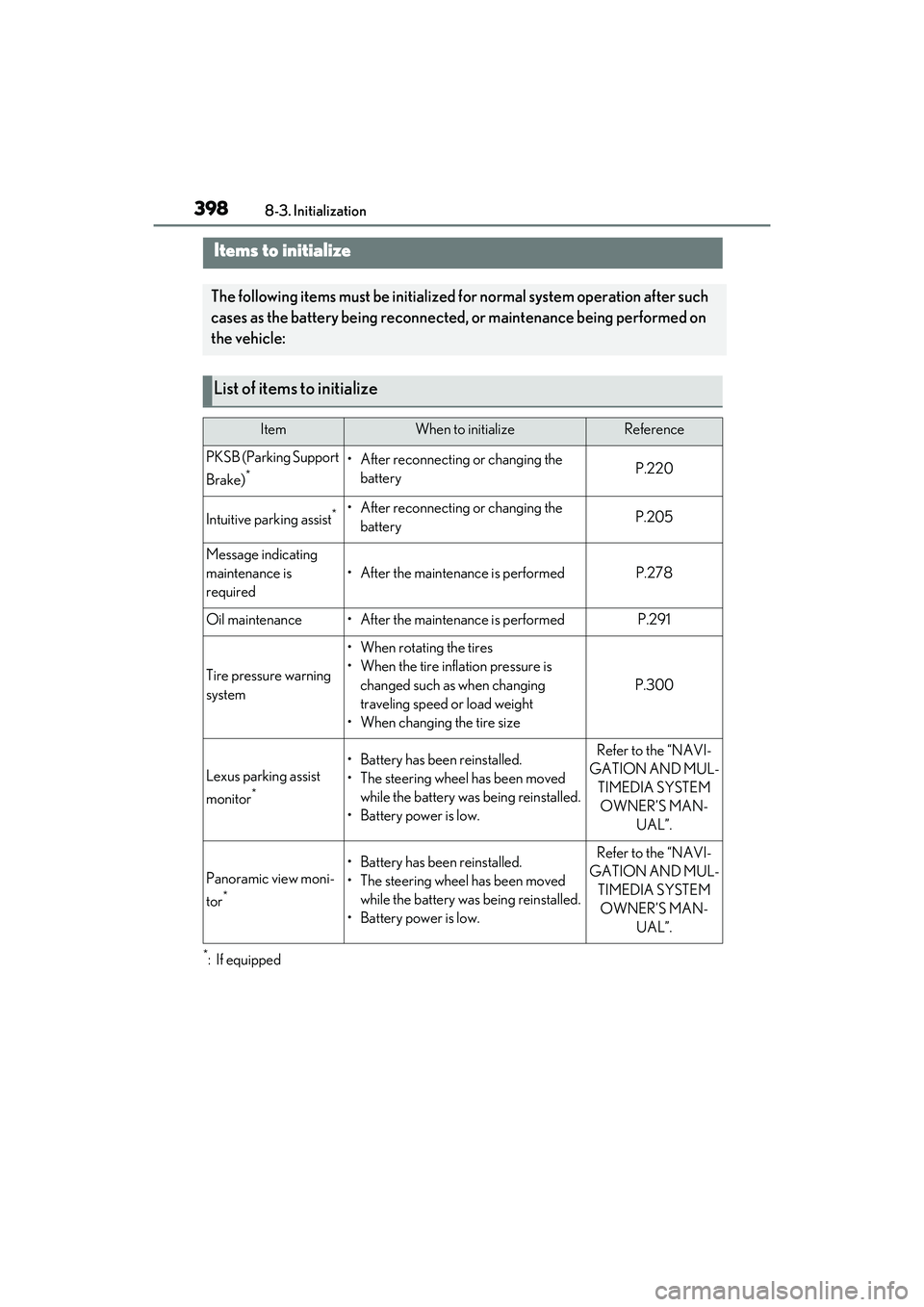
Items to initialize
The following items must be initialized for normal system operation after such
cases as the battery being reconnecte d, or maintenance being performed on
the vehicle:
List of items to initialize
ItemWhen to initializeReference
PKSB (Parking Support
Brake)
*• After reconnecting or changing the
batteryP.220
Intuitive parking assist*• After reconnecting or changing the
batteryP.205
Message indicating
maintenance is
required
• After the maintenance is performedP.278
Oil maintenance• After the maintenance is performedP.291
Tire pressure warning
system
• When rotating the tires
• When the tire inflation pressure is
changed such as when changing
traveling speed or load weight
• When changing the tire size
P.300
Lexus parking assist
monitor
*
• Battery has been reinstalled.
• The steering wheel has been moved while the battery was being reinstalled.
• Battery power is low.Refer to the “NAVI-
GATION AND MUL- TIMEDIA SYSTEM OWNER’S MAN- UAL”.
Panoramic view moni-
tor
*
• Battery has been reinstalled.
• The steering wheel has been moved while the battery was being reinstalled.
• Battery power is low.Refer to the “NAVI-
GATION AND MUL- TIMEDIA SYSTEM OWNER’S MAN- UAL”.