ECO mode LEXUS IS350 2022 Repair Manual
[x] Cancel search | Manufacturer: LEXUS, Model Year: 2022, Model line: IS350, Model: LEXUS IS350 2022Pages: 440, PDF Size: 22.72 MB
Page 325 of 440
3237-2. Steps to take in an emergency
7
When trouble arises
7-2.Steps to take in an emergency
If your vehicle needs to be
towed
If towing is necessary, we recom-
mend having your vehicle towed by
your Lexus dealer or commercial
towing service, using a wheel-lift
type truck or flatbed truck.
Use a safety chain system for all
towing, and abide by all state/pro-
vincial and local laws.
If towing your vehicle with a
wheel-lift type truck from the front,
the vehicle’s rear wheels and axles
must be in good conditions.
( P.324)
If they are damaged, use a towing
dolly or flatbed truck.
WARNING
Observe the following precautions.
Failure to do so may result in death or
serious injury.
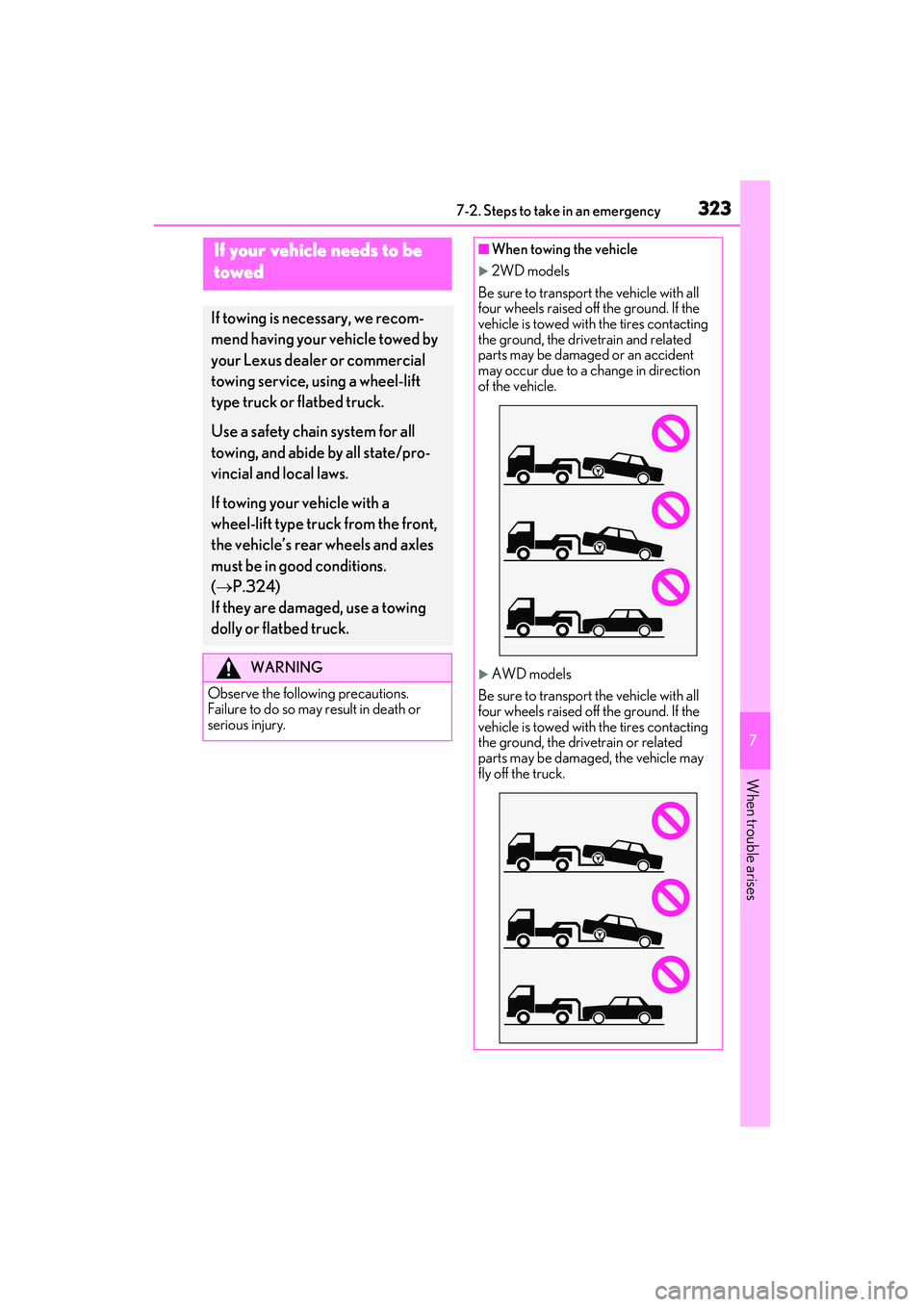
■When towing the vehicle
2WD models
Be sure to transport the vehicle with all
four wheels raised off the ground. If the
vehicle is towed with the tires contacting
the ground, the drivetrain and related
parts may be damaged or an accident
may occur due to a change in direction
of the vehicle.
AWD models
Be sure to transport the vehicle with all
four wheels raised off the ground. If the
vehicle is towed with the tires contacting
the ground, the drivetrain or related
parts may be damaged, the vehicle may
fly off the truck.
Page 338 of 440

3367-2. Steps to take in an emergency
●Is the fuel tank empty?
If it is, fill the fuel tank immediately.
●Is the fuel tank cap loose?
If it is, tighten it securely.
The light will go off after several driving
trips.
If the light does not go off even after several
trips, contact your Lexus dealer as soon as
possible.
■Electric power steering system warning
light (warning buzzer)
When the battery charge becomes insuffi-
cient or the voltage temporarily drops, the
electric power steeri ng system warning
light may come on and the warning buzzer
may sound.
■When the tire pressure warning light
comes on
Inspect the tires to check if a tire is punc-
tured.
If a tire is punctured: P.341
If none of the tires are punctured:
Turn the engine switch off then turn it to
IGNITION ON mode. Check if the tire
pressure warning light comes on or blinks.
If the tire pressure wa rning light blinks for
approximately 1 minute then stays on
There may be a malfunction in the tire
pressure warning system. Have the vehicle
inspected by your Lexus dealer immedi-
ately.
If the tire pressure warning light comes
on
1 After the temperature of the tires has
lowered sufficiently, check the inflation
pressure of each tire and adjust them to
the specified level.
2 If the warning light does not turn off
even after several minutes have
elapsed, check that the inflation pres-
sure of each tire is at the specified level
and perform initialization. ( P.301)
■The tire pressure warning light may
come on due to natural causes
The tire pressure warning light may come
on due to natural causes such as natural air
leaks and tire inflation pressure changes
caused by temperature. In this case, adjust-ing the tire inflation pressure will turn off the
warning light (after a few minutes).
■When a tire is replaced with the spare
tire
The spare tire is not equipped with a tire
pressure warning valve and transmitter. If a
tire goes flat, the tire pressure warning light
will not turn off even th ough the flat tire has
been replaced with the spare tire.
■Conditions that the tire pressure warn-
ing system may not function properly
P.299
WARNING
■If both the ABS and the brake system
warning lights remain on
Stop your vehicle in a safe place immedi-
ately and contact your Lexus dealer.
The vehicle will become extremely
unstable during br aking, and the ABS
system may fail, which could cause an
accident resulting in death or serious
injury.
■When the electric power steering
system warning light comes on
When the light comes on yellow, the
assist to the power st eering is restricted.
When the light comes on red, the assist
to the power steering is lost and handling
operations of the steering wheel become
extremely heavy.
When steering wheel operations are
heavier than usual, grip the steering
wheel firmly and operate it using more
force than usual.
■If the tire pressure warning light
comes on
Be sure to observe the following precau-
tions.
Failure to do so could cause a loss of
vehicle control and result in death or
serious injury.
●Decelerate to the lowest appropriate
speed as soon as possible. Do not
drive over 50 mph (80 km/h).
Page 352 of 440
3507-2. Steps to take in an emergency
2Shift the shift lever to P.
3 Turn the engine switch to ACCES-
SORY mode.
4 Press and hold the engine switch
for about 15 seconds while
depressing the brake pedal firmly.
Even if the engine can be started using
the above steps, the system may be
malfunctioning. Have the vehicle
inspected by your Lexus dealer.If you lose your keys
New genuine mechanical keys can
be made by your Lexus dealer using
another mechanical key and the
key number stamped on your key
number plate.
Keep the plate in a safe place such
as your wallet, not in the vehicle.
NOTICE
■When an electronic key is lost
If the electronic key remains lost, the risk
of vehicle theft increases significantly.
Visit your Lexus deal er immediately with
all remaining electronic keys and the
card key that were pr ovided with your
vehicle.
Page 354 of 440

3527-2. Steps to take in an emergency
1Locks all the doors
2 Unlocks the door
Turning the key rearward unlocks the
driver’s door. Turning the key once again
within 5 seconds unlocks the other doors.
■Trunk
Turn the mechanical key clockwise to
open. ( P.61)
■Key linked functions
1 Closes the windows and moon roof
(turn and hold)
*
2Opens the windows and moon roof
(turn and hold)
*
*
: This setting must be customized at your Lexus dealer.
1
Ensure that the shift lever is in P and
depress the brake pedal.
2 Touch the Lexus emblem side of the
electronic key to the engine switch.
When the electronic key is detected, a
buzzer sounds and the engine switch will
turn to IGNITION ON mode.
When the smart access system with
push-button start is deactivated in
customization setting, the engine switch
will turn to ACCESSORY mode.
3 Firmly depress the brake pedal and
check that is shown on the
multi-information display.
4 Press the engine switch.
In the event that the engine still cannot
WARNING
■When using the mechanical key and
operating the power windows or
moon roof
Operate the power window or moon
roof after checking to make sure that
there is no possibility of any passenger
having any of their body parts caught in
the window or moon roof.
Also, do not allow children to operate the
mechanical key. It is possible for children
and other passengers to get caught in
the power window or moon roof.
Starting the engine
Page 355 of 440

3537-2. Steps to take in an emergency
7
When trouble arises
be started, contact your Lexus dealer.
■Stopping the engine
Shift the shift lever to P and press the engine
switch as you normally do when stopping
the engine.
■Replacing the key battery
As the above procedure is a temporary
measure, it is recommended that the elec-
tronic key battery be replaced immediately
when the battery is depleted. ( P.308)
■Changing engine switch modes
Release the brake pedal and press the
engine switch in step 3 above. The engine
does not start and modes will be changed
each time the switch is pressed. ( P.132)
If the vehicle battery is dis-
charged
The following procedures may be
used to start the engine if the vehi-
cle’s battery is discharged.
You can also call your Lexus dealer
or a qualified repair shop.
Page 358 of 440

3567-2. Steps to take in an emergency
6Open and close any of the doors of
your vehicle with the engine switch
off.
7 Maintain the engine speed of the
second vehicle and start the engine
of your vehicle by turning the
engine switch to IGNITION ON
mode.
8 Once the vehicle’s engine has
started, remove the jumper cables
in the exact reverse order from
which they were connected.
Once the engine starts, have the vehi-
cle inspected at your Lexus dealer as
soon as possible.
■Starting the engine when the battery is
discharged
The engine cannot be started by push-start-
ing.
■To prevent battery discharge
●Turn off the headlights and the audio sys-
tem while the engine is off.
●Turn off any unnecessary electrical com-
ponents when the vehicle is running at a
low speed for an extended period, such
as in heavy traffic.
■Charging the battery
The electricity stored in the battery will dis-
charge gradually even when the vehicle is
not in use, due to natural discharge and the
draining effects of certain electrical appli-
ances. If the vehicle is left for a long time,
the battery may discharge, and the engine
may be unable to start. (The battery
recharges automatically during driving.)
■When recharging or replacing the bat-
tery
●In some cases, it may not be possible to
unlock the doors using the smart access
system with push-button start when the
battery is discharged. Use the wireless
remote control or the mechanical key to
lock or unlock the doors.
●The engine may not start on the first
attempt after the battery has recharged
but will start normally after the second
attempt. This is not a malfunction.
●The engine switch mode is memorized by
the vehicle. When the battery is recon-
nected, the system will return to the
mode it was in before the battery was dis-
charged. Before disconnecting the bat-
tery, turn the engine switch off. If you are
unsure what mode th e engine switch was
in before the battery discharged, be
especially careful when reconnecting the
battery.
WARNING
■Avoiding battery fires or explosions
Observe the following precautions to
prevent accidentally igniting the flamma-
ble gas that may be emitted from the bat-
tery:
●Make sure each jumper cable is con-
nected to the correct terminal and that
it is not unintentionally in contact with
any other than the intended terminal.
●Do not allow the other end of the
jumper cable connected to the “+” ter-
minal to come into contact with any
other parts or meta l surfaces in the
area, such as brackets or unpainted
metal.
●Do not allow the + and - clamps of the
jumper cables to come into contact
with each other.
●Do not smoke, use matches, cigarette
lighters or allow open flame near the
battery.
■Battery precautions
The battery contains poisonous and cor-
rosive acidic electrol yte, while related
parts contain lead and lead compounds.
Observe the following precautions when
handling the battery:
Page 387 of 440

3858-1. Specifications
8
Vehicle specifications
Intended outboard sidewall
(a) The sidewall that contains a whitewall, bears
white lettering, or bears manufacturer, brand,
and/or model name molding that is higher or
deeper than the same molding on the other sidewall
of the tire, or
(b) The outward facing sidewall of an asymmetrical
tire that has a particular side that must always face
outward when mounted on a vehicle
Light truck (LT) tire
A tire designated by its manufacturer as primarily
intended for use on lightwe ight trucks or multipur-
pose passenger vehicles
Load ratingThe maximum load that a tire is rated to carry for a
given inflation pressure
Maximum load ratingThe load rating for a tire at the maximum permissi-
ble inflation pressure for that tire
Maximum permissible inflation pres-
sureThe maximum cold inflation pressure to which a tire
may be inflated
Measuring rimThe rim on which a tire is fitted for physical dimen-
sion requirements
Open spliceAny parting at any junction of tread, sidewall, or
innerliner that extends to cord material
Outer diameterThe overall diameter of an inflated new tire
Overall width
The linear distance between the exteriors of the
sidewalls of an inflated tire, including elevations due
to labeling, decorations, or protective bands or ribs
Passenger car tire
A tire intended for use on passenger cars, multipur-
pose passenger vehicles, and trucks, that have a
gross vehicle weight rating (GVWR) of 10,000 lb.
or less.
PlyA layer of rubber-c oated parallel cords
Ply separationA parting of rubber comp ound between adjacent
plies
Pneumatic tire
A mechanical device made of rubber, chemicals,
fabric and steel or other materials, that, when
mounted on an automotive wheel, provides the
traction and contains the gas or fluid that sustains
the load
Tire related termMeaning
Page 398 of 440
3968-2. Customization
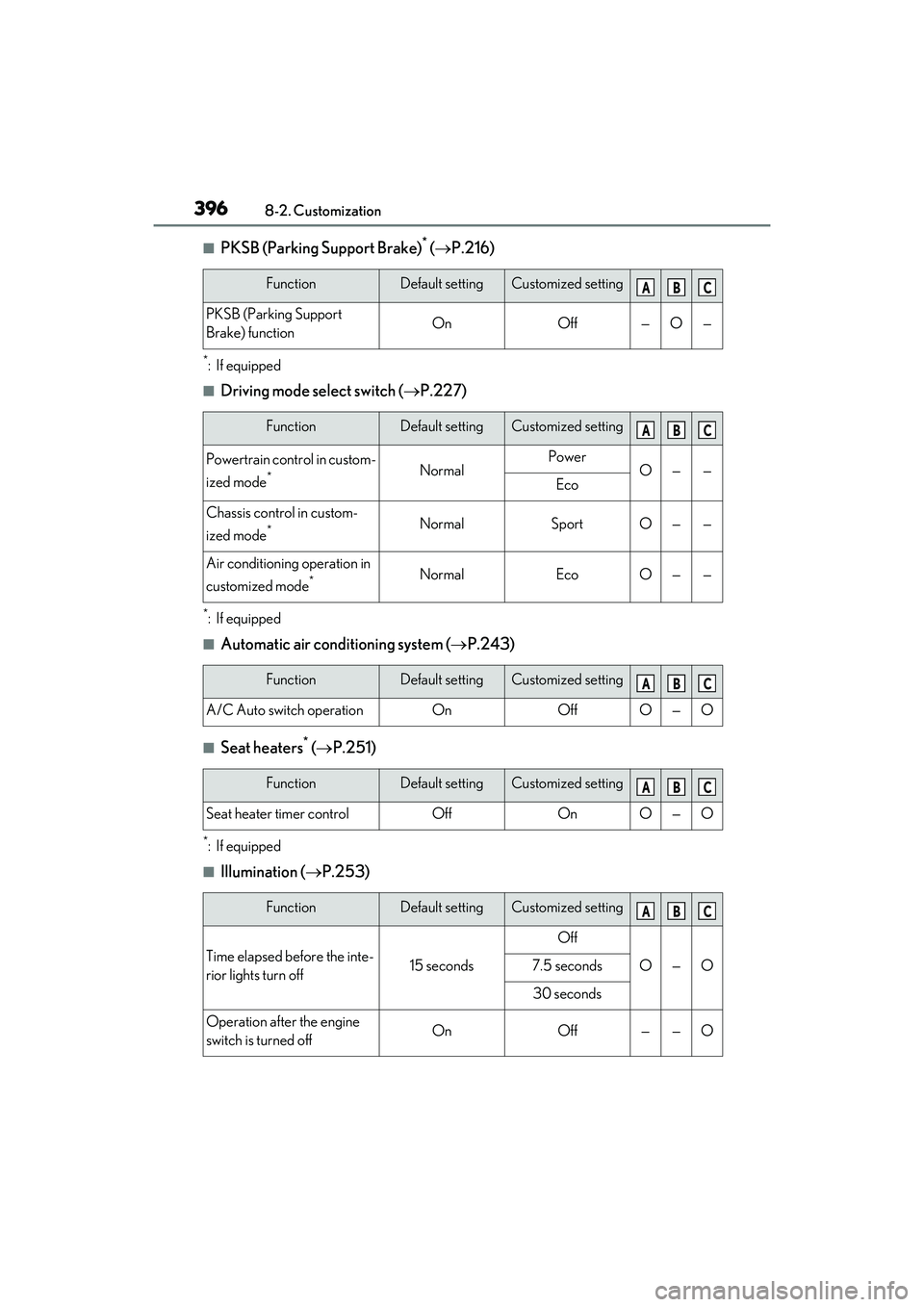
■PKSB (Parking Support Brake)* ( P.216)
*:If equipped
■Driving mode select switch ( P.227)
*:If equipped
■Automatic air conditioning system ( P.243)
■Seat heaters* ( P.251)
*:If equipped
■Illumination ( P.253)
FunctionDefault settingCustomized setting
PKSB (Parking Support
Brake) functionOnOff—O—
FunctionDefault settingCustomized setting
Powertrain control in custom-
ized mode
*NormalPowerO——Eco
Chassis control in custom-
ized mode
*NormalSportO——
Air conditioning operation in
customized mode
*NormalEcoO——
FunctionDefault settingCustomized setting
A/C Auto switch operationOnOffO—O
FunctionDefault settingCustomized setting
Seat heater timer controlOffOnO—O
FunctionDefault settingCustomized setting
Time elapsed before the inte-
rior lights turn off15 seconds
Off
O—O7.5 seconds
30 seconds
Operation after the engine
switch is turned offOnOff——O
ABC
ABC
ABC
ABC
ABC
Page 415 of 440

413What to do if... (Troubleshooting)
depleted?
In this case, the engine can be started in a
temporary way. (P.352)
Is the battery discharged?
( P.353)
Is the engine switch in IGNITION
ON mode?
If you cannot release the shift lever by
depressing the brake pedal with the engine
switch in IGNITION ON mode. ( P.135)
It is locked automatically to prevent
theft of the vehicle. ( P.130)
Is the window lock switch pressed?
The power window except for the one at
the driver’s seat cannot be operated if the
window lock switch is pressed. ( P.115)
The auto power off function will be
operated if the vehicle is left in
ACCESSORY or IGNITION ON
mode (the engine is not running) for
a period of time. ( P.132)
The seat belt reminder light is flash-
ing
Are the driver and the front passenger
wearing the seat belts? ( P.332)
The parking brake indicator is on
Is the parking brake released? ( P.139)
Depending on the situation, other
types of warning buzzer may also
sound. (P.329, 338)
Did anyone inside the vehicle open
a door during setting the alarm?
The sensor detects it and the alarm sounds.
(P.61)
Do one of the following to deactivate
or stop the alarm:
Unlock the doors.
Open the trunk.
Turn the engine switch to ACCES-
SORY or IGNITION ON mode, or
start the engine. (The alarm will be
deactivated or stopped after a few
seconds.)
Is the electronic key left inside the
vehicle or the moon roof opened?
Check the message on the multi-informa-
The shift lever cannot be shifted
from P even if you depress the
brake pedal
The steering wheel cannot be
turned after the engine is
stopped
The windows do not open or
close by operating the power
window switches
The engine switch is turned off
automatically
A warning buzzer sounds during
driving
An alarm is activated and the
horn sounds
A warning buzzer sounds when
leaving the vehicle
Page 417 of 440

415Alphabetical Index
Alphabetical Index
A
A/CAir conditioning filter ............................... 307
Automatic air conditioning system ... 243
Micro dust and pollen filter................... 248
ABS (Anti-lock Brake System).............. 229 Warning light .................................................331
ACA (Active Cornering Assist) ........... 229
Active Cornering Assist (ACA) ........... 229
Active Sound Control (ASC) ..................144
Adaptive Variable Suspension system229
AHB (Automatic High Beam) ................. 147
Air conditioning filter ................................. 307
Air conditioning system Air conditioning filter ............................... 307
Automatic air conditioning system ... 243
Micro dust and pollen filter................... 248
Airbags Airbag operating conditions................... 30
Airbag precautions for your child ........ 33
Correct driving posture .............................23
Curtain shield airbag operating condi- tions .................................................................. 30
Curtain shield airbag precautions ....... 33
Front passenger occupa nt classification
system ............................................................. 36
General airbag precautions ................... 33
Locations of airbags.................................... 28
Modification and disposal of airbags . 35
Side airbag operating conditions ......... 30
Side airbag precautions ............................ 33
Side and curtain shield airbags operating conditions ...................................................... 30
Side and curtain shield airbags precau- tions .................................................................. 33
SRS airbags ..................................................... 28
SRS warning light ......................................330
Alarm ..................................................................... 61 Warning buzzer......................................... 329
Anchor brackets .......................................42, 51 Antennas (smart acc
ess system with
push-button start).........................................97
Anti-lock Brake System (ABS).............. 229 Warning light ................................................ 331
Approach warning........................................192
Armrest............................................................ 260
ASC (Active Sound Control) ..................144
Assist grips ..................................................... 260
Audio system-linked display ...................... 80
Automatic air conditioning system ...... 243
Automatic headlight leveling system ....146
Automatic High Beam ................................ 147
Automatic light control system................145
Automatic transmission ..............................134 M mode ............................................................137
Paddle shift switches ....................... 136, 137
Snow mode.................................................... 136
Average fuel economy................................. 78
Average vehicle speed ................................ 78
B
Back-up lights Replacing light bulbs ..................................314
Battery If the battery is discharged ....................353
Preparing and checking before winter.......................................................................... 234
Warning light .............................................. 330
Blind Spot Monitor (BSM)......................... 197
Boost gauge.......................................................79
Brake Brake hold .......................................................142
Fluid.........................................................294, 371
Parking brake ............................................... 139
Warning light ...............................................329
Brake assist .................................................... 229
Break-in tips...................................................... 121
Brightness control Instrument panel light control................. 75
BSM (Blind Spot Monitor)......................... 197