towing LEXUS IS350C 2013 Owners Manual
[x] Cancel search | Manufacturer: LEXUS, Model Year: 2013, Model line: IS350C, Model: LEXUS IS350C 2013Pages: 624, PDF Size: 6.58 MB
Page 3 of 624

1
2
3
4
5
6
7
3
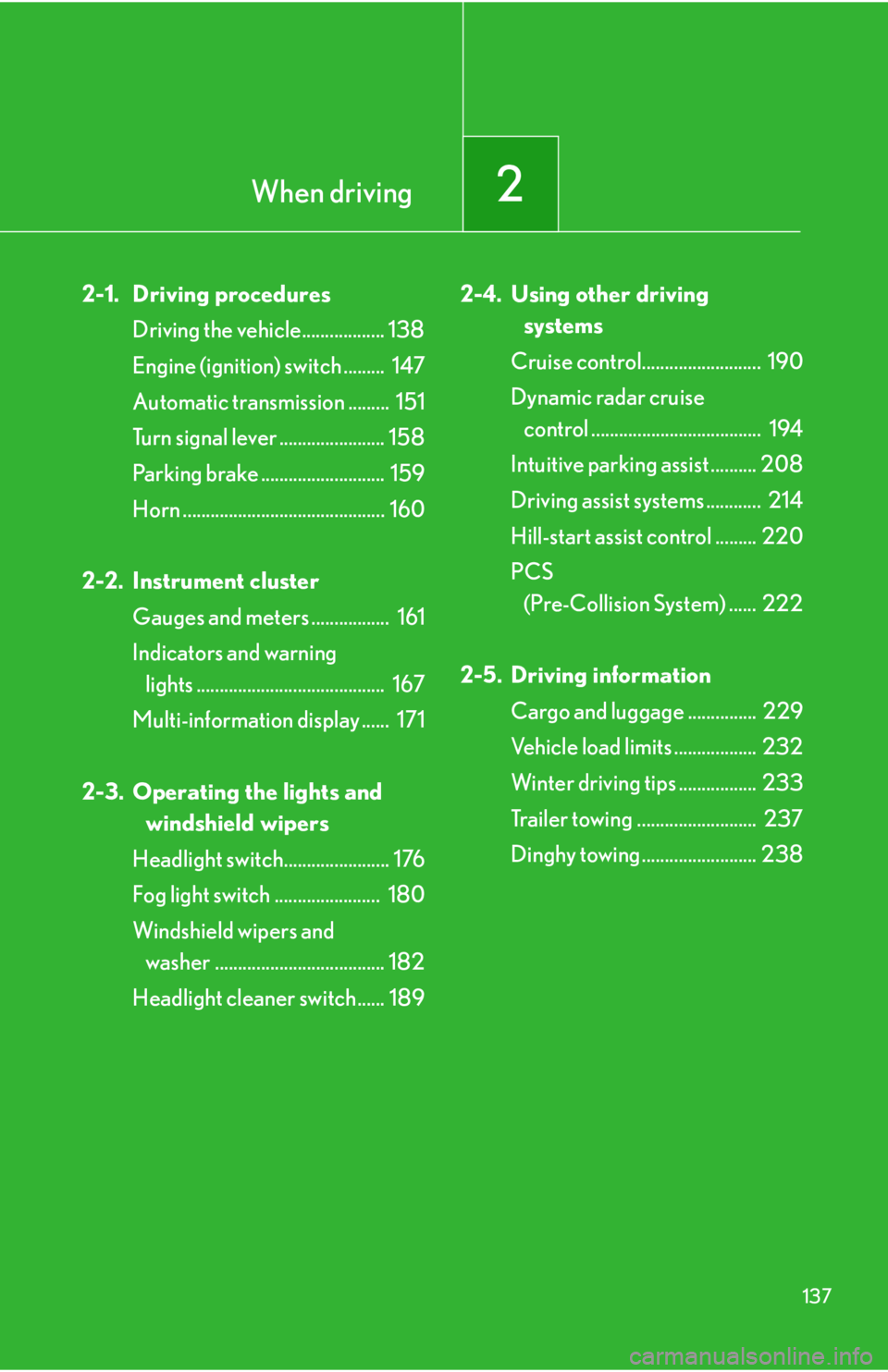
2-1. Driving proceduresDriving the vehicle ........................ 138
Engine (ignition) switch .............. 147
Automatic transmission................ 151
Turn signal lever ............................ 158
Parking brake ................................. 159
Horn.................................................... 160
2-2. Instrument cluster Gauges and meters ....................... 161
Indicators and warning lights................................................. 167
Multi-information display............. 171
2-3. Operating the lights and windshield wipers
Headlight switch ............................ 176
Fog light switch .............................. 180
Windshield wipers and washer............................................. 182
Headlight cleaner switch ........... 189 2-4. Using other driving systems
Cruise control ................................ 190
Dynamic radar cruise control............................................. 194
Intuitive parking assist ............... 208
Driving assist systems.................. 214
Hill-start assist control ............... 220
PCS (Pre-Collision System) ........... 222
2-5. Driving information Cargo and luggage ..................... 229
Vehicle load limits ........................ 232
Winter driving tips ....................... 233
Trailer towing ................................. 237
Dinghy towing ............................... 238
2When driving
Page 137 of 624
When driving2
137
2-1. Driving proceduresDriving the vehicle.................. 138
Engine (ignition) switch ......... 147
Automatic transmission ......... 151
Turn signal lever ....................... 158
Parking brake ........................... 159
Horn ............................................ 160
2-2. Instrument cluster Gauges and meters ................. 161
Indicators and warning lights ......................................... 167
Multi-information display ...... 171
2-3. Operating the lights and windshield wipers
Headlight switch....................... 176
Fog light switch ....................... 180
Windshield wipers and washer ..................................... 182
Headlight cleaner switch...... 189 2-4. Using other driving
systems
Cruise control.......................... 190
Dynamic radar cruise control ..................................... 194
Intuitive parking assist .......... 208
Driving assist systems ............ 214
Hill-start assist control ......... 220
PCS (Pre-Collision System) ...... 222
2-5. Driving information Cargo and luggage ............... 229
Vehicle load limits .................. 232
Winter driving tips ................. 233
Trailer towing .......................... 237
Dinghy towing ......................... 238
Page 193 of 624
193
2-4. Using other driving systems
2
When driving
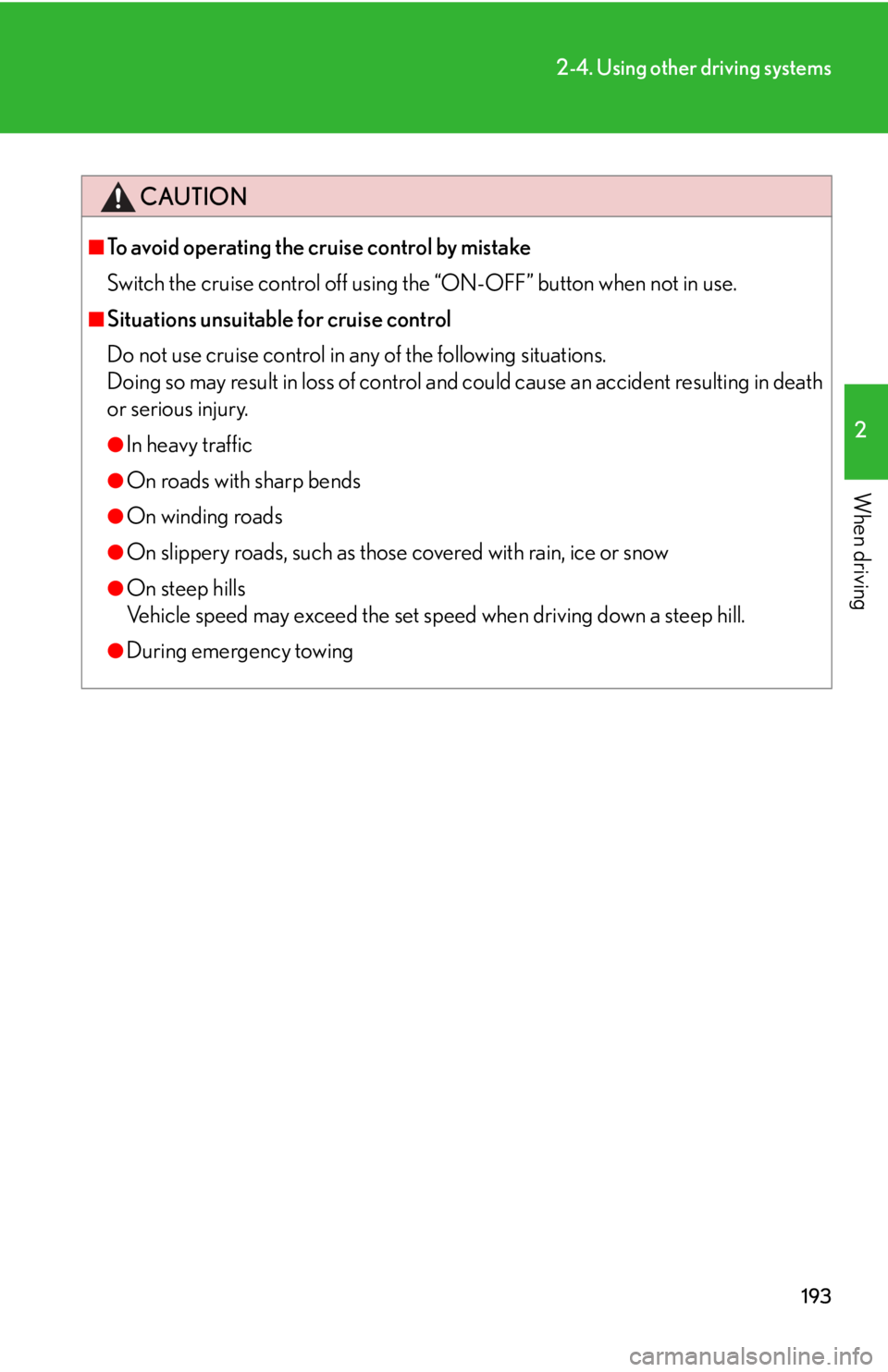
CAUTION
■To avoid operating the cruise control by mistake
Switch the cruise control off using the “ON-OFF” button when not in use.
■Situations unsuitable for cruise control
Do not use cruise control in any of the following situations.
Doing so may result in loss of control and could cause an accident resulting in death
or serious injury.
●In heavy traffic
●On roads with sharp bends
●On winding roads
●On slippery roads, such as thos e covered with rain, ice or snow
●On steep hills
Vehicle speed may exceed the set speed when driving down a steep hill.
●During emergency towing
Page 206 of 624

206
2-4. Using other driving systems
CAUTION
■To avoid inadvertent cruise control activation
Switch the cruise control off using the “ON-OFF” button when not in use.
■Situations unsuitable for dynamic radar cruise control
Do not use dynamic radar cruise contro l in any of the following situations.
Doing so may result in inappropriate sp eed control and could cause an accident
resulting in death or serious injury.
●In heavy traffic
●On roads with sharp bends
●On winding roads
●On slippery roads, such as thos e covered with rain, ice or snow
●On steep downhills, or where there are sudden changes between sharp up and
down gradients
Vehicle speed may exceed the set speed when driving down a steep hill.
●At entrances to expressways
●When weather conditions are bad enough that they may prevent the sensors
from functioning correctly (fog, sn ow, sandstorm, heavy rain, etc.)
●When an approach warning buzzer is heard often
●During emergency towing
■When the sensor may not be correctly detecting the vehicle ahead
Apply the brakes as necessary when any of the following types of vehicles are in
front of you.
As the sensor may not be able to correctly detect these types of vehicles, the
approach warning ( P. 200) will not be activated, and a fatal or serious accident
may result.
●Vehicles that cut in suddenly
●Vehicles traveling at low speeds
●Vehicles that are not moving
●Vehicles with small rear ends (tra ilers with no load on board etc.)
●Motorcycles traveling in the same lane
Page 212 of 624

212
2-4. Using other driving systems
■Sensor detection information
●Certain vehicle conditions and the surrounding environment may affect the
ability of the sensor to correctly detect obstacles. Particular instances where this
may occur are listed below.
• There is dirt, snow or ice on the sensor.
• The sensor is frozen.
• The sensor is covered in any way.
• The vehicle is leaning considerably to one side.
• On an extremely bumpy road, on an incline, on gravel, or on grass.
• The vicinity of the vehicle is noisy due to vehicle horns, motorcycle engines,
air brakes of large vehicles, or other loud noises producing ultrasonic waves.
• There is another vehicle equipped with parking assist sensors in the vicinity.
• The sensor is coated with a sheet of spray or heavy rain.
• The vehicle is equipped with a fender pole or wireless antenna.
• Towing eyelets are installed.
• The bumper or sensor receives a strong impact.
• The vehicle is approaching a tall or curved curb.
• In harsh sunlight or intense cold weather
In addition to the examples above, there are instances in which, because of their
shapes, signs and other object s may be judged by the sensor to be closer than they
are.
●The shape of the obstacle may prevent th e sensor from detecting it. Pay particu-
lar attention to the following obstacles.
• Wires, fences, ropes etc.
• Cotton, snow and other materials that absorb radio waves
• Sharply-angled objects
•Low obstacles
• Tall obstacles with upper sections projec ting outwards in the direction of your
vehicle
■When the display flashes an d a message is displayed
P. 5 0 0
Page 230 of 624

230
2-5. Driving information
(6)If your vehicle will be towing a trailer, load from your trailer will betransferred to your vehicle. Consul t this manual to determine how this
reduces the available cargo and luggage load capacity of your vehi-
cle.
Lexus does not recommend towing a trailer with your vehicle. Your vehicle is
not designed for trailer towing.
Calculation formula for your vehicle
Cargo capacity
Total load capacity (vehicle
capacity weight) (P. 5 5 2 )
When 2 people with the combined weight of A lb. (kg) are riding in your
vehicle, which has a total load capacity (vehicle ca pacity weight) of B lb.
(kg), the available amount of cargo and luggage load capacity will be C
lb. (kg) as follows:
B*
2 lb. (kg) - A*1 lb. (kg) = C*3 lb. (kg)
*
1: A =Weight of people
*2: B =Total load capacity
*3: C =Available cargo and luggage load
In this condition, if 2 more passengers with the combined weight of D lb. (kg)
get on, the available cargo and luggage lo ad will be reduced E lb. (kg) as fol-
lows:
C lb. (kg) - D*4 lb. (kg) = E*5 lb. (kg)
*
4: D =Additional weight of people
*5: E =Available cargo and luggage load
Page 232 of 624

232
2-5. Driving information
Vehicle load limits
■Total load capacity and seating capacity
These details are also described on the tire and loading information label.
( P. 4 4 1 )
CAUTION
■Overloading the vehicle
Do not overload the vehicle.
It may not only cause damage to the tire s, but also degrade steering and braking
ability, resulting in an accident.
Vehicle load limits include total lo ad capacity, seating capacity, towing
capacity and cargo capacity.
■ Total load capacity (vehicle capacity weight): ( P. 5 5 2 )
Total load capacity means the combined weight of occupants, cargo and
luggage.
■ Seating capacity: 4 occupants (Front 2, Rear 2)
Seating capacity means the maximum number of occupants whose esti-
mated average weight is 150 lb. (68 kg) per person.
■Towing capacity
Lexus does not recommend towing a trailer with your vehicle.
■Cargo capacity
Cargo capacity may increase or decrease depending on the weight and
the number of occupants.
Page 237 of 624

237
2-5. Driving information
2
When driving
Trailer towing
Lexus does not recommend towing a trailer with your vehicle. Lexus also
does not recommend the installation of a tow hitch or the use of a tow hitch
carrier for a wheelchair, scooter, bicycle, etc. Your Lexus is not designed
for trailer towing or for the us e of tow hitch mounted carriers.
Page 238 of 624

238
2-5. Driving information
Dinghy towing
NOTICE
■To avoid serious damage to your vehicle
Do not tow your vehicle with four wheels on the ground.
Your vehicle is not designed to be dinghy towed (with 4 wheels on the
ground) behind a motor home.
Page 391 of 624

391
3-7. Other interior features
3
Interior features
■Stolen Vehicle Location
If your vehicle is stolen, Safety Co nnect can work with local authorities
to assist them in locating and recovering the vehicle. After filing a
police report, call the Safety Conn ect response center at 1-800-25-
LEXUS (1-800-255-3987) and follo w the prompts for Safety Con-
nect to initiate this service.
In addition to assisting law enforcemen t with recovery of a stolen vehi-
cle, Safety-Connect-equipped vehicl e location data may, under cer-
tain circumstances, be shared with third parties to locate your vehicle.
Further information is available at Lexus.com.
■ Emergency Assistance Button (“SOS”)
In the event of an emergency on the road, push the “SOS” button to
reach the Safety Connect response center. The answering agent will
determine your vehicle’s location, assess the emergency, and dispatch
the necessary assistance required.
If you accidentally press the “SOS” bu tton, tell the response-center agent
that you are not experiencing an emergency.
■ Enhanced Roadside Assistance
Enhanced Roadside Assistance ad ds GPS data to the already
included warranty-based Lexus roadside service.
Subscribers can press the “SOS” button to reach a Safety Connect
response-center agent, who can help with a wide range of needs, such
as: towing, flat tire, fuel delivery, etc. For a description of the Enhanced
Roadside Assistance services and th eir limitations, please see the
Safety Connect Terms and Conditions, which are available at
Lexus.com.