tires lexus LC500C 2021 / LEXUS 2021 LC500 CONVERTIBLE (OM11498U) Owner's Guide
[x] Cancel search | Manufacturer: LEXUS, Model Year: 2021, Model line: LC500C, Model: Lexus LC500C 2021Pages: 410, PDF Size: 8.71 MB
Page 297 of 410
2956-3. Do-it-yourself maintenance
6
Maintenance and care
When replacing wheels, care should
be taken to ensure that they are equiv-
alent to those removed in load capac-
ity, diameter, rim width and inset
*.
Replacement wheels are available at
your Lexus dealer.
*: Conventionally referred to as offset.
Lexus does not recommend using the
following:
Wheels of different sizes or types
Used wheels
Bent wheels that have been
straightened
■When replacing wheels
The wheels of your vehicle are equipped
with tire pressure warning valves and trans-
mitters that allow the tire pressure warning
system to provide advance warning in the
event of a loss in tire inflation pressure.
Whenever wheels are replaced, tire pres-
sure warning valves an d transmitters must
be installed. ( P.285) Use only Lexus wheel nuts and
wrenches designed for use with
your aluminum wheels.
When rotating, repairing or chang-
ing your tires, check that the wheel
nuts are still tight after driving 1000
miles (1600 km).
Use only Lexus genuine balance
weights or equivalent and a plastic
or rubber hammer when balancing
your wheels.
Wheels
If a wheel is bent, cracked or heav-
ily corroded, it should be replaced.
Otherwise, the tire may separate
from the wheel or cause a loss of
handling control.
Wheel selection
WARNING
■When replacing wheels
●Do not use wheels that are a different
size from those recommended in the
Owner’s Manual, as this may result in a
loss of handling control.
●Never use an inner tube in a leaking
wheel which is designed for a tubeless
tire. Doing so may result in an acci-
dent, causing death or serious injury.
■Use of defective wheels prohibited
Do not use cracked or deformed wheels.
Doing so could cause the tire to leak air
during driving, possibly causing an acci-
dent.
NOTICE
■Replacing tire pressure warning
valves and transmitters
●Because tire repair or replacement
may affect the tire pressure warning
valves and transmitters, make sure to
have tires serviced by your Lexus
dealer or other qua lified service shop.
In addition, make sure to purchase
your tire pressure warning valves and
transmitters at your Lexus dealer.
●Ensure that only genuine Lexus wheels
are used on your vehicle.
Tire pressure warning valves and
transmitters may not work properly
with non-genuine wheels.
Aluminum wheel precautions
Page 311 of 410
3097-2. Steps to take in an emergency
7
When trouble arises
7-2.Steps to take in an emergency
If your vehicle needs to be
t
owed
If towing is ne cessary, we recom-
mend having your vehicle towed by
your Lexus dealer or commercial
towing service, using a wheel-lift
type truck or flatbed truck.
Use a safety chain system for all
towing, and abide by all state/pro-
vincial and local laws.
WARNING
Observe the following precautions.
Failure to do so may result in death or
serious injury.
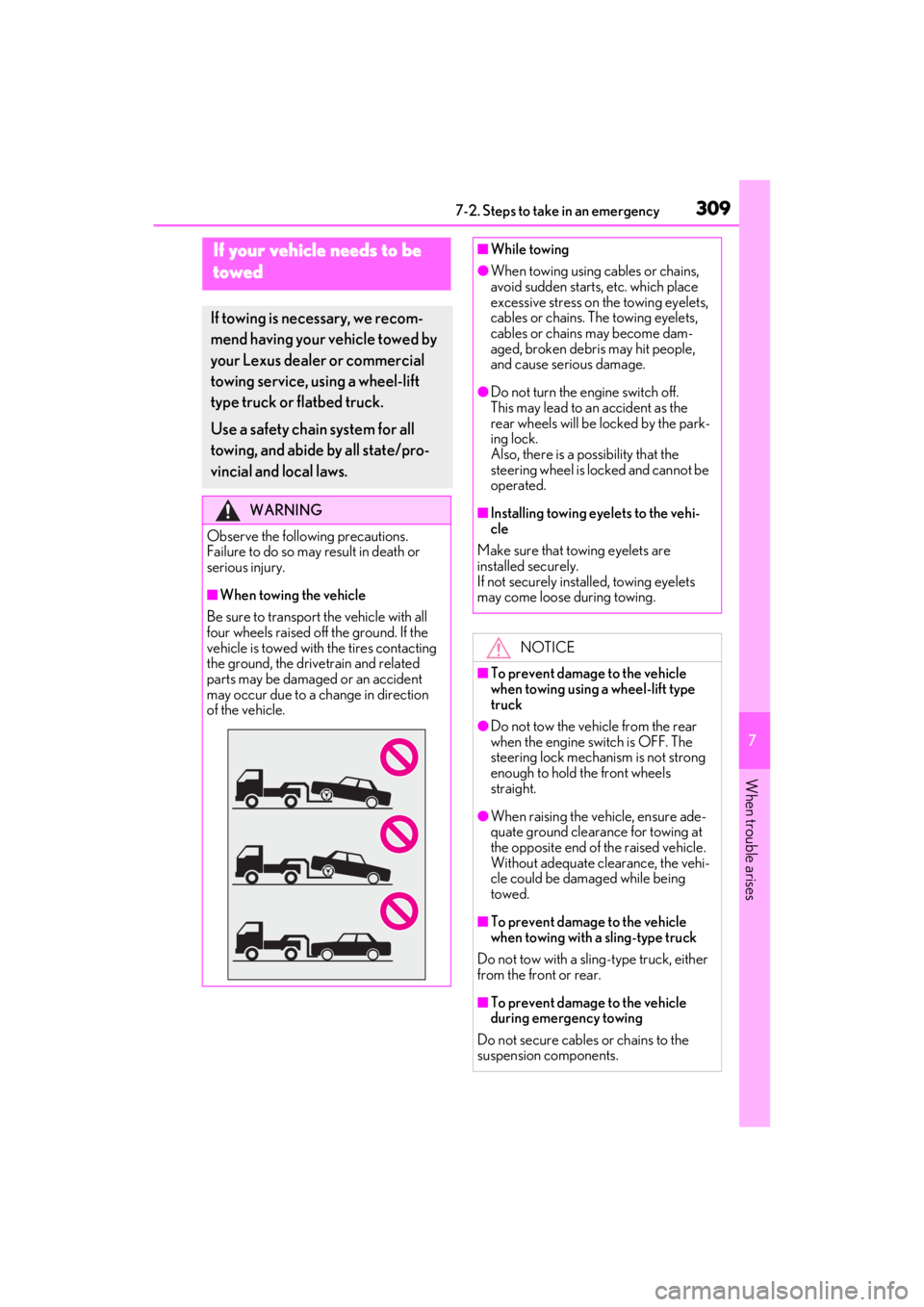
■When towing the vehicle
Be sure to transport the vehicle with all
four wheels raised off the ground. If the
vehicle is towed with the tires contacting
the ground, the drivetrain and related
parts may be damaged or an accident
may occur due to a change in direction
of the vehicle.
■While towing
●When towing using cables or chains,
avoid sudden starts, etc. which place
excessive stress on the towing eyelets,
cables or chains. The towing eyelets,
cables or chains may become dam-
aged, broken debris may hit people,
and cause serious damage.
●Do not turn the engine switch off.
This may lead to an accident as the
rear wheels will be locked by the park-
ing lock.
Also, there is a possibility that the
steering wheel is locked and cannot be
operated.
■Installing towing eyelets to the vehi-
cle
Make sure that towing eyelets are
installed securely.
If not securely installed, towing eyelets
may come loose during towing.
NOTICE
■To prevent damage to the vehicle
when towing using a wheel-lift type
truck
●Do not tow the vehicle from the rear
when the engine switch is OFF. The
steering lock mechanism is not strong
enough to hold the front wheels
straight.
●When raising the vehicle, ensure ade-
quate ground clearance for towing at
the opposite end of the raised vehicle.
Without adequate clearance, the vehi-
cle could be damaged while being
towed.
■To prevent damage to the vehicle
when towing with a sling-type truck
Do not tow with a sling-type truck, either
from the front or rear.
■To prevent damage to the vehicle
during emergency towing
Do not secure cables or chains to the
suspension components.
Page 314 of 410
3127-2. Steps to take in an emergency
7Shift the shift position to N and
release the parking brake.
Turn automatic mode off. ( P.158)
■While towing
If the engine is not running, the power assist
for the brakes and steering will not function,
making steering and braking more difficult.
■Wheel nut wrench
Wheel nut wrench can be purchased at
your Lexus dealer.
Fluid leaks under the vehicle.
(Water dripping from the air condi-
tioning after use is normal.)
Flat-looking tires or uneven tire
wear
Engine coolant temperature gauge
continually points higher than nor-
mal.
Changes in exhaust sound
Excessive tire squeal when corner-
ing
Strange noises related to the sus-
pension system
Pinging or other noises related to
the engine
Engine missing, stumbling or run-
ning roughly
Appreciable loss of power
Vehicle pulls heavily to one side
when braking
If you think something is
wrong
If you notice any of the following
symptoms, your vehicle probably
needs adjustment or repair. Con-
tact your Lexus dealer as soon as
possible.
Visible symptoms
Audible symptoms
Operational symptoms
Page 323 of 410
3217-2. Steps to take in an emergency
7
When trouble arises
WARNING
■If both the ABS and the brake system warning lights remain on
Stop your vehicle in a safe place immediately and contact your Lexus dealer. The vehicle
will become extremely unstable during braking, and the ABS system may fail, which
could cause an accident resulting in death or serious injury.
■When the electric power steering system warning light comes on
When the light comes on in yellow, the assist to the power steering is restricted. When
the light comes on red, the assist to the power steering is lost and handling operations of
the steering wheel become extremely heavy. When steering wheel operations are
heavier than usual, grip the steering wheel firmly and operate it using more force than
usual.
■If the tire pressure warning light comes on
Be sure to observe the following precautions. Failure to do so could cause a loss of vehi-
cle control and result in death or serious injury.
●Decelerate to the lowest appr opriate speed as soon as possible. Do not drive over 50
mph (80 km/h).
●Check and adjust the tire in flation pressure immediately.
●If the tire pressure warning light comes on even after tire inflation pressure adjustment,
it is probable that you have a flat tire. Have the flat tire replaced by the nearest Lexus
dealer.
●Avoid abrupt maneuvering and braking. If th e vehicle tires deteriorate, you could lose
control of the steering wheel or the brakes.
■If a blowout or sudden air leakage should occur
The tire pressure warning system may not activate immediately.
■Maintenance of the tires
Each tire, including the spare (if provided), should be checked monthly when cold and
inflated to the inflation pressure recommended by the vehicle manufacturer on the vehi-
cle placard or tire inflation pr essure label (tire and load information label). (If your vehicle
has tires of a different size th an the size indicated on the vehicle placard or tire inflation
pressure label [tire and load information label], you should determine the proper tire
inflation pressure for those tires.)
As an added safety feature, your vehicle has been equipped with a tire pressure monitor-
ing system (TPMS-tire pressure warning system) that illuminates a low tire pressure tell- tale (tire pressure warning light) when one or more of your tires is significantly under-
inflated. Accordingly, when the low tire pressu re telltale (tire pressure warning light) illu-
minates, you should stop and check your tires as soon as possible, and inflate them to the
proper pressure. Driving on a si gnificantly under-inflated tire causes the tire to overheat
and can lead to tire failure. Under-inflation al so reduces fuel efficiency and tire tread life,
and may affect the vehicle’s handling and stopping ability.
Page 324 of 410

3227-2. Steps to take in an emergency
WARNING
Please note that the TPMS (tire pressure warning system) is not a substitute for proper
tire maintenance, and it is th e driver’s responsibility to ma intain correct tire pressure,
even if under-inflation has not reached the le vel to trigger illumination of the TPMS low
tire pressure telltale (tire pressu re warning light).
Your vehicle has also been equipped with a TPMS (tire pressure warning system) mal-
function indicator to indicate when the system is not operating properly. The TPMS (tire
pressure warning system) malfunction indicator is combined with the low tire pressure
telltale (tire pressure warning light). When the system detect s a malfunction, the telltale
will flash for approximately one minute and then remain continuously illuminated. This
sequence will continue upon subsequent vehicle start-ups as long as the malfunction
exists. When the malfunction in dicator is illuminated, the system may not be able to
detect or signal low tire pressure as intended.
TPMS (tire pressure warning system) malfunctions may occur for a variety of reasons,
including the installation of re placement or alternate tires or wheels on the vehicle that
prevent the TPMS (tire pressure warning sy stem) from functioning properly. Always
check the TPMS (tire pressure warning system ) malfunction telltale after replacing one
or more tires or wheels on yo ur vehicle to ensure that the replacement or alternate tires
and wheels allow the TPMS (tir e pressure warning system) to continue to function prop-
erly.
NOTICE
■To ensure the tire pressure warning system operates properly
Do not install tires with differ ent specifications or makers, as the tire pressure warning
system may not operate properly.
Page 329 of 410
3277-2. Steps to take in an emergency
7
When trouble arises
Take your vehicle to the nearest Lexus
dealer or authorized tire dealer as
soon as possible if any tire goes flat.
The vehicle can be driven for a maximum
of 100 miles (160 km) at a speed below 50
mph (80 km/h) after the tire pressure
warning light comes on. ( P.319)
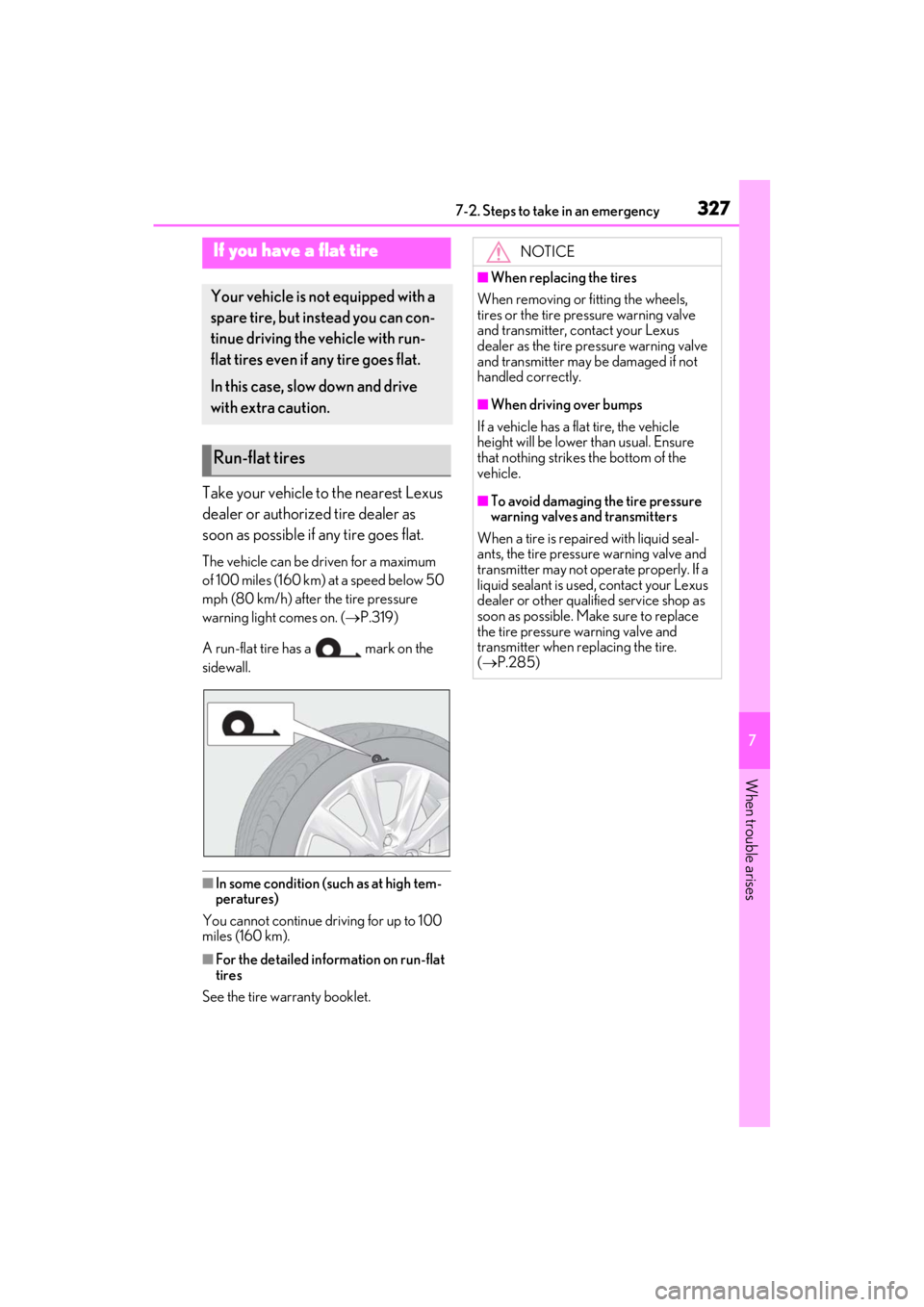
A run-flat tire has a mark on the
sidewall.
■In some condition (such as at high tem-
peratures)
You cannot continue driving for up to 100
miles (160 km).
■For the detailed information on run-flat
tires
See the tire warranty booklet.
If you have a flat tire
Your vehicle is not equipped with a
spare tire, but instead you can con-
tinue driving the vehicle with run-
flat tires even if any tire goes flat.
In this case, slow down and drive
with extra caution.
Run-flat tires
NOTICE
■When replacing the tires
When removing or fitting the wheels,
tires or the tire pr essure warning valve
and transmitter, contact your Lexus
dealer as the tire pressure warning valve
and transmitter may be damaged if not
handled correctly.
■When driving over bumps
If a vehicle has a flat tire, the vehicle
height will be lower than usual. Ensure
that nothing strikes the bottom of the
vehicle.
■To avoid damaging the tire pressure
warning valves and transmitters
When a tire is repaired with liquid seal-
ants, the tire pressure warning valve and
transmitter may not operate properly. If a
liquid sealant is used , contact your Lexus
dealer or other qualified service shop as
soon as possible. Make sure to replace
the tire pressure warning valve and
transmitter when replacing the tire.
( P.285)
Page 349 of 410
3477-2. Steps to take in an emergency
7
When trouble arises
1Stop the engine. Set the parking
brake and shift the shift position to
P.
2
Remove the mud, snow or sand
from around the rear wheels.
3
Place wood, stones or some other
material under the rear wheels to
help provide traction.
4
Restart the engine.
5
Shift the shift position to D or R and
release the parking brake. Then,
while exercising caution, depress
the accelerator pedal.
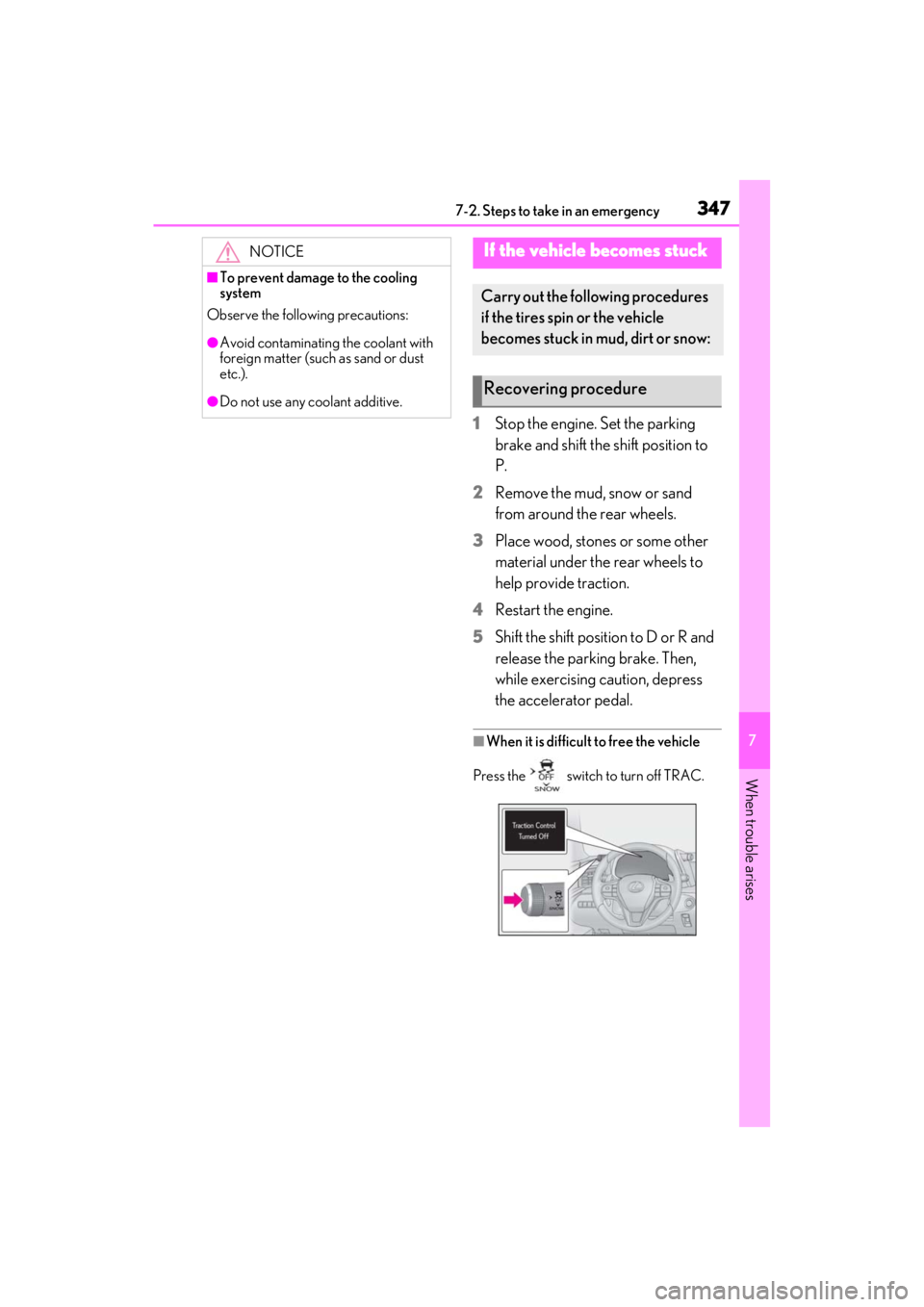
■When it is difficult to free the vehicle
Press the switch to turn off TRAC.
NOTICE
■To prevent damage to the cooling
system
Observe the following precautions:
●Avoid contaminating the coolant with
foreign matter (such as sand or dust
etc.).
●Do not use any coolant additive.
If the vehicle becomes stuck
Carry out the following procedures
if the tires spin or the vehicle
becomes stuck in mud, dirt or snow:
Recovering procedure
Page 357 of 410
3558-1. Specifications
8
Vehicle specifications
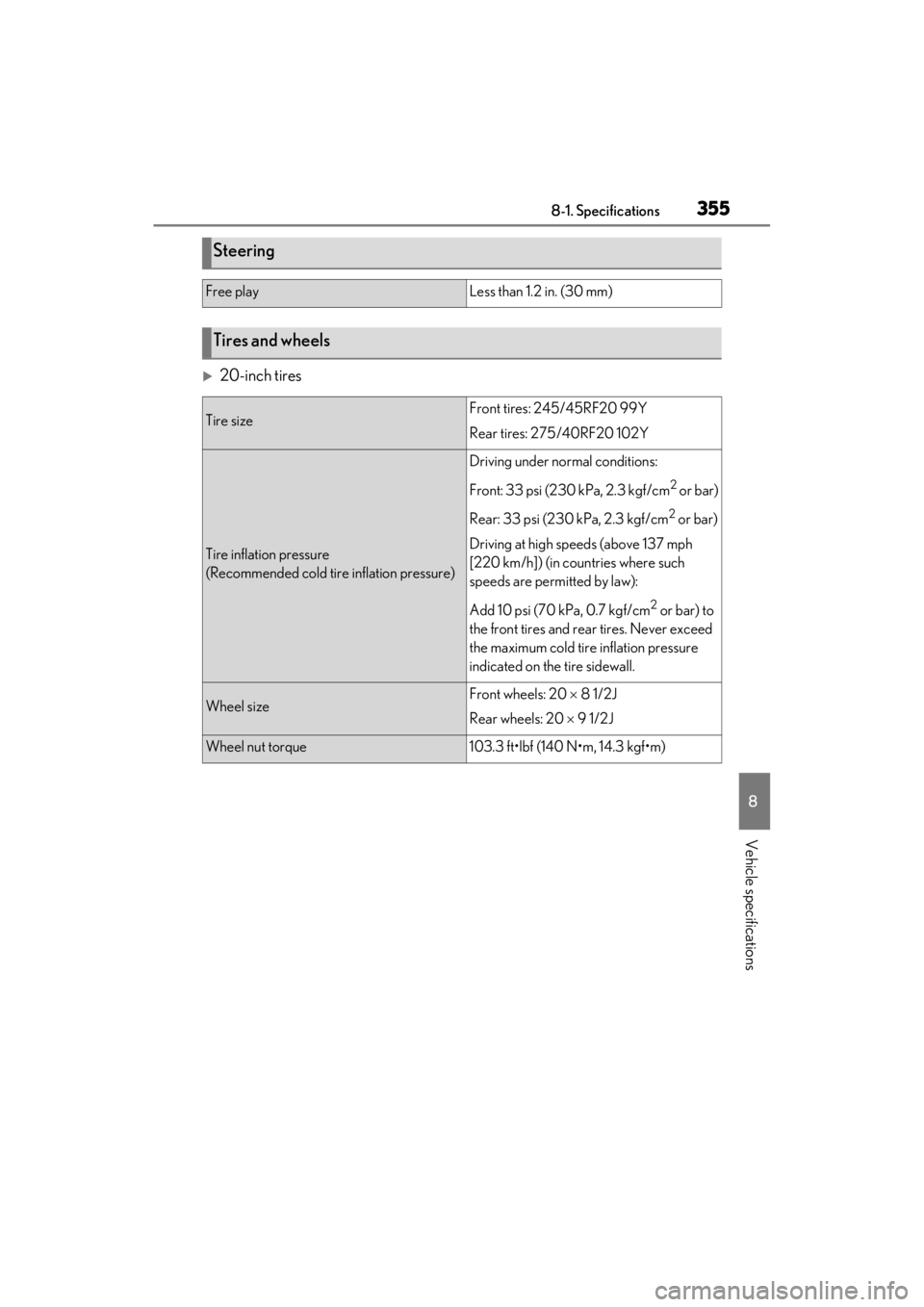
20-inch tires
Steering
Free playLess than 1.2 in. (30 mm)
Tires and wheels
Tire sizeFront tires: 245/45RF20 99Y
Rear tires: 275/40RF20 102Y
Tire inflation pressure
(Recommended cold tire inflation pressure)
Driving under normal conditions:
Front: 33 psi (230 kPa, 2.3 kgf/cm
2 or bar)
Rear: 33 psi (230 kPa, 2.3 kgf/cm
2 or bar)
Driving at high speeds (above 137 mph
[220 km/h]) (in countries where such
speeds are permitted by law):
Add 10 psi (70 kPa, 0.7 kgf/cm
2 or bar) to
the front tires and rear tires. Never exceed
the maximum cold tire inflation pressure
indicated on the tire sidewall.
Wheel sizeFront wheels: 20 8 1/2J
Rear wheels: 20 9 1/2J
Wheel nut torque103.3 ft•lbf (140 N•m, 14.3 kgf•m)
Page 358 of 410
3568-1. Specifications
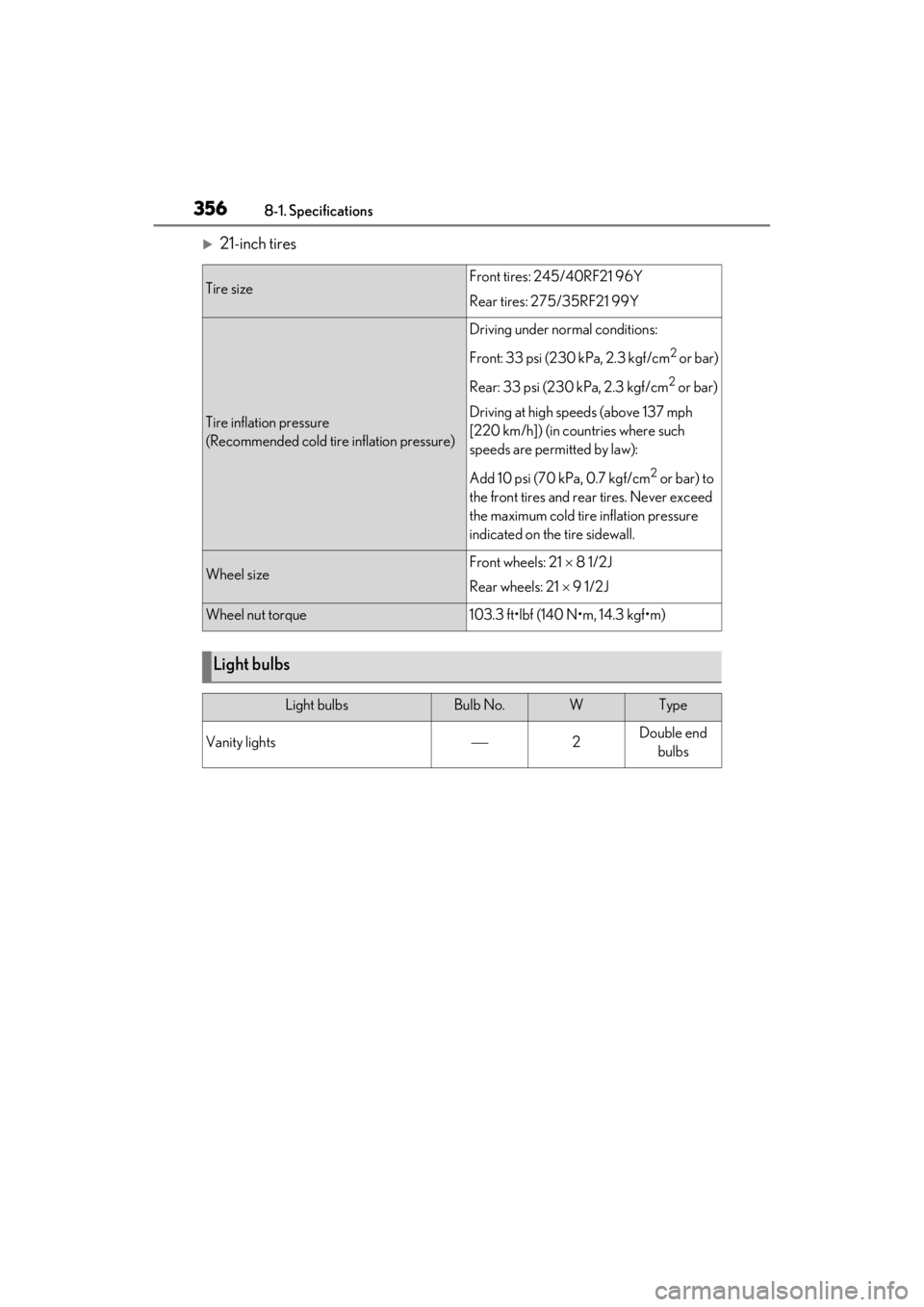
21-inch tires
Tire sizeFront tires: 245/40RF21 96Y
Rear tires: 275/35RF21 99Y
Tire inflation pressure
(Recommended cold tire inflation pressure)
Driving under normal conditions:
Front: 33 psi (230 kPa, 2.3 kgf/cm
2 or bar)
Rear: 33 psi (230 kPa, 2.3 kgf/cm
2 or bar)
Driving at high speeds (above 137 mph
[220 km/h]) (in countries where such
speeds are permitted by law):
Add 10 psi (70 kPa, 0.7 kgf/cm
2 or bar) to
the front tires and rear tires. Never exceed
the maximum cold tire inflation pressure
indicated on the tire sidewall.
Wheel sizeFront wheels: 21 8 1/2J
Rear wheels: 21 9 1/2J
Wheel nut torque103.3 ft•lbf (140 N•m, 14.3 kgf•m)
Light bulbs
Light bulbsBulb No.WType
Vanity lights2Double end
bulbs
Page 361 of 410
3598-1. Specifications
8
Vehicle specifications
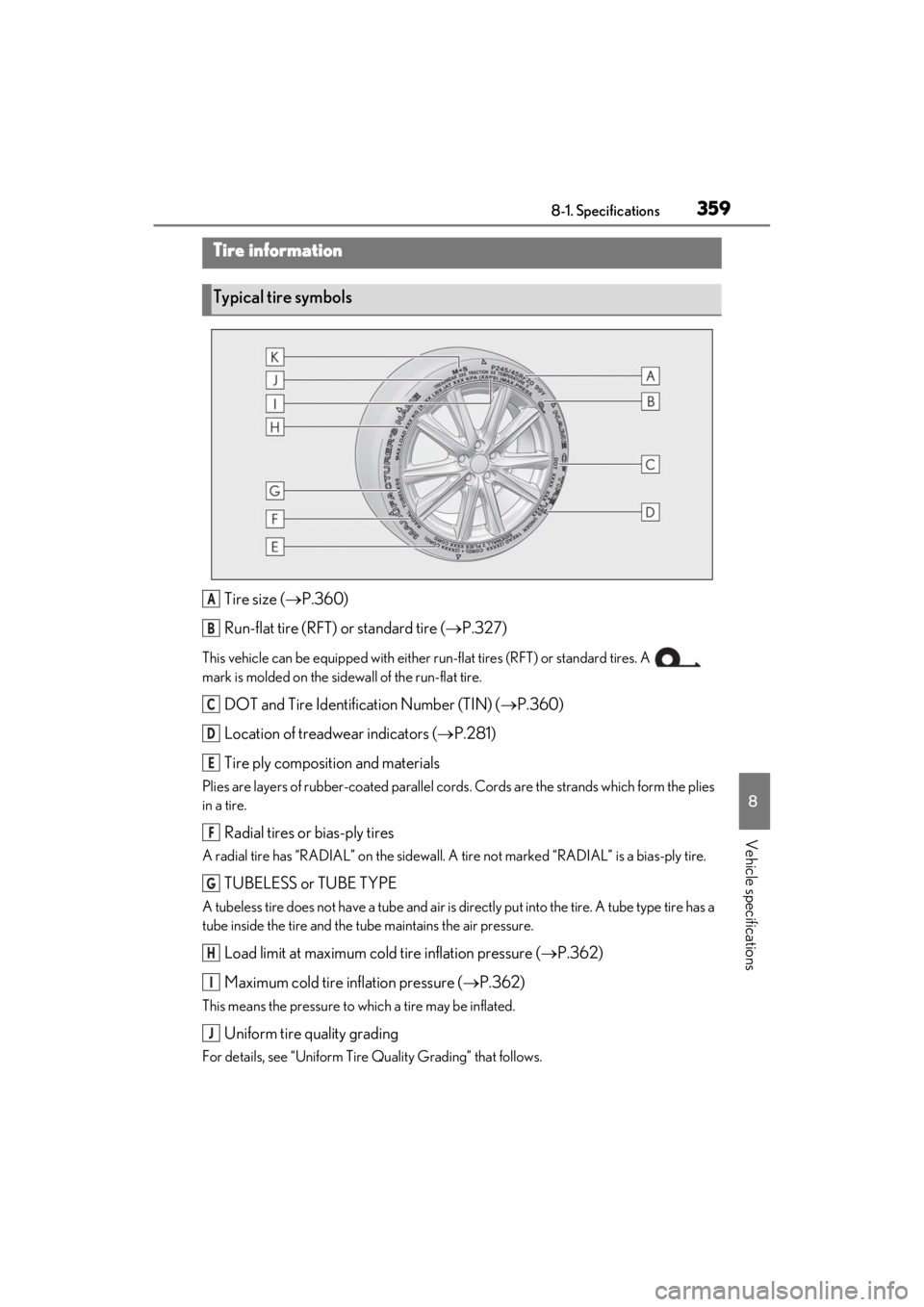
Tire size (P.360)
Run-flat tire (RFT) or standard tire ( P.327)
This vehicle can be equipped with either run-flat tires (RFT) or standard tires. A
mark is molded on the sidewall of the run-flat tire.
DOT and Tire Identification Number (TIN) ( P.360)
Location of treadwear indicators ( P.281)
Tire ply composition and materials
Plies are layers of rubber-coated parallel cords. Cords are the strands which form the plies
in a tire.
Radial tires or bias-ply tires
A radial tire has “RADIAL” on the sidewall. A tire not marked “RADIAL” is a bias-ply tire.
TUBELESS or TUBE TYPE
A tubeless tire does not have a tube and air is directly put into the tire. A tube type tire has a
tube inside the tire and the tube maintains the air pressure.
Load limit at maximum cold tire inflation pressure ( P.362)
Maximum cold tire inflation pressure ( P.362)
This means the pressure to which a tire may be inflated.
Uniform tire quality grading
For details, see “Uniform Tire Quality Grading” that follows.
Tire information
Typical tire symbols
A
B
C
D
E
F
G
H
I
J