brakes lexus LFA 2012 Owner's Manual / LEXUS 2012 LFA (OM77006U) User Guide
[x] Cancel search | Manufacturer: LEXUS, Model Year: 2012, Model line: LFA, Model: Lexus LFA 2012Pages: 420, PDF Size: 5.02 MB
Page 309 of 420
5
When trouble arises
307
5-1. Essential information
■Emergency towing procedureStart the engine.
If the engine cannot be started, turn the ignition switch to the “ACC” or
“ON” position.
With Neutral selected, release the parking brake.
■When using the towing eyelet
Use the towing eyelet only when your vehicle is being towed.
Do not use the towing eyelet to tow another vehicle or to tie down your vehicle on a
flatbed truck.
CAUTION
■Caution while towing
●Use extreme caution when towing the vehicle.
Avoid sudden starts or erratic driving maneuvers which place excessive stress on
the emergency towing eyelet and the cable or chain. Always be cautious of the
surroundings and other vehicles while towing.
●If the engine is not running , the power assist for the brakes and steering may not
function, making steering and braking more difficult.
■Installing towing eyelet to the vehicle
Make sure that towing eyelet is installed securely.
If not securely installed, towing eyelet may come loose during towing. This may lead
to accidents that cause serious injury or even death.
NOTICE
■To prevent vehicle damage
Observe the following precautions when using a flatbed truck:
●Do not drive over wheel chocks, as doing so may damage the tires.
●Do not tie down the vehicle over any part s other than the tires (do not use parts
such as the suspension).
STEP1
STEP2
Page 321 of 420
5
When trouble arises
319
5-2. Steps to take in an emergency
CAUTION
■When the electric power steering system warning light comes on
The steering wheel may become extremely heavy.
If the steering wheel becomes heavier than usual when operating, hold firmly and
operate using more force than usual.
■If the tire pressure warning light comes on
Be sure to observe the following precaution s. Failure to do so could cause a loss of
vehicle control and result in death or serious injury.
●Stop your vehicle in a safe place as soon as possible. Adjust the tire inflation pres-
sure immediately.
●If the tire pressure warning light comes on even after tire inflation pressure adjust-
ment, it is probable that you have a flat tire. Check the tires. If a tire is flat, tempo-
rarily repair the tire using the em ergency tire puncture repair kit ( P. 3 3 2 ) a n d
then have the tire repaired or replaced by the nearest Lexus dealer.
●Avoid abrupt maneuvering and braking. If the vehicle tires deteriorate, you could
lose control of the steering wheel or the brakes.
■If a blowout or sudden air leakage should occur
The tire pressure warning system may not activate immediately.
Page 358 of 420
356
5-2. Steps to take in an emergency
CAUTION
■If the engine has to be turned off while driving
●If the engine is turned off, the power assist for the brakes and steering may not
function, making braking and steering more difficult. Decelerate as much as pos-
sible before turning off the engine.
●Never attempt to remove the key, as doing so will lock the steering wheel.
Page 366 of 420
364
6-1. Specifications
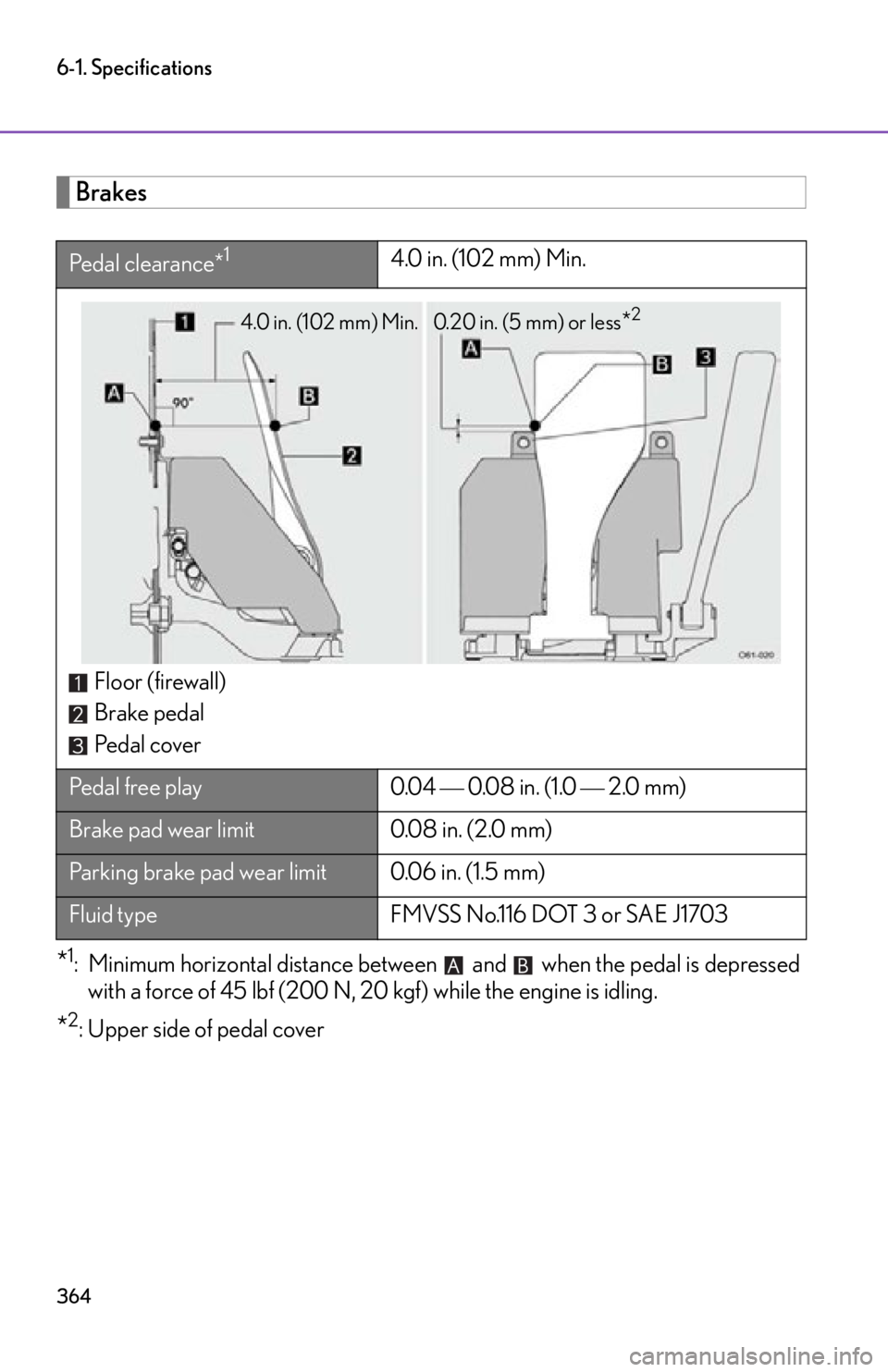
Brakes
*1: Minimum horizontal distance between and when the pedal is depressedwith a force of 45 lbf (200 N, 20 kgf) while the engine is idling.
*2: Upper side of pedal cover
Pedal clearance*14.0 in. (102 mm) Min.
Floor (firewall)
Brake pedal
Pe d a l c o ve r
Pedal free play 0.04 0.08 in. (1.0 2.0 mm)
Brake pad wear limit0.08 in. (2.0 mm)
Parking brake pad wear limit0.06 in. (1.5 mm)
Fluid typeFMVSS No.116 DOT 3 or SAE J1703
4.0 in. (102 mm) Min. 0.20 in. (5 mm) or less*2
Page 379 of 420
377
6-1. Specifications
6
Vehicle specifications
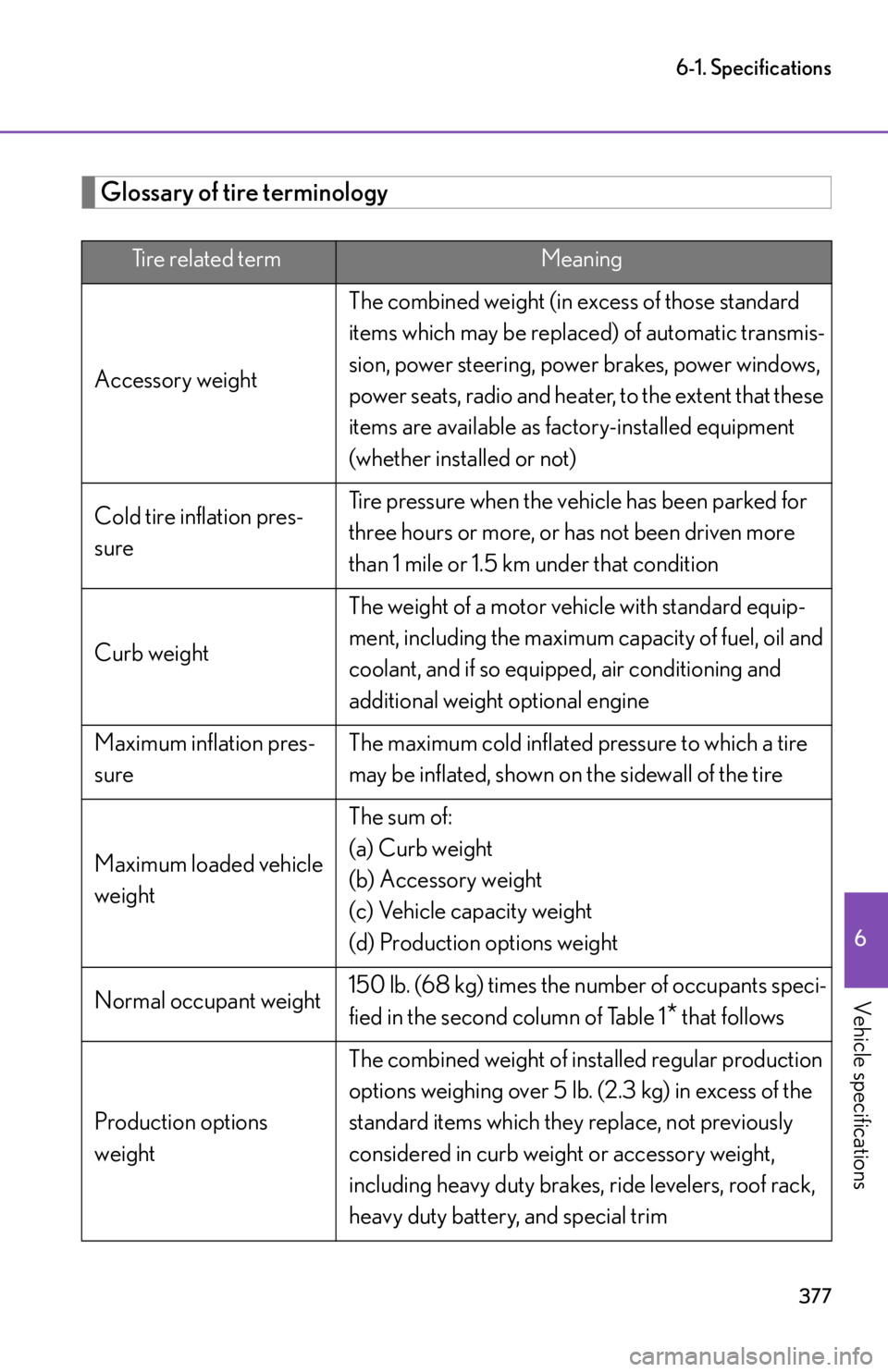
Glossary of tire terminology
Tire related termMeaning
Accessory weight The combined weight (in excess of those standard
items which may be replaced) of automatic transmis-
sion, power steering, power brakes, power windows,
power seats, radio and heater, to the extent that these
items are available as factory-installed equipment
(whether installed or not)
Cold tire inflation pres-
sure Tire pressure when the vehicle has been parked for
three hours or more, or has not been driven more
than 1 mile or 1.5 km under that condition
Curb weight The weight of a motor vehicle with standard equip-
ment, including the maximum capacity of fuel, oil and
coolant, and if so equipp
ed, air conditioning and
additional weight optional engine
Maximum inflation pres-
sure The maximum cold inflated pressure to which a tire
may be inflated, shown on the sidewall of the tire
Maximum loaded vehicle
weight The sum of:
(a) Curb weight
(b) Accessory weight
(c) Vehicle capacity weight
(d) Production options weight
Normal occupant weight 150 lb. (68 kg) times the number of occupants speci-
fied in the second column of Table 1
* that follows
Production options
weight The combined weight of installed regular production
options weighing over 5 lb. (2.3 kg) in excess of the
standard items which they replace, not previously
considered in curb weight or accessory weight,
including heavy duty brakes, ride levelers, roof rack,
heavy duty battery, and special trim