rate lexus LFA 2012 Technical Information / LEXUS 2012 LFA: INSIDE THE LFA
[x] Cancel search | Manufacturer: LEXUS, Model Year: 2012, Model line: LFA, Model: Lexus LFA 2012Pages: 128, PDF Size: 5.91 MB
Page 47 of 128
45
Steering
■
■Steering wheel
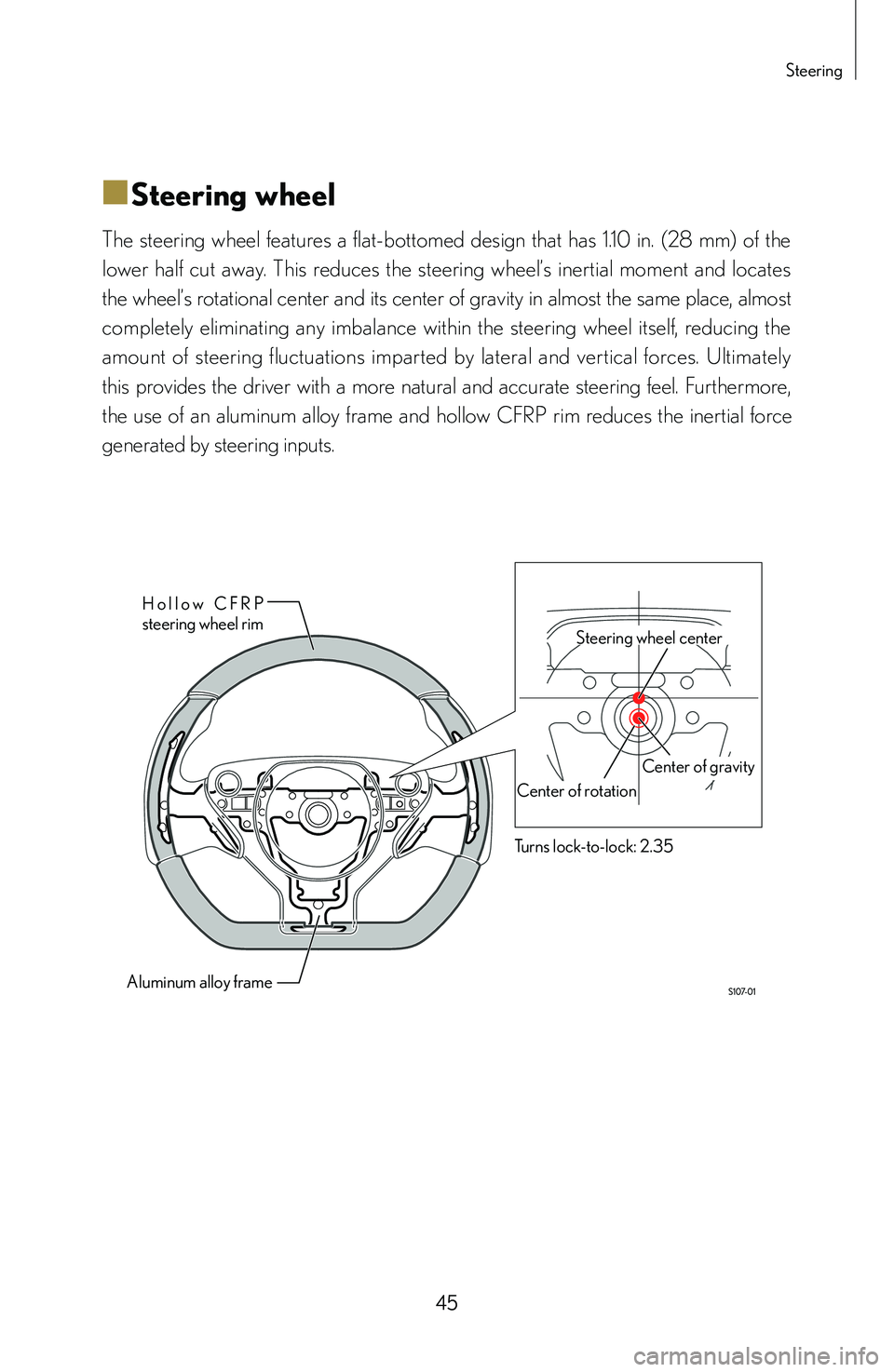
The steering wheel features a flat-bottomed design that has 1.10 in. (28 mm) of the
lower half cut away. This reduces the steering wheel’s inertial moment and locates
the wheel’s rotational center and its center of gravity in almost the same place, almost
completely eliminating any imbalance within the steering wheel itself, reducing the
amount of steering fluctuations imparted by lateral and vertical forces. Ultimately
this provides the driver with a more natural and accurate steering feel. Furthermore,
the use of an aluminum alloy frame and hollow CFRP rim reduces the inertial force
generated by steering inputs.
H o l l o w C F R P
steering wheel rim
Center of rotation
Center of gravity
Turns lock-to-lock: 2.35
Aluminum alloy frame
Steering wheel center
Page 48 of 128
46
■
■Steering rack and gearbox
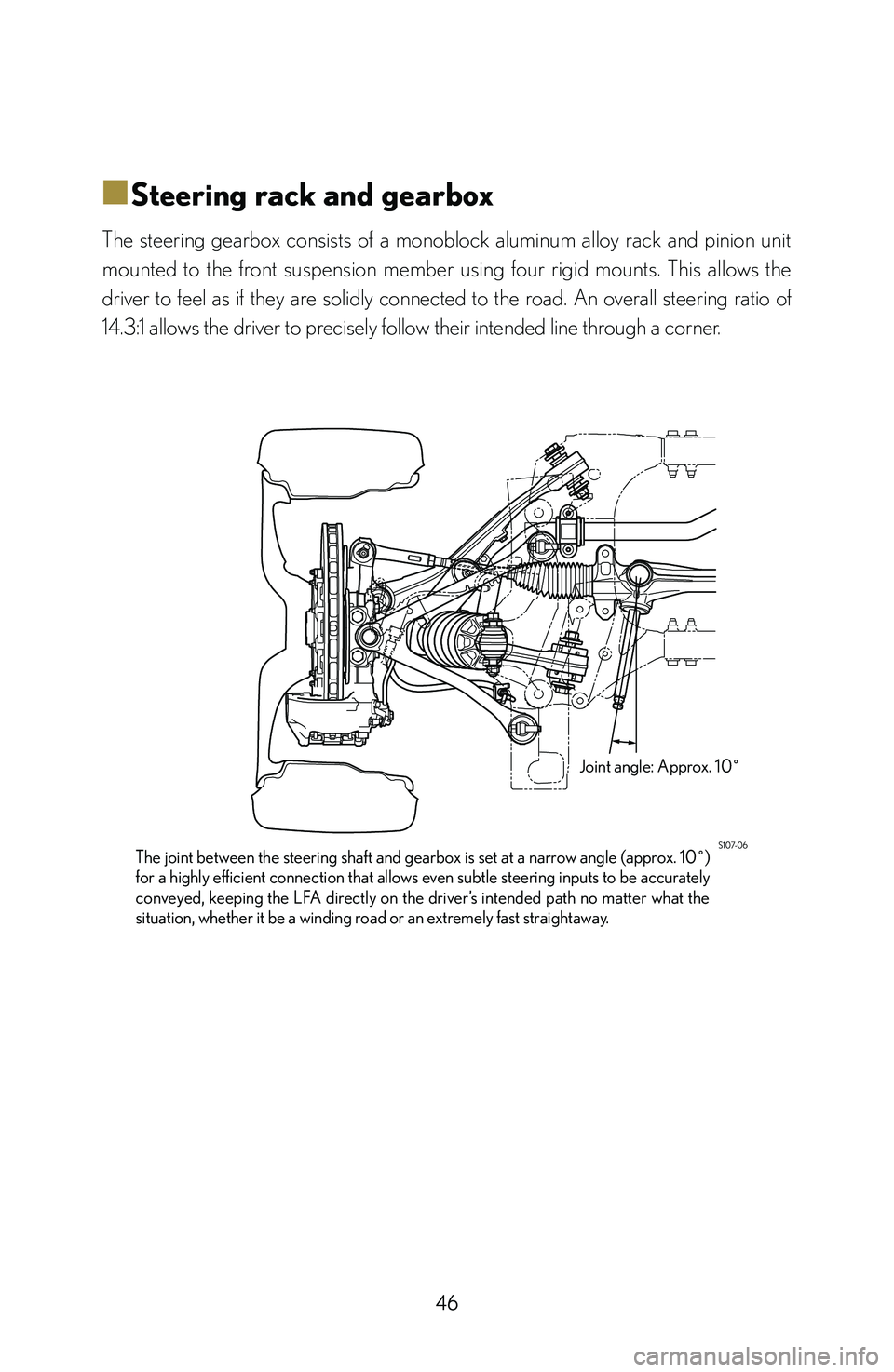
The steering gearbox consists of a monoblock aluminum alloy rack and pinion unit
mounted to the front suspension member using four rigid mounts. This allows the
driver to feel as if they are solidly connected to the road. An overall steering ratio of
14.3:1 allows the driver to precisely follow their intended line through a corner.
S107-06The joint between the steering shaft and gearbox is set at a narrow angle (approx. 10˚)
for a highly efficient connection that allows even subtle steering inputs to be accurately
conveyed, keeping the LFA directly on the driver’s intended path no matter what the
situation, whether it be a winding road or an extremely fast straightaway. Joint angle: Approx. 10˚
Page 52 of 128
50
Braking
The LFA is equipped with an ECB (Electronically Controlled Brake) system.
When the brake pedal is depressed, information on how much force is being used to
depress the pedal and the amount it is depressed is sent to the ECB computer. This
computer takes into account the vehicle’s overall condition using inputs from various
sensors and distributes the optimal amount of brake force to each individual wheel.
The ECB system uses an electric pump to generate hydraulic pressure, thereby
providing braking power without relying on engine vacuum. The use of this
technology ensures a consistent supply of effective braking power.
However, the detail behind the LFA brake system does not end with the ECB system.
Monoblock calipers and CCM (Carbon Ceramic Material) discs are just a few of the
other components that give the LFA its generous braking power. Furthermore, large
brake ducts have been proactively integrated in order to feed the brakes fresh, cold
air to keep them working at their optimum temperature for consistent performance.
Regarding the brake override system:
If the driver depresses the brake and accelerator pedals at the same time or if
the ECU judges that both acceleration and braking commands are being issued,
braking will be prioritized. The system will ignore the signal from the accelerator
pedal, close all throttle valves and provide the appropriate amount of braking force
demanded by the driver’s braking effort.
Page 54 of 128
52
■
■Brake caliper
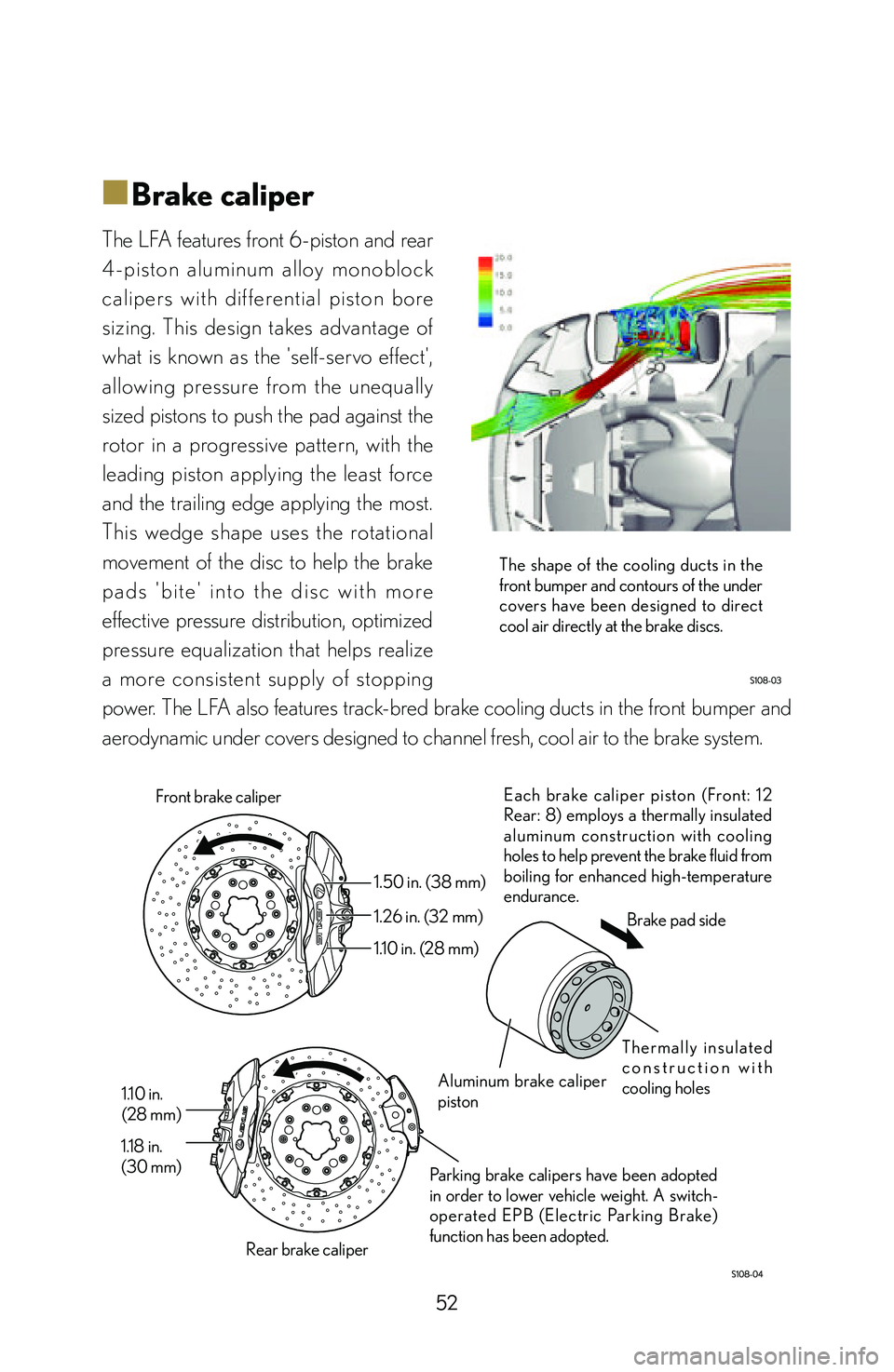
The LFA features front 6-piston and rear
4-piston aluminum alloy monoblock
calipers with dif ferential piston bore
sizing. This design takes advantage of
what is known as the 'self-servo effect',
allowing pressure from the unequally
sized pistons to push the pad against the
rotor in a progressive pattern, with the
leading piston applying the least force
and the trailing edge applying the most.
This wedge shape uses the rotational
movement of the disc to help the brake
p a d s ' b i t e ' i n t o t h e d i s c w i t h m o r e
effective pressure distribution, optimized
pressure equalization that helps realize
a more consistent supply of stopping
power. The LFA also features track-bred brake cooling ducts in the front bumper and
aerodynamic under covers designed to channel fresh, cool air to the brake system.
Each brake caliper piston (Front: 12
Rear: 8) employs a thermally insulated
aluminum construction with cooling
holes to help prevent the brake fluid from
boiling for enhanced high-temperature
endurance.
Parking brake calipers have been adopted
in order to lower vehicle weight. A switch-
operated EPB (Electric Parking Brake)
function has been adopted.
1.50 in. (38 mm)
1.26 in. (32 mm)
1.10 in. (28 mm)
1.10 in.
(28 mm)
1.18 in.
(30 mm) Front brake caliper
Rear brake caliper Aluminum brake caliper
piston
T h e r m a l l y i n s u l a t e d
c o n s t r u c t i o n w i t h
cooling holesBrake pad side
The shape of the cooling ducts in the
front bumper and contours of the under
covers have been designed to direct
cool air directly at the brake discs.
Page 58 of 128

56
Checking the engine
Components expected to operate at high speeds have been made as light and
precise as possible, realizing a superfast engine capable of revving from idle to 9,000
rpm in only 0.6 seconds.
In order to ensure adequate lubrication under high G-loads, a dry sump lubrication
system has been adopted.
The engine oil is cooled by a liquid-cooled oil cooler located in the valley between
each bank of cylinders and an air-cooled oil cooler housed within the front overhang.
In addition, two high-per formance radiators have been housed within the rear
overhang for an optimal front-rear weight balance.
A TFT LCD panel has been adopted to accurately transmit various information from
the engine to the driver. An analog-style digital tachometer displays engine speed
while other real-time engine information is displayed digitally for both superior visual
clarity and response.
An acrylic lens with a metal ring is positioned at the center of the meter to clearly
display the primary instruments and to create a three-dimensional appearance.
Page 65 of 128

63
Checking the engine
■
■Fuel gauge
The fuel gauge displays the amount of fuel remaining on a scale of 0 to 1/1. The
saddle-shaped fuel tank consists of a main tank compartment and a sub-tank
compartment. When the fuel level drops to approximately 2.9 gal. (11 L, 2.4 Imp. gal.)
between both compartments, the bar display will blink in amber to inform the driver
that the remaining fuel level is low. In this state, the remaining amount of fuel is directed
into the main tank compartment in order to ensure a stable supply of fuel to the engine
even under high cornering G-loads.
S109-14Main tank
compartment Sub-tank compartment
Fuel
Remaining fuel directed to main tank
compartment
Blinks when remaining fuel drops to approx. 2.9 gal. (11 L, 2.4 Imp. gal.)
The main tank compar tment and sub-tank compar tment each have their own
individual sender gauges to monitor the fuel levels. The ECU calculates the total
amount of fuel remaining from both of these sensors and informs the driver using
the fuel gauge. The ECU digitally processes the fuel level data in order to display a
clear and accurate fuel level even when the fuel level fluctuates under high cornering
G-loads.
Page 71 of 128
69
Using the meter
Checking and topping up the oil level
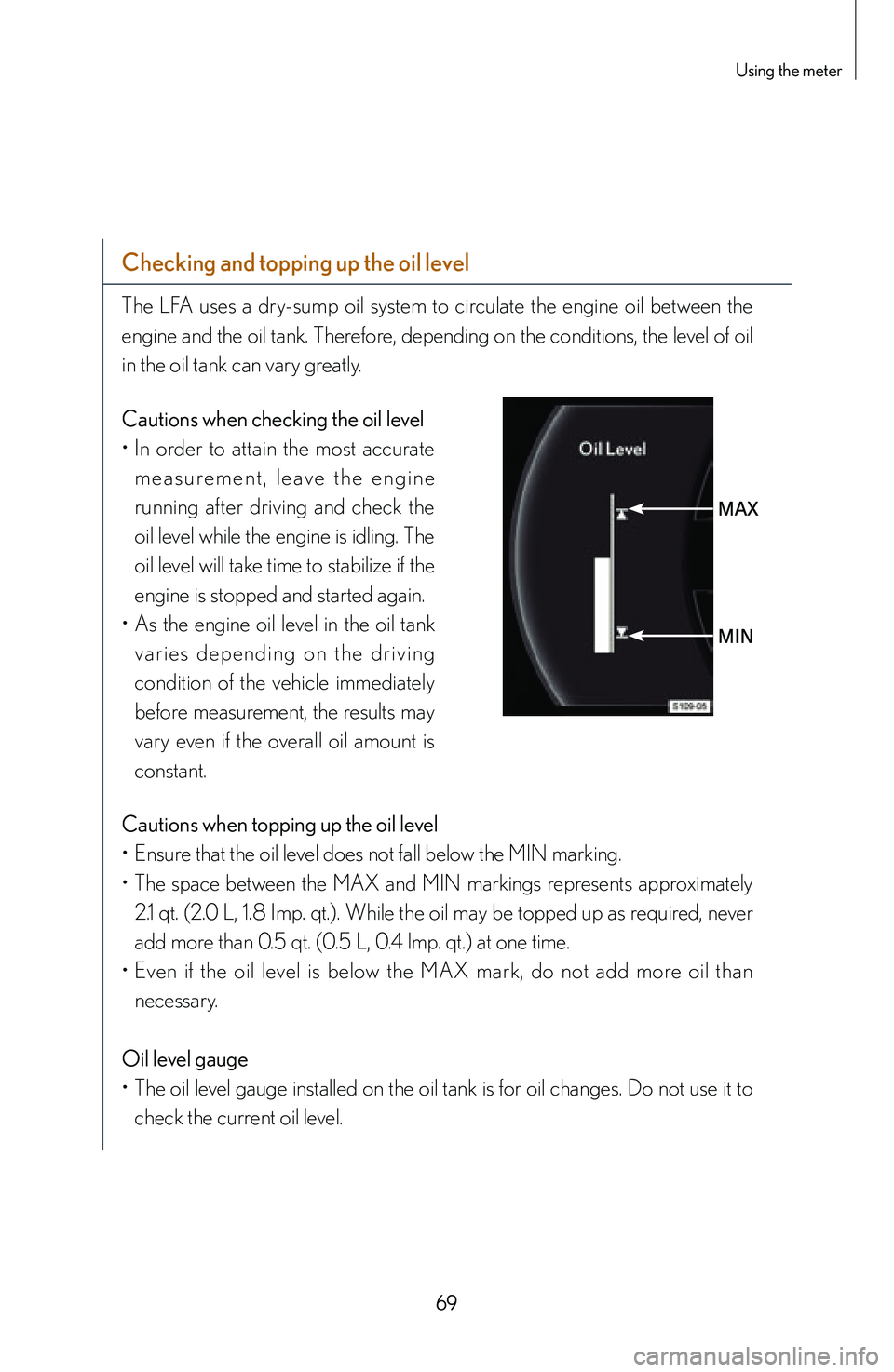
The LFA uses a dry-sump oil system to circulate the engine oil between the
engine and the oil tank. Therefore, depending on the conditions, the level of oil
in the oil tank can vary greatly.
Cautions when checking the oil level
• In order to attain the most accurate
m e a s u r e m e n t , l e a v e t h e e n g i n e
running after driving and check the
oil level while the engine is idling. The
oil level will take time to stabilize if the
engine is stopped and started again.
• As the engine oil level in the oil tank
va r i e s d e p e n d i n g o n t h e d r i v i n g
condition of the vehicle immediately
before measurement, the results may
vary even if the overall oil amount is
constant.
MAX
MIN
Cautions when topping up the oil level
• Ensure that the oil level does not fall below the MIN marking.
• The space between the MAX and MIN markings represents approximately
2.1 qt. (2.0 L, 1.8 Imp. qt.). While the oil may be topped up as required, never
add more than 0.5 qt. (0.5 L, 0.4 lmp. qt.) at one time.
• Even if the oil level is below the MAX mark, do not add more oil than
necessary.
Oil level gauge
• The oil level gauge installed on the oil tank is for oil changes. Do not use it to
check the current oil level.
Page 82 of 128
80
■
■Rear quarter glass
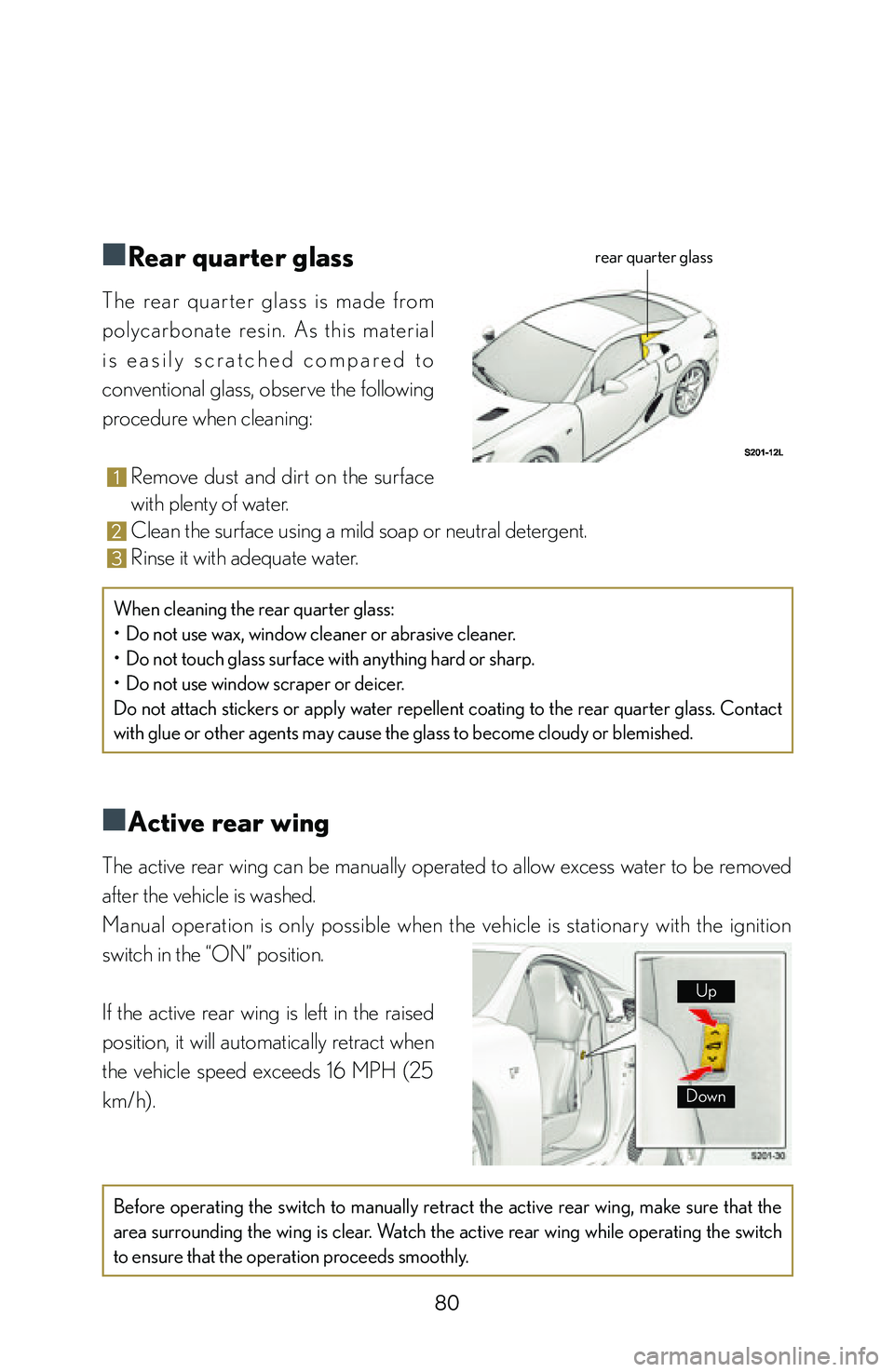
The rear quar ter glass is made from
polycarbonate resin. As this material
i s e a s i l y s c r a t c h e d c o m p a r e d t o
conventional glass, observe the following
procedure when cleaning:
1 Remove dust and dirt on the surface
with plenty of water.
2 Clean the surface using a mild soap or neu tral detergent.
3 Rinse it with adequate water.
When cleaning the rear quarter glass:
• Do not use wax, window cleaner or abrasive cleaner.
• Do not touch glass surface with anything hard or sharp.
• Do not use window scraper or deicer.
Do not attach stickers or apply water repellent coating to the rear quarter glass. Contact
with glue or other agents may cause the glass to become cloudy or blemished.
■
■Active rear wing
The active rear wing can be manually operated to allow excess water to be removed
after the vehicle is washed.
Manual operation is only possible when the vehicle is stationary with the ignition
switch in the “ON” position.
If the active rear wing is left in the raised
position, it will automatically retract when
the vehicle speed exceeds 16 MPH (25
km/h).
Before operating the switch to manually retract the active rear wing, make sure that the
area surrounding the wing is clear. Watch the active rear wing while operating the switch
to ensure that the operation proceeds smoothly.
rear quarter glass
Up
Down
Page 114 of 128
112
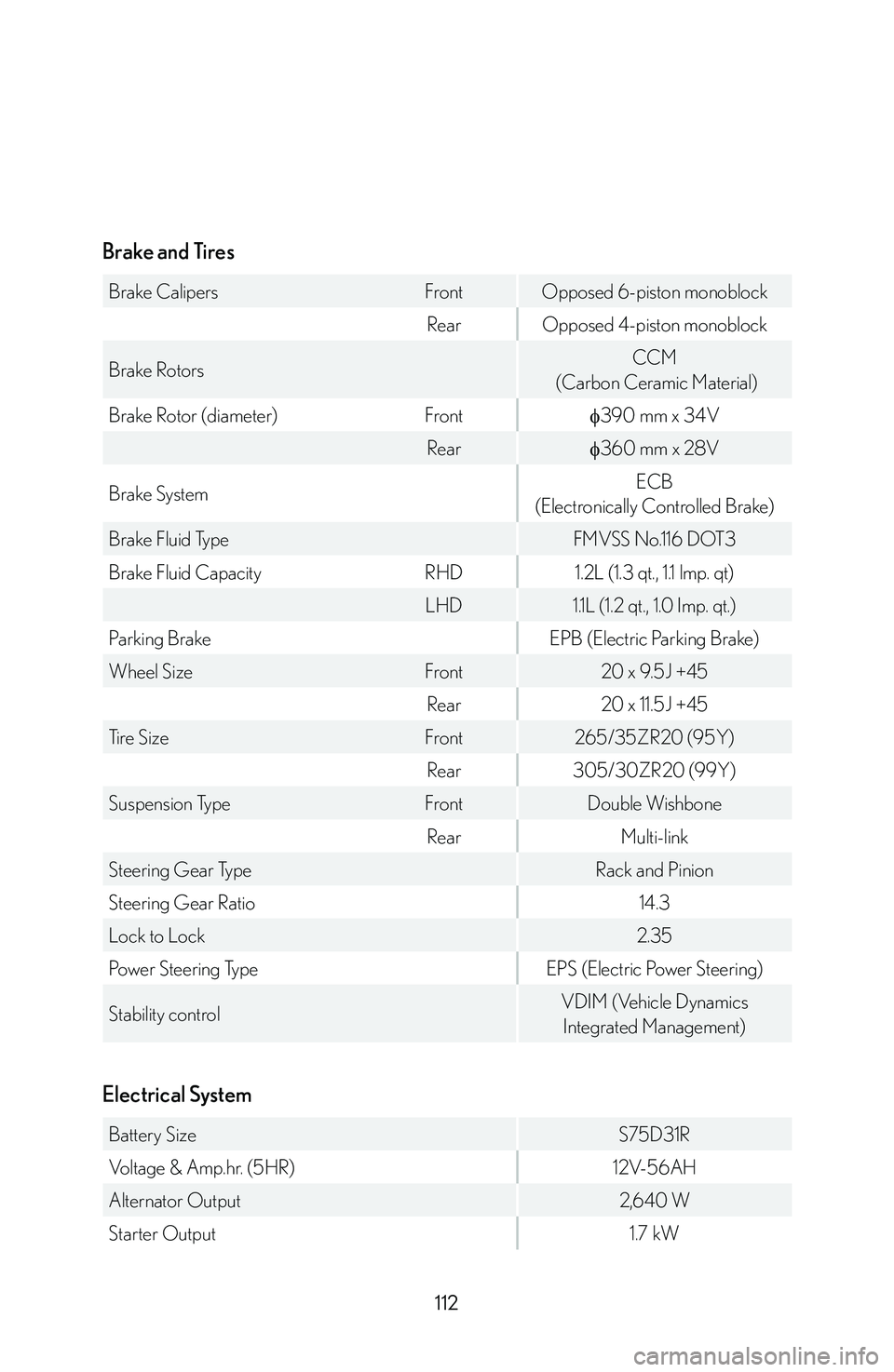
Brake and Tires
Brake Calipers FrontOpposed 6-piston monoblock
Rear Opposed 4-piston monoblock
Brake Rotors CCM
(Carbon Ceramic Material)
Brake Rotor (diameter) Front
f390 mm x 34V
Rear f360 mm x 28V
Brake System ECB
(Electronically Controlled Brake)
Brake Fluid Type FMVSS No.116 DOT3
Brake Fluid Capacity RHD1.2L (1.3 qt., 1.1 lmp. qt)
LHD 1.1L (1.2 qt., 1.0 Imp. qt.)
Parking Brake EPB (Electric Parking Brake)
Wheel Size Front20 x 9.5J +45
Rear 20 x 11.5J +45
Tire Size Front265/35ZR20 (95Y)
Rear 305/30ZR20 (99Y)
Suspension Type FrontDouble Wishbone
Rear Multi-link
Steering Gear Type Rack and Pinion
Steering Gear Ratio 14.3
Lock to Lock 2.35
Power Steering Type EPS (Electric Power Steering)
Stability control VDIM (Vehicle Dynamics
Integrated Management)
Electrical System
Battery Size S75D31R
Voltage & Amp.hr. (5HR) 12V-56AH
Alternator Output 2,640 W
Starter Output 1.7 kW
Page 123 of 128
121
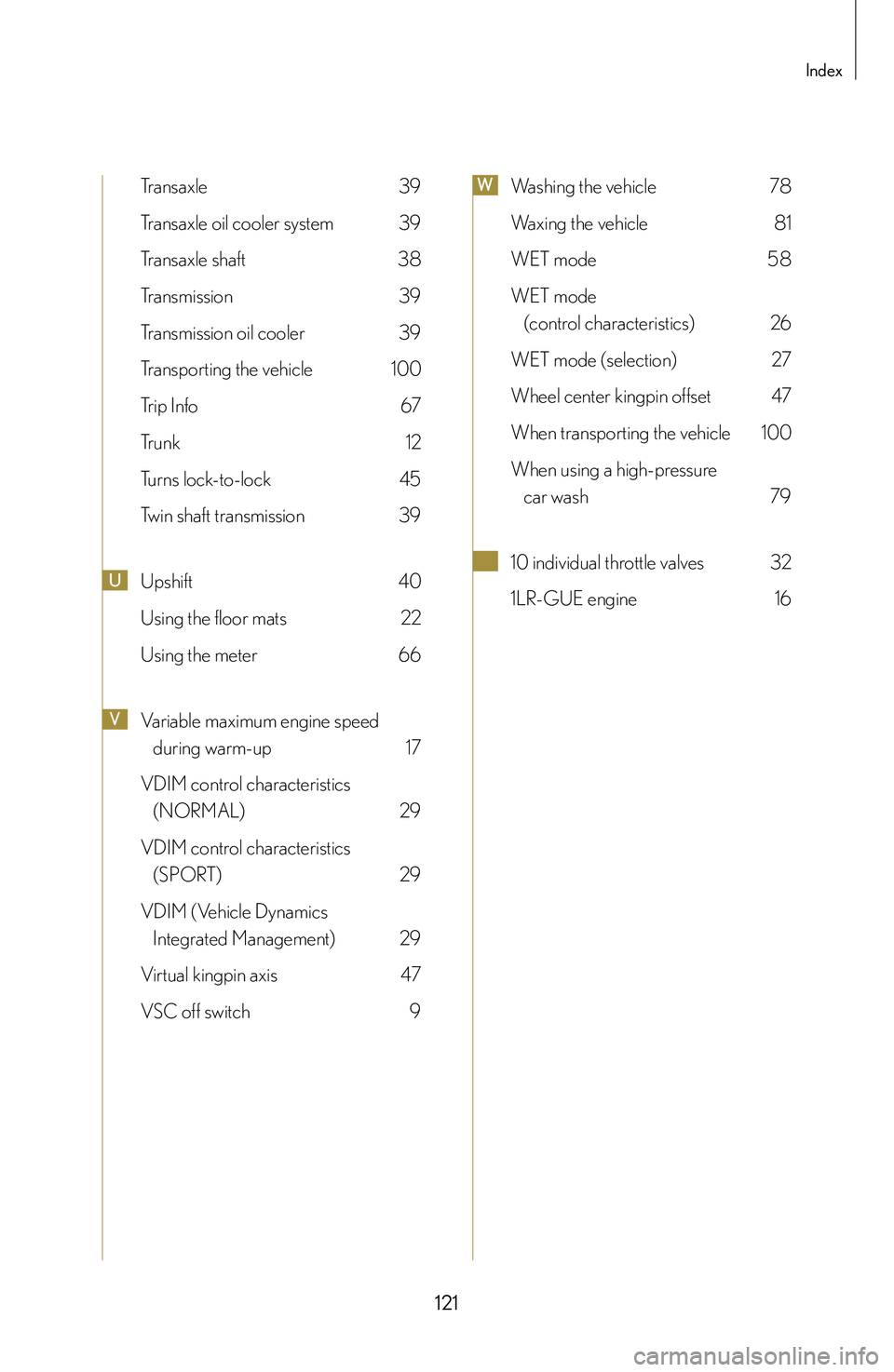
Index
Transaxle 39
Transaxle oil cooler system 39
Transaxle shaft 38
Transmission 39
Transmission oil cooler 39
Transporting the vehicle 100
Trip Info 67
Trunk 12
Turns lock-to-lock 45
Twin shaft transmission 39
UUpshift 40
Using the floor mats 22
Using the meter 66
VVariable maximum engine speed
during warm-up 17
VDIM control characteristics
(NORMAL) 29
VDIM control characteristics
(SPORT) 29
VDIM (Vehicle Dynamics
Integrated Management) 29
Virtual kingpin axis 47
VSC off switch 9
WWashing the vehicle 78
Waxing the vehicle 81
WET mode 58
WET mode
(control characteristics) 26
WET mode (selection) 27
Wheel center kingpin offset 47
When transporting the vehicle 100
When using a high-pressure
car wash 79
10 individual throttle valves 32
1LR-GUE engine 16