ESP lexus LFA 2012 Technical Information / LEXUS 2012 LFA (OM77006U) User Guide
[x] Cancel search | Manufacturer: LEXUS, Model Year: 2012, Model line: LFA, Model: Lexus LFA 2012Pages: 420, PDF Size: 5.02 MB
Page 71 of 420
69
1-7. Safety information
1
Before driving
CAUTION
■SRS airbag precautions
●The SRS passenger airbag also deploys with considerable force, and can cause
death or serious injury especially if the passenger is very close to the airbag. The
passenger seat should be as far from the airbag as possible with the seatback
adjusted, so the passenger sits upright.
●Improperly seated and/or restrained infants and children can be killed or seri-
ously injured by a deploying airbag. An infant or child who is too small to use a
seat belt should be properly secured using a child restraint system. Lexus strongly
recommends that all infants and children be properly restrained. The rear seats
are the safest for infants and children. ( P. 76 )
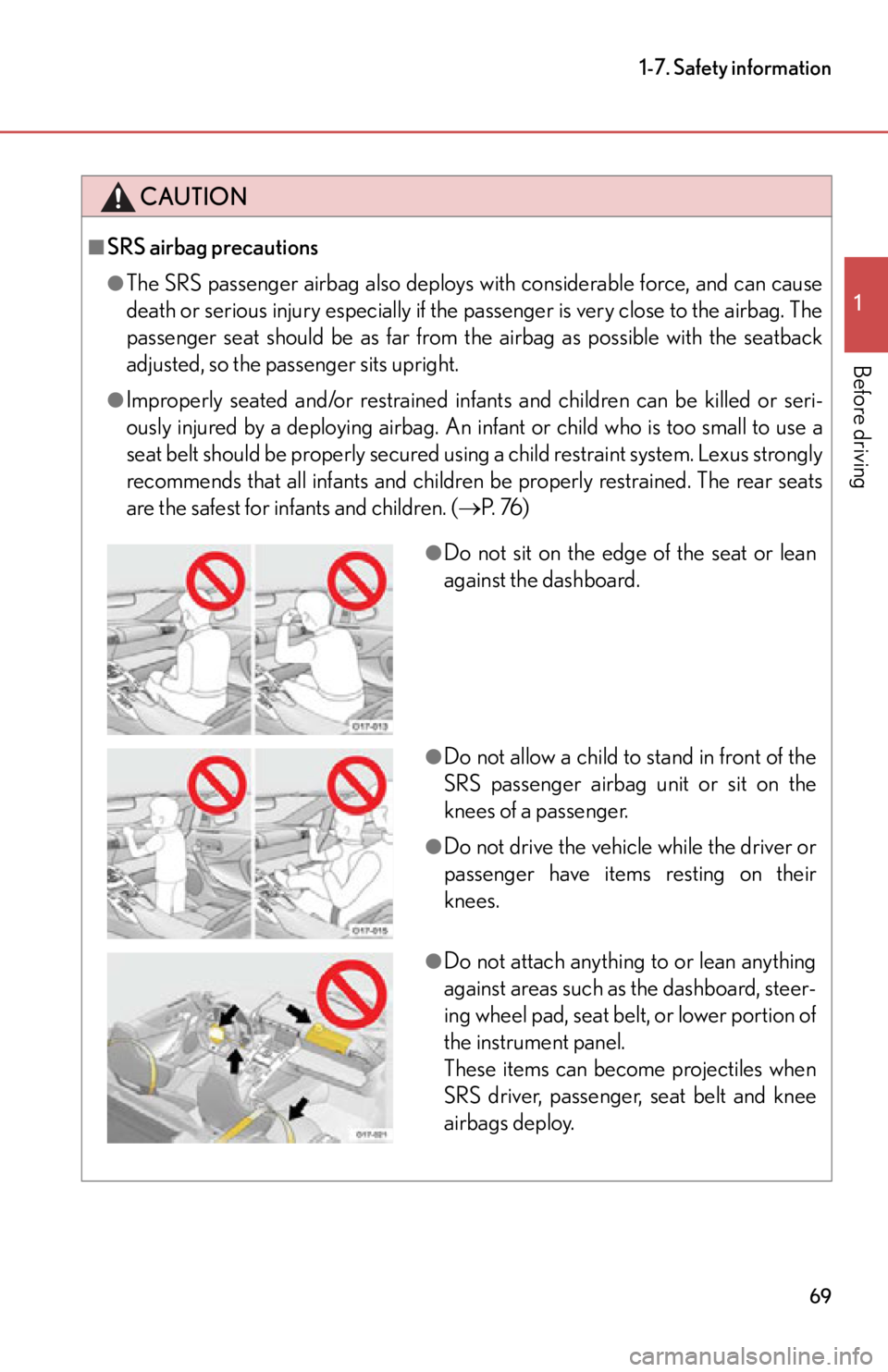
●Do not sit on the edge of the seat or lean
against the dashboard.
●Do not allow a child to stand in front of the
SRS passenger airbag unit or sit on the
knees of a passenger.
●Do not drive the vehicle while the driver or
passenger have items resting on their
knees.
●Do not attach anything to or lean anything
against areas such as the dashboard, steer-
ing wheel pad, seat belt, or lower portion of
the instrument panel.
These items can become projectiles when
SRS driver, passenger, seat belt and knee
airbags deploy.
Page 75 of 420

73
1-7. Safety information
1
Before driving
Condition and operation in the passenger occupant classification system
■Adult*1
■Child *3 or child restraint system*4
■Unoccupied
Indicator/
warning light “AIR BAG ON” and “AIR BAG OFF”
indicator lights “A I R B A G
ON”
SRS warning light Off
Passenger’s seat belt reminder light Flashing
*2
DevicesPassenger airbag
Activated
Seat belt airbag on the passenger seat
Passenger’s seat belt pretensioner
Indicator/
warning light “AIR BAG ON” and “AIR BAG OFF”
indicator lights “A I R B A G
OFF”
*5
SRS warning light Off
Passenger’s seat belt reminder light Flashing
*2
DevicesPassenger airbag
Deactivated
Seat belt airbag on the passenger seat
Passenger’s seat belt pretensioner Activated
Indicator/
warning light “AIR BAG ON” and “AIR BAG OFF”
indicator lights
Not illuminated
SRS warning light Off
Passenger’s seat belt reminder light
Devices Passenger airbag
Deactivated
Seat belt airbag on the passenger seat
Passenger’s seat belt pretensioner
Page 92 of 420

90
2-1. Driving procedures
■Engine speed restrictions
The following restrictions exist for engine protection:
●The engine speed is limited to 7400 rpm if the total mileage shown on the
odometer is less than 310 miles (500 km).
●The engine speed is limited when the engine is not sufficiently warmed-up, such
as immediately after the engine is started or during the engine warm-up period.
The variable red zone shows the maximum engine speed currently available.
( P. 1 1 9 )
●The engine speed is limited to 4400 rpm for approximately 8 minutes when the
engine is started with the coolant temperature at 5 F (-15 C) or lower.
●The engine speed may be limited when either the coolant temperature gauge
or oil temperature gauge is flashing.
■Idling with five cylinders
To improve fuel consumption, the engine may idle at a reduced speed using five cyl-
inders on one side of the engine whil e stopped or immediately before stopping
when 1st gear is selected in AUTO driving mode. During this time, “5 cylinders
idling” will be displayed on the meter an d vibration or a change in engine sound
may occur. This is normal and does not indicate a malfunction.
■ASG (Automated Sequential Gearbox) operating sounds
P. 1 1 0
■Braking sound
●As the LFA uses CCM (Carbon Ceramic Material) brake discs with high-fric-
tion pads, it may be possible to hear the sound of the brakes operating (such as
a rubbing or squealing sound). This is normal and does not indicate a malfunc-
tion.
●The sound of a motor operating may be heard after the engine is stopped. This
does not indicate a malfunction.
■Driving in the rain
●Drive carefully when it is raining, because visibility will be reduced, the windows
may become fogged-up, and the road will be slippery.
●Drive carefully when it starts to rain, because the road surface will be especially
slippery.
●Refrain from driving at high speeds on wet surfaces such as on an expressway in
the rain, as the LFA is fitted with wide-t read tires that may increase the risk of
hydroplaning.
Page 95 of 420

93
2-1. Driving procedures
2
When driving
CAUTION
■When the vehicle is stopped
●Do not race the engine.
• If the vehicle is in any gear other than Neutral the vehicle may accelerate sud-denly and unexpectedly, causing an accident.
• Running the engine at high speed while the vehicle is stopped may cause the exhaust system to overheat, which could result in a fire if flammable material is
nearby.
• Racing the engine may emit loud noise, and possibly cause a nuisance, espe- cially after just starting the engine. This is because the structure of the exhaust
pipes cause the sound emitted from the exhaust to be louder than usual for
approximately 1 minute after the engine is started.
●Do not leave the vehicle with the engine running for a long time.
If such a situation cannot be avoided, park the vehicle in an open space and
check that exhaust fumes do no t enter the vehicle interior.
●If the vehicle is stopped on an incline, in order to prevent accidents caused by the
vehicle rolling forward or backward, always depress the brake pedal and securely
apply the parking brake as needed.
■When the vehicle is parked
●Do not leave glasses, cigarette lighters, spray cans, or soft drink cans in the vehi-
cle when it is in the sun.
Doing so may result in the following:
• Gas may leak from a cigarette lighter or spray can, and may lead to a fire.
• The temperature inside the vehicle may cause the plastic lenses and plastic material of glasses to deform or crack.
• Soft drink cans may fracture, causing the contents to spray over the interior of
the vehicle, and may also cause a short circuit in the vehicle's electrical com-
ponents.
●Do not leave cigarette lighters in the vehicle. If a cigarette lighter is in a place such
as the glove box or on the floor, it may be lit accidentally when luggage is loaded
or the seat is adjusted, causing a fire.
●Do not attach adhesive discs to the wind shield or windows. Do not place contain-
ers such as air fresheners on the instru ment panel or dashboard. Adhesive discs
or containers may act as lenses, causing a fire in the vehicle.
Page 97 of 420

95
2-1. Driving procedures
2
When driving
CAUTION
■Exhaust gases
Exhaust gases include harmful carbon monoxide (CO), which is colorless and
odorless. Inhaling exhaust gases may lead to death or a serious health hazard.
●If the vehicle is in a poorly ventilated ar ea, stop the engine. In a closed area, such
as a garage, exhaust gases may collect and enter the vehicle. This may lead to
death or a serious health hazard.
●The exhaust system should be checked occasionally. If there is a hole or crack
caused by corrosion, damage to a joint or abnormal exhaust noise, be sure to
have the vehicle inspected and repaired by your Lexus dealer. Failure to do so
may allow exhaust gases to enter the vehicl e, resulting in death or a serious health
hazard.
■When taking a nap in the vehicle
Always turn the engine off. If you take a nap with the engine on, you may acciden-
tally depress the accelerator and an accident or fire may occur due to engine over-
heating. In addition, if the vehicle is parked in a poorly ventilated area, exhaust gases
may enter the vehicle, leading to death or a serious health hazard.
■When braking the vehicle
●Be especially careful if the brakes are wet, such as when driving on wet or snowy
roads or immediately after washing the vehicle. When the brakes are wet, their
efficiency may be reduced and the vehicle may brake unevenly to the left or right.
The efficiency of the parking brake may also be reduced.
●The brake system consists of 3 individual hydraulic systems; if one of the systems
fails, the others will still operate. In th is case, the brake pedal should be depressed
more firmly than usual and the braking distance will increase. If this happens, do
not continue to drive the vehicle. If the brake system warning light (red indicator)
comes on together with the buzzer sound while driving, immediately stop the
vehicle in a safe place and contact your Lexus dealer.
Page 112 of 420

110
2-1. Driving procedures
■Shift speed
●When the driving mode is changed, the shift speed levels will be set as follows:
●Shift shock increases as the shift speed becomes faster.
■When parking the vehicle
There is no P (Park) setting for the ASG. When parking the vehicle, set the parking
brake, select 1st gear or Reverse, and ch eck that the gear indicator shows “D1”, “1”
or “R” before stopping the engine.
●Approximately one second after the engine is stopped, the vehicle will enter a
parked gear state.
If the vehicle fails to enter a parked gear state, a buzzer sounds and the gear
indicator flashes. Select Neutral and then follow the same procedure again.
●Make sure to stop the engine. Opening the driver’s door without first stopping
the engine will cause a warning to sound and Neutral to be automatically
selected after 5 seconds. Even if the driver’s door is not opened, a warning will
sound and Neutral will be automatically selected after 90 seconds.
■ASG operating sounds
●Even when the engine is stopped, operating sounds of the electric oil pump may
be heard. This is normal and does not indicate a malfunction.
●As the drive train of the LFA is designed to be especially responsive to acceler-
ator pedal operation, a sound may be heard from the transaxle when driving at
low engine speeds. This does not indicate a malfunction.
■Customization that can be configured at your Lexus dealer
The sound pattern of the reverse warning buzzer can be changed.
(Customizable features P. 383)
Driving modeDefault levelAdjustable range
AUTO 2
SPORT 5 1 7
NORMAL 3
WET 1
Page 168 of 420

166
2-4. Using other driving systems
Driving assist systems
To help enhance driving safety and performance, the following systems oper-
ate automatically in response to various driving situations. Be aware, however,
that these systems are supplementary and should not be relied upon too
heavily when operating the vehicle.
■ ABS (Anti-lock Brake System)
Helps to prevent wheel lock when the br akes are applied suddenly, or if the
brakes are applied while driving on a slippery road surface.
■ Brake assist
Generates an increased level of braking force after the brake pedal is
depressed when the system de tects a panic stop situation.
■VSC (Vehicle Stability Control)
Helps the driver to control skidding when swerving suddenly or turning on
slippery road surfaces.
■ TRAC (Traction Control)
Helps to maintain drive power and prevent the drive wheels from spinning
when starting the vehicle or accelerating on slippery roads.
■Hill-start assist control
Helps to reduce the vehicle’s rolling backward distance when starting on an
incline or slippery slope.
■EPS (Electric Power Steering)
Employs an electric motor to reduce the amount of effort needed to turn the
steering wheel.
■VDIM (Vehicle Dynamics Integrated Management)
Provides integrated control of the ABS, brake assist, VSC, TRAC, and hill-
start assist control systems.
Helps to maintain vehicle stability when swerving on slippery road surfaces
by controlling the brakes and engine output.
When switched to SPORT driving mode, the control characteristics of the
VDIM system are altered.
■ Active rear wing
P. 1 7 1
Page 171 of 420

169
2-4. Using other driving systems
2
When driving
CAUTION
■The ABS does not operate effectively when
●Tires with inadequate gripping ability are used.
●The vehicle hydroplanes while driving at high speed on wet or slick roads.
■Stopping distance when the ABS is operating will exceed that of normal condi-
tions
The ABS is not designed to shorten the vehicle’s stopping distance. Always main-
tain a safe distance from the vehicle in front of you in the following situations:
●When driving on dirt, gravel or snow-covered roads
●When driving over bumps in the road
●When driving over roads with potholes or roads with uneven surfaces
■TRAC may not operate effectively in some conditions
Directional control and power may not be ac hievable while driving on slippery road
surfaces, even if the TRAC system is operating.
Do not drive the vehicle in conditions where stability and power may be lost.
■Hill-start assist control does not operate effectively in some conditions
Do not overly rely on the hill-start assist co ntrol. The hill-start assist control may not
operate effectively depending on the grad e of incline and on roads covered with
ice.
■If the slip indicator flashes while driving
The slip indicator flashes to indicate that ABS, VSC, TRAC or hill-start assist con-
trol is operating. Always drive carefully. Reckless driving may cause an accident.
Exercise particular care when the indicator light flashes.
■When the VSC/TRAC systems are turned off
Be especially careful and drive at a speed appropriate to the road conditions. As
these are the systems to help ensure vehicl e stability and driving force by automati-
cally controlling the brakes and engine ou tput, do not turn the VSC/TRAC systems
off unless necessary.
Page 173 of 420
171
2-4. Using other driving systems
2
When driving
Active rear wing
The LFA is equipped with an active rear wing that operates automatically
while the vehicle is being driven. This active rear wing enhances aerodynamic
performance especially at high speeds, contributing to a more stable ride.
The active rear wing can be controlled using a switch while the vehicle is
stopped.
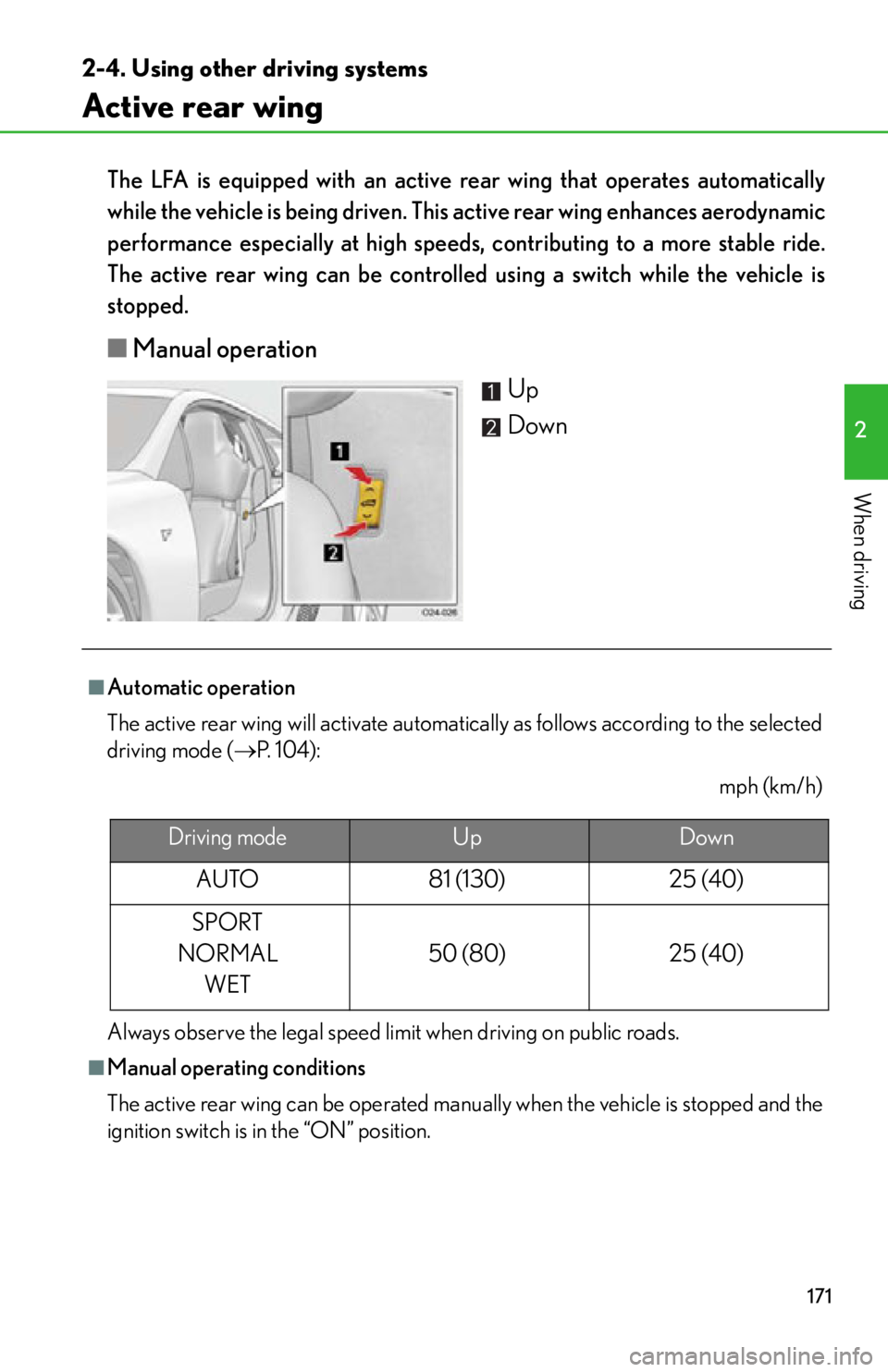
■ Manual operation
Up
Down
■Automatic operation
The active rear wing will activate automatically as follows according to the selected
driving mode (P. 1 0 4 ) :
mph (km/h)
Always observe the legal speed limit when driving on public roads.
■Manual operating conditions
The active rear wing can be operated manu ally when the vehicle is stopped and the
ignition switch is in the “ON” position.
Driving modeUpDown
AUTO 81 (130) 25 (40)
SPORT
NORMAL
WET 50 (80) 25 (40)
Page 174 of 420
172
2-4. Using other driving systems
■Automatic retraction
Even if the active rear wing is raised manually, it will automatically retract when the
vehicle speed exceeds 16 mph (25 km/h).
(It will not rise again until the abov e mentioned trigger speed is reached.)
■When there is a malfunction in the system
“Failure of active rear wing” will be shown on the meter. ( P. 3 2 5 )
Avoid high speed driving and have the vehicle inspected by your Lexus dealer.
CAUTION
■When manually operating the active rear wing
Observe the following precautions before operating the active rear wing. Failure to
do so may result in de ath or serious injury.
●Ensure that the surrounding area is free from any foreign objects that may come
into contact with or get caught by the active rear wing.
●If there is a risk that a foreign object may become jammed during operation, stop
operation immediately or raise the active re ar wing by pressing up on the switch.
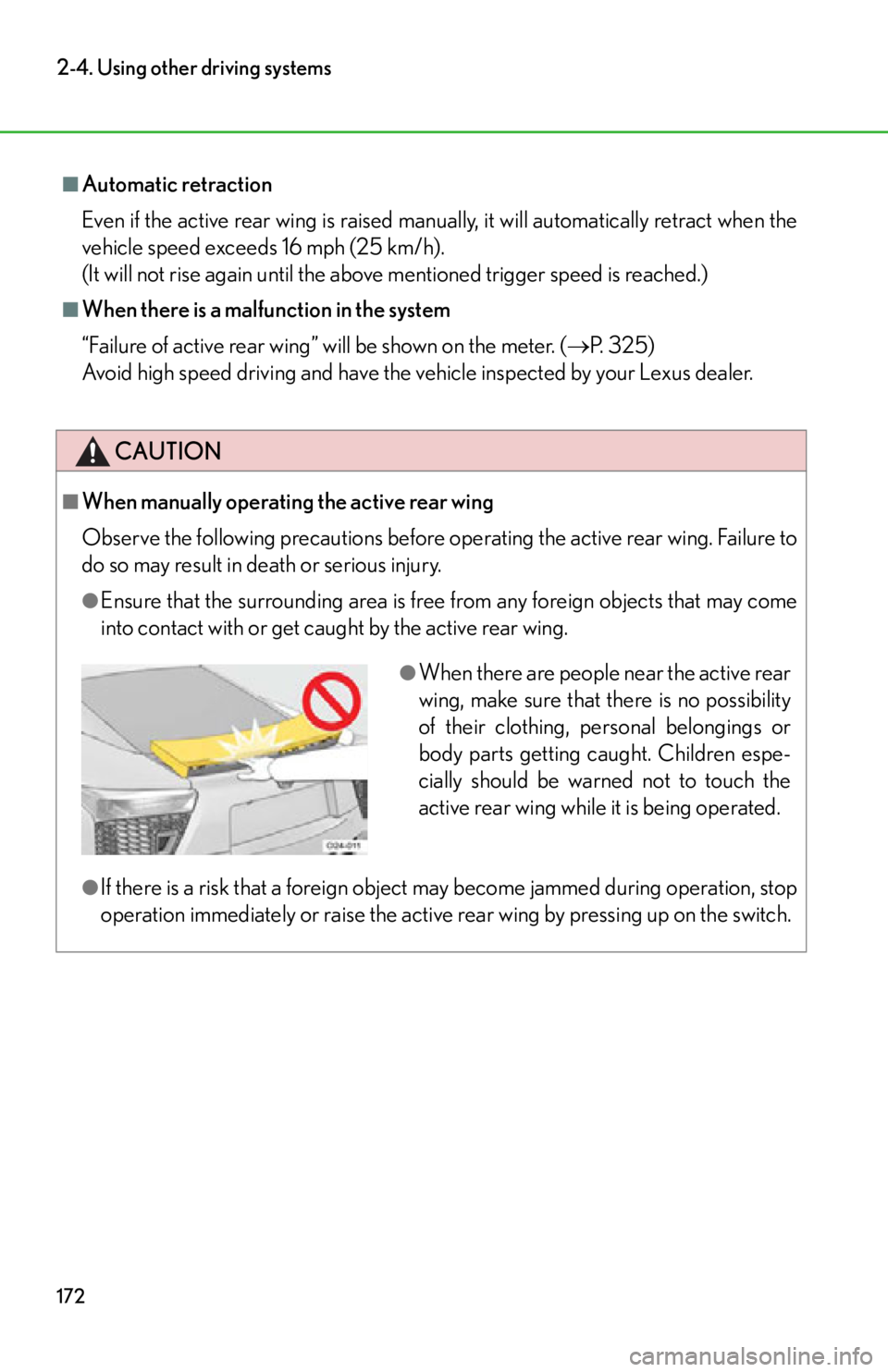
●When there are people near the active rear
wing, make sure that there is no possibility
of their clothing, personal belongings or
body parts getting caught. Children espe-
cially should be warned not to touch the
active rear wing while it is being operated.