ignition lexus LFA 2012 Technical Information / LEXUS 2012 LFA (OM77006U) User Guide
[x] Cancel search | Manufacturer: LEXUS, Model Year: 2012, Model line: LFA, Model: Lexus LFA 2012Pages: 420, PDF Size: 5.02 MB
Page 53 of 420

51
1-5. Refueling
1
Before driving
CAUTION
■When refueling the vehicle
Observe the following precautions while refueling the vehicle.
Failure to do so may result in death or serious injury.
●Touch a metal surface (such as a static discharge plate if available) to discharge
any static electricity. As the vehicle body is made of resin touching the vehicle
body will not discharge static electricity.
Sparks resulting from discharging static electricity may cause the fuel vapors to
ignite.
●Always hold the grips on the fuel tank cap and turn it slowly to remove it.
A whooshing sound may be heard when the fuel tank cap is loosened. Wait until
the sound cannot be heard before fully removing the cap.
In hot weather, pressurized fuel may spra y out the filler neck and cause injury.
●Do not allow anyone that has not discharged static electricity from their bodies to
come close to an open fuel tank.
●Do not inhale vaporized fuel.
Fuel contains substances that are harmful if inhaled.
●Do not smoke while refueling the vehicle.
Doing so may cause the fuel to ignite and cause a fire.
●Do not return to the vehicle or touch an y person or object that is statically
charged.
This may cause static electricity to build up , resulting in a possible ignition hazard.
■When refueling
Securely insert the fuel nozzle into the fuel filler neck. When the fuel tank is filled to
the maximum level, the automatic shut of f function will engage. Do not continue
fueling once the automatic shut off function engages, as this may result in fuel over-
flowing from the tank.
■When replacing the fuel cap
Do not use anything but a genuine Lexus fuel tank cap designed for your vehicle.
Failure to do so may cause a fire or other incident which may result in death or seri-
ous injury.
Page 55 of 420
53
1
Before driving
1-6.Theft deterrent system
Engine immobilizer system
The vehicle's keys have built-in transponder chips that prevent the engine
from starting if the key has not been previously registered in the vehicle's on-
board computer.
Never leave the keys inside the vehicle when you leave the vehicle.
■ Setting and canceling the engine immobilizer system
U.S.A.
The system will set after the key has been removed from the ignition
switch.
The system will be canceled when the registered key is inserted into the
ignition switch.
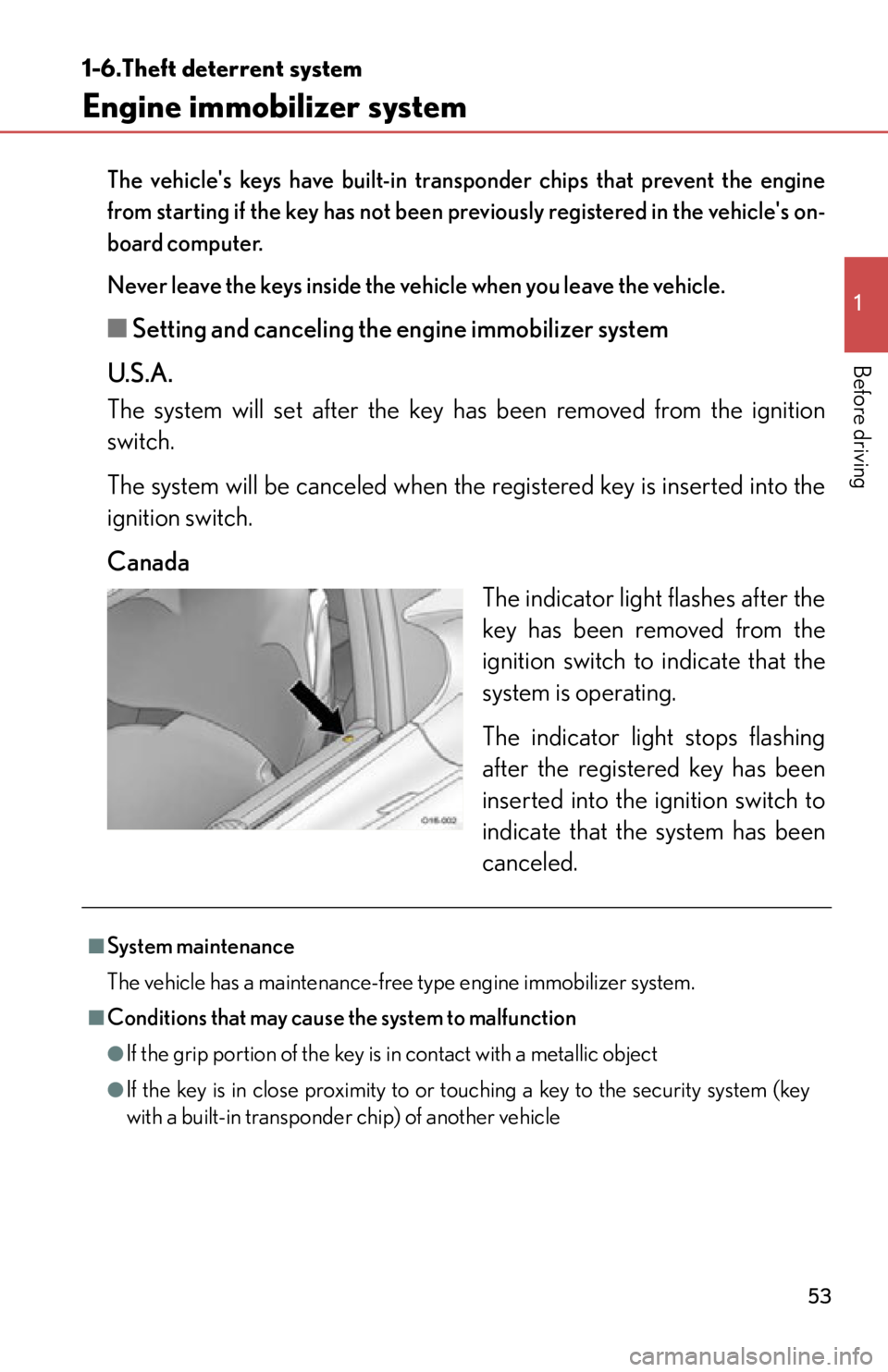
Canada
The indicator light flashes after the
key has been removed from the
ignition switch to indicate that the
system is operating.
The indicator light stops flashing
after the registered key has been
inserted into the ignition switch to
indicate that the system has been
canceled.
■System maintenance
The vehicle has a maintenance-free type engine immobilizer system.
■Conditions that may cause the system to malfunction
●If the grip portion of the key is in contact with a metallic object
●If the key is in close proximity to or touching a key to the security system (key
with a built-in transponder chip) of another vehicle
Page 58 of 420
56
1-6. Theft deterrent system
Tilt sensorThe tilt sensor detects changes in vehicle inclination, such as when the
vehicle is towed away.
This system is designed to deter and p revent vehicle theft but does not
guarantee absolute security against all tilts.
The tilt sensor can be canceled using the cancel switch.
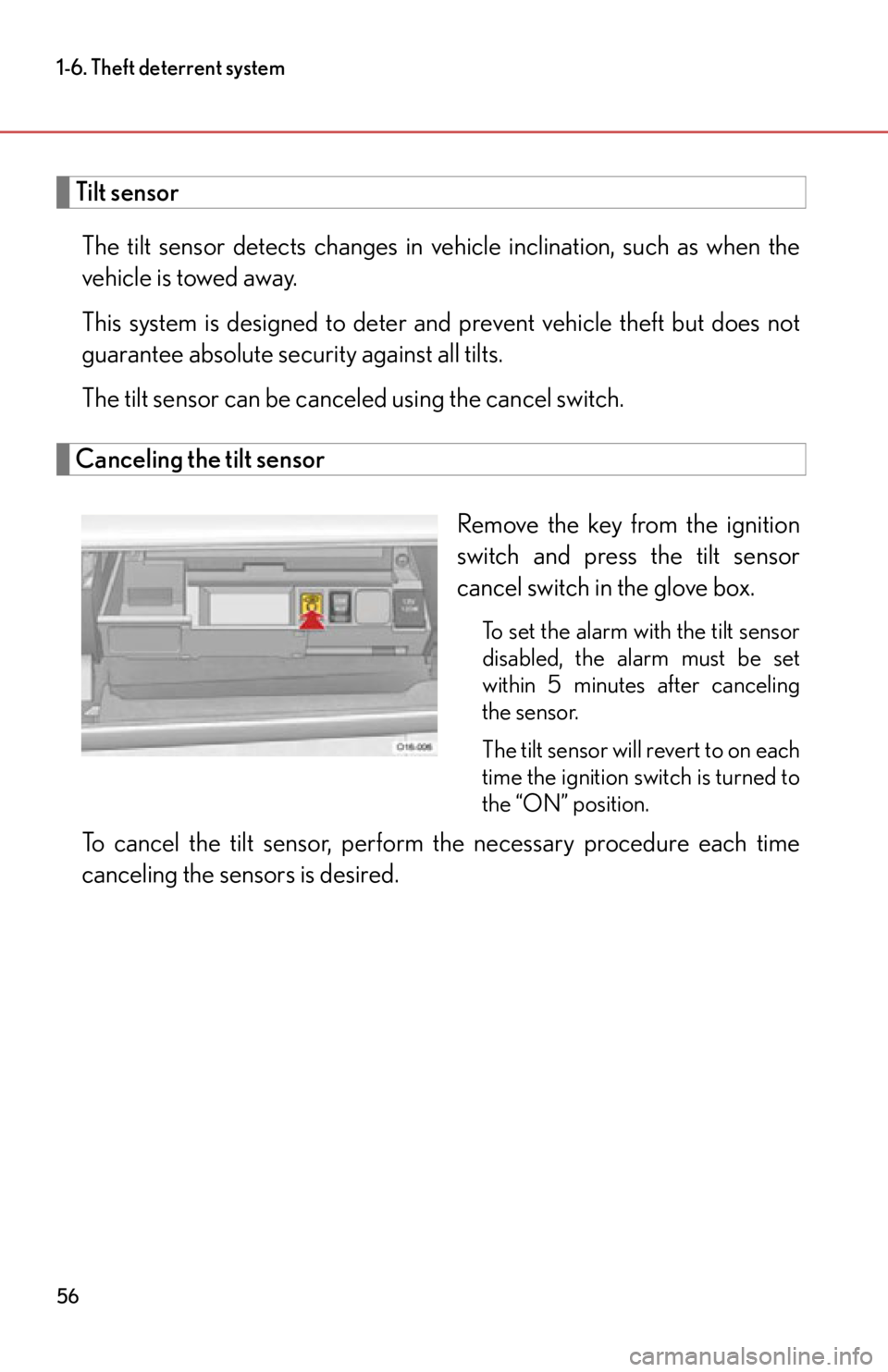
Canceling the tilt sensor
Remove the key from the ignition
switch and press the tilt sensor
cancel switch in the glove box.
To set the alarm with the tilt sensor
disabled, the alarm must be set
within 5 minutes after canceling
the sensor.
The tilt sensor will revert to on each
time the ignition switch is turned to
the “ON” position.
To cancel the tilt sensor, perform the necessary procedure each time
canceling the sensors is desired.
Page 60 of 420

58
1-6. Theft deterrent system
■The alarm cannot be set when
In the following situations, the alarm cannot be set. Be careful if the vehicle will not
be used for an extended period of time.
●When a battery terminal is disconnected
●When the “D/C CUT” fuse is removed
■Canceling and automatic re-enabling of the tilt sensor
●The alarm will still be set even when the tilt sensor is canceled.
●After the tilt sensor is canceled, turning the ignition switch to the “ON” position
or unlocking the doors using the wireless remote control or key will re-enable
the tilt sensor.
●When the alarm system is set again, the intrusion sensor and tilt sensor will be
set.
■Tilt sensor detection considerations
The sensor may trigger the alarm in the fo llowing situations. Cancel the tilt sensor
as necessary.
●The vehicle is transported by a ferry, a flatbed track, train, etc.
●The vehicle is parked in a parking garage.
●Any of the tires loses air pressure.
●The vehicle is jacked up.
●An earthquake occurs or the road caves in.
NOTICE
■To ensure the system operates correctly
Do not modify or remove the system. If mo dified or removed, the proper operation
of the system cannot be guaranteed.
Page 89 of 420

When driving2
87
2-1. Driving proceduresDriving the vehicle................... 88
Ignition switch ........................... 98
ASG (Automated Sequential Gearbox) .......... 102
Turn signal lever ........................ 112
Parking brake ............................ 113
Horn ............................................. 115
2-2. Instrument cluster Gauges and meters ................. 116
Indicators and warning lights .......................................... 121
Using the menu........................ 124
2-3. Operating the lights and windshield wipers
Headlight switch...................... 158
Windshield wipers and washer ..................................... 160 2-4. Using other driving
systems
Rear view monitor system .... 163
Driving assist systems ............ 166
Active rear wing ........................ 171
Launch control.......................... 174
2-5. Driving information Cargo and luggage ................. 176
Vehicle load limits .................... 179
Winter driving tips .................. 180
Trailer towing ........................... 182
Dinghy towing .......................... 183
Page 90 of 420

88
2-1.Driving procedures
Driving the vehicle
The following procedures should be observed to ensure safe driving:
■Starting the engine
P. 9 8
■ Driving
With the brake pedal depressed, select 1st gear. ( P. 1 0 2 )
Check that “D1” or “1” is displayed on the gear indicator.
Release the parking brake. ( P. 113)
Gradually release the brake pedal and gently depress the accel-
erator pedal to accelerate the vehicle.
■ Stopping
Depress the brake pedal.
If necessary, set the parking brake.
If the vehicle is to be stopped for an extended period of time, select
Neutral. ( P. 1 0 3 )
■Parking the vehicle
Depress the brake pedal.
Set the parking brake. ( P. 113)
Select 1st gear or Reverse. ( P. 1 0 2 )
Check that “D1”, “1” or “R” is displayed on the gear indicator.
Turn the ignition switch to the “LOCK” position to stop the
engine.
Check that “D1” or “R” is no long er displayed on the gear indicator.
Lock the door, making sure that you have the key on your person.
STEP1
STEP2
STEP3
STEP1
STEP2
STEP1
STEP2
STEP3
STEP4
STEP5
Page 100 of 420

98
2-1. Driving procedures
Ignition switch
■Starting the engine
Sit in the driver’s seat and firmly depress the brake pedal.
Turn the ignition switch to the
“ON” position.
The current gear will be displayed
on the meter as a blinking symbol.
Pull both paddle shift switches at
the same time.
“N” will be displayed in the gear
indicator.
The indicator light on the steering
wheel illuminates in red.
Press the “ENGINE START”
switch.
After one press, the engine will
crank until it starts or for up to 20
seconds, whichever is less.
Continue depressing the brake
pedal until the engine is completely
started.
STEP1
STEP2
STEP3
STEP4
Page 101 of 420
99
2-1. Driving procedures
2
When driving
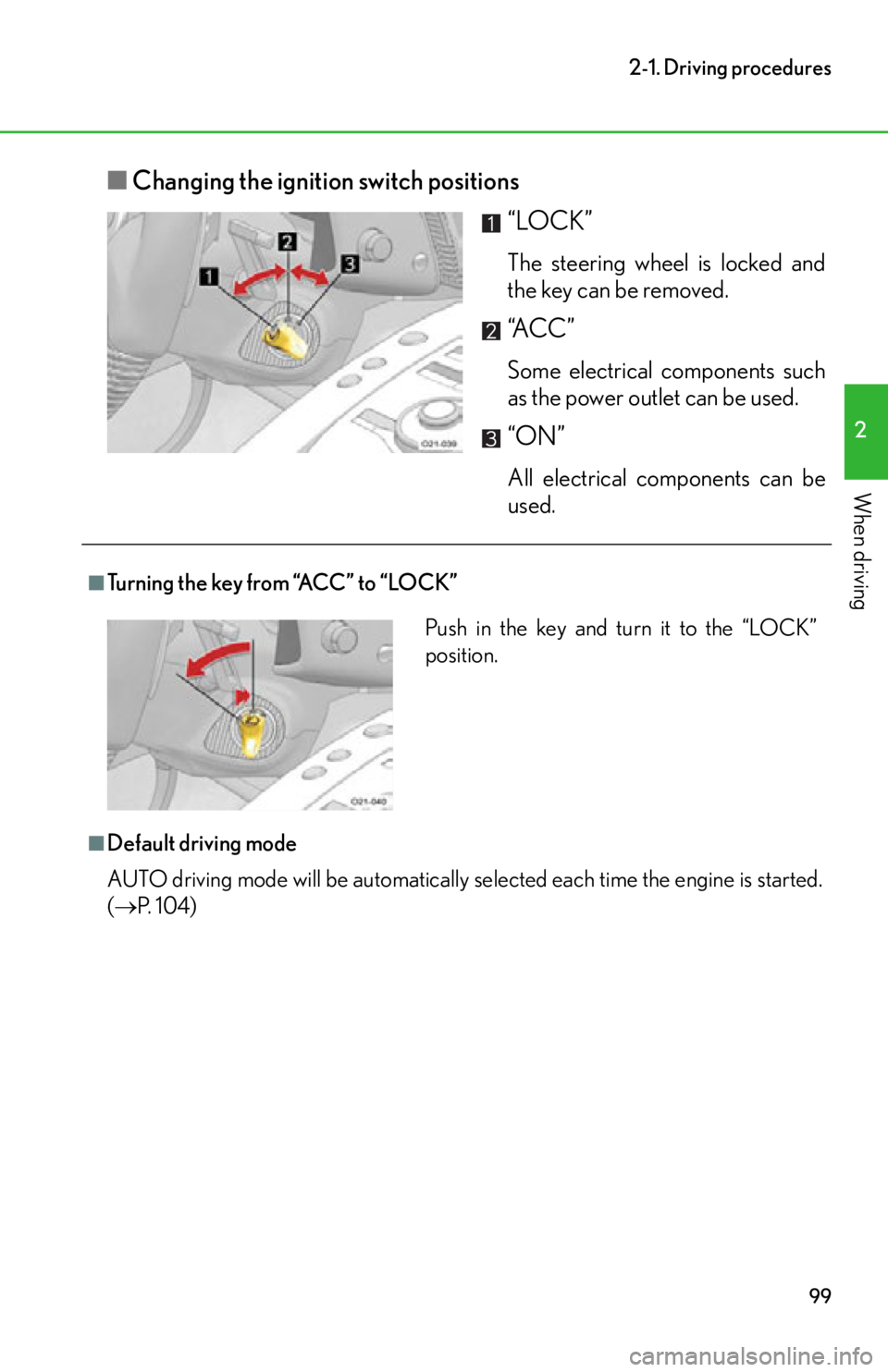
■Changing the ignition switch positions
“LOCK”
The steering wheel is locked and
the key can be removed.
“A C C ”
Some electrical components such
as the power outlet can be used.
“ON”
All electrical components can be
used.
■Turning the key from “ACC” to “LOCK”
■Default driving mode
AUTO driving mode will be automatically se lected each time the engine is started.
( P. 1 0 4 )
Push in the key and turn it to the “LOCK”
position.
Page 102 of 420
100
2-1. Driving procedures
■If the engine does not start
●Repeat the procedure again. If the engine does not start after a few tries, the
“ENGINE START” switch may be malfunctioning. Have the vehicle inspected
by your Lexus dealer.
●Check to make sure that the brake pedal is firmly depressed and that “N” is dis-
played in the gear indicator. (If the brake pedal is not depressed or “N” is not
displayed, the engine will not start.)
●The engine immobilizer system may not have been deactivated. ( P. 5 3 )
●In order to protect the engine, the engine may not start when the engine coolant
temperature or the engine oil temperature is below -13 F (-25C). In that case,
a buzzer will sound and “Temp low Engine cannot be started” will be shown on
the meter. ( P. 3 2 7 )
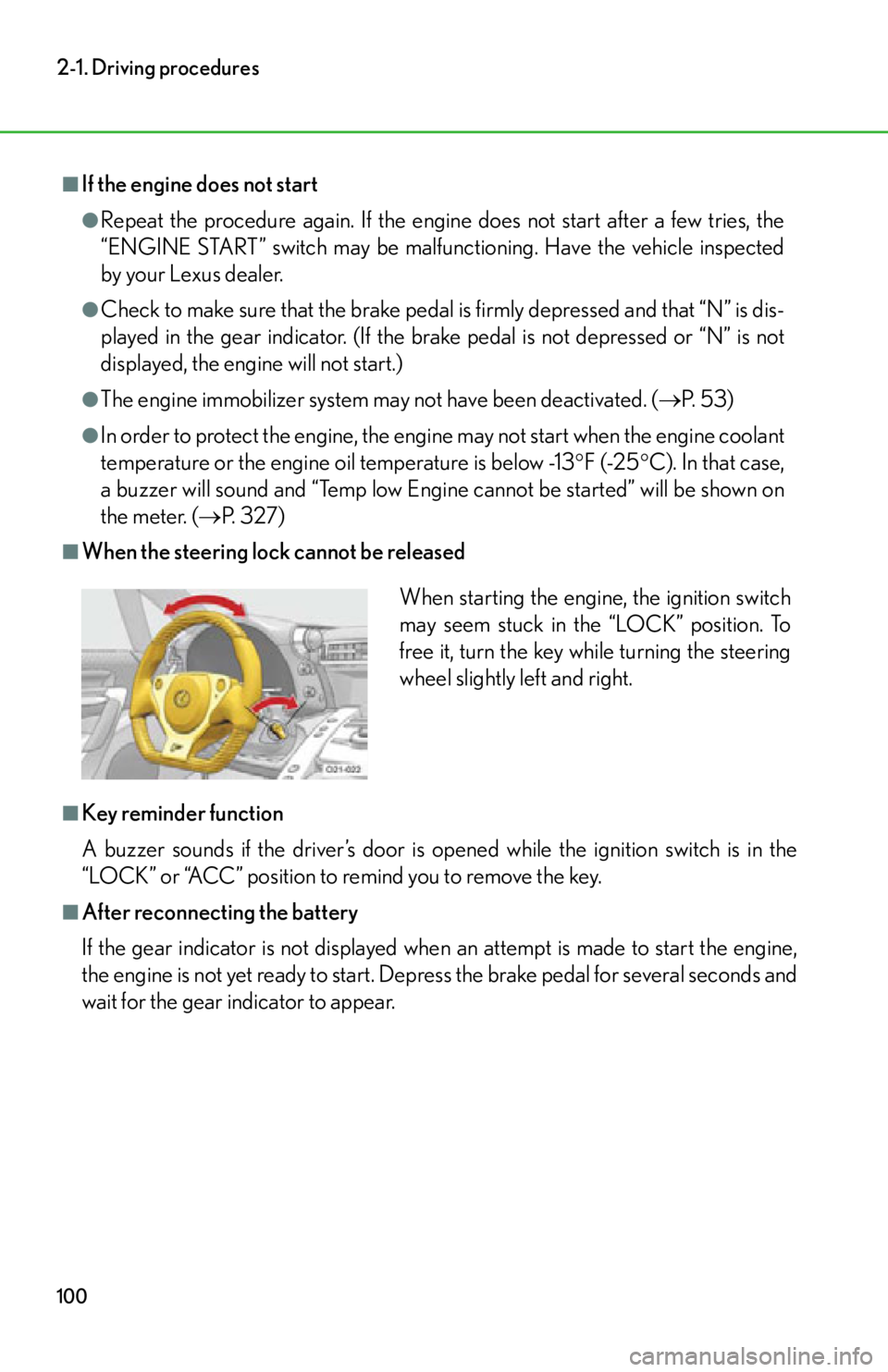
■When the steering lock cannot be released
■Key reminder function
A buzzer sounds if the driver’s door is opened while the ignition switch is in the
“LOCK” or “ACC” position to remind you to remove the key.
■After reconnecting the battery
If the gear indicator is not displayed when an attempt is made to start the engine,
the engine is not yet ready to start. Depr ess the brake pedal for several seconds and
wait for the gear indicator to appear.
When starting the engine, the ignition switch
may seem stuck in the “LOCK” position. To
free it, turn the key while turning the steering
wheel slightly left and right.
Page 103 of 420

101
2-1. Driving procedures
2
When driving
CAUTION
■When starting the engine
Always start the engine while sitting in the driver’s seat. Do not press the accelera-
tor pedal while starting the engine under any circumstances.
Doing so may cause an accident, resulting in death or serious injury.
■Caution when driving
Do not turn the ignition switch to the “LOCK” position while driving. An accident
may result if the engine is stopped while driving.
If you must turn the engine off while the vehicle is moving (due to an emergency),
turn the ignition switch on ly to the “ACC” position. (P. 355)
NOTICE
■To prevent battery discharge
Do not leave the ignition switch in the “A CC” or “ON” position for long periods of
time without the engine running.
■When starting the engine
●Do not race a cold engine.
●If the engine becomes difficult to start or stalls frequently, have the engine
checked immediately.