warning light lexus LFA 2012 Technical Information / LEXUS 2012 LFA (OM77006U) User Guide
[x] Cancel search | Manufacturer: LEXUS, Model Year: 2012, Model line: LFA, Model: Lexus LFA 2012Pages: 420, PDF Size: 5.02 MB
Page 97 of 420

95
2-1. Driving procedures
2
When driving
CAUTION
■Exhaust gases
Exhaust gases include harmful carbon monoxide (CO), which is colorless and
odorless. Inhaling exhaust gases may lead to death or a serious health hazard.
●If the vehicle is in a poorly ventilated ar ea, stop the engine. In a closed area, such
as a garage, exhaust gases may collect and enter the vehicle. This may lead to
death or a serious health hazard.
●The exhaust system should be checked occasionally. If there is a hole or crack
caused by corrosion, damage to a joint or abnormal exhaust noise, be sure to
have the vehicle inspected and repaired by your Lexus dealer. Failure to do so
may allow exhaust gases to enter the vehicl e, resulting in death or a serious health
hazard.
■When taking a nap in the vehicle
Always turn the engine off. If you take a nap with the engine on, you may acciden-
tally depress the accelerator and an accident or fire may occur due to engine over-
heating. In addition, if the vehicle is parked in a poorly ventilated area, exhaust gases
may enter the vehicle, leading to death or a serious health hazard.
■When braking the vehicle
●Be especially careful if the brakes are wet, such as when driving on wet or snowy
roads or immediately after washing the vehicle. When the brakes are wet, their
efficiency may be reduced and the vehicle may brake unevenly to the left or right.
The efficiency of the parking brake may also be reduced.
●The brake system consists of 3 individual hydraulic systems; if one of the systems
fails, the others will still operate. In th is case, the brake pedal should be depressed
more firmly than usual and the braking distance will increase. If this happens, do
not continue to drive the vehicle. If the brake system warning light (red indicator)
comes on together with the buzzer sound while driving, immediately stop the
vehicle in a safe place and contact your Lexus dealer.
Page 116 of 420

114
2-1. Driving procedures
■When there is a malfunction in the system
Warning lights and/or warning messages will turn on or flash. (P. 325, 327)
Depending on the condition, the parking brake indicator light may flash.
NOTICE
■When parking the vehicle
Before you leave the vehicle, set the parking brake, select 1st gear or Reverse, and
stop the engine. Make sure that the vehicle does not move.
■When the system malfunctions
Stop the vehicle in a safe place and check the warning messages.
■When the parking brake cannot be released due to a malfunction
Use the parking brake release tool to manually release the parking brake.
( P. 3 4 5 )
Driving the vehicle with the parking brake set will lead to brake components over-
heating, which may affect braking performance and increase brake wear.
Page 123 of 420
121
2-2. Instrument cluster
2
When driving
Indicators and warning lights
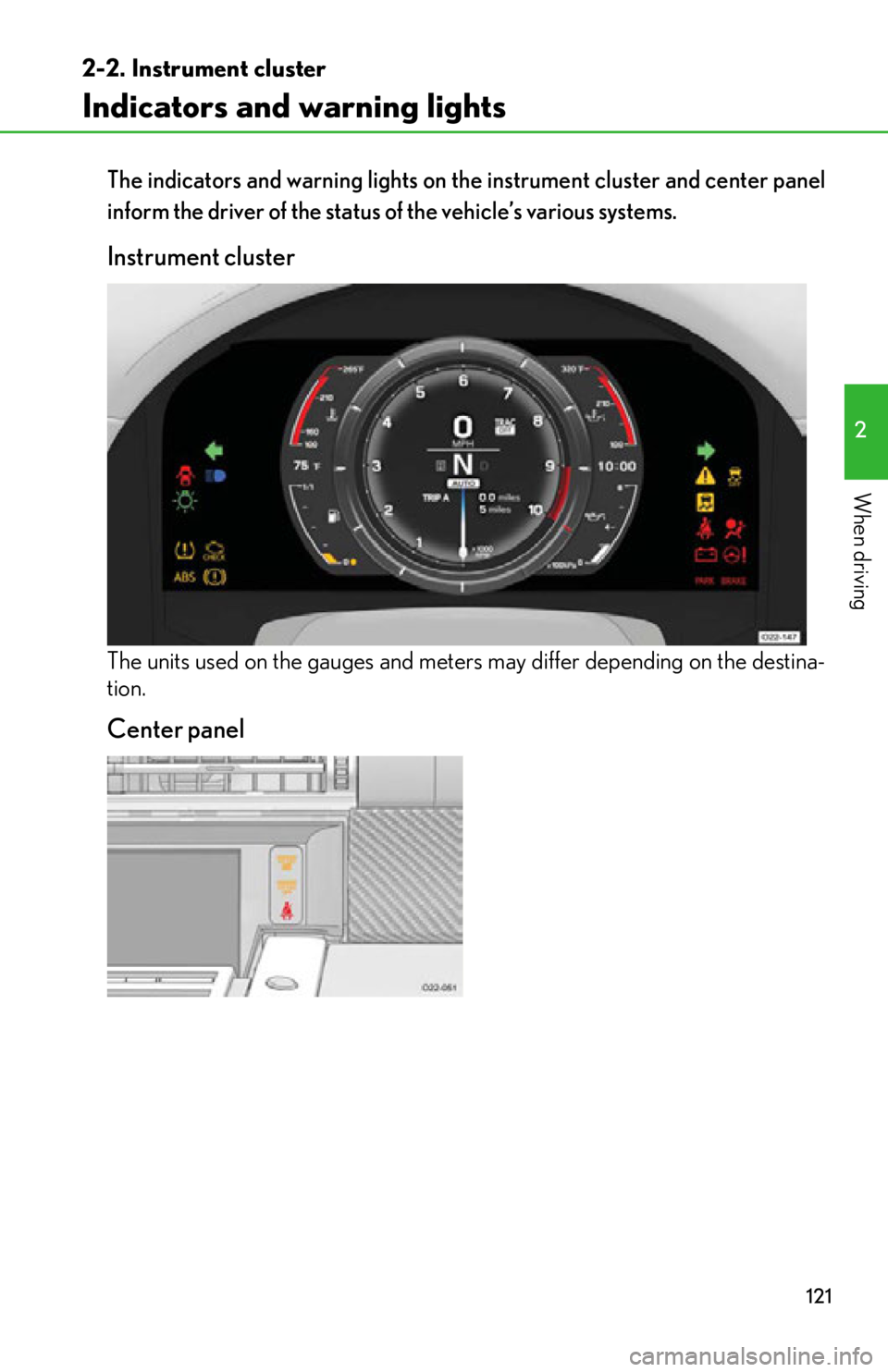
The indicators and warning lights on the instrument cluster and center panel
inform the driver of the status of the vehicle’s various systems.
Instrument cluster
The units used on the gauges and meters may differ depending on the destina-
tion.
Center panel
Page 125 of 420
123
2-2. Instrument cluster
2
When driving
■Warning lights
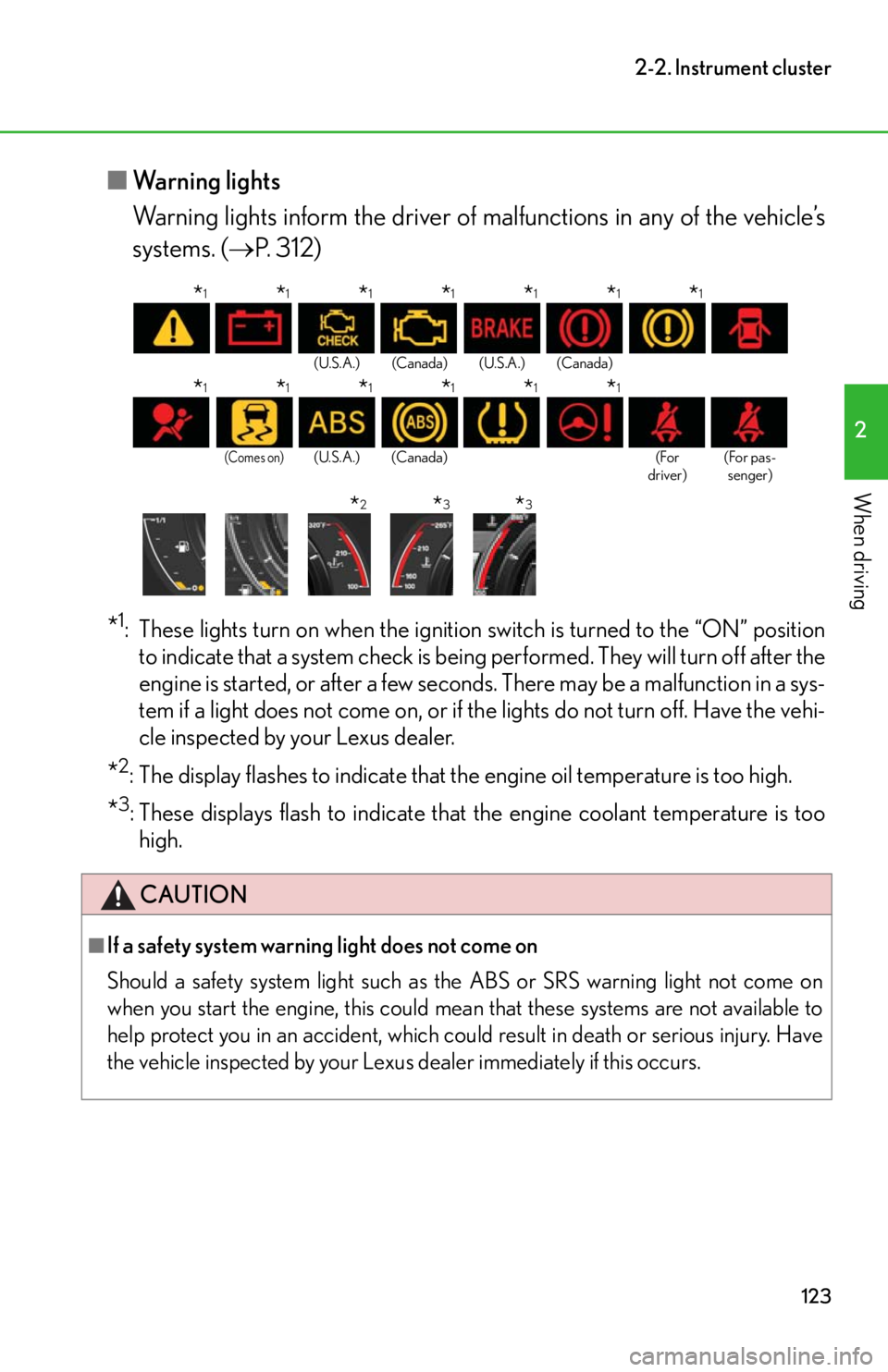
Warning lights inform the driver of ma lfunctions in any of the vehicle’s
systems. ( P. 312)
*1: These lights turn on when the ignition switch is turned to the “ON” position
to indicate that a system check is being performed. They will turn off after the
engine is started, or after a few seconds. There may be a malfunction in a sys-
tem if a light does not come on, or if th e lights do not turn off. Have the vehi-
cle inspected by your Lexus dealer.
*2: The display flashes to indicate that the engine oil temperature is too high.
*3: These displays flash to indicate that the engine coolant temperature is too
high.
(U.S.A.) (Canada) (U.S.A.) (Canada)
(Comes on)(U.S.A.) (Canada) (For
driver) (For pas-
senger)
CAUTION
■If a safety system warning light does not come on
Should a safety system lig ht such as the ABS or SRS warning light not come on
when you start the engine, this could mean that these systems are not available to
help protect you in an accident, which could result in death or serious injury. Have
the vehicle inspected by your Lexus dealer immediately if this occurs.
*1*1*1*1*1*1*1
*1*1*1*1*1*1
*2*3*3
Page 273 of 420
271
4-3. Do-it-yourself maintenance
4
Maintenance and care
Initializing the tire pressure warning systemThe tire pressure warning system must be initialized when the tire infla-
tion pressure is changed (such as when changing traveling speed).
When the tire pressure warning system is initialized, the current tire infla-
tion pressure is set as the benchmark pressure.
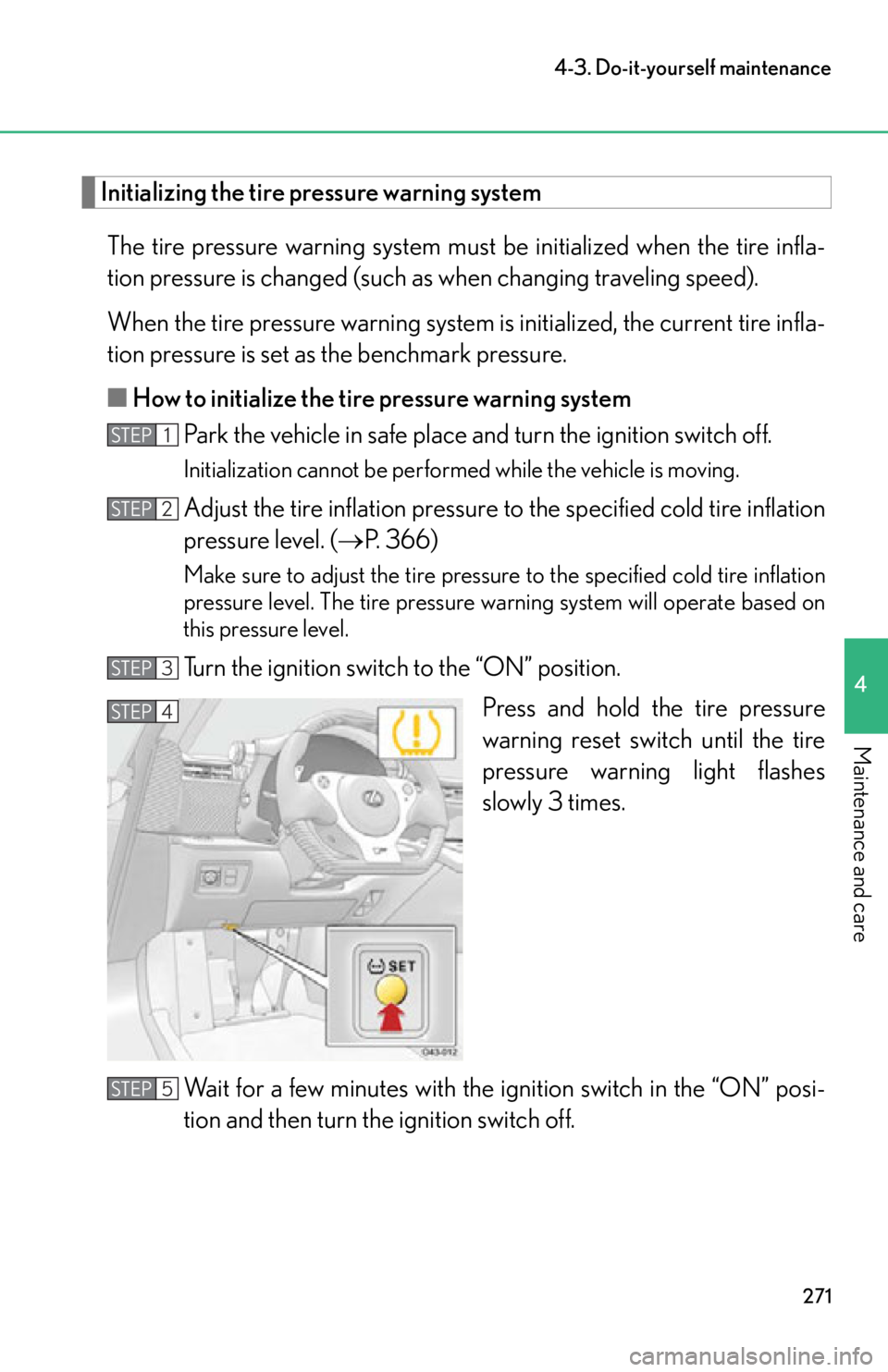
■ How to initialize the tire pressure warning system
Park the vehicle in safe place and turn the ignition switch off.
Initialization cannot be performed while the vehicle is moving.
Adjust the tire inflation pressure to the specified cold tire inflation
pressure level. ( P. 366)
Make sure to adjust the tire pressure to the specified cold tire inflation
pressure level. The tire pressure warning system will operate based on
this pressure level.
Turn the ignition switch to the “ON” position.
Press and hold the tire pressure
warning reset switch until the tire
pressure warning light flashes
slowly 3 times.
Wait for a few minutes with th e ignition switch in the “ON” posi-
tion and then turn the ignition switch off.
STEP1
STEP2
STEP3
STEP4
STEP5
Page 274 of 420

272
4-3. Do-it-yourself maintenance
Registering ID codesThe tire pressure warning valve and transmitter is equipped with a unique
ID code. When replacing a tire pressu re warning valve and transmitter, it
is necessary to register the ID code. Ha ve the ID code registered by your
Lexus dealer.
■When to replace your vehicle’s tires
Tires should be replaced if:
●You have tire damage such as cuts, splits, cracks deep enough to expose the
fabric or bulges indicating internal damage
●A tire goes flat repeatedly or cannot be properly repaired due to the size or
location of a cut or other damage
If you are not sure, consult with your Lexus dealer.
■Replacing tires and wheels
If the ID code of the tire pressure warning valve and transmitter is not registered,
the tire pressure warning system will not work properly. After driving for about 20
minutes, the tire pressure warning light fl ashes for 1 minute to indicate a system mal-
function.
■Tire life
Any tire over 6 years old must be checked by a qualified technician even if they
have seldom or never been used or damage is not obvious.
■Routine tire inflation pressure checks
The tire pressure warning system does not replace routine tire inflation pressure
checks. Make sure to check tire inflation pressure as part of your routine of daily
vehicle checks.
■Tire rotation
It is not possible to rotate the tires, as each tire is designed only for its original posi-
tion on the vehicle.
Page 276 of 420

274
4-3. Do-it-yourself maintenance
■If you press the tire pressure warning reset switch accidentally
If initialization is performed, adjust the tire inflation pressure to the specified level
and initialize the tire pressure warning system again.
■When the initialization of the tire pressure warning system has failed
Initialization can be completed in a few minutes. However, in the following cases,
the settings have not been recorded and the system will not operate properly. If
repeated attempts to record tire inflation pressure settings are unsuccessful, have
the vehicle inspected by your Lexus dealer.
●When operating the tire pressure warning reset switch, the tire pressure warning
light does not flash 3 times.
●After carrying out the initialization procedure, the tire pressure warning light
flashes for 1 minute then stays on after driving for 20 minutes.
■Tire pressure warning system certification
MODEL/FCC IDs:
Tr a n s m i t t e r : PA X P M V 1 0 7 J
Receiver: HYQ13BDK
For vehicles sold in the U.S.A.
NOTE:
This device complies with part 15 of the FCC Rules. Operation is subject to the fol-
lowing two conditions: (1) This device may not cause harmful interference, and (2)
this device must accept any interference received, including interference that may
cause undesired operation.
FCC WARNING:
Changes or modifications not expressly approved by the party responsible for
compliance could void the user's authority to operate the equipment.
For vehicles sold in Canada
NOTE:
Operation is subject to the following two conditions: (1) this device may not cause
interference, and (2) this device must accept any interference, including interfer-
ence that may cause undesired operation of the device.
Page 277 of 420
275
4-3. Do-it-yourself maintenance
4
Maintenance and care
CAUTION
■When inspecting or replacing tires
Observe the following precautions to prevent accidents.
Failure to do so may cause damage to parts of the drive train, as well as dangerous
handling characteristics, which may lead to an accident resulting in death or serious
injury.
●Do not mix tires of different makes, models or tread patterns.
Also, do not mix tires of remarkably different treadwear.
●Do not use tire sizes other th an those recommended by Lexus.
●Do not mix summer, all season and snow tires.
●Do not use tires that have been used on another vehicle.
Do not use tires if you do not know how they were used previously.
■To avoid burns
Do not touch the wheels or the area around the brakes immediately after the vehi-
cle has been driven, as they will be extremely hot.
■When initializing the tire pressure warning system
Do not operate the tire pressure warning re set switch without first adjusting the tire
inflation pressure to the specified level. Otherwise, the tire pressure warning light
may not come on even if the tire inflation pressure is low, or it may come on when
the tire inflation pressure is actually normal.
Page 295 of 420
293
4-3. Do-it-yourself maintenance
4
Maintenance and care
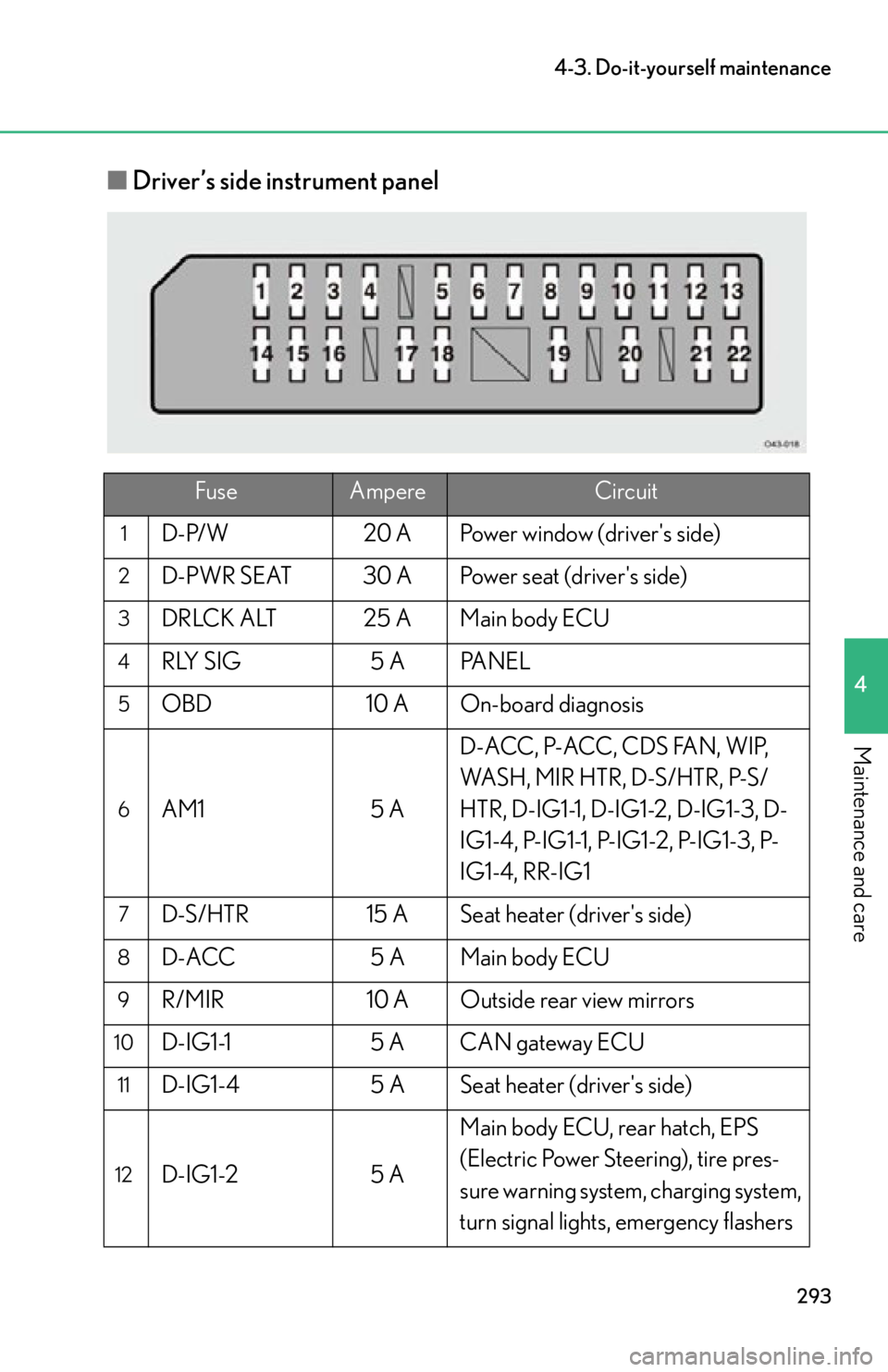
■Driver’s side instrument panel
FuseAmpereCircuit
1D-P/W 20 A Power window (driver's side)
2D-PWR SEAT 30 A Power seat (driver's side)
3DRLCK ALT 25 A Main body ECU
4RLY SIG 5 A PANEL
5OBD10 A On-board diagnosis
6AM1 5 AD-ACC, P-ACC, CDS FAN, WIP,
WASH, MIR HTR, D-S/HTR, P-S/
HTR, D-IG1-1, D-IG1-2, D-IG1-3, D-
IG1-4, P-IG1-1, P-IG1-2, P-IG1-3, P-
IG1-4, RR-IG1
7D-S/HTR 15 A Seat heater (driver's side)
8D-ACC
5 A Main body ECU
9R/MIR10 A Outside rear view mirrors
10D-IG1-1 5 A CAN gateway ECU
11D-IG1-4 5 A Seat heater (driver's side)
12D-IG1-25 AMain body ECU, rear hatch, EPS
(Electric Power Steering), tire pres-
sure warning system, charging system,
turn signal lights, emergency flashers
Page 303 of 420

When trouble arises5
301
5-1. Essential informationEmergency flashers.............. 302
If your vehicle needs to be towed................................ 303
If you think something is wrong ..................................... 308
Fuel pump shut off system .................................... 309
Event data recorder ............... 310 5-2. Steps to take in an
emergency
If a warning light turns on or a warning buzzer
sounds... .................................. 312
If a warning message is displayed................................ 322
If you have a flat tire............... 332
If the engine will not start .... 343
If you lose your keys/ wireless remote
control transmitter ............. 344
If the parking brake cannot be released ............. 345
If the vehicle battery is discharged ............................ 348
If your vehicle overheats ...... 351
If the vehicle becomes stuck........................................ 354
If your vehicle has to be stopped in an
emergency ............................ 355