ECU LEXUS LS430 2006 User Guide
[x] Cancel search | Manufacturer: LEXUS, Model Year: 2006, Model line: LS430, Model: LEXUS LS430 2006Pages: 419, PDF Size: 11.19 MB
Page 91 of 419
75
1-7. Safety information
1
Before driving
CAUTION
■Child restraint precautions
●For effective protection in automobile accidents and sudden stops, a child must
be properly restrained, using a seat belt or child restraint system depending on
the age and size of the child.
Holding a child in your arms is not a substitute for a child restraint system. In an
acc
ident, the child can be crushed against the windshield, or between you and
the vehicle’s interior.
●Lexus strongly urges use of a proper chil d restraint system which conforms to the
size of the child, installed on the rear seat. According to accident statistics, the
child is safer when properly restrained in the rear seat than in the front seat.
●Never install a rear-facing child restraint system on the front passenger seat. In
the event of an accident, the force of the rapid inflation of the front passenger air -
bag can cause death or serious injury to th e chi
ld, if the rear-facing child restraint
system is installed on the front passenger seat.
●A forward-facing child restraint system sh ould not be placed on the front passen-
ger seat except when it is unavoidable. Always move the front seat as far back as
possible
, because the front passenger airb ag could inflate by considerable speed
and force. Otherwise, the child may be killed or seriously injured.
●Do not use the seat belt extender when installing a child restraint system on the
front or rear passenger seat. If installing a child restraint system with the seat belt
extender connected to the seat belt, the seat belt will not securely hold the child
restraint system, which could cause death or serious injury to the child or other
passengers in the event of collision.
●Do not allow the child to lean his/her head or any part of his/her body against the
door or the area of the seat, front pillar or roof side rail from which the side air -
bags or curtain shield airbags deploy, even if the child is seated in the child
r
estraint system. It is dangerous if th e side airbags and curtain shield airbags
inflate, and the impact could cause death or serious injury to the child.
●Make sure you have complied with all inst allation instructions provided by the
child restraint manufacturer and that the sy stem is properly secured. If it is not
secured properly, it may cause death or serious injury to the child in the event of a
sudden stop or accident.
Page 92 of 419
76
1-7. Safety information
Installing child restraints
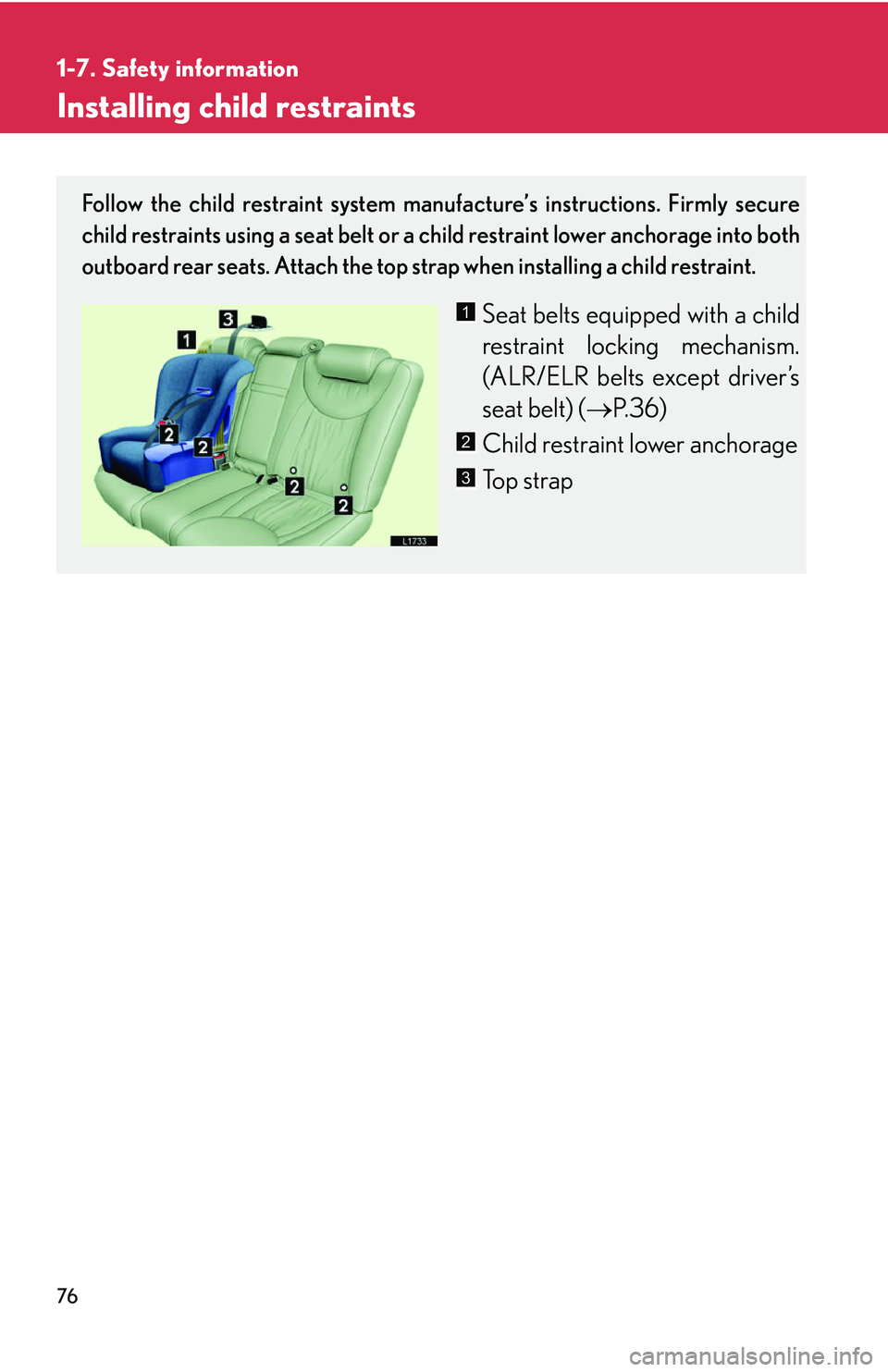
Follow the child restraint system manufacture’s instructions. Firmly secure
child restraints using a seat belt or a child restraint lower anchorage into both
outboard rear seats. Attach the top strap when installing a child restraint.
Seat belts equipped with a child
restraint locking mechanism.
(ALR/ELR belts e
xcept driver’s
seat belt) ( P.36 )
Child restraint lower anchorage
To p s t r a p
1
2
3
Page 94 of 419
78
1-7. Safety information
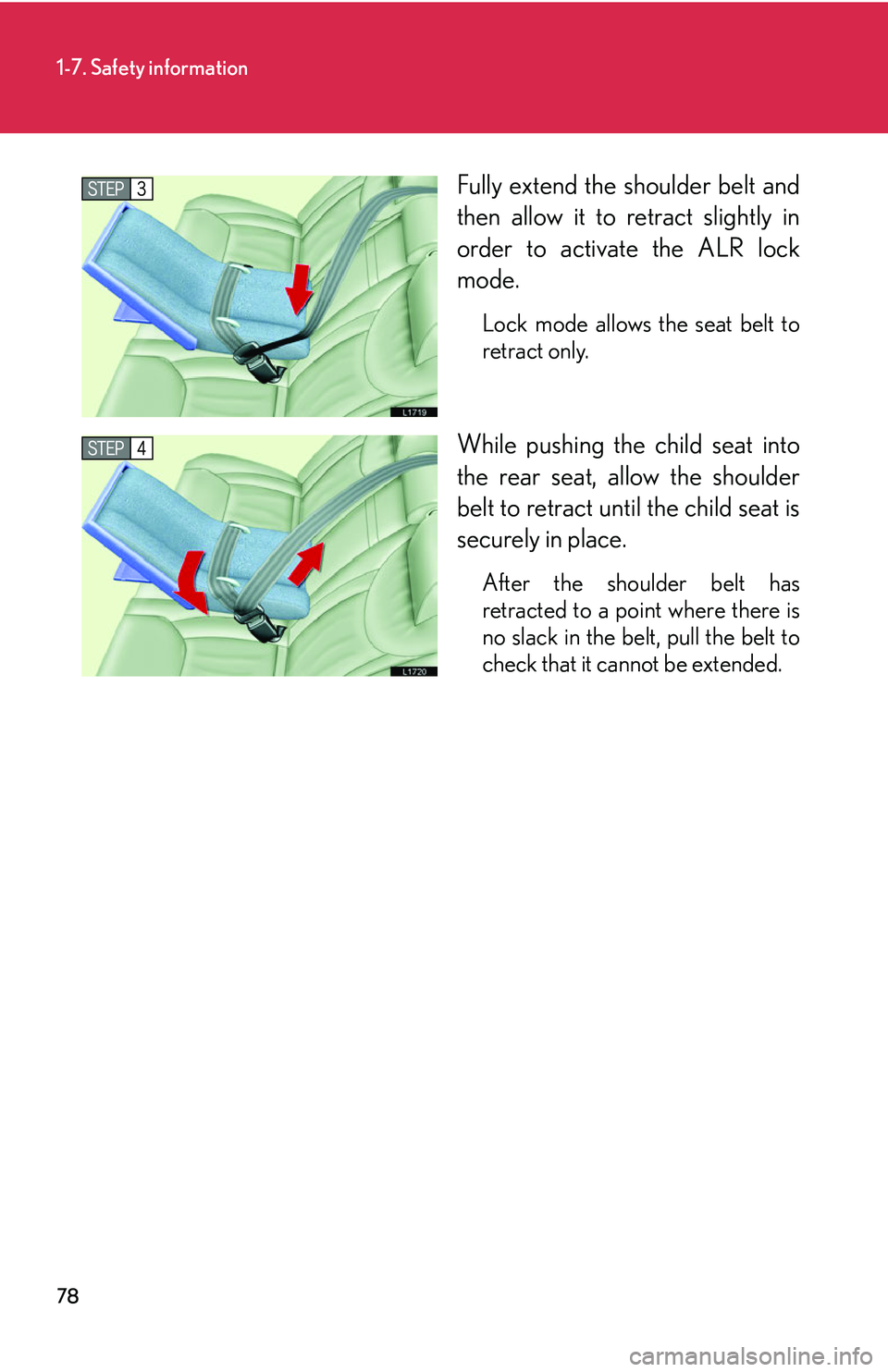
Fully extend the shoulder belt and
then allow it to retract slightly in
order to activate the ALR lock
mode.
Lock mode allows the seat belt to
retract only.
While pushing the child seat into
the rear seat, allow the shoulder
belt to retract until the child seat is
securely in place.
After the shoulder belt has
retracted to a point where there is
no slack in the belt, pull the belt to
check that it cannot be extended.
Page 95 of 419
79
1-7. Safety information
1
Before driving
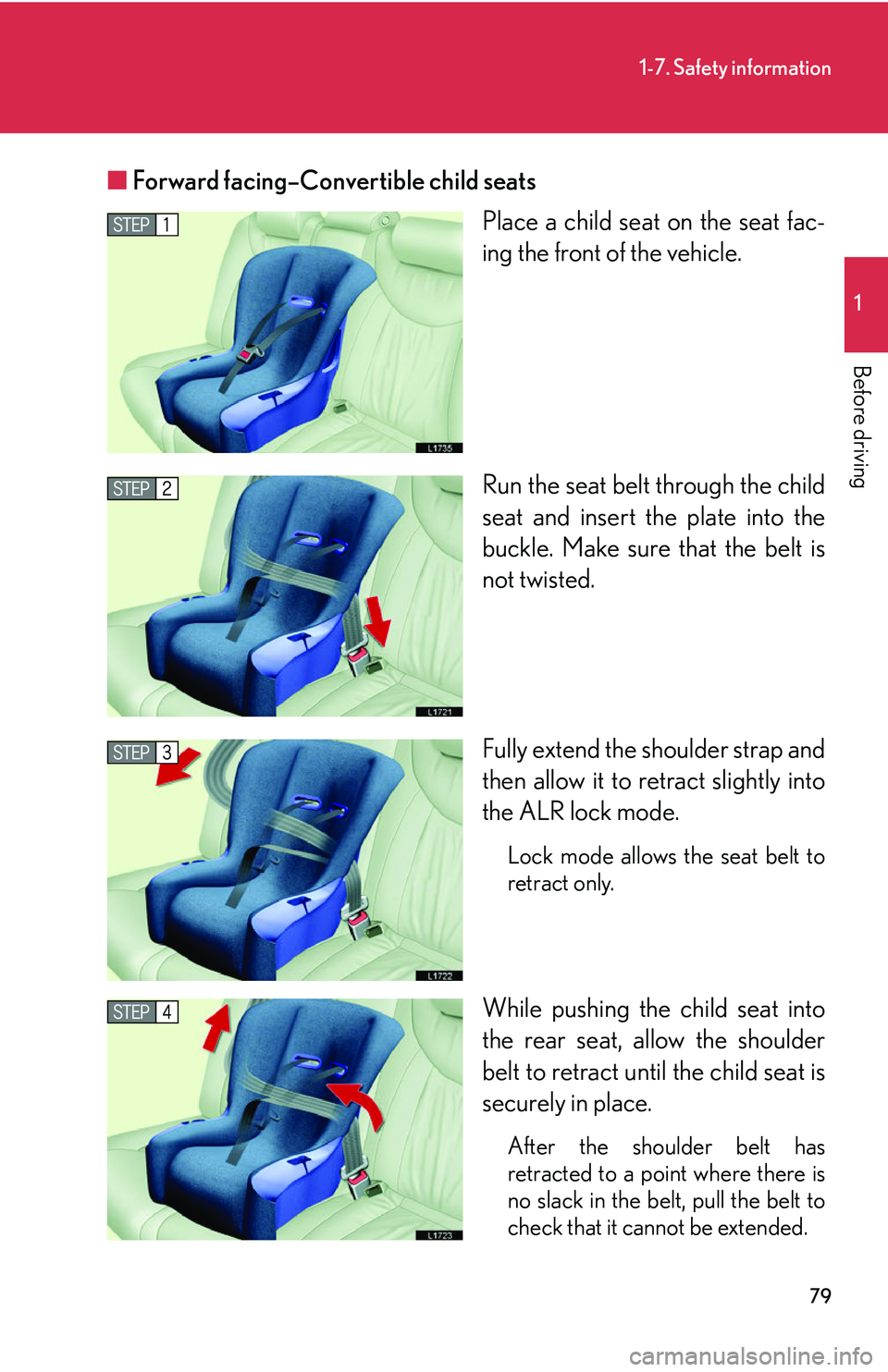
■Forward facing–Convertible child seats
Place a child seat on the seat fac-
ing the front of the vehicle.
Run the seat belt through the child
seat and inser
t the plate into the
buckle. Make sure that the belt is
not twisted.
Fully extend the shoulder strap and
then allo
w it to retract slightly into
the ALR lock mode.
Lock mode allows the seat belt to
retract only.
While pushing the child seat into
the rear seat, allow the shoulder
belt to retract until the child seat is
securely in place.
After the shoulder belt has
retracted to a point where there is
no slack in the belt, pull the belt to
check that it cannot be extended.
Page 97 of 419
81
1-7. Safety information
1
Before driving
CAUTION
■When installing the child restraint system
●When a booster seat is installed, always ensure that the shoulder belt is posi-
tioned across the center of the child’s shou lder
. The belt should be kept away from
the child’s neck, but not so that it could fall off the child's shoulder. Failing to do so
may result in death or serious injury in the event of an accident or sudden braking.
●Ensure that the belt and tab are securely locked and the seat belt is not twisted.
●Push and pull the child seat in different directions to be sure it is secure.
●Follow all installation instructions provid ed by the child restraint system manufac -
turer.
■Do not use the seat belt extender
If using the seat belt extender when inst al
ling a child seat, the seat belt will not
securely hold the child restraint system, which could cause death or serious injury
to the child or other passengers in the event of collision.
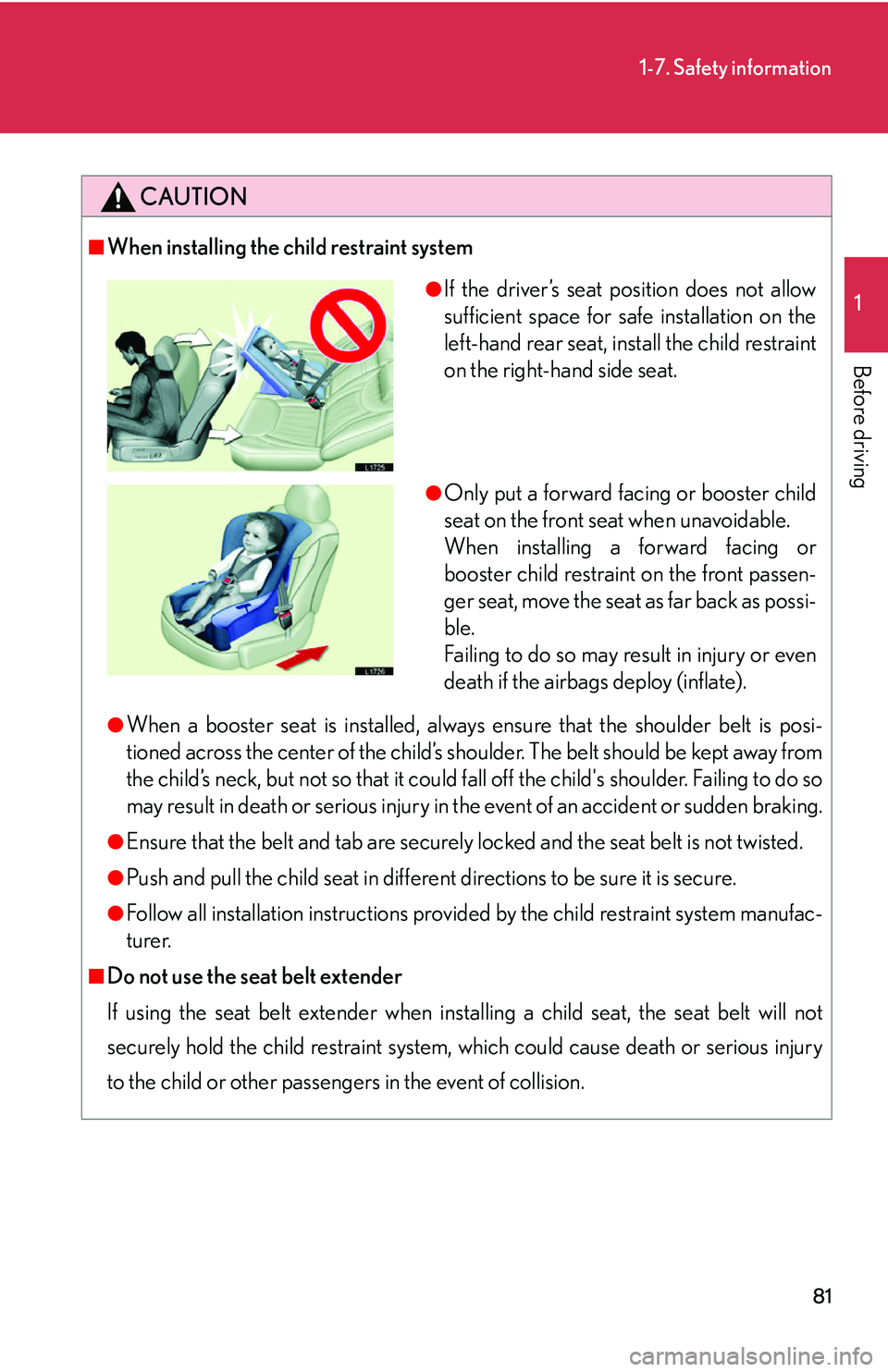
●If the driver’s seat position does not allow
sufficient space for safe installation on the
left-hand rear seat, install the child restraint
on the right-hand side seat.
●Only put a forward facing or booster child
seat on the front seat when unavoidable.
When installing a forward facing or
booster child restraint on the front passen-
ger seat, move the seat as far back as possi-
ble.
Failing to do so may result in injury or even
death if the airbags deploy (inflate).
Page 98 of 419
82
1-7. Safety information
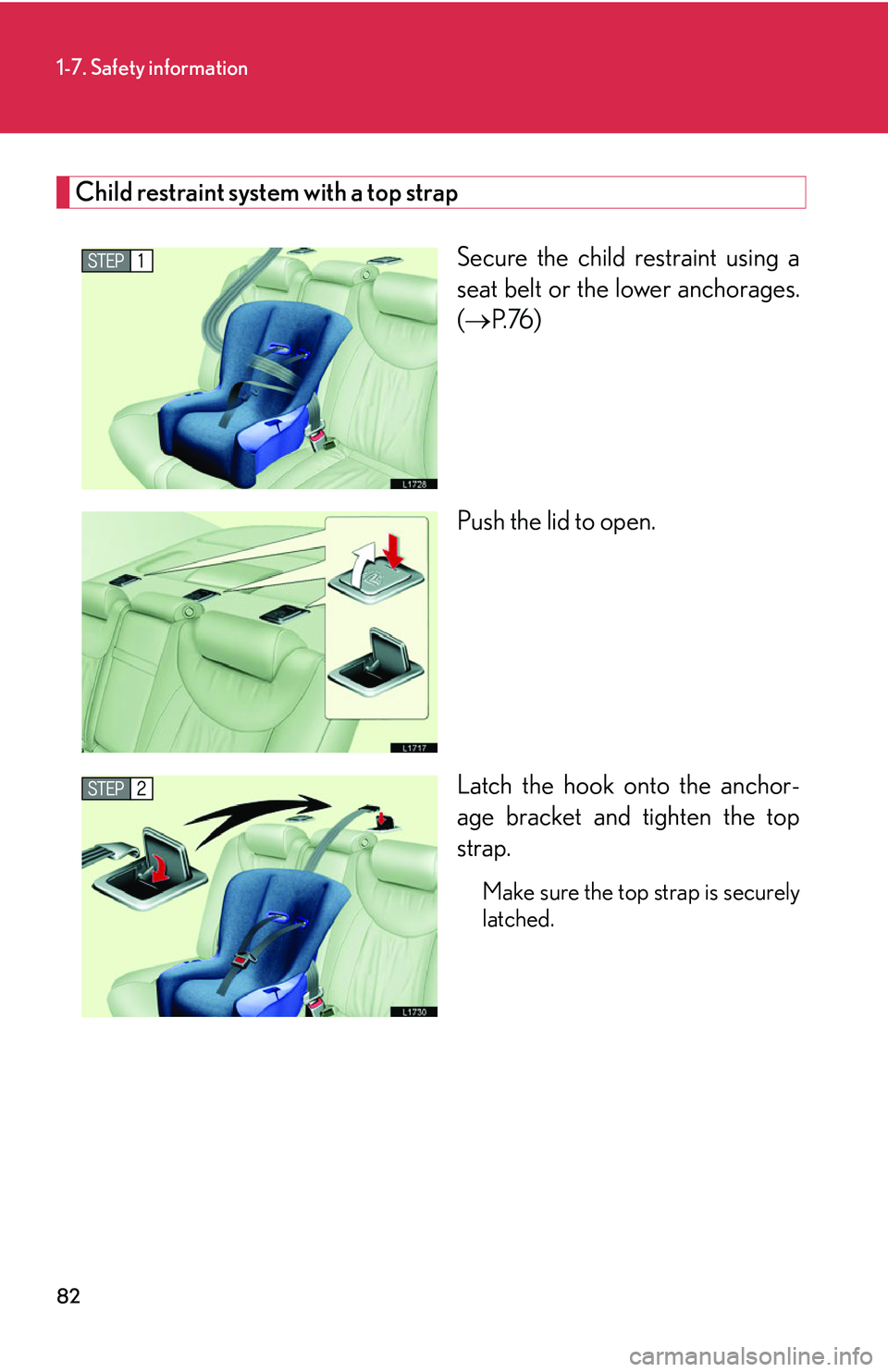
Child restraint system with a top strap
Secure the child restraint using a
seat belt or the lower anchorages.
( P.76 )
Push the lid to open.
Latch the hook onto the anchor -
age bracket and tighten the top
str
ap.
Make sure the top strap is securely
latched.
Page 100 of 419
84
1-7. Safety information
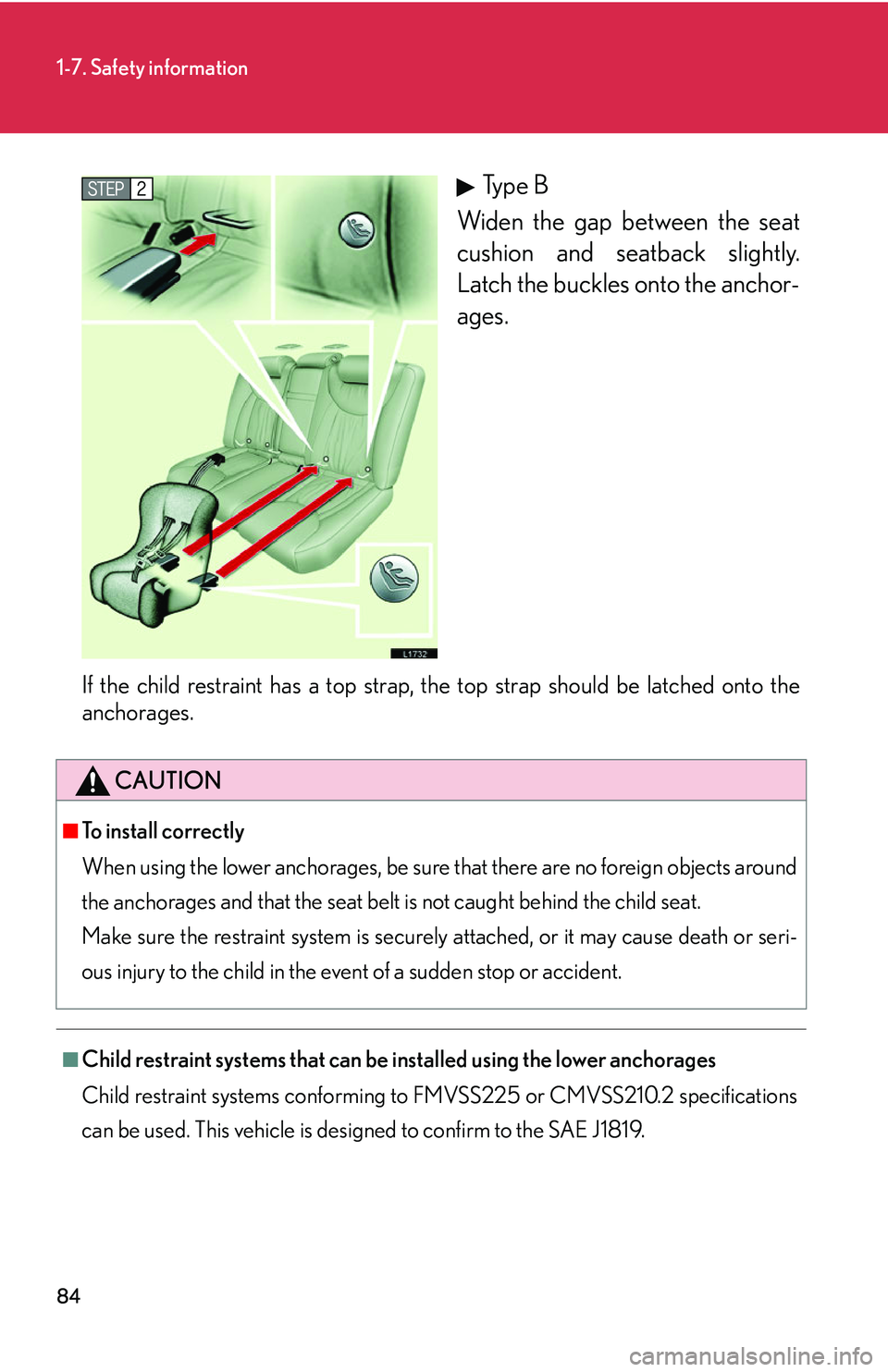
Type B
Widen the gap between the seat
cushion and seatback slightly
.
Latch the buckles onto the anchor-
ages.
If the child restraint has a top strap, the top strap should be latched onto the
anchorages.
CAUTION
■To install correctly
When using the lower anchorages, be sure that there are no foreign objects around
the ancho
rages and that the seat belt is not caught behind the child seat.
Make sure the restraint system is securely
attached, or it may cause death or seri-
ous injury to the child in the even t of
a sudden stop or accident.
■Child restraint systems that can be installed using the lower anchorages
Child restraint systems conforming to FM V
SS225 or CMVSS210.2 specifications
can be used. This vehicle is designed to confirm to the SAE J1819.
Page 108 of 419
92
2-1. Driving procedures
CAUTION
■When braking the vehicle
●When the brakes are wet, drive more cautiously.
Braking distance increases when the brakes are wet, and may cause one side of
th
e vehicle to brake differently than the other side. Also the parking brake may
not securely hold the vehicle.
●If the power brake assist function does not operate, do not follow other vehicles
closely and avoid downhill or sharp turns that require making.
Braking is still possible, but it will re quir
e more force on the pedal than usual.
Braking distance may also increase.
●Do not pump the brake pedal if the engine stalls. Each push on the pedal uses up
your reserved brake fluid pressure.
●Even if the power assist is completely lost, the brakes will still work. But you will
have to push the pedal hard, much hard er than normal. And your braking dis-
tance will increase.
●Do not drive your vehicle with only a single brake system. Have your brakes fixed
immediately.
NOTICE
■While driving the vehicle
Do not use the accelerator pedal or depres s acceler
ator and brake pedals together
to hold the vehicle on a hill.
■When parking the vehicle
Always put the selector lever in P. The vehicle may begin to move, or the vehicle
ma
y accelerate suddenly if the accelerat or pedal is accidentally depressed.
Page 140 of 419
124
2-4. Using other driving systems
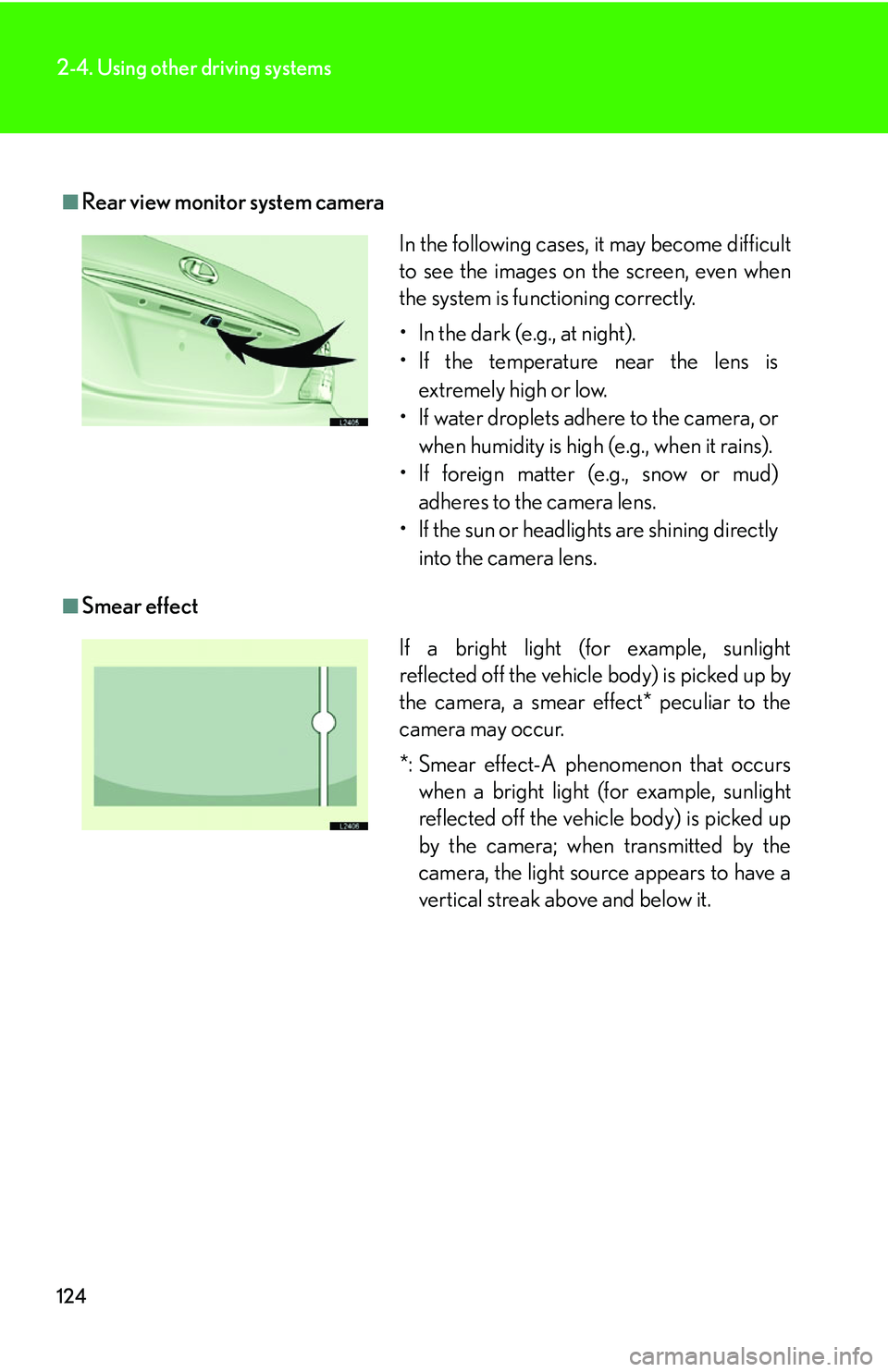
■Rear view monitor system camera
■Smear effect
In the following cases, it may become difficult
to see the images on the screen, even when
the system is functioning correctly.
• In the dark (e.g., at night).
• If the temperature near the lens is extremely high or low.
• If water droplets adhere to the camera, or when humidity is high (e.g., when it rains).
• If foreign matter (e.g., snow or mud) adheres to the camera lens.
• If the sun or headlights are shining directly
into the camera lens.
If a bright light (for example, sunlight
reflected off the vehicle body) is picked up by
the camera, a smear effect* peculiar to the
camera may occur.
*: Smear effect-A phenomenon that occurs when a bright light (for example, sunlight
reflected off the vehicle body) is picked up
by the camera; when transmitted by the
camera, the light source appears to have a
vertical streak above and below it.
Page 161 of 419
145
2
When driving
2-5. Driving information
Cargo & luggage
Capacity and distribution
Cargo capacity depends on the total weight of the occupants.
(Cargo capacity) = (Total load capacity) - (T
otal weight of occupants)
■ Steps for determining corr
ect load limit
Locate the statement “The combin ed w
eight of occupants and
cargo should never exceed xxx pounds” on your vehicle’s plac -
ard.
Determine the combined weight of the driv
er and passengers
that will be riding in your vehicle.
Subtract the combined weight of the driver and passengers from
xxx pounds or xxx kilograms
The resulting figure equals the available amount of car
go and lug-
gage load capacity.
For example, if the “xxx” amount equa ls 1400 lbs. and there will be five
150 lb. passengers in your vehicle, the amount of available cargo and
luggage load capacity is 650 lbs. 1400 - 750 (5 150) = 650 lbs.
Take notice of the following information about stowage precautions, cargo
capacity and load.
When stowing cargo and luggage in the vehicle, observe the following precau-
tions:
• Put cargo and luggage in the trunk wh en at all possible. Be sure all
items are secured in place.
• Be careful to keep the vehicle level. Placing the w
eight as far forward
as possible helps maintain vehicle balance.
• For better fuel economy, do not carry unnecessary weight.