fuel LEXUS LS430 2006 User Guide
[x] Cancel search | Manufacturer: LEXUS, Model Year: 2006, Model line: LS430, Model: LEXUS LS430 2006Pages: 419, PDF Size: 11.19 MB
Page 69 of 419
53
1-5. Opening the fuel tank cap
1
Before driving
CAUTION
■Refueling the vehicle
Observe the following precautions while refueling the vehicle. Failure to do so may
r
esult in death or serious injury.
• Touch the vehicle or some other metal surf ace to dischar
ge any static electricity.
Sparks resulting from discharging static electricity may cause the fuel vapors to
ignite.
• Always hold the grip on the fuel tank cap and turn it slowly to remove it. A whooshin
g sound may be heard when the fu el tank cap is loosened. Wait until
the sound cannot be heard before fully removing the cap. In hot weather, pres -
surized fuel may spray out the filler neck and cause injury.
• Do not allow any one that has not discharge
d static electricity from their bodies,
to come close to an open fuel tank.
• Do not inhale vaporized fuel.
Fuel contains substances that are harmful to the human body, if inhaled.
• Do not smoke while refueling the vehicle.
Doing so may cause the fuel to ignite and cause a fire.
• Do not return to the vehicle or touch an y perso
n or object that is statically
charged.
This may cause static electricity to build up, resulting in a possible ignition haz -
ard.
■Fuel cap precaution
Do not use anything but a genuine Lexus fuel tank cap designed for your vehicle.
F
ailure to do so may cause a fire or other incident which may result in death or seri -
ous injury.
NOTICE
■Refueling
Observe the following precautions when refueling the vehicle.
Failing to do so damages the vehicle, su ch
as causing the exhaust systems to oper -
ate abnormally or damaging fuel system c
omponents or the vehicle’s painted sur-
face.
• Do not use any type of gasoline other than as recommended. ( P.373 )
• Do not spill fuel during refueling.
Page 104 of 419

88
2-1. Driving procedures
■ Braking in your new Lexus
To extend the life of the vehicle, observe the following precautions.
For the first 200 miles (300 km):
Avoid sudden stops.
For the first 1000 miles (1600 km):
• Do not drive in excess of 62 mph (100 km/h).
• Maintain engine speed of between 2000 and 4000 rpm.
• Avoid sudden acceleration.
• Do not drive at a constant speed for e
xtended periods.
■Operation in foreign countries
Comply with the relevant vehicle registration laws and confirm the availability
of the correct fuel (unleaded and minimum octane rating P.373
).
CAUTION
■When starting the vehicle
Always keep your foot on the brake pedal while stopped with the engine running.
This pr
events the vehicle from creeping.
Page 114 of 419
98
2-1. Driving procedures
Automatic transmission
Select a gear position appropriate for the driving conditions.
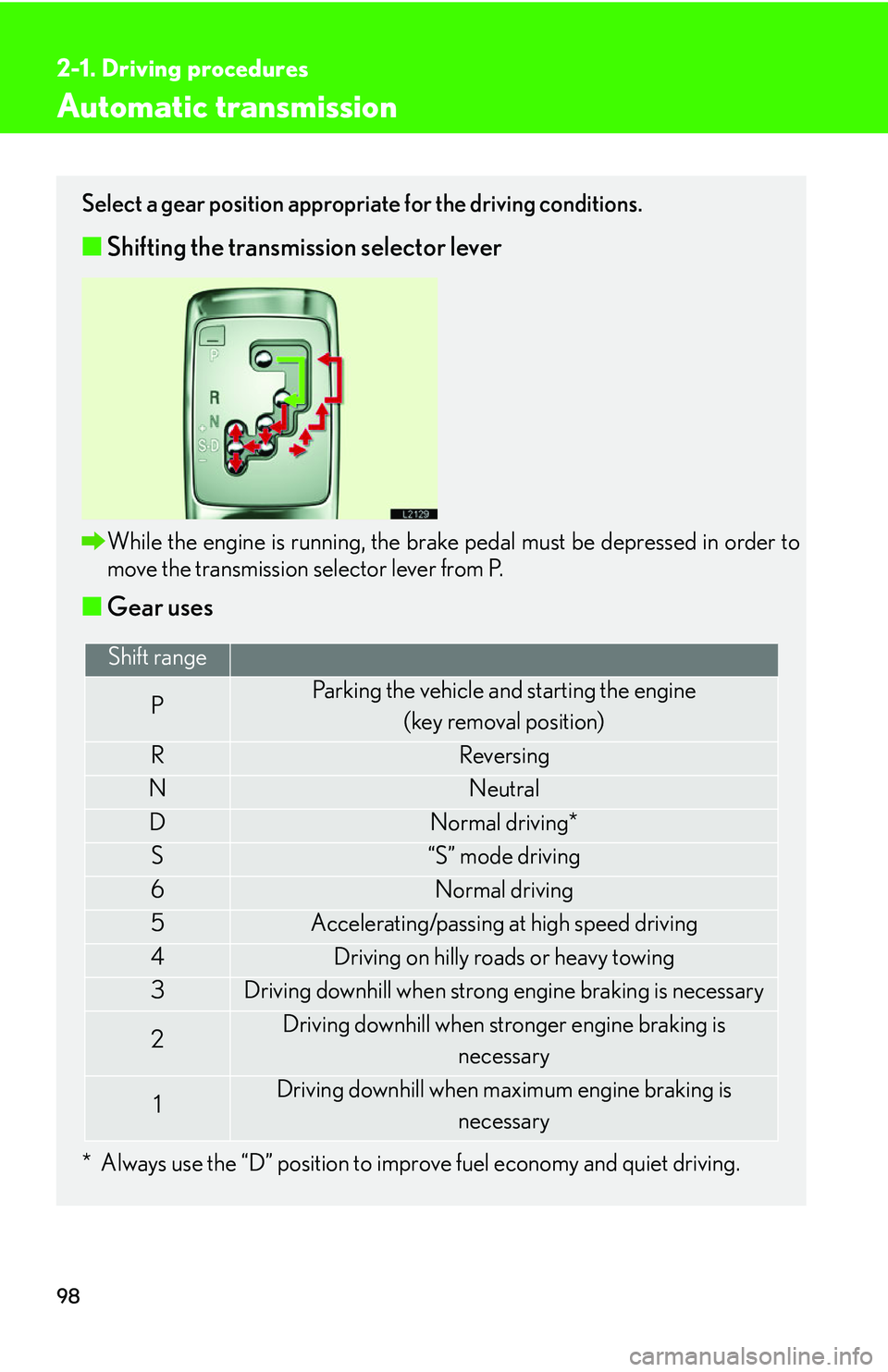
■Shifting the transmission selector lever
While the engine is running, the brake pedal must be depressed in order to
move the transmission selector lever from P.
■Gear uses
* Always use the “D” position to improve fuel economy and quiet driving.
Shift range
PParking the vehicle and starting the engine
(key removal position)
RReversing
NNeutral
DNormal driving*
S“S” mode driving
6Normal driving
5Accelerating/passing at high speed driving
4Driving on hilly roads or heavy towing
3Driving downhill when strong engine braking is necessary
2Driving downhill when stronger engine braking is necessary
1Driving downhill when maximum engine braking is
necessary
Page 119 of 419
103
2
When driving
2-2. Instrument cluster
Gauges and meters
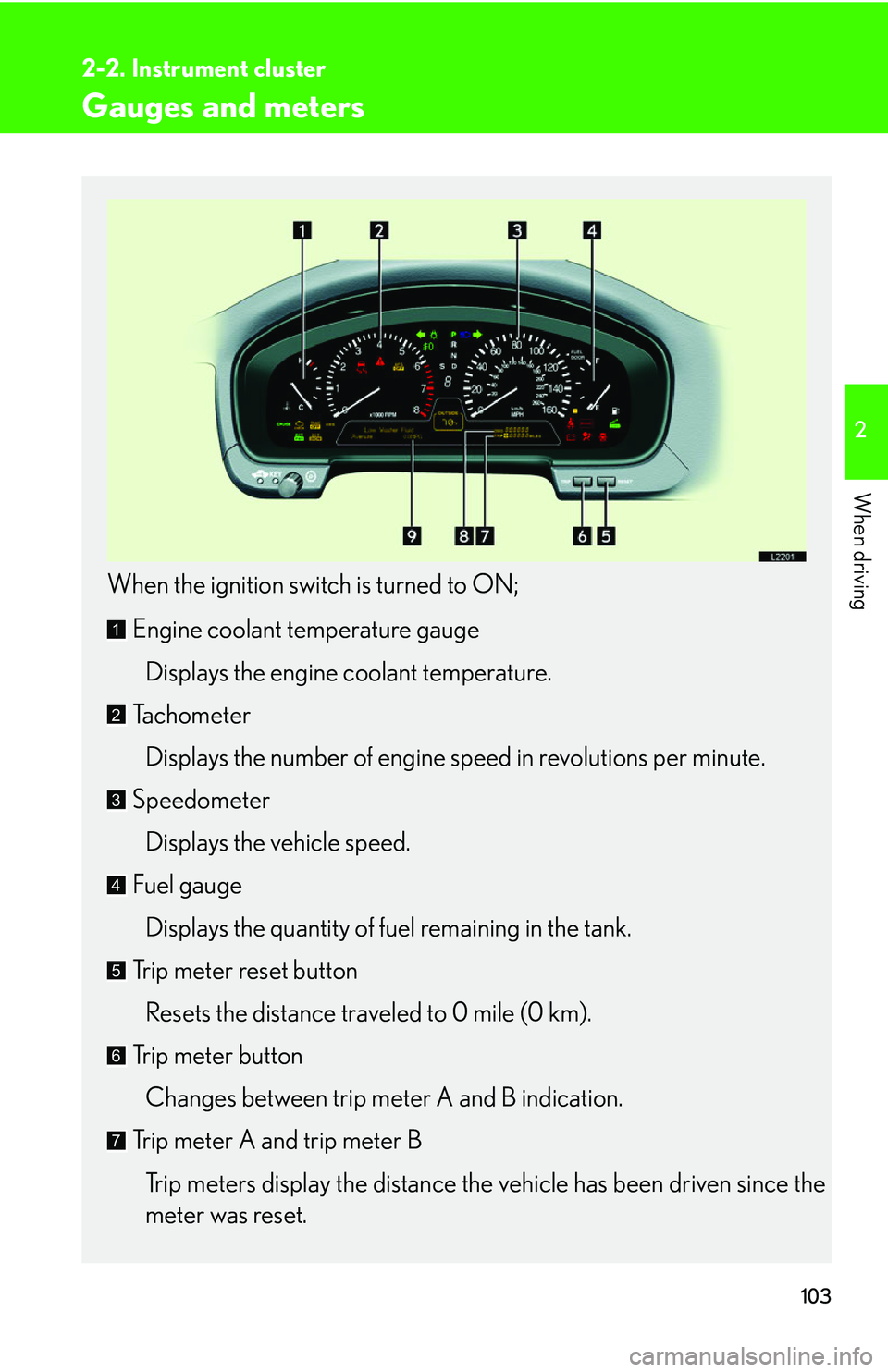
When the ignition switch is turned to ON;
Engine coolant temperature gaugeDisplays the engine coolant temperature.
Tachometer
Displays the number of engine speed in revolutions per minute.
Speedometer Displays the vehicle speed.
Fuel gauge Displays the quantity of fuel remaining in the tank.
Trip meter reset button
Resets the distance traveled to 0 mile (0 km).
Trip meter button Changes between trip meter A and B indication.
Trip meter A and trip meter B Trip meters display the distance the v
ehicle has been driven since the
meter was reset.
1
2
3
4
5
6
7
Page 123 of 419
107
2-2. Instrument cluster
2
When driving
Multi-information display
Cruise information
■Changing the cruise information displayed
Push . Pushing the button changes the cruise information in the fol-
lowing order
• Available driving distance
• Average fuel consumption
• Current fuel consumption
• Average fuel consumption after being refueling
• Driving distance after being refueled
• Elapsed time
• Average vehicle speed
• No display
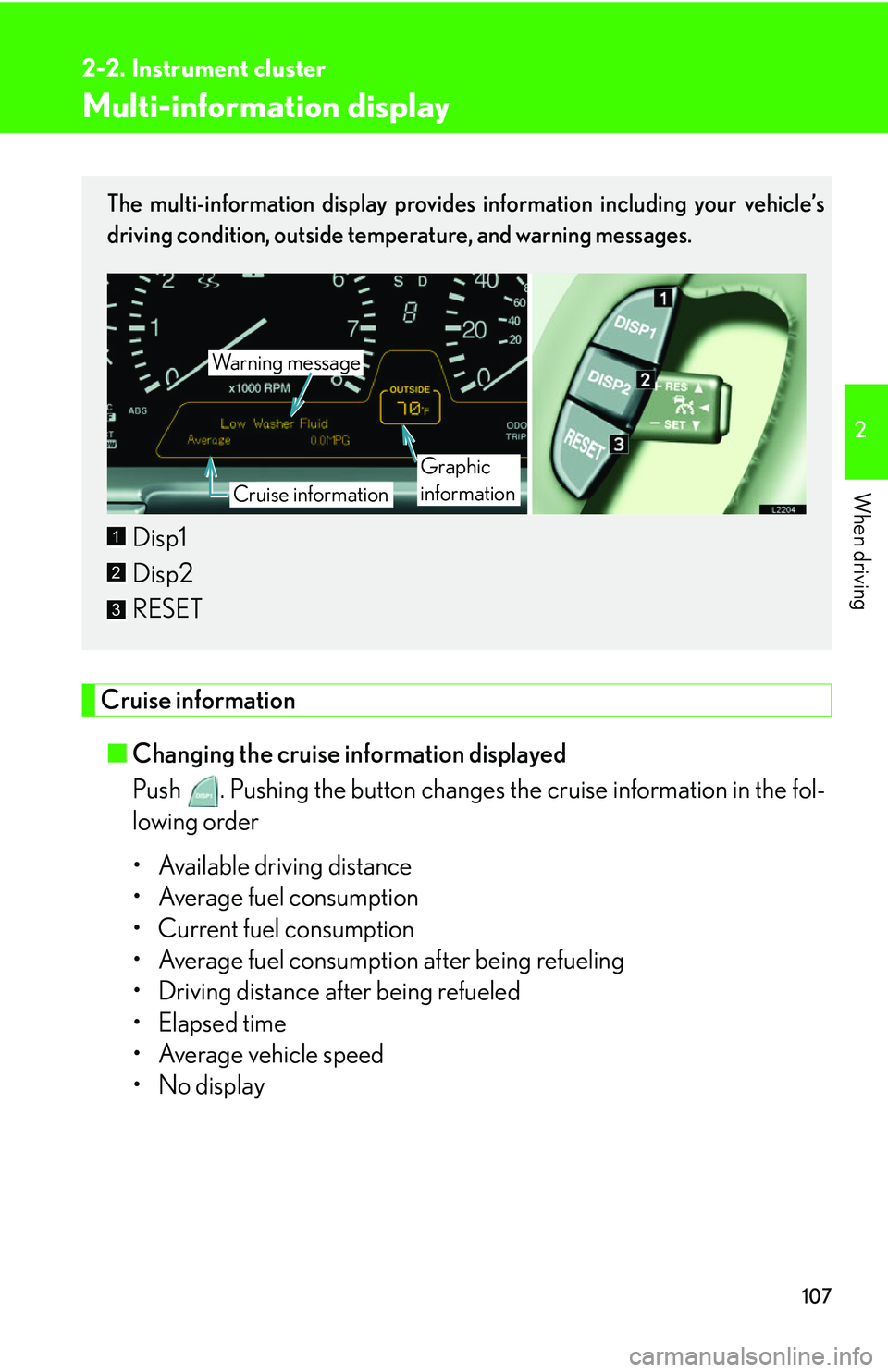
The multi-information display provides information including your vehicle’s
driving condition, outside temperature, and warning messages.
Disp1
Disp2
RESET
Wa r n i n g m e s s a g e
Cruise information
Graphic
information
1
2
3
Page 124 of 419
108
2-2. Instrument cluster
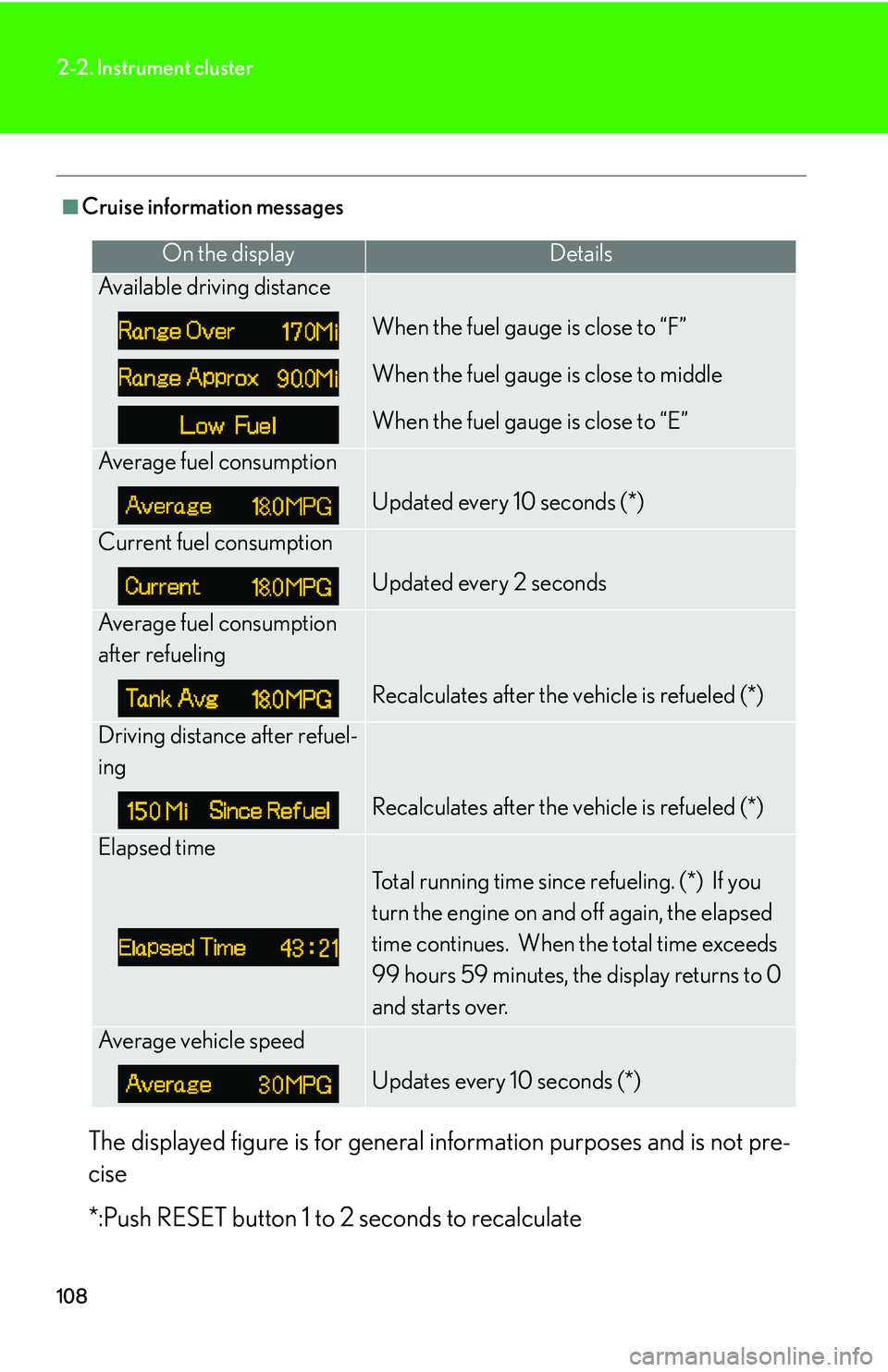
■Cruise information messages
The displayed figure is for general information purposes and is not pre -
cise
*:Push RESET button 1 to 2 se
conds to recalculate
On the displayDetails
Available driving distance
When the fuel gauge is close to “F”
When the fuel gauge is close to middle
When the fuel gauge is close to “E”
Average fuel consumption
Updated every 10 seconds (*)
Current fuel consumption
Updated every 2 seconds
Average fuel consumption
after refueling
Recalculates after the vehicle is refueled (*)
Driving distance after refuel-
ing
Recalculates after the vehicle is refueled (*)
Elapsed time
Total running time since refueling. (*) If you
turn the engine on and off again, the elapsed
time continues. When the total time exceeds
99 hours 59 minutes, the display returns to 0
and starts over.
Average vehicle speed
Updates every 10 seconds (*)
Page 161 of 419
145
2
When driving
2-5. Driving information
Cargo & luggage
Capacity and distribution
Cargo capacity depends on the total weight of the occupants.
(Cargo capacity) = (Total load capacity) - (T
otal weight of occupants)
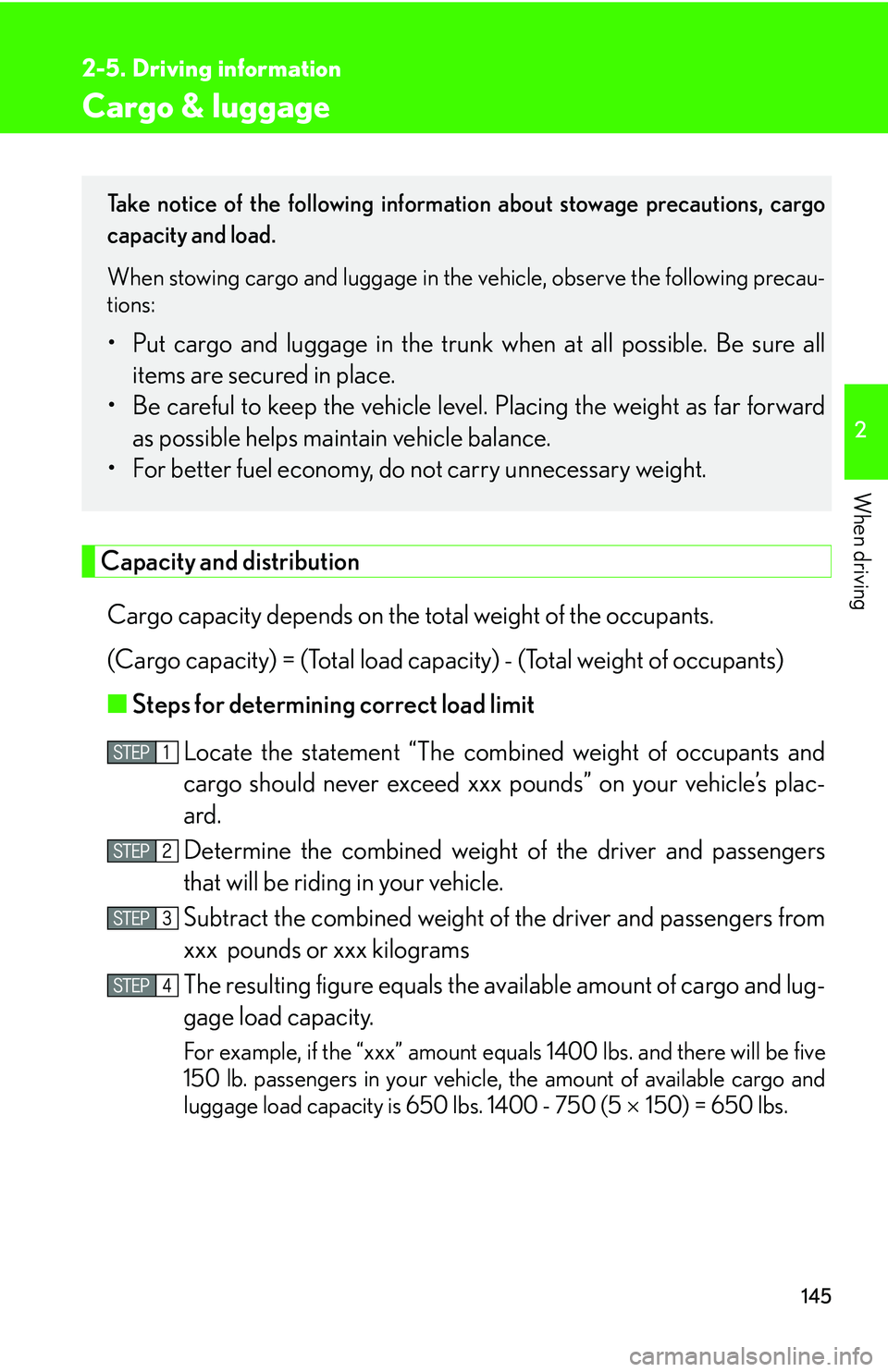
■ Steps for determining corr
ect load limit
Locate the statement “The combin ed w
eight of occupants and
cargo should never exceed xxx pounds” on your vehicle’s plac -
ard.
Determine the combined weight of the driv
er and passengers
that will be riding in your vehicle.
Subtract the combined weight of the driver and passengers from
xxx pounds or xxx kilograms
The resulting figure equals the available amount of car
go and lug-
gage load capacity.
For example, if the “xxx” amount equa ls 1400 lbs. and there will be five
150 lb. passengers in your vehicle, the amount of available cargo and
luggage load capacity is 650 lbs. 1400 - 750 (5 150) = 650 lbs.
Take notice of the following information about stowage precautions, cargo
capacity and load.
When stowing cargo and luggage in the vehicle, observe the following precau-
tions:
• Put cargo and luggage in the trunk wh en at all possible. Be sure all
items are secured in place.
• Be careful to keep the vehicle level. Placing the w
eight as far forward
as possible helps maintain vehicle balance.
• For better fuel economy, do not carry unnecessary weight.
Page 168 of 419
152
2-5. Driving information
Trailer Towing
Your vehicle is designed primarily as a passenger-carrying vehicle, thus tow-
ing a trailer will have an adverse effec t on
handling, performance, braking,
durability, and fuel consumption. For yo ur safety and the safety of others, do
not overload the vehicle or trailer.
Lexus warranties do not apply to damage or malfunction caused b
y towing a
trailer for commercial purposes
■ Weight limits
Confirm the total trailer weight, gross v
ehicle weight, gross axle weight
and trailer tongue load are all within the limits.
■ Gr
oss vehicle weight
The gross vehicle weight must not exceed the Gross Vehicle Weight
R
ating (GVWR) indicated on the Certification Label. The gross vehi -
cle weight is the sum weight of th e unloaded v
ehicle, driver, passen-
gers, luggage, hitch and trailer tongue load. Also included is the w
eight
of any special equipment installed on your vehicle.
■ Gr
oss axle weight
The load on either the front or rear axle r
esulting from distribution of
the gross vehicle weight on both ax les must not exceed the Gross Axle
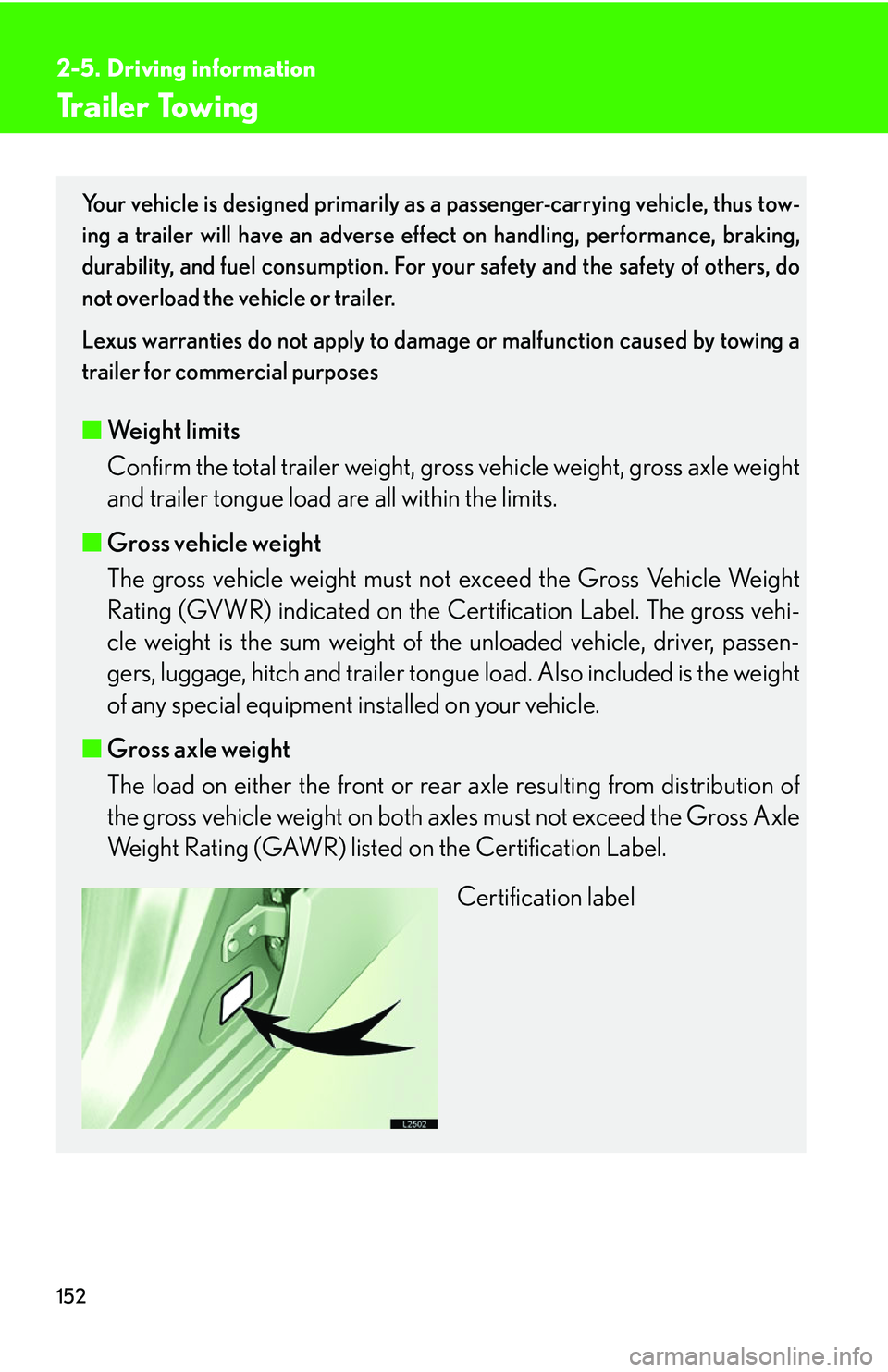
Weight Rating (GAWR) listed on the Certification Label.
Certification label
Page 260 of 419
244
4-1. Maintenance and care
Cleaning and protecting the vehicle exterior
■Automatic car washes
●Fold the mirrors back before washing the vehicle.
●Brushes used in automatic car washes may scratch the vehicle surface, which
can harm your vehicle’s paint.
■High pressure automatic car washes
Do not allow the nozzles of the car wash to come within close proximity of the win-
dows or door weather seals of your vehicle.
Before entering the automatic car wash, check that the fuel filler door on your vehi -
cle is closed properly.
Follow these guidelines when washing and waxing your Lexus:
●Working from top to bottom, libera lly apply water to the vehicle body,
wheel wells and underside of the vehi cle to remove any built up dirt
and dust.
Wash the vehicle body using a sponge or sof
t cloth, such as a chamois.
●For hard-to-remove dirts, use car wash soap and rinse thoroughly with
water.
●Thoroughly dry your vehicle.
●Apply polish or wax only when the vehicle body is cool.
Wax or polish your vehicle when the e
xisting coating of wax or polish
begin to deteriorate. A good way to determine this, is by checking to
see if water beads on the painted surfac e of your vehicle. If it does not
bead, that means the wax or polish is no longer protecting the finish,
and therefore should be reapplied.
Page 267 of 419
251
4-2. Maintenance
4
Maintenance and care
■Repair and replacement
It is recommended that genuine Lexus parts be used for repairs to ensure optimum
pe
rformance. If non-Lexus replacement parts are used or if a repair shop other
than a Lexus dealer performs repairs, confirm the warranty coverage.
■Have inspections and repairs performe d by a Lexus dealer whenever possible
●Lexus technicians are well-trained specialists and are kept up to date with the
latest service information. They specialize in the operation of all systems on your
Lexus.
●Keep a copy of the repair order. It proves that the maintenance that has been
performed is under warranty coverage. If any problem should arise while your
vehicle is under warranty, your Lexus de aler will promptly take care of it.
CAUTION
■Hazardous materials
●Engine exhaust, some of its constituents, and a wide variety of automobile com -
ponents contain or emit chemicals known to the State of California to cause can -
cer and birth defects and other reproductive harm. Work in a well ventilated area.
●Oils, fuels and fluids contained in vehicles as well as waste produced by compo -
nent wear contain or emit chemicals known to the State of California to cause
cance
r and birth defects or other reproductive harm. Avoid exposure and wash
any affected area immediately.
●Battery posts, terminals and related accessories contain lead and lead com -
pounds which are known to cause brain damage. Wash your hands after han -
dling. ( P.273 )
●Used engine oil contains chemicals that have caused cancer in laboratory ani -
mals. Avoid prolonged and repeated contact. Always protect your skin by wash -
ing thoroughly with soap and water.