parking brake LEXUS LS430 2006 User Guide
[x] Cancel search | Manufacturer: LEXUS, Model Year: 2006, Model line: LS430, Model: LEXUS LS430 2006Pages: 419, PDF Size: 11.19 MB
Page 118 of 419
102
2-1. Driving procedures
Parking brake
NOTICE
■Before driving
Fully release the parking brake.
Driving the vehicle with the parking brake set will lead to brake components over -
heating, which may affect braking performance and increase brake wear.
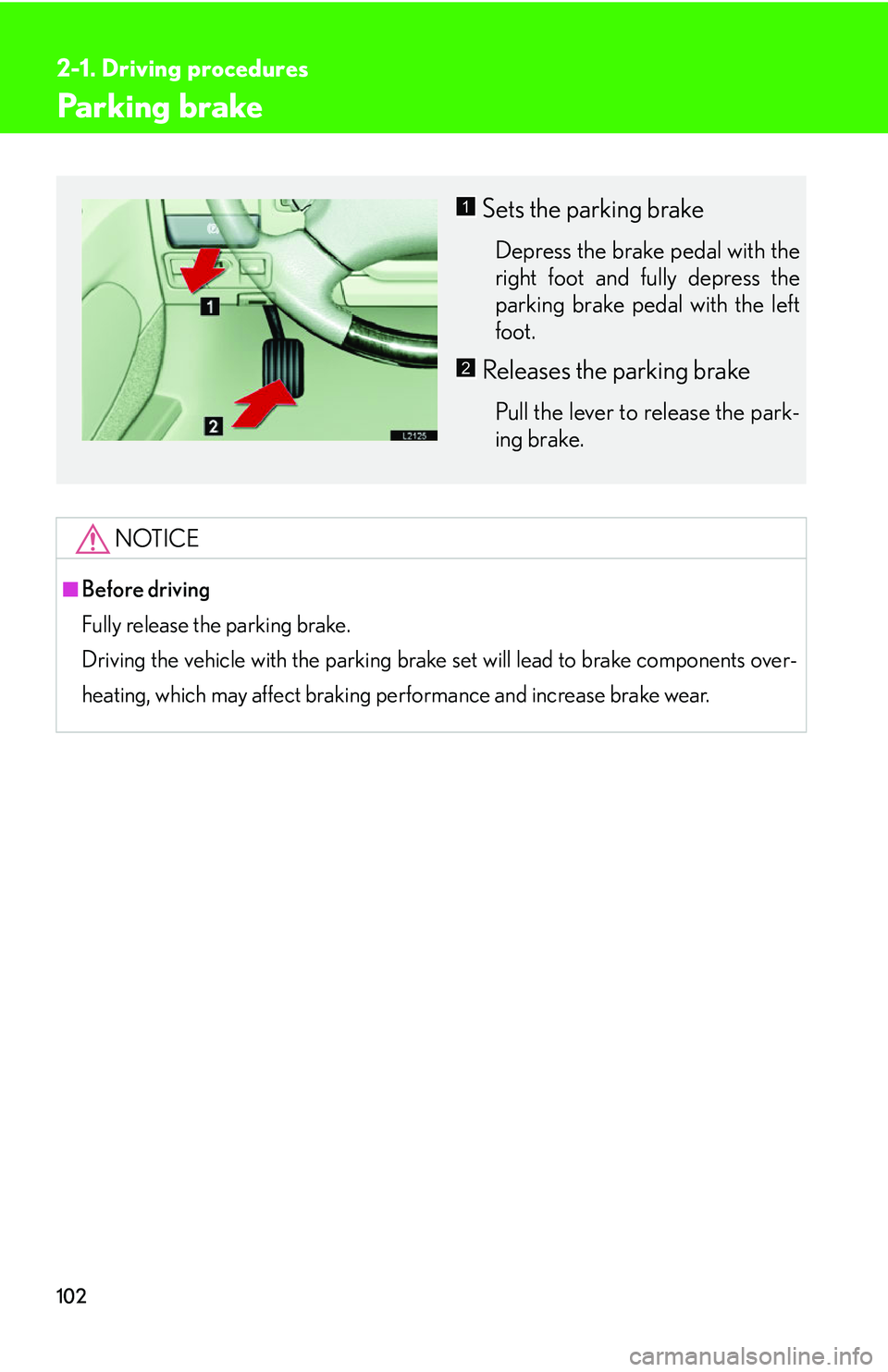
Sets the parking brake
Depress the brake pedal with the
right foot and fully depress the
parking brake pedal with the left
foot.
Releases the parking brake
Pull the lever to release the park -
ing brake.
1
2
Page 127 of 419

111
2-3. Operating the headlight and windshield wipers
2
When driving
Daytime running light system
The headlights turn on automatically (at a reduced intensity) whenever the
engine is started and the parking brake is released to make your vehicle
more visible to other drivers. Dayt ime running lights are not designed for
use at night.
■Headlight control sensor
■Automatic light off system
The headlights turn off automatically if the engine is stopped and the driver’s door is
opened wh
ile the headlights are turned on.
To turn the headlights on again, turn the key to ON, or turn the light switch off once
and then
back to or position.
■Automatic headlight leveling system
The level of the headlights is
automatically adjusted according to the number of
passengers and the loading condition of the vehicle to ensure that the headlights do
not interfere other road users.
■Customization
The time it takes for the headlights to automatically turn on or off can be changed.
( P.384 )
The sensor may not function properly if an
object is placed on the sensor, or anything
that blocks the sensor is affixed to the wind-
shield.
Doing so interferes with the sensor detect-
ing the level of ambient light and may cause
the automatic headlight system malfunc-
tion.
Page 166 of 419
150
2-5. Driving information
Regulations on the use of snow chains
●Regulations regarding the use of tire chains vary according to location
and type of road. Alwa ys check local regulations before installing
chains.
●Use SAE Class “S” type radial tire chains, with the exception of radial
cable chains or V-bar type chains.
• Install the chains on the rear tires.
• Refer to the explanation that comes with the tir
e chains for installa-
tion instructions.
●Retighten chains after driving 1 /4 - 1 /2 mile (0.5 - 1.0 km).
■If the chains are installed
The tire pressure warning system may not operate properly.
■Tire chain installation
Observe the following installation, removal and care precautions.
• Install and remove tire chains in a safe location.
• Install tire chains on the rear tires only. Do not install tire chains on front tir
es.
• Install the tire chains on rear tires as tightly as possible. Retighten chains af
ter driving 1 /4 - 1 /2 mile (0.5 - 1.0 km).
• Install tire chains following the inst ructions pr
ovided with the chains.
■When driving the vehicle
Accelerate the vehicle slowly and driv e at a reduced speed suitable to
road conditions.
■ When parking the v
ehicle
The parking brake may freeze up, prev enting it fr
om being released.,
Place the selector lever in P and park the vehicle without applying the
parking brake.
Page 174 of 419
158
2-5. Driving information
• Always place wheel blocks under both the vehicle and the trailer
wheels when parking. Apply the pa rking brake firmly, and put the
transmission in “P”. Avoi d parking on a slope, but if unavoidable, do so
only after performing the following:
Apply the brakes and keep them applied.
Have someone place wheel blocks under both the v
ehicle and
trailer wheels.
When the wheel blocks are in pl ace, r
elease the brakes slowly
until the blocks absorb the load.
Apply the parking brake firmly.
Shift into “P” and turn off the engine.
• When restarting after parking on a slope:
With the transmission in the “P” position, star
t the engine. Be sure
to keep the brake pedal pressed.
Shift into “3”, “2”, “1”, or the “R” position (if r
eversing).
Release the parking brake and br ak
e pedal, and slowly pull or
back away from the wheel blocks.
Stop and apply the brakes.
Have someone retrieve the blocks.
Page 277 of 419

261
4-3. Do-it-yourself maintenance
4
Maintenance and care
Positioning the jack
CAUTION
■When raising your vehicle:
Make sure to observe the following to reduce the possibility of death or serious
injur
y.
• Do not put any part of your body or get underneath the vehicle supported only b
y the jack. Always use automotive jack stands or a solid, level, surface.
• Do not start or run the engine while your vehicle is supported by the jack.
• Stop the vehicle on level firm ground, firmly
set the parking brake and put the
selector lever in “P” position.
• Make sure to set the jack properly at the jack point.
Raising the vehicle with an improperly positioned jack will damage the vehicle
or
may allow the vehicle to fall off the jack.
• Do not raise the vehicle with someone in the vehicle.
• When raising the vehicle, do not place an y ob
jects on top of or underneath the
jack.
When raising your vehicle, position the jack correctly.
Improper placement may damage your vehicle or cause injury.
Dummy
Page 337 of 419
5
When trouble arises
321
5-1. Essential information
Emergency towing
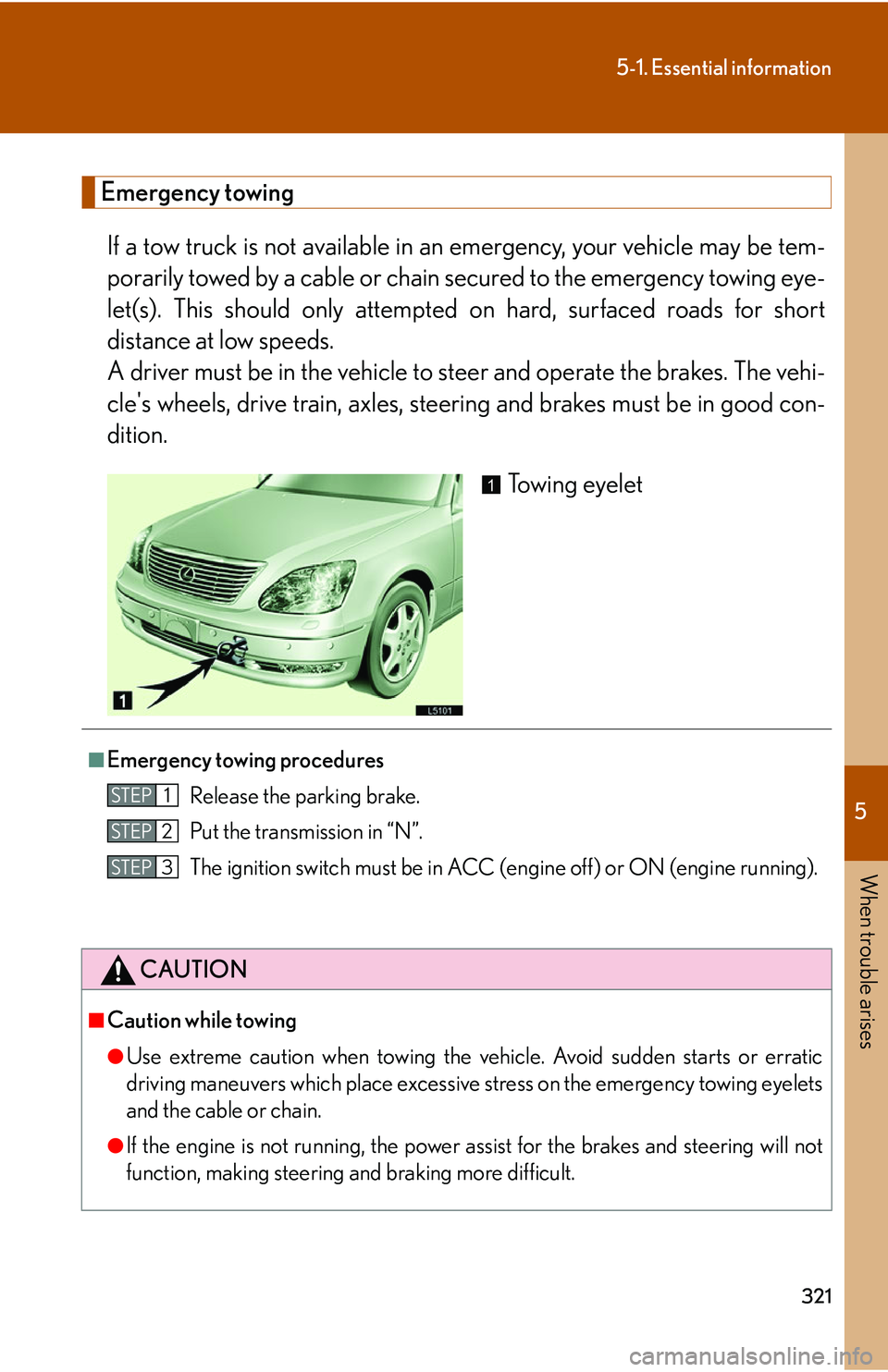
If a tow truck is not available in an emergency, your vehicle may be tem-
porarily towed by a cable or chain secur
ed to the emergency towing eye-
let(s). This should only attempted on har
d, surfaced roads for short
distance at low speeds.
A driver must be in the vehicle to steer and oper
ate the brakes. The vehi-
cle's wheels, drive train, axles, steer ing and br
akes must be in good con-
dition.
Towing eyelet
1
■Emergency towing proceduresRelease the parking brake.
Put the transmission in “N”.
The ignition switch must be in ACC (eng
ine off) or ON (engine running).
CAUTION
■Caution while towing
●Use extreme caution when towing the vehi cle. Avoid sudden starts or erratic
driving maneuvers which place excessive stress on the emergency towing eyelets
and the cable or chain.
●If the engine is not running, the power assi st for the brakes and steering will not
function, making steering and braking more difficult.
STEP1
STEP2
STEP3
Page 344 of 419
328
5-2. Steps to take in an emergency
If a warning light turns on...
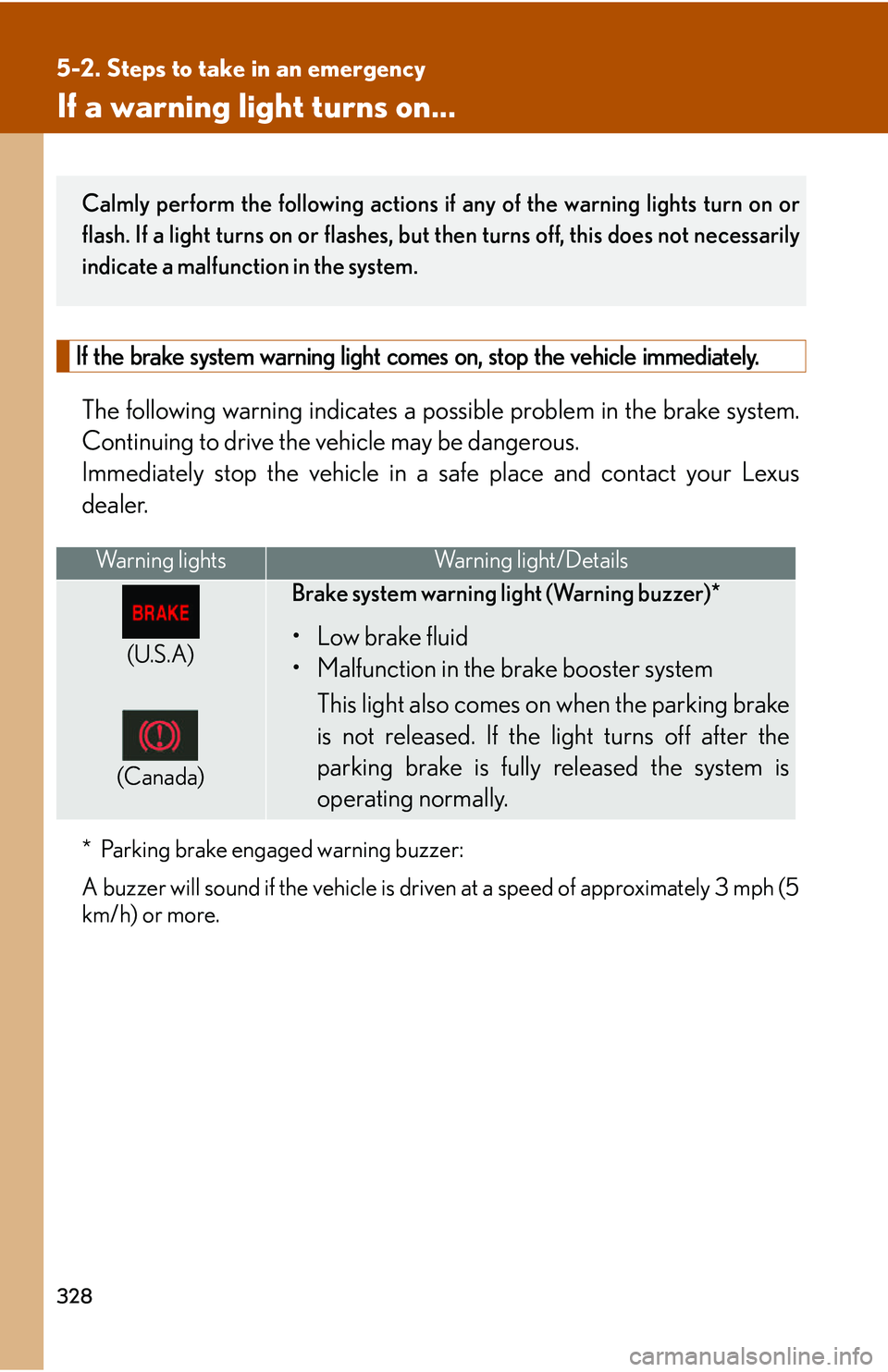
If the brake system warning light comes on, stop the vehicle immediately.
The following warning indicates a possible problem in the brake system.
Continuing to drive the vehicle may be dangerous.
Immediately stop the vehicl e in a safe place and contact y
our Lexus
dealer.
* Parking brake engaged warning buzzer:
A buzzer will sound if the vehicle is driv en at a speed of approximately 3 mph (5
km/h) or more.
Calmly perform the following actions if any of the warning lights turn on or
flash. If a light turns on or flashes, but then turns off, this does not necessarily
indicate a malfunction in the system.
Warning lightsWarning light/Details
(U.S.A)
(Canada)
Brake system warning light (Warning buzzer)*
• Low brake fluid
• Malfunction in the brake booster system This light also comes on when the parking brake
is not released. If the light turns off after the
parking brake is fully released the system is
operating normally.
Page 354 of 419
338
5-2. Steps to take in an emergency
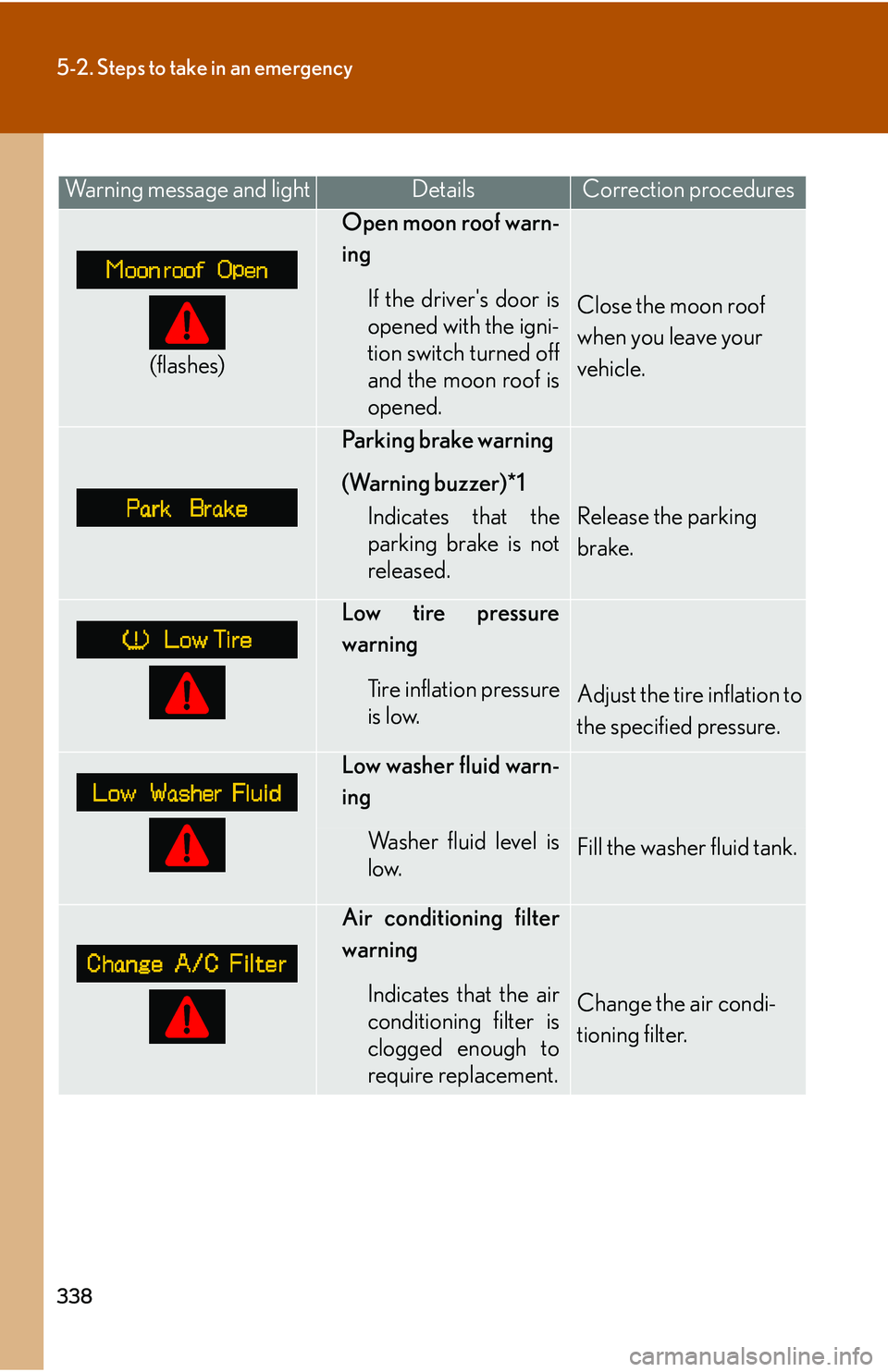
Warning message and lightDetailsCorrection procedures
(flashes)
Open moon roof warn-
ing
If the driver's door is
opened with the igni-
tion switch turned off
and the moon roof is
opened.
Close the moon roof
when you leave your
vehicle.
Parking brake warning
(Warning buzzer)*1
Indicates that the
parking brake is not
released.Release the parking
brake.
Low tire pressure
warning
Tire inflation pressure
is low.Adjust the tire inflation to
the specified pressure.
Low washer fluid warn -
ing
Washer fluid level is
low.Fill the washer fluid tank.
Air conditioning filter
warning
Indicates that the air
conditioning filter is
clogged enough to
require replacement.Change the air condi-
tioning filter.
Page 363 of 419
5
When trouble arises
347
5-2. Steps to take in an emergency
If you have a flat tire
Remove the flat tire and replace it with the spare provided.
■Before jacking the vehicle
●Stop the vehicle on a hard, flat surface.
●Set the parking brake.
●Set the transmission selector lever in P.
●Stop the engine.
●Turn on the emergency flashers.
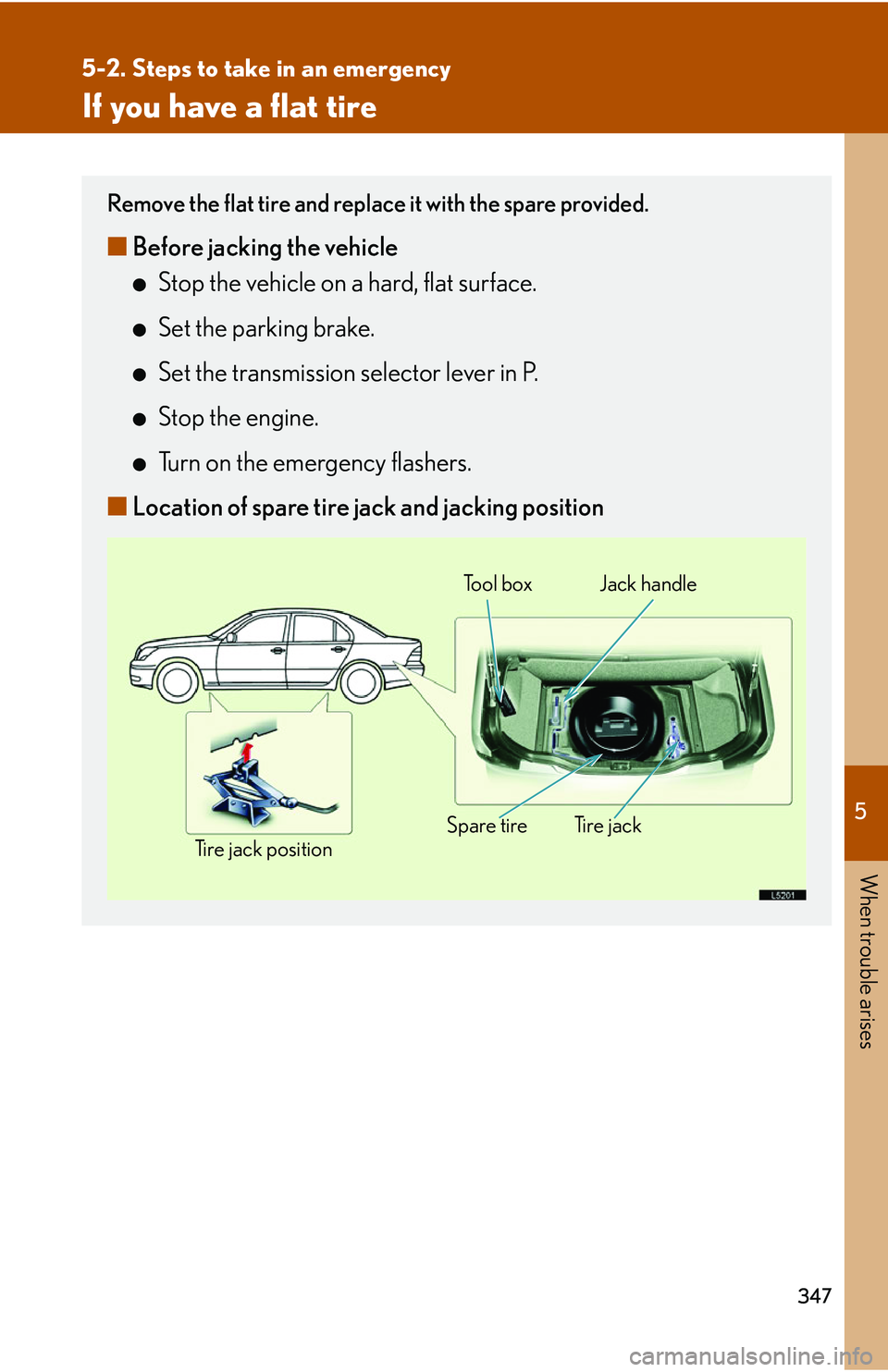
■ Location of spar
e tire jack and jacking position
Tire jack position Spare tire
Tire jack
Tool box Jack handle
Page 370 of 419
354
5-2. Steps to take in an emergency
If the transmission selector lever cannot be shifted from P
If the transmission selector lever cannot be shifted with your foot on the
brake, there may be a problem with the shift lock system (a system to prevent
accidental operation of the selector lever). Have the vehicle inspected by
your Lexus dealer immediately.
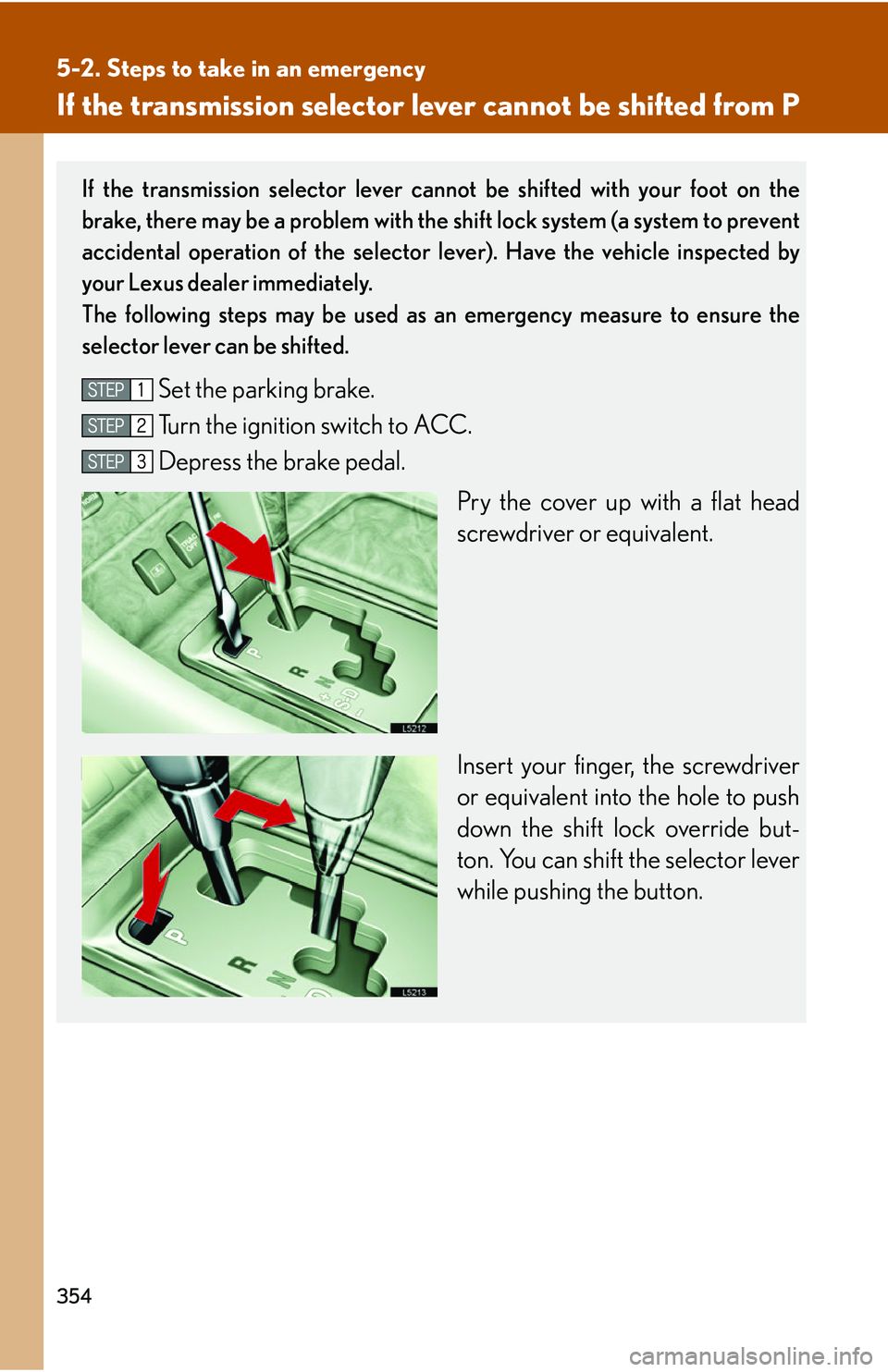
The following steps may be used as an
emergency measure to ensure the
selector lever can be shifted.
Set the parking brake.
Turn the ignition switch to ACC.
Depress the brake pedal.
Pry the cover up with a flat head
s
crewdriver or equivalent.
Insert your finger, the sc rewd
river
or equivalent into the hole to push
down the shift lock override but -
ton. You can shift the selector lever
while pushing the button.