seats LEXUS LS430 2006 User Guide
[x] Cancel search | Manufacturer: LEXUS, Model Year: 2006, Model line: LS430, Model: LEXUS LS430 2006Pages: 419, PDF Size: 11.19 MB
Page 75 of 419
59
1-7. Safety information
1
Before driving
CAUTION
■When driving:
●Do not adjust the position of the driver’s seat while driving.
Doing so could cause the driver to lose control of the vehicle.
●Do not place a cushion between the driv er or passenger and the seat back.
A cushion may prevent correct posture from being achieved and reduce the
ef
fect of the seat belt and head restraint, increasing the risk of injury to the driver
or passenger.
●Do not place anything under the front seats.
Objects placed under the front seats may become jammed in the seat tracks and
sto
p the seat from locking in place. This may lead to an accident. The adjustment
mechanism may also be damaged.
■Adjusting the seat position:
●Do not recline the seat more than necessary when the vehicle is in motion, to
reduce the risk of sliding under the lap belt.
If the seat is too reclined during an accident, the lap belt may slide past the hips
and
apply restraint forces directly to th e abdomen or your neck may contact the
shoulder belt, increasing the risk of death or serious injury.
●Take care when adjusting the seat positi on, to ensure that other passengers are
not injured by the moving seat.
●Do not put your hands under the seat or ne ar the moving parts, to avoid injury to
hands or fingers.
Fingers or hands may become ja
mmed in the seat mechanism.
Page 78 of 419
62
1-7. Safety information
■If the SRS airbags deploy (inflate)
●Bruising and slight abrasions may result from contact with a deploying (inflating)
SRS airbag.
●A loud noise and white powder will be emitted.
●Parts of the airbag module (steering whee l hub, airbag cover and inflator), as
well as the front seats, apart from the front pillar and roof side rail may be hot for
several minutes, and the airbags themselves will be hot.
●The front windshield may crack.
■Operating conditions (front airbags)
●The SRS front airbags will deploy if the severity of the frontal impact is above the
designed threshold level, comparable to an approximate 15 mph (25 km/h) col -
lision, when the vehicle imp acts
straight into a fixed barrier that does not move
or deform.
However, this threshold velocity will be considerably higher, if the vehicle strikes
a
n object, such as a parked vehicle or sign pole, which can move or deform on
impact, or if the vehicle is involved in an underride collision (e.g., a collision in
which the front of the vehicle “underrides”, or goes under, the bed of a truck, etc.).
●It is possible that in some collisions where the forward deceleration of the vehi -
cle is very close to the designed thresh ol
d level, the SRS front airbags and the
seat belt pretensioners ma y not activate together.
●The SRS front passenger airbag will not activate, if there is no passenger sitting
in the front passenger seat. However, th e front passenger airbag may deploy, if
luggage is put in the seat or the seat belt is buckled up, regardless of the pres -
ence of an occupant in the seat.
■Operating conditions (side and curtain shield airbags)
●The SRS side airbags and curtain shield airbags are designed to inflate, when
the passenger compartment is subjected to a severe impact from the side.
●The SRS side airbag on the passenger seat will not activate, if there is no passen -
ger sitting in the front passenger seat. Ho
wever, the side airbag on the passen-
ger seat may deploy, if luggage is put in the seat or the seat belt is buckled up,
r
egardless of the presence of the occupant in the seat.
Page 81 of 419
65
1-7. Safety information
1
Before driving
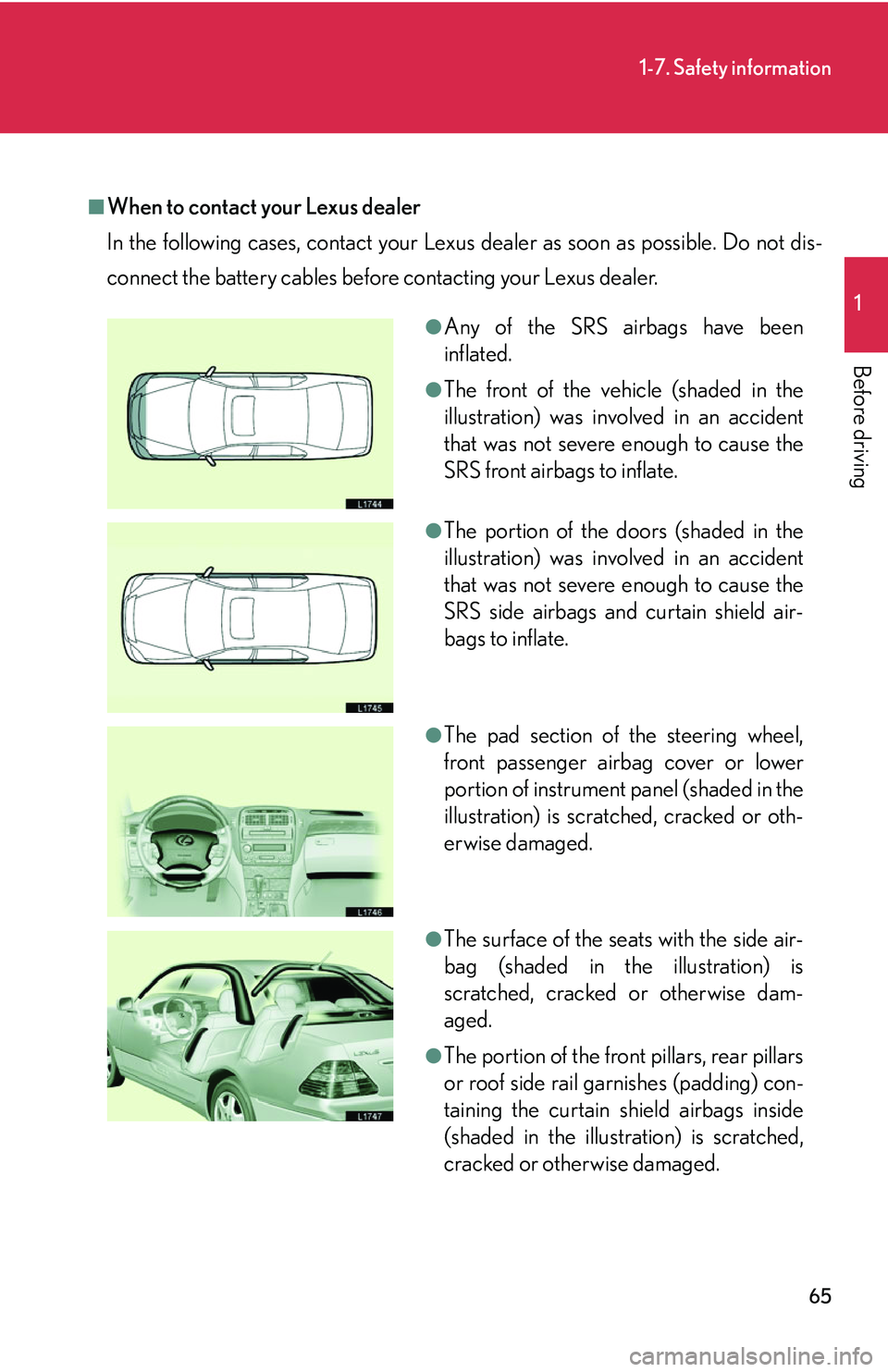
■When to contact your Lexus dealer
In the following cases, contact your Lexus dealer as soon as possible. Do not dis-
connect the battery cables before contacting your Lexus dealer.
●Any of the SRS airbags have been
inflated.
●The front of the vehicle (shaded in the
illustration) was involved in an accident
that was not severe enough to cause the
SRS front airbags to inflate.
●The portion of the doors (shaded in the
illustration) was involved in an accident
that was not severe enough to cause the
SRS side airbags and curtain shield air-
bags to inflate.
●The pad section of the steering wheel,
front passenger airbag cover or lower
portion of instrument panel (shaded in the
illustration) is scratched, cracked or oth-
erwise damaged.
●The surface of the seats with the side air-
bag (shaded in the illustration) is
scratched, cracked or otherwise dam-
aged.
●The portion of the front pillars, rear pillars
or roof side rail garnishes (padding) con-
taining the curtain shield airbags inside
(shaded in the illustration) is scratched,
cracked or otherwise damaged.
Page 85 of 419
69
1-7. Safety information
1
Before driving
CAUTION
■SRS airbag precautions
●Improperly seated and/or restrained infants and children can be killed or seri-
ously injured by the deploying airbags. An infant or child who is too small to use a
sea
t belt should be properly secured using a child restraint system. Lexus strongly
recommends that all infants and children be placed in the rear seats of the vehicle
and properly restrained. The rear seats are the safest for infants and children.
( P.73 )
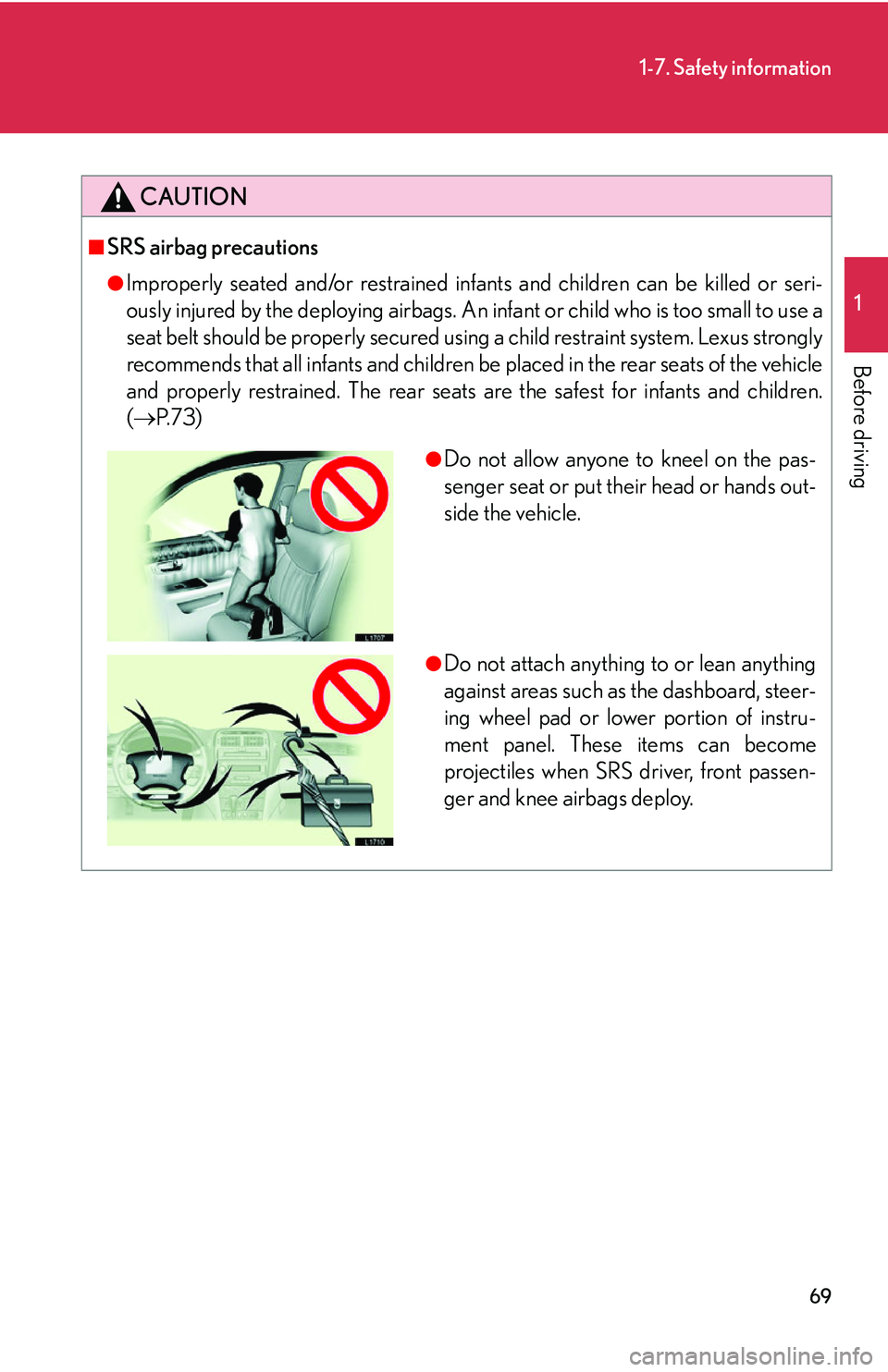
●Do not allow anyone to kneel on the pas-
senger seat or put their head or hands out-
side the vehicle.
●Do not attach anything to or lean anything
against areas such as the dashboard, steer-
ing wheel pad or lower portion of instru-
ment panel. These items can become
projectiles when SRS driver, front passen-
ger and knee airbags deploy.
Page 88 of 419
72
1-7. Safety information
CAUTION
■Modifications and disposal of SRS airbag system components
Do not perform any of the following modifications to o
r dispose of the vehicle with -
out consulting your Lexus dealer. The SRS airb
ag may malfunction and may deploy
(inflate) accidentally, causing death or serious injury.
• Installation, removal, disassembl y and r
epair of the SRS airbags.
• Repairs, modifications, removal or replacement of the steering wheel, instru -
ment panel, dashboard, seats or seat upholste
ry, front, side and rear pillars or
roof side rail.
• Repair or modification of the front fender , fr
ont bumper or side of the occupant
compartment.
• Installation of snow plows, winches, etc. to the front grille (bull bars, kangaroo ba
r, etc.).
• Modifications to the vehi cle
’s suspension system.
• Installation of electronic devices such as a mobile two-way radio, cassette tape pl
ayer or CD player.
Page 92 of 419
76
1-7. Safety information
Installing child restraints
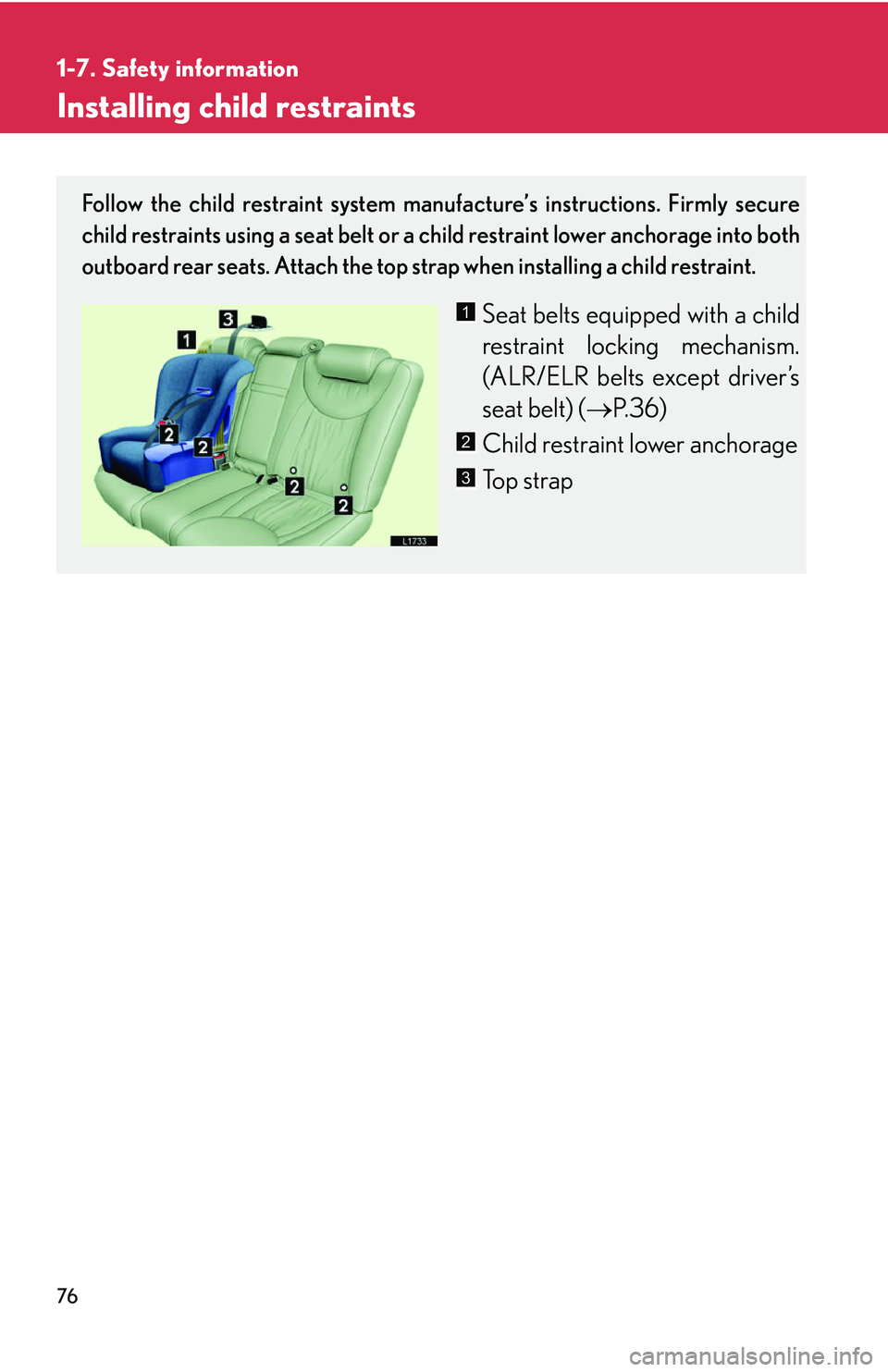
Follow the child restraint system manufacture’s instructions. Firmly secure
child restraints using a seat belt or a child restraint lower anchorage into both
outboard rear seats. Attach the top strap when installing a child restraint.
Seat belts equipped with a child
restraint locking mechanism.
(ALR/ELR belts e
xcept driver’s
seat belt) ( P.36 )
Child restraint lower anchorage
To p s t r a p
1
2
3
Page 95 of 419
79
1-7. Safety information
1
Before driving
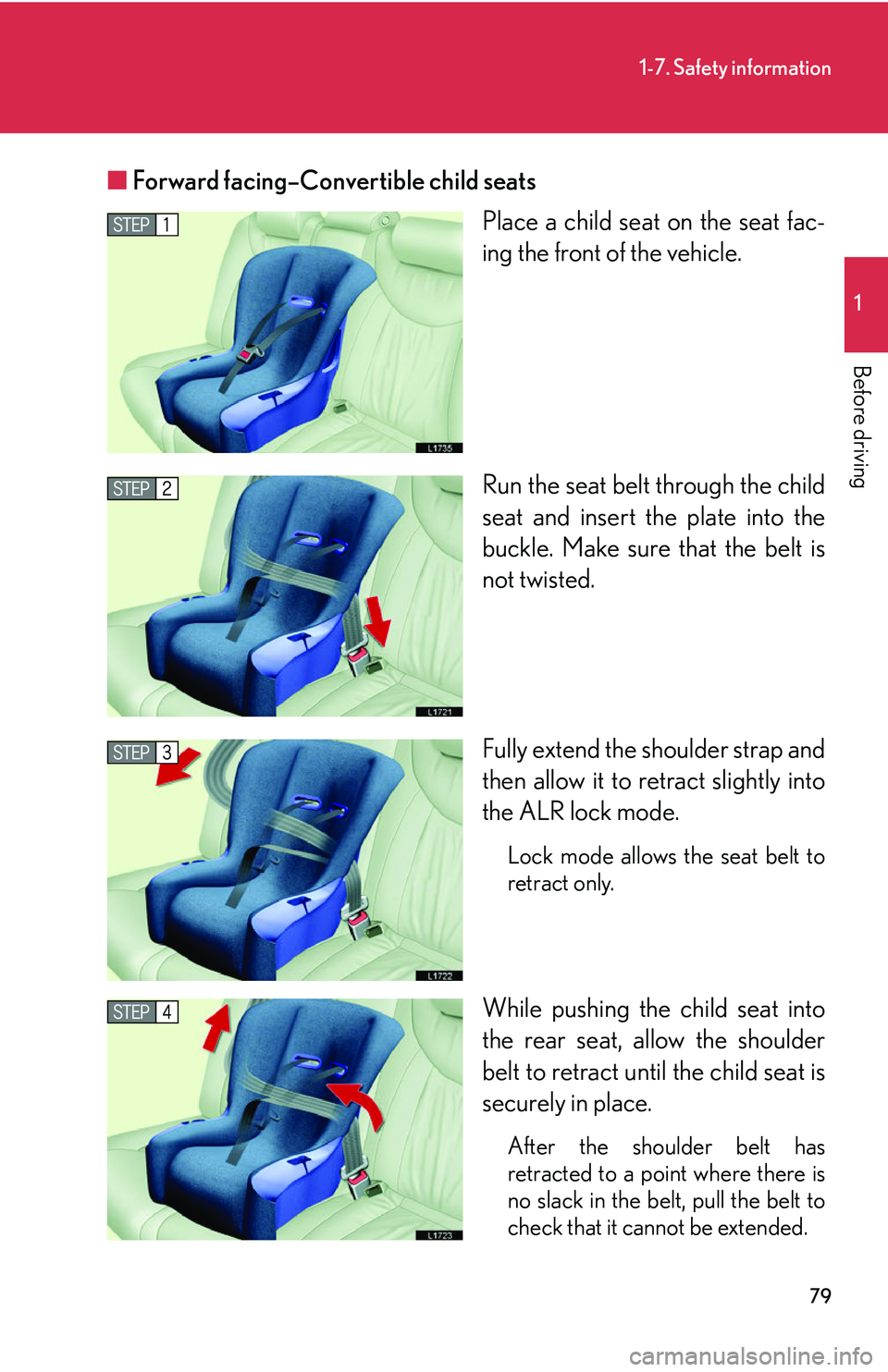
■Forward facing–Convertible child seats
Place a child seat on the seat fac-
ing the front of the vehicle.
Run the seat belt through the child
seat and inser
t the plate into the
buckle. Make sure that the belt is
not twisted.
Fully extend the shoulder strap and
then allo
w it to retract slightly into
the ALR lock mode.
Lock mode allows the seat belt to
retract only.
While pushing the child seat into
the rear seat, allow the shoulder
belt to retract until the child seat is
securely in place.
After the shoulder belt has
retracted to a point where there is
no slack in the belt, pull the belt to
check that it cannot be extended.
Page 96 of 419
80
1-7. Safety information
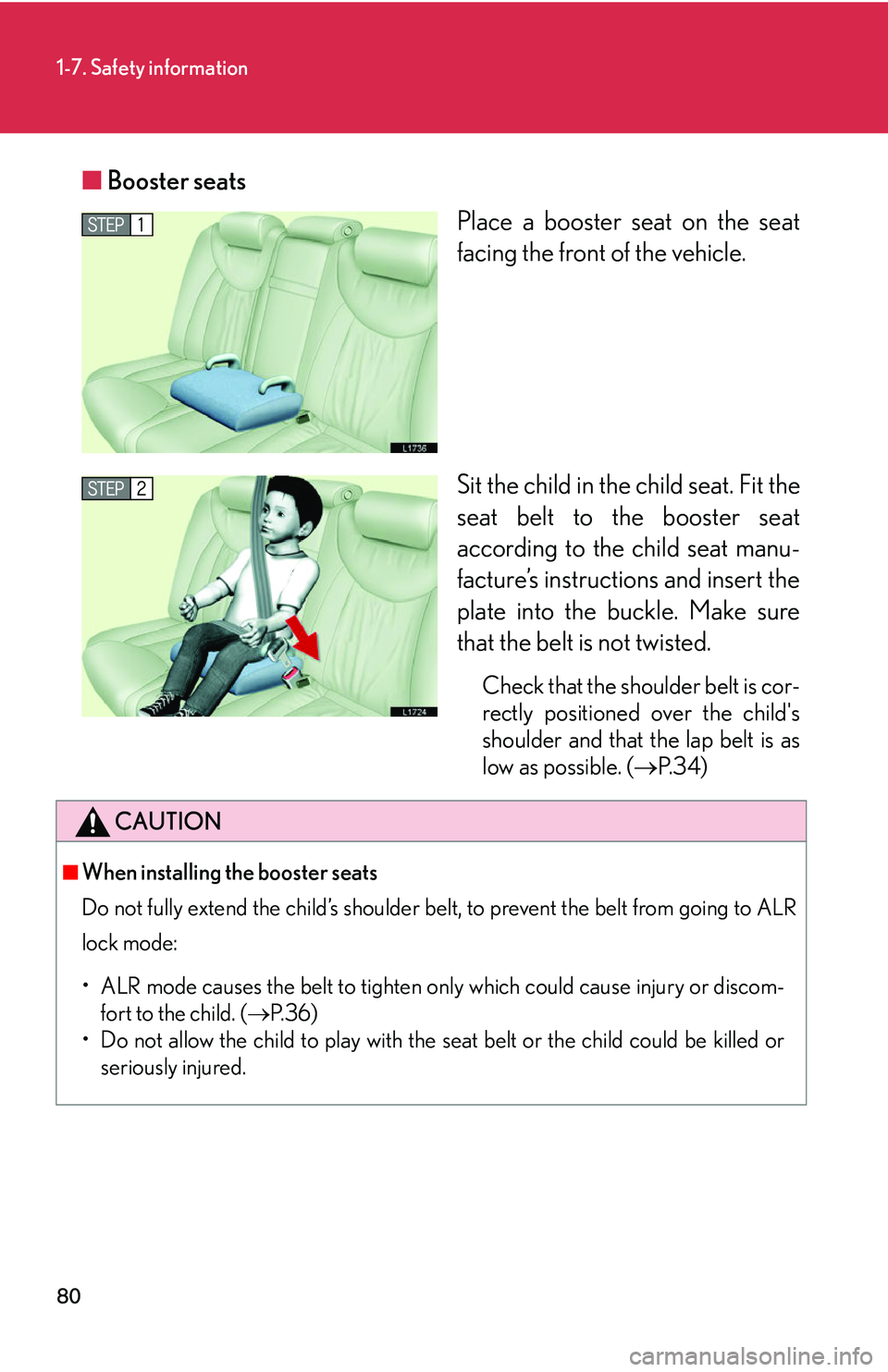
■Booster seats
Place a booster seat on the seat
facing the fr
ont of the vehicle.
Sit the child in the child seat. Fit the
seat belt to the booster seat
accor
ding to the child seat manu -
facture’s instructio ns and inser
t the
plate into the buckle. Make sure
that the belt is not twisted.
Check that the shoulder belt is cor -
rectly positioned over the child's
shoulder and that the lap belt is as
lo
w as possible. ( P.34 )
CAUTION
■When installing the booster seats
Do not fully extend the child’s shoulder belt, to prevent the belt from going to ALR
lo
ck mode:
• ALR mode causes the belt to tighten on ly
which could cause injury or discom-
fort to the child. ( P.36 )
• Do not allow the child to play with the seat belt or the child could be killed or seriously injur
ed.
Page 99 of 419
83
1-7. Safety information
1
Before driving
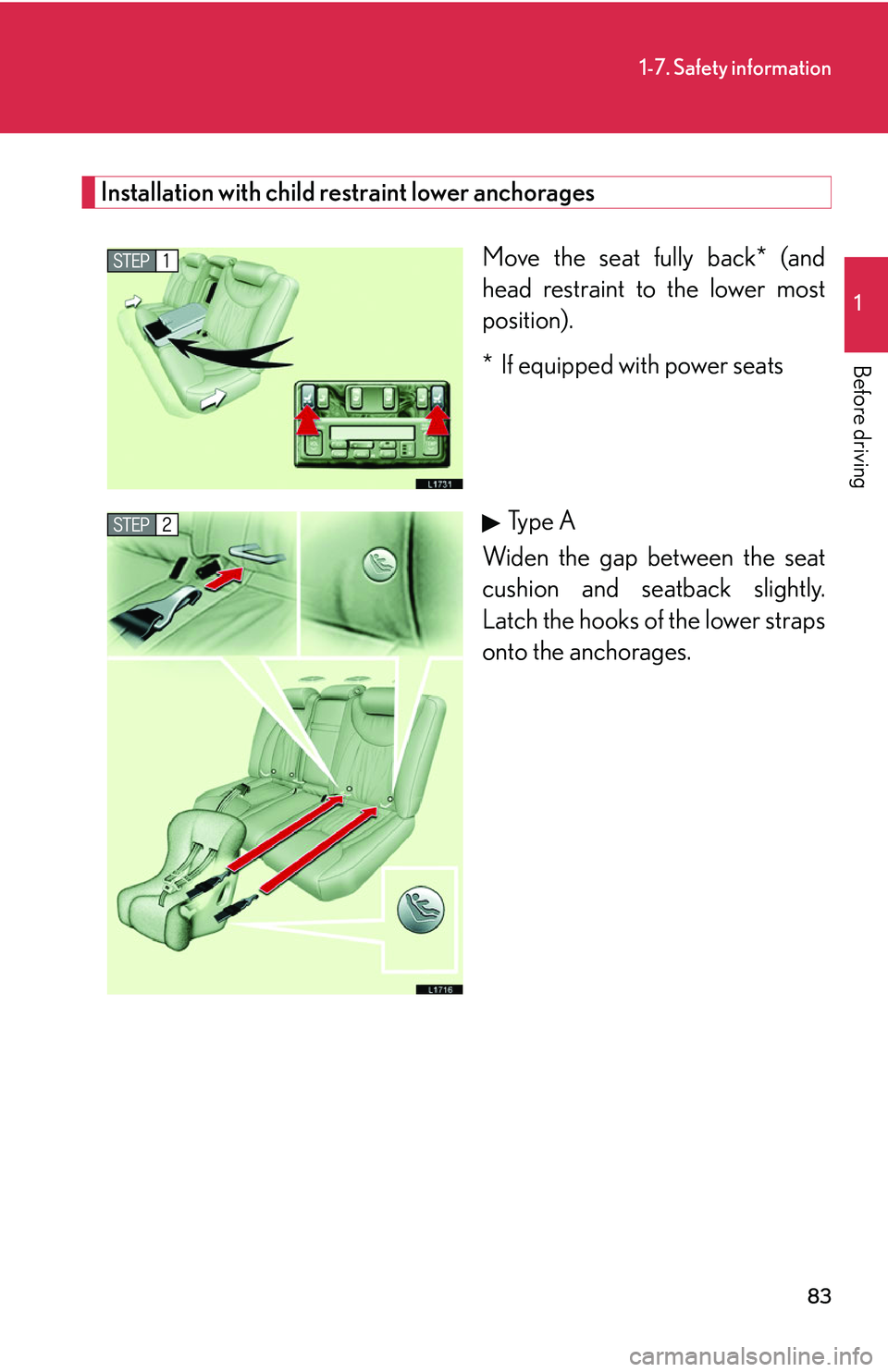
Installation with child restraint lower anchorages
Move the seat fully back* (and
head restraint to the lower most
position).
* If equipped with power seats
Ty p e A
Widen the gap between the seat
cushion and seatback slightly
.
Latch the hooks of the lower straps
onto the anchorages.
Page 151 of 419
135
2-4. Using other driving systems
2
When driving
CAUTION
■To avoid accidentally engaging the cruise control
Keep the ON-OFF switch OFF when not in use.
■To avoid death or serious injury
The following conditions are unsuitable for cruise control use:
• In bad weather (rain, fog, sno
w, sandstorms, etc.)
• If the wipers are operated at high speed (radar cruise control), or at high or low spe
eds (laser cruise control.) This includes when the wiper lever is set to the
“AUTO” position.
• In heavy traffic.
• On roads with sharp bends.
• On slippery road surfaces.
• On steep downhill slopes.
• When the warning tone sounds frequently.
• On roads with steep, short inclines and declines.
• When exiting from, or when ente ri
ng or merging onto a freeway.
■When using the dynamic radar/laser cruise control
Always drive carefully and attentively.
Do not rely on the system to avoid accidents or control the vehicle’s speed in emer -
gency situations. The cruise control is not a collision-av
oidance system.
■Conditions which hinder the radar cruise control's vehicle detection capability
●The rear section of the vehicle ahead is extremely small (unloaded trailer etc.)
●The vehicle ahead or other vehicles are flinging up water or snow.
●Heavy luggage in your trunk or on your rear seats causes the nose of your vehicle
to rise.