tow LEXUS LS430 2006 User Guide
[x] Cancel search | Manufacturer: LEXUS, Model Year: 2006, Model line: LS430, Model: LEXUS LS430 2006Pages: 419, PDF Size: 11.19 MB
Page 143 of 419
127
2-4. Using other driving systems
2
When driving
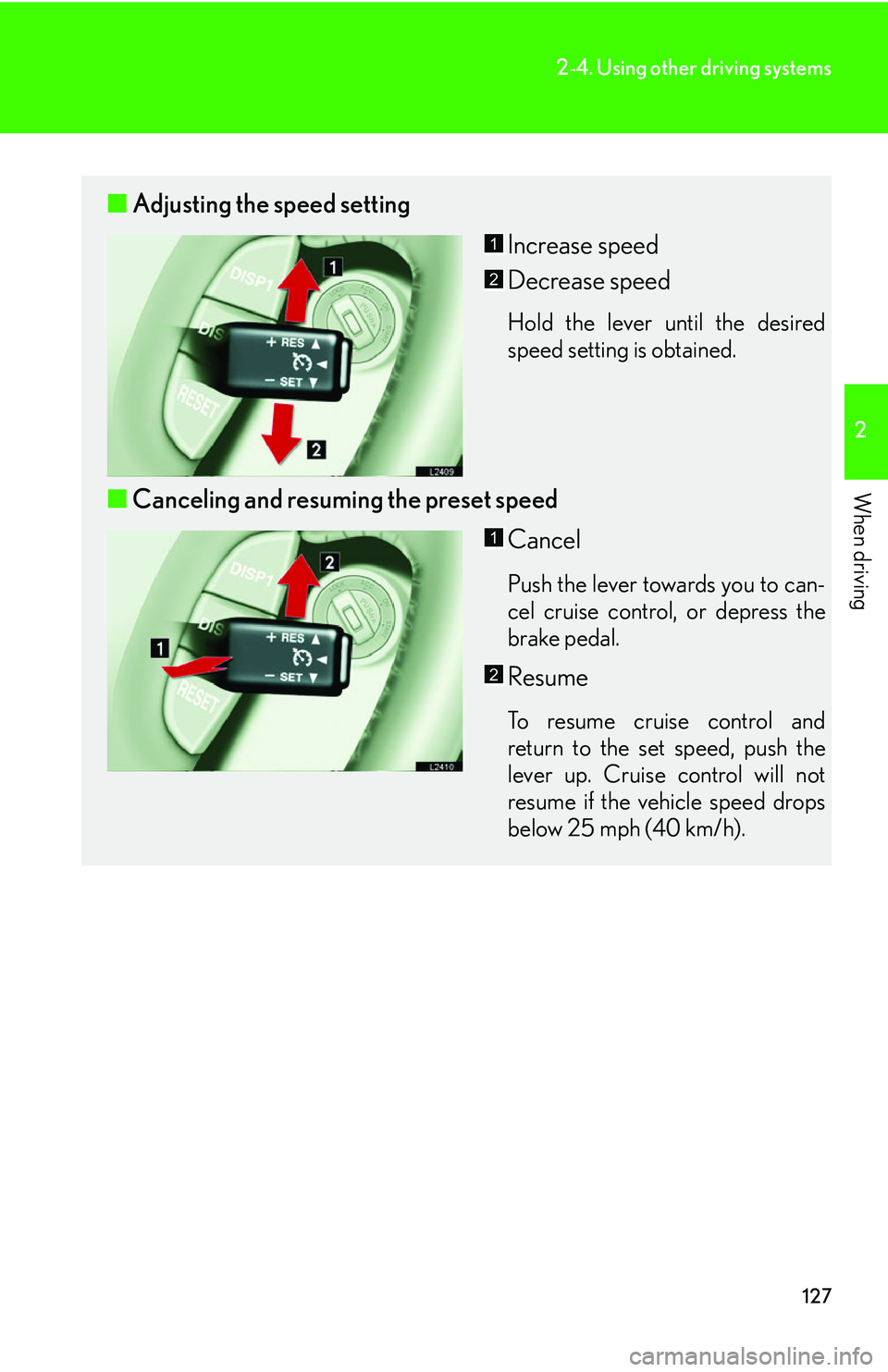
■Adjusting the speed setting
Increase speed
Decrease speed
Hold the lever until the desired
speed setting is obtained.
■Canceling and resuming the preset speed
Cancel
Push the lever towards you to can-
cel cruise control, or depress the
br
ake pedal.
Resume
To resume cruise control and
return to the set speed, push the
lever up. Cruise control will not
resume if the vehicle speed drops
below 25 mph (40 km/h).
1
2
1
2
Page 158 of 419
142
2-4. Using other driving systems
CAUTION
Any of the following conditions may result in-an accident which could cause death
or serious injury:
■The ABS may not operate effectively when:
●The limits of tire gripping performance have been exceeded.
●If the vehicle hydroplanes while driving at high speed while the road is wet or
slick.
■Stopping distance when the ABS is activated will exceed that of normal condi -
tions
The ABS is not designed to shorten the v
ehicle’s stopping distance. Always main -
tain a safe distance between you and the vehicle in front of you, particularly in the
fo
llowing situations.
• When driving on dirt, gravel or snow-covered roads
• When driving with tire chains
• When driving over bumps in the road
• When driving over roads with potholes or uneven roads
• When towing a trailer
■TRAC may not operate effectively when:
Directional control and power may not be ac hi
evable while driving on slippery road
surfaces, even if the TRAC system is operating.
Do not drive the vehicle in conditions where control and power may be lost.
■When the slip indicator flashe s and a warning buzzer sounds
This situation occurs immediately before VSC is activated. Always drive carefully.
R
eckless driving may cause an at the recommended level.
Exercise particular care when an indicator light flashes and a buzzer sounds.
■Replacing tires
Ensure that all tires are the same size an d
brand, have the same tread pattern, and
that the level of tire pressure is at the recommended level.
The ABS and VSC systems may not operate no rmal
ly if different tires are installed
to the vehicle.
Contact your Lexus dealer for further info rmati
on when replacing tires or wheels.
Page 161 of 419
145
2
When driving
2-5. Driving information
Cargo & luggage
Capacity and distribution
Cargo capacity depends on the total weight of the occupants.
(Cargo capacity) = (Total load capacity) - (T
otal weight of occupants)
■ Steps for determining corr
ect load limit
Locate the statement “The combin ed w
eight of occupants and
cargo should never exceed xxx pounds” on your vehicle’s plac -
ard.
Determine the combined weight of the driv
er and passengers
that will be riding in your vehicle.
Subtract the combined weight of the driver and passengers from
xxx pounds or xxx kilograms
The resulting figure equals the available amount of car
go and lug-
gage load capacity.
For example, if the “xxx” amount equa ls 1400 lbs. and there will be five
150 lb. passengers in your vehicle, the amount of available cargo and
luggage load capacity is 650 lbs. 1400 - 750 (5 150) = 650 lbs.
Take notice of the following information about stowage precautions, cargo
capacity and load.
When stowing cargo and luggage in the vehicle, observe the following precau-
tions:
• Put cargo and luggage in the trunk wh en at all possible. Be sure all
items are secured in place.
• Be careful to keep the vehicle level. Placing the w
eight as far forward
as possible helps maintain vehicle balance.
• For better fuel economy, do not carry unnecessary weight.
Page 162 of 419
146
2-5. Driving information
Determine the combined weight of luggage and cargo being
loaded on the vehicle.
The weight may not safely exceed the available cargo and luggage load
capacity calculated in Step .
If your vehicle will be towing a trailer, load from your trailer will be
transferred to your vehicle. Consu lt this manual to determine ho
w
this reduces the available cargo and luggage load capacity of
your vehicle. ( P.148 )
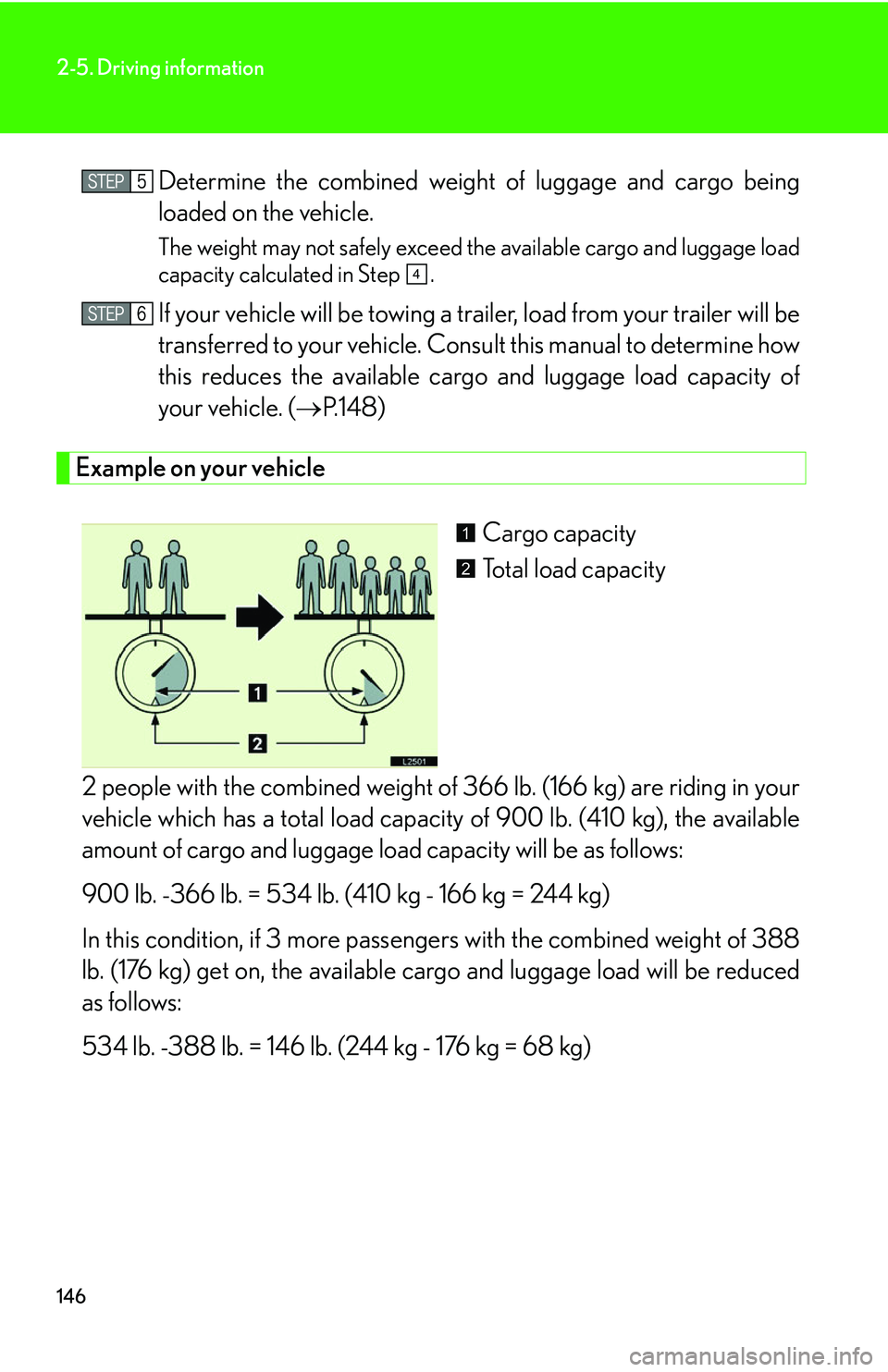
Example on your vehicle
Cargo capacity
Total load capacity
2 people with the combined weight of 366 lb. (166 kg) are riding in your
v
ehicle which has a total load capacity of 900 lb. (410 kg), the available
amount of cargo and luggage load capacity will be as follows:
900 lb. -366 lb. = 534 lb. (410 kg - 166 kg = 244 kg)
In this condition, if 3 mor
e passengers with the combined weight of 388
lb. (176 kg) get on, the available cargo and luggage load will be reduced
as follows:
534 lb. -388 lb. = 146 lb. (244 kg - 176 kg = 68 kg)
4
1
2
Page 164 of 419
148
2-5. Driving information
Vehicle load limits
■Total load capacity and seating capacity
These are also described on the tire and loading information label. ( P. 2 8 3 )
CAUTION
■Overload
Do not apply excess load.
It may cause not only damage to the tires, but also
deterioration of steering ability
and braking ability, resu lting in an accident.
Vehicle load limits include total load ca pacity, seating capacity, towing capac-
ity and cargo capacity.
■ Total load capacity: 900 lb. (410 kg)
Total load capacity means the comb ined w
eight of occupants, cargo
and luggage.
■ Seating capacity: T
otal 5 (Front 2, Rear 3)
Seating capacity means the maxi mum number of occupants whose
estimated a
verage weight is 150 lb. (68 kg) per person.
Even if the number of occupants ar e within the seating capacity, do not
exceed the total load capacity.
■ Towing capacity: 2000 lb. (907 kg)
Towing capacity means the maximum gross trailer weight (trailer
w
eight plus its cargo weight) that your vehicle is able to tow.
■ Car
go capacity
Cargo capacity ma y incr
ease or decrease depending on the weight
and the number of occupants. ( P.145 )
Page 168 of 419
152
2-5. Driving information
Trailer Towing
Your vehicle is designed primarily as a passenger-carrying vehicle, thus tow-
ing a trailer will have an adverse effec t on
handling, performance, braking,
durability, and fuel consumption. For yo ur safety and the safety of others, do
not overload the vehicle or trailer.
Lexus warranties do not apply to damage or malfunction caused b
y towing a
trailer for commercial purposes
■ Weight limits
Confirm the total trailer weight, gross v
ehicle weight, gross axle weight
and trailer tongue load are all within the limits.
■ Gr
oss vehicle weight
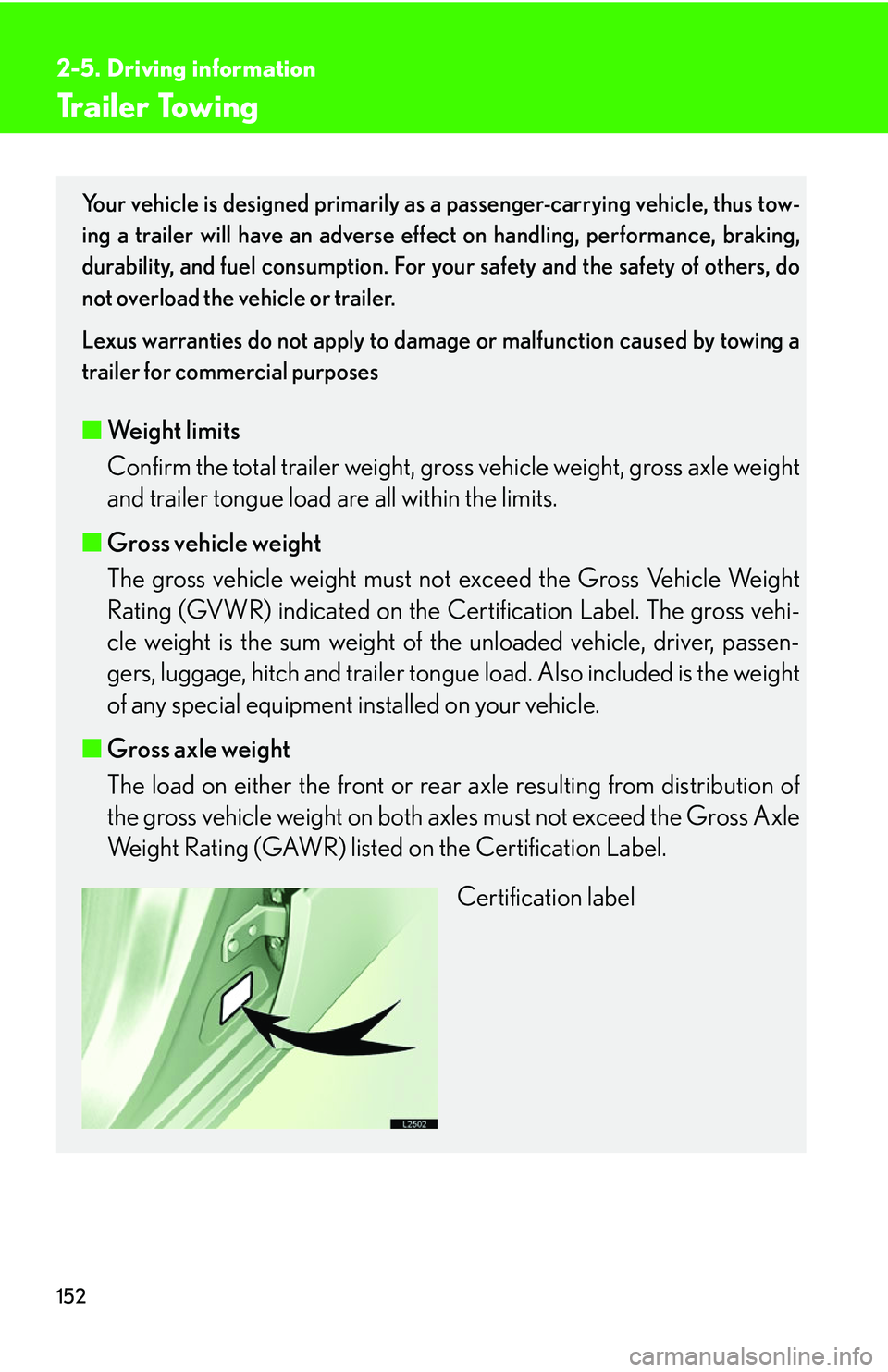
The gross vehicle weight must not exceed the Gross Vehicle Weight
R
ating (GVWR) indicated on the Certification Label. The gross vehi -
cle weight is the sum weight of th e unloaded v
ehicle, driver, passen-
gers, luggage, hitch and trailer tongue load. Also included is the w
eight
of any special equipment installed on your vehicle.
■ Gr
oss axle weight
The load on either the front or rear axle r
esulting from distribution of
the gross vehicle weight on both ax les must not exceed the Gross Axle
Weight Rating (GAWR) listed on the Certification Label.
Certification label
Page 169 of 419
153
2-5. Driving information
2
When driving
Towing a trailer
Consult your Lexus dealer for further information on additional require -
ments such as a towing kit, etc.
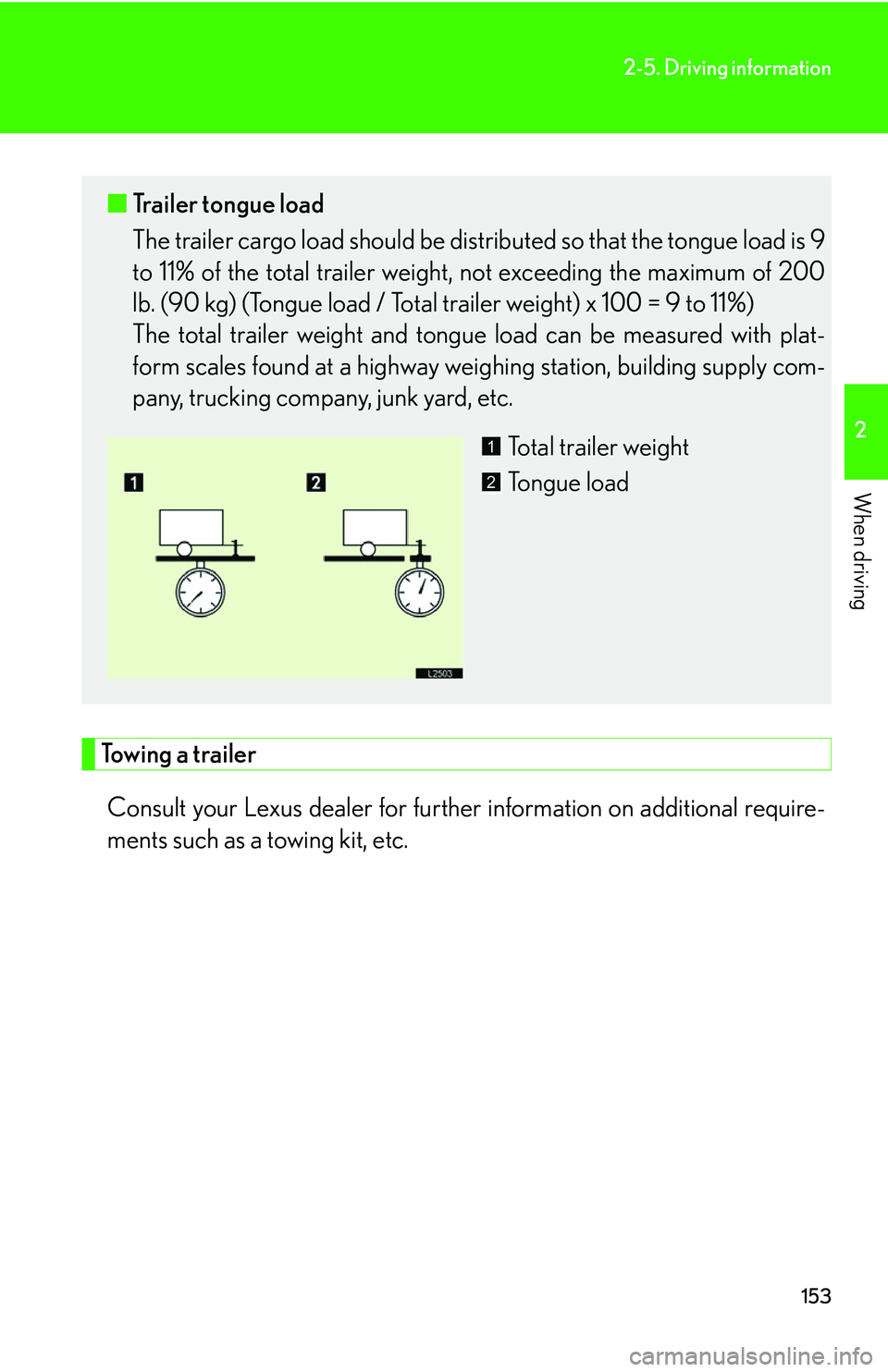
■Trailer tongue load
The trailer cargo load should be dis tributed so that the tongue load is 9
to 11% of the total trailer weight , not exceeding the maximum of 200
lb. (90 kg) (Tongue load / Total trailer weight) x 100 = 9 to 11%)
The total trailer weight and tongue load can be measur
ed with plat-
form scales found at a highw
ay weighing station, building supply com -
pany, trucking company, junk yard, etc.
Total trailer weight
Tongue load
1
2
Page 170 of 419
154
2-5. Driving information
■Before towing
●Ensure that your vehicle’s tires are properly inflated. (P.283 )
●Trailer tires should be inflated according to the trailer manufacturer’s recom -
mendation.
●All trailer lights must work to be legal.
●Confirm all lights work each time you connect them.
●Check that your vehicle remains level when a loaded or unloaded trailer is
hitched. Do not drive if the vehicle is not level, and check for improper tongue
load, overloading, worn suspension, or other possible causes.
●Make sure the trailer cargo is securely loaded.
●Check that your rear view mirrors conform to any federal, state/provincial or
local regulations. If they do not, instal l rear view mirrors appropriate for towing
purposes.
■Break-in schedule
Lexus recommends that you do not use a new vehicle or a vehicle with any new
p
ower train components (engine, transmissi on, differential, wheel bearing, etc.) to
tow a trailer for the first 500 miles (800 km) of driving.
■Maintenance
●If you tow a trailer, your vehicle will require more frequent maintenance due to
the additional load. (see “Owner’s Manual Supplement/ Scheduled Mainte -
nance”)
●Retighten the fixing bolts of the towing ball and bracket after approximately
600 miles (1000 km) of trailer towing.
Page 171 of 419
155
2-5. Driving information
2
When driving
CAUTION
■To avoid accident or injury
●The total trailer weight (trailer weight plus the weight of cargo) must not exceed
2000 lb. (907 kg).
●Do not exceed the trailer hitch assembly weight, gross vehicle weight, gross axle
weight and trailer tongue load capacities.
●Never load more weight in the back than in the front of the trailer. About 60% of
the load should be in the front half of the trailer, and the remaining 40% in the
rear.
■Hitches
Trailer hitch assemblies have different weight capacities established by the hitch
ma
nufacturer. Even though the vehicle may be physically capable of towing a
higher weight, the operator must never exceed the maximum weight rating speci -
fied for the trailer hitch.
• If you wish to install a trailer hitch, your Lexus dealer should be consulted.
• Use only a hitch that conforms to the total trailer weight requirement.
• Follow the directions supplied by the hitch manufacturer.
• Lubricate the hitch ball with a light coat of grease.
• Remove the trailer hitch whenever you are not towing a trailer. After r
emoving the hitch, seal any mounting holes in the vehicle body to prevent
entry of any substances into the vehicle.
■When towing a trailer
●If the total trailer weight exceeds 1000 lb . (450 kg), trailer brakes are required.
●Never tap into your vehicle's hydraulic system, as this will lower the vehicle's
braking effectiveness.
●Never tow a trailer without using a safety chain securely attached to both the
trailer and the vehicle. If damage occurs to the coupling unit or hitch ball, there is
danger of the trailer wandering into another lane.
Page 172 of 419
156
2-5. Driving information
Trailer towing tips
Your vehicle will handle differently when towing a trailer. The three main
causes of vehicle-trailer accidents are driver error, excessive speed and
improper trailer loading. Keep these in mind when towing.
• Before starting out, check the tra iler
’s lights and the vehicle-trailer
connections. Recheck after driving a short distance.
• Practice turning, stopping and reversi ng with the tr
ailer attached in an
area away from traffic until you be come accustomed to the feel of the
vehicle.
• Reversing with a trailer attached is dif
ficult and requires practice. Grip
the bottom of the steering wheel and move your hand to the left to
move the trailer to the left. Move yo ur hand to the right to move the
trailer to the right. (This is gene rally opposite to reversing without a
trailer attached.) Avoid sharp or prolonged turning. Have someone
guide you when reversing to redu ce the risk of an accident.
NOTICE
■When installing a trailer hitch
●Use only the position recommended by your Lexus dealer. Do not install the
trailer hitch on the bumper; this may cause body damage.
●Do not use axle-mounted hitches as they can cause damage to the axle housing,
wheel bearings, wheels or tires.
■Brakes
Lexus recommends trailers with brakes that conform to any applicable federal and
sta
te/provincial requlations.
■Do not directly splice trailer lights
Direct splicing may damage your vehicle’s electrical system and cause a malfunc -
tion.