tires LEXUS LS430 2006 Owner's Manual
[x] Cancel search | Manufacturer: LEXUS, Model Year: 2006, Model line: LS430, Model: LEXUS LS430 2006Pages: 419, PDF Size: 11.19 MB
Page 358 of 419
342
5-2. Steps to take in an emergency
■Resetting the tire pressure warning data
After adjusting the tire inflation pressur
e, be sure to initialize the data. (P. 2 7 9 )
If the message remains on, the system may have malfunctioned. Have the vehicle
inspected b
y your Lexus dealer as soon as possible
■The tire pressure warning system may not function properly in the following con -
ditions
●Tires other than the sp ecified sizes are used, or if tires of different sizes or tread
pattern are mixed, or the degree of tread wear is very different among the
installed tires.
●A compact spare tire, snow tires, or tire chains are used.
●The tire inflation pressure is excessively higher than specified, or tire inflation
pressure suddenly drops due to buresting or other causes.
●Driving on slippery road surfaces such as rough or frozen roads.
●Driving under 19 mph (30 km/h) or above 62 mph (100 km/h), or less than 5
minutes drive.
●Initialization was not performed correctly after replacing or rotating tires or
wheels.
●The outside temperature is below 32 °F (0 °C) or above 104 °F(40 °C).
CAUTION
■When the low tire pressure warning message appears
Avoid abrupt maneuvering and braking. If th
e vehicle’s tires have deteriorated, you
could lose control of the vehicle, resulting in death or serious injury.
Page 364 of 419
348
5-2. Steps to take in an emergency
Replacing a flat tire
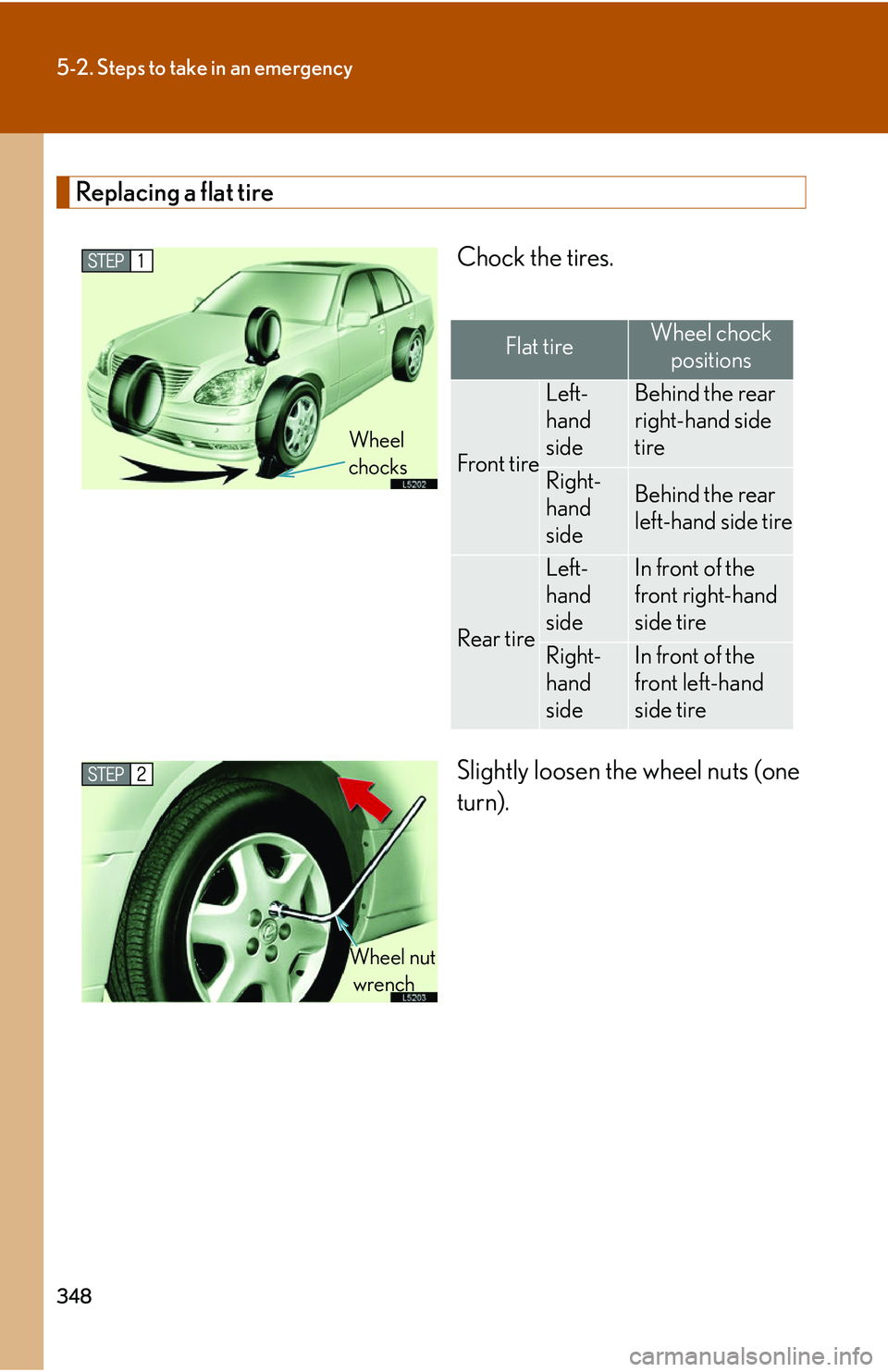
Chock the tires.
Slightly loosen the wheel nuts (one
turn).
Wheel
chocks
Flat tireWheel chock positions
Front tire
Left-
hand
sideBehind the rear
right-hand side
tire
Right-
hand
sideBehind the rear
left-hand side tire
Rear tire
Left-
hand
sideIn front of the
front right-hand
side tire
Right-
hand
sideIn front of the
front left-hand
side tire
Wheel nut
wrench
Page 368 of 419
352
5-2. Steps to take in an emergency
CAUTION
■Using the tire jack
Improper use of the tire jack may lead to death or injuries due to the vehicle sud-
denly falling off the jack.
Observe the following precautions to prevent accidents.
• Do not use the tire jack for any purpose other than replacing tires or installing and
removing tire chains.
• Only use the tire jack that comes with this vehicle for replacing a flat tire.
Do not use this tire jack on other vehicl
es, and do not use other tire jacks for
replacing tires on this vehicle.
• Always check that the tire jack is securely set to the jack point.
• Do not raise the vehicle while someone is in it.
• When raising the vehicle, do not put an object on or under the jack.
• Do not raise the vehicle to a height greate r than
that required to replace the tire.
• Do not put any part of your body under the vehicle supported by a jack.
• Do not start or run the engine while your vehicle is supported by the jack.
• Use a jack stand if it is necessary to get under the vehicle.
• Take particular care when lowering the vehicle to ensure that no one working on or
near the vehicle may be injured.
■Replacing a flat tire
Observe the following precautions to reduce
the risk of death or serious injury.
• Never use oil or grease on the wheel bolts or wheel nuts.
The oil or grease can cause the wheel nuts to loosen, causing a serious accident.
R
emove any oil or grease on the wheel bolts or wheel nuts.
• Have the wheel nuts tightene d with a tor
que wrench to 76 f t•lbf (105 N•m, 10.5
kgf
•m) as soon as possible after changing wheels.
Failure to follow these pre-cautions could cause, the wheel nuts to loosen and the
w
heels may fall off, which could lead to an accident causing death or serious injury.
NOTICE
■Do not drive the vehicle with a flat tire.
Do not continue driving with a flat tire.
Driving even a short distance can damage a tire and wheel beyond repair.
Page 377 of 419
5
When trouble arises
361
5-2. Steps to take in an emergency
If the vehicle becomes stuck
CAUTION
■When removing the stuck vehicle
If you choose to rock the vehicle back and forth to free it, make sure the surround-
ing area is clear, to avoid striking other vehicles, objects or persons. The vehicle
may
also lunge forward or lunge back suddenly as it becomes free, use extreme
caution.
NOTICE
■To avoid damaging the transmission and other components
●Do not operate the selector lever while depressing the accelerator pedal.
●Avoid spinning the wheels and do not rev the engine.
●If the vehicle remains stuck after trying these procedures the vehicle may require
towing to be freed.
Carry out the following procedures if the tires spin or the vehicle becomes
stuck in mud, dirt, or snow to the extent that it cannot move.
• Stop the engine. Set the parking brake and put the transmission
selector lever in “P”.
• Remove the mud, snow, or sand from around the stuck tire.
• Place wood, stones or some other ma terial to help pr
ovide traction
under the tires.
• Restart the engine.
• Turn off the traction control system. ( P.141)
• Carefully apply the accelerator to free the vehicle.
Page 386 of 419
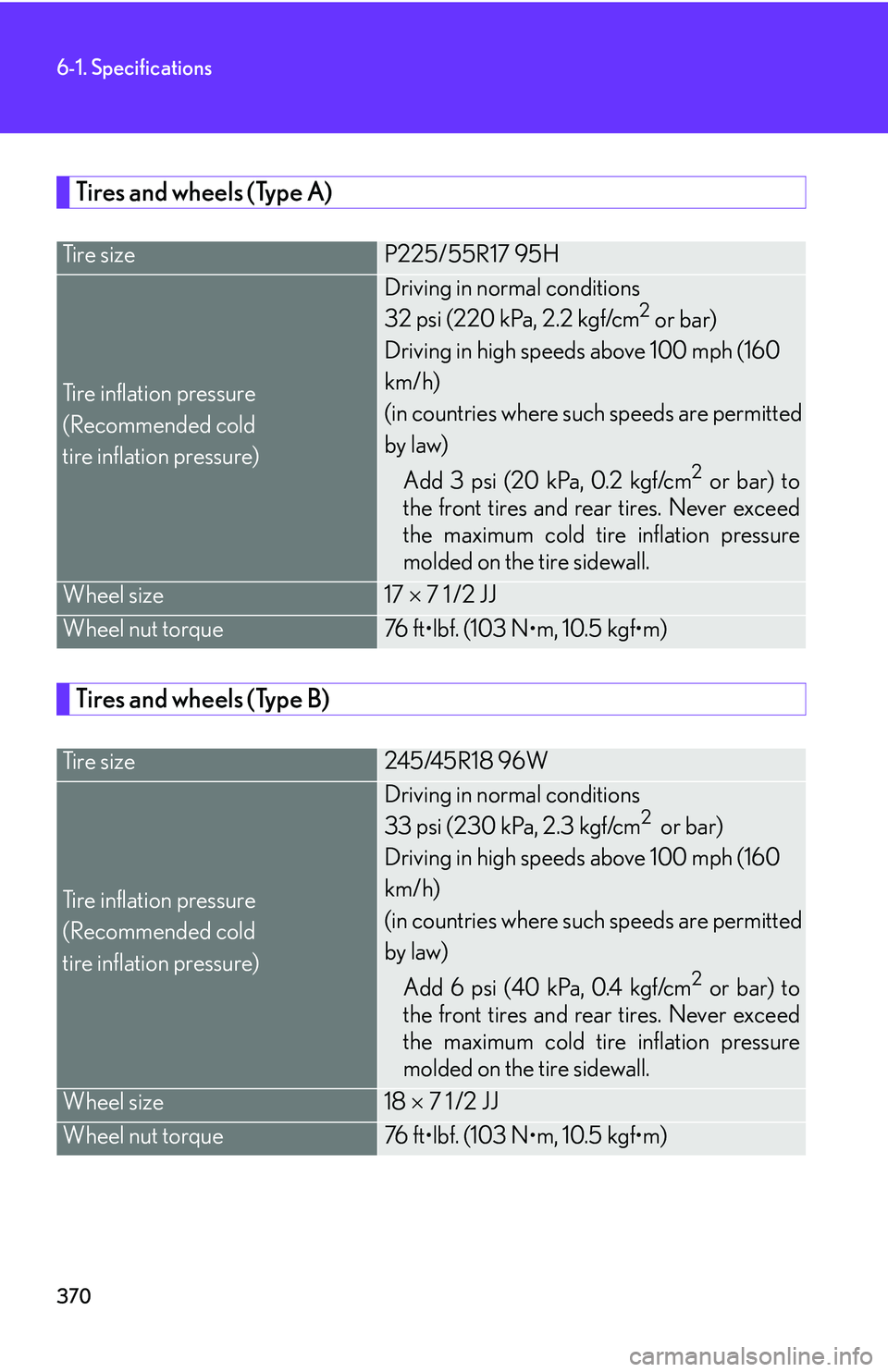
370
6-1. Specifications
Tires and wheels (Type A)
Tires and wheels (Type B)
Ti r e s i z eP225/55R17 95H
Tire inflation pressure
(Recommended cold
tire inflation pressure)
Driving in normal conditions
32 psi (220 kPa, 2.2 kgf/cm2 or bar)
Driving in high speeds above 100 mph (160
km/
h)
(in countries where such speeds are permitted
b
y law)
Add 3 psi (20 kPa, 0.2 kgf/cm
2 or bar) to
the front tires and rear tires. Never exceed
the maximum cold tire inflation pressure
molded on the tire sidewall.
Wheel size17 7 1 /2 JJ
Wheel nut torque76 f t•lbf. (103 N•m, 10.5 kgf•m)
Ti r e s i z e245/45R18 96W
Tire inflation pressure
(Recommended cold
tire inflation pressure)
Driving in normal conditions
33 psi (230 kPa, 2.3 kgf/cm2 or bar)
Driving in high speeds above 100 mph (160
km/
h)
(in countries where such speeds are permitted
b
y law)
Add 6 psi (40 kPa, 0.4 kgf/cm
2 or bar) to
the front tires and rear tires. Never exceed
the maximum cold tire inflation pressure
molded on the tire sidewall.
Wheel size18 7 1 /2 JJ
Wheel nut torque76 f t•lbf. (103 N•m, 10.5 kgf•m)
Page 387 of 419
371
6-1. Specifications
6
Vehicle specifications
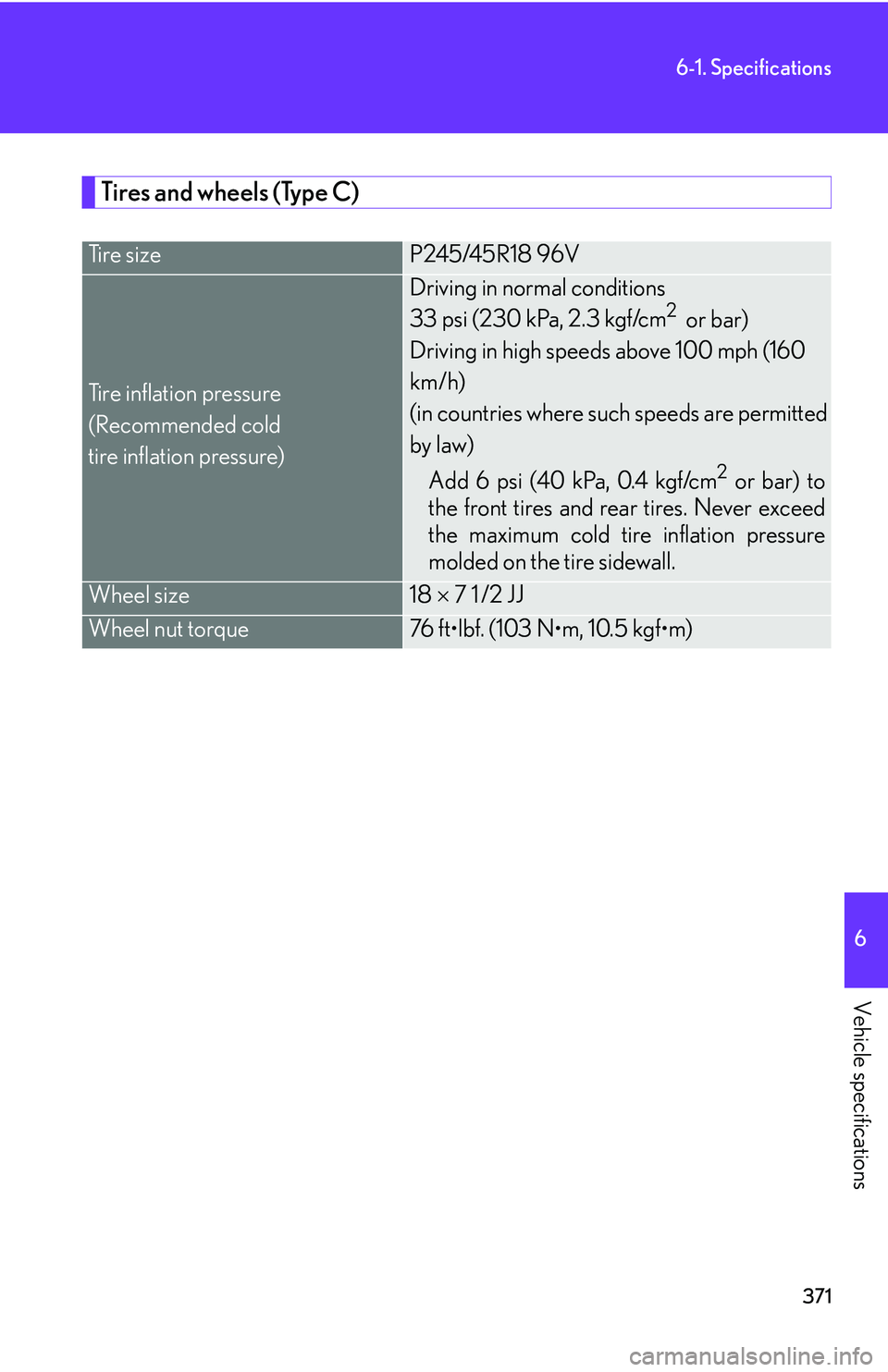
Tires and wheels (Type C)
Ti r e s i z eP245/45R18 96V
Tire inflation pressure
(Recommended cold
tire inflation pressure)
Driving in normal conditions
33 psi (230 kPa, 2.3 kgf/cm2 or bar)
Driving in high speeds above 100 mph (160
km/
h)
(in countries where such speeds are permitted
b
y law)
Add 6 psi (40 kPa, 0.4 kgf/cm
2 or bar) to
the front tires and rear tires. Never exceed
the maximum cold tire inflation pressure
molded on the tire sidewall.
Wheel size18 7 1 /2 JJ
Wheel nut torque76 f t•lbf. (103 N•m, 10.5 kgf•m)
Page 392 of 419
376
6-1. Specifications
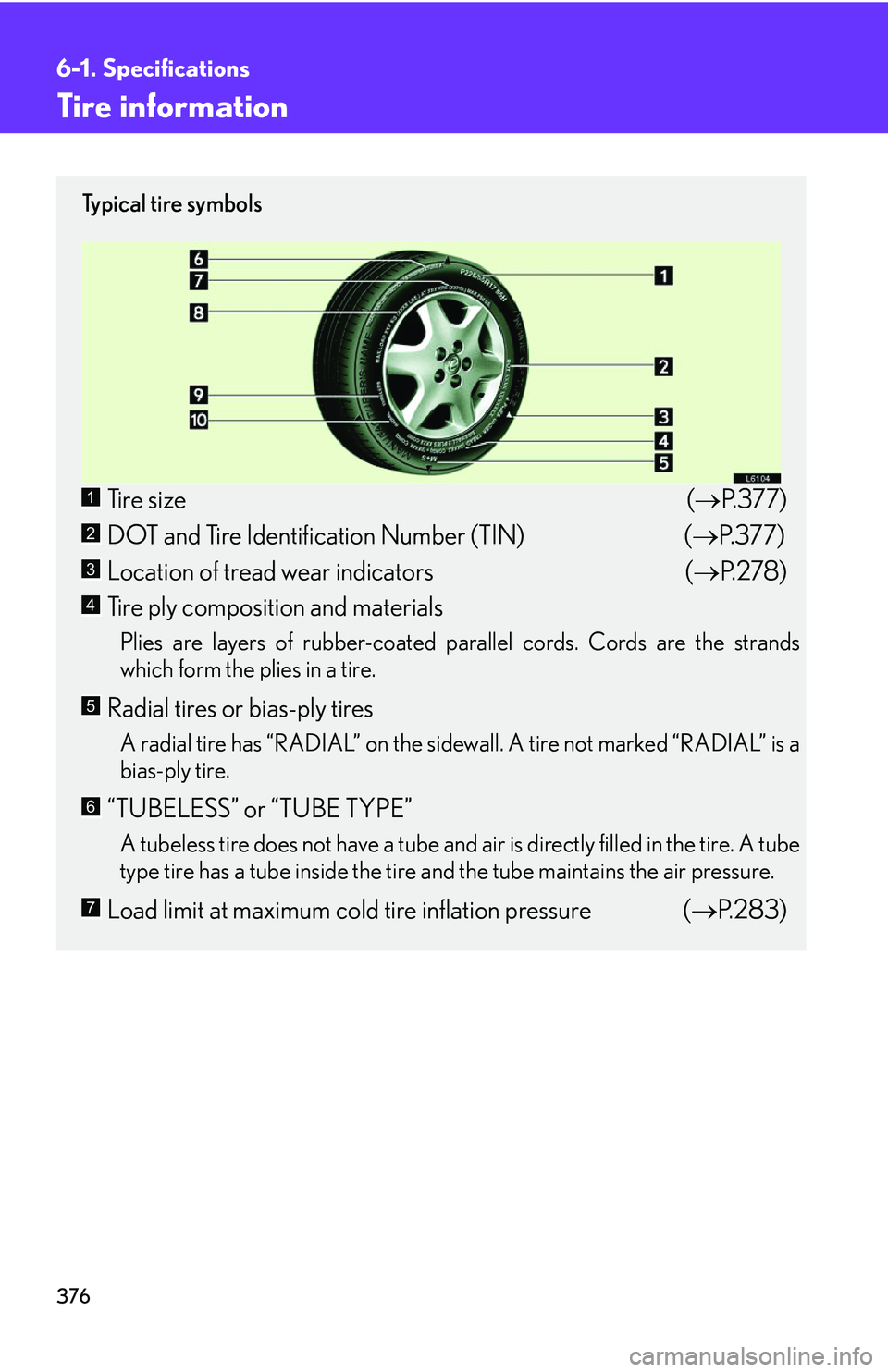
Tire information
Ty p i c a l t i r e s y m b o l s
Tire size(P.377 )
DOT and Tire Identification Number (TIN) ( P.377 )
Location of tread wear indicators ( P.278 )
Tire ply composition and materials
Plies are layers of rubber-coated parallel cords. Cords are the strands
which form the plies in a tire.
Radial tires or bias-ply tires
A radial tire has “RADIAL” on the sidewall. A tire not marked “RADIAL” is a
bias-ply tire.
“TUBELESS” or “TUBE TYPE”
A tubeless tire does not have a tube and air is directly filled in the tire. A tube
type tire has a tube inside the tire and the tube maintains the air pressure.
Load limit at maximum cold tire inflation pressure ( P.283 )
1
2
3
4
5
6
7
Page 395 of 419
379
6-1. Specifications
6
Vehicle specifications
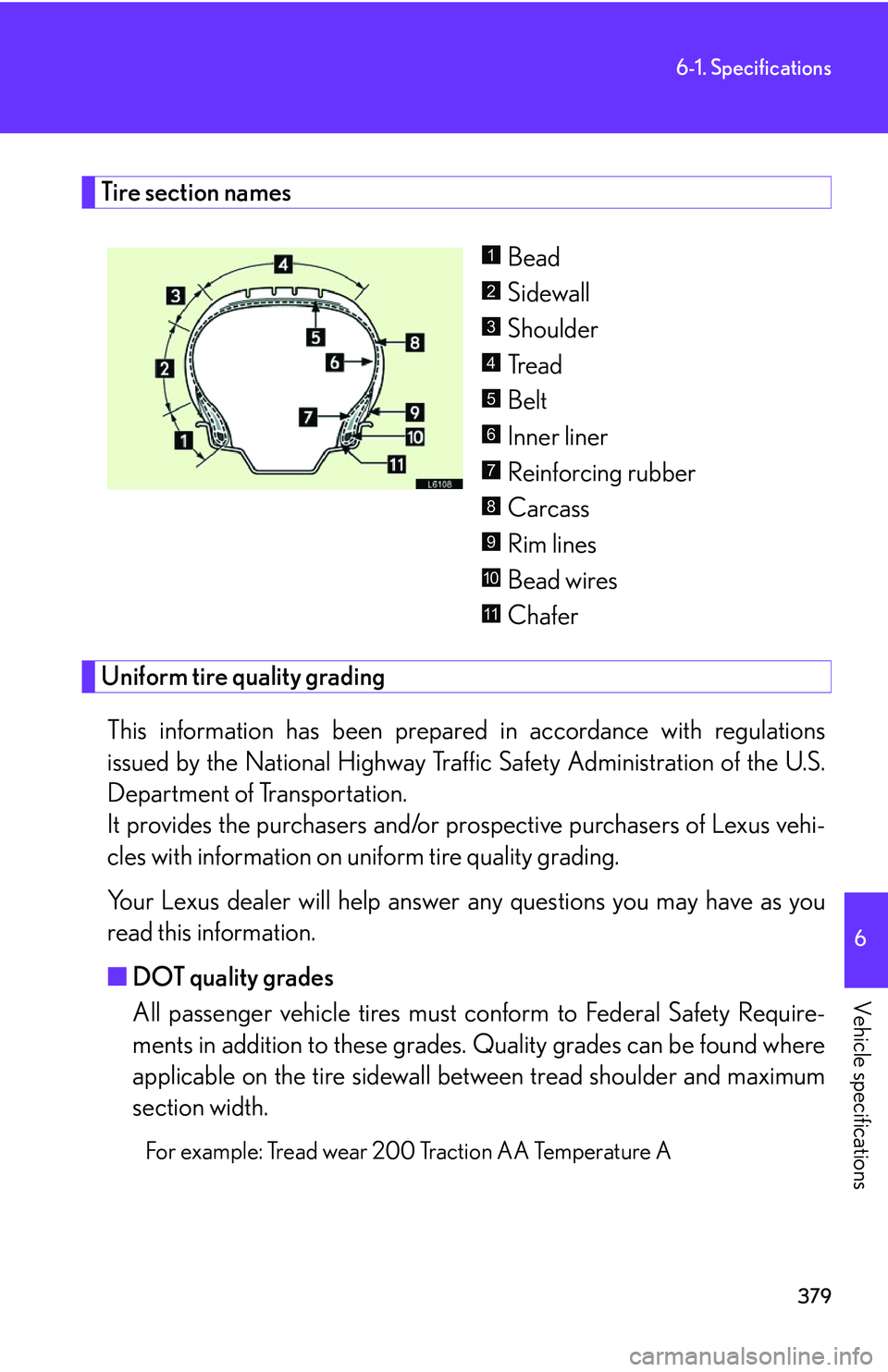
Tire section names
Bead
Sidewall
Shoulder
Tread
Belt
Inner liner
Reinforcing rubber
Carcass
Rim lines
Bead wires
Chafer
Uniform tire quality grading
This information has been prepared in accordance with regulations
issued by the National Highway Traffic Safety Ad ministration of the U.S.
Department of Transportation.
It provides the purchasers and/or prospective purchasers of Lexus vehi -
cles with information on uniform tir
e quality grading.
Your Lexus dealer will help answer any que
stions you may have as you
read this information.
■ DO
T quality grades
All passenger vehicle tires must co nform to F
ederal Safety Require -
ments in addition to these grades. Quality gr
ades can be found where
applicable on the tire sidewall between tread shoulder and maximum
section width.
For example: Tread wear 200 Traction AA Temperature A
1
2
3
4
5
6
7
8
9
10
11
Page 396 of 419
380
6-1. Specifications
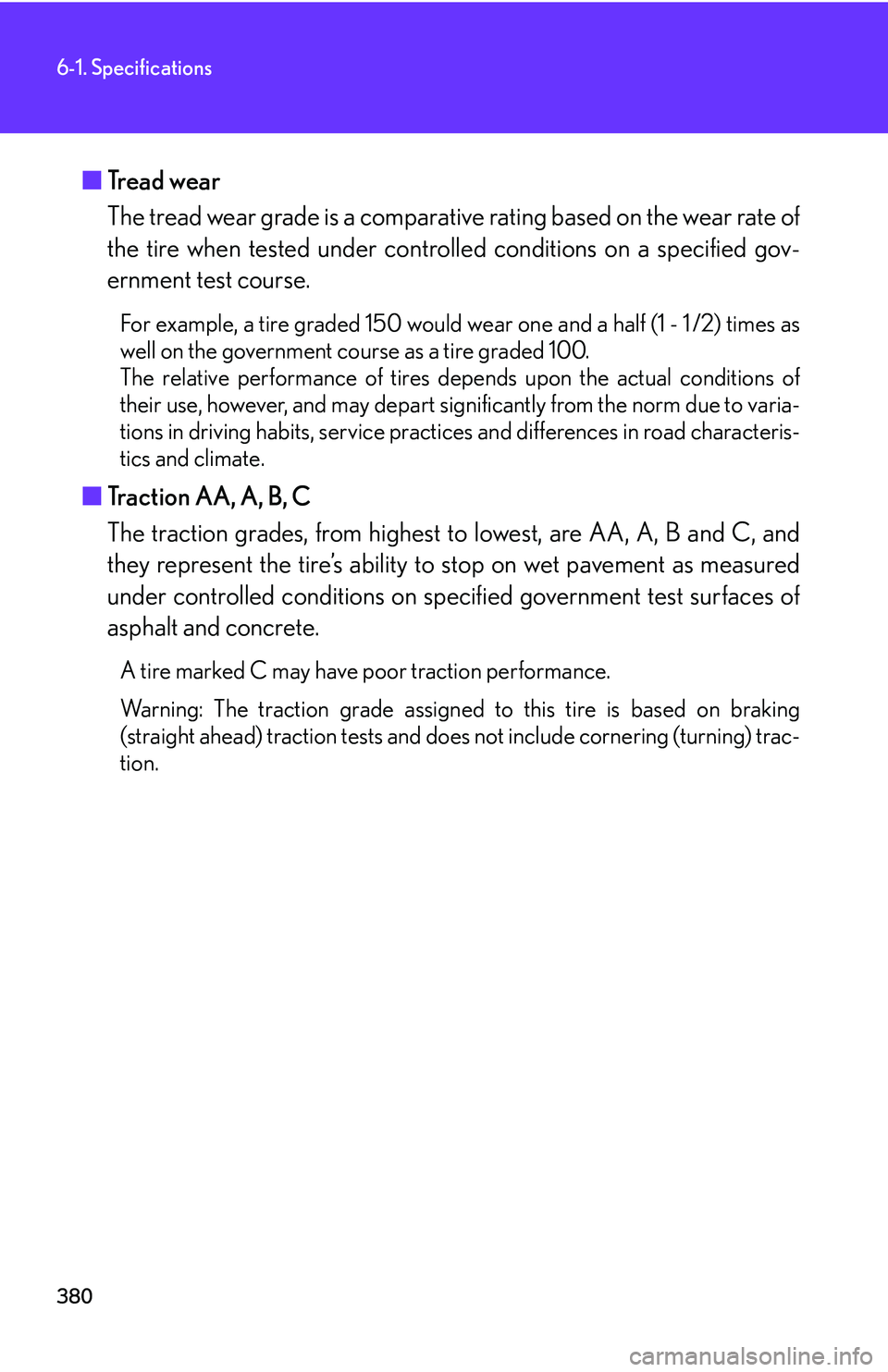
■Tread wear
The tread wear grade is a comparative rating based on the wear rate of
the tir
e when tested under controll ed conditions on a specified gov -
ernment test course.
For example, a tire graded 150 would wear one and a half (1 - 1 /2) times as
well on the government course as a tire graded 100.
The relative performance of tires de pends upon the actual conditions of
their
use, however, and may depart significantly from the norm due to varia -
tions in driving habits, service practices
and differences in road characteris-
tics and climate.
■ Traction AA, A, B, C
The traction grades, from highest to lo
west, are AA, A, B and C, and
they represent the tire’s ability to stop on wet pavement as measured
under controlled condit ions on specified government test surfaces of
asphalt and concrete.
A tire marked C may have poor traction performance.
Warning: The traction grade assigned to this tir
e is based on braking
(straight ahead) traction tests and does not include cornering (turning) trac-
tion.
Page 403 of 419
387
6-2. Owner’s customize
6
Vehicle specifications
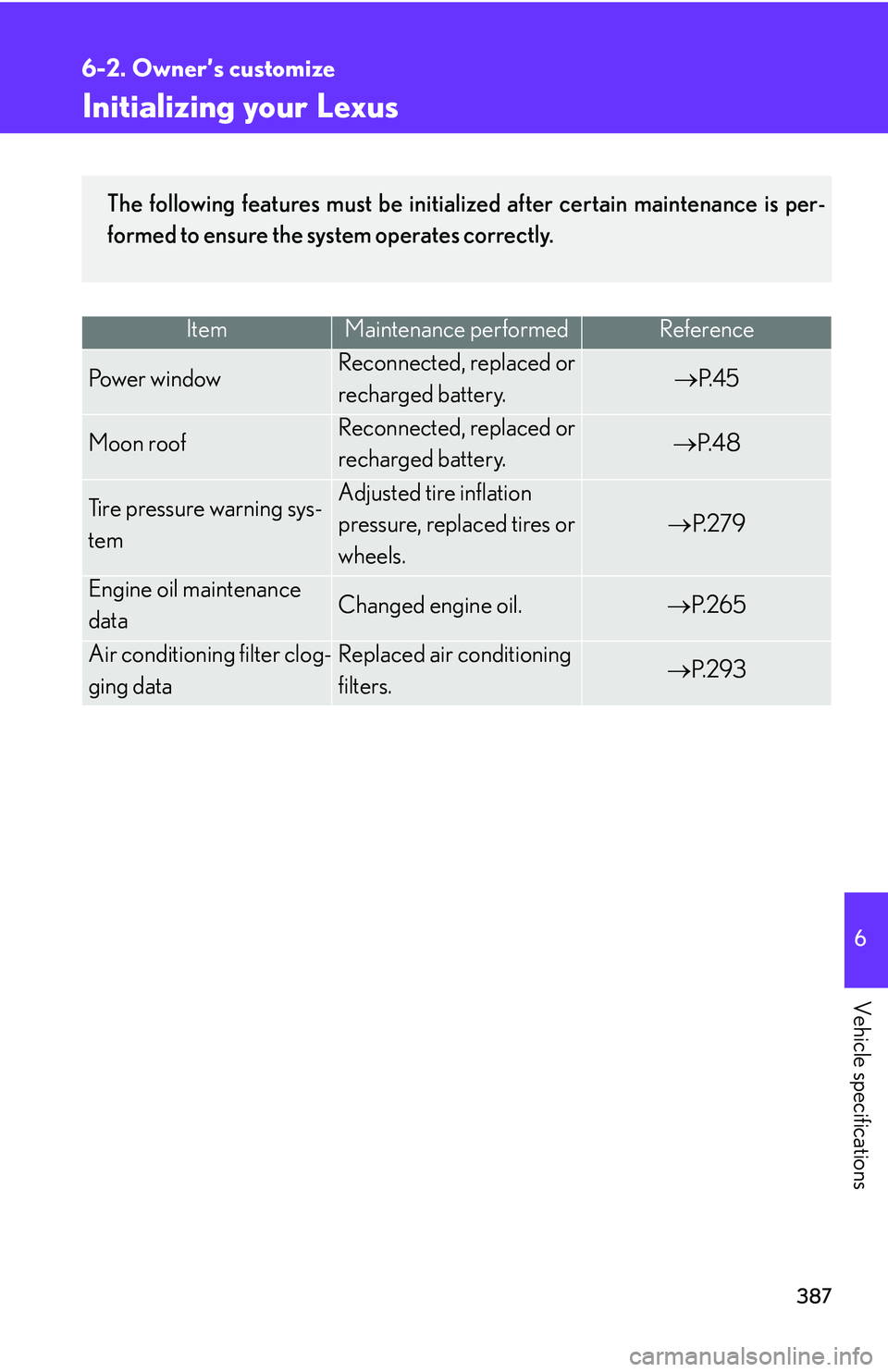
Initializing your Lexus
ItemMaintenance performedReference
Po w e r w i n d o wReconnected, replaced or
recharged battery.P. 4 5
Moon roofReconnected, replaced or
recharged battery.P. 4 8
Tire pressure warning sys-
tem
Adjusted tire inflation
pressure, replaced tires or
wheels.
P. 2 7 9
Engine oil maintenance
dataChanged engine oil.P. 2 6 5
Air conditioning filter clog-
ging data
Replaced air conditioning
filters.P. 2 9 3
The following features must be initialized after certain maintenance is per-
formed to ensure the system operates correctly.