change wheel LEXUS LS460L 2016 Owners Manual
[x] Cancel search | Manufacturer: LEXUS, Model Year: 2016, Model line: LS460L, Model: LEXUS LS460L 2016Pages: 708, PDF Size: 36.57 MB
Page 54 of 708
541-1. For safe use
LS460/LS460L_GE (OM50G06E)
The main SRS airbag system components are shown above. The SRS air-
bag system is controlled by the airbag sensor assembly. As the airbags
deploy, a chemical reaction in the inflators quickly fills the airbags with
non-toxic gas to help restrain the motion of the occupants.
CAUTION
■SRS airbag precautions
Observe the following precautions regarding the SRS airbags.
Failure to do so may cause death or serious injury.
●The driver and all passengers in the vehicle must wear their seat belts properly.
The SRS airbags are supplemental devices to be used with the seat belts.
●The SRS driver airbag deploys with considerable force, and can cause death or
serious injury especially if the driver is very close to the airbag.
Since the risk zone for the driver’s airbag is the first 50 - 75 mm (2 - 3 in.) of
inflation, placing yourself 250 mm (10 in.) from your driver airbag provides you
with a clear margin of safety. This distance is measured from the center of the
steering wheel to your breastbone. If you sit less than 250 mm (10 in.) away now,
you can change your driving position in several ways:
• Move your seat to the rear as far as you can while still reaching the pedals
comfortably.
• Slightly recline the back of the seat.
Although vehicle designs vary, many drivers can achieve the 250 mm (10 in.)
distance, even with the driver seat all the way forward, simply by reclining the
back of the seat somewhat. If reclining the back of your seat makes it hard to
see the road, raise yourself by using a fi rm, non-slippery cushion, or raise the
seat if your vehicle has that feature.
• If your steering wheel is adjustable, t ilt it downward. This points the airbag
toward your chest instead of your head and neck.
The seat should be adjusted as recommended above, while still maintaining con-
trol of the foot pedals, steering wheel, and your view of the instrument panel con-
trols.
Page 234 of 708
2343-4. Adjusting the steering wheel and mirrors
LS460/LS460L_GE (OM50G06E)
When the mirror select switch is in the “L” or “R” position, the outside rear
view mirrors will automatically angle downwards when the vehicle is
reversing in order to give a better view of the ground.
To disable this function, move the mirror select switch to the neutral posi-
tion (between “L” and “R”).
■Adjusting the mirror angle when the vehicle is reversing
With the shift lever in R, adjust the mirror angle at a desired position.
The adjusted angle will be memorized and the mirror will automatically
tilt to the memorized angle whenever the shift lever is shifted to R from
next time.
The memorized downward tilt position of the mirror is linked to the normal
position (angle adjusted with the shift lever in other than R). Therefore, if the
normal position is changed after adjustment, the tilt position will also change.
When the normal position is changed, readjust the angle in reversing.
■Mirror angle can be adjusted when
The engine switch is in ACCE SSORY or IGNITION ON mode.
■When the mirrors are fogged up
The outside rear view mirrors can be cleared using the mirror defoggers. Turn on the
rear window defogger to turn on the outside rear view mirror defoggers. ( P. 445)
■Automatic adjustment of the mirror angle
A desired mirror face angle can be entered to memory and recalled automatically
by the driving position memory. ( P. 218)
■Auto anti-glare function
When the anti-glare inside rear view mirror is set to automatic mode, the outside
rear view mirrors will activate in conjunction with the anti-glare inside rear view mir-
ror to reduce reflected light. ( P. 230)
■Using automatic mode in cold weather
When automatic mode is used in cold weather, the door mirror could freeze up and
automatic stowing and return may not be possible. In this event, remove any ice and
snow from the door mirror, then either operate the mirror using manual mode or
move the mirror by hand.
Linked mirror function when reversing
Page 295 of 708
2954-3. Operating the lights and wipers
4
Driving
LS460/LS460L_GE (OM50G06E)
■The Adaptive High-beam System can be operated when
The engine switch is in IGNITION ON mode.
■Camera sensor detection information
●High beam may not be automatically turned off or changed to variable shade beam
in the following situations:
• When oncoming vehicles suddenly appear from a curve
• When the vehicle is cut in front of by another
• When oncoming or preceding vehicles are hidden from sight due to repeated
curves, road dividers or roadside trees
●High beam may be turned off or variable shade beam may be changed to if an
oncoming vehicle that is using fog lights without using the headlights is detected.
●House lights, street lights, red traffic signals, and illuminated billboards or signs may
cause the high beam to turn off or variable shade beam to be changed to and may
change the area that is shielded.
●The following factors may affect the amount of time taken to turn high beam on or
off, or the speed by which the shielded areas change:
• The brightness of headlights, fog lights, and tail lights of oncoming and preced-
ing vehicles
• The movement and direction of oncoming and preceding vehicles
• When a oncoming or preceding vehicle only has operational lights on one side
• When a oncoming or preceding vehicle is a two-wheeled vehicle
• The condition of the road (gradient, curve, condition of the road surface etc.)
• The number of passengers and amount of luggage
●High beam and variable shade beam may be turned on or off when unexpected by
the driver.
●Small vehicles, such as bicycles, may not be detected.
Page 349 of 708
3494-5. Using the driving support systems
4
Driving
LS460/LS460L_GE (OM50G06E)
■Temporary cancelation of the LKA system functions
If any of the following occurs, the LKA system functions will be temporarily canceled.
The functions will resume after the necessary operating conditions have returned.
●The steering wheel is turned as far as necessary to cause the vehicle to change
lanes.
●When the system detects no-handed driving. (The lane keeping assist function will
be temporarily canceled, but the lane departure warning function will continue.)
●The turn signal lever is operated.
●The vehicle speed deviates from the operating range of the LKA system functions.
(The buzzer will beep twice when the lane keeping assist function is being can-
celed.)
●When the lane lines cannot be recognized while driving. (The buzzer will beep
twice when the lane keeping assist function is being canceled.)
●When the wiper switch is in the high spee d position or is set to “AUTO” mode with
the wipers operating at high speed. (The lane keeping assist function will be tempo-
rarily canceled, but the lane departure warning function will continue.)
●If the vehicle crosses a line for approximately half a minute or more. (The lane keep-
ing assist function will be temporarily canceled, but the lane departure warning
function will continue.)
●When the lane departure warning function is activated.
The lane departure warning function will not operate again for several seconds
after it has been activated, even if the vehicle leaves the lane again.
■The lane departure warning
It may be difficult to feel the sensory warning depending on the road conditions.
■No-handed driving warning
If the steering wheel is not operated for approximately 15 seconds on a straight road
or approximately 5 seconds on a curve, the buzzer will beep twice, indicators on the
multi-information display will flash, and the lane keeping assist function will be tem-
porarily canceled. If you drive the vehicle with your hands lightly touching the steer-
ing wheel, this may also be detected as no-handed driving.
Page 359 of 708
3594-5. Using the driving support systems
4
Driving
LS460/LS460L_GE (OM50G06E)
CAUTION
■Be sure to stop the engine in the following situations in order to stop operation of
the electronically modulated air suspension:
●The vehicle is parked on a curb.
●Any of the wheels is stuck in a ditch.
●It is necessary to jack up the vehicle.
●It is necessary to tow the vehicle with part of it lifted.
If the engine switch remains in IGNITION ON mode, the vehicle height may
change, and you may catch part of your body in the vehicle, resulting in accidental
damage.
Page 364 of 708
3644-5. Using the driving support systems
LS460/LS460L_GE (OM50G06E)
■When the message is displayed on the multi-information display showing that TRC
has been disabled even if the VSC OFF switch has not been pressed
TRC and hill-start assist control cannot be operated. Contact your Lexus dealer.
■Hill-start assist control is operational when
●The system has detected that the vehicle is moving backward.
●Vehicles without paddle shift switches: The shift lever is in the D or S position.
Vehicles with paddle shift switches: The shift lever is in the D or M position.
●The brake pedal is not depressed.
■VGRS is disabled when
VGRS may stop operating in the following situations.
In this event, the steering wheel may move from its straight forward position, but it
will return when the system restarts.
●When the steering wheel is operated for an extended period of time while the vehi-
cle is stopped or is moving very slowly
●When the steering wheel has been held fully to the left or right
●When the battery is low or the voltage temporarily drops
The center position of the steering wheel may change when VGRS is disabled. How-
ever, the position will return to normal after VGRS is reactivated.
■Sounds and vibrations caused by the ABS, brake assist, TRC, VSC, hill-start assist
control and VGRS systems
●A sound may be heard from the engine compartment when the brake pedal is
depressed repeatedly, when the engine is started or just after the vehicle begins to
move. This sound does not indicate that a malfunction has occurred in any of these
systems.
●Any of the following conditions may occur when the above systems are operating.
None of these indicates that a malfunction has occurred.
• Vibrations may be felt through the vehicle body and steering.
• A motor sound may be heard after the vehicle comes to a stop.
●The steering wheel may be moved slightly or a sound may be heard when the
engine is started or stopped. None of these indicate that a malfunction has
occurred.
■EPS operation sound
When the steering wheel is operated, a motor sound (whirring sound) may be heard.
This does not indicate a malfunction.
Page 375 of 708
3754-5. Using the driving support systems
4
Driving
LS460/LS460L_GE (OM50G06E)
■Situations in which the pre-crash safety system does not function properly
The system may not function effectively in situations such as the following:
●On roads with sharp bends or uneven surfaces
●If a vehicle suddenly moves in front of your vehicle, such as at an intersection
●If a vehicle suddenly cuts in front of your vehicle, such as when overtaking
●In inclement weather such as heavy rain, fog, snow or sand storms
●If the vehicle is skidding when VSC is not operating
●When an extreme change in vehicle height occurs
●When only part of your vehicle’s front end collides with, or contacts, a vehicle or
object in a frontal collision
●When the radar sensor moves off position due to its surrounding area being sub-
jected to a strong impact
●If an obstacle in front of the vehicle is small
●When the system judges that the driver performed a collision avoidance operation
via the accelerator pedal, brake pedal, or steering wheel
■Automatic cancelation of the pre-crash safety system
When a malfunction occurs due to sensor contamination, etc. that results in the sen-
sors being unable to detect obstacles, the pre-crash safety system will be automati-
cally disabled. In this case, the system will not activate even if there is a collision
possibility.
■When there is a malfunction in the system
The pre-crash safety system warning light will flash and warning messages will be
displayed. ( P. 607, 614)
Page 522 of 708
5226-2. Maintenance
LS460/LS460L_GE (OM50G06E)
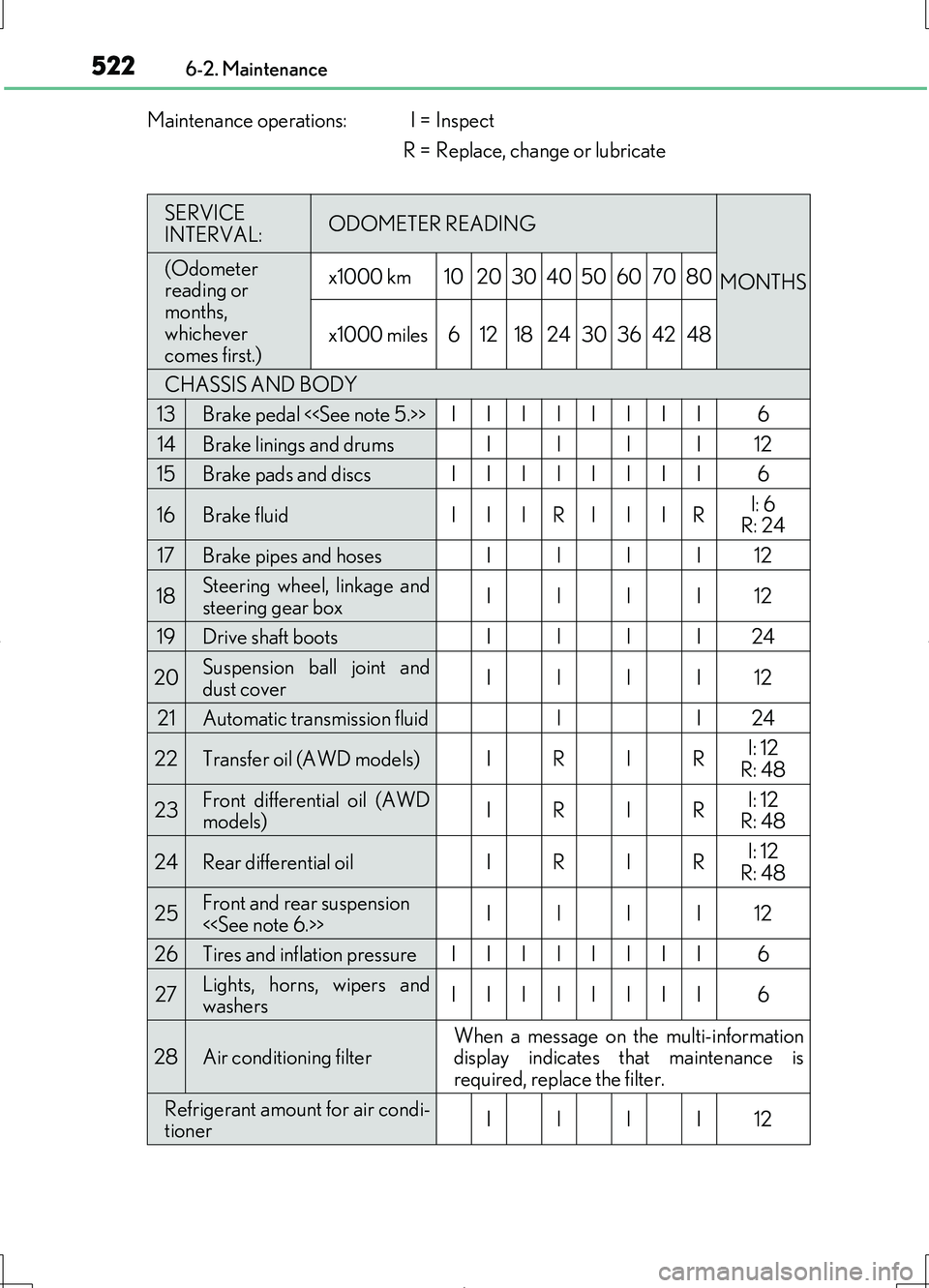
CHASSIS AND BODY
13Brake pedal <
14Brake linings and drumsIIII12
15Brake pads and discsIIIIIIII6
16Brake fluidIIIRIIIRI: 6
R: 24
17Brake pipes and hosesIIII12
18Steering wheel, linkage and
steering gear boxIIII12
19Drive shaft bootsIIII24
20Suspension ball joint and
dust coverIIII12
21Automatic transmission fluidII24
22Transfer oil (AWD models)IRIRI: 12
R: 48
23Front differential oil (AWD
models)IRIRI: 12
R: 48
24Rear differential oilIRIRI: 12
R: 48
25Front and rear suspension
<
26Tires and inflation pressureIIIIIIII6
27Lights, horns, wipers and
washersIIIIIIII6
28Air conditioning filter
When a message on the multi-information
display indicates that maintenance is
required, replace the filter.
Refrigerant amount for air condi-
tionerIIII12
Maintenance operations:I =Inspect
R =Replace, change or lubricate
SERVICE
INTERVAL:ODOMETER READING
MONTHS(Odometer
reading or
months,
whichever
comes first.)
x1000 km1020304050607080
x1000 miles612182430364248
Page 529 of 708
5296-2. Maintenance
6
Maintenance and care
LS460/LS460L_GE (OM50G06E)
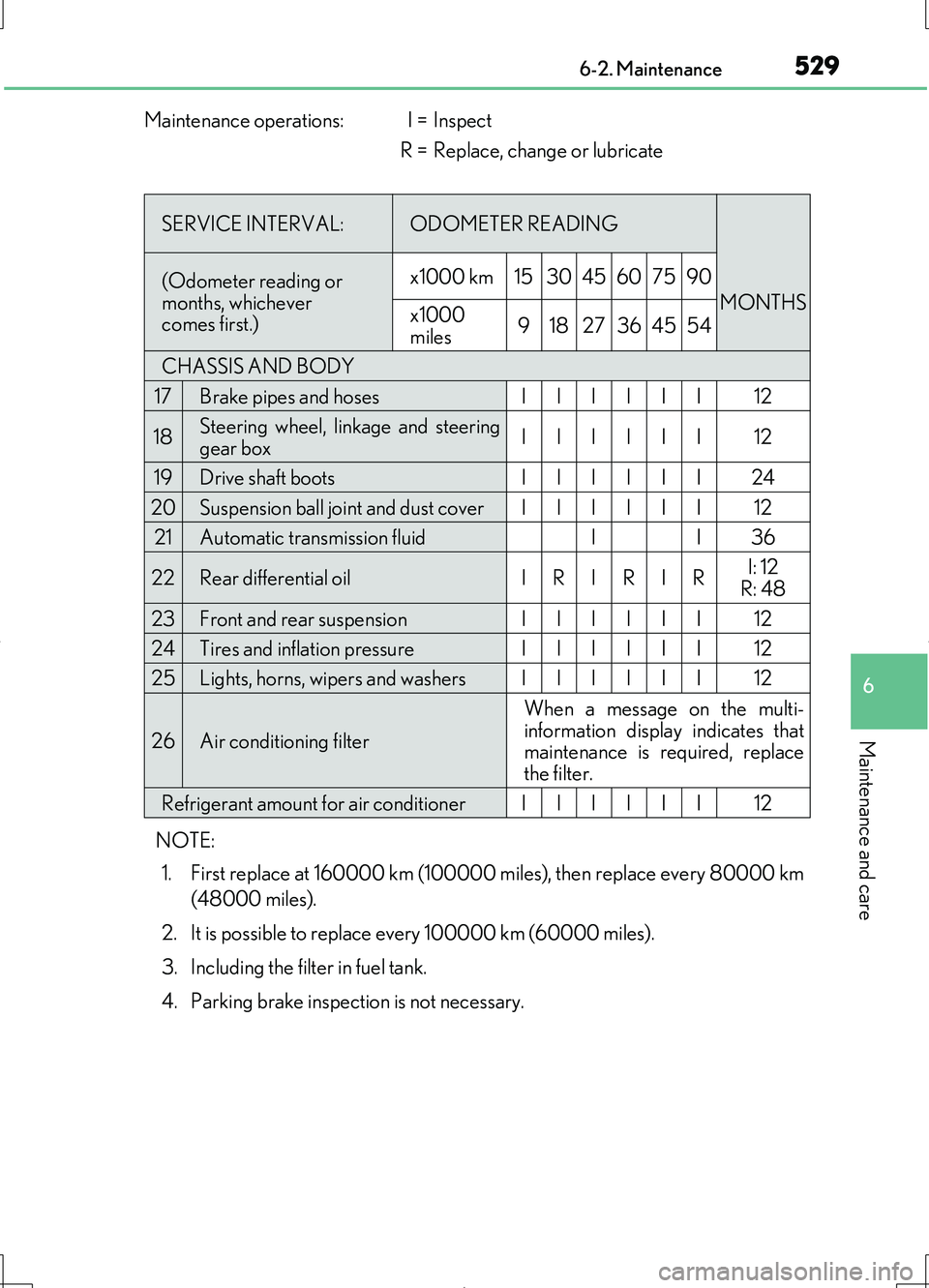
NOTE:
1. First replace at 160000 km (100000 miles), then replace every 80000 km
(48000 miles).
2. It is possible to replace every 100000 km (60000 miles).
3. Including the filter in fuel tank.
4. Parking brake inspection is not necessary.
CHASSIS AND BODY
17Brake pipes and hosesIIIIII12
18Steering wheel, linkage and steering
gear boxIIIIII12
19Drive shaft bootsIIIIII24
20Suspension ball joint and dust coverIIIIII12
21Automatic transmission fluidII36
22Rear differential oilIRIRIRI: 12
R: 48
23Front and rear suspensionIIIIII12
24Tires and inflation pressureIIIIII12
25Lights, horns, wipers and washersIIIIII12
26Air conditioning filter
When a message on the multi-
information display indicates that
maintenance is required, replace
the filter.
Refrigerant amount for air conditionerIIIIII12
Maintenance operations:I =Inspect
R =Replace, change or lubricate
SERVICE INTERVAL:ODOMETER READING
(Odometer reading or
months, whichever
comes first.)
x1000 km153045607590
MONTHSx1000
miles91827364554
Page 558 of 708
5586-3. Do-it-yourself maintenance
LS460/LS460L_GE (OM50G06E)
Your vehicle is equipped with a tire pressure warning system that uses tire
pressure warning valves and transmitters to detect low tire inflation pres-
sure before serious problems arise.
●If the tire pressure drops below a predetermined level, the driver is
warned by a screen display and a warning light. ( P. 609, 614)
◆Installing tire pressure wa rning valves and transmitters
When replacing tires or wheels, tire pressure warning valves and trans-
mitters must also be installed.
When new tire pressure warning valves and transmitters are installed,
new ID codes must be registered in the tire pressure warning computer
and the tire pressure warning system must be initialized. Have tire pres-
sure warning valve and transmitter ID codes registered by your Lexus
dealer. ( P. 560)
◆Initializing the tire pressure warning system
■The tire pressure warning system must be initialized in the following
circumstances:
●When rotating the tires.
●When the tire inflation pressure is changed such as when changing
traveling speed. ( P. 660, 662)
●When changing the tire size.
When the tire pressure warning system is initialized, the current tire
inflation pressure is set as the benchmark pressure.
Tire pressure warning system (if equipped)
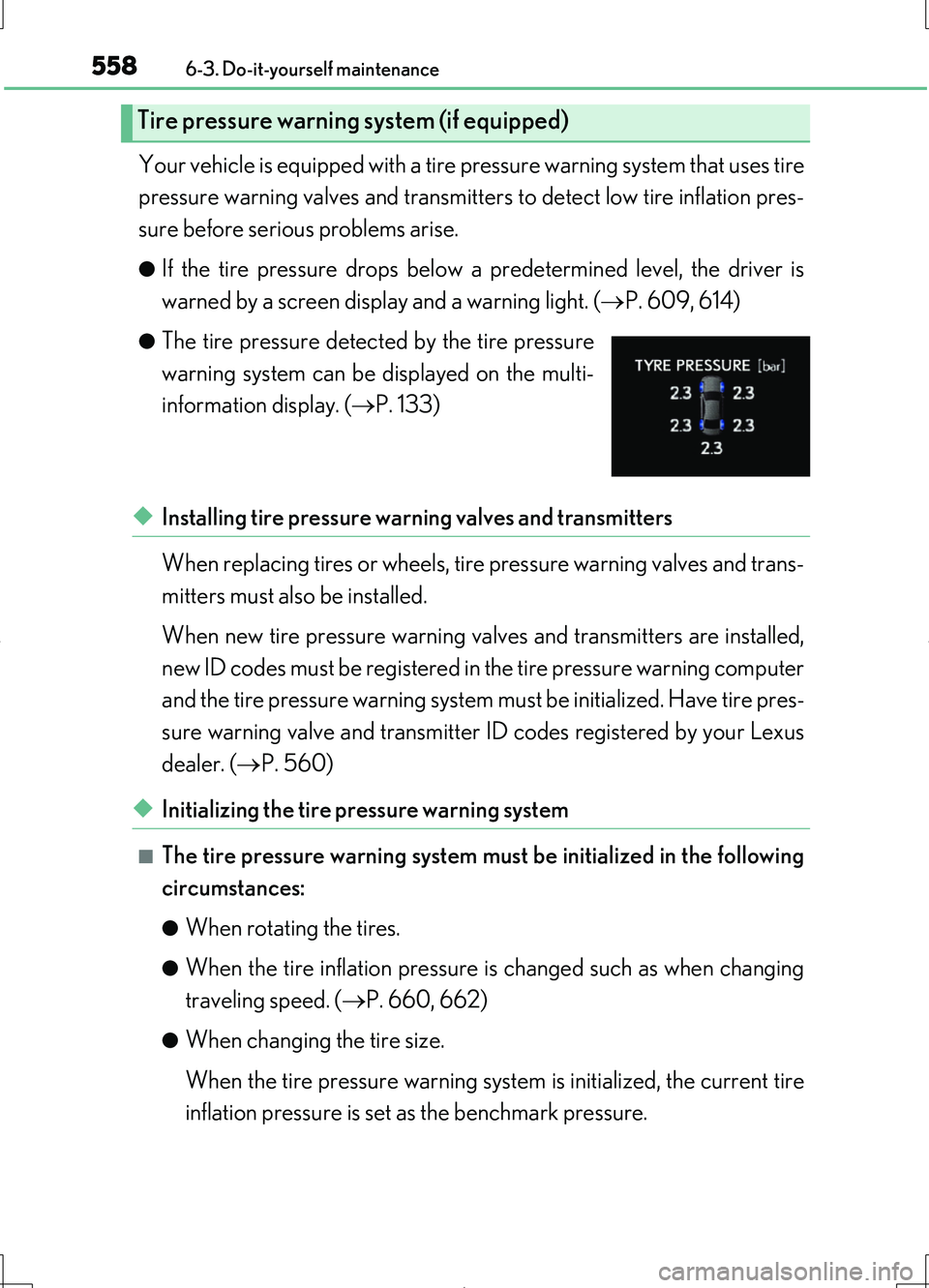
●The tire pressure detected by the tire pressure
warning system can be displayed on the multi-
information display. ( P. 133)