wheel LEXUS LS500 2018 Owners Manual
[x] Cancel search | Manufacturer: LEXUS, Model Year: 2018, Model line: LS500, Model: LEXUS LS500 2018Pages: 514, PDF Size: 10.62 MB
Page 430 of 514
430 7-2. Steps to take in an emergency
LS500_OM_OM50F54U_(U) In some situations, the master warning light and warning buzzer may not oper-
ate as specified. In this case, follow the instructions displayed in the warning
message.
If a warning light comes on or flashes at the same time that a warning message is
displayed, take corrective actio n according to the warning light. ( → P.418)*
: A buzzer sounds the first time a message is shown on the multi-information display.
■
Warning messages
The warning messages explained below
may differ from the actual messages
according to operation conditions and vehi-
cle specifications. ■
Warning buzzer
In some cases, the bu zzer may not be heard
due to being in a noisy location or audio
sound. ■
If “Engine Oil Level Low Add or
Replace” is displayed
The engine oil level is low. Check the level
of the engine oil, and add if necessary.
This message may appear if the vehicle is
stopped on a slope. Move the vehicle to a
level surface and check to see if the mes-
sage disappears.
■
If “Engine Stoppe d Steering Power
Low” is displayed
This message is displa yed if the engine is
stopped while driving.
When steering wheel operations are
heavier than usual, grip the steering wheel
firmly and operate it using more force than
usual. ■
If “Auto Power Off to Conserve Battery”
is displayed
Power was turned off due to the automatic
power off function. Next time when starting
the engine, increase the engine speed
slightly and maintain that level for approxi-
mately 5 minutes to recharge the battery. ■
If “Headlight System Malfunction Visit
Your Dealer” is displayed
The following systems may be malfunction-
ing. Have the vehicle inspected by your
Lexus dealer immediately. ●
The LED headlight system ●
AFS (Adaptive Front-lighting System) ●
The automatic headlight leveling system ●
AHB (Automatic High Beam)
■
If “Front Camera Unav ailable” or “Front
Camera Unavailable Remove Debris
On Windshield” is displayed
The following systems may be suspended
until the problem shown in the message is
resolved. ( → P.210, 217, 424)
●
PCS (Pre-Collision system)
●
LTA (Lane Tracing Assist) (if equipped)
●
LKA (Lane Keeping Assist) (if equipped)
●
Dynamic radar cruise control with
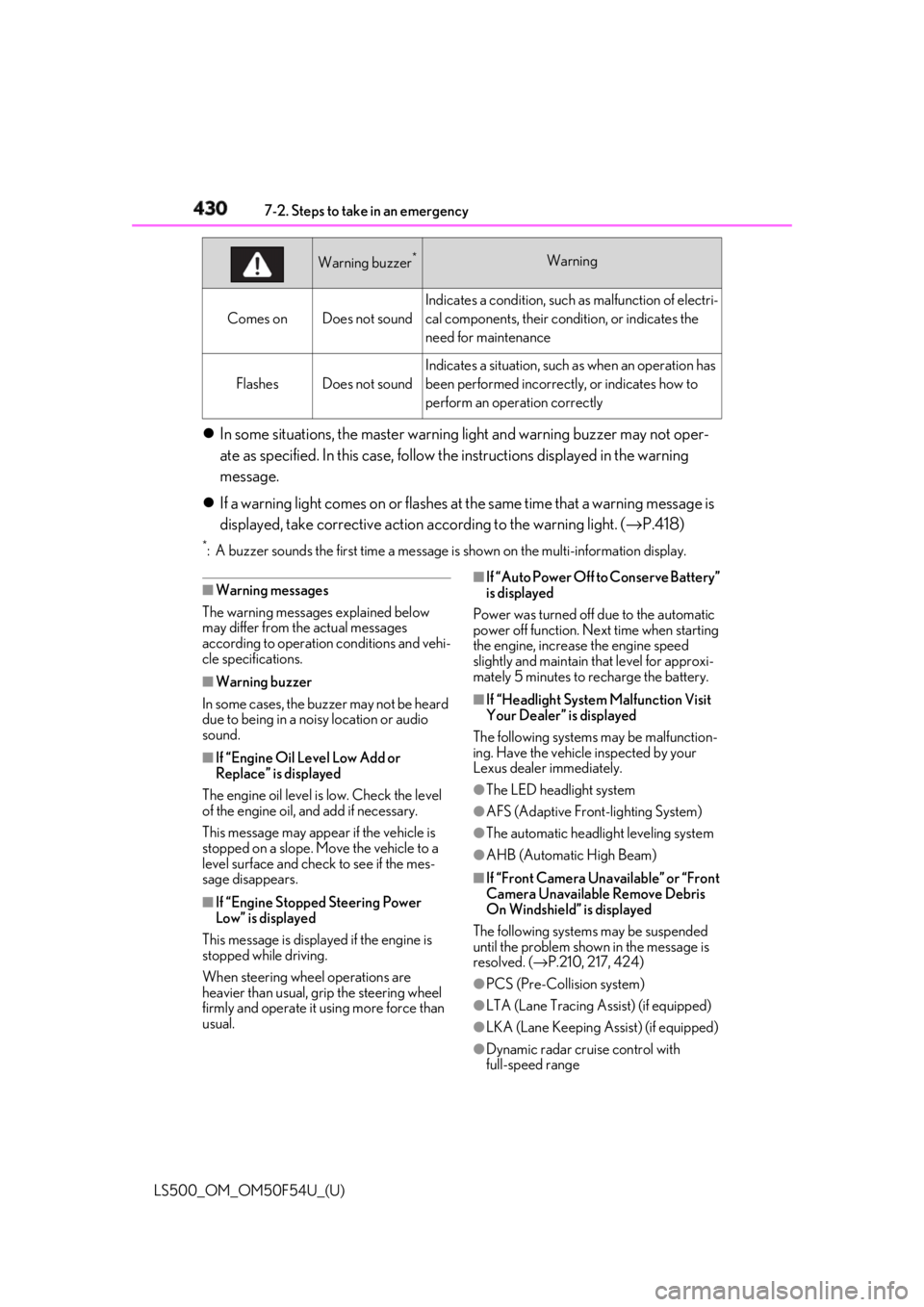
full-speed rangeComes on Does not sound Indicates a condition, such as malfunction of electri-
cal components, their cond ition, or indicates the
need for maintenance
Flashes Does not sound Indicates a situation, such as when an operation has
been performed incorrectly, or indicates how to
perform an operation correctlyWarning buzzer *
Warning
Page 433 of 514
4337-2. Steps to take in an emergency
LS500_OM_OM50F54U_(U) 7
When trouble arises One of the following may be the cause
of the problem:
There may not be sufficient fuel in
the vehicle’s tank.
Refuel the vehicle.
The engine may be flooded.
Try to restart the engine again fol-
lowing correct starting procedures.
( → P.160)
There may be a malfunction in the
engine immobilizer system.
( → P.58)
There may be a malfunction in the
shift control system. *
( → P.163, 431) *
: It may not be possible to shift the shift
position from P.
One of the following may be the cause
of the problem:
The battery may be discharged. NOTICE■
When replacing the tires
When removing or fitting the wheels,
tires or the tire pressure warning valve
and transmitter, contact your Lexus
dealer as the tire pr essure warning valve
and transmitter may be damaged if not
handled correctly. ■
When driving over bumps
If a vehicle has a flat tire, the vehicle
height will be lower than usual. Ensure
that nothing strikes the bottom of the
vehicle. ■
To avoid damage to the tire pressure
warning valves and transmitters
When a tire is repaired with liquid seal-
ants, the tire pressu re warning valve and
transmitter may not operate properly. If a
liquid sealant is used , contact your Lexus
dealer or other qualified service shop as
soon as possible. Make sure to replace
the tire pressure warning valve and trans-
mitter when replacing the tire. ( → P.392) If the engine will not start If the engine will not start even
though correct starting procedures
are being followed ( → P.160), con-
sider each of the following points:
The engine will not start even
though the starter motor oper-
ates normally.
The starter motor turns over
slowly, the interior lights and
headlights are dim, or the horn
does not sound or sounds at a low
volume.
Page 446 of 514
446 7-2. Steps to take in an emergency
LS500_OM_OM50F54U_(U) 1 Stop the engine. Set the parking
brake and shift the shift position to
P.
2 Remove the mud, snow or sand
from around the rear wheels.
3 Place wood, stones or some other
material under the rear wheels to
help provide traction.
4 Restart the engine.
5 Shift the shift position to D or R and
release the parking brake. Then,
while exercising caution, depress
the accelerator pedal. ■
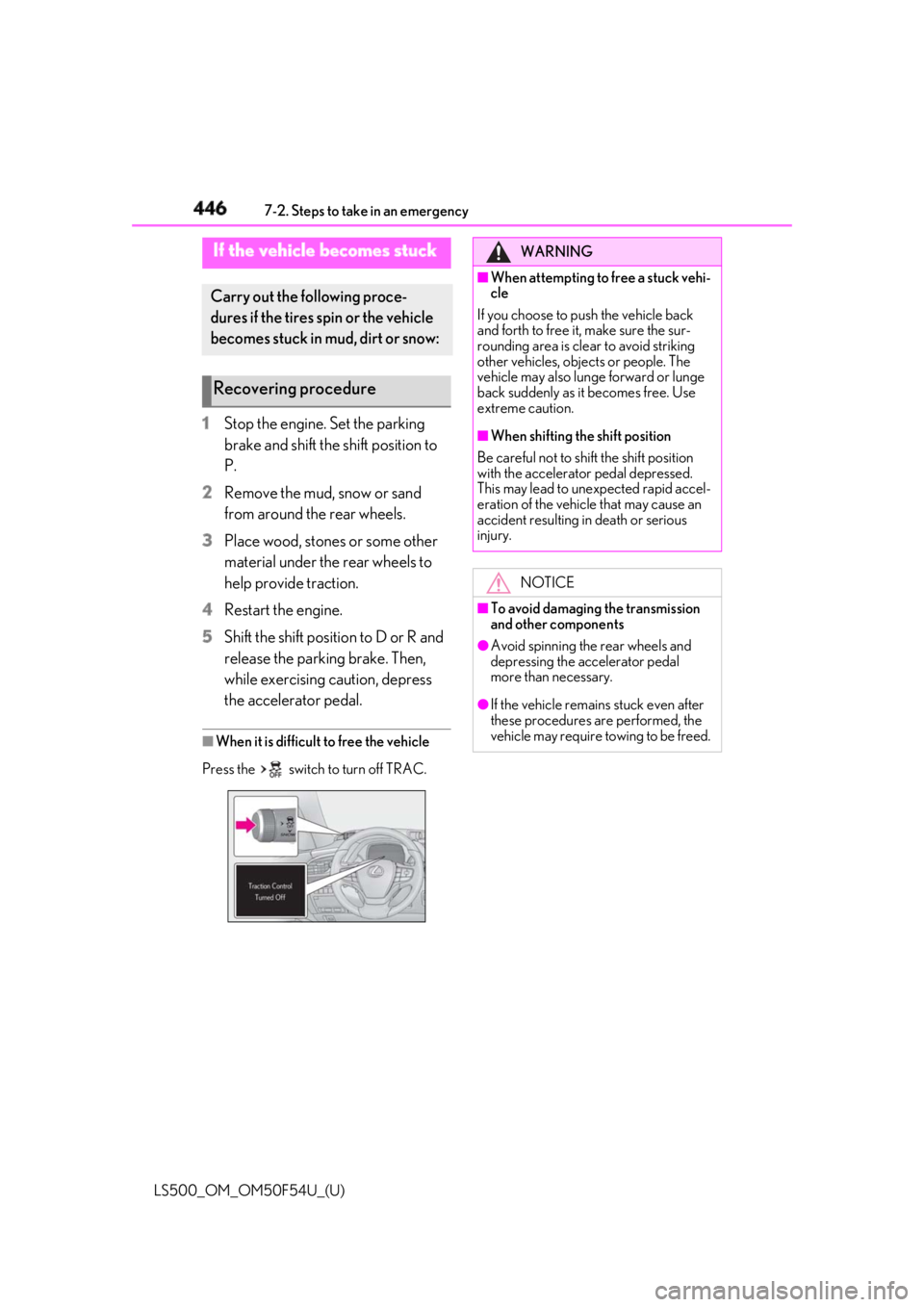
When it is difficult to free the vehicle
Press the switch to turn off TRAC.If the vehicle becomes stuck Carry out the following proce-
dures if the tires spin or the vehicle
becomes stuck in mud, dirt or snow:
Recovering procedure WARNING■
When attempting to free a stuck vehi-
cle
If you choose to push the vehicle back
and forth to free it, make sure the sur-
rounding area is clear to avoid striking
other vehicles, obje cts or people. The
vehicle may also lunge forward or lunge
back suddenly as it becomes free. Use
extreme caution. ■
When shifting the shift position
Be careful not to shift the shift position
with the accelerator pedal depressed.
This may lead to un expected rapid accel-
eration of the vehicle that may cause an
accident resulting in death or serious
injury.
NOTICE■
To avoid damaging the transmission
and other components ●
Avoid spinning the rear wheels and
depressing the accelerator pedal
more than necessary. ●
If the vehicle remains stuck even after
these procedures are performed, the
vehicle may require towing to be freed.
Page 450 of 514
448 8-1. Specifications
LS500_OM_OM50F54U_(U) 8-1.Specifications
*1
: Unladen vehicles *2
: Without electronically modulated air suspension *3
: With electronically mo dulated air suspension*4
:Except F SPORT models *5
:F SPORT models
■
Vehicle identification number
The vehicle identification number
(VIN) is the legal identifier for your
vehicle. This is the primary identifica-
tion number for your Lexus. It is used in
registering the ownership of your vehi-
cle.
This number is stamped on the top left of the instrument panel.Maintenance data (fue l, oil level, etc.)
Dimensions and weight Overall length 206.1 in. (5235 mm)
Overall width 74.8 in. (1900 mm)
Overall height *1
2WD models 57.5 in. (1460 mm) *2
57.1 in. (1450 mm) *3
AWD models 57.9 in. (1470 mm) *2
57.5 in. (1460 mm) *3
Wheelbase 123.0 in. (3125 mm)
Tread *1
Front 2WD models 64.2 in. (1630 mm)
AWD models 64.2 in. (1630 mm) *2
64.4 in. (1635 mm) *3
Rear 64.4 in. (1635 mm) *4
63.6 in. (1615 mm) *5
Vehicle capacity weight
(Occupants + luggage) 870 lb. (395 kg)
Vehicle identification
Page 456 of 514
454 8-1. Specifications
LS500_OM_OM50F54U_(U) warning light is illuminated, refer to P.418.) *2
: Make sure to confirm that the brake warning light (yellow) does not illuminate. (If the
brake warning light illuminates, refer to P.418.) *3
: Vehicles without Lexus Safety System+A *4
: Vehicles with Lexus Safety System+A
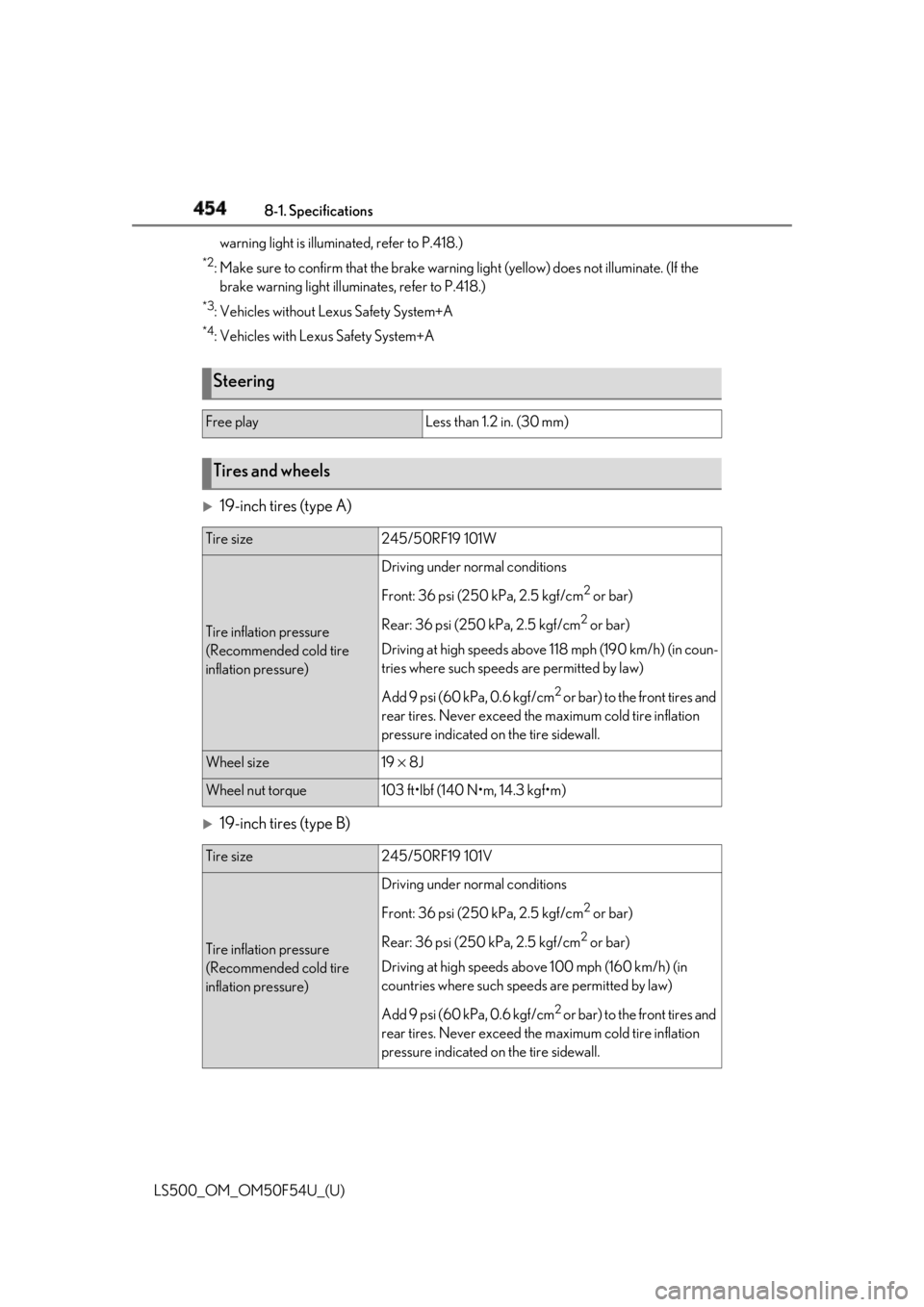
19-inch tires (type A)
19-inch tires (type B)Steering Free play Less than 1.2 in. (30 mm)
Tires and wheels Tire size 245/50RF19 101W
Tire inflation pressure
(Recommended cold tire
inflation pressure) Driving under normal conditions
Front: 36 psi (250 kPa, 2.5 kgf/cm 2
or bar)
Rear: 36 psi (250 kPa, 2.5 kgf/cm 2
or bar)
Driving at high speeds above 118 mph (190 km/h) (in coun-
tries where such speeds are permitted by law)
Add 9 psi (60 kPa, 0.6 kgf/cm 2
or bar) to the front tires and
rear tires. Never exceed the maximum cold tire inflation
pressure indicated on the tire sidewall.
Wheel size 19 × 8J
Wheel nut torque 103 ft•lbf (140 N•m, 14.3 kgf•m)
Tire size 245/50RF19 101V
Tire inflation pressure
(Recommended cold tire
inflation pressure) Driving under normal conditions
Front: 36 psi (250 kPa, 2.5 kgf/cm 2
or bar)
Rear: 36 psi (250 kPa, 2.5 kgf/cm 2
or bar)
Driving at high speeds above 100 mph (160 km/h) (in
countries where such speeds are permitted by law)
Add 9 psi (60 kPa, 0.6 kgf/cm 2
or bar) to the front tires and
rear tires. Never exceed the maximum cold tire inflation
pressure indicated on the tire sidewall.
Page 457 of 514
4558-1. Specifications
LS500_OM_OM50F54U_(U) 8
Vehicle specifications
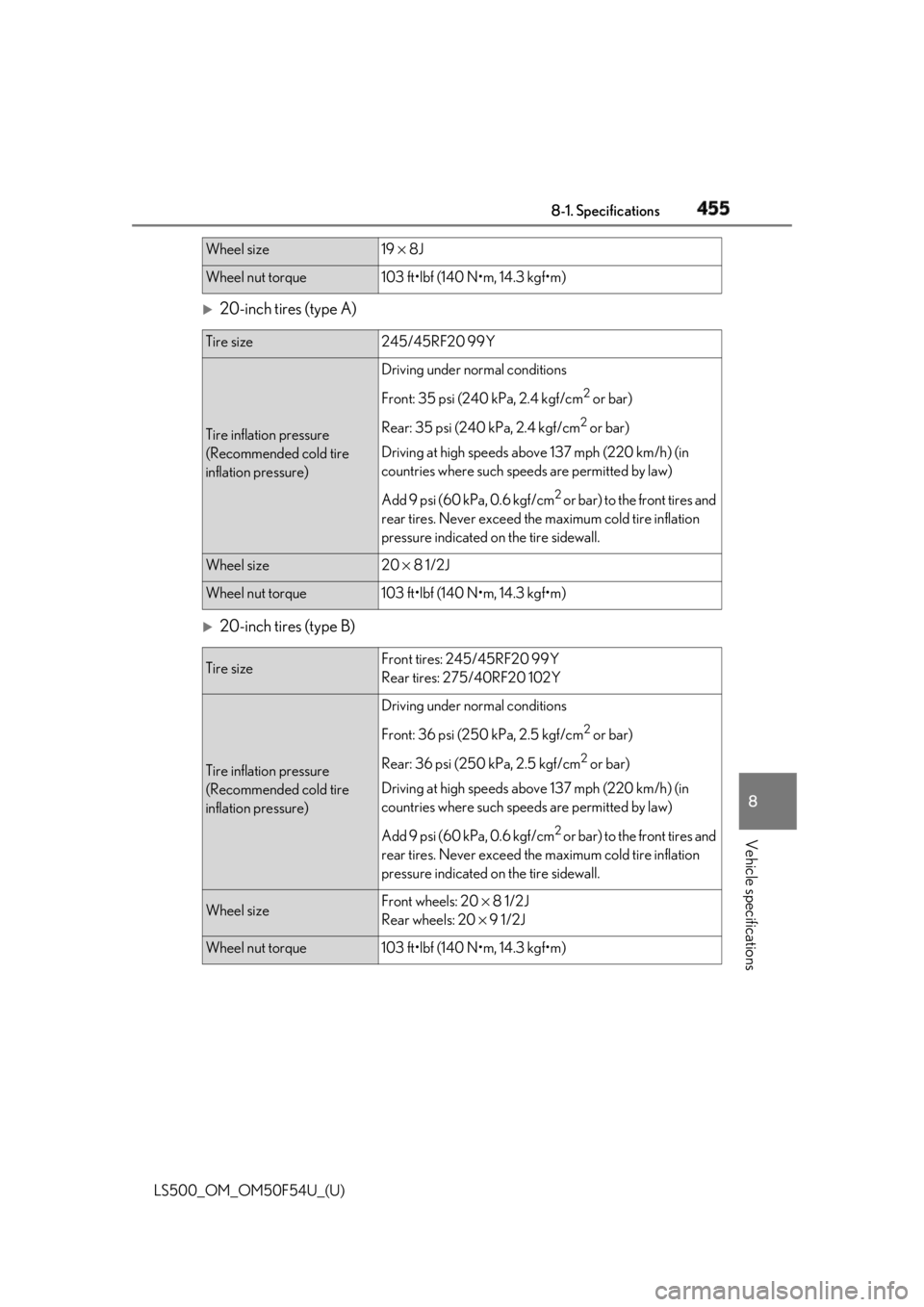
20-inch tires (type A)
20-inch tires (type B) Wheel size 19 × 8J
Wheel nut torque 103 ft•lbf (140 N•m, 14.3 kgf•m)
Tire size 245/45RF20 99Y
Tire inflation pressure
(Recommended cold tire
inflation pressure) Driving under normal conditions
Front: 35 psi (240 kPa, 2.4 kgf/cm 2
or bar)
Rear: 35 psi (240 kPa, 2.4 kgf/cm 2
or bar)
Driving at high speeds above 137 mph (220 km/h) (in
countries where such speeds are permitted by law)
Add 9 psi (60 kPa, 0.6 kgf/cm 2
or bar) to the front tires and
rear tires. Never exceed the maximum cold tire inflation
pressure indicated on the tire sidewall.
Wheel size 20 × 8 1/2J
Wheel nut torque 103 ft•lbf (140 N•m, 14.3 kgf•m)
Tire size Front tires: 245/45RF20 99Y
Rear tires: 275/40RF20 102Y
Tire inflation pressure
(Recommended cold tire
inflation pressure) Driving under normal conditions
Front: 36 psi (250 kPa, 2.5 kgf/cm 2
or bar)
Rear: 36 psi (250 kPa, 2.5 kgf/cm 2
or bar)
Driving at high speeds above 137 mph (220 km/h) (in
countries where such speeds are permitted by law)
Add 9 psi (60 kPa, 0.6 kgf/cm 2
or bar) to the front tires and
rear tires. Never exceed the maximum cold tire inflation
pressure indicated on the tire sidewall.
Wheel size Front wheels: 20 × 8 1/2J
Rear wheels: 20 × 9 1/2J
Wheel nut torque 103 ft•lbf (140 N•m, 14.3 kgf•m)
Page 458 of 514
456 8-1. Specifications
LS500_OM_OM50F54U_(U)
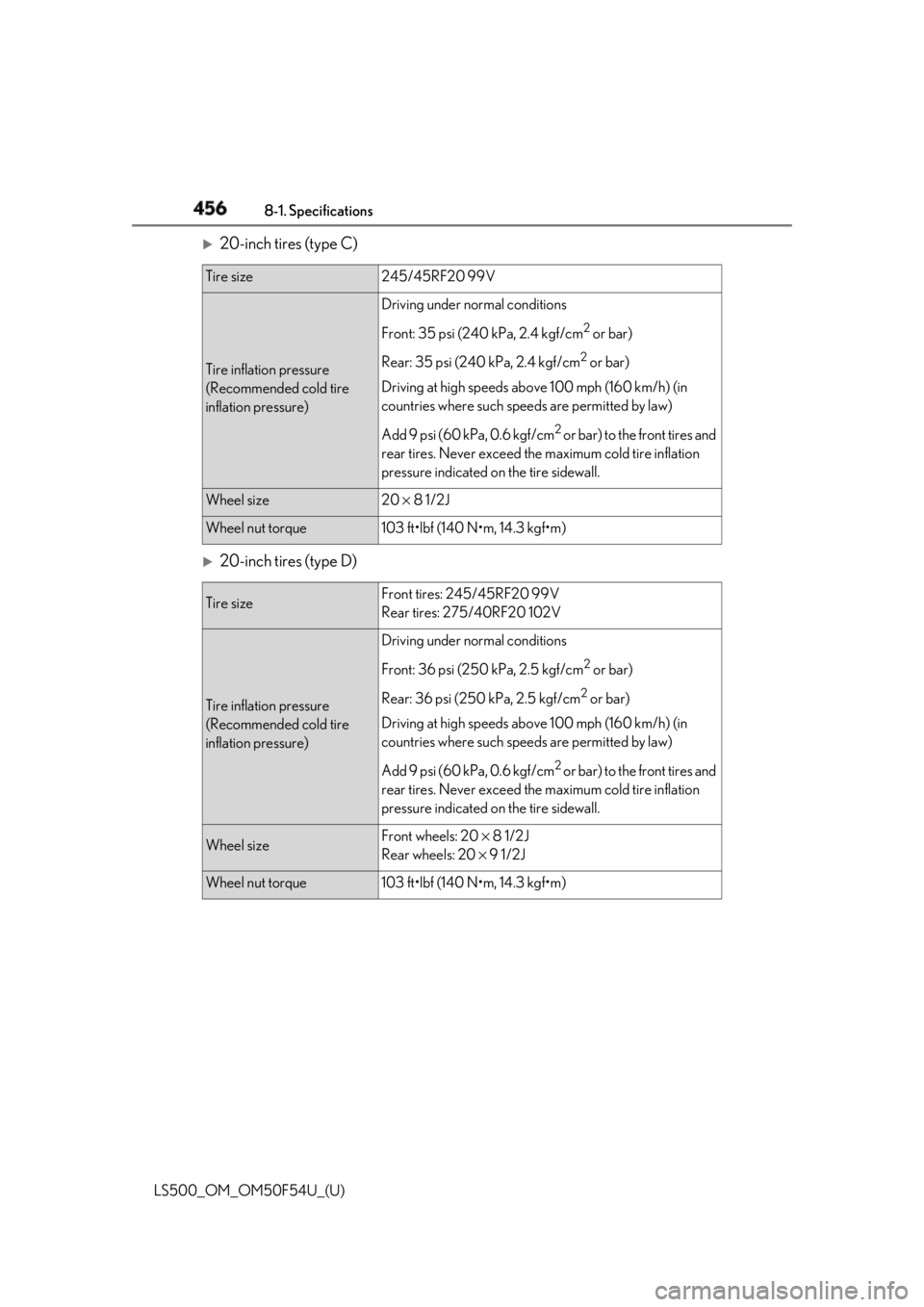
20-inch tires (type C)
20-inch tires (type D) Tire size 245/45RF20 99V
Tire inflation pressure
(Recommended cold tire
inflation pressure) Driving under normal conditions
Front: 35 psi (240 kPa, 2.4 kgf/cm 2
or bar)
Rear: 35 psi (240 kPa, 2.4 kgf/cm 2
or bar)
Driving at high speeds above 100 mph (160 km/h) (in
countries where such speeds are permitted by law)
Add 9 psi (60 kPa, 0.6 kgf/cm 2
or bar) to the front tires and
rear tires. Never exceed the maximum cold tire inflation
pressure indicated on the tire sidewall.
Wheel size 20 × 8 1/2J
Wheel nut torque 103 ft•lbf (140 N•m, 14.3 kgf•m)
Tire size Front tires: 245/45RF20 99V
Rear tires: 275/40RF20 102V
Tire inflation pressure
(Recommended cold tire
inflation pressure) Driving under normal conditions
Front: 36 psi (250 kPa, 2.5 kgf/cm 2
or bar)
Rear: 36 psi (250 kPa, 2.5 kgf/cm 2
or bar)
Driving at high speeds above 100 mph (160 km/h) (in
countries where such speeds are permitted by law)
Add 9 psi (60 kPa, 0.6 kgf/cm 2
or bar) to the front tires and
rear tires. Never exceed the maximum cold tire inflation
pressure indicated on the tire sidewall.
Wheel size Front wheels: 20 × 8 1/2J
Rear wheels: 20 × 9 1/2J
Wheel nut torque 103 ft•lbf (140 N•m, 14.3 kgf•m)
Page 462 of 514
460 8-1. Specifications
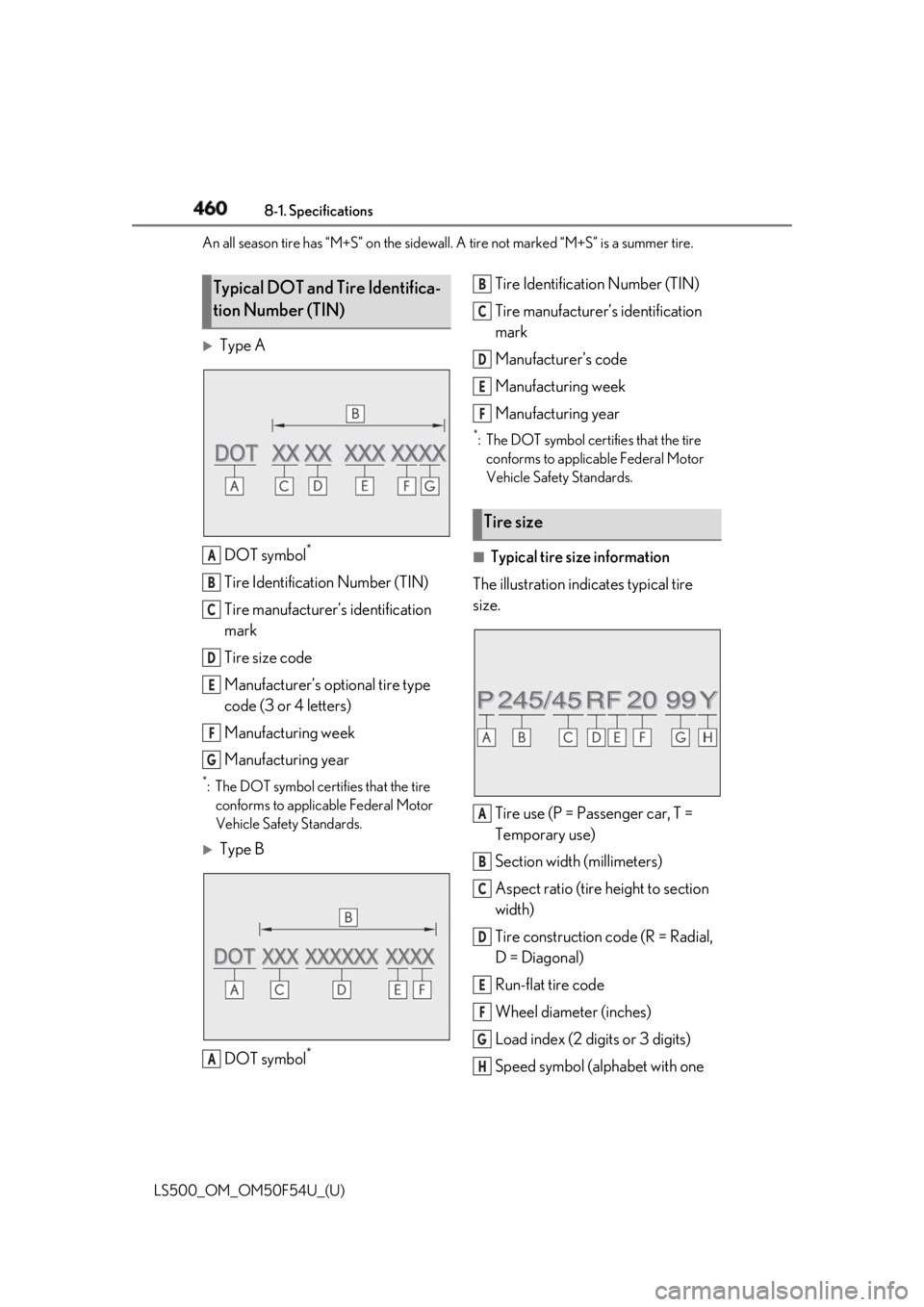
LS500_OM_OM50F54U_(U) An all season tire has “M+S” on the sidewall. A tire not marked “M+S” is a summer tire.
Type A
DOT symbol *
Tire Identification Number (TIN)
Tire manufacturer’s identification
mark
Tire size code
Manufacturer’s optional tire type
code (3 or 4 letters)
Manufacturing week
Manufacturing year *
:The DOT symbol cert ifies that the tire
conforms to applicable Federal Motor
Vehicle Safety Standards.
Type B
DOT symbol * Tire Identification Number (TIN)
Tire manufacturer’s identification
mark
Manufacturer’s code
Manufacturing week
Manufacturing year *
: The DOT symbol certifies that the tire
conforms to applicable Federal Motor
Vehicle Safety Standards.
■
Typical tire size information
The illustration indicates typical tire
size.
Tire use (P = Passenger car, T =
Temporary use)
Section width (millimeters)
Aspect ratio (tire height to section
width)
Tire construction code (R = Radial,
D = Diagonal)
Run-flat tire code
Wheel diameter (inches)
Load index (2 digits or 3 digits)
Speed symbol (alphabet with one Typical DOT and Tire Identifica-
tion Number (TIN)
A
B
C
D
E
F
G
A Tire size B
C
D
E
F
A
B
C
D
E
F
G
H
Page 463 of 514
4618-1. Specifications
LS500_OM_OM50F54U_(U) 8
Vehicle specifications letter) ■
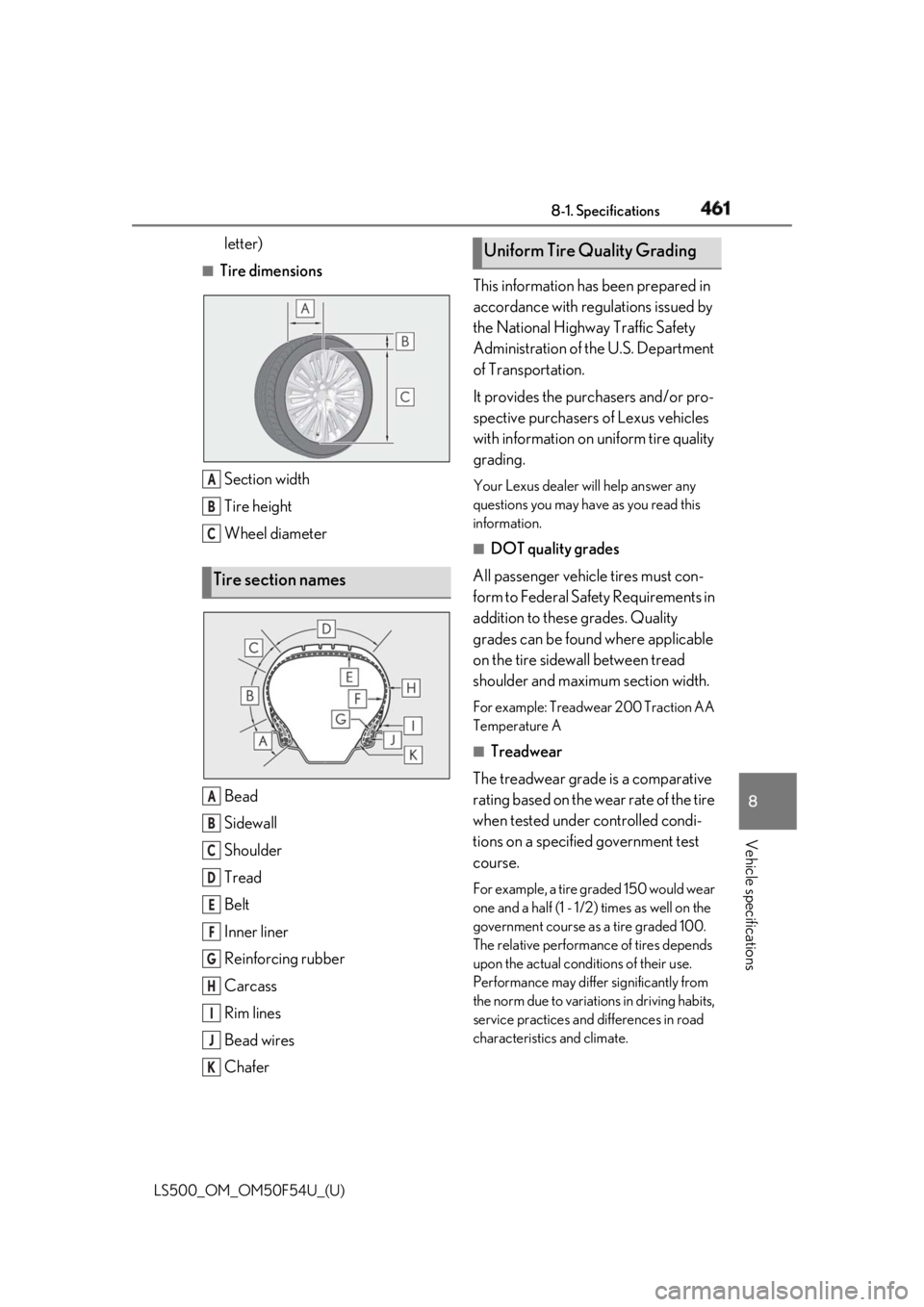
Tire dimensions
Section width
Tire height
Wheel diameter
Bead
Sidewall
Shoulder
Tread
Belt
Inner liner
Reinforcing rubber
Carcass
Rim lines
Bead wires
Chafer This information has been prepared in
accordance with regulations issued by
the National Highway Traffic Safety
Administration of the U.S. Department
of Transportation.
It provides the purchasers and/or pro-
spective purchasers of Lexus vehicles
with information on uniform tire quality
grading. Your Lexus dealer will help answer any
questions you may have as you read this
information. ■
DOT quality grades
All passenger vehicle tires must con-
form to Federal Safety Requirements in
addition to these grades. Quality
grades can be found where applicable
on the tire sidewall between tread
shoulder and maximum section width. For example: Treadwear 200 Traction AA
Temperature A ■
Treadwear
The treadwear grade is a comparative
rating based on the wear rate of the tire
when tested under controlled condi-
tions on a specified government test
course. For example, a tire graded 150 would wear
one and a half (1 - 1/2) times as well on the
government course as a tire graded 100.
The relative performa nce of tires depends
upon the actual conditions of their use.
Performance may differ significantly from
the norm due to variatio ns in driving habits,
service practices and differences in road
characteristics and climate.Tire section names A
B
C
A
B
C
D
E
F
G
H
I
J
K Uniform Tire Quality Grading
Page 464 of 514
462 8-1. Specifications
LS500_OM_OM50F54U_(U) ■
Traction AA, A, B, C
The traction grades, from highest to
lowest, are AA, A, B and C, and they
represent the tire’s ability to stop on
wet pavement as measured under con-
trolled conditions on specified govern-
ment test surfaces of asphalt and
concrete. A tire marked C may have poor traction
performance.
Warning: The traction grade assigned to
this tire is based on braking (straight
ahead) traction tests and does not include
cornering (turning) traction. ■
Temperature A, B, C
The temperature grades are A (the
highest), B, and C, representing the
tire’s resistance to the generation of
heat and its ability to dissipate heat when tested under controlled condi-
tions on a specified indoor laboratory
test wheel. Sustained high temperature can cause the
material of the tire to degenerate and
reduce tire life, and excessive temperature
can lead to sudd en tire failure.
Grade C corresponds to a level of perfor-
mance which all passenger car tires must
meet under the Fede ral Motor Vehicle
Safety Standard No. 109.
Grades B and A represent higher levels of
performance on the laboratory test wheel
than the minimum required by law.
Warning: The temperature grades of a tire
assume that it is prop erly inflated and not
overloaded.
Excessive speed, unde rinflation, or exces-
sive loading, either separately or in combi-
nation, can cause heat buildup and
possible tire failure.
Glossary of tire terminology Tire related term Meaning
Cold tire inflation pressure Tire pressure when the vehicle has been parked for
three hours or more, or has not been driven more
than 1 mile or 1.5 km under that condition
Maximum inflation pressure The maximum cold inflated pressure to which a tire
may be inflated, shown on the sidewall of the tire
Recommended inflation pressure Cold tire inflation pressure recommended by a
manufacturer
Accessory weight The combined weight (in excess of those standard
items which may be replaced) of automatic trans-
mission, power steering, power brakes, power win-
dows, power seats, radio and heater, to the extent
that these items are available as factory-installed
equipment (whether installed or not)