air suspension LEXUS LS500 2018 User Guide
[x] Cancel search | Manufacturer: LEXUS, Model Year: 2018, Model line: LS500, Model: LEXUS LS500 2018Pages: 514, PDF Size: 10.62 MB
Page 294 of 514
294 4-5. Using the driving support systems
LS500_OM_OM50F54U_(U) ■
ECB (Electronically Controlled
Brake System) (if equipped)
The electronically controlled system
generates braking force correspond-
ing to the brake operation ■
ABS (Anti-lock Brake System)
Helps to prevent wheel lock when the
brakes are applied suddenly, or if the
brakes are applied while driving on a
slippery road surface ■
Brake assist
Generates an increased level of brak-
ing force after the brake pedal is
depressed when the system detects a
panic stop situation ■
VSC (Vehicle Stability Control)
Helps the driver to control skidding
when swerving sudden ly or turning on
slippery road surfaces. ■
Secondary Collision Brake
When the airbag sensor detects a colli-
sion, the brakes and brake lights are
automatically controlled to reduce the vehicle speed and that helps reduce
the possibility of further damage due to
a secondary collision. ■
TRAC (Traction Control)
Helps to maintain drive power and pre-
vent the drive wheels from spinning
when starting the vehicle or accelerat-
ing on slippery roads ■
Hill-start assist control
Helps to reduce the backward move-
ment of the vehicle when starting on an
uphill ■
VGRS (Variable Gear Ratio Steer-
ing) (if equipped)
Adjusts the front wheel turning angle in
accordance with the vehicle speed and
steering wheel movement ■
DRS (Dynamic Rear Steering) (if
equipped)
Contributes to the turning characteris-
tics and responsiveness of the vehicle
by adjusting the rear wheel angle of the
vehicle in accordance with steering
wheel movement. ■
EPS (Electric Power Steering)
Employs an electric motor to reduce
the amount of effort needed to turn the
steering wheel. ■
Active stabilizer suspension sys-
tem (if equipped)
Reduces sway when cornering accord-
ing to steering wheel movement in
order to maintain a stable vehicle pos-
ture.Driving assist systems To keep driving safety and perfor-
mance, the following systems oper-
ate automatically in response to
various driving situations. Be aware,
however, that these systems are
supplementary and should not be
relied upon too heavily when oper-
ating the vehicle.
Summary of the driving assist
systems
Page 299 of 514
2994-6. Driving tips
LS500_OM_OM50F54U_(U) 4
Driving 4-6.Driving tips
Use fluids that are appropriate to
the prevailing outside temperatures. •Engine oil
• Engine coolant
•Washer fluid
Have a service technician inspect
the condition of the battery.
Have the vehicle fitted with four
snow tires or purchase a set of tire
chains for the rear tires. *
Ensure that all tires are the specified size
and brand, and that chains match the size
of the tires. *
: Tire chains cannot be mounted on vehi-
cles with front and rear tires of differing
sizes.Winter driving tips Carry out the necessary prepara-
tions and inspections before driving
the vehicle in winter. Always drive
the vehicle in a manner appropriate
to the prevailing weather condi-
tions.
Preparation for winter
WARNING
■
Driving with snow tires
Observe the following precautions to
reduce the risk of accidents.
Failure to do so may result in a loss of
vehicle control and cause death or seri-
ous injury.
●
Use tires of the specified size.
●
Maintain the recommended level of air
pressure. ●
Do not drive in excess of 75 mph (120
km/h), regardless of the type of snow
tires being used. ●
Use snow tires on all, not just some
wheels. ■
When installing tire chains
Before installing tire chains, make sure to
disable all functions of the vehicle height
control of the electronically modulated
air suspension. Otherwise, the vehicle
height may change while installing the
tire chains and part or your body may be
caught under the vehicle, possibly caus-
ing injury. ( → P.293)■
Driving with tire chains
Observe the following precautions to
reduce the risk of accidents.
Failure to do so may result in the vehicle
being unable to be driven safely, and may
cause death or serious injury. ●
Do not drive in excess of the speed
limit specified for the tire chains being
used, or 30 mph (50 km/h), which-
ever is lower. ●
Avoid driving on bumpy road surfaces
or over potholes. ●
Avoid sudden acceleration, abrupt
steering, sudden br aking and shifting
operations that cause sudden engine
braking.
●
Slow down sufficiently before entering
a curve to ensure that vehicle control is
maintained.
●
Do not use LTA (Lane Tracing Assist)
system. (if equipped)
●
Do not use LKA (Lane-Keeping
Assist) system. (if equipped)
Page 362 of 514

362 6-1. Maintenance and care
LS500_OM_OM50F54U_(U) 6-1.Maintenance and care
Working from top to bottom, liber-
ally apply water to the vehicle body,
wheel wells and underside of the
vehicle to remove any dirt and dust.
Wash the vehicle body using a
sponge or soft cloth, such as a
chamois.
For hard-to-remove marks, use car
wash soap and rinse thoroughly with
water.
Wipe away any water.
Wax the vehicle when the water-
proof coating deteriorates. If water does not bead on a clean surface,
apply wax when the vehicle body is cool.
■
Self-restoring coat
The vehicle body has a self-restoring coat-
ing that is resistant to small surface
scratches caused in a car wash etc.
●
The coating lasts for 5 to 8 years from
when the vehicle is delivered from the
plant.
●
The restoration time differs depending on
the depth of the scratch and outside tem-
perature.
The restoration time may become
shorter when the coating is warmed by
applying warm water.
●
Deep scratches caused by keys, coins,
etc. cannot be restored.
●
Do not use wax that contains abrasives. ■
Automatic car washes ●
Before washing the vehicle:
• Fold the mirrors
• Turn off the power trunk opener and
closer (if equipped)
Start washing from the front of the vehicle.
Extend the mirrors before driving.●
Brushes used in automatic car washes
may scratch the vehicl e surface and harm
your vehicle’s paint. ■
High pressure car washes ●
Do not allow the nozzles of the car wash
to come within close proximity of the win-
dows and the air suspension unit (if
equipped). ●
Before using the car wash, check that the
fuel filler door on your vehicle is closed
properly. ■
When using a car wash
If the door handle becomes wet while the
electronic key is within the effective range,
the door may lock and unlock repeatedly. In
that case, follow the following correction
procedures to wash the vehicle: ●
Place the key in a position 6 ft. (2 m) or
more separate from the vehicle while the
vehicle is being wash ed. (Take care to
ensure that the key is not stolen.) ●
Set the electronic key to battery-saving
mode to disable the smart access system
with push-button start. ( → P.108)■
Aluminum wheels ●
Remove any dirt immediately by using a
neutral detergent. ●
Wash detergent off with water immedi-
ately after use.
●
To protect the paint from damage, make
sure to observe the following precau-
tions.
• Do not use acidic, alkaline or abrasive
detergent
• Do not use hard brushes
• Do not use detergent on the wheels when
they are hot, such as after driving or park-
ing in hot weatherCleaning and protecting the
vehicle exterior Perform cleaning in a manner
appropriate to each component
and its material.
Cleaning instructions
Page 364 of 514
364 6-1. Maintenance and care
LS500_OM_OM50F54U_(U) WARNING■
Precaution regarding the front
bumper (vehicles with Lexus Safety
System+A)
If the paint of the fr ont bumper is chipped
or scratched, the Lexus Safety System+A
may not function correctly. If this occurs,
consult your Lexus dealer. ■
Precaution regarding the rear
bumper
If the paint of the rear bumper is chipped
or scratched, the fo llowing systems may
not function correctly. If this occurs, con-
sult your Lexus dealer. ●
Lexus Safety System+A (if equipped)●
BSM (if equipped)●
RCTA (if equipped)●
PKSB (if equipped)
NOTICE■
To prevent paint deterioration and
corrosion on the body and compo-
nents (aluminum wheels, etc.)●
Wash the vehicle immediately in the
following cases:
• After driving near the sea coast
• After driving on salted roads
• If coal tar or tree sap is present on the
paint surface
• If dead insects, in sect droppings or
bird droppings are present on the
paint surface
• After driving in an area contaminated
with soot, oily smoke, mine dust, iron
powder or chemical substances
• If the vehicle becomes heavily soiled
with dust or mud
• If liquids such as benzene and gasoline
are spilled on the paint surface ●
If the paint is chipped or scratched,
have it repaired immediately. ●
To prevent the wheels from corroding,
remove any dirt and store in a place
with low humidity when storing the
wheels. ■
Cleaning the exterior lights ●
Wash carefully. Do not use organic
substances or scrub with a hard brush.
This may damage the surfaces of the
lights. ●
Do not apply wax to the surfaces of the
lights.
Wax may cause damage to the lenses. ■
When using an automatic car wash
Set the wiper switch to the off position.
If the wiper switch is in “AUTO”, the wip-
ers may operate and the wiper blades
may be damaged. ■
When using a high pressure car wash ●
When washing the vehicle, do not
spray the camera or its surrounding
area directly with a high pressure
washer. Shock applied from high pres-
sure water may cause the device to not
operate normally. ●
Do not bring the nozzle tip close to
boots (rubber or re sin manufactured
cover), connectors or the following
parts. The parts may be damaged if
they come into contact with high-pres-
sure water.
• Traction related parts
•Steering parts
• Suspension parts
• Brake parts
Page 396 of 514
396 6-3. Do-it-yourself maintenance
LS500_OM_OM50F54U_(U) Stop the vehicle in a safe place on a
hard, flat surface.
Set the parking brake.
Shift the shift position to P.
Disabling the height control. (if
equipped) ( → P.293)
Stop the engine. ■
Jack and tools
As your vehicle is equipped with run-flat
tires, the following tools for replacing a tire
are not included with your vehicle. They can
be purchased at your Lexus dealer. ●
Wheel nut wrench●
Jack●
Jack handleReplacing the tire When raising your vehicle with a
jack, position the jack correctly.
Improper placement may damage
your vehicle or cause injury.
If necessary tire replacement
seems difficult to perform, contact
your Lexus dealer.
Before jacking up the vehicle WARNING■
Using the tire jack
Observe the following precautions.
Improper use of the tire jack may cause
the vehicle to suddenly fall off the jack,
leading to death or serious injury. ●
Do not use the tire jack for any pur-
pose other than replacing tires or
installing and removing tire chains. ●
Do not use other tire jacks for replac-
ing tires on this vehicle. ●
Put the jack properly in its jack point. ●
Do not put any part of your body under
the vehicle while it is supported by the
jack. ●
Do not start the engine or drive the
vehicle while the vehicle is supported
by the jack. ●
Do not raise the vehicle while some-
one is inside. ●
When raising the vehicle, do not put an
object on or under the jack. ●
Do not raise the vehicle to a height
greater than that required to replace
the tire. ●
Use a jack stand if it is necessary to get
under the vehicle. ●
Make sure to disable all functions of
the vehicle height control of the elec-
tronically modulated air suspension
and then stopping the engine.
( → P.293)●
When lowering the vehicle, make sure
that there is no-one near the vehicle. If
there are people nearby, warn them
vocally before lowering.
Page 412 of 514
412 7-2. Steps to take in an emergency
LS500_OM_OM50F54U_(U) 7-2.Steps to take in an emergency
If your vehicle needs to be
towed If towing is ne cessary, we recom-
mend having your vehicle towed by
your Lexus dealer or commercial
towing service, using a wheel-lift
type truck or flatbed truck.
Use a safety chain system for all
towing, and abide by all state/pro-
vincial and local laws. WARNING
Observe the following precautions.
Failure to do so may result in death or
serious injury. ■
When towing the vehicle
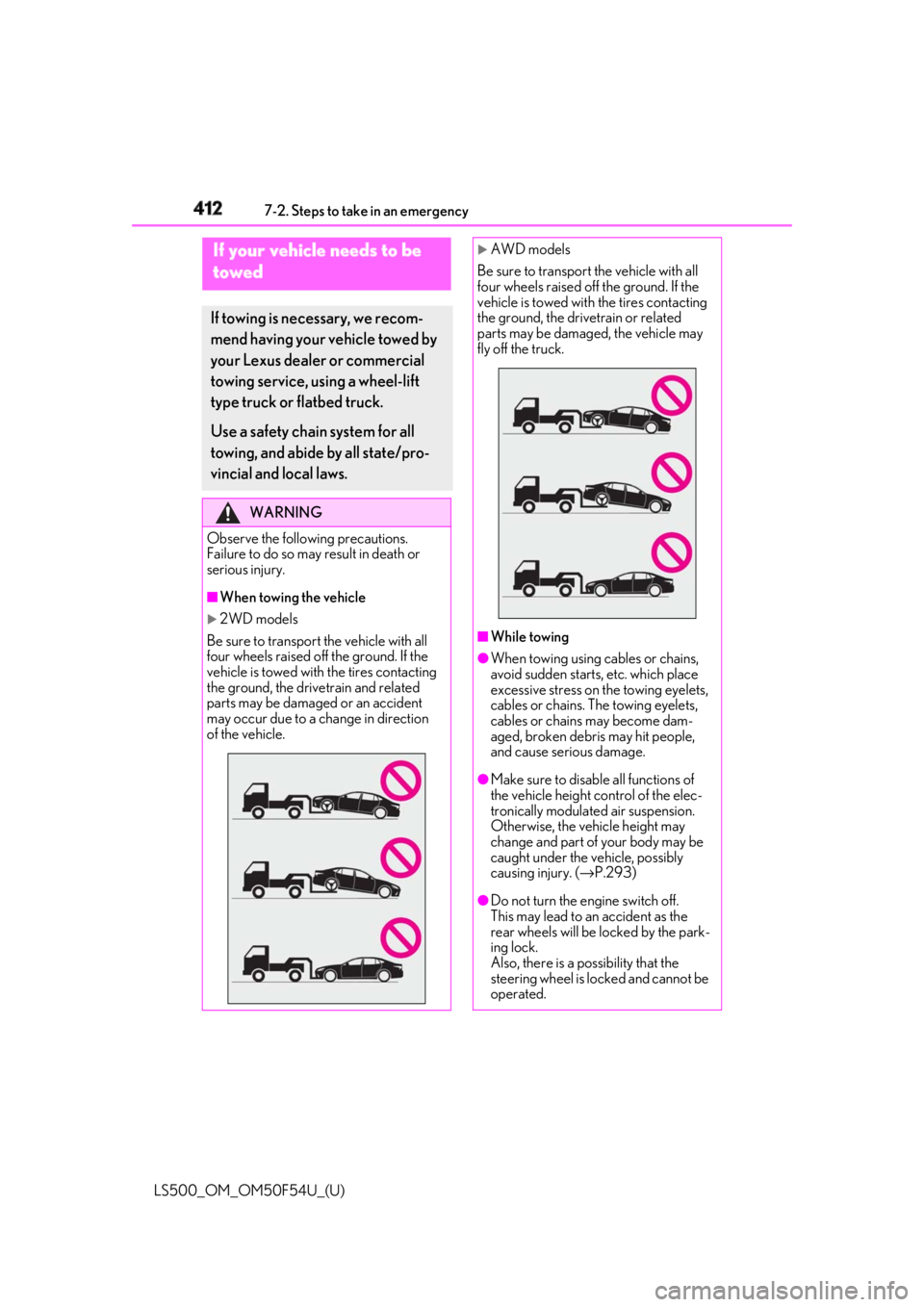
2WD models
Be sure to transport the vehicle with all
four wheels raised off the ground. If the
vehicle is towed with the tires contacting
the ground, the driv etrain and related
parts may be damaged or an accident
may occur due to a change in direction
of the vehicle.
AWD models
Be sure to transport the vehicle with all
four wheels raised off the ground. If the
vehicle is towed with the tires contacting
the ground, the driv etrain or related
parts may be damaged, the vehicle may
fly off the truck.
■
While towing ●
When towing using cables or chains,
avoid sudden starts, etc. which place
excessive stress on the towing eyelets,
cables or chains. The towing eyelets,
cables or chains may become dam-
aged, broken debris may hit people,
and cause serious damage.
●
Make sure to disable all functions of
the vehicle height control of the elec-
tronically modulated air suspension.
Otherwise, the vehicle height may
change and part of your body may be
caught under the vehicle, possibly
causing injury. ( → P.293)
●
Do not turn the engine switch off.
This may lead to an accident as the
rear wheels will be locked by the park-
ing lock.
Also, there is a possibility that the
steering wheel is locked and cannot be
operated.
Page 414 of 514
414 7-2. Steps to take in an emergency
LS500_OM_OM50F54U_(U)
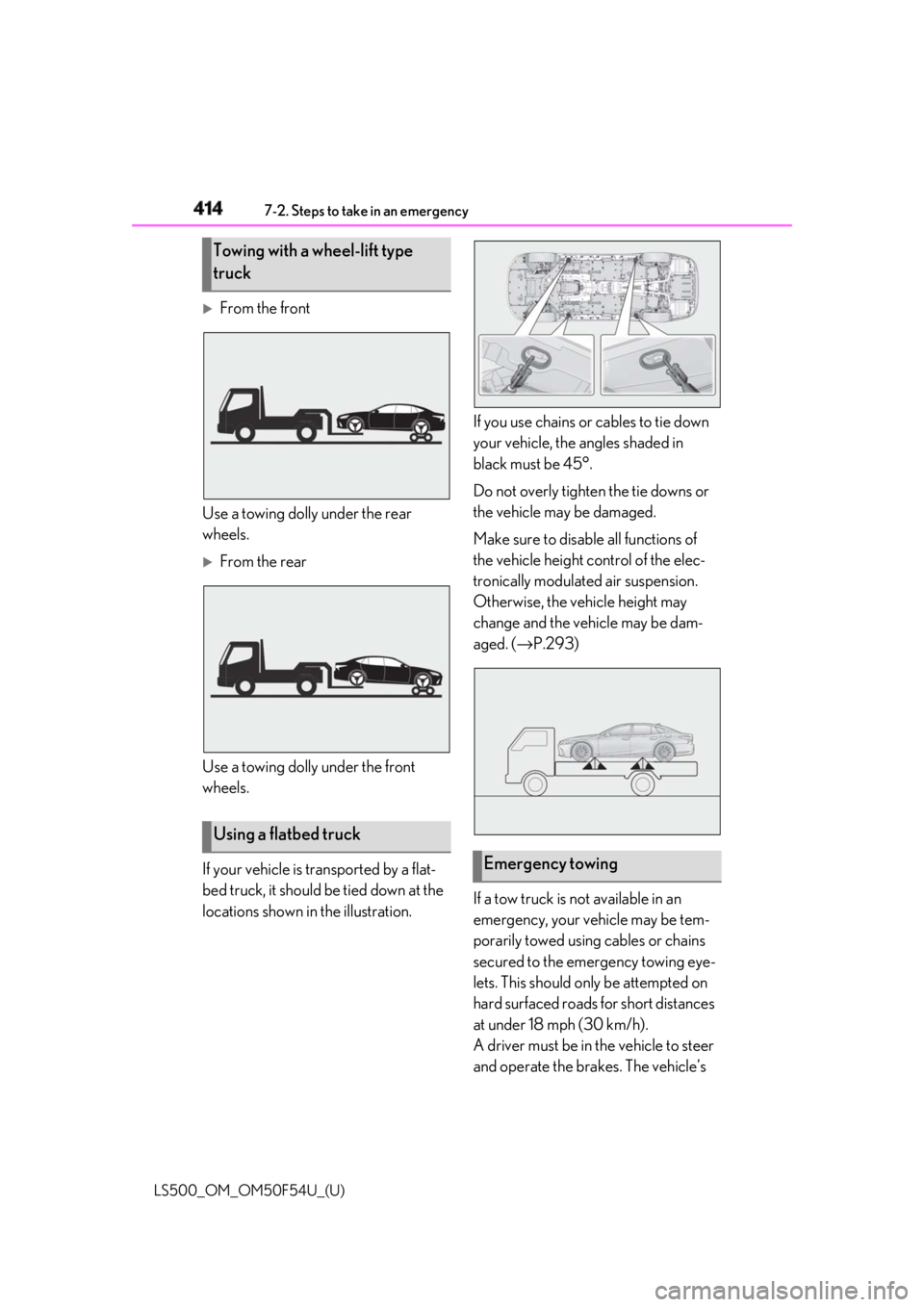
From the front
Use a towing dolly under the rear
wheels.
From the rear
Use a towing dolly under the front
wheels.
If your vehicle is transported by a flat-
bed truck, it should be tied down at the
locations shown in the illustration. If you use chains or cables to tie down
your vehicle, the angles shaded in
black must be 45°.
Do not overly tighten the tie downs or
the vehicle may be damaged.
Make sure to disable all functions of
the vehicle height control of the elec-
tronically modulated air suspension.
Otherwise, the vehicle height may
change and the vehicle may be dam-
aged. ( → P.293)
If a tow truck is not available in an
emergency, your vehicle may be tem-
porarily towed using cables or chains
secured to the emergency towing eye-
lets. This should only be attempted on
hard surfaced roads for short distances
at under 18 mph (30 km/h).
A driver must be in the vehicle to steer
and operate the brakes. The vehicle’s Towing with a wheel-lift type
truck
Using a flatbed truck
Emergency towing
Page 450 of 514
448 8-1. Specifications
LS500_OM_OM50F54U_(U) 8-1.Specifications
*1
: Unladen vehicles *2
: Without electronically modulated air suspension *3
: With electronically mo dulated air suspension*4
:Except F SPORT models *5
:F SPORT models
■
Vehicle identification number
The vehicle identification number
(VIN) is the legal identifier for your
vehicle. This is the primary identifica-
tion number for your Lexus. It is used in
registering the ownership of your vehi-
cle.
This number is stamped on the top left of the instrument panel.Maintenance data (fue l, oil level, etc.)
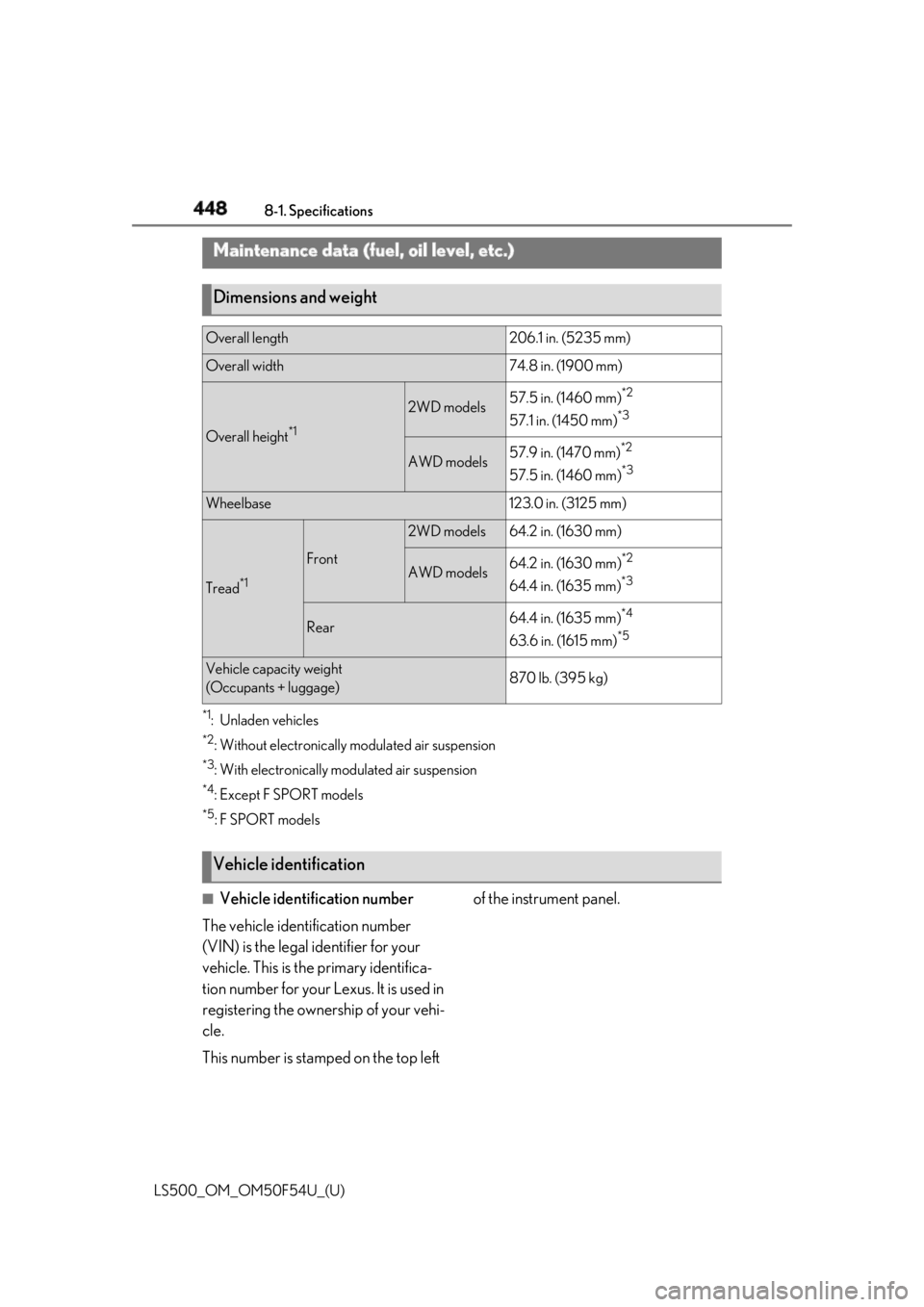
Dimensions and weight Overall length 206.1 in. (5235 mm)
Overall width 74.8 in. (1900 mm)
Overall height *1
2WD models 57.5 in. (1460 mm) *2
57.1 in. (1450 mm) *3
AWD models 57.9 in. (1470 mm) *2
57.5 in. (1460 mm) *3
Wheelbase 123.0 in. (3125 mm)
Tread *1
Front 2WD models 64.2 in. (1630 mm)
AWD models 64.2 in. (1630 mm) *2
64.4 in. (1635 mm) *3
Rear 64.4 in. (1635 mm) *4
63.6 in. (1615 mm) *5
Vehicle capacity weight
(Occupants + luggage) 870 lb. (395 kg)
Vehicle identification
Page 481 of 514
4798-2. Customization
LS500_OM_OM50F54U_(U) 8
Vehicle specifications ■
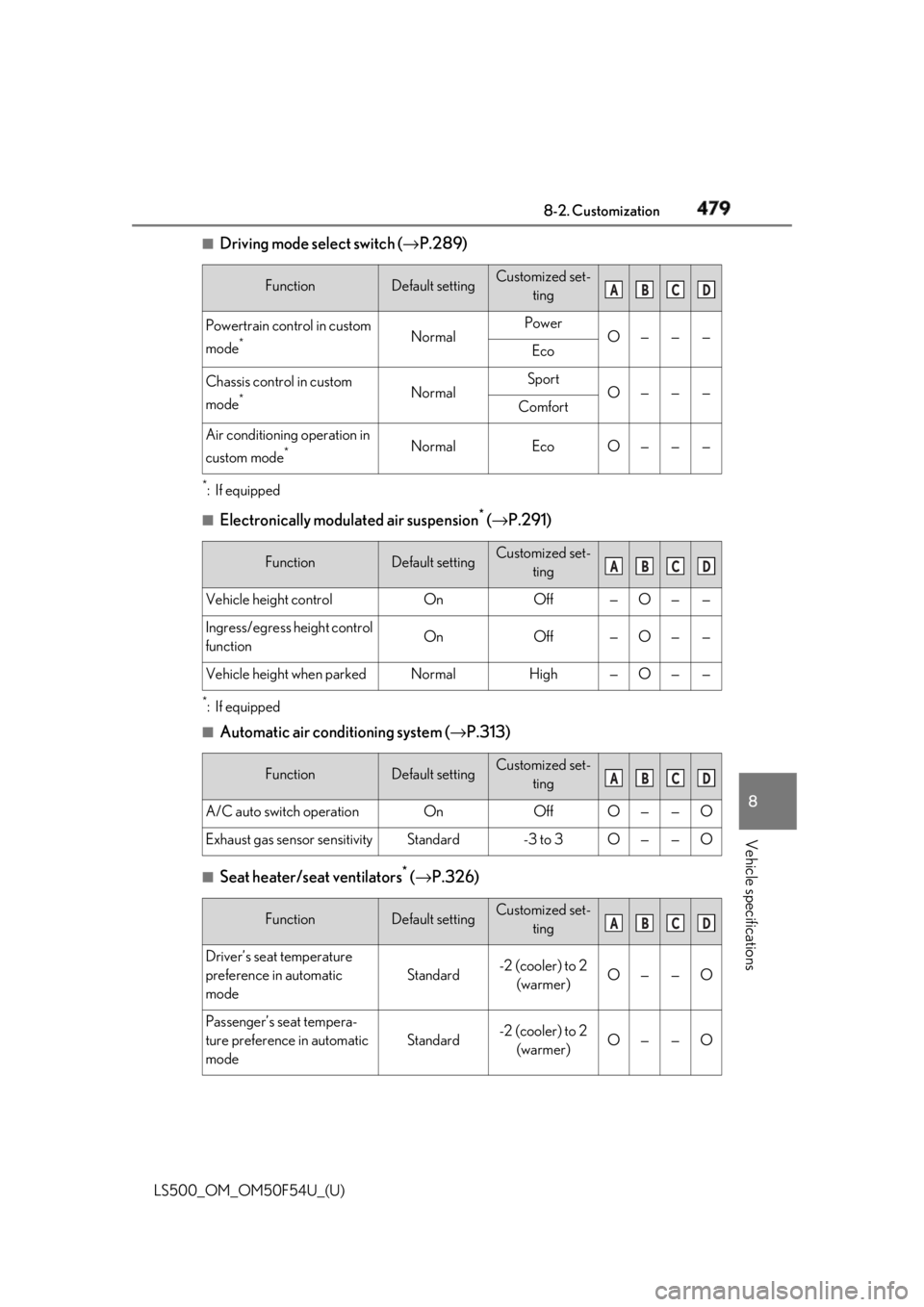
Driving mode select switch ( → P.289)*
:If equipped ■
Electronically modulated air suspension *
( → P.291)*
:If equipped ■
Automatic air conditioning system ( → P.313)
■
Seat heater/seat ventilators *
( → P.326)Function Default setting Customized set-
ting
Powertrain control in custom
mode *
Normal Power
O — — —
Eco
Chassis control in custom
mode *
Normal Sport
O — — —
Comfort
Air conditioning operation in
custom mode *
Normal Eco O — — —
Function Default setting Customized set-
ting
Vehicle height control On Off — O — —
Ingress/egress height control
function On Off — O — —
Vehicle height when parked Normal High — O — —
Function Default setting Customized set-
ting
A/C auto switch operation On Off O — — O
Exhaust gas sensor sensitivity Standard -3 to 3 O — — O
Function Default setting Customized set-
ting
Driver’s seat temperature
preference in automatic
mode Standard -2 (cooler) to 2
(warmer) O — — O
Passenger’s seat tempera-
ture preference in automatic
mode Standard -2 (cooler) to 2
(warmer) O — — O A B C D
A B C D
A B C D
A B C D
Page 499 of 514

4971-1. What to do if... (Troubleshooting)
LS500_OM_OM50F54U_(U) 497Alphabetical Index
Alphabetical Index A
A/C
Air conditioning filter ............................... 402
Front automatic air conditioning system
...........................................................................313
Micro dust and pollen filter.....................319
Rear air conditioning system ............... 323
ABS (Anti-lock Brake System).............. 294
Warning light ............................................... 420
Active stabilizer suspension system .... 294
Adaptive Front-lighting System (AFS) . 177
Adaptive Variable Suspension System295
AFS (Adaptive Front-lighting System) . 177
Air conditioning filter ................................. 402
Air conditioning system
Air conditioning filter ............................... 402
Front automatic air conditioning system
...........................................................................313
Micro dust and pollen filter.....................319
Rear air conditioning system ............... 323
Airbags
Airbag operating conditions..................... 31
Airbag precautions for your child ........ 34
Correct driving posture .............................23
Curtain shield airbag operating condi-
tions .................................................................... 31
Curtain shield airbag precautions ....... 34
Front passenger occupa nt classification
system ............................................................. 40
General airbag precautions ................... 34
Locations of airbags.................................... 29
Modification and disposal of airbags ..37
Side airbag operating conditions ........... 31
Side airbag precautions ............................ 34
Side and curtain shield airbags operating
conditions........................................................ 31
Side and curtain shield airbags precau-
tions .................................................................. 34
SRS airbags ..................................................... 29
SRS warning light ........................................419 Alarm
Alarm...................................................................60
Warning buzzer .......................................... 418
Anchor brackets ..................................... 46, 55
Antennas (smart acc ess system with
push-button start).......................................107
Anti-lock Brake System (ABS).............. 294
Warning light ...............................................420
Approach warning.......................................247
Armrest............................................................ 343
Assist grips ..................................................... 343
Audio system-linked display ........................81
Automatic headlight leveling system .... 176
Automatic High Beam ................................178
Automatic light control system................ 175
Automatic transmission ..............................163
M mode ........................................................... 168
Paddle shift switches .......................167, 168
Snow mode.....................................................167
Auxiliary boxes ................................. 338, 340
Average fuel economy................................. 78
Average vehicle speed ................................ 78
B
Back-up lights
Replacing light bulbs ............................... 408
Battery
Battery checking ....................................... 384
If the battery is discharged ................... 438
Preparing and checking before winter
..........................................................................299
Warning light ................................................ 419
Blind Spot Monitor (BSM).........................251
Boost gauge.......................................................79
Brake
Brake hold .......................................................173
Fluid...................................................................453
Parking brake ............................................... 170
Warning light ................................................ 418
Brake assist .................................................... 294
Break-in tips...................................................... 151