fuel pressure LEXUS LS500 2018 Owners Manual
[x] Cancel search | Manufacturer: LEXUS, Model Year: 2018, Model line: LS500, Model: LEXUS LS500 2018Pages: 514, PDF Size: 10.62 MB
Page 1 of 514

1
2
3
4
5
6
7
8
9
LS500_OM_OM50F54U_(U) Pictorial index Search by illustration
For safety
and security Make sure to read through them
(Main topics: Child seat, theft deterrent system)
Vehicle status
information and
indicators Reading driving-related information
(Main topics: Meters, multi-information display)
Before driving Opening and closing the doors and windows,
adjustment before driving
(Main topics: Keys, doors, seats)
Driving Operations and advice which are necessary for driving
(Main topics: Starting engine, refueling)
Interior features Usage of the interior features
(Main topics: Air conditioner, storage features)
Maintenance
and care Caring for your vehicle and maintenance procedures
(Main topics: Interior and exterior, light bulbs)
When trouble
arises What to do in case of malfunction and emergency
(Main topics: Battery discharge, flat tire)
Vehicle
specifications Vehicle specifications, customizable features
(Main topics: Fuel, oil, tire inflation pressure)
For owners Reporting safety defects for U.S. owners, seat belt and
SRS airbag instructions for Canadian owners
Index Search by symptom
Search alphabetically
Page 4 of 514

4 TABLE OF CONTENTS
LS500_OM_OM50F54U_(U) 5-6. Using the other interior features
Other interior features .............. 342
Garage door opener.................. 349
Lexus Enform Safety Connect
........................................................... 355
6-1. Maintenance and care
Cleaning and protecting the vehi-
cle exterior ................................... 362
Cleaning and protecting the vehi-
cle interior .................................... 365
6-2. Maintenance
Maintenance requirements ..... 368
General maintenance ................ 369
Emission inspection and mainte-
nance (I/M) programs ............ 372
6-3. Do-it-yourself maintenance
Do-it-yourself service precautions
........................................................... 373
Hood.................................................. 375
Positioning a floor jack............... 375
Engine compartment.................. 377
Battery .............................................. 384
Tires ................................................... 386
Replacing the tire ......................... 396
Tire inflation pressure ................. 399
Wheels............................................... 401
Air conditioning filter.................. 402
Electronic key battery ................ 403
Checking and replacing fuses
........................................................... 405
Light bulbs ....................................... 408 7-1. Essential information
Emergency flashers ..................... 410
If your vehicle has to be stopped in
an emergency ............................. 410
7-2. Steps to take in an emergency
If your vehicle needs to be towed
............................................................ 412
If you think something is wrong
........................................................... 416
Fuel pump shut off system .......... 417
If a warning light turns on or a warn-
ing buzzer sounds...................... 418
If a warning messa ge is displayed
.......................................................... 428
If you have a flat tire .................... 432
If the engine will not start .......... 433
If you lose your keys.................... 435
If the fuel filler door cannot be
opened .......................................... 435
If the electronic key does not oper-
ate properly ................................. 436
If the vehicle battery is discharged
.......................................................... 438
If your vehicle overheats ........... 443
If the vehicle becomes stuck ... 446
8-1. Specifications
Maintenance data (fuel, oil level,
etc.) ................................................. 448
Fuel information............................ 457
Tire information ............................ 4596
Maintenance and care 7
When trouble arises
8
Vehicle specifications
Page 13 of 514
13Pictorial index
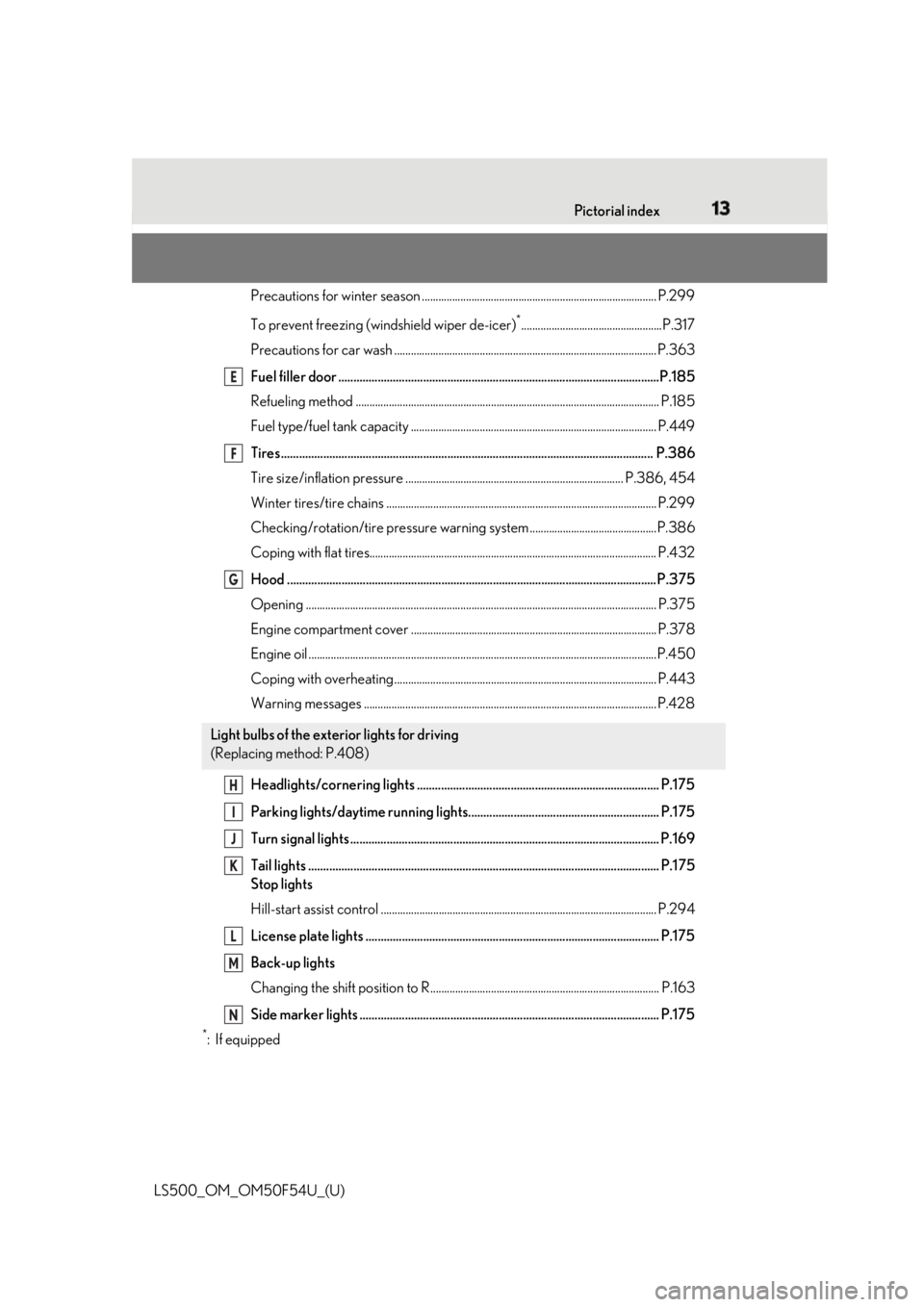
LS500_OM_OM50F54U_(U) Precautions for winter season .. ................................................................................... P.299
To prevent freezing (windshield wiper de-icer) *
...................................................P.317
Precautions for car wash ............................................................................................... P.363
Fuel filler door ..........................................................................................................P.185
Refueling method .............................................................................................................. P .185
Fuel type/fuel tank capacity ...... ................................................................................... P.449
Tires.......................................................................................................................... .P.386
Tire size/inflation pressure ............................ ................................................... P.386, 454
Winter tires/tire chains .................................................................................................. P.299
Checking/rotation/tire pressu re warning system..............................................P.386
Coping with flat tires........................................................................................................ P .432
Hood .......................................................................................................................... P .375
Opening ........................................................................................................................ ....... P.375
Engine compartment cover ......................................................................................... P.378
Engine oil ..................................................................................................................... .........P.450
Coping with overheating ............................................................................................... P.443
Warning messages .......................................................................................................... P.428
Headlights/cornering lights ................................................................................ P.175
Parking lights/daytime running lights............................................................... P.175
Turn signal lights ...................................................................................................... P.169
Tail lights .................................................................................................................... P.175
Stop lights
Hill-start assist control .................................................................................................... P. 294
License plate lights ................................................................................................. P.175
Back-up lights
Changing the shift position to R................................................................................... P.163
Side marker lights ................................................................................................... P.175 *
:If equipped Light bulbs of the exterior lights for driving
(Replacing method: P.408) E
F
G
H
I
J
K
L
M
N
Page 65 of 514
652-1. Instrument cluster
LS500_OM_OM50F54U_(U) 2
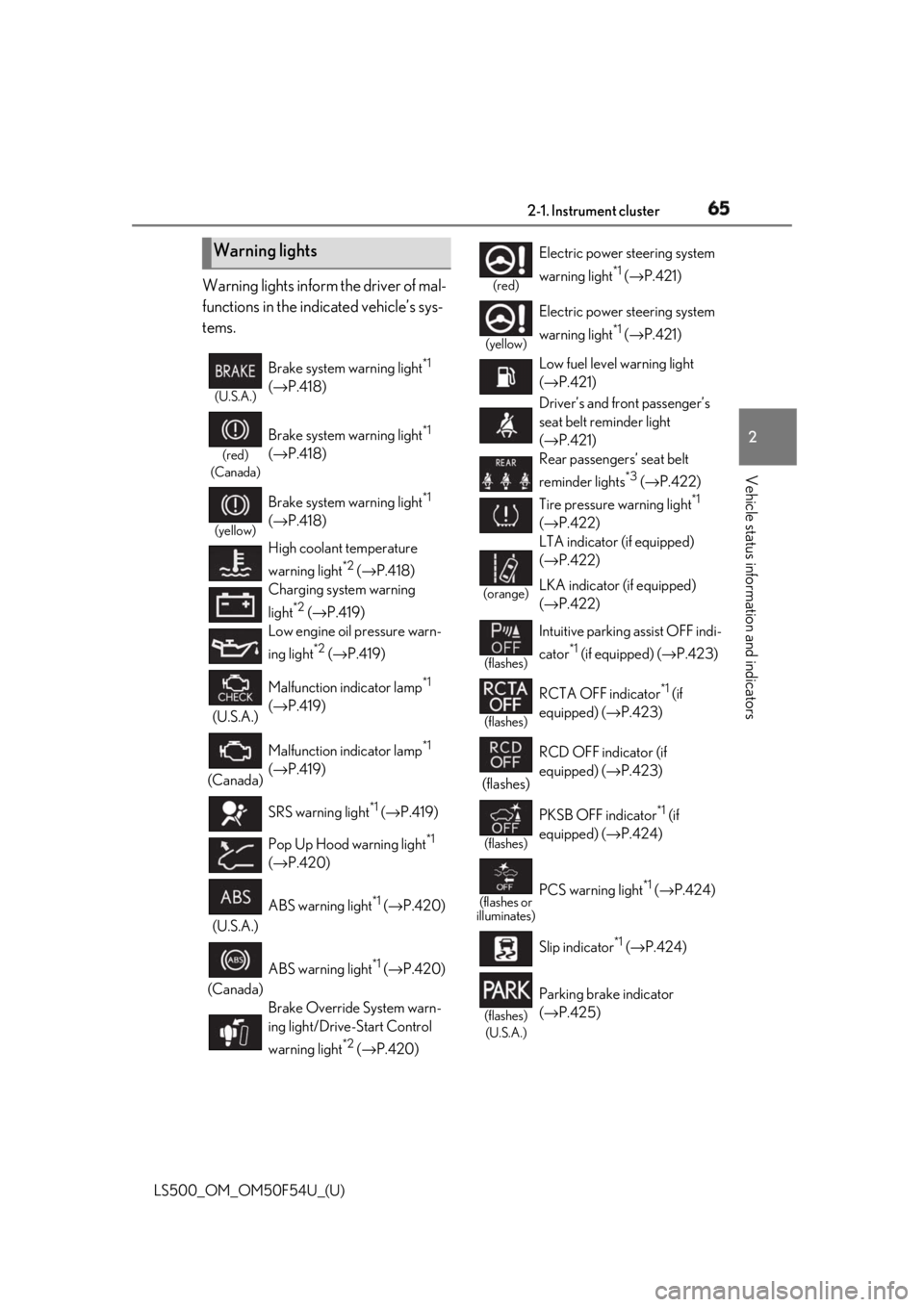
Vehicle status information and indicators Warning lights inform the driver of mal-
functions in the indicated vehicle’s sys-
tems.
Warning lights (U.S.A.)
Brake system warning light *1
( → P.418)(red)
(Canada)
Brake system warning light *1
( → P.418)(yellow)
Brake system warning light *1
( → P.418)
High coolant temperature
warning light *2
( → P.418)
Charging system warning
light *2
( → P.419)
Low engine oil pressure warn-
ing light *2
( → P.419)
(U.S.A.) Malfunction indicator lamp *1
( → P.419)
(Canada) Malfunction indicator lamp *1
( → P.419)
SRS warning light *1
( → P.419)
Pop Up Hood warning light *1
( → P.420)
(U.S.A.) ABS warning light *1
( → P.420)
(Canada) ABS warning light *1
( → P.420)
Brake Override System warn-
ing light/Drive-Start Control
warning light *2
( → P.420) (red)
Electric power steering system
warning light *1
( → P.421)(yellow)
Electric power steering system
warning light *1
( → P.421)
Low fuel level warning light
( → P.421)
Driver’s and front passenger’s
seat belt reminder light
( → P.421)
Rear passengers’ seat belt
reminder lights *3
( → P.422)
Tire pressure warning light *1
( → P.422)(orange)
LTA indicator (if equipped)
( → P.422)
LKA indicator (if equipped)
( → P.422)(flashes)
Intuitive parking assist OFF indi-
cator *1
(if equipped) ( → P.423)
(flashes)
RCTA OFF indicator *1
(if
equipped) ( → P.423)
(flashes) RCD OFF indicator (if
equipped) ( → P.423)
(flashes)
PKSB OFF indicator *1
(if
equipped) ( → P.424)
(flashes or
illuminates)
PCS warning light *1
( → P.424)
Slip indicator *1
( → P.424)
(flashes)
(U.S.A.) Parking brake indicator
( → P.425)
Page 78 of 514
78 2-1. Instrument cluster
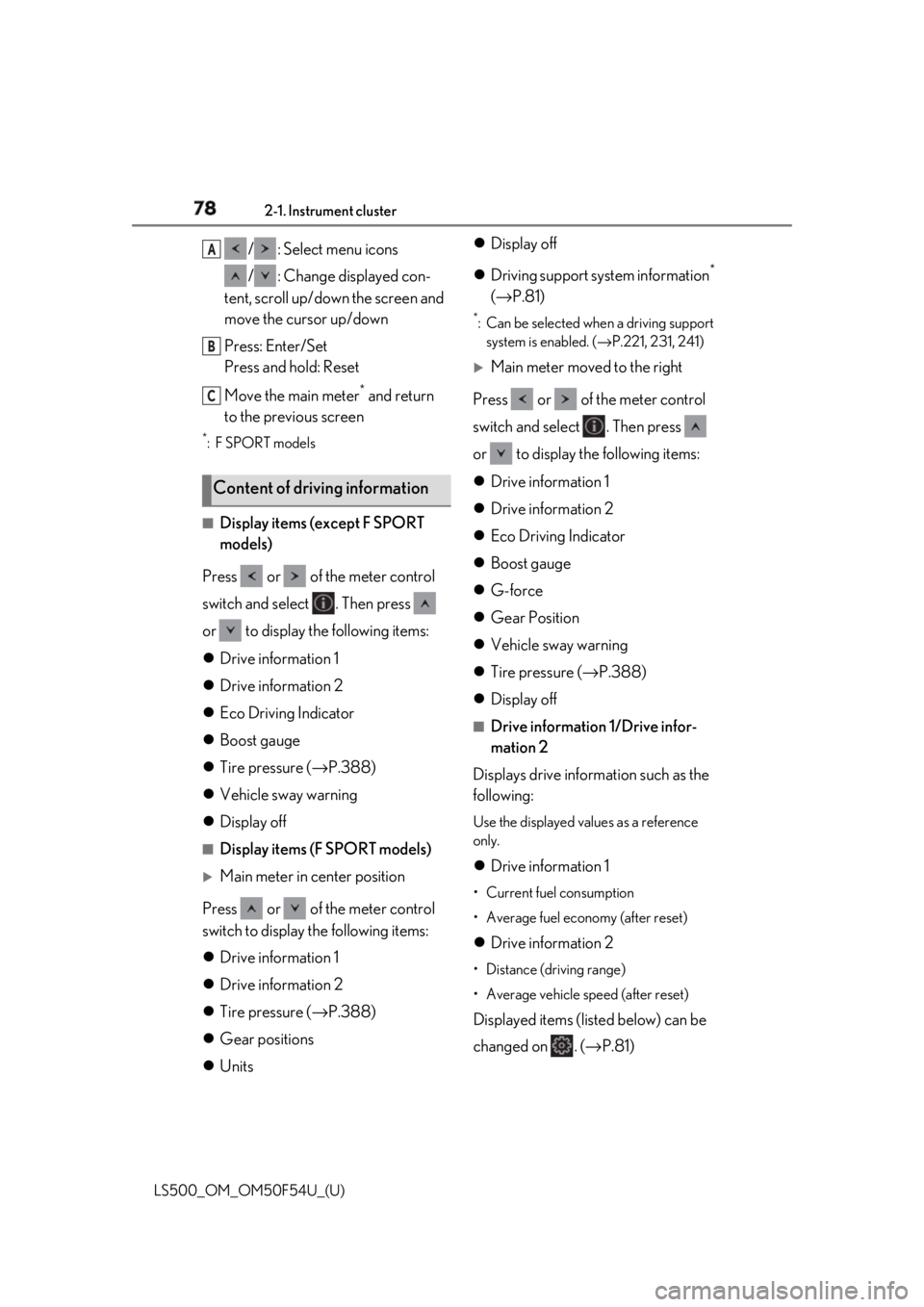
LS500_OM_OM50F54U_(U) / : Select menu icons
/ : Change displayed con-
tent, scroll up/down the screen and
move the cursor up/down
Press: Enter/Set
Press and hold: Reset
Move the main meter *
and return
to the previous screen *
:F SPORT models
■
Display items (except F SPORT
models)
Press or of the meter control
switch and select . Then press
or to display the following items:
Drive information 1
Drive information 2
Eco Driving Indicator
Boost gauge
Tire pressure ( → P.388)
Vehicle sway warning
Display off ■
Display items (F SPORT models)
Main meter in center position
Press or of the meter control
switch to display the following items:
Drive information 1
Drive information 2
Tire pressure ( → P.388)
Gear positions
Units Display off
Driving support system information *
( → P.81) *
: Can be selected when a driving support
system is enabled. ( → P.221, 231, 241)
Main meter moved to the right
Press or of the meter control
switch and select . Then press
or to display the following items:
Drive information 1
Drive information 2
Eco Driving Indicator
Boost gauge
G-force
Gear Position
Vehicle sway warning
Tire pressure ( → P.388)
Display off ■
Drive information 1/Drive infor-
mation 2
Displays drive information such as the
following: Use the displayed values as a reference
only.
Drive information 1 • Current fuel consumption
• Average fuel economy (after reset)
Drive information 2 • Distance (driving range)
• Average vehicle speed (after reset)
Displayed items (listed below) can be
changed on . ( → P.81)Content of driving information A
B
C
Page 79 of 514
792-1. Instrument cluster
LS500_OM_OM50F54U_(U) 2
Vehicle status information and indicators Current fuel consumption Bar type: Displays instantaneous current
fuel consumption
Average fuel economy After reset: Displays average fuel con-
sumption since the display was reset *1
After start: Displays average fuel con-
sumption since engine start
After refuel: Displays average fuel con-
sumption since refuel
Average vehicle speed After reset: Displays average vehicle
speed since the display was reset *1
After start: Displays average vehicle speed
since engine start
Elapsed time After reset: Displays elapsed time since the
display was reset *1
After start: Displays elapsed time since
engine start
Distance Driving range: Displays driving range with
remaining fuel *2, 3
After start: Displays the distance driven
since engine start
Other Blank: No item *1
: To reset, display the desired item and
press and hold of the meter control
switch. *2
: This distance is computed based on
your average fuel consumption. As a
result, the actual distance that can be
driven may differ from that displayed. *3
: When only a small amount of fuel is
added to the tank, the display may not be updated.
When refueling, turn the engine switch
off. If the vehicle is refueled without
turning the engine switch off, the display
may not be updated. ■
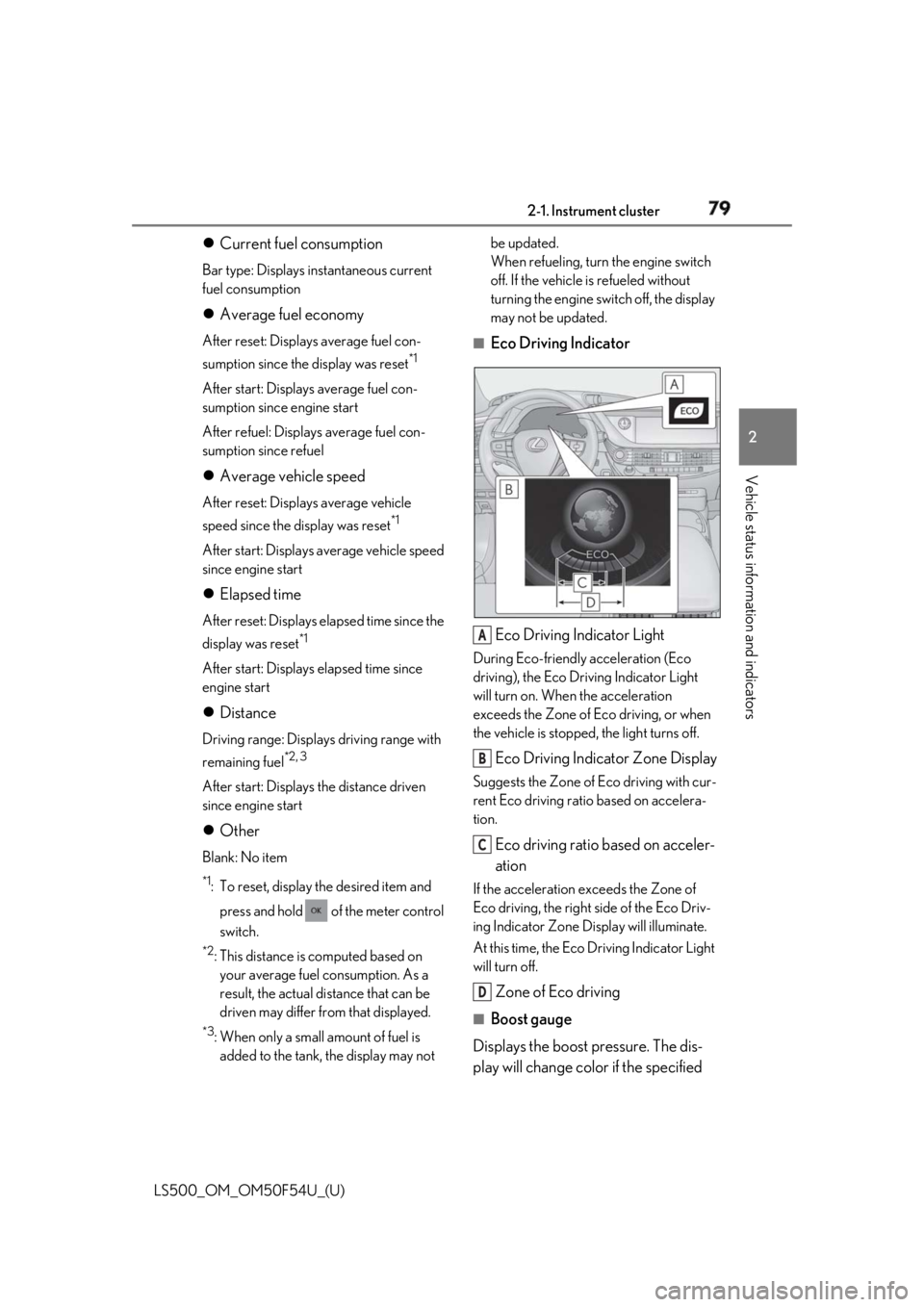
Eco Driving Indicator
Eco Driving Indicator Light During Eco-friendly acceleration (Eco
driving), the Eco Driving Indicator Light
will turn on. When the acceleration
exceeds the Zone of Eco driving, or when
the vehicle is stopped, the light turns off.
Eco Driving Indicator Zone Display Suggests the Zone of Eco driving with cur-
rent Eco driving ratio based on accelera-
tion.
Eco driving ratio based on acceler-
ation If the acceleration exceeds the Zone of
Eco driving, the right side of the Eco Driv-
ing Indicator Zone Display will illuminate.
At this time, the Eco Driving Indicator Light
will turn off.
Zone of Eco driving ■
Boost gauge
Displays the boost pressure. The dis-
play will change color if the specified A
B
C
D
Page 362 of 514

362 6-1. Maintenance and care
LS500_OM_OM50F54U_(U) 6-1.Maintenance and care
Working from top to bottom, liber-
ally apply water to the vehicle body,
wheel wells and underside of the
vehicle to remove any dirt and dust.
Wash the vehicle body using a
sponge or soft cloth, such as a
chamois.
For hard-to-remove marks, use car
wash soap and rinse thoroughly with
water.
Wipe away any water.
Wax the vehicle when the water-
proof coating deteriorates. If water does not bead on a clean surface,
apply wax when the vehicle body is cool.
■
Self-restoring coat
The vehicle body has a self-restoring coat-
ing that is resistant to small surface
scratches caused in a car wash etc.
●
The coating lasts for 5 to 8 years from
when the vehicle is delivered from the
plant.
●
The restoration time differs depending on
the depth of the scratch and outside tem-
perature.
The restoration time may become
shorter when the coating is warmed by
applying warm water.
●
Deep scratches caused by keys, coins,
etc. cannot be restored.
●
Do not use wax that contains abrasives. ■
Automatic car washes ●
Before washing the vehicle:
• Fold the mirrors
• Turn off the power trunk opener and
closer (if equipped)
Start washing from the front of the vehicle.
Extend the mirrors before driving.●
Brushes used in automatic car washes
may scratch the vehicl e surface and harm
your vehicle’s paint. ■
High pressure car washes ●
Do not allow the nozzles of the car wash
to come within close proximity of the win-
dows and the air suspension unit (if
equipped). ●
Before using the car wash, check that the
fuel filler door on your vehicle is closed
properly. ■
When using a car wash
If the door handle becomes wet while the
electronic key is within the effective range,
the door may lock and unlock repeatedly. In
that case, follow the following correction
procedures to wash the vehicle: ●
Place the key in a position 6 ft. (2 m) or
more separate from the vehicle while the
vehicle is being wash ed. (Take care to
ensure that the key is not stolen.) ●
Set the electronic key to battery-saving
mode to disable the smart access system
with push-button start. ( → P.108)■
Aluminum wheels ●
Remove any dirt immediately by using a
neutral detergent. ●
Wash detergent off with water immedi-
ately after use.
●
To protect the paint from damage, make
sure to observe the following precau-
tions.
• Do not use acidic, alkaline or abrasive
detergent
• Do not use hard brushes
• Do not use detergent on the wheels when
they are hot, such as after driving or park-
ing in hot weatherCleaning and protecting the
vehicle exterior Perform cleaning in a manner
appropriate to each component
and its material.
Cleaning instructions
Page 374 of 514
374 6-3. Do-it-yourself maintenance
LS500_OM_OM50F54U_(U) Tire inflation pres-
sure ( → P.399) • Tire pressure gauge
•Compressed air
source
Washer fluid
( → P.383) • Water or washer
fluid containing anti-
freeze (for winter
use)
• Funnel (used only for
adding water or
washer fluid)
WARNING
The engine compartment contains many
mechanisms and fluids that may move
suddenly, become hot, or become elec-
trically energized. To avoid death or seri-
ous injury, observe the following
precautions. ■
When working on the engine com-
partment●
Keep hands, clothi ng and tools away
from the moving fan and engine drive
belt.●
Be careful not to touch the engine,
radiator, exhaust manifold, etc. right
after driving as they may be hot. Oil
and other fluids may also be hot.
●
Do not leave anything that may burn
easily, such as paper and rags, in the
engine compartment.
●
Do not smoke, cause sparks or expose
an open flame to fuel. Fuel fumes are
flammable.
■
When working near the electric cool-
ing fan or radiator grille
Be sure the engine switch is off.
With the engine switch in IGNITION
ON mode, the electric cooling fan may
automatically start to run if the air condi-
tioning is on and/or the coolant tempera-
ture is high. ( → P.382)Items Parts and tools ■
Safety glasses
Wear safety glasses to prevent flying or
falling material, fluid spray, etc. from get-
ting in your eyes.
NOTICE■
If you remove the air cleaner filter
Driving with the air cleaner filter
removed may cause excessive engine
wear due to dirt in the air.
Page 400 of 514
400 6-3. Do-it-yourself maintenance
LS500_OM_OM50F54U_(U) 1 Remove the tire valve cap.
2 Press the tip of the tire pressure
gauge onto the tire valve.
3 Read the pressure using the gauge
gradations.
4 If the tire inflation pressure is not at
the recommended level, adjust the
pressure.
If you add too much air, press the
center of the valve to deflate.
5 After completing the tire inflation
pressure measurem ent and adjust-
ment, apply soapy water to the
valve and check for leakage.
6 Put the tire valve cap back on. ■
Tire inflation pressure check interval
You should check tire inflation pressure
every two weeks, or at least once a month.
Do not forget to check the spare. ■
Effects of incorrect tire inflation pres-
sure
Driving with incorrect ti re inflation pressure
may result in the following: ●
Reduced fuel economy●
Reduced driving comfort and poor han-
dling●
Reduced tire life due to wear●
Reduced safety●
Damage to the drive train
If a tire needs frequent inflating, have it
checked by your Lexus dealer.
■
Instructions for checking tire inflation
pressure
When checking tire inflation pressure,
observe the following:
●
Check only when the tires are cold.
If your vehicle has been parked for at
least 3 hours or has not been driven for
more than 1 mile or 1.5 km, you will get an
accurate cold tire in flation pressure read- ing. ●
Always use a tire pressure gauge.
It is difficult to judge if a tire is properly
inflated based only on its appearance. ●
It is normal for the ti re inflation pressure
to be higher after driving as heat is gen-
erated in the tire. Do not reduce tire infla-
tion pressure after driving. ●
Never exceed the vehicle capacity
weight.
Passengers and luggage weight should
be placed so that the vehicle is balanced.
WARNING■
Proper inflation is critical to save tire
performance
Keep your tires properly inflated.
If the tires are not properly inflated, the
following conditions may occur which
could lead to an accident resulting in
death or serious injury: ●
Excessive wear ●
Uneven wear ●
Poor handling ●
Possibility of blowouts resulting from
overheated tires
●
Air leaking from between tire and
wheel
●
Wheel deformation and/or tire dam-
age
●
Greater possibility of tire damage
while driving (due to road hazards,
expansion joints, sharp edges on the
road, etc.)
NOTICE
■
When inspecting and adjusting tire
inflation pressure
Be sure to put the tire valve caps back on.
If a valve cap is not installed, dirt or mois-
ture may get into the valve and cause an
air leak, resulting in decreased tire infla-
tion pressure.
Page 427 of 514
4277-2. Steps to take in an emergency
LS500_OM_OM50F54U_(U) 7
When trouble arises WARNING●
Avoid abrupt maneuvering and brak-
ing.
If the vehicle tires deteriorate, you
could lose control of the steering
wheel or the brakes.■
If a blowout or sudden air leakage
should occur
The tire pressure warning system may
not activate immediately. ■
Maintenance of the tires
Each tire, including the spare (if pro-
vided), should be checked monthly when
cold and inflated to the inflation pressure
recommended by the vehicle manufac-
turer on the vehicle placard or tire infla-
tion pressure label (tire and load
information label). (I f your vehicle has
tires of a different size than the size indi-
cated on the vehicle placard or tire infla-
tion pressure label [tire and load
information label], yo u should determine
the proper tire infl ation pressure for
those tires.)
As an added safety feature, your vehicle
has been equipped with a tire pressure
monitoring system (TPMS-tire pressure
warning system) that illuminates a low
tire pressure telltale (tire pressure warn-
ing light) when one or more of your tires
is significantly under-inflated. Accord-
ingly, when the low tire pressure telltale
(tire pressure warnin g light) illuminates,
you should stop and check your tires as
soon as possible, and inflate them to the
proper pressure. Driving on a signifi-
cantly under-inflated tire causes the tire
to overheat and can lead to tire failure.
Under-inflation also reduces fuel effi-
ciency and tire tread life, and may affect
the vehicle’s handling and stopping abil-
ity. Please note that the TPMS (tire pressure
warning system) is not a substitute for
proper tire maintenance, and it is the
driver’s responsibility to maintain correct
tire pressure, even if under-inflation has
not reached the level to trigger illumina-
tion of the TPMS low tire pressure telltale
(tire pressure warning light).
Your vehicle has also been equipped with
a TPMS (tire pressure warning system)
malfunction indicator to indicate when
the system is not operating properly. The
TPMS (tire pressure warning system)
malfunction indicator is combined with
the low tire pressure telltale (tire pres-
sure warning light) . When the system
detects a malfunction, the telltale will
flash for approximately one minute and
then remain continuously illuminated.
This sequence will continue upon subse-
quent vehicle start-ups as long as the
malfunction exists. When the malfunction
indicator is illuminated, the system may
not be able to detect or signal low tire
pressure as intended.
TPMS (tire pressure warning system)
malfunctions may occur for a variety of
reasons, including the installation of
replacement or alternate tires or wheels
on the vehicle that prevent the TPMS
(tire pressure warning system) from func-
tioning properly. Always check the
TPMS (tire pressure warning system)
malfunction telltale after replacing one
or more tires or wheels on your vehicle to
ensure that the replacement or alternate
tires and wheels allow the TPMS (tire
pressure warning system) to continue to
function properly.
NOTICE
■
To ensure the tire pressure warning
system operates properly
Do not install tires with different specifi-
cations or makers, as the tire pressure
warning system may not operate prop-
erly.