park assist LEXUS LS500 2018 Owners Manual
[x] Cancel search | Manufacturer: LEXUS, Model Year: 2018, Model line: LS500, Model: LEXUS LS500 2018Pages: 514, PDF Size: 10.62 MB
Page 3 of 514
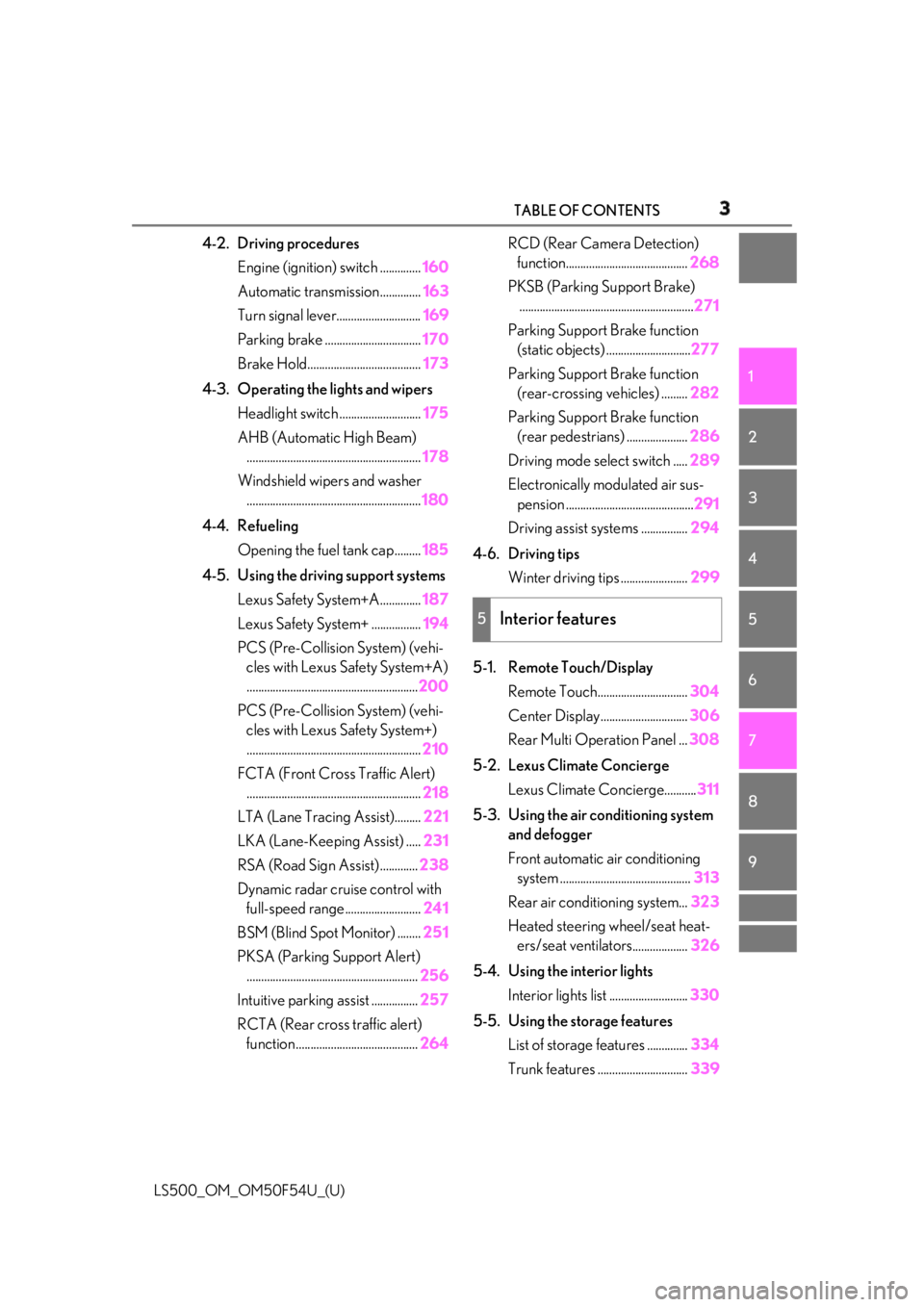
3TABLE OF CONTENTS
LS500_OM_OM50F54U_(U) 1
2
3
4
5
6
7
8
94-2. Driving procedures
Engine (ignition) switch .............. 160
Automatic transmission.............. 163
Turn signal lever............................. 169
Parking brake ................................. 170
Brake Hold....................................... 173
4-3. Operating the lights and wipers
Headlight switch ............................ 175
AHB (Automatic High Beam)
............................................................ 178
Windshield wipers and washer
............................................................ 180
4-4. Refueling
Opening the fuel tank cap......... 185
4-5. Using the driving support systems
Lexus Safety System+A.............. 187
Lexus Safety System+ ................. 194
PCS (Pre-Collision System) (vehi-
cles with Lexus Safety System+A)
........................................................... 200
PCS (Pre-Collision System) (vehi-
cles with Lexus Safety System+)
............................................................ 210
FCTA (Front Cross Traffic Alert)
............................................................ 218
LTA (Lane Tracing Assist)......... 221
LKA (Lane-Keeping Assist) ..... 231
RSA (Road Sign Assist) ............. 238
Dynamic radar crui se control with
full-speed range.......................... 241
BSM (Blind Spot Monitor) ........ 251
PKSA (Parking Support Alert)
........................................................... 256
Intuitive parking assist ................ 257
RCTA (Rear cross traffic alert)
function .......................................... 264 RCD (Rear Camera Detection)
function.......................................... 268
PKSB (Parking Support Brake)
............................................................ 271
Parking Support Brake function
(static objects) ............................. 277
Parking Support Brake function
(rear-crossing vehicles) ......... 282
Parking Support Brake function
(rear pedestrians) ..................... 286
Driving mode select switch ..... 289
Electronically modulated air sus-
pension ............................................ 291
Driving assist systems ................ 294
4-6. Driving tips
Winter driving tips ....................... 299
5-1. Remote Touch/Display
Remote Touch............................... 304
Center Display.............................. 306
Rear Multi Operation Panel ... 308
5-2. Lexus Climate Concierge
Lexus Climate Concierge........... 311
5-3. Using the air conditioning system
and defogger
Front automatic air conditioning
system ............................................. 313
Rear air conditioning system... 323
Heated steering wheel/seat heat-
ers/seat ventilators
......
............. 326
5-4. Using the interior lights
Interior lights list ........................... 330
5-5. Using the storage features
List of storag e features .............. 334
Trunk features ............................... 3395
Interior features
Page 7 of 514

7
LS500_OM_OM50F54U_(U) sophisticated computers that will
record certain data, such as:
Engine speed
Accelerator status
Brake status
Vehicle speed
Shift position
Images from the camera sensor
(available only in situations when
sudden inputs o ccur while driving
[sudden acceleration, etc.], the
pre-collision braking function or the
pre-collision brake assist function
was operating, the Parking Support
Brake function [static objects] was
operating, or your vehicle was
involved in a collision)
The recorded data varies according to
the vehicle grade level and options
with which it is equipped. These com-
puters do not record conversations or
sounds, and only record images out-
side of the vehicle in certain situations.
Data Transmission Your vehicle may transmit the data
recorded in these computers to Lexus
without notification to you.
Data usage Lexus may use the data recorded in these
computers to diagnose malfunctions, con-
duct research and development, and
improve quality.
Lexus will not disclose the recorded data to
a third party except:
• With the consent of the vehicle owner or
with the consent of the lessee if the vehi-
cle is leased • In response to an official request by the
police, a court of law or a government
agency
• For use by Lexus in a lawsuit
• For research purposes where the data is
not tied to a specific vehicle or vehicle
owner
Usage of data collected through
Lexus Enform (U.S. mainland only) If your Lexus has Lexus Enform and if you
have subscribed to those services, please
refer to the Lexus Enform Telematics Sub-
scription Service Ag reement for informa-
tion on data collected and its usage.
To learn more abou t the vehicle data
collected, used and shared by
Lexus, please visit
www.lexus.com/privacyvts/
.
This vehicle is equipped with an event
data recorder (EDR). The main pur-
pose of an EDR is to record, in certain
crash or near crash-like situations, such
as an air bag deployment or hitting a
road obstacle, data that will assist in
understanding how a vehicle’s systems
performed. The EDR is designed to
record data related to vehicle dynam-
ics and safety systems for a short
period of time, typically 30 seconds or
less.
The EDR in this vehicle is designed to
record such data as:
• How various systems in your vehicle
were operating;
• Whether or not the driver and pas-
senger safety belts were buck-
led/fastened; Event data recorder
Page 13 of 514
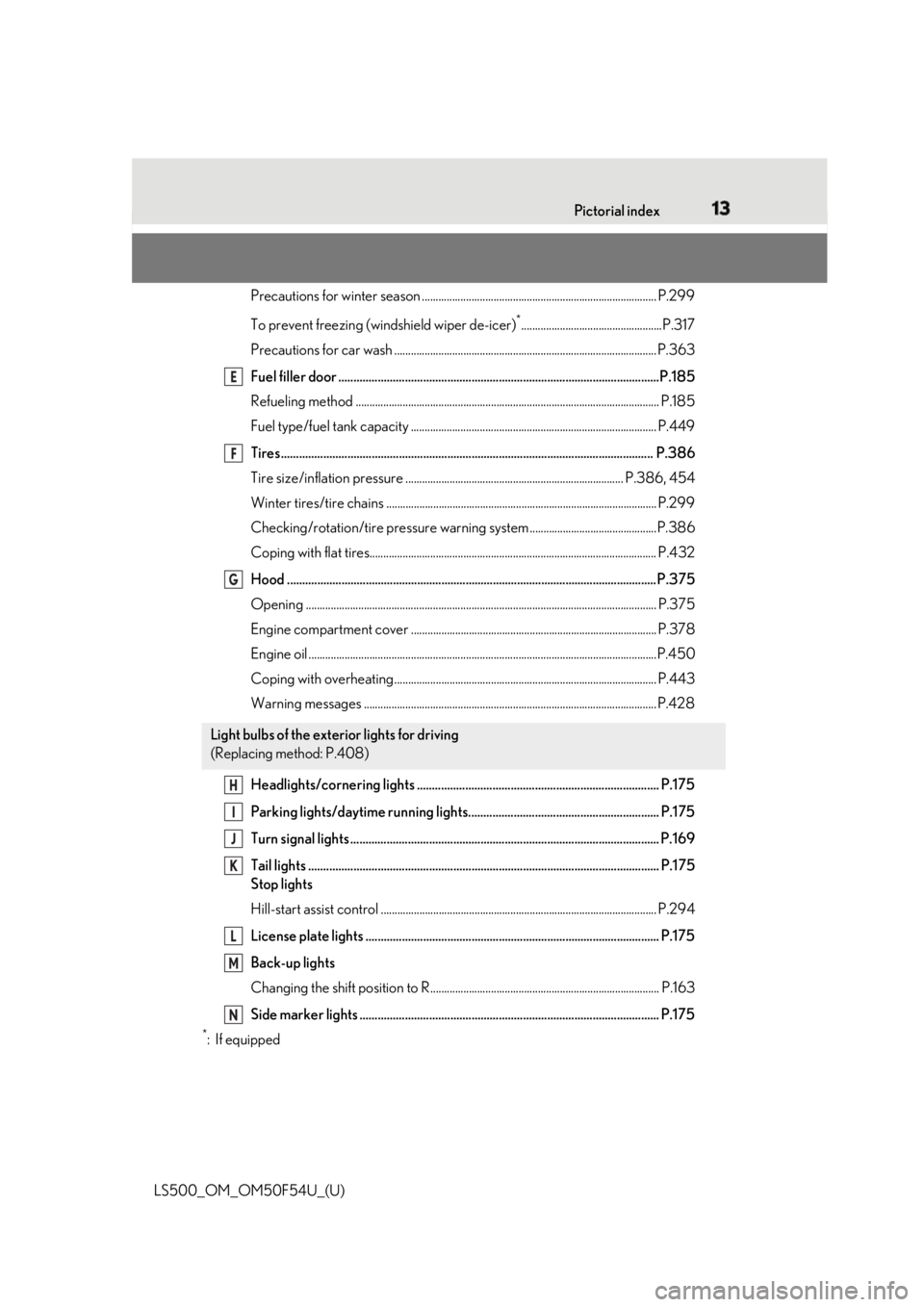
13Pictorial index
LS500_OM_OM50F54U_(U) Precautions for winter season .. ................................................................................... P.299
To prevent freezing (windshield wiper de-icer) *
...................................................P.317
Precautions for car wash ............................................................................................... P.363
Fuel filler door ..........................................................................................................P.185
Refueling method .............................................................................................................. P .185
Fuel type/fuel tank capacity ...... ................................................................................... P.449
Tires.......................................................................................................................... .P.386
Tire size/inflation pressure ............................ ................................................... P.386, 454
Winter tires/tire chains .................................................................................................. P.299
Checking/rotation/tire pressu re warning system..............................................P.386
Coping with flat tires........................................................................................................ P .432
Hood .......................................................................................................................... P .375
Opening ........................................................................................................................ ....... P.375
Engine compartment cover ......................................................................................... P.378
Engine oil ..................................................................................................................... .........P.450
Coping with overheating ............................................................................................... P.443
Warning messages .......................................................................................................... P.428
Headlights/cornering lights ................................................................................ P.175
Parking lights/daytime running lights............................................................... P.175
Turn signal lights ...................................................................................................... P.169
Tail lights .................................................................................................................... P.175
Stop lights
Hill-start assist control .................................................................................................... P. 294
License plate lights ................................................................................................. P.175
Back-up lights
Changing the shift position to R................................................................................... P.163
Side marker lights ................................................................................................... P.175 *
:If equipped Light bulbs of the exterior lights for driving
(Replacing method: P.408) E
F
G
H
I
J
K
L
M
N
Page 65 of 514
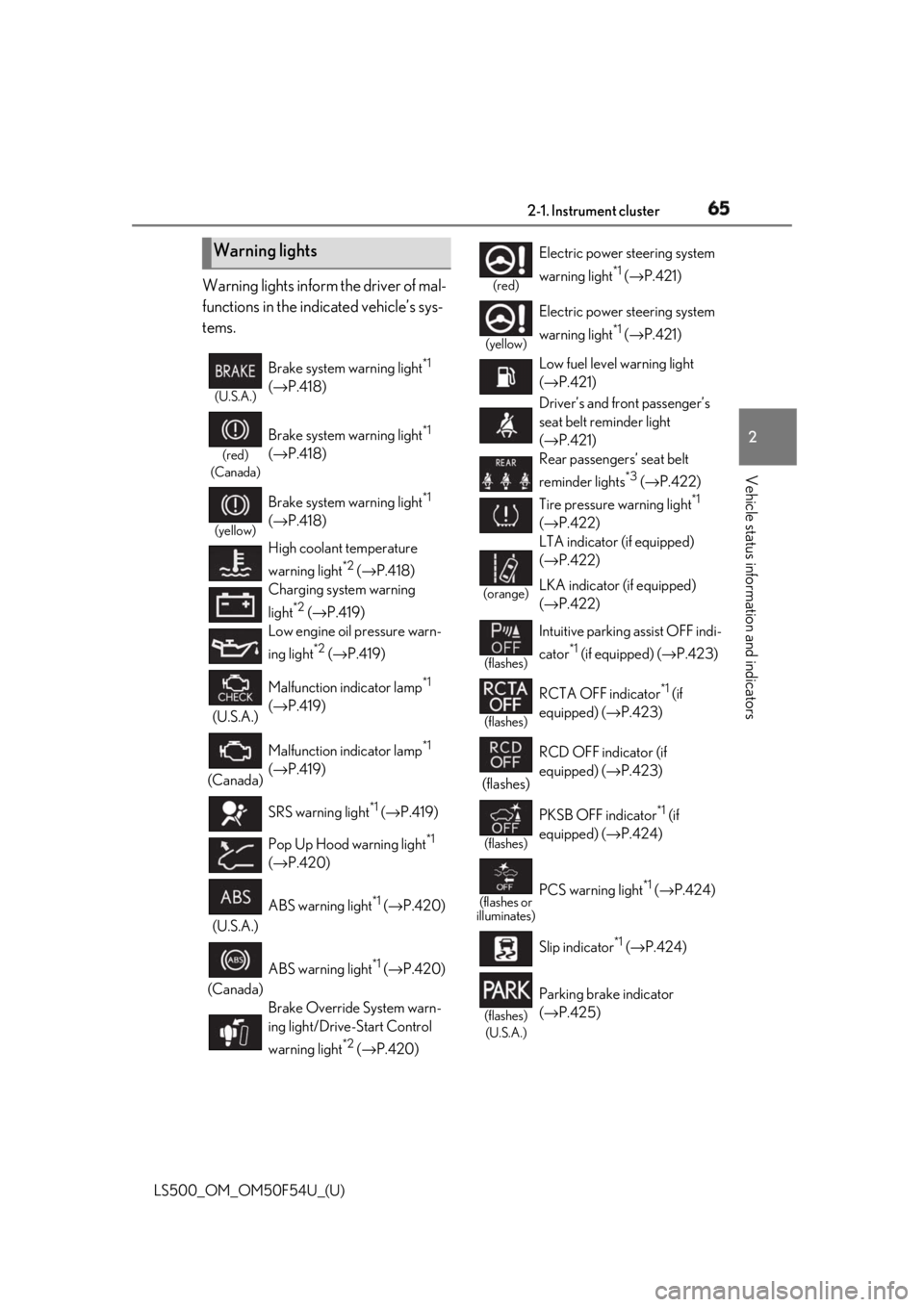
652-1. Instrument cluster
LS500_OM_OM50F54U_(U) 2
Vehicle status information and indicators Warning lights inform the driver of mal-
functions in the indicated vehicle’s sys-
tems.
Warning lights (U.S.A.)
Brake system warning light *1
( → P.418)(red)
(Canada)
Brake system warning light *1
( → P.418)(yellow)
Brake system warning light *1
( → P.418)
High coolant temperature
warning light *2
( → P.418)
Charging system warning
light *2
( → P.419)
Low engine oil pressure warn-
ing light *2
( → P.419)
(U.S.A.) Malfunction indicator lamp *1
( → P.419)
(Canada) Malfunction indicator lamp *1
( → P.419)
SRS warning light *1
( → P.419)
Pop Up Hood warning light *1
( → P.420)
(U.S.A.) ABS warning light *1
( → P.420)
(Canada) ABS warning light *1
( → P.420)
Brake Override System warn-
ing light/Drive-Start Control
warning light *2
( → P.420) (red)
Electric power steering system
warning light *1
( → P.421)(yellow)
Electric power steering system
warning light *1
( → P.421)
Low fuel level warning light
( → P.421)
Driver’s and front passenger’s
seat belt reminder light
( → P.421)
Rear passengers’ seat belt
reminder lights *3
( → P.422)
Tire pressure warning light *1
( → P.422)(orange)
LTA indicator (if equipped)
( → P.422)
LKA indicator (if equipped)
( → P.422)(flashes)
Intuitive parking assist OFF indi-
cator *1
(if equipped) ( → P.423)
(flashes)
RCTA OFF indicator *1
(if
equipped) ( → P.423)
(flashes) RCD OFF indicator (if
equipped) ( → P.423)
(flashes)
PKSB OFF indicator *1
(if
equipped) ( → P.424)
(flashes or
illuminates)
PCS warning light *1
( → P.424)
Slip indicator *1
( → P.424)
(flashes)
(U.S.A.) Parking brake indicator
( → P.425)
Page 67 of 514
672-1. Instrument cluster
LS500_OM_OM50F54U_(U) 2
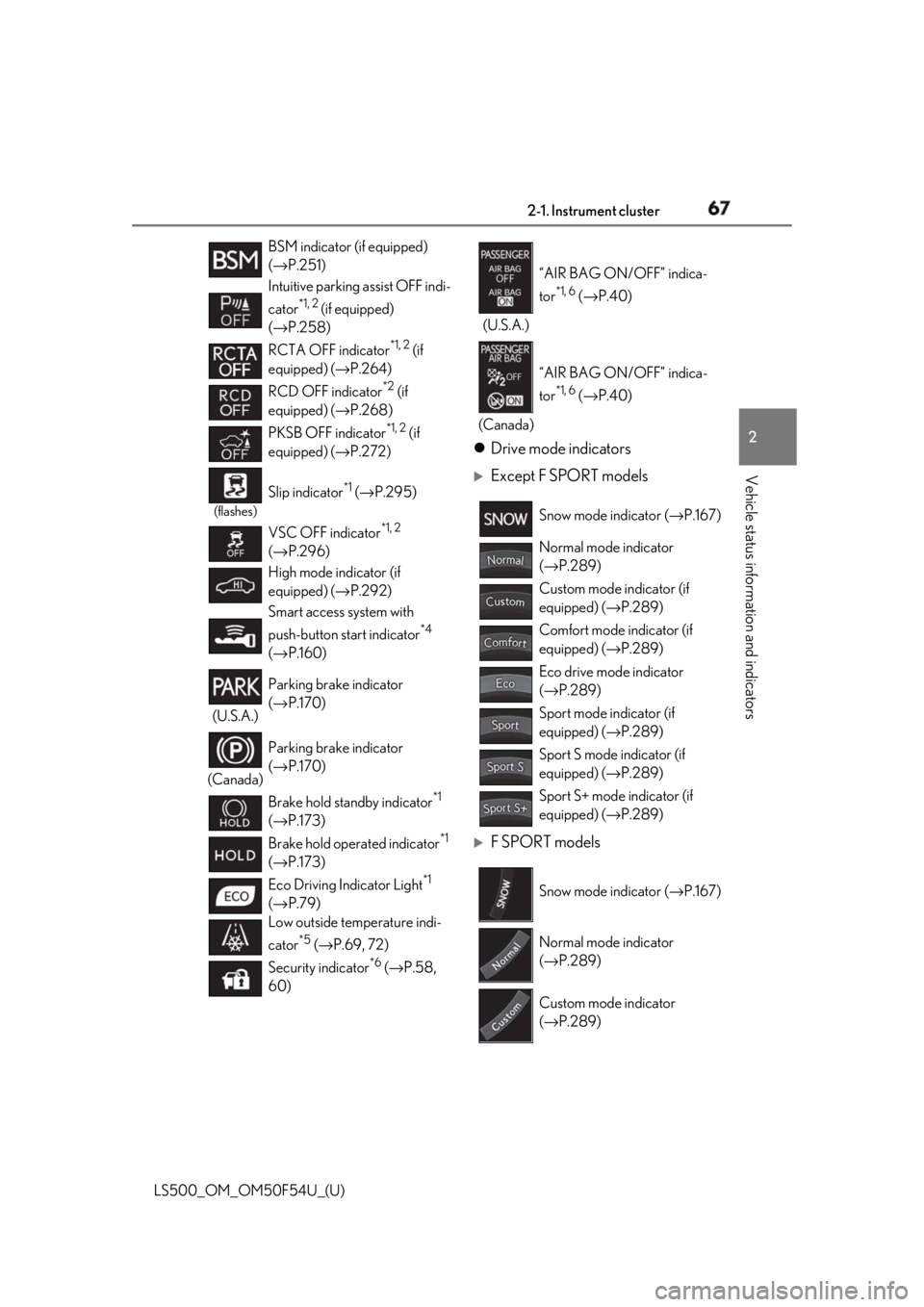
Vehicle status information and indicators Drive mode indicators
Except F SPORT models
F SPORT modelsBSM indicator (if equipped)
( → P.251)
Intuitive parking assist OFF indi-
cator *1, 2
(if equipped)
( → P.258)
RCTA OFF indicator *1, 2
(if
equipped) ( → P.264)
RCD OFF indicator *2
(if
equipped) ( → P.268)
PKSB OFF indicator *1, 2
(if
equipped) ( → P.272)(flashes)
Slip indicator *1
( → P.295)
VSC OFF indicator *1, 2
( → P.296)
High mode indicator (if
equipped) ( → P.292)
Smart access system with
push-button start indicator *4
( → P.160)
(U.S.A.) Parking brake indicator
( → P.170)
(Canada) Parking brake indicator
( → P.170)
Brake hold standby indicator *1
( → P.173)
Brake hold operated indicator *1
( → P.173)
Eco Driving Indicator Light *1
( → P.79)
Low outside temperature indi-
cator *5
( → P.69, 72)
Security indicator *6
( → P.58,
60) (U.S.A.) “AIR BAG ON/OFF” indica-
tor *1, 6
( → P.40)
(Canada) “AIR BAG ON/OFF” indica-
tor *1, 6
( → P.40)
Snow mode indicator ( → P.167)
Normal mode indicator
( → P.289)
Custom mode indicator (if
equipped) ( → P.289)
Comfort mode indicator (if
equipped) ( → P.289)
Eco drive mode indicator
( → P.289)
Sport mode indicator (if
equipped) ( → P.289)
Sport S mode indicator (if
equipped) ( → P.289)
Sport S+ mode indicator (if
equipped) ( → P.289)
Snow mode indicator ( → P.167)
Normal mode indicator
( → P.289)
Custom mode indicator
( → P.289)
Page 86 of 514
86 2-1. Instrument cluster
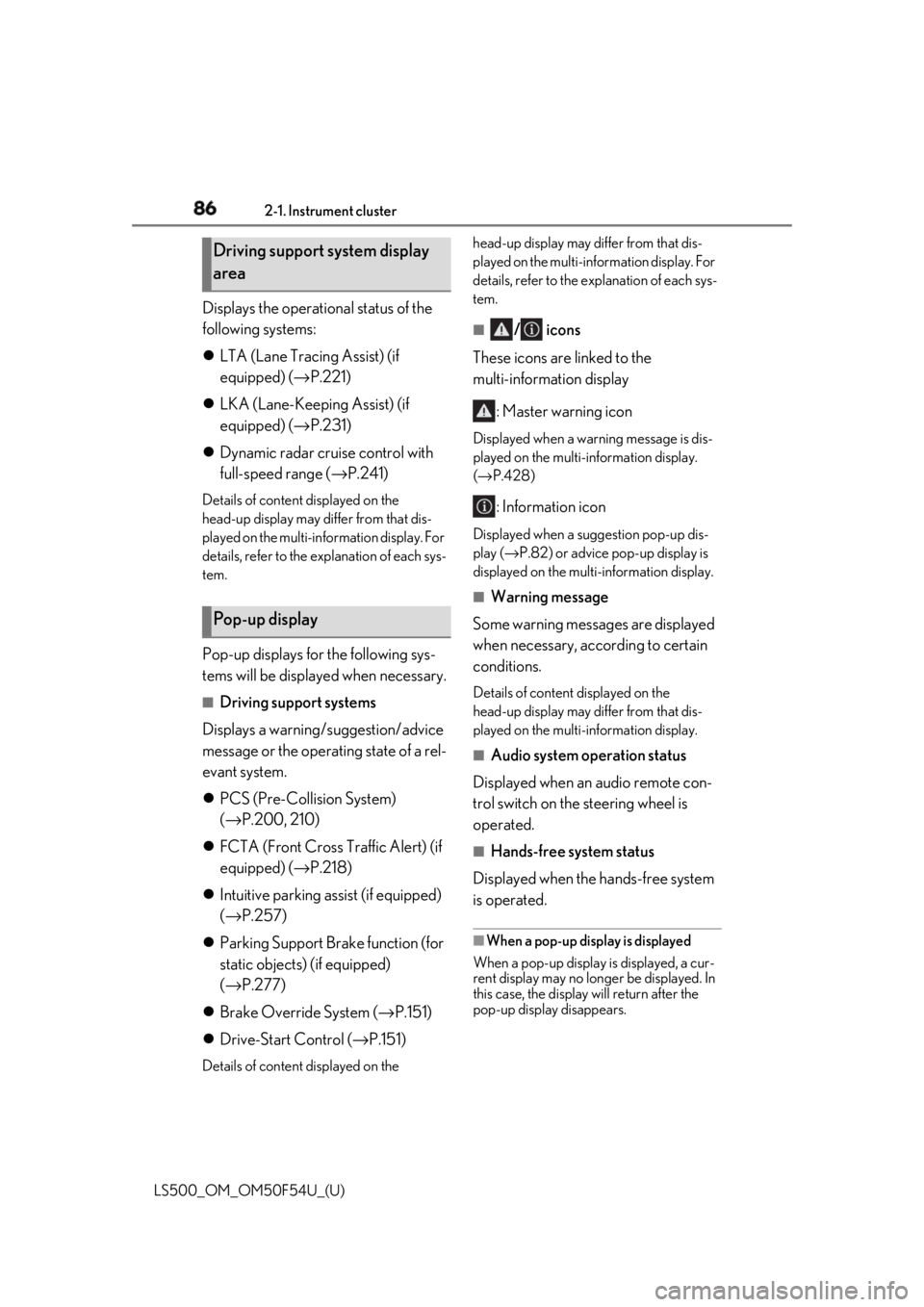
LS500_OM_OM50F54U_(U) Displays the operational status of the
following systems:
LTA (Lane Tracing Assist) (if
equipped) ( → P.221)
LKA (Lane-Keeping Assist) (if
equipped) ( → P.231)
Dynamic radar cruise control with
full-speed range ( → P.241)Details of content displayed on the
head-up display may differ from that dis-
played on the multi-information display. For
details, refer to the explanation of each sys-
tem.
Pop-up displays for the following sys-
tems will be displayed when necessary. ■
Driving support systems
Displays a warning/suggestion/advice
message or the operating state of a rel-
evant system.
PCS (Pre-Collision System)
( → P.200, 210)
FCTA (Front Cross Traffic Alert) (if
equipped) ( → P.218)
Intuitive parking assist (if equipped)
( → P.257)
Parking Support Brake function (for
static objects) (if equipped)
( → P.277)
Brake Override System ( → P.151)
Drive-Start Control ( → P.151)
Details of content displayed on the head-up display may differ from that dis-
played on the multi-information display. For
details, refer to the explanation of each sys-
tem. ■
/ icons
These icons are linked to the
multi-information display
: Master warning icon Displayed when a warn ing message is dis-
played on the multi-information display.
( → P.428)
: Information icon Displayed when a suggestion pop-up dis-
play ( → P.82) or advice pop-up display is
displayed on the multi-information display. ■
Warning message
Some warning messages are displayed
when necessary, according to certain
conditions. Details of content displayed on the
head-up display may differ from that dis-
played on the multi-information display. ■
Audio system operation status
Displayed when an audio remote con-
trol switch on the steering wheel is
operated. ■
Hands-free system status
Displayed when the hands-free system
is operated. ■
When a pop-up display is displayed
When a pop-up display is displayed, a cur-
rent display may no long er be displayed. In
this case, the display will return after the
pop-up display disappears.Driving support system display
area
Pop-up display
Page 109 of 514

1093-2. Opening, closing and locking the doors and trunk
LS500_OM_OM50F54U_(U) 3
Before driving gas station, radio stat ion, large display,
airport or other faci lity that generates
strong radio waves or electrical noise●
When carrying a portable radio, cellular
phone, cordless phone or other wireless
communication device●
When the electronic key is in contact
with, or is covered by the following metal-
lic objects
• Cards to which aluminum foil is attached
• Cigarette boxes that have aluminum foil
inside
• Metallic wallets or bags
•Coins
• Hand warmers made of metal
• Media such as CDs and DVDs ●
When other wireless ke ys (that emit radio
waves) are being used nearby●
When carrying the electronic key
together with the following devices that
emit radio waves
• Another vehicle’s electronic key or a
wireless key that emits radio waves
• Personal computers or personal digital
assistants (PDAs)
• Digital audio players
• Portable game systems ●
If window tint with a metallic content or
metallic objects are attached to the rear
window●
When the electronic key is placed near a
battery charger or electronic devices●
When the vehicle is parked in a pay park-
ing spot where radio waves are emitted.■
Note for the entry function●
Even when the electronic key is within the
effective range (detection areas), the sys-
tem may not operate properly in the fol-
lowing cases:
• The electronic key is too close to the win-
dow or outside door handle, near the
ground, or in a high place when the doors
are locked or unlocked.
• The electronic key is near the ground or
in a high place, or too close to the center
of the rear bumper when the trunk is
opened.
• The electronic key is on the instrument
panel, rear package tray or floor, or in the
door pockets or glove box when the engine is started or engine switch modes
are changed. ●
Do not leave the electronic key on top of
the instrument panel or near the door
pockets when exiting the vehicle.
Depending on the radio wave reception
conditions, it may be detected by the
antenna outside the cabin and the doors
will become lockable from the outside,
possibly trapping the electronic key
inside the vehicle. ●
As long as the electronic key is within the
effective range, the doors may be locked
or unlocked by anyone. However, only
the doors detecting the electronic key
can be used to unlock the vehicle. ●
Even if the electronic key is not inside the
vehicle, it may be po ssible to start the
engine if the electronic key is near the
window. ●
The doors may unlock or lock if a large
amount of water splashes on the door
handle, such as in the rain or in a car
wash, when the electronic key is within
the effective range. (The doors will auto-
matically be locked after approximately
60 seconds if the doors are not opened
and closed.) ●
If the wireless remote control is used to
lock the doors when the electronic key is
near the vehicle, there is a possibility that
the door may not be unlocked by the
entry function. (Use the wireless remote
control to unlock the doors.) ●
Touching the door lock sensor while
wearing gloves may delay or prevent lock
operation. ●
When the lock operation is performed
using the lock sensor, recognition signals
will be shown up to two consecutive
times. After this, no recognition signals
will be given.
●
If the door handle becomes wet while the
electronic key is within the effective
range, the door may lock and unlock
repeatedly. In this case, follow the follow-
ing correction procedures to wash the
vehicle:
• Place the electronic key in a location 6 ft.
(2 m) or more away from the vehicle.
(Take care to ensure that the key is not
Page 149 of 514
149
LS500_OM_OM50F54U_(U) 4 4
Driving Driving .
4-1. Before driving
Driving the vehicle ..................... 150
Cargo and luggage ................... 156
Vehicle load limits ...................... 158
Trailer towing ............................... 159
Dinghy towing ............................. 159
4-2. Driving procedures
Engine (ignition) switch ........... 160
Automatic transmission........... 163
Turn signal lever.......................... 169
Parking brake .............................. 170
Brake Hold.................................... 173
4-3. Operating the lights and wipers
Headlight switch ......................... 175
AHB (Automatic High Beam)
......................................................... 178
Windshield wipers and washer
......................................................... 180
4-4. Refueling
Opening the fuel tank cap...... 185
4-5. Using the driving support sys-
tems
Lexus Safety System+A........... 187
Lexus Safety System+ .............. 194
PCS (Pre-Collision System) (vehi-
cles with Lexus Safety Sys-
tem+A) ....................................... 200
PCS (Pre-Collision System) (vehi-
cles with Lexus Safety System+)
......................................................... 210 FCTA (Front Cross Traffic Alert)
........................................................ 218
LTA (Lane Tracing Assist) ...... 221
LKA (Lane-Keeping Assist)
........................................................ 231
RSA (Road Sign Assist).......... 238
Dynamic radar cruise control with
full-speed range........................ 241
BSM (Blind Spot Monitor) ..... 251
PKSA (Parking Support Alert)
....................................................... 256
Intuitive parking assist ............. 257
RCTA (Rear cross traffic alert)
function....................................... 264
RCD (Rear Camera Detection)
function....................................... 268
PKSB (Parking Support Brake)
......................................................... 271
Parking Support Brake function
(static objects) ......................... 277
Parking Support Brake function
(rear-crossing vehicles) ...... 282
Parking Support Brake function
(rear pedestrians) .................. 286
Driving mode select switch .. 289
Electronically modulated air sus-
pension ........................................ 291
Driving assist systems.............. 294
4-6. Driving tips
Winter driving tips .................... 299
Page 150 of 514
150 4-1. Before driving
LS500_OM_OM50F54U_(U) 4-1.Before driving
■
Starting the engine
→ P.160 ■
Driving
1 With the brake pedal depressed,
shift the shift position to D.
( → P.163)Check that the shift position indicator
shows D.
2 If the parking brake is in manual
mode, release the parking brake.
( → P.170)
3 Gradually release the brake pedal
and gently depress the accelerator
pedal to accelerate the vehicle. ■
Stopping
1 With the shift position in D, depress
the brake pedal.
2 If necessary, set the parking brake.If the vehicle is to be stopped for an
extended period of time, shift the shift posi-
tion to P. ( → P.166)
■
Parking the vehicle
1 With the shift position in D, depress
the brake pedal to stop the vehicle
completely.
2 If the parking brake is in manual
mode, set the parking brake.
( → P.170)
3 Shift the shift position to P.
( → P.166) 4 Press the engine switch to stop the
engine.
5 Slowly release the brake pedal.
6 Lock the door, making sure that you
have the electronic key on your
person. If parking on a hill, block the wheels as
needed. ■
Starting off on a steep uphill
1 Make sure that the parking brake is
set and shift the shift position to D. Hill-start assist control will operate.
( → P.294)
2 Gently depress the accelerator
pedal.
3 Release the parking brake. ■
Driving in the rain ●
Drive carefully when it is raining, because
visibility will be reduced, the windows
may become fogged-up, and the road
will be slippery. ●
Drive carefully when it starts to rain,
because the road surface will be espe-
cially slippery. ●
Refrain from high speeds when driving on
an expressway in the rain, because there
may be a layer of wa ter between the tires
and the road surface, preventing the
steering and brakes from operating prop-
erly.
■
Engine speed while driving
In the following conditions, the engine
speed may become high while driving. This
is due to automatic up-shifting control or
down-shifting implementation to meet driv-
ing conditions. It does not indicate sudden
acceleration.
●
The vehicle is judged to be driving uphill
or downhill
●
When the accelerato r pedal is released
●
When the brake pedal is depressedDriving the vehicle The following procedures should be
observed to ensure safe driving:
Driving procedure
Page 155 of 514
1554-1. Before driving
LS500_OM_OM50F54U_(U) 4
Driving WARNING●
Vehicles with Lexus Safety System+A:
If the electronically controlled brake
system does not operate, do not follow
other vehicles closely and avoid hills or
sharp turns that require braking.
In this case, braking is still possible, but
the brake pedal should be depressed
more firmly than usual. Also, the brak-
ing distance will increase. Have your
brakes fixed immediately.●
Vehicles without Lexus Safety Sys-
tem+A: Do not pump the brake pedal
if the engine stalls.
Each push on the brake pedal uses up
the reserve for the power-assisted
brakes.●
Vehicles without Lexus Safety Sys-
tem+A: The brake system consists of 2
individual hydraulic systems; if one of
the systems fails, the other will still
operate. In this case, the brake pedal
should be depressed more firmly than
usual and the braking distance will
increase. Have your brakes fixed
immediately.●
Vehicles with Lexus Safety System+A:
The brake system consists of 2 or more
individual hydraulic systems; if one of
the systems fails, the other(s) will still
operate. In this case, the brake pedal
should be depressed more firmly than
usual and the braking distance will
increase. Have your brakes fixed
immediately.
■
If the vehicle becomes stuck
Do not spin the wheels excessively when
a driven wheel is up in the air, or the vehi-
cle is stuck in sand, mud, etc. This may
damage the driveline components or
propel the vehicle forward or backward,
causing an accident. NOTICE■
When driving the vehicle ●
Do not depress the accelerator and
brake pedals at the same time during
driving, as this may restrain the engine
output. ●
Do not use the accelerator pedal or
depress the accelerator and brake
pedals at the same time to hold the
vehicle on a hill. ■
When parking the vehicle
Always set the parking brake, and shift
the shift position to P. Failure to do so
may cause the vehicle to move or the
vehicle may accelerate suddenly if the
accelerator pedal is accidentally
depressed. ■
Avoiding damage to vehicle parts ●
Do not turn the steering wheel fully in
either direction and hold it there for an
extended period of time.
Doing so may damage the power
steering motor. ●
When driving over bumps in the road,
drive as slowly as possible to avoid
damaging the wheels, underside of the
vehicle, etc.
●
Make sure to idle the engine immedi-
ately after high-load driving. Stop the
engine only after the turbocharger has
cooled down.
Failure to do so may cause damage to
the turbocharger.
■
If you get a flat tire while driving
A flat or damaged tire may cause the fol-
lowing situations. Hold the steering
wheel firmly and gradually depress the
brake pedal to slow down the vehicle.
●
It may be difficult to control your vehi-
cle.
●
The vehicle will make abnormal
sounds or vibrations.
●
The vehicle will lean abnormally.