air LEXUS LS500 2019 Owners Manual
[x] Cancel search | Manufacturer: LEXUS, Model Year: 2019, Model line: LS500, Model: LEXUS LS500 2019Pages: 512, PDF Size: 9.71 MB
Page 430 of 512
430 7-2. Steps to take in an emergency
LS500_OM_(U)_1810 One of the following may be the cause
of the problem:
There may not be sufficient fuel in
the vehicle’s tank.
Refuel the vehicle.
The engine may be flooded.
Try to restart the engine again fol-
lowing correct starting procedures.
( P.164)
There may be a malfunction in the
engine immobilizer system.
( P.63)
There may be a malfunction in the
shift control system. *
( P.167, 428) *
: It may not be possible to shift the shift
position from P.
One of the following may be the cause
of the problem:
The battery may be discharged. NOTICE■
When replacing the tires
When removing or fitting the wheels,
tires or the tire pressure warning valve
and transmitter, contact your Lexus
dealer as the tire pr essure warning valve
and transmitter may be damaged if not
handled correctly. ■
When driving over bumps
If a vehicle has a flat tire, the vehicle
height will be lower than usual. Ensure
that nothing strikes the bottom of the
vehicle. ■
To avoid damage to the tire pressure
warning valves and transmitters
When a tire is repaired with liquid seal-
ants, the tire pressu re warning valve and
transmitter may not operate properly. If a
liquid sealant is used , contact your Lexus
dealer or other qualified service shop as
soon as possible. Make sure to replace
the tire pressure warning valve and trans-
mitter when replacing the tire. ( P.387) If the engine will not start If the engine will not start even
though correct starting procedures
are being followed ( P.164), con-
sider each of the following points:
The engine will not start even
though the starter motor oper-
ates normally.
The starter motor turns over
slowly, the interior lights and
headlights are dim, or the horn
does not sound or sounds at a low
volume.
Page 431 of 512
4317-2. Steps to take in an emergency
LS500_OM_(U)_1810 7
When trouble arises ( P.435)
The battery terminal connections
may be loose or corroded.
( P.380)
The engine starting system may be
malfunctioning due to an electrical
problem such as electronic key battery
depletion or a blown fuse. However, an
interim measure is available to start the
engine. ( P.431)
One of the following may be the cause
of the problem:
One or both of the battery terminals
may be disconnected. ( P.380)
The battery may be discharged.
( P.435)
There may be a malfunction in the
steering lock system. Contact your Lexus dealer if the problem
cannot be repaired, or if repair procedures
are unknown.
When the engine does not start, the
following steps can be used as an
interim measure to start the engine if
the engine switch is functioning nor- mally.
Do not use this starting procedure
except in cases of emergency.
1 Press the parking brake switch to
check that the parking brake is set.
( P.174) Parking brake indicator will come on.
2 Turn the engine switch to ACCES-
SORY mode.
3 Press and hold the engine switch
for about 15 seconds while
depressing the brake pedal firmly.
Even if the engine can be started using
the above steps, the system may be
malfunctioning. Have the vehicle
inspected by your Lexus dealer.The starter motor does not turn
over
The starter motor does not turn
over, the interior lights and head-
lights do not turn on, or the horn
does not sound.
Starting the engine in an emer-
gency
Page 435 of 512
4357-2. Steps to take in an emergency
LS500_OM_(U)_1810 7
When trouble arises If you have a set of jumper (or booster)
cables and a second vehicle with a
12-volt battery, you can jump start your
vehicle by following the steps below.
Method connecting jumper (or
booster) cables to the battery
1 Confirm that the electronic key is
being carried. When connecting the jumper (or booster)
cables, depending on the situation, the
alarm may activate and doors locked.
( P.66)
2 Open the trunk lid and remove the
luggage mat. ( P.340)In the event that the trunk opener cannot
be used, use the mechanical key to open
the trunk. ( P.433)
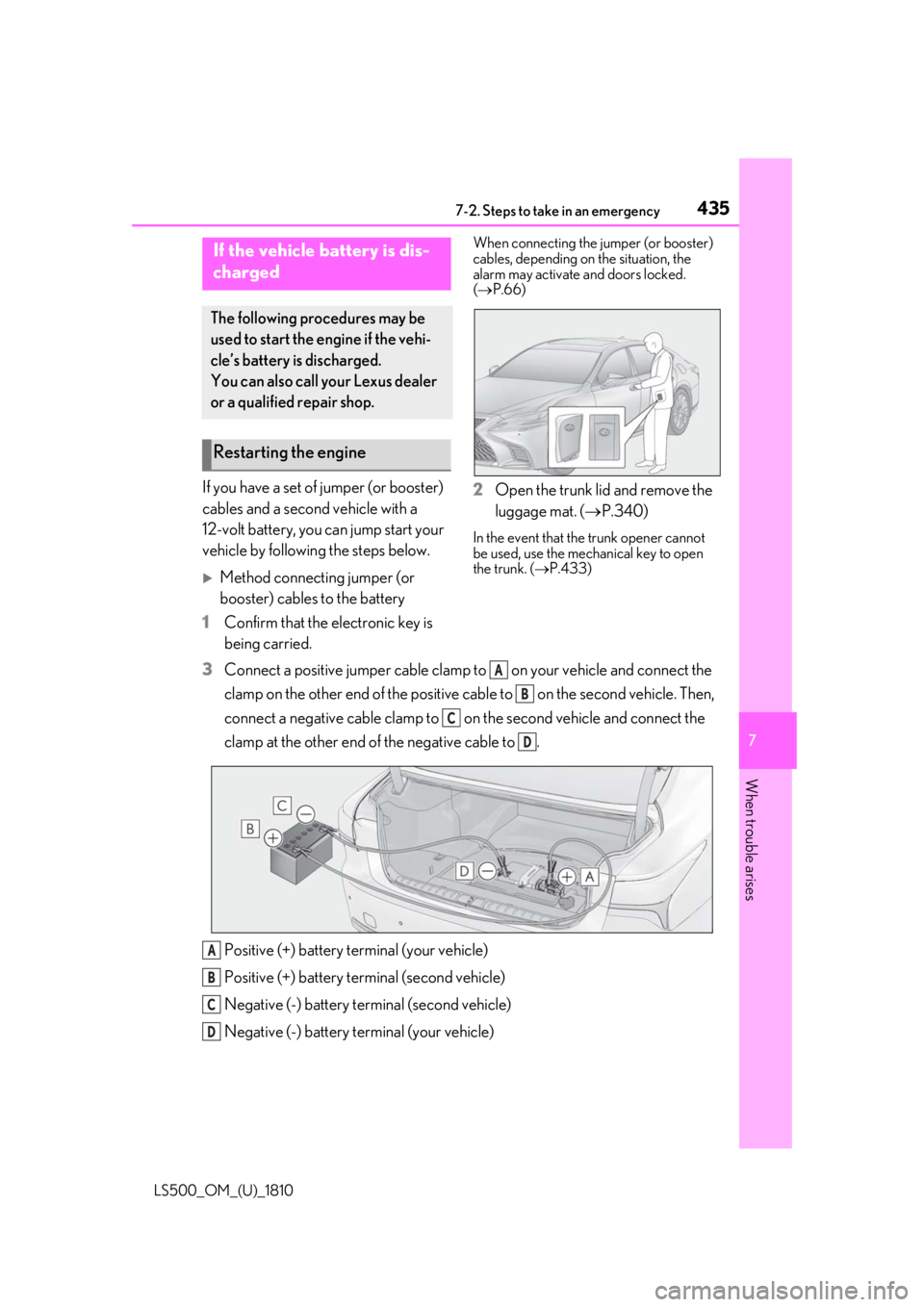
3 Connect a positive jumper cable clamp to on your vehicle and connect the
clamp on the other end of the positive cab le to on the second vehicle. Then,
connect a negative cable clamp to on the second vehicle and connect the
clamp at the other end of the negative cable to .
Positive (+) battery terminal (your vehicle)
Positive (+) battery terminal (second vehicle)
Negative (-) battery terminal (second vehicle)
Negative (-) battery terminal (your vehicle)If the vehicle battery is dis-
charged The following procedures may be
used to start the engine if the vehi-
cle’s battery is discharged.
You can also call your Lexus dealer
or a qualified repair shop.
Restarting the engine
A
B
C
D
A
B
C
D
Page 440 of 512

440 7-2. Steps to take in an emergency
LS500_OM_(U)_1810 1 Stop the vehicle in a safe place and
turn off the air conditioning system,
and then stop the engine.
2 If you see steam:
Carefully lift the hood after the
steam subsides.
If you do not see steam:
Carefully lift the hood.
3 After the engine has cooled down
sufficiently, inspect the hoses and radiator core (radiator) for any
leaks.
Radiators
Cooling fan If a large amount of coolant leaks, immedi-
ately contact your Lexus dealer.
4 The coolant level is satisfactory if it
is between the “F” and “L” lines on
the reservoir.
Engine
Reservoir
“F” line
“L” line
Coolant inlet cap
IntercoolerIf your vehicle overheats The following may indicate that
your vehicle is overheating.
The engine coolant temperature
gauge ( P.73, 76) is in the red
zone or a loss of engine power is
experienced. (For example, the
vehicle speed does not increase.)
“Engine Coolant Temp High Stop
in a Safe Place See Owner’s
Manual” is shown on the
multi-information display.
Steam comes out from under the
hood.
Correction procedures A
B
A
B
C
D
Page 441 of 512

4417-2. Steps to take in an emergency
LS500_OM_(U)_1810 7
When trouble arises Reservoir
“F” line
“L” line
5 Add coolant if necessary.Water can be used in an emergency if
coolant is unavailable.
Engine
P.441
Intercooler Remove the engine compartment cover
and add coolant. 6 Start the engine and turn the air
conditioning system on to check
that the radiator cooling fan oper-
ates and to check for coolant leaks
from the radiator or hoses. The fan operates when the air conditioning
system is turned on immediately after a
cold start. Confirm that the fan is operating
by checking the fan sound and air flow. If it
is difficult to check these, turn the air con-
ditioning system on and off repeatedly.
(The fan may not oper ate in freezing tem-
peratures.)
7 If the fan is not operating:
Stop the engine immediately and
contact your Lexus dealer.
If the fan is operating:
Have the vehicle inspected at the
nearest Lexus dealer. ■
When adding engine coolant
Add coolant in accordance with the follow-
ing procedure.A
B
C
Page 446 of 512
446 8-1. Specifications
LS500_OM_(U)_1810 8-1.Specifications
*1
: Unladen vehicles *2
: Without electronically modulated air suspension *3
: With electronically mo dulated air suspension*4
:Except F SPORT models *5
:F SPORT models
■
Vehicle identification number
The vehicle identification number
(VIN) is the legal identifier for your
vehicle. This is the primary identifica-
tion number for your Lexus. It is used in
registering the ownership of your vehi-
cle.
This number is stamped on the top left of the instrument panel.Maintenance data (fuel, oil level, etc.)
Dimensions and weight Overall length 206.1 in. (5235 mm)
Overall width 74.8 in. (1900 mm)
Overall height *1
2WD models 57.5 in. (1460 mm) *2
57.1 in. (1450 mm) *3
AWD models 57.9 in. (1470 mm) *2
57.5 in. (1460 mm) *3
Wheelbase 123.0 in. (3125 mm)
Tread *1
Front 2WD models 64.2 in. (1630 mm)
AWD models 64.2 in. (1630 mm) *2
64.4 in. (1635 mm) *3
Rear 64.4 in. (1635 mm) *4
63.6 in. (1615 mm) *5
Vehicle capacity weight
(Occupants + luggage) 870 lb. (395 kg)
Vehicle identification
Page 457 of 512

4578-1. Specifications
LS500_OM_(U)_1810 8
Vehicle specifications
Tire size ( P.458)
Run-flat tire (RFT) or standard tire ( P.429)This vehicle can be equipped with either run-flat tires (RFT) or standard tires. A
mark is molded on the side wall of the run-flat tire.
DOT and Tire Identification Number (TIN) ( P.458)
Location of treadwear indicators ( P.382)
Tire ply composition and materialsPlies are layers of rubber-coa ted parallel cords. Cords are the strands which form the plies
in a tire.
Radial tires or bias-ply tiresA radial tire has “RADIAL” on the sidewall. A tire not marked “RADIAL” is a bias-ply tire.
TUBELESS or TUBE TYPEA tubeless tire does not have a tube and air is directly put into the tire. A tube type tire has a
tube inside the tire and the tube maintains the air pressure.
Load limit at maximum cold tire inflation pressure ( P.383)
Maximum cold tire inflation pressure ( P.452)This means the pressure to which a tire may be inflated.
Uniform tire quality gradingFor details, see “Uniform Tire Quality Grading” that follows.
Summer tires or all season tires ( P.383)Tire information
Typical tire symbols
A
B
C
D
E
F
G
H
I
J
K
Page 461 of 512
4618-1. Specifications
LS500_OM_(U)_1810 8
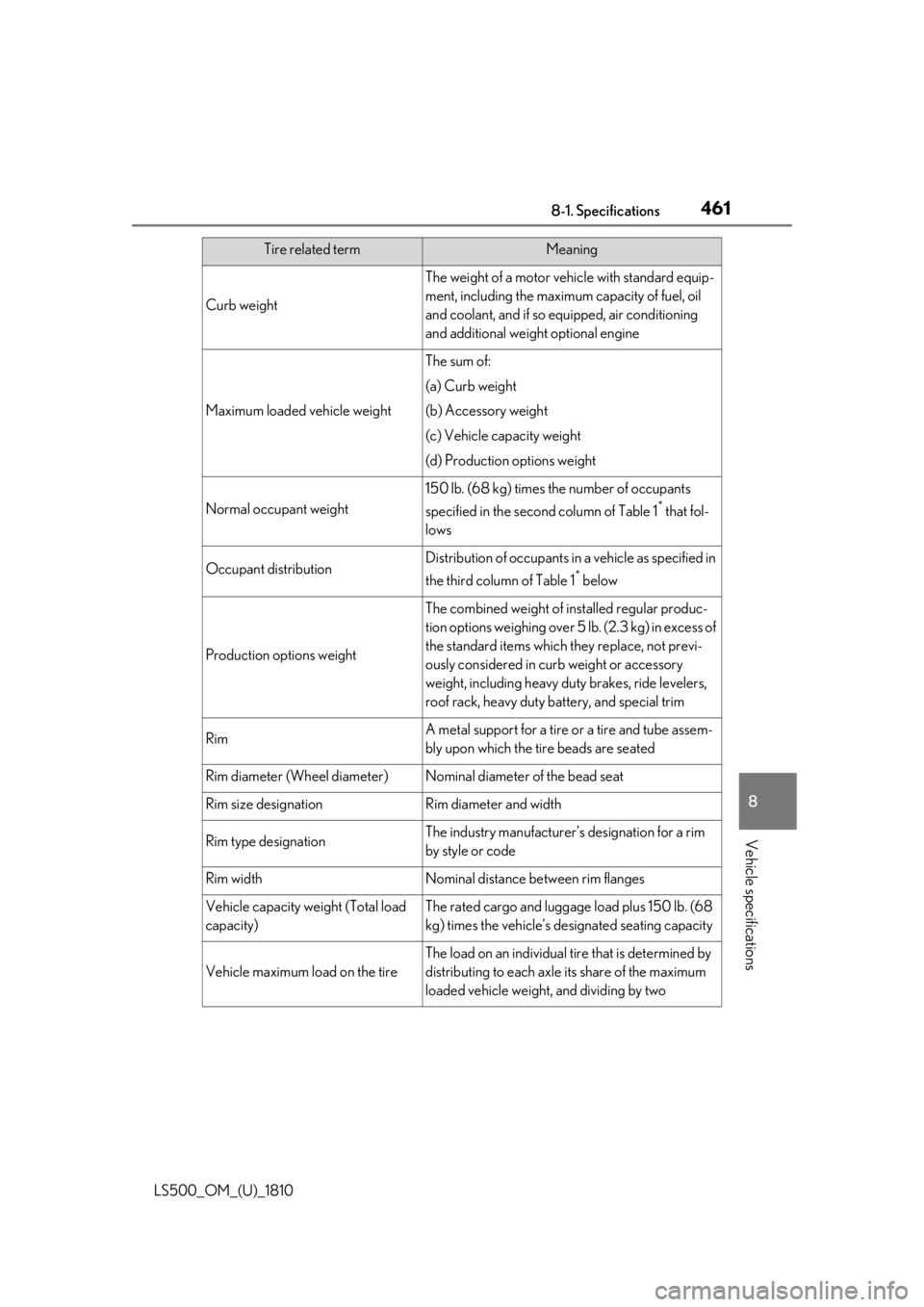
Vehicle specifications Curb weight The weight of a motor vehicle with standard equip-
ment, including the maximum capacity of fuel, oil
and coolant, and if so equipped, air conditioning
and additional weight optional engine
Maximum loaded vehicle weight The sum of:
(a) Curb weight
(b) Accessory weight
(c) Vehicle capacity weight
(d) Production options weight
Normal occupant weight 150 lb. (68 kg) times the number of occupants
specified in the second column of Table 1 *
that fol-
lows
Occupant distribution Distribution of occupants in a vehicle as specified in
the third column of Table 1 *
below
Production options weight The combined weight of installed regular produc-
tion options weighing over 5 lb. (2.3 kg) in excess of
the standard items which they replace, not previ-
ously considered in curb weight or accessory
weight, including heavy duty brakes, ride levelers,
roof rack, heavy duty battery, and special trim
Rim A metal support for a tire or a tire and tube assem-
bly upon which the tire beads are seated
Rim diameter (Wheel diameter) Nominal diameter of the bead seat
Rim size designation Rim diameter and width
Rim type designation The industry manufacturer’s designation for a rim
by style or code
Rim width Nominal distance between rim flanges
Vehicle capacity weight (Total load
capacity) The rated cargo and luggage load plus 150 lb. (68
kg) times the vehicle’s de signated seating capacity
Vehicle maximum load on the tire The load on an individual ti re that is determined by
distributing to each axle its share of the maximum
loaded vehicle weight, and dividing by twoTire related term Meaning
Page 462 of 512
462 8-1. Specifications
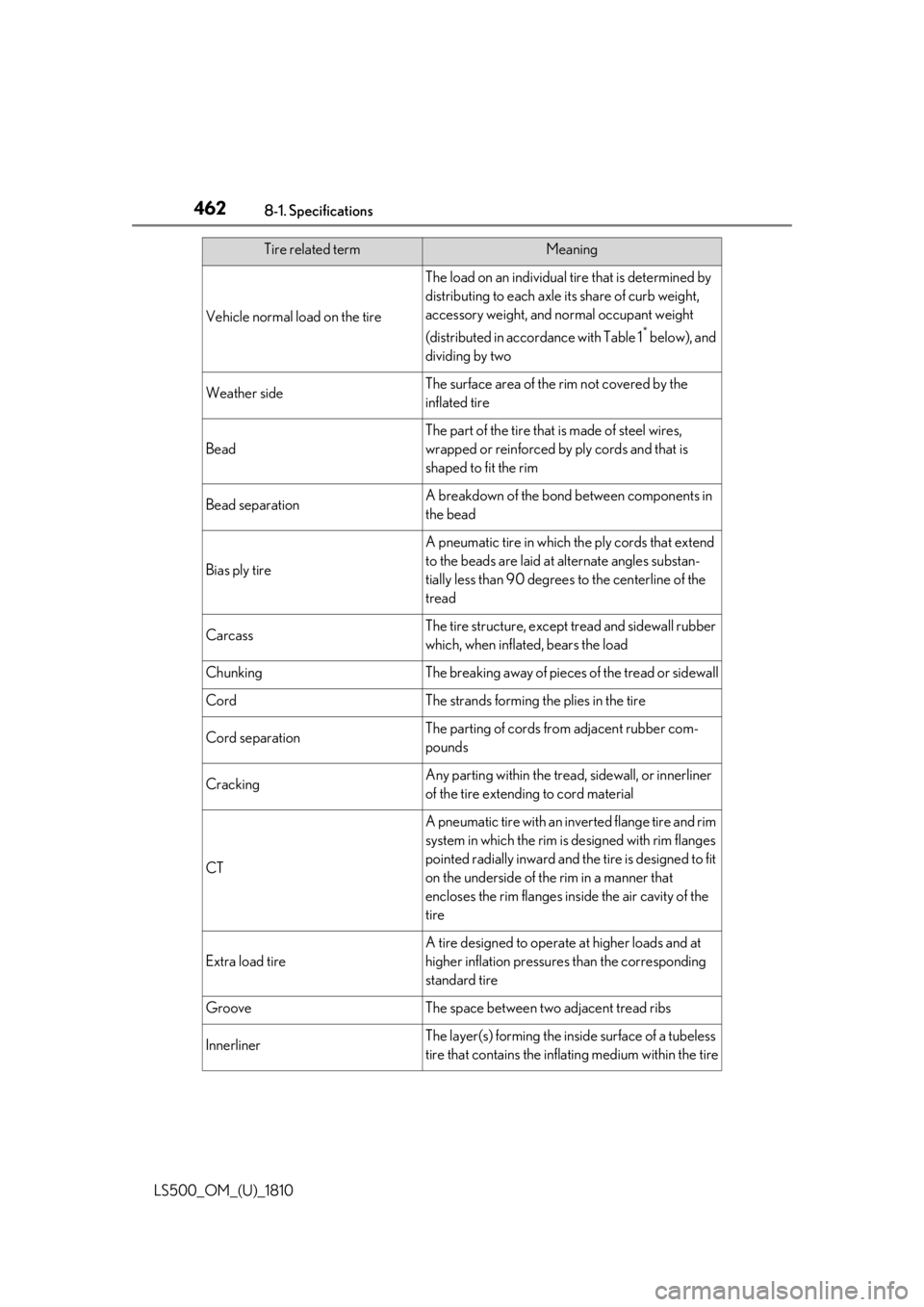
LS500_OM_(U)_1810 Vehicle normal load on the tire The load on an individual ti re that is determined by
distributing to each axle its share of curb weight,
accessory weight, and normal occupant weight
(distributed in accor dance with Table 1 *
below), and
dividing by two
Weather side The surface area of the rim not covered by the
inflated tire
Bead The part of the tire that is made of steel wires,
wrapped or reinforced by ply cords and that is
shaped to fit the rim
Bead separation A breakdown of the bond between components in
the bead
Bias ply tire A pneumatic tire in which the ply cords that extend
to the beads are laid at alternate angles substan-
tially less than 90 degrees to the centerline of the
tread
Carcass The tire structure, except tread and sidewall rubber
which, when inflated, bears the load
Chunking The breaking away of pieces of the tread or sidewall
Cord The strands forming the plies in the tire
Cord separation The parting of cords from adjacent rubber com-
pounds
Cracking Any parting within the tread, sidewall, or innerliner
of the tire extending to cord material
CT A pneumatic tire with an inverted flange tire and rim
system in which the rim is designed with rim flanges
pointed radially inward and the tire is designed to fit
on the underside of the rim in a manner that
encloses the rim flanges inside the air cavity of the
tire
Extra load tire A tire designed to operat e at higher loads and at
higher inflation pressures than the corresponding
standard tire
Groove The space between two adjacent tread ribs
Innerliner The layer(s) forming the in side surface of a tubeless
tire that contains the inflating medium within the tireTire related term Meaning
Page 477 of 512

4778-2. Customization
LS500_OM_(U)_1810 8
Vehicle specifications ■
PKSB (Parking Support Brake) *
( P.270)*
:If equipped ■
Driving mode select switch ( P.289)*
:If equipped ■
Electronically modulated air suspension *
( P.291)
*
:If equipped
■
Automatic air conditioning system ( P.313)Function Default setting Customized set-
ting
PKSB (Parking Support
Brake) function On Off — O — —
Function Default setting Customized set-
ting
Powertrain control in custom
mode *
Normal Power
O — — —
Eco
Chassis control in custom
mode *
Normal Sport
O — — —
Comfort
Air conditioning operation in
custom mode *
Normal Eco O — — —
Function Default setting Customized set-
ting
Vehicle height control On Off — O — —
Ingress/egress height control
function On Off — O — —
Vehicle height when parked Normal High — O — —
Function Default setting Customized set-
ting
A/C auto switch operation On Off O — — O
Exhaust gas sensor sensitivity Standard -3 to 3 O — — O A B C D
A B C D
A B C D
A B C D