recommended LEXUS LS500 2019 User Guide
[x] Cancel search | Manufacturer: LEXUS, Model Year: 2019, Model line: LS500, Model: LEXUS LS500 2019Pages: 512, PDF Size: 9.71 MB
Page 395 of 512
3956-3. Do-it-yourself maintenance
LS500_OM_(U)_1810 6
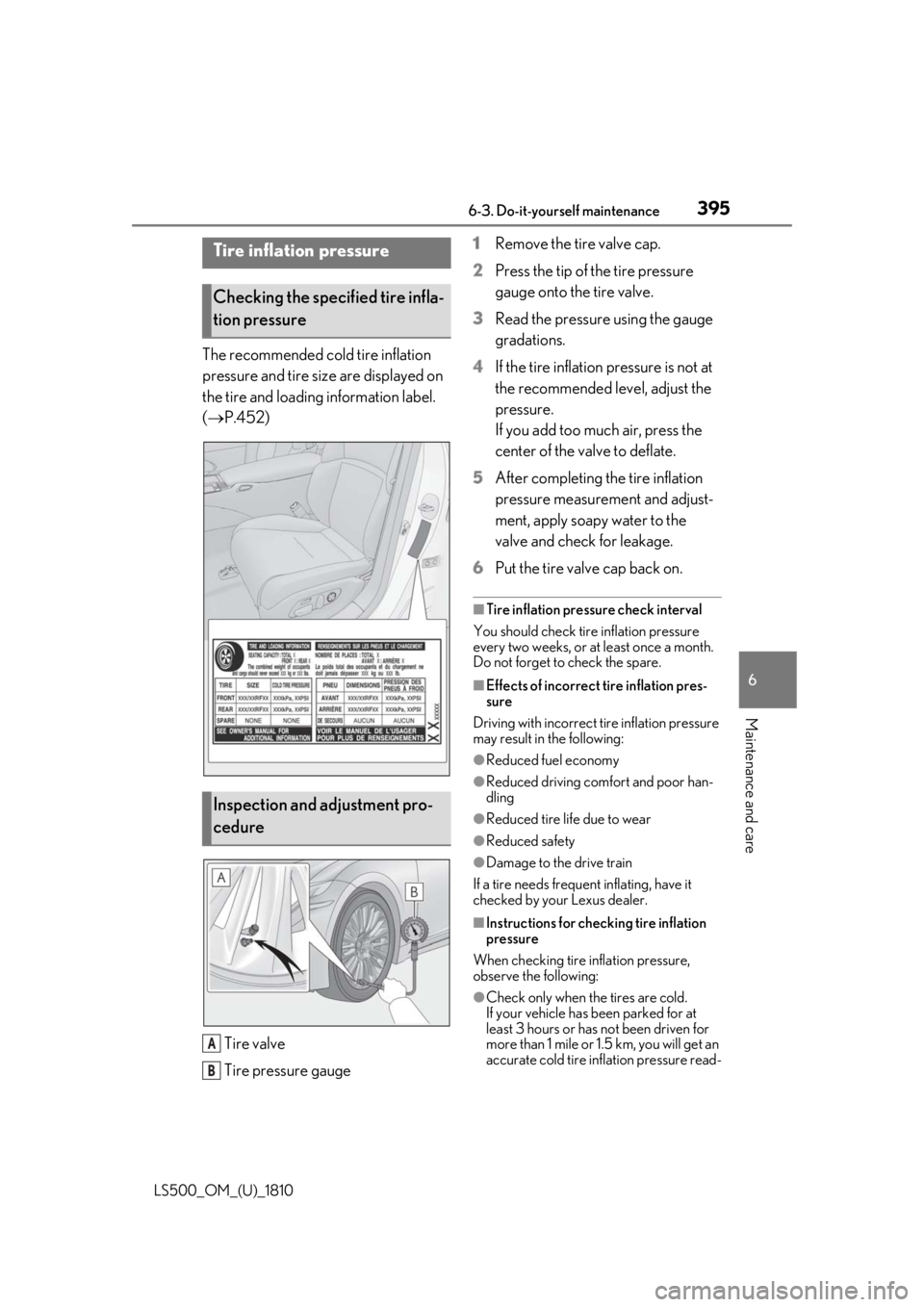
Maintenance and care The recommended cold tire inflation
pressure and tire size are displayed on
the tire and loading information label.
( P.452)
Tire valve
Tire pressure gauge 1 Remove the tire valve cap.
2 Press the tip of the tire pressure
gauge onto the tire valve.
3 Read the pressure using the gauge
gradations.
4 If the tire inflation pressure is not at
the recommended level, adjust the
pressure.
If you add too much air, press the
center of the valve to deflate.
5 After completing the tire inflation
pressure measurement and adjust-
ment, apply soapy water to the
valve and check for leakage.
6 Put the tire valve cap back on. ■
Tire inflation pressure check interval
You should check tire inflation pressure
every two weeks, or at least once a month.
Do not forget to check the spare. ■
Effects of incorrect tire inflation pres-
sure
Driving with incorrect ti re inflation pressure
may result in the following: ●
Reduced fuel economy ●
Reduced driving comfort and poor han-
dling ●
Reduced tire life due to wear ●
Reduced safety ●
Damage to the drive train
If a tire needs frequent inflating, have it
checked by your Lexus dealer.
■
Instructions for checking tire inflation
pressure
When checking tire inflation pressure,
observe the following:
●
Check only when the tires are cold.
If your vehicle has been parked for at
least 3 hours or has not been driven for
more than 1 mile or 1.5 km, you will get an
accurate cold tire inflation pressure read-Tire inflation pressure
Checking the specified tire infla-
tion pressure
Inspection and adjustment pro-
cedure
A
B
Page 396 of 512
396 6-3. Do-it-yourself maintenance
LS500_OM_(U)_1810 ing.●
Always use a tire pressure gauge.
It is difficult to judge if a tire is properly
inflated based only on its appearance.●
It is normal for the tire inflation pressure
to be higher after driving as heat is gen-
erated in the tire. Do not reduce tire infla-
tion pressure after driving.●
Never exceed the vehicle capacity
weight.
Passengers and luggage weight should
be placed so that the vehicle is balanced.
When replacing wheels, care should
be taken to ensure that they are equiv-
alent to those removed in load capac-
ity, diameter, rim width and inset *
.
Replacement wheels are available at
your Lexus dealer. *
: Conventionally referred to as offset.
Lexus does not recommend using the
following:
Wheels of different sizes or types
Used wheels
Bent wheels that have been straight-
ened ■
When replacing wheels
The wheels of your vehicle are equipped
with tire pressure wa rning valves and trans-
mitters that allow the tire pressure warning
system to provide advance warning in the
event of a loss in tire inflation pressure.
Whenever wheels are replaced, the tire
pressure warning valves and transmitters
must be installed. ( P.387)WARNING■
Proper inflation is critical to save tire
performance
Keep your tires properly inflated.
If the tires are not properly inflated, the
following conditions may occur which
could lead to an accident resulting in
death or serious injury: ●
Excessive wear●
Uneven wear●
Poor handling●
Possibility of blowouts resulting from
overheated tires
●
Air leaking from between tire and
wheel
●
Wheel deformation and/or tire dam-
age
●
Greater possibility of tire damage
while driving (due to road hazards,
expansion joints, sharp edges in the
road, etc.)
NOTICE
■
When inspecting and adjusting tire
inflation pressure
Be sure to put the tire valve caps back on.
If a valve cap is not installed, dirt or mois-
ture may get into the valve and cause an
air leak, resulting in decreased tire infla-
tion pressure. Wheels If a wheel is bent, cracked or heavily
corroded, it should be replaced.
Otherwise, the tire may separate
from the wheel or cause a loss of
handling control.
Wheel selection
WARNING
■
When replacing wheels
●
Do not use wheels that are a different
size from those recommended in the
Owner’s Manual, as this may result in a
loss of handling control.
Page 399 of 512
3996-3. Do-it-yourself maintenance
LS500_OM_(U)_1810 6
Maintenance and care filter.
■
If the electronic key battery is depleted
The following symptoms may occur: ●
The smart access system with push-but-
ton start and wireless remote control will
not function properly. ●
The operationa l range will be reduced.■
When the card key battery needs to be
replaced (if equipped)
The battery for the card key is available only
at Lexus dealers. Your Lexus dealer can
replace the battery for you.
Flathead screwdriver
Small flathead screwdriver
Lithium battery CR2032 ■
Use a CR2032 lithium battery ●
Batteries can be purchased at your Lexus
dealer, local electrical appliance shops or
camera stores.
●
Replace only with the same or equivalent
type recommended by the manufacturer.
●
Dispose of used batteries according to
local laws.NOTICE■
When using the air conditioning sys-
tem
Make sure that a filter is always installed.
Using the air conditioning system without
a filter may cause damage to the system. ■
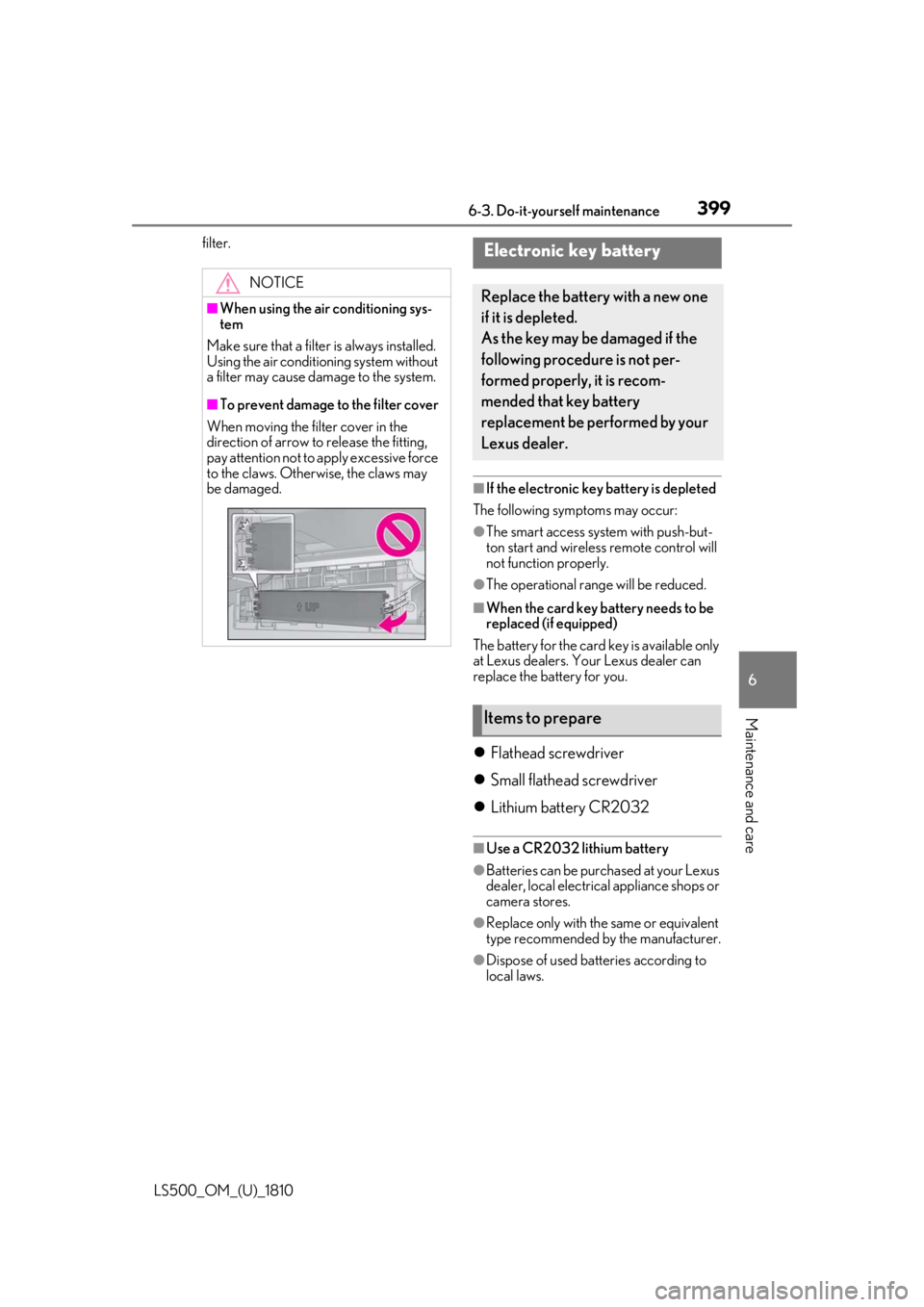
To prevent damage to the filter cover
When moving the filter cover in the
direction of arrow to release the fitting,
pay attention not to apply excessive force
to the claws. Otherwise, the claws may
be damaged. Electronic key battery Replace the battery with a new one
if it is depleted.
As the key may be damaged if the
following procedure is not per-
formed properly, it is recom-
mended that key battery
replacement be performed by your
Lexus dealer.
Items to prepare
Page 424 of 512
424 7-2. Steps to take in an emergency
LS500_OM_(U)_1810 WARNING●
Avoid abrupt maneuvering and brak-
ing.
If the vehicle tires deteriorate, you
could lose control of the steering
wheel or the brakes.■
If a blowout or sudden air leakage
should occur
The tire pressure warning system may
not activate immediately. ■
Maintenance of the tires
Each tire, including the spare (if pro-
vided), should be checked monthly when
cold and inflated to the inflation pressure
recommended by the vehicle manufac-
turer on the vehicle placard or tire infla-
tion pressure label (tire and load
information label). (I f your vehicle has
tires of a different size than the size indi-
cated on the vehicle placard or tire infla-
tion pressure label [tire and load
information label], yo u should determine
the proper tire infl ation pressure for
those tires.)
As an added safety feature, your vehicle
has been equipped with a tire pressure
monitoring system (TPMS-tire pressure
warning system) that illuminates a low
tire pressure telltale (tire pressure warn-
ing light) when one or more of your tires
is significantly under-inflated. Accord-
ingly, when the low tire pressure telltale
(tire pressure warnin g light) illuminates,
you should stop and check your tires as
soon as possible, and inflate them to the
proper pressure. Driving on a signifi-
cantly under-inflated tire causes the tire
to overheat and can lead to tire failure.
Under-inflation also reduces fuel effi-
ciency and tire tread life, and may affect
the vehicle’s handling and stopping abil-
ity. Please note that the TPMS (tire pressure
warning system) is not a substitute for
proper tire maintenance, and it is the
driver’s responsibility to maintain correct
tire pressure, even if under-inflation has
not reached the level to trigger illumina-
tion of the TPMS low tire pressure telltale
(tire pressure warning light).
Your vehicle has also been equipped with
a TPMS (tire pressure warning system)
malfunction indicator to indicate when
the system is not operating properly. The
TPMS (tire pressure warning system)
malfunction indicator is combined with
the low tire pressure telltale (tire pres-
sure warning light) . When the system
detects a malfunction, the telltale will
flash for approximately one minute and
then remain continuously illuminated.
This sequence will continue upon subse-
quent vehicle start-ups as long as the
malfunction exists. When the malfunction
indicator is illuminated, the system may
not be able to detect or signal low tire
pressure as intended.
TPMS (tire pressure warning system)
malfunctions may occur for a variety of
reasons, including the installation of
replacement or alternate tires or wheels
on the vehicle that prevent the TPMS
(tire pressure warning system) from func-
tioning properly. Always check the
TPMS (tire pressure warning system)
malfunction telltale after replacing one
or more tires or wheels on your vehicle to
ensure that the replacement or alternate
tires and wheels allow the TPMS (tire
pressure warning system) to continue to
function properly.
NOTICE
■
To ensure the tire pressure warning
system operates properly
Do not install tires with different specifi-
cations or makers, as the tire pressure
warning system may not operate prop-
erly.
Page 434 of 512
434 7-2. Steps to take in an emergency
LS500_OM_(U)_1810 ■
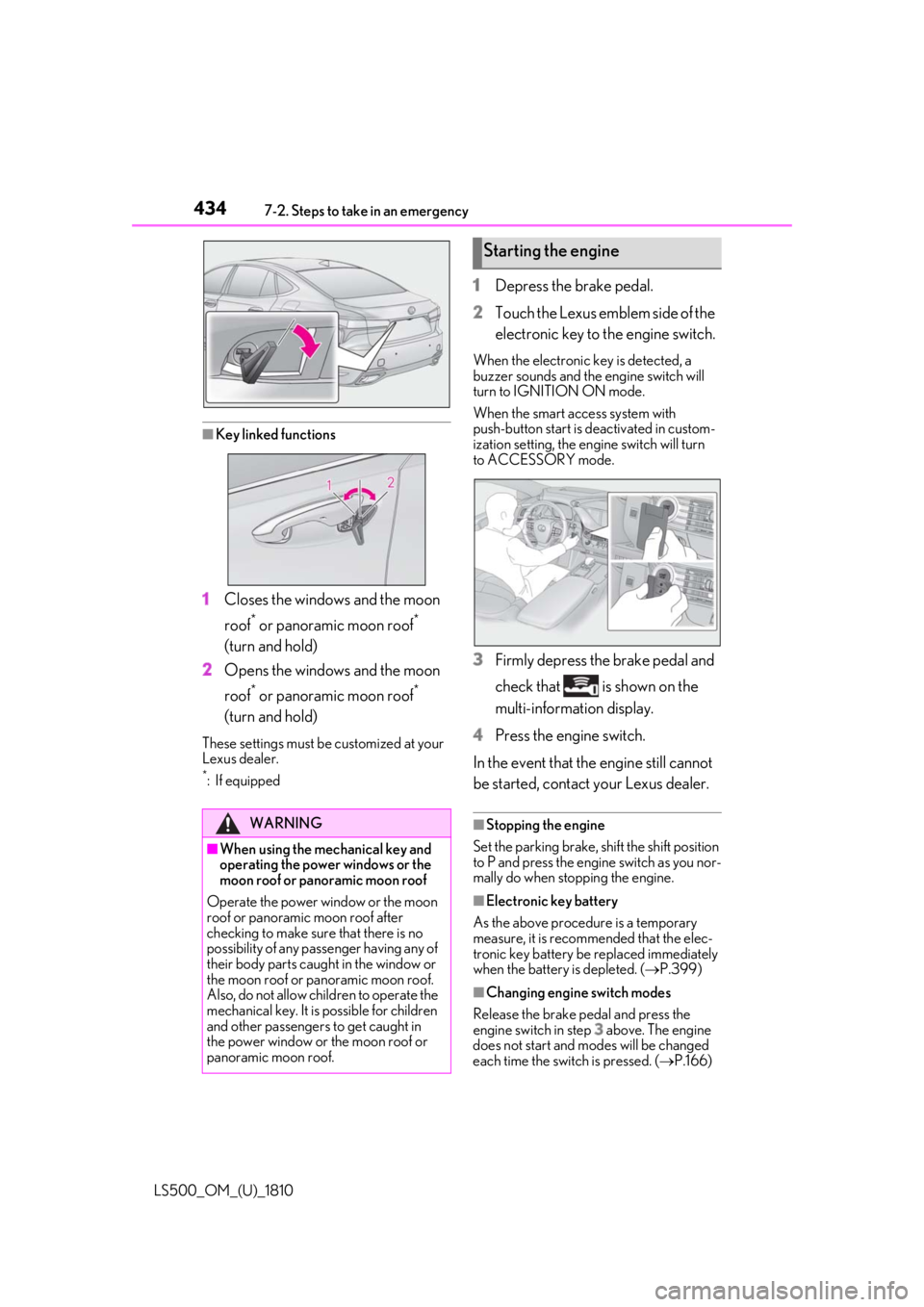
Key linked functions
1 Closes the windows and the moon
roof *
or panoramic moon roof *
(turn and hold)
2 Opens the windows and the moon
roof *
or panoramic moon roof *
(turn and hold)These settings must be customized at your
Lexus dealer. *
:If equipped 1 Depress the brake pedal.
2 Touch the Lexus emblem side of the
electronic key to the engine switch. When the electronic key is detected, a
buzzer sounds and the engine switch will
turn to IGNITION ON mode.
When the smart access system with
push-button start is deactivated in custom-
ization setting, the engine switch will turn
to ACCESSORY mode.
3 Firmly depress the brake pedal and
check that is shown on the
multi-information display.
4 Press the engine switch.
In the event that the engine still cannot
be started, contact your Lexus dealer. ■
Stopping the engine
Set the parking brake, shift the shift position
to P and press the engine switch as you nor-
mally do when stop ping the engine.
■
Electronic key battery
As the above procedure is a temporary
measure, it is recommended that the elec-
tronic key battery be replaced immediately
when the battery is depleted. ( P.399)
■
Changing engine switch modes
Release the brake pe dal and press the
engine switch in step 3 above. The engine
does not start and modes will be changed
each time the switch is pressed. ( P.166)WARNING
■
When using the mechanical key and
operating the power windows or the
moon roof or panoramic moon roof
Operate the power window or the moon
roof or panoramic moon roof after
checking to make sure that there is no
possibility of any passe nger having any of
their body parts caught in the window or
the moon roof or panoramic moon roof.
Also, do not allow ch ildren to operate the
mechanical key. It is possible for children
and other passengers to get caught in
the power window or the moon roof or
panoramic moon roof. Starting the engine
Page 448 of 512

448 8-1. Specifications
LS500_OM_(U)_1810 ■
Oil capacity (Drain and refill [Ref-
erence *
]) *
: The engine oil capacity is a reference
quantity to be used when changing the
engine oil. Warm up and turn off the
engine, wait more than 5 minutes, and
check the oil level on the dipstick.■
Engine oil selection
“Toyota Genuine Motor Oil” is used in
your Lexus vehicle. Use Lexus
approved “Toyota Genuine Motor Oil”
or equivalent to satisfy the following
grade and viscosity.
Oil grade: ILSAC GF-5 multigrade
engine oil
Recommended viscosity: SAE 0W-20
SAE 0W-20 is the best choice for
good fuel economy and good starting
in cold weather.
If SAE 0W-20 is not available, SAE
5W-20 oil may be used. However, it
must be replaced with SAE 0W-20 at the next oil change.
Recommended viscosity (SAE):
Outside temperature
Oil viscosity (0W-20 is explained here
as an example):
• The 0W in 0W-20 indicates the
characteristic of the oil which allows
cold startability. Oils with a lower
value before the W allow for easier
starting of the engine in cold
weather.
• The 20 in 0W-20 indicates the vis-
cosity characteristic of the oil when
the oil is at high temperature. An oil
with a higher viscosity (one with a
higher value) may be better suited if
the vehicle is operated at high
speeds, or under extreme load con-
ditions.
How to read oil container label:
The International Lubricant Specifica-
tion Advisory Committee (ILSAC)
Certification Mark is added to some oil Octane Rating 91 (Research Octane Number 96) or higher
Fuel tank capacity
(Reference) 21.7 gal. (82.0 L, 18.0 Imp. gal.)
Lubrication system With filter
2WD models
6.7 qt. (6.3 L, 5.5 Imp. qt.)
AWD models
7.5 qt. (7.1 L, 6.2 Imp. qt.)
Without fil-
ter
2WD models
6.1 qt. (5.8 L, 5.1 Imp. qt.)
AWD models
7.0 qt. (6.6 L, 5.8 Imp. qt.)
A
Page 452 of 512
452 8-1. Specifications
LS500_OM_(U)_1810 warning light is illumin ated, refer to P.415.)*2
: Make sure to confirm that the brake warning light (yellow) does not illuminate. (If the
brake warning light illuminates, refer to P.415.) *3
: Vehicles without Lexus Safety System + A *4
: Vehicles with Lexus Safety System + A
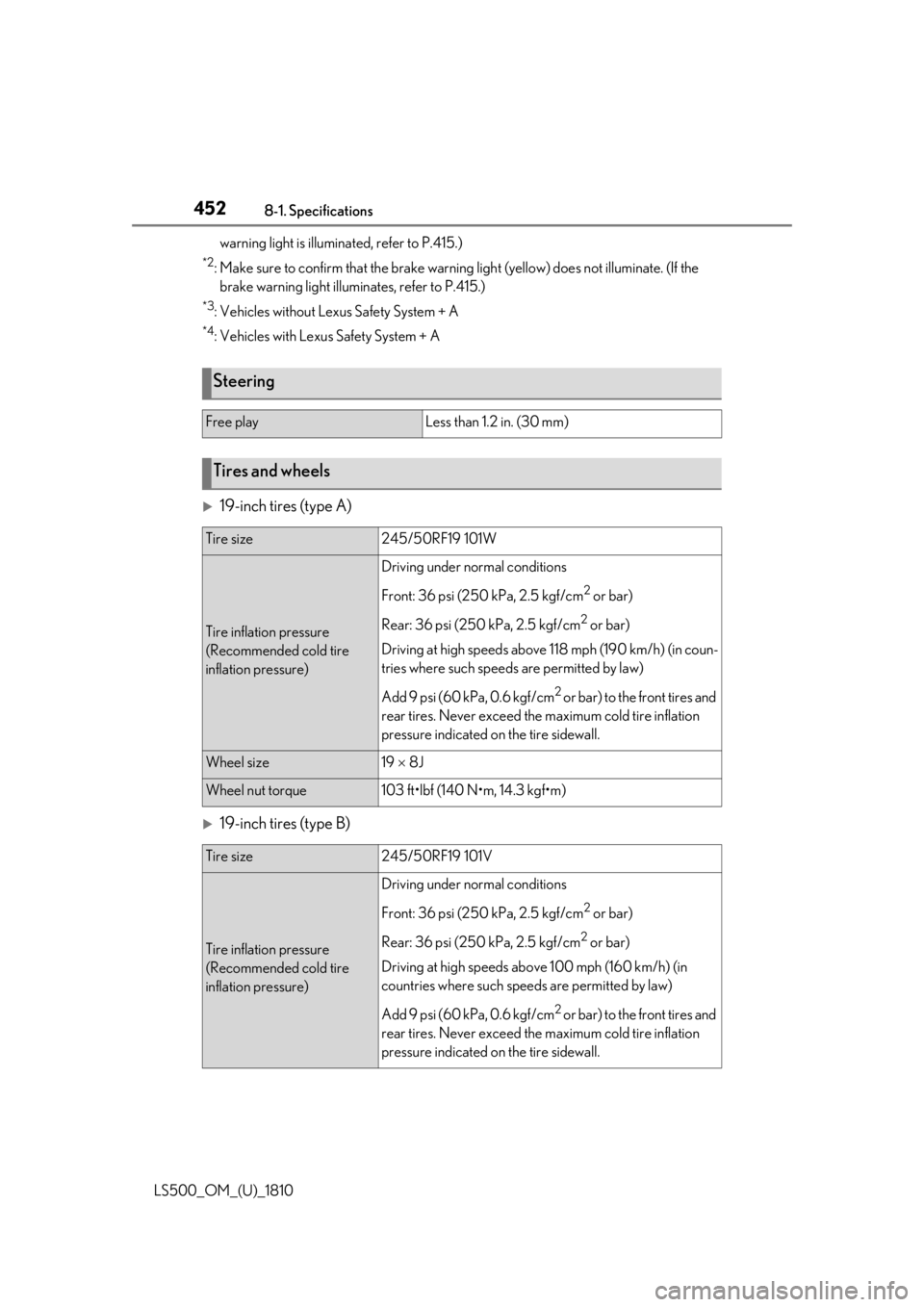
19-inch tires (type A)
19-inch tires (type B)Steering Free play Less than 1.2 in. (30 mm)
Tires and wheels Tire size 245/50RF19 101W
Tire inflation pressure
(Recommended cold tire
inflation pressure) Driving under normal conditions
Front: 36 psi (250 kPa, 2.5 kgf/cm 2
or bar)
Rear: 36 psi (250 kPa, 2.5 kgf/cm 2
or bar)
Driving at high speeds above 118 mph (190 km/h) (in coun-
tries where such speeds are permitted by law)
Add 9 psi (60 kPa, 0.6 kgf/cm 2
or bar) to the front tires and
rear tires. Never exceed the maximum cold tire inflation
pressure indicated on the tire sidewall.
Wheel size 19 8J
Wheel nut torque 103 ft•lbf (140 N•m, 14.3 kgf•m)
Tire size 245/50RF19 101V
Tire inflation pressure
(Recommended cold tire
inflation pressure) Driving under normal conditions
Front: 36 psi (250 kPa, 2.5 kgf/cm 2
or bar)
Rear: 36 psi (250 kPa, 2.5 kgf/cm 2
or bar)
Driving at high speeds above 100 mph (160 km/h) (in
countries where such speeds are permitted by law)
Add 9 psi (60 kPa, 0.6 kgf/cm 2
or bar) to the front tires and
rear tires. Never exceed the maximum cold tire inflation
pressure indicated on the tire sidewall.
Page 453 of 512
4538-1. Specifications
LS500_OM_(U)_1810 8
Vehicle specifications
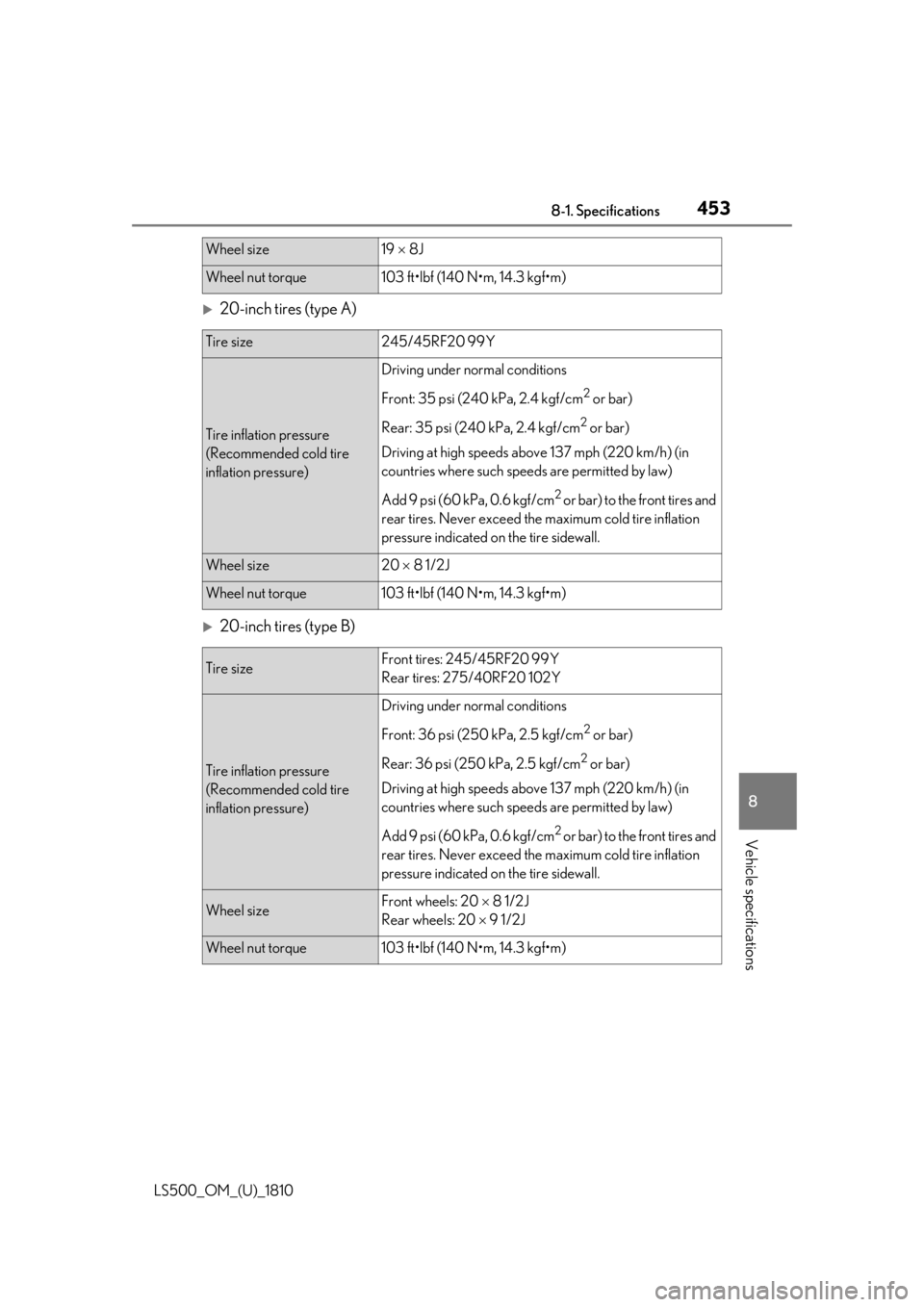
20-inch tires (type A)
20-inch tires (type B) Wheel size 19 8J
Wheel nut torque 103 ft•lbf (140 N•m, 14.3 kgf•m)
Tire size 245/45RF20 99Y
Tire inflation pressure
(Recommended cold tire
inflation pressure) Driving under normal conditions
Front: 35 psi (240 kPa, 2.4 kgf/cm 2
or bar)
Rear: 35 psi (240 kPa, 2.4 kgf/cm 2
or bar)
Driving at high speeds above 137 mph (220 km/h) (in
countries where such speeds are permitted by law)
Add 9 psi (60 kPa, 0.6 kgf/cm 2
or bar) to the front tires and
rear tires. Never exceed the maximum cold tire inflation
pressure indicated on the tire sidewall.
Wheel size 20 8 1/2J
Wheel nut torque 103 ft•lbf (140 N•m, 14.3 kgf•m)
Tire size Front tires: 245/45RF20 99Y
Rear tires: 275/40RF20 102Y
Tire inflation pressure
(Recommended cold tire
inflation pressure) Driving under normal conditions
Front: 36 psi (250 kPa, 2.5 kgf/cm 2
or bar)
Rear: 36 psi (250 kPa, 2.5 kgf/cm 2
or bar)
Driving at high speeds above 137 mph (220 km/h) (in
countries where such speeds are permitted by law)
Add 9 psi (60 kPa, 0.6 kgf/cm 2
or bar) to the front tires and
rear tires. Never exceed the maximum cold tire inflation
pressure indicated on the tire sidewall.
Wheel size Front wheels: 20 8 1/2J
Rear wheels: 20 9 1/2J
Wheel nut torque 103 ft•lbf (140 N•m, 14.3 kgf•m)
Page 454 of 512
454 8-1. Specifications
LS500_OM_(U)_1810
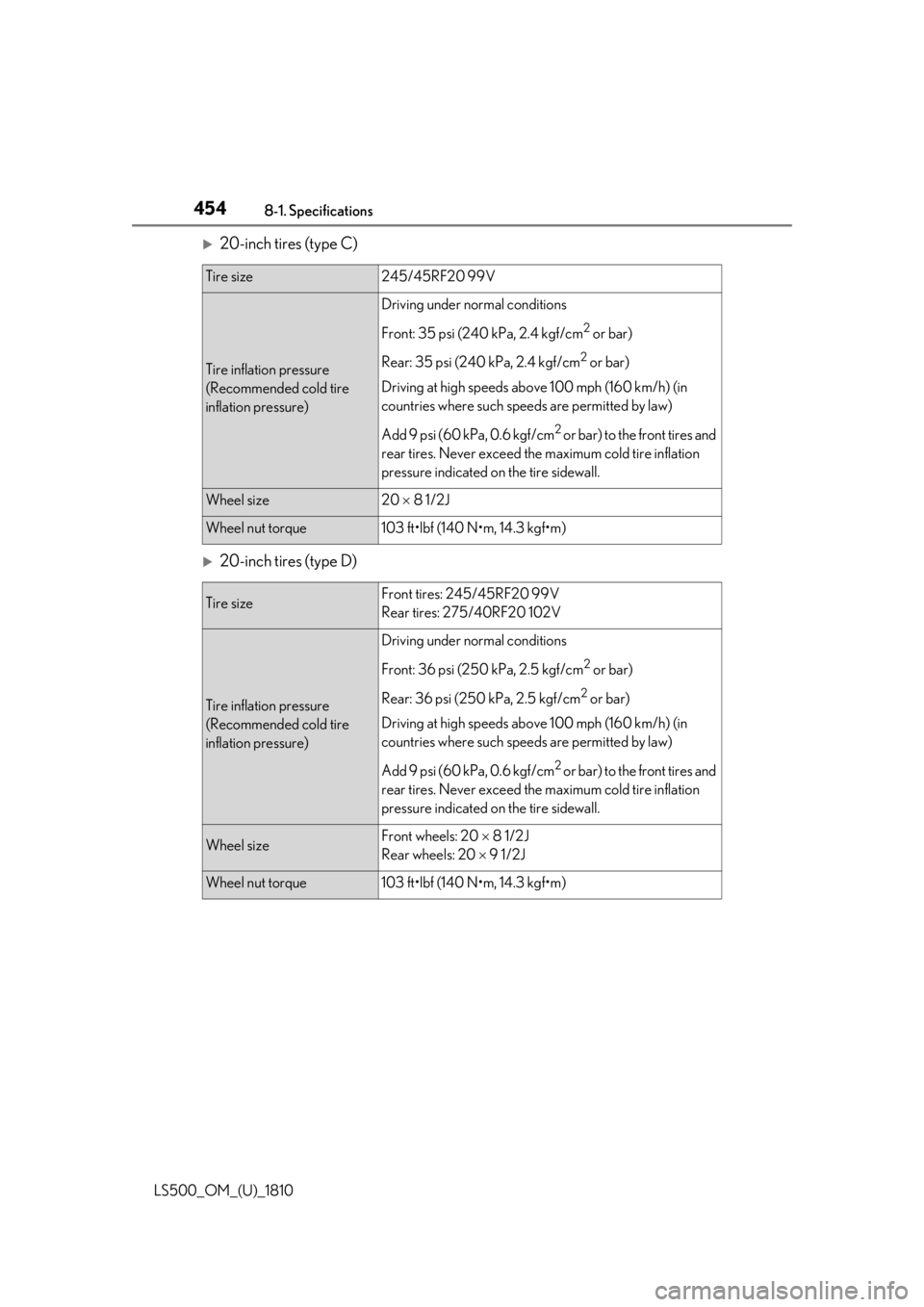
20-inch tires (type C)
20-inch tires (type D) Tire size 245/45RF20 99V
Tire inflation pressure
(Recommended cold tire
inflation pressure) Driving under normal conditions
Front: 35 psi (240 kPa, 2.4 kgf/cm 2
or bar)
Rear: 35 psi (240 kPa, 2.4 kgf/cm 2
or bar)
Driving at high speeds above 100 mph (160 km/h) (in
countries where such speeds are permitted by law)
Add 9 psi (60 kPa, 0.6 kgf/cm 2
or bar) to the front tires and
rear tires. Never exceed the maximum cold tire inflation
pressure indicated on the tire sidewall.
Wheel size 20 8 1/2J
Wheel nut torque 103 ft•lbf (140 N•m, 14.3 kgf•m)
Tire size Front tires: 245/45RF20 99V
Rear tires: 275/40RF20 102V
Tire inflation pressure
(Recommended cold tire
inflation pressure) Driving under normal conditions
Front: 36 psi (250 kPa, 2.5 kgf/cm 2
or bar)
Rear: 36 psi (250 kPa, 2.5 kgf/cm 2
or bar)
Driving at high speeds above 100 mph (160 km/h) (in
countries where such speeds are permitted by law)
Add 9 psi (60 kPa, 0.6 kgf/cm 2
or bar) to the front tires and
rear tires. Never exceed the maximum cold tire inflation
pressure indicated on the tire sidewall.
Wheel size Front wheels: 20 8 1/2J
Rear wheels: 20 9 1/2J
Wheel nut torque 103 ft•lbf (140 N•m, 14.3 kgf•m)
Page 460 of 512
460 8-1. Specifications
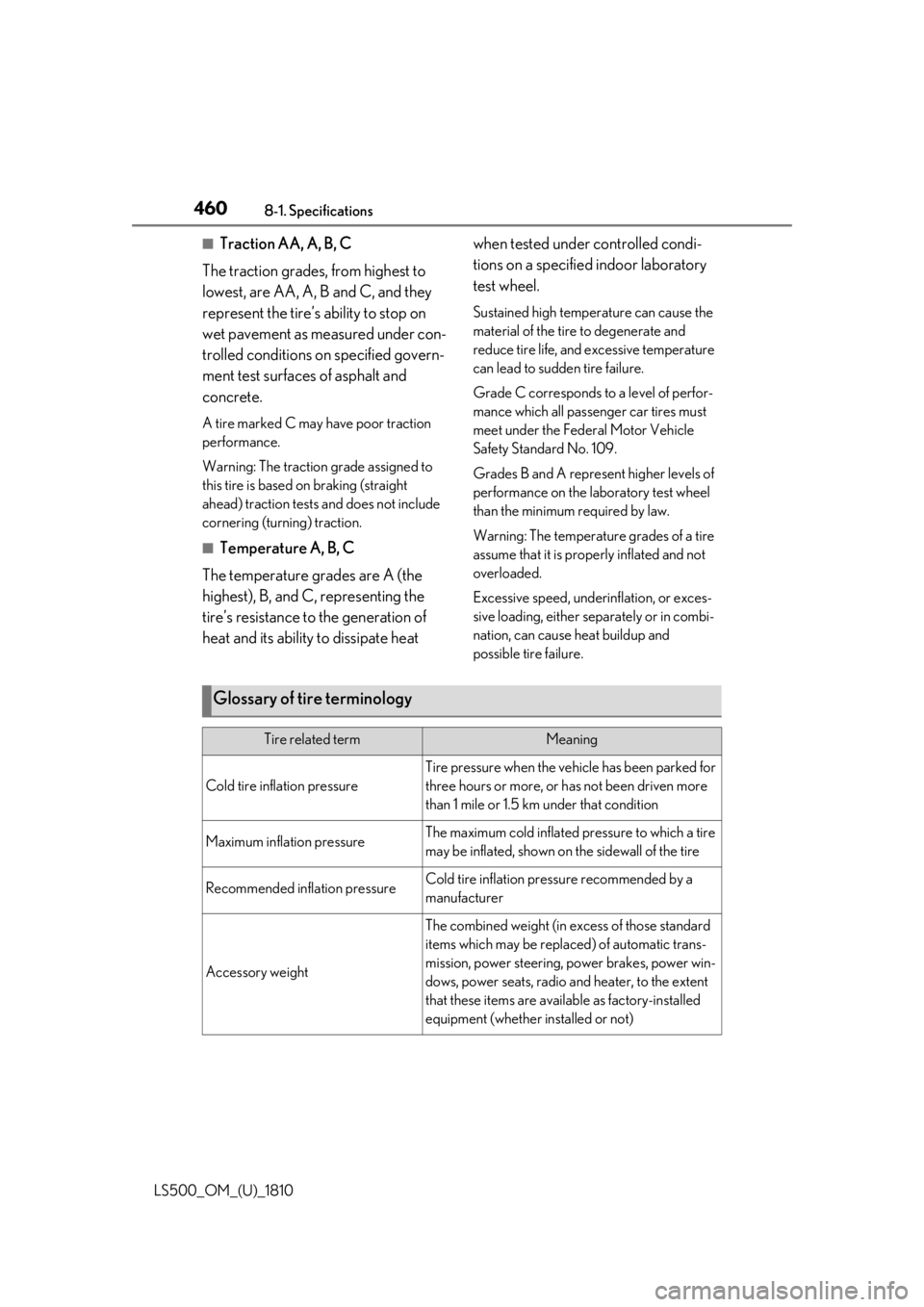
LS500_OM_(U)_1810 ■
Traction AA, A, B, C
The traction grades, from highest to
lowest, are AA, A, B and C, and they
represent the tire’s ability to stop on
wet pavement as measured under con-
trolled conditions on specified govern-
ment test surfaces of asphalt and
concrete. A tire marked C may have poor traction
performance.
Warning: The traction grade assigned to
this tire is based on braking (straight
ahead) traction tests and does not include
cornering (turning) traction. ■
Temperature A, B, C
The temperature grades are A (the
highest), B, and C, representing the
tire’s resistance to the generation of
heat and its ability to dissipate heat when tested under controlled condi-
tions on a specified indoor laboratory
test wheel. Sustained high temperature can cause the
material of the tire to degenerate and
reduce tire life, and excessive temperature
can lead to sudd en tire failure.
Grade C corresponds to a level of perfor-
mance which all passenger car tires must
meet under the Fede ral Motor Vehicle
Safety Standard No. 109.
Grades B and A represent higher levels of
performance on the laboratory test wheel
than the minimum required by law.
Warning: The temperature grades of a tire
assume that it is prop erly inflated and not
overloaded.
Excessive speed, unde rinflation, or exces-
sive loading, either separately or in combi-
nation, can cause heat buildup and
possible tire failure.
Glossary of tire terminology Tire related term Meaning
Cold tire inflation pressure Tire pressure when the vehicle has been parked for
three hours or more, or has not been driven more
than 1 mile or 1.5 km under that condition
Maximum inflation pressure The maximum cold inflated pressure to which a tire
may be inflated, shown on the sidewall of the tire
Recommended inflation pressure Cold tire inflation pressure recommended by a
manufacturer
Accessory weight The combined weight (in excess of those standard
items which may be replaced) of automatic trans-
mission, power steering, power brakes, power win-
dows, power seats, radio and heater, to the extent
that these items are available as factory-installed
equipment (whether installed or not)