inflation pressure LEXUS LS500 2019 Owners Manual
[x] Cancel search | Manufacturer: LEXUS, Model Year: 2019, Model line: LS500, Model: LEXUS LS500 2019Pages: 512, PDF Size: 9.71 MB
Page 1 of 512

LS500_OM_(U)_1810 1
2
3
4
5
6
7
8
9Pictorial index Search by illustration
For safety
and security Make sure to read through them
(Main topics: Child seat, theft deterrent system)
Vehicle status
information and
indicators Reading driving-related information
(Main topics: Meters, multi-information display)
Before driving Opening and closing the doors and windows,
adjustment before driving
(Main topics: Keys, doors, seats)
Driving Operations and advice which are necessary for driving
(Main topics: Starting engine, refueling)
Interior features Usage of the interior features
(Main topics: Air conditioner, storage features)
Maintenance
and care Caring for your vehicle and maintenance procedures
(Main topics: Interior and exterior, light bulbs)
When trouble
arises What to do in case of malfunction and emergency
(Main topics: Battery discharge, flat tire)
Vehicle
specifications Vehicle specifications, customizable features
(Main topics: Fuel, oil, tire inflation pressure)
For owners Reporting safety defects for U.S. owners, seat belt and
SRS airbag instructions for Canadian owners
Index Search by symptom
Search alphabetically
Page 4 of 512

4 TABLE OF CONTENTS
LS500_OM_(U)_1810 5-6. Using the other interior features
Other interior features .............. 343
Garage door opener.................. 350
6-1. Maintenance and care
Cleaning and protecting the vehi-
cle exterior ................................... 358
Cleaning and protecting the vehi-
cle interior ..................................... 361
6-2. Maintenance
Maintenance requirements ..... 364
General maintenance ................ 365
Emission inspection and mainte-
nance (I/M) programs ............ 368
6-3. Do-it-yourself maintenance
Do-it-yourself service precautions
........................................................... 369
Hood................................................... 371
Positioning a floor jack................ 371
Engine compartment.................. 373
Battery .............................................. 380
Tires ................................................... 382
Replacing the tire .......................... 391
Tire inflation pressure ................. 395
Wheels.............................................. 396
Air conditioning filter.................. 398
Electronic key battery ................ 399
Checking and replacing fuses
............................................................ 401
Light bulbs ....................................... 404 7-1. Essential information
Emergency flashers .................... 406
If your vehicle has to be stopped in
an emergency ............................ 406
If the vehicle is trapped in rising
water .............................................. 407
7-2. Steps to take in an emergency
If your vehicle needs to be towed
.......................................................... 409
If you think something is wrong
............................................................ 413
Fuel pump shut off system .......... 414
If a warning light turns on or a warn-
ing buzzer sounds...................... 415
If a warning messa ge is displayed
.......................................................... 425
If you have a flat tire .................... 429
If the engine will not start .......... 430
If you lose your keys.................... 432
If the fuel filler door cannot be
opened .......................................... 432
If the electronic key does not oper-
ate properly ................................. 433
If the vehicle battery is discharged
.......................................................... 435
If your vehicle overheats ........... 440
If the vehicle becomes stuck ... 443
8-1. Specifications
Maintenance data (fuel, oil level,
etc.) ................................................. 446
Fuel information............................ 4556
Maintenance and care 7
When trouble arises
8
Vehicle specifications
Page 13 of 512
13Pictorial index
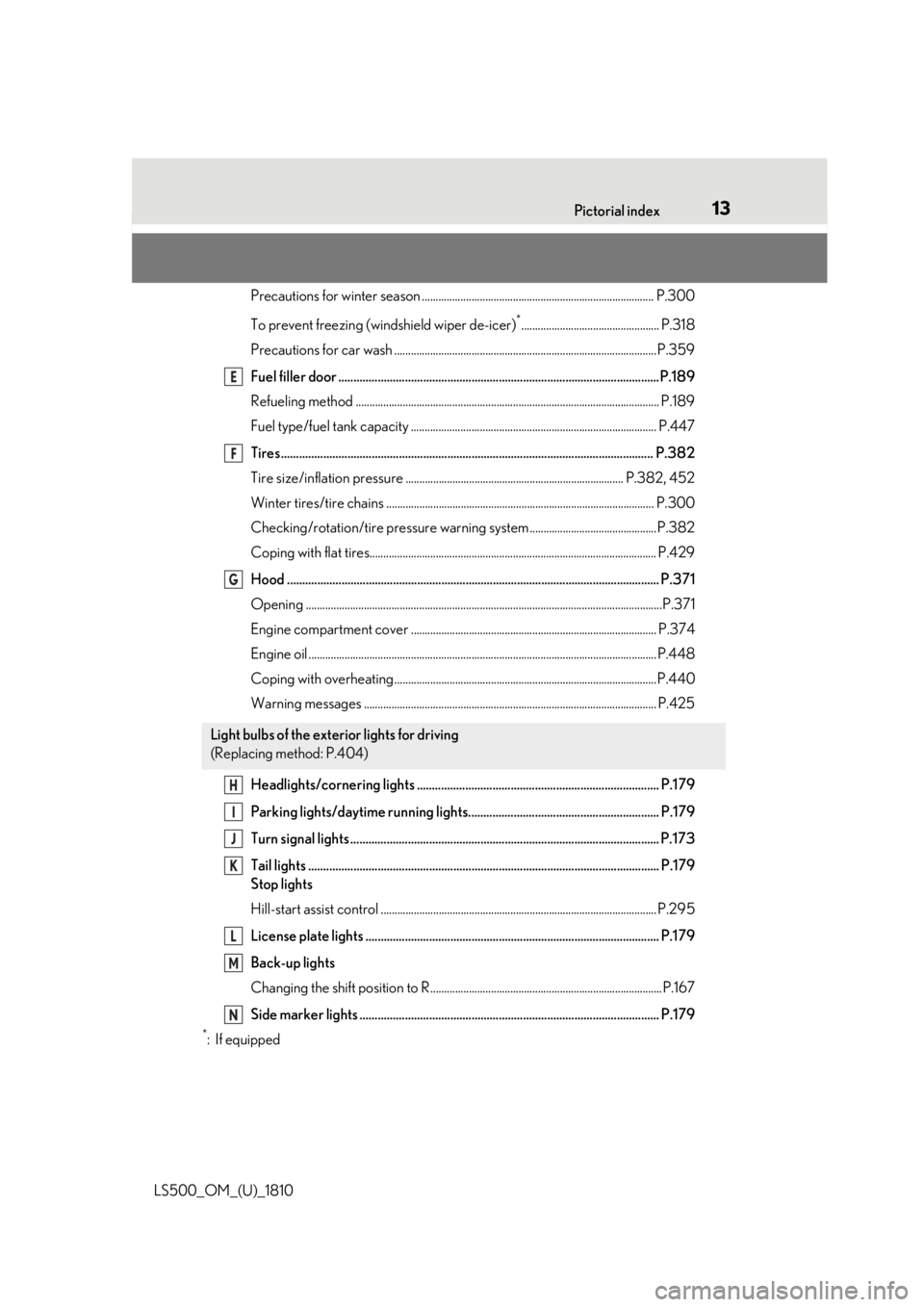
LS500_OM_(U)_1810 Precautions for winter season .. .................................................................................. P.300
To prevent freezing (windshield wiper de-icer) *
.................................................. P.318
Precautions for car wash ...............................................................................................P.359
Fuel filler door ..........................................................................................................P.189
Refueling method .............................................................................................................. P .189
Fuel type/fuel tank capacity ...... ................................................................................... P.447
Tires.......................................................................................................................... .P.382
Tire size/inflation pressure ............................................................................... P.382, 452
Winter tires/tire chains ................................................................................................. P.300
Checking/rotation/tire pressu re warning system..............................................P.382
Coping with flat tires........................................................................................................ P .429
Hood ........................................................................................................................... P.371
Opening ........................................................................................................................ .........P.371
Engine compartment cover ......................................................................................... P.374
Engine oil ..................................................................................................................... ......... P.448
Coping with overheating ............................................................................................... P.440
Warning messages .......................................................................................................... P.425
Headlights/cornering lights ................................................................................ P.179
Parking lights/daytime running lights............................................................... P.179
Turn signal lights ...................................................................................................... P.173
Tail lights .................................................................................................................... P.179
Stop lights
Hill-start assist control .................................................................................................... P. 295
License plate lights ................................................................................................. P.179
Back-up lights
Changing the shift position to R....................................................................................P.167
Side marker lights ................................................................................................... P.179 *
:If equipped Light bulbs of the exterior lights for driving
(Replacing method: P.404) E
F
G
H
I
J
K
L
M
N
Page 214 of 512

214 4-5. Using the driving support systems
LS500_OM_(U)_1810 ●
In some situations, such as the following,
the sensors may not detect the lane lines
or a safe space the vehicle can be steered
into, preventing the ac tive steering assist
from operating properly:
• When the white (yellow) lane lines are
difficult to see, such as when they are
faint, diverging/merging, or a shadow is
cast upon them
• When the lane is more wide or narrow
than normal
• When there is a light and dark pattern on
the road surface, such as due to road
repairs
• If the system determines that a collision
can be avoided by only using the brakes
• When a pedestrian is detected near the
centerline of the vehicle●
In some situations such as the following,
sufficient braking force or steering force
may not be obtained, preventing the sys-
tem from performing properly:
• If the braking functions cannot operate to
their full extent, such as when the brake
parts are extremely cold, extremely hot,
or wet
• If the vehicle is not properly maintained
(brakes or tires are excessively worn,
improper tire inflation pressure, etc.)
• When the vehicle is being driven on a
gravel road or other slippery surface
• If there are deep ruts in the road
• When driving on a slope
• When driving on a horizontally slanted
road●
Some guardrails, such as the following,
may not be detected by the sensors, pre-
venting the system from operating prop-
erly:
• Guardrails which are less than approxi-
mately 1.9 ft. (60 cm) tall
• Short guardrails
• Irregularly-shaped guardrails (wire cable
guardrails, guardrails made of thin poles,
etc.)
• Guardrails which are not illuminated by
the headlights at night, in a tunnel, etc.
• Guardrails which appear to be nearly the
same color or brig htness as their sur-
roundings
• Guardrails which appear to be nearly the
same shape as their surroundings (walls,
etc.) • Guardrails which are over a metal object
(manhole cover, steel plate, etc.)
• Guardrails which are hidden behind thick
grass
• Guardrails which are extremely close to
the side of the vehicle (outside rear view
mirror, etc.)
• Curved guardrails or guardrails at the
entrance of a curve ●
In some situations su ch as the following,
the system may detect a pedestrian and
display a warning on the head-up display,
even though no pedestrian exists:
• If the front of the vehicle is raised or low-
ered, such as when the road surface is
uneven or undulating (due to ruts, etc.)
• When driving on a slope
• When driving on a horizontally slanted
road
• If the driver’s posture (driver seat posi-
tion) is extreme, such as excessively
reclined
• If the head-up display position is set
extremely high ■
If VSC is disabled ●
If VSC is disabled ( P.294), the pre-col-
lision brake assist and pre-collision brak-
ing functions are also disabled. ●
The PCS warning light will turn on and
“VSC Turned Off Pre-Collision Brake
System Unavailable” will be displayed on
the multi-information display.
Page 222 of 512
222 4-5. Using the driving support systems
LS500_OM_(U)_1810 • If the wheels are misaligned
• If a wiper blade is blocking the front cam-
era
• The vehicle is being driven at extremely
high speeds
• When driving on a hill
• If the radar sensor or front camera is mis-
aligned●
In some situations such as the following,
sufficient braking force may not be
obtained, preventing the system from
performing properly:
• If the braking functions cannot operate to
their full extent, such as when the brake
parts are extremely cold, extremely hot,
or wet
• If the vehicle is not properly maintained
(brakes or tires are excessively worn,
improper tire inflation pressure, etc.)
• When the vehicle is being driven on a
gravel road or other slippery surface■
If VSC is disabled●
If VSC is disabled ( P.296), the pre-col-
lision brake assist and pre-collision brak-
ing functions are also disabled.●
The PCS warning light will turn on and
“VSC Turned Off Pre-Collision Brake
System Unavailable” will be displayed on
the multi-information display. *
: If equipped
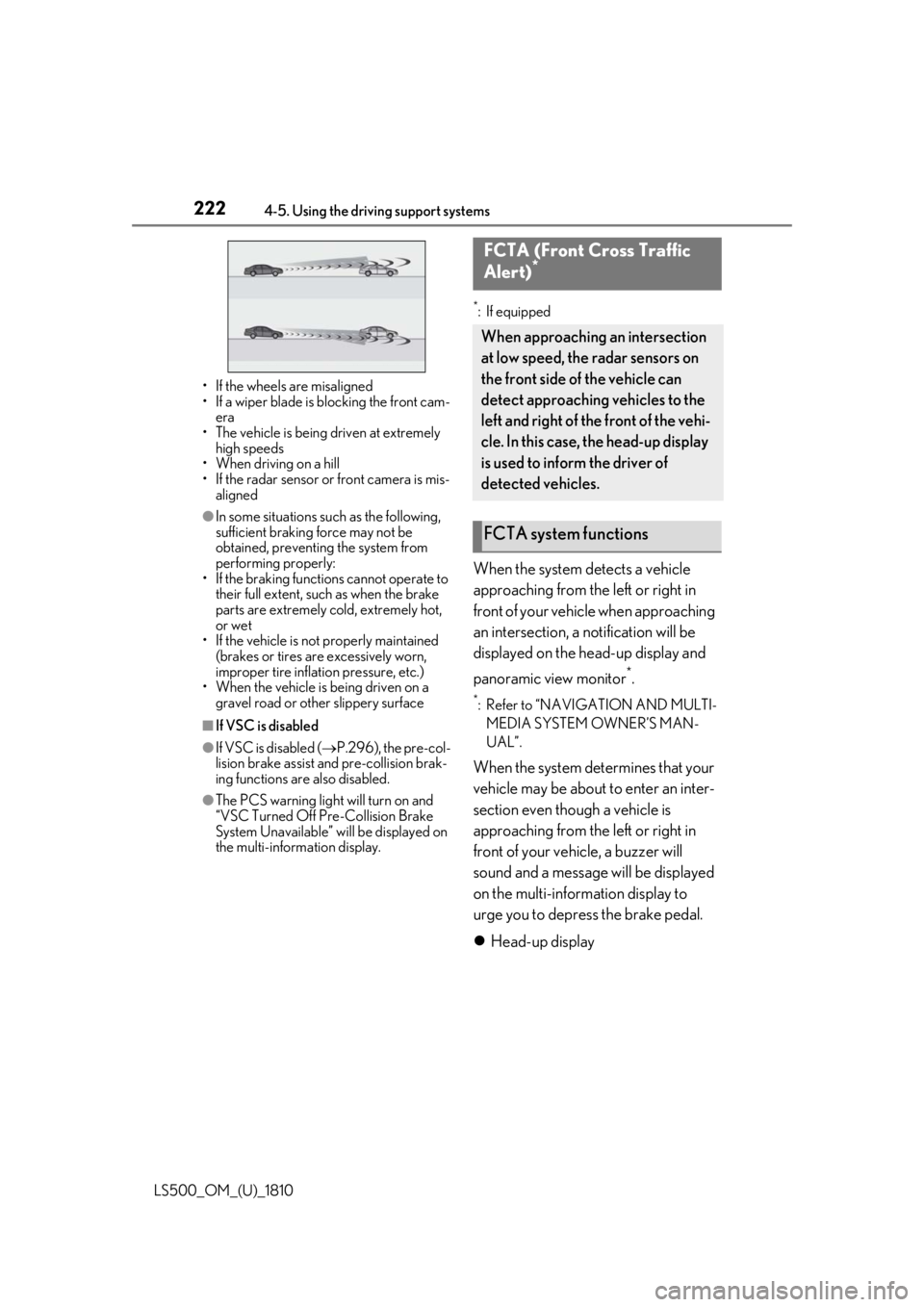
When the system detects a vehicle
approaching from the left or right in
front of your vehicle when approaching
an intersection, a notification will be
displayed on the head-up display and
panoramic view monitor *
. *
: Refer to “NAVIGATION AND MULTI-
MEDIA SYSTEM OWNER’S MAN-
UAL”.
When the system determines that your
vehicle may be about to enter an inter-
section even though a vehicle is
approaching from the left or right in
front of your vehicle, a buzzer will
sound and a message will be displayed
on the multi-information display to
urge you to depress the brake pedal.
Head-up displayFCTA (Front Cross Traffic
Alert) *
When approaching an intersection
at low speed, the radar sensors on
the front side of the vehicle can
detect approaching vehicles to the
left and right of the front of the vehi-
cle. In this case, the head-up display
is used to inform the driver of
detected vehicles.
FCTA system functions
Page 299 of 512

2994-5. Using the driving support systems
LS500_OM_(U)_1810 4
Driving WARNING■
Secondary Collision Brake
Do not overly rely on the Secondary Col-
lision Brake. This system is designed to
help reduce the possibility of further
damage due to a secondary collision,
however, that effect changes according
to various conditions. Overly relying on
the system may result in death or serious
injury. ■
Replacing tires
Make sure that all ti res are of the speci-
fied size, brand, tread pattern and total
load capacity. In addition, make sure that
the tires are inflated to the recom-
mended tire inflation pressure level.
The ABS, TRAC and VSC systems will
not function correctly if different tires are
installed on the vehicle.
Contact your Lexus dealer for further
information when replacing tires or
wheels. ■
Handling of tires and the suspension
Using tires with any kind of problem or
modifying the suspension will affect the
driving assist systems, and may cause a
system to malfunction.
Page 357 of 512

357
LS500_OM_(U)_1810 6 6
Maintenance and care Maintenance and care .
6-1. Maintenance and care
Cleaning and protecting the vehi-
cle exterior ................................ 358
Cleaning and protecting the vehi-
cle interior .................................. 361
6-2. Maintenance
Maintenance requirements
........................................................ 364
General maintenance ............. 365
Emission inspection and mainte-
nance (I/M) programs ......... 368
6-3. Do-it-yourself maintenance
Do-it-yourself service precautions
........................................................ 369
Hood................................................ 371
Positioning a floor jack............. 371
Engine compartment............... 373
Battery ........................................... 380
Tires ................................................ 382
Replacing the tire ....................... 391
Tire inflation pressure .............. 395
Wheels........................................... 396
Air conditioning filter............... 398
Electronic key battery ............. 399
Checking and replacing fuses
......................................................... 401
Light bulbs .................................... 404
Page 367 of 512
3676-2. Maintenance
LS500_OM_(U)_1810 6
Maintenance and care Parking brake • Does the parking
brake operate nor-
mally?
•When parked on a
slope and the park-
ing brake is on, is the
vehicle securely
stopped?
Seat belts • Do the seat belts
operate smoothly?
• The seat belts should
not be damaged.
Seats • Do the seat controls
operate properly?
Steering wheel • Does the steering
wheel rotate
smoothly?
• Does the steering
wheel have the cor-
rect amount of free
play?
•There should not be
any strange sounds
coming from the
steering wheel.
Vehicle exterior Items Check points
Doors/trunk • Do the doors/trunk
operate smoothly?
Engine hood •Does the engine
hood lock system
work properly?
Fluid leaks •There should not be
any signs of fluid
leakage after the
vehicle has been
parked.Items Check points
Tires • Is the tire inflation
pressure correct?
• The tires should not
be damaged or
excessively worn.
• Have the tires been
rotated according to
the maintenance
schedule?
•The wheel nuts
should not be loose.
Windshield wip-
ers • The wiper blades
should not show any
signs of cracking,
splitting, wear, con-
tamination or defor-
mation.
• The wiper blades
should clear the
windshield without
streaking or skip-
ping.Items Check points
Page 370 of 512
370 6-3. Do-it-yourself maintenance
LS500_OM_(U)_1810 Tire inflation pres-
sure ( P.395) • Tire pressure gauge
•Compressed air
source
Washer fluid
( P.379) • Water or washer
fluid containing anti-
freeze (for winter
use)
• Funnel (used only for
adding water or
washer fluid)
WARNING
The engine compartment contains many
mechanisms and fluids that may move
suddenly, become hot, or become elec-
trically energized. To avoid death or seri-
ous injury, observe the following
precautions. ■
When working on the engine com-
partment●
Keep hands, clothi ng and tools away
from the moving fan and engine drive
belt.●
Be careful not to touch the engine,
radiator, exhaust manifold, etc. right
after driving as they may be hot. Oil
and other fluids may also be hot.
●
Do not leave anything that may burn
easily, such as paper and rags, in the
engine compartment.
●
Do not smoke, cause sparks or expose
an open flame to fuel. Fuel fumes are
flammable.
■
When working near the electric cool-
ing fan or radiator grille
Be sure the engine switch is off.
With the engine switch in IGNITION
ON mode, the electric cooling fan may
automatically start to run if the air condi-
tioning is on and/or the coolant tempera-
ture is high. ( P.378)Items Parts and tools ■
Safety glasses
Wear safety glasses to prevent flying or
falling material, fluid spray, etc. from get-
ting in your eyes.
NOTICE■
If you remove the air cleaner filter
Driving with the air cleaner filter
removed may cause excessive engine
wear due to dirt in the air.
Page 383 of 512
3836-3. Do-it-yourself maintenance
LS500_OM_(U)_1810 6
Maintenance and care ■
When to replace your vehicle’s tires
Tires should be replaced if: ●
The treadwear indicators are showing on
a tire.●
You have tire damage such as cuts, splits,
cracks deep enough to expose the fabric,
and bulges indicating internal damage●
A tire goes flat repeatedly or cannot be
properly repaired due to the size or loca-
tion of a cut or other damage
If you are not sure, consult with your Lexus
dealer. ■
Tire life
Any tire over 6 years old must be checked
by a qualified technician even if it has sel-
dom or never been used or damage is not
obvious. ■
Maximum load of tire
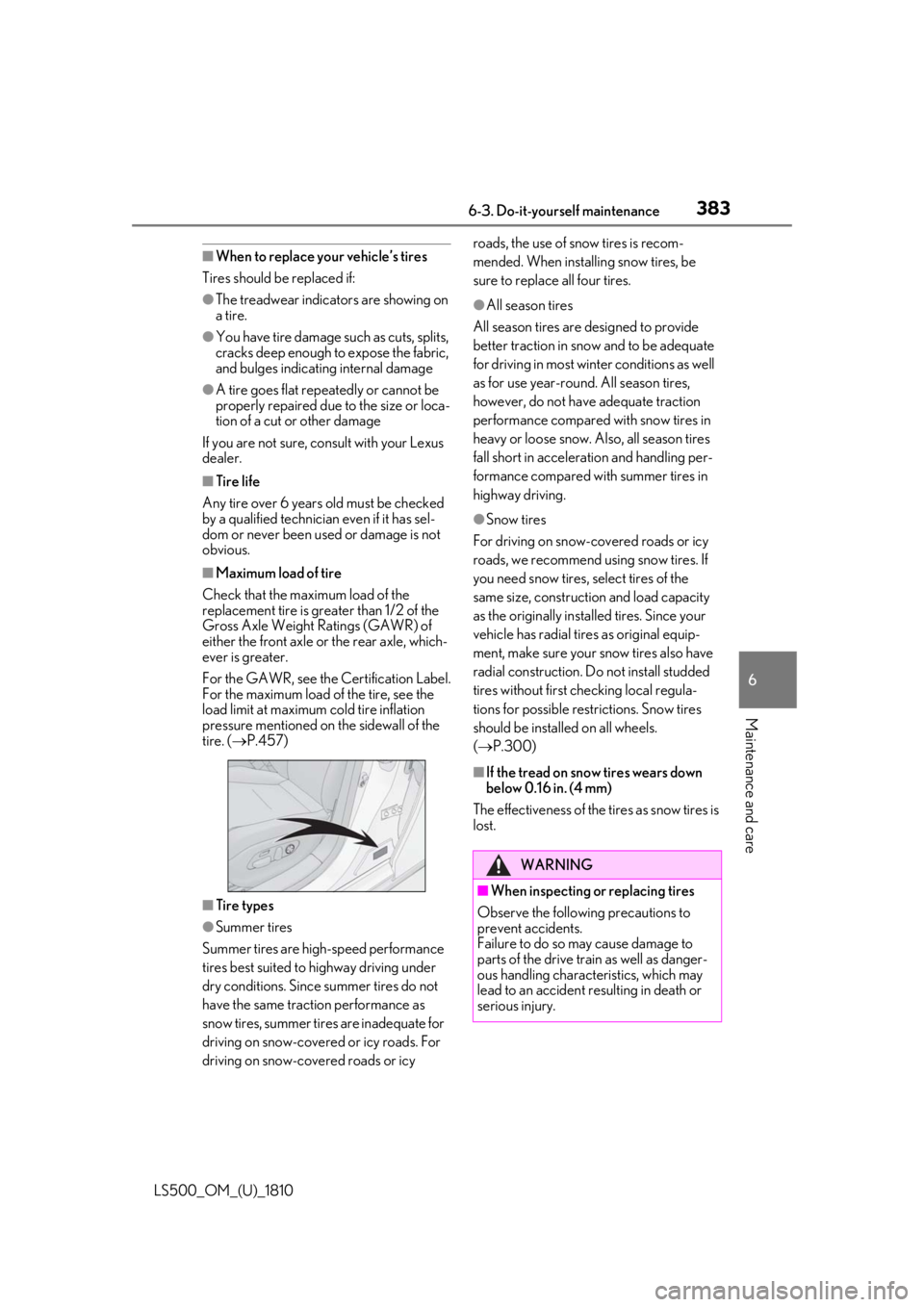
Check that the maximum load of the
replacement tire is greater than 1/2 of the
Gross Axle Weight Ratings (GAWR) of
either the front axle or the rear axle, which-
ever is greater.
For the GAWR, see the Certification Label.
For the maximum load of the tire, see the
load limit at maximum cold tire inflation
pressure mentioned on the sidewall of the
tire. ( P.457)
■
Tire types
●
Summer tires
Summer tires are high-speed performance
tires best suited to highway driving under
dry conditions. Since summer tires do not
have the same traction performance as
snow tires, summer tires are inadequate for
driving on snow-covered or icy roads. For
driving on snow-covered roads or icy roads, the use of snow tires is recom-
mended. When installing snow tires, be
sure to replace all four tires. ●
All season tires
All season tires are designed to provide
better traction in snow and to be adequate
for driving in most winter conditions as well
as for use year-round. All season tires,
however, do not have adequate traction
performance compared with snow tires in
heavy or loose snow. Also, all season tires
fall short in accelerati on and handling per-
formance compared with summer tires in
highway driving. ●
Snow tires
For driving on snow-covered roads or icy
roads, we recommend using snow tires. If
you need snow tires, select tires of the
same size, construction and load capacity
as the originally instal led tires. Since your
vehicle has radial tires as original equip-
ment, make sure your snow tires also have
radial construction. Do not install studded
tires without first checking local regula-
tions for possible restrictions. Snow tires
should be installed on all wheels.
( P.300) ■
If the tread on snow tires wears down
below 0.16 in. (4 mm)
The effectiveness of the tires as snow tires is
lost.
WARNING
■
When inspecting or replacing tires
Observe the following precautions to
prevent accidents.
Failure to do so may cause damage to
parts of the drive train as well as danger-
ous handling characteristics, which may
lead to an accident resulting in death or
serious injury.