power steering LEXUS LS500 2019 Owners Manual
[x] Cancel search | Manufacturer: LEXUS, Model Year: 2019, Model line: LS500, Model: LEXUS LS500 2019Pages: 512, PDF Size: 9.71 MB
Page 2 of 512
2
LS500_OM_(U)_1810 TABLE OF CONTENTS
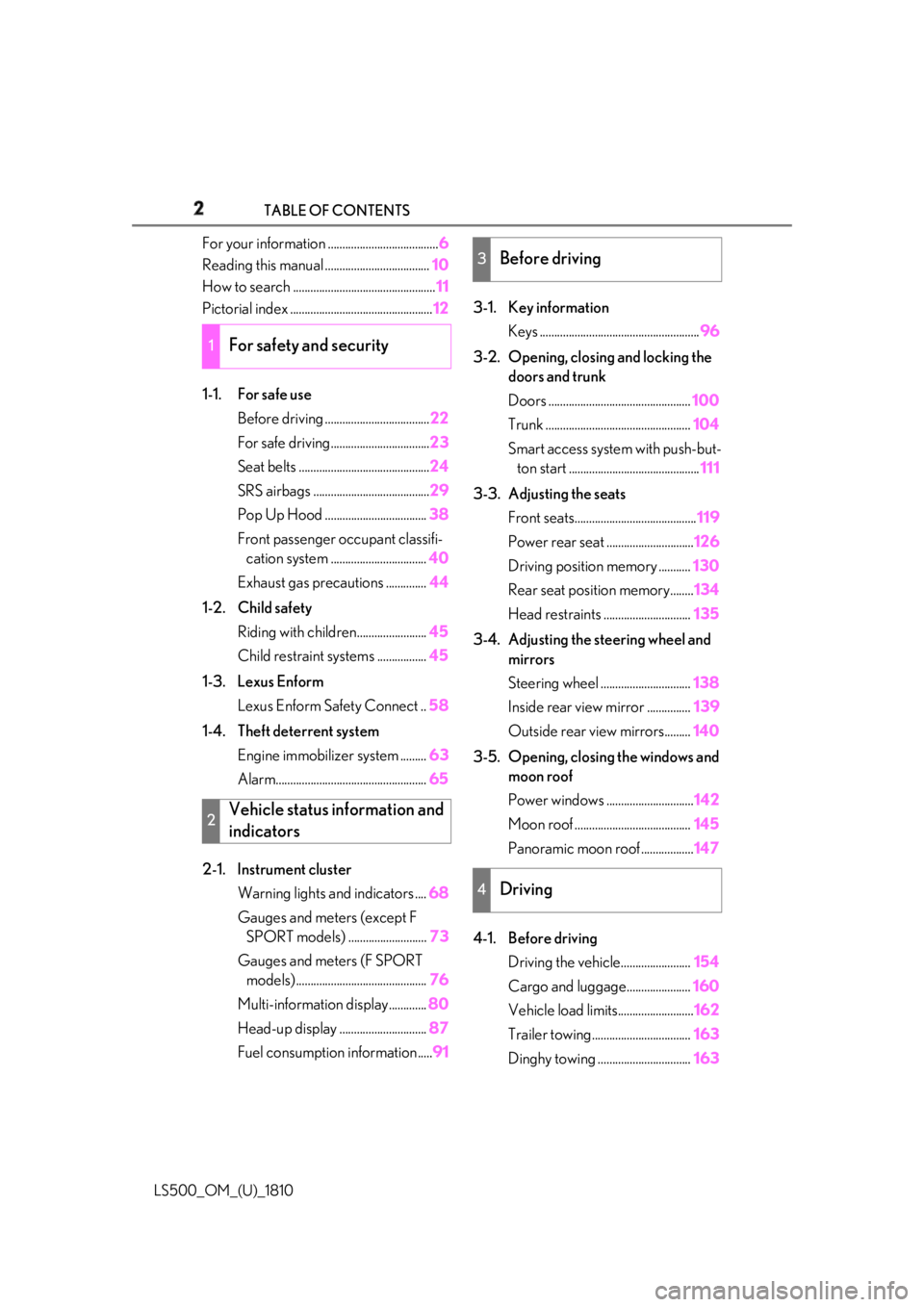
For your information ...................................... 6
Reading this manual .................................... 10
How to search ................................................. 11
Pictorial index ................................................. 12
1-1. For safe use
Before driving .................................... 22
For safe driving.................................. 23
Seat belts ............................................. 24
SRS airbags ........................................ 29
Pop Up Hood ................................... 38
Front passenger occupant classifi-
cation system ................................. 40
Exhaust gas precautions .............. 44
1-2. Child safety
Riding with children........................ 45
Child restraint systems ................. 45
1-3. Lexus Enform
Lexus Enform Safety Connect .. 58
1-4. Theft deterrent system
Engine immobilizer system ......... 63
Alarm.................................................... 65
2-1. Instrument cluster
Warning lights and indicators .... 68
Gauges and meters (except F
SPORT models) ........................... 73
Gauges and meters (F SPORT
models) ............................................. 76
Multi-information display............. 80
Head-up display .............................. 87
Fuel consumption information ..... 91 3-1. Key information
Keys ....................................................... 96
3-2. Opening, closing and locking the
doors and trunk
Doors ................................................. 100
Trunk .................................................. 104
Smart access system with push-but-
ton start ............................................. 111
3-3. Adjusting the seats
Front seats.......................................... 119
Power rear seat .............................. 126
Driving position memory ........... 130
Rear seat position memory........ 134
Head restraints .............................. 135
3-4. Adjusting the steering wheel and
mirrors
Steering wheel ............................... 138
Inside rear view mirror ............... 139
Outside rear view mirrors......... 140
3-5. Opening, closing the windows and
moon roof
Power windows .............................. 142
Moon roof ........................................ 145
Panoramic moon roof .................. 147
4-1. Before driving
Driving the vehicle........................ 154
Cargo and luggage...................... 160
Vehicle load limits.......................... 162
Trailer towing.................................. 163
Dinghy towing ................................ 1631
For safety and security
2
Vehicle status information and
indicators 3
Before driving
4
Driving
Page 34 of 512
34 1-1. For safe use
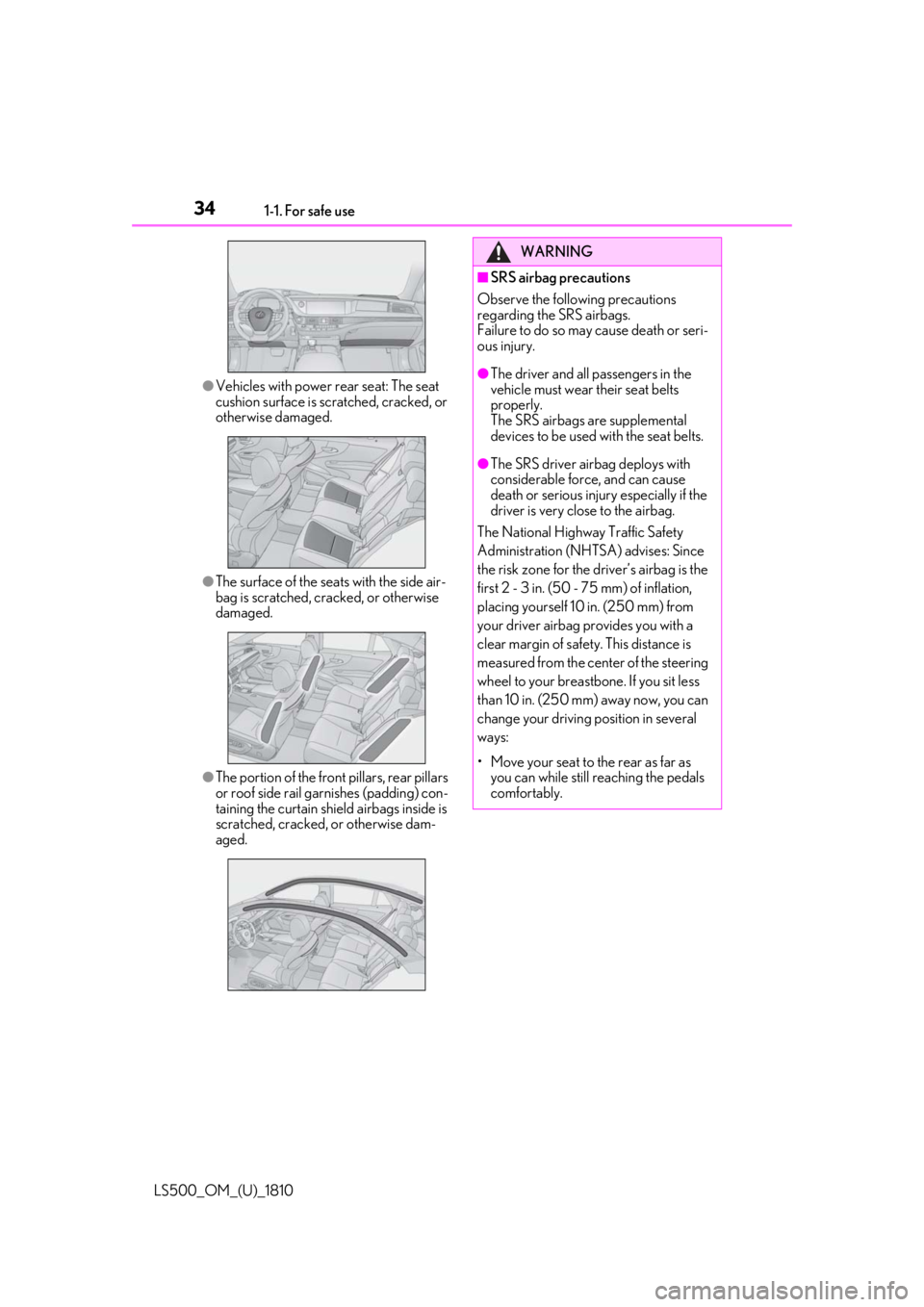
LS500_OM_(U)_1810 ●
Vehicles with power rear seat: The seat
cushion surface is scratched, cracked, or
otherwise damaged.
●
The surface of the seat s with the side air-
bag is scratched, cracked, or otherwise
damaged.
●
The portion of the front pillars, rear pillars
or roof side rail garnishes (padding) con-
taining the curtain shield airbags inside is
scratched, cracked, or otherwise dam-
aged. WARNING■
SRS airbag precautions
Observe the following precautions
regarding the SRS airbags.
Failure to do so may cause death or seri-
ous injury. ●
The driver and all passengers in the
vehicle must wear their seat belts
properly.
The SRS airbags are supplemental
devices to be used with the seat belts. ●
The SRS driver airbag deploys with
considerable force, and can cause
death or serious injury especially if the
driver is very close to the airbag.
The National Highway Traffic Safety
Administration (NHTSA) advises: Since
the risk zone for the driver’s airbag is the
first 2 - 3 in. (50 - 75 mm) of inflation,
placing yourself 10 in. (250 mm) from
your driver airbag provides you with a
clear margin of safety. This distance is
measured from the center of the steering
wheel to your breastbone. If you sit less
than 10 in. (250 mm) away now, you can
change your driving position in several
ways:
• Move your seat to the rear as far as
you can while still reaching the pedals
comfortably.
Page 69 of 512
692-1. Instrument cluster
LS500_OM_(U)_1810 2
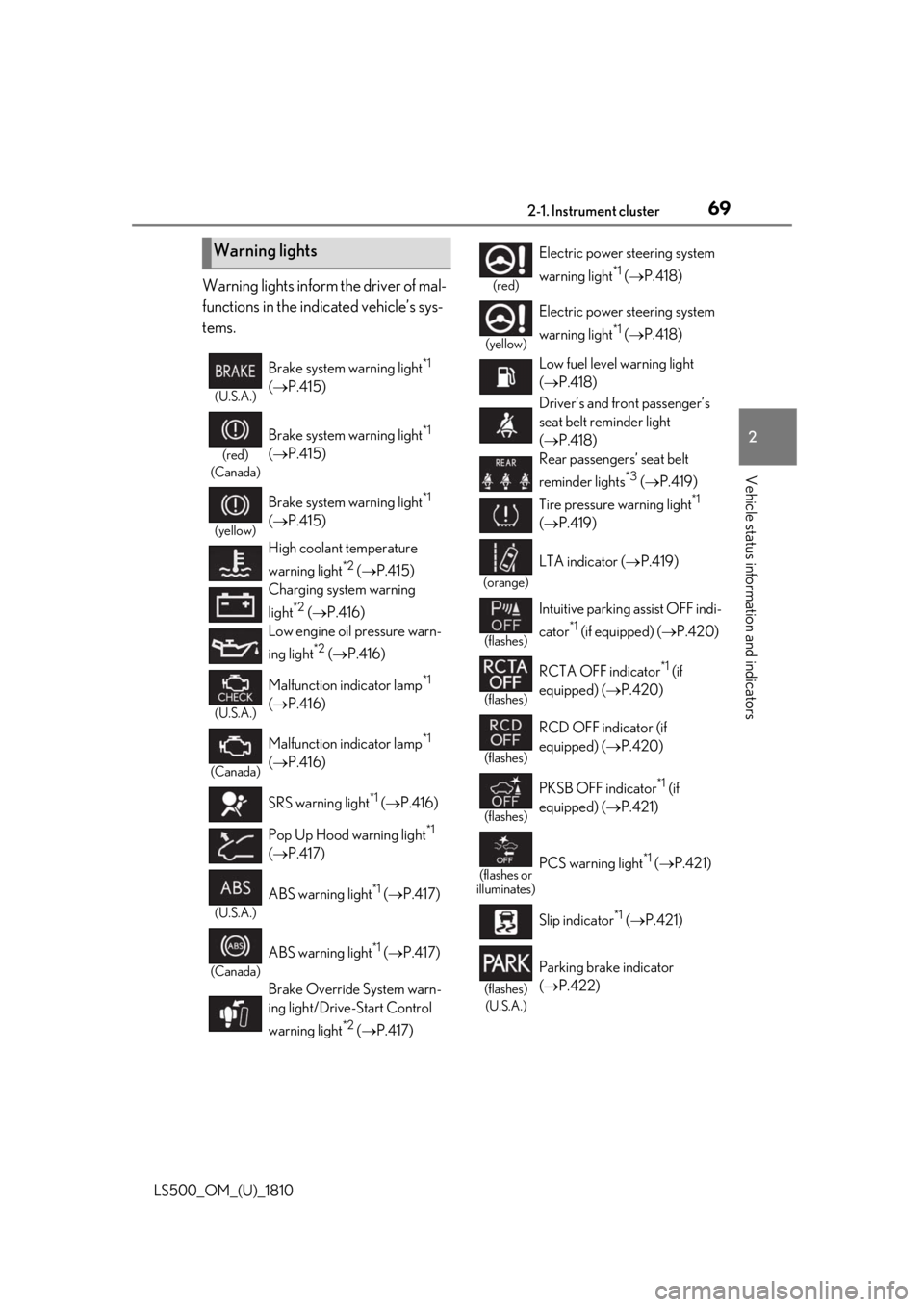
Vehicle status information and indicators Warning lights inform the driver of mal-
functions in the indicated vehicle’s sys-
tems.
Warning lights (U.S.A.)
Brake system warning light *1
( P.415)(red)
(Canada)
Brake system warning light *1
( P.415)(yellow)
Brake system warning light *1
( P.415)
High coolant temperature
warning light *2
( P.415)
Charging system warning
light *2
( P.416)
Low engine oil pressure warn-
ing light *2
( P.416)(U.S.A.)
Malfunction indicator lamp *1
( P.416)
(Canada)
Malfunction indicator lamp *1
( P.416)
SRS warning light *1
( P.416)
Pop Up Hood warning light *1
( P.417)
(U.S.A.)
ABS warning light *1
( P.417)
(Canada)
ABS warning light *1
( P.417)
Brake Override System warn-
ing light/Drive-Start Control
warning light *2
( P.417) (red)
Electric power steering system
warning light *1
( P.418)(yellow)
Electric power steering system
warning light *1
( P.418)
Low fuel level warning light
( P.418)
Driver’s and front passenger’s
seat belt reminder light
( P.418)
Rear passengers’ seat belt
reminder lights *3
( P.419)
Tire pressure warning light *1
( P.419)(orange)
LTA indicator ( P.419)
(flashes)
Intuitive parking assist OFF indi-
cator *1
(if equipped) ( P.420)
(flashes)
RCTA OFF indicator *1
(if
equipped) ( P.420)
(flashes)
RCD OFF indicator (if
equipped) ( P.420)
(flashes)
PKSB OFF indicator *1
(if
equipped) ( P.421)
(flashes or
illuminates)
PCS warning light *1
( P.421)
Slip indicator *1
( P.421)
(flashes)
(U.S.A.) Parking brake indicator
( P.422)
Page 84 of 512
84 2-1. Instrument cluster
LS500_OM_(U)_1810 surface condition, temperature and vehicle
speed, the display may not show the actual
condition of the vehicle. ■
G-force (F SPORT models)
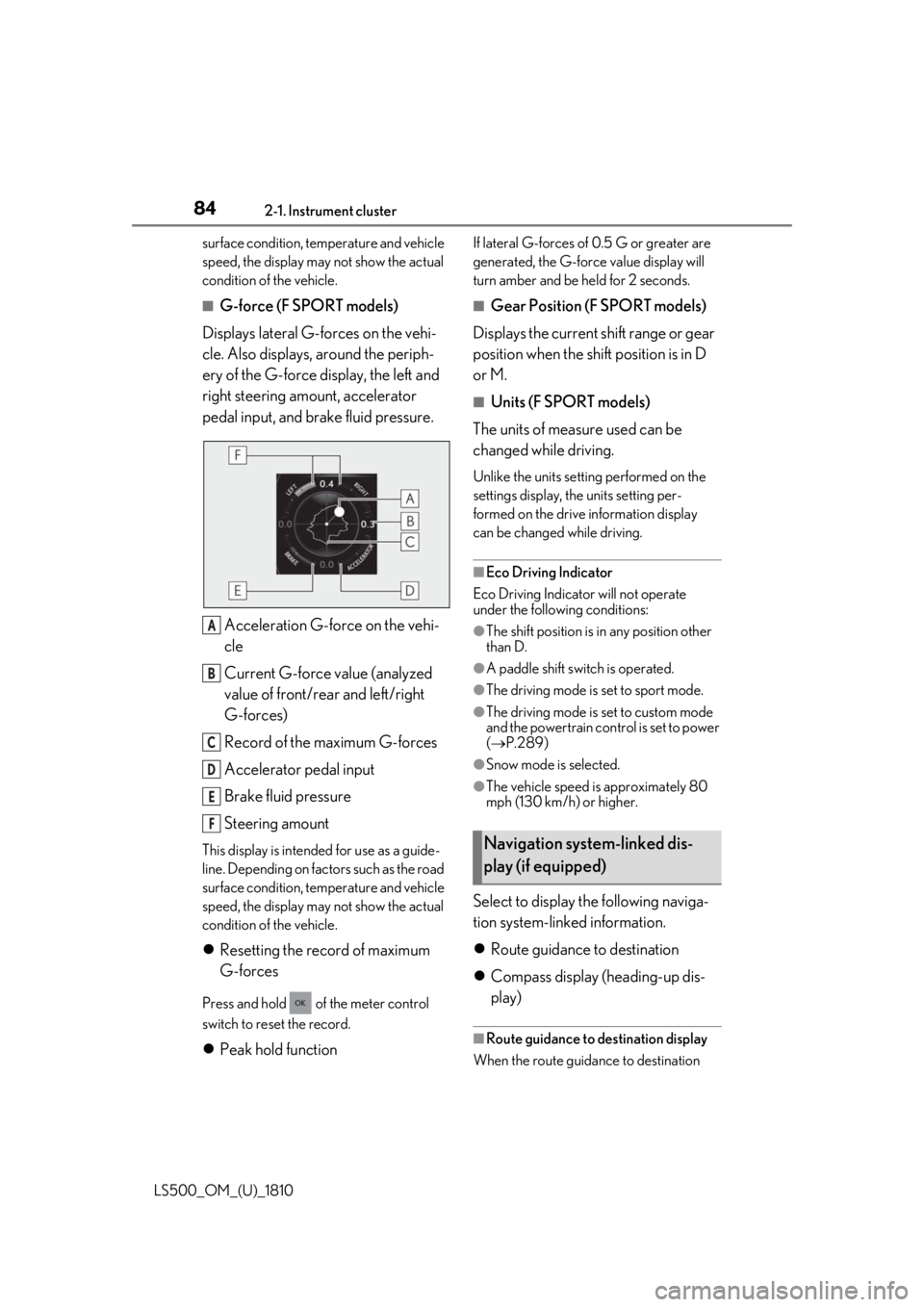
Displays lateral G-forces on the vehi-
cle. Also displays, around the periph-
ery of the G-force display, the left and
right steering amount, accelerator
pedal input, and brake fluid pressure.
Acceleration G-force on the vehi-
cle
Current G-force value (analyzed
value of front/rear and left/right
G-forces)
Record of the maximum G-forces
Accelerator pedal input
Brake fluid pressure
Steering amountThis display is intended for use as a guide-
line. Depending on factors such as the road
surface condition, temperature and vehicle
speed, the display may not show the actual
condition of the vehicle.
Resetting the record of maximum
G-forces
Press and hold of the meter control
switch to reset the record.
Peak hold function If lateral G-forces of 0.5 G or greater are
generated, the G-forc e value display will
turn amber and be held for 2 seconds. ■
Gear Position (F SPORT models)
Displays the current shift range or gear
position when the shift position is in D
or M. ■
Units (F SPORT models)
The units of measure used can be
changed while driving. Unlike the units sett ing performed on the
settings display, th e units setting per-
formed on the drive information display
can be changed while driving.
■
Eco Driving Indicator
Eco Driving Indicator will not operate
under the following conditions: ●
The shift position is in any position other
than D. ●
A paddle shift swit ch is operated.●
The driving mode is set to sport mode. ●
The driving mode is set to custom mode
and the powertrain control is set to power
( P.289)●
Snow mode is selected. ●
The vehicle speed is approximately 80
mph (130 km/h) or higher.
Select to display the following naviga-
tion system-linked information.
Route guidance to destination
Compass display (heading-up dis-
play) ■
Route guidance to destination display
When the route guidance to destination A
B
C
D
E
F
Navigation system-linked dis-
play (if equipped)
Page 95 of 512
95
LS500_OM_(U)_1810 3 3
Before driving Before driving .
3-1. Key information
Keys ................................................... 96
3-2. Opening, closing and locking the
doors and trunk
Doors............................................... 100
Trunk................................................ 104
Smart access system with
push-button start ....................... 111
3-3. Adjusting the seats
Front seats ...................................... 119
Power rear seat........................... 126
Driving position memory ........ 130
Rear seat position memory .... 134
Head restraints............................ 135
3-4. Adjusting the steering wheel and
mirrors
Steering wheel............................. 138
Inside rear view mirror............. 139
Outside rear view mirrors ...... 140
3-5. Opening, closing the windows
and moon roof
Power windows........................... 142
Moon roof ..................................... 145
Panoramic moon roof .............. 147
Page 130 of 512
130 3-3. Adjusting the seats
LS500_OM_(U)_1810 If a seat is not occupi ed, do not operate the
rear seat relaxation system for that seat. ■
Relaxation system●
Operating conditions
• The engine switch is in IGNITION ON
mode.
• The temperature in the cabin is not
extremely high.
• The weight of an occupant is detected on
the rear seat or the rear seat belt is fas-
tened.
Once weight is detect ed on the seat, the
seat will be judged as occupied until a rear
door is opened then closed or the engine
switch is turned off and the doors are
locked. ●
Automatic stop function
• The operation will be canceled automati-
cally after approximately 15 minutes.
• If the door for a seat that the relaxation
system is currently being used is opened,
the relaxation system will stop operating.
The seat and steering wheel are auto-
matically adjusted to allow the driver to
enter and exit the vehicle easily.
Driver’s seat
When all of the following have been
performed, the seat and steering
wheel are automatically adjusted to a
position that allows driver to enter and
exit the vehicle easily.
• The shift position has been shifted to
P.
• The engine switch has been turned
off.
• The driver’s seat belt has been
unfastened. When the driver’s seat adjustment
switches are in front passenger mode
( P.121), the seat and steering wheel will
not move.WARNING■
Using the relaxation system●
Those who are pregnant, have recently
given birth, or suffer from ailments
requiring rest (heart disease etc.)
should consult a doctor before use.
●
Do not allow children to use the relax-
ation function.
●
Do not use immediately after consum-
ing a meal or alcohol, or for an
extended period of time.
●
If you feel sick while using the relax-
ation function, immediately discon-
tinue use. Driving position memory This feature automatically adjusts
the positions of the front seats,
steering wheel, outside rear view
mirrors and head-up display (if
equipped) to make entering and
exiting the vehicle easier or to suit
your preferences.
Up to 3 different driving positions
can be recorded.
Each electronic key (including a
card key) can be registered to
recall your preferred driving posi-
tion.
Power easy access system
Page 131 of 512
1313-3. Adjusting the seats
LS500_OM_(U)_1810 3
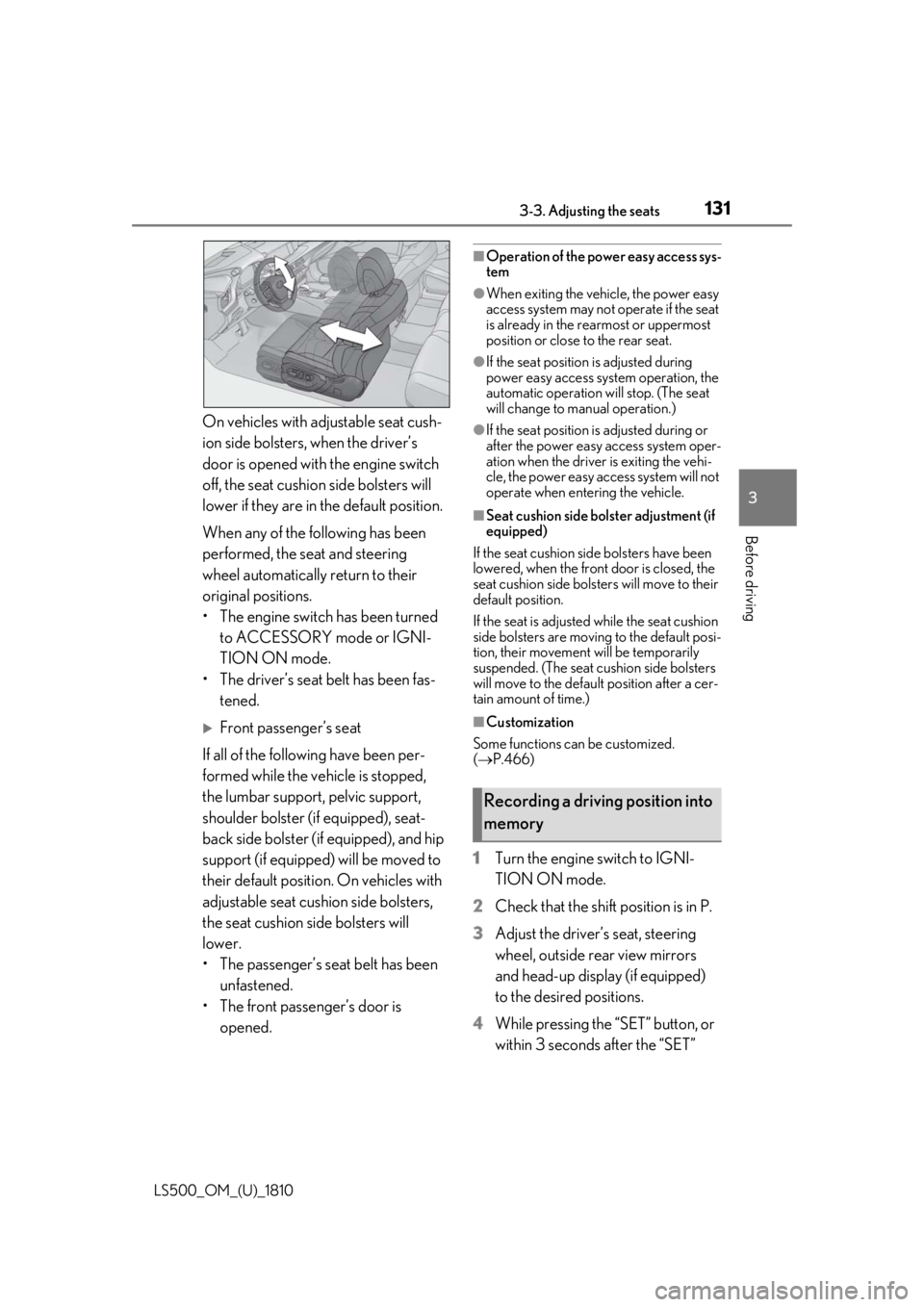
Before driving On vehicles with adjustable seat cush-
ion side bolsters, when the driver’s
door is opened with the engine switch
off, the seat cushio n side bolsters will
lower if they are in the default position.
When any of the following has been
performed, the seat and steering
wheel automatically return to their
original positions.
• The engine switch has been turned
to ACCESSORY mode or IGNI-
TION ON mode.
• The driver’s seat belt has been fas-
tened.
Front passenger’s seat
If all of the following have been per-
formed while the vehicle is stopped,
the lumbar support, pelvic support,
shoulder bolster (if equipped), seat-
back side bolster (if equipped), and hip
support (if equipped) will be moved to
their default position. On vehicles with
adjustable seat cushion side bolsters,
the seat cushion side bolsters will
lower.
• The passenger’s seat belt has been
unfastened.
• The front passenger’s door is
opened. ■
Operation of the power easy access sys-
tem ●
When exiting the vehicle, the power easy
access system may not operate if the seat
is already in the rearmost or uppermost
position or close to the rear seat. ●
If the seat position is adjusted during
power easy access syst em operation, the
automatic operation will stop. (The seat
will change to manual operation.) ●
If the seat position is adjusted during or
after the power easy access system oper-
ation when the driver is exiting the vehi-
cle, the power easy access system will not
operate when entering the vehicle. ■
Seat cushion side bolster adjustment (if
equipped)
If the seat cushion side bolsters have been
lowered, when the front door is closed, the
seat cushion side bolsters will move to their
default position.
If the seat is adjusted while the seat cushion
side bolsters are moving to the default posi-
tion, their movement will be temporarily
suspended. (The seat cushion side bolsters
will move to the default position after a cer-
tain amount of time.) ■
Customization
Some functions can be customized.
( P.466)
1 Turn the engine switch to IGNI-
TION ON mode.
2 Check that the shift position is in P.
3 Adjust the driver’s seat, steering
wheel, outside rear view mirrors
and head-up display (if equipped)
to the desired positions.
4 While pressing the “SET” button, or
within 3 seconds after the “SET” Recording a driving position into
memory
Page 138 of 512
138 3-4. Adjusting the steering wheel and mirrors
LS500_OM_(U)_1810 3-4.Adjusting the steering wheel and mirrors
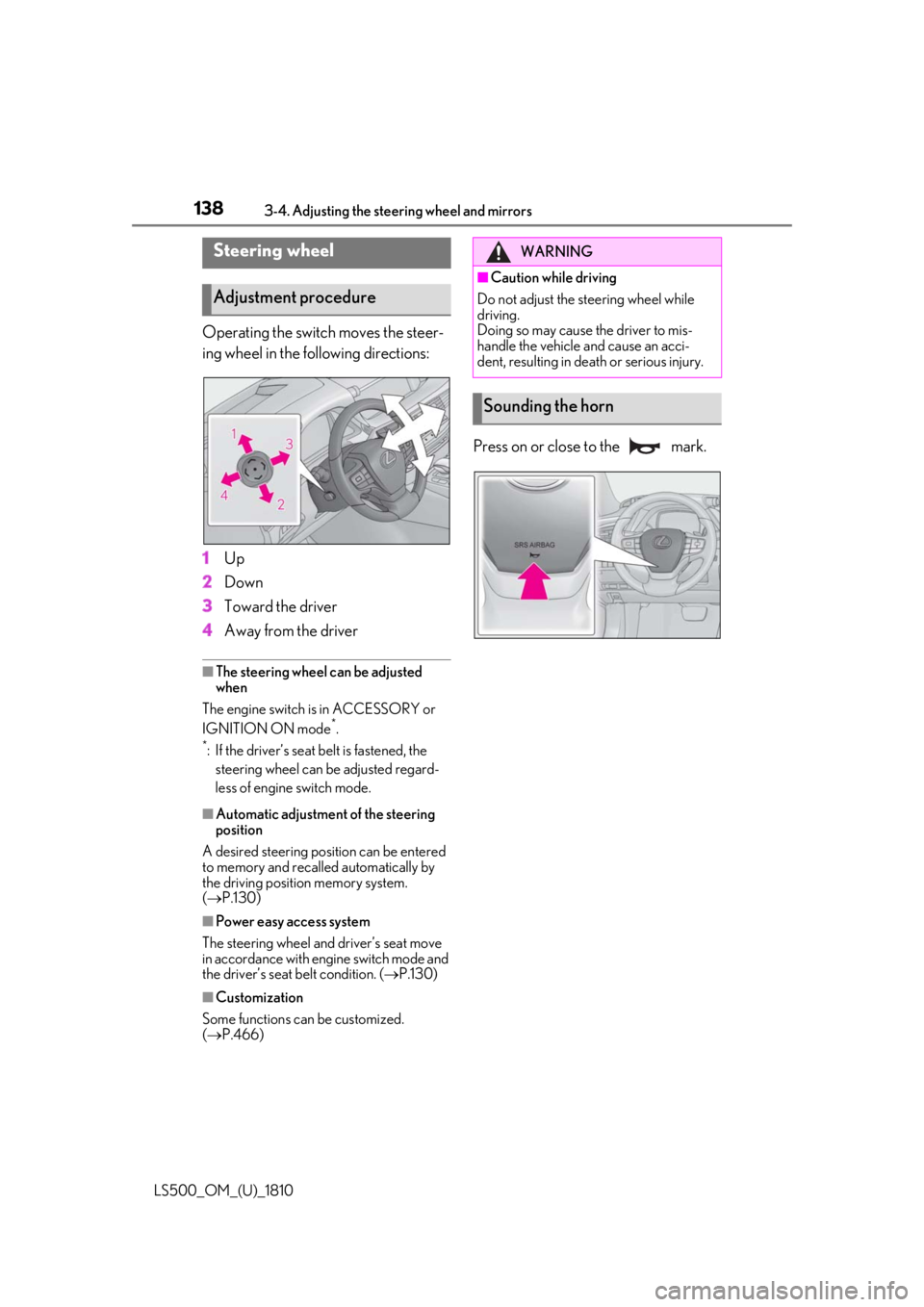
Operating the switch moves the steer-
ing wheel in the following directions:
1 Up
2 Down
3 Toward the driver
4 Away from the driver ■
The steering wheel can be adjusted
when
The engine switch is in ACCESSORY or
IGNITION ON mode *
.*
: If the driver’s seat belt is fastened, the
steering wheel can be adjusted regard-
less of engine switch mode.
■
Automatic adjustment of the steering
position
A desired steering position can be entered
to memory and recalled automatically by
the driving position memory system.
( P.130)
■
Power easy access system
The steering wheel and driver’s seat move
in accordance with engine switch mode and
the driver’s seat belt condition. ( P.130)
■
Customization
Some functions can be customized.
( P.466) Press on or close to the mark.Steering wheel
Adjustment procedure WARNING■
Caution while driving
Do not adjust the steering wheel while
driving.
Doing so may cause the driver to mis-
handle the vehicle and cause an acci-
dent, resulting in death or serious injury.
Sounding the horn
Page 156 of 512
156 4-1. Before driving
LS500_OM_(U)_1810 WARNING■
When driving the vehicle●
Do not drive if you are unfamiliar with
the location of the brake and accelera-
tor pedals to avoid depressing the
wrong pedal.
• Accidentally depressing the accelera-
tor pedal instead of the brake pedal
will result in sudden acceleration that
may lead to an accident.
• When backing up, you may twist your
body around, leading to a difficulty in
operating the pedals. Make sure to
operate the pedals properly.
• Make sure to keep a correct driving
posture even when moving the vehicle
only slightly. This allows you to depress
the brake and accelerator pedals
properly.
• Depress the brake pedal using your
right foot. Depressing the brake pedal
using your left foot may delay
response in an emergency, resulting in
an accident.●
Do not drive the vehicle over or stop
the vehicle near flammable materials.
The exhaust system and exhaust gases
can be extremely hot. These hot parts
may cause a fire if there is any flamma-
ble material nearby.
●
Vehicles without Lexus Safety System
+ A: During normal driving, do not turn
off the engine. Turning the engine off
while driving will not cause loss of
steering or braking control, but the
power assist to these systems will be
lost. This will make it more difficult to
steer and brake, so you should putt
over and stop the vehicle as soon as it
is safe to do so.
However, in the event of an emer-
gency, such as if it becomes impossible
to stop the vehicle in the normal way:
P.406 ●
Vehicles with Lexus Safety System + A:
During normal driving, do not turn off
the engine. Turning the engine off
while driving will not cause loss of
steering or braking control, however,
power assist to the st eering will be lost.
This will make it more difficult to steer
smoothly, so you should pull over and
stop the vehicle as soon as it is safe to
do so.
In the event of an emergency, such as if
it becomes impossible to stop the vehi-
cle in the normal way: P.406●
Use engine braking (downshift) to
maintain a safe speed when driving
down a steep hill.
Using the brakes continuously may
cause the brakes to overheat and lose
effectiveness. ( P.167)●
Do not adjust the positions of the
steering wheel, the seat, or the inside
or outside rear view mirrors while driv-
ing.
Doing so may result in a loss of vehicle
control. ●
Always check that all passengers’
arms, heads or other parts of their
body are not outside the vehicle. ●
Do not drive in excess of the speed
limit. Even if the legal speed limit per-
mits it, do not drive over 85 mph (140
km/h) unless your vehicle has
high-speed capability tires. Driving
over 85 mph (140 km /h) may result in
tire failure, loss of control and possible
injury. Be sure to consult a tire dealer
to determine whether the tires on your
vehicle are high-speed capability tires
or not before driving at such speeds.
■
When driving on slippery road sur-
faces
●
Sudden braking, acceleration and
steering may cause tire slippage and
reduce your ability to control the vehi-
cle.
●
Sudden acceleration, engine braking
due to shifting, or changes in engine
speed could cause the vehicle to skid.
Page 157 of 512
1574-1. Before driving
LS500_OM_(U)_1810 4
Driving WARNING●
After driving through a puddle, lightly
depress the brake pedal to make sure
that the brakes are functioning prop-
erly. Wet brake pads may prevent the
brakes from functioning properly. If the
brakes on only one side are wet and
not functioning properly, steering con-
trol may be affected.■
When shifting the shift position●
Do not let the vehicle roll backward
while a forward driving position is
selected, or roll forward while the shift
position is in R.
Doing so may cause the engine to stall
or lead to poor brake and steering
performance, resulting in an accident
or damage to the vehicle.●
Do not shift the shift position to P while
the vehicle is moving.
Doing so can damage the transmission
and may result in a loss of vehicle con-
trol.●
Do not shift the shift position to R while
the vehicle is moving forward.
Doing so can damage the transmission
and may result in a loss of vehicle con-
trol.
●
Do not shift the shift position to a driv-
ing position while the vehicle is moving
backward.
Doing so can damage the transmission
and may result in a loss of vehicle con-
trol.
●
Changing the shift position to N while
the vehicle is moving will disengage
the engine from the transmission.
Engine braking is not available when N
is selected. ●
Be careful not to change the shift posi-
tion with the accelerator pedal
depressed. Changing the shift posi-
tion to any positions other than P or N
may lead to unexpected rapid acceler-
ation of the vehicle that may cause an
accident and result in death or serious
injury.
After changing the shift position, make
sure to confirm the current shift posi-
tion displayed on the shift position indi-
cator inside the meter. ■
Brake pad wear
If any of the following situations occurs,
have the brake pads visually checked and
replaced by your Lexus dealer as soon as
possible. ●
If the brake pad wear limit of a brake
pad is found to have been exceeded
when visually checking the brake pads
for each wheel (for the brake pad wear
limit, refer to P.451) ●
If a warning message is displayed on
the multi-information display (only the
right-side pads can be detected)
Rotor damage may result if the pads are
not replaced when needed.
F SPORT models: Moderate levels of the
brake pad and disc wear allow enhanced
braking power. As a result, the discs may
wear more quickly than conventional
brake discs. Therefore, when replacing
the brake pads, Lexus recommends that
you also have the thickness of the discs
measured.
It is dangerous to drive the vehicle when
the wear limits of the brake pads and/or
those of the brake discs are exceeded.
■
When the vehicle is stopped
●
Do not race the engine.
If the vehicle is in any gear other than P
or N, the vehicle may accelerate sud-
denly and unexpectedly, causing an
accident.