tow LEXUS LS500 2020 User Guide
[x] Cancel search | Manufacturer: LEXUS, Model Year: 2020, Model line: LS500, Model: LEXUS LS500 2020Pages: 516, PDF Size: 10.38 MB
Page 124 of 516
1243-3. Adjusting the seats
the head restraint will also move.
■Operating the front passenger’s seat
from the rear seat
●In the following situations, the front pas-
senger’s seat cannot be operated using
the Rear Multi Operation Panel:
• The engine switch is in ACCESSORY mode or off.
• The rear seat belt is not fastened and
weight is not detected on the rear seat.
Once weight is detect ed on the seat, the
seat will be judged as occupied until a rear
door is opened then closed or the engine
switch is turned off and the doors are
locked.
• The weight of an occupant or heavy object, etc. is detected on the front pas-
senger’s seat.
Once weight is detect ed on the seat, the
seat will be judged as occupied until the
front passenger’s door is opened then
closed or the engine switch is turned off.
• The front passenger’s seat belt is fas-
tened.
• The front passenger’s door is open. (The
front seat will not move forward.)
●If the rear armrest is stowed while the
seat position is being adjusted, the opera-
tion will stop.
■Canceling an operation
To cancel an operation, press and hold the
button of the Rear Multi Opera-
tion Panel or press it 3 times in quick suc-
cession.
■When the front passenger’s seat is
folded forward
P.123
Pneumatic chambers built into the
front seat apply pre ssure to the occu-
pant’s body at different modes and intensities.
1
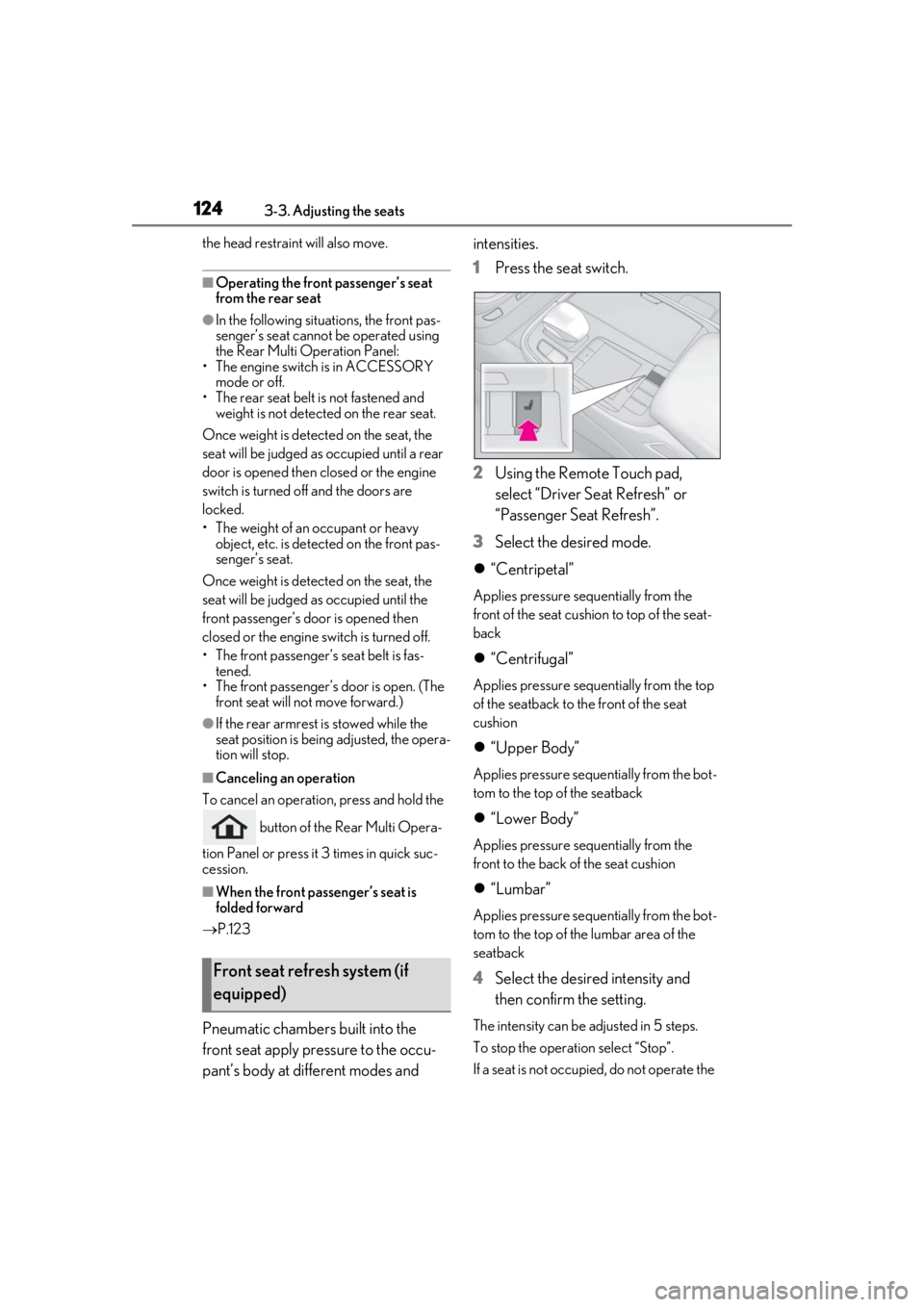
Press the seat switch.
2 Using the Remote Touch pad,
select “Driver Se at Refresh” or
“Passenger Seat Refresh”.
3 Select the desired mode.
“Centripetal”
Applies pressure sequentially from the
front of the seat cushion to top of the seat-
back
“Centrifugal”
Applies pressure sequentially from the top
of the seatback to the front of the seat
cushion
“Upper Body”
Applies pressure sequentially from the bot-
tom to the top of the seatback
“Lower Body”
Applies pressure sequentially from the
front to the back of the seat cushion
“Lumbar”
Applies pressure sequentially from the bot-
tom to the top of the lumbar area of the
seatback
4 Select the desired intensity and
then confirm the setting.
The intensity can be adjusted in 5 steps.
To stop the operation select “Stop”.
If a seat is not occupied, do not operate the
Front seat refresh system (if
equipped)
Page 126 of 516
1263-3. Adjusting the seats
■Automatic operation
The seat can be moved to preset posi-
tions.
1
Display the home screen on the
Rear Multi Operation Panel
( P.312) and then touch “Seat”.
2
Touch “Left” or “Right”.
3
Touch the desired preset button.
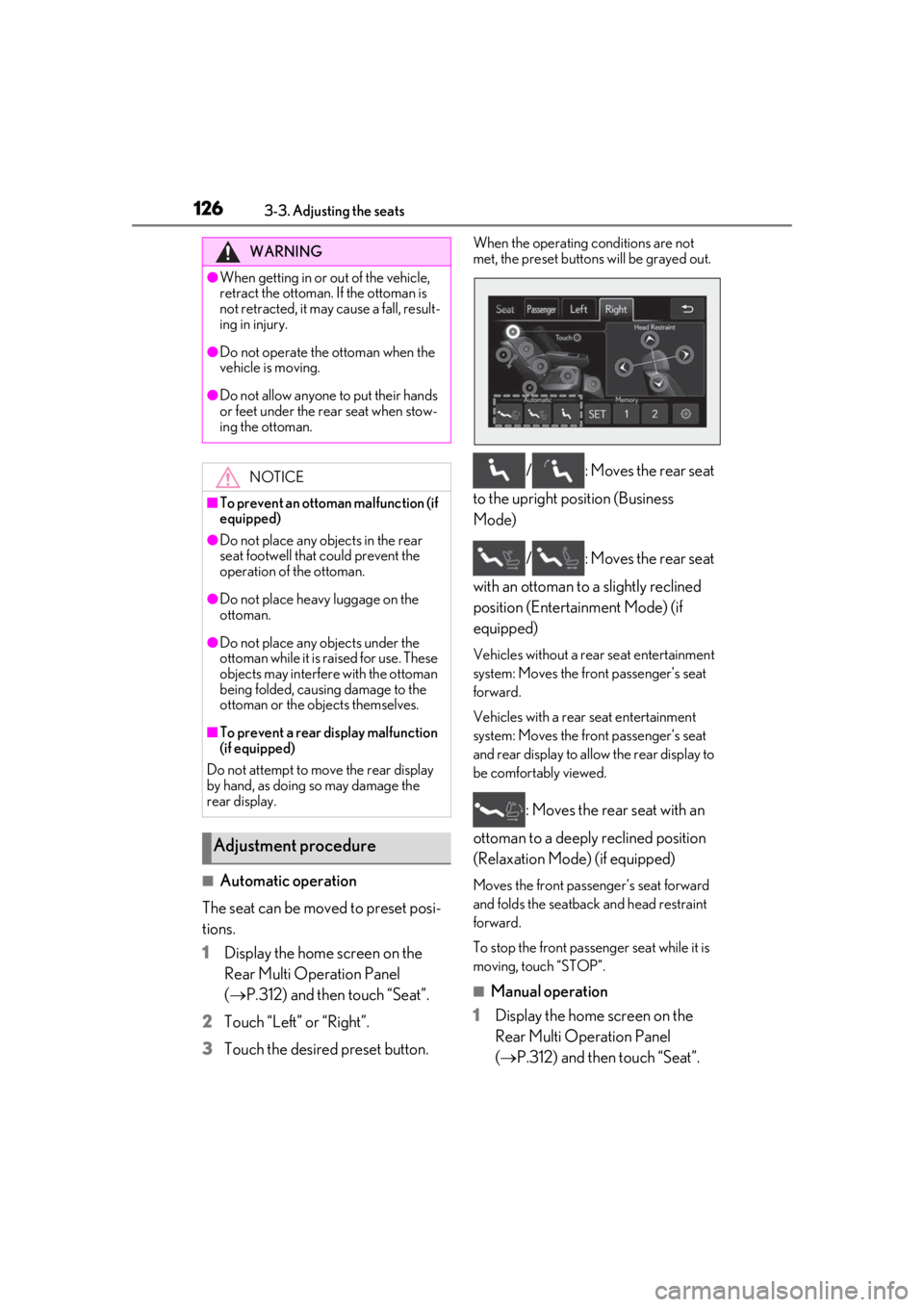
When the operating conditions are not
met, the preset buttons will be grayed out.
/ : Moves the rear seat
to the upright position (Business
Mode)
/ : Moves the rear seat
with an ottoman to a slightly reclined
position (Entertainment Mode) (if
equipped)
Vehicles without a rear seat entertainment
system: Moves the fron t passenger’s seat
forward.
Vehicles with a rear seat entertainment
system: Moves the fron t passenger’s seat
and rear display to allow the rear display to
be comfortably viewed.
: Moves the rear seat with an
ottoman to a deeply reclined position
(Relaxation Mode) (if equipped)
Moves the front passenger’s seat forward
and folds the seatback and head restraint
forward.
To stop the front passenger seat while it is
moving, touch “STOP”.
■Manual operation
1
Display the home screen on the
Rear Multi Operation Panel
( P.312) and then touch “Seat”.
WARNING
●When getting in or out of the vehicle,
retract the ottoman. If the ottoman is
not retracted, it may cause a fall, result-
ing in injury.
●Do not operate the ottoman when the
vehicle is moving.
●Do not allow anyone to put their hands
or feet under the rear seat when stow-
ing the ottoman.
NOTICE
■To prevent an ottoman malfunction (if
equipped)
●Do not place any objects in the rear
seat footwell that could prevent the
operation of the ottoman.
●Do not place heavy luggage on the
ottoman.
●Do not place any objects under the
ottoman while it is raised for use. These
objects may interfere with the ottoman
being folded, causing damage to the
ottoman or the objects themselves.
■To prevent a rear display malfunction
(if equipped)
Do not attempt to move the rear display
by hand, as doing so may damage the
rear display.
Adjustment procedure
Page 127 of 516
1273-3. Adjusting the seats
3
Before driving
2Touch “Left” or “Right”.
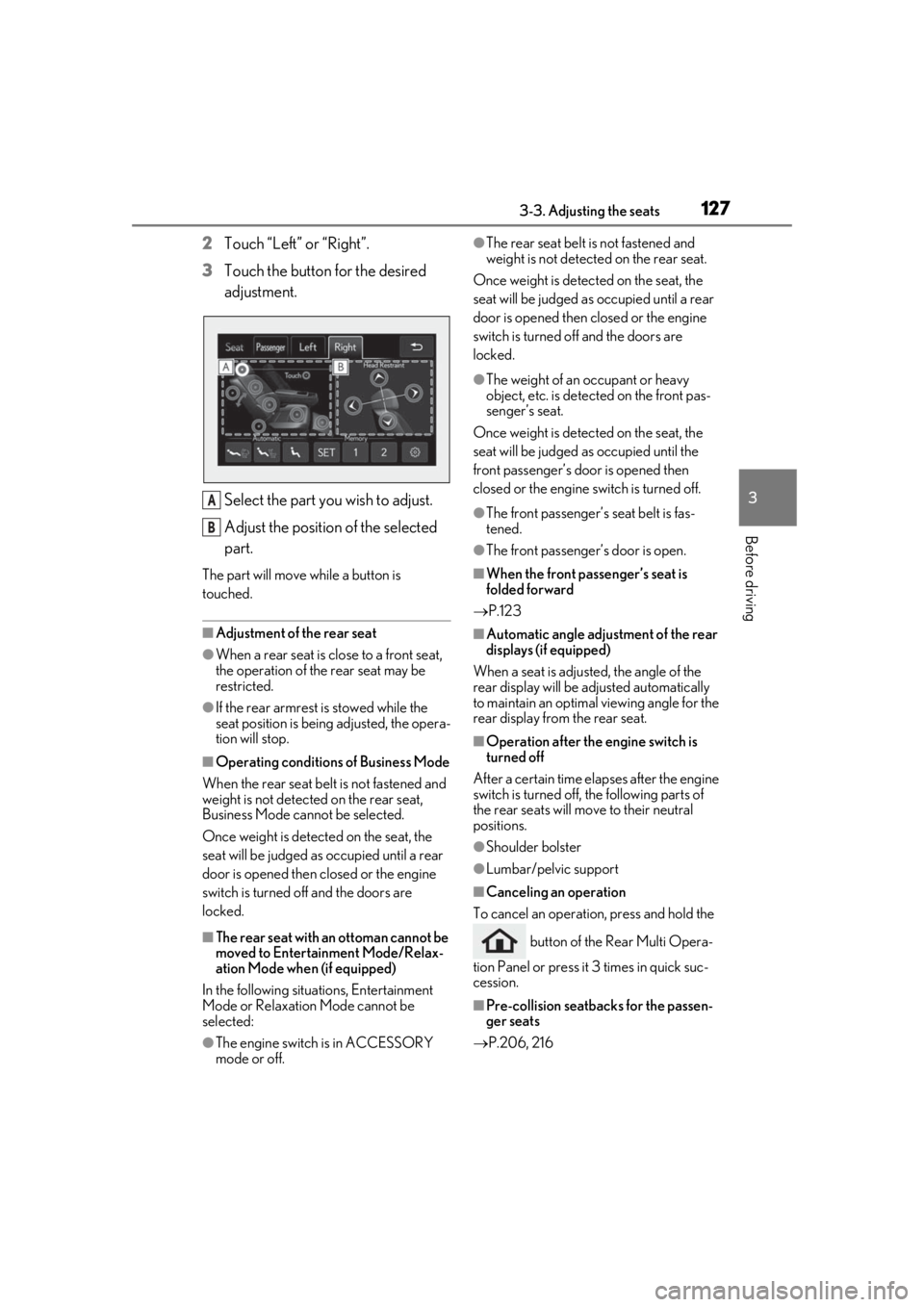
3 Touch the button for the desired
adjustment.
Select the part you wish to adjust.
Adjust the position of the selected
part.
The part will move while a button is
touched.
■Adjustment of the rear seat
●When a rear seat is close to a front seat,
the operation of the rear seat may be
restricted.
●If the rear armrest is stowed while the
seat position is being adjusted, the opera-
tion will stop.
■Operating conditions of Business Mode
When the rear seat belt is not fastened and
weight is not detected on the rear seat,
Business Mode cannot be selected.
Once weight is detect ed on the seat, the
seat will be judged as occupied until a rear
door is opened then closed or the engine
switch is turned off and the doors are
locked.
■The rear seat with an ottoman cannot be
moved to Entertainment Mode/Relax-
ation Mode when (if equipped)
In the following situations, Entertainment
Mode or Relaxation Mode cannot be
selected:
●The engine switch is in ACCESSORY
mode or off.
●The rear seat belt is not fastened and
weight is not detected on the rear seat.
Once weight is detected on the seat, the
seat will be judged as occupied until a rear
door is opened then closed or the engine
switch is turned off and the doors are
locked.
●The weight of an occupant or heavy
object, etc. is detected on the front pas-
senger’s seat.
Once weight is detected on the seat, the
seat will be judged as occupied until the
front passenger’s door is opened then
closed or the engine switch is turned off.
●The front passenger’s seat belt is fas-
tened.
●The front passenger’s door is open.
■When the front passenger’s seat is
folded forward
P.123
■Automatic angle adjustment of the rear
displays (if equipped)
When a seat is adjusted, the angle of the
rear display will be adjusted automatically
to maintain an optimal viewing angle for the
rear display from the rear seat.
■Operation after the engine switch is
turned off
After a certain time elapses after the engine
switch is turned off, the following parts of
the rear seats will move to their neutral
positions.
●Shoulder bolster
●Lumbar/pelvic support
■Canceling an operation
To cancel an operatio n, press and hold the
button of the Rear Multi Opera-
tion Panel or press it 3 times in quick suc-
cession.
■Pre-collision seatback s for the passen-
ger seats
P.206, 216
A
B
Page 128 of 516
1283-3. Adjusting the seats
■Customization
Some functions can be customized.
( P.470)
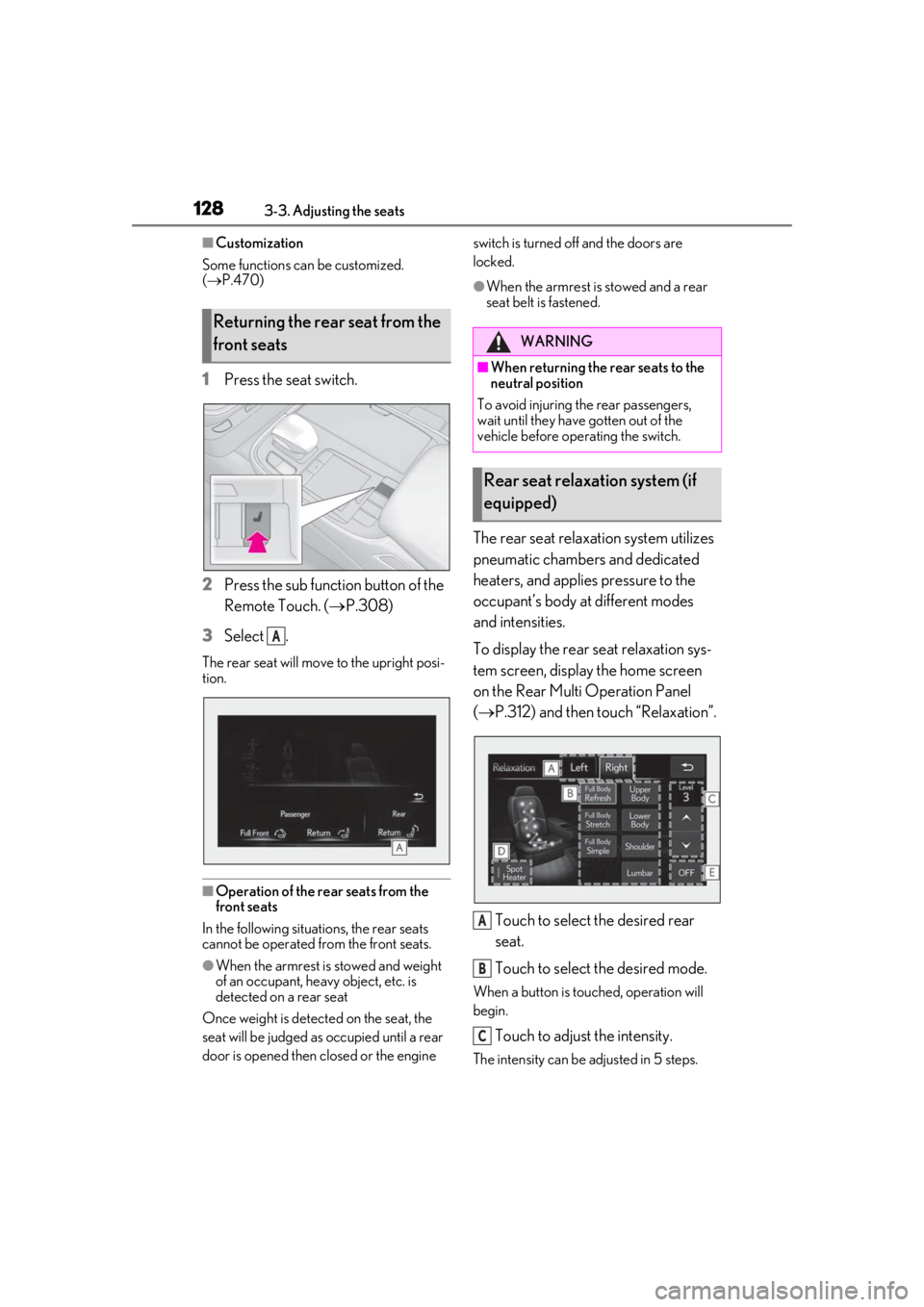
1Press the seat switch.
2
Press the sub function button of the
Remote Touch. ( P.308)
3
Select .
The rear seat will move to the upright posi-
tion.
■Operation of the rear seats from the
front seats
In the following situations, the rear seats
cannot be operated from the front seats.
●When the armrest is stowed and weight
of an occupant, heavy object, etc. is
detected on a rear seat
Once weight is detect ed on the seat, the
seat will be judged as occupied until a rear
door is opened then closed or the engine switch is turned off and the doors are
locked.
●When the armrest is stowed and a rear
seat belt is fastened.
The rear seat relaxation system utilizes
pneumatic chambers and dedicated
heaters, and applies pressure to the
occupant’s body at different modes
and intensities.
To display the rear seat relaxation sys-
tem screen, display the home screen
on the Rear Multi Operation Panel
(
P.312) and then touch “Relaxation”.
Touch to select the desired rear
seat.
Touch to select the desired mode.
When a button is touched, operation will
begin.
Touch to adjust the intensity.
The intensity can be adjusted in 5 steps.
Returning the rear seat from the
front seats
A
WARNING
■When returning the rear seats to the
neutral position
To avoid injuring the rear passengers,
wait until they have gotten out of the
vehicle before operating the switch.
Rear seat relaxation system (if
equipped)
A
B
C
Page 129 of 516
1293-3. Adjusting the seats
3
Before driving
Touch to turn the spot heaters
on/off.
Touch to stop the operation.
If a seat is not occupied, do not operate the
rear seat relaxation system for that seat.
■Relaxation system
●Operating conditions
• The engine switch is in IGNITION ON mode.
• The temperature in the cabin is not extremely high.
• The weight of an occupant is detected on
the rear seat or the rear seat belt is fas-
tened.
Once weight is detect ed on the seat, the
seat will be judged as occupied until a rear
door is opened then closed or the engine
switch is turned off and the doors are
locked.
●Automatic stop function
• The operation will be canceled automati-
cally after approximately 15 minutes.
• If the door for a seat that the relaxation
system is currently being used is opened,
the relaxation system will stop operating.
The following functions will cause the
rear seats to move automatically.
■Seat return function linked to the
door opening operation
The rear seat will return to the upright
position automatically when the rear
door is opened for ea sier entry and exit
of the vehicle.
For the rear seat with an ottoman (if
equipped): When the rear door on the
side with the rear seat with an ottoman
is opened, the seatback of the rear seat
with an ottoman will move to a more
upright position. The seatback will
move to the upright position after the
door is closed and the system deter-
mines that the rear passenger has
exited.
However, if the armrest is stowed, the
rear seat will not move.
■Shift-linked rear seat reclining
function
When the shift position is shifted from
P, to enhance rear visibility for the
driver, the rear seats will recline slightly.
However, the shift-linked rear seat
reclining function will not operate in
the following situations:
The weight of an occupant or heavy
object, etc. is detected on a rear
seat.
Once weight is detected on the seat, the
seat will be judged as occupied until a rear
door is opened then closed or the engine
switch is turned off and the doors are
locked.
WARNING
■Using the relaxation system
●Those who are pregnant, have recently
given birth, or suffer from ailments
requiring rest (heart disease etc.)
should consult a doctor before use.
●Do not allow children to use the relax-
ation function.
●Do not use immediately after consum-
ing a meal or alcohol, or for an
extended period of time.
●If you feel sick while using the relax-
ation function, immediately discon-
tinue use.
D
E
Automatic Seat Operation
Page 130 of 516
1303-3. Adjusting the seats
A rear seat belt is fastened.
A rear door is open.
The armrest is stowed.
When a front seat is close to a rear
seat, the rear seats may not operate or
the range of movement may be
restricted.
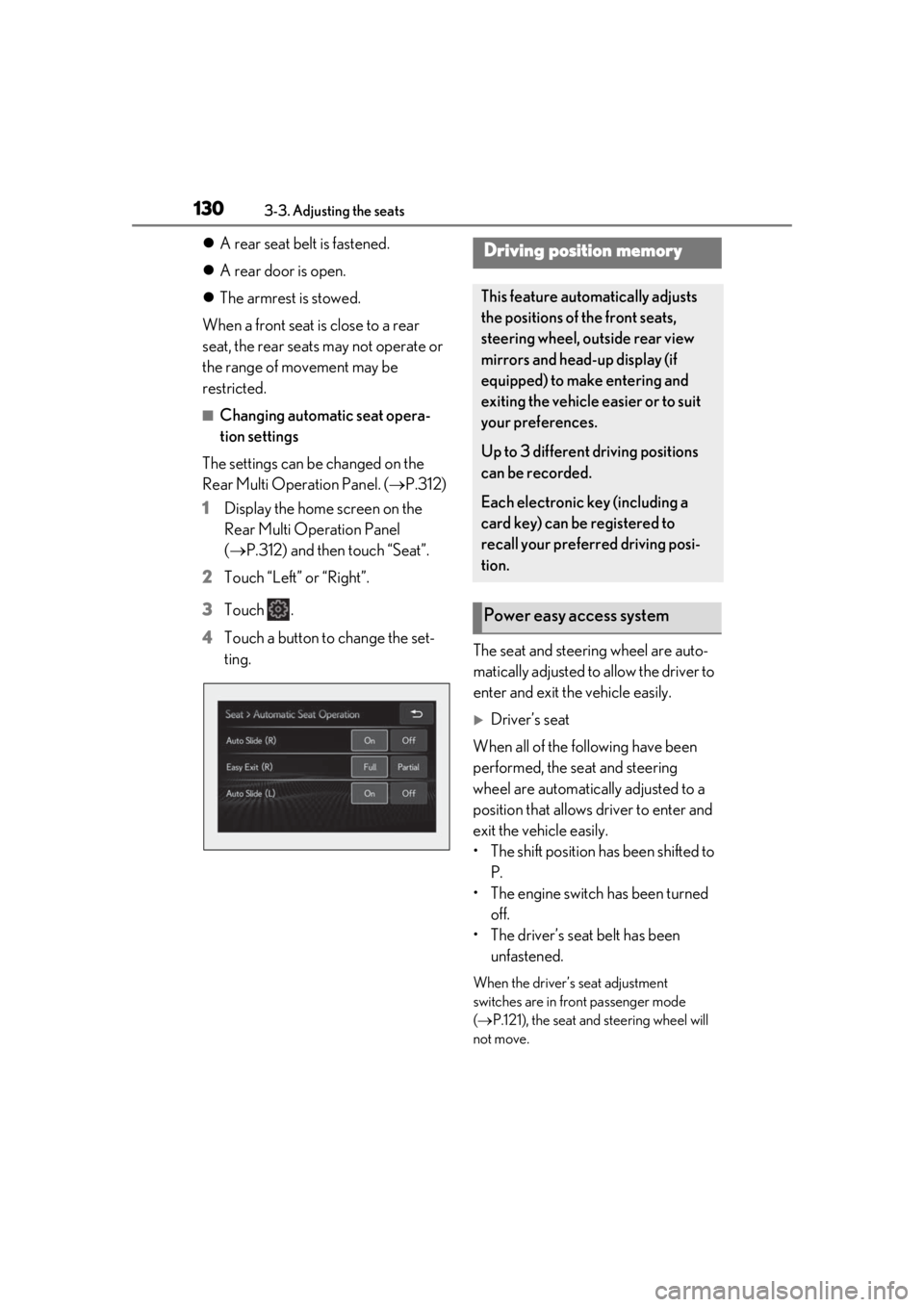
■Changing automatic seat opera-
tion settings
The settings can be changed on the
Rear Multi Operation Panel. ( P.312)
1 Display the home screen on the
Rear Multi Operation Panel
(P.312) and then touch “Seat”.
2 Touch “Left” or “Right”.
3 Touch .
4 Touch a button to change the set-
ting. The seat and steering wheel are auto-
matically adjusted to allow the driver to
enter and exit the vehicle easily.
Driver’s seat
When all of the following have been
performed, the seat and steering
wheel are automatically adjusted to a
position that allows driver to enter and
exit the vehicle easily.
• The shift position has been shifted to P.
• The engine switch has been turned off.
• The driver’s seat belt has been unfastened.
When the driver’s seat adjustment
switches are in front passenger mode
( P.121), the seat and steering wheel will
not move.
Driving position memory
This feature automatically adjusts
the positions of the front seats,
steering wheel, outside rear view
mirrors and head-up display (if
equipped) to make entering and
exiting the vehicle easier or to suit
your preferences.
Up to 3 different driving positions
can be recorded.
Each electronic key (including a
card key) can be registered to
recall your preferred driving posi-
tion.
Power easy access system
Page 137 of 516

1373-3. Adjusting the seats
3
Before driving
1Up
Pull the head restraints up.
2Down
Push the head restraint down while press-
ing the lock release button .
■Front seat head restraints (power head
restraints)
Depending on the position of the front seat,
the front head restraint may not be able to
be adjusted upward if it is close to the ceil-
ing.
■Adjusting the height of the head
restraints
Make sure that the head restraints are
adjusted so that the center of the head
restraint is closest to the top of your ears.
■Adjusting the rear seat head restraints
(manual head restraints)
Always raise the head restraint one level
from the stowed position when using.
The position of the head restraint can
be adjusted forward in 4 stages.
If the head restraint is pulled forward from
the foremost position, it will return to the
rearmost position.
Push the sides of the head restraint.
Pull the head restraint up while press-
ing the lock release button .
Adjusting a head restraint verti-
cally (manual head restraints)
A
Adjusting a head restraint hori-
zontally (manual head restraints)
Adjusting the side supports (if
equipped)
Removing the head restraints
(manual head restraints)
A
Page 139 of 516
1393-4. Adjusting the steering wheel and mirrors
3
Before driving
3-4.Adjusting the steering wheel and mirrors
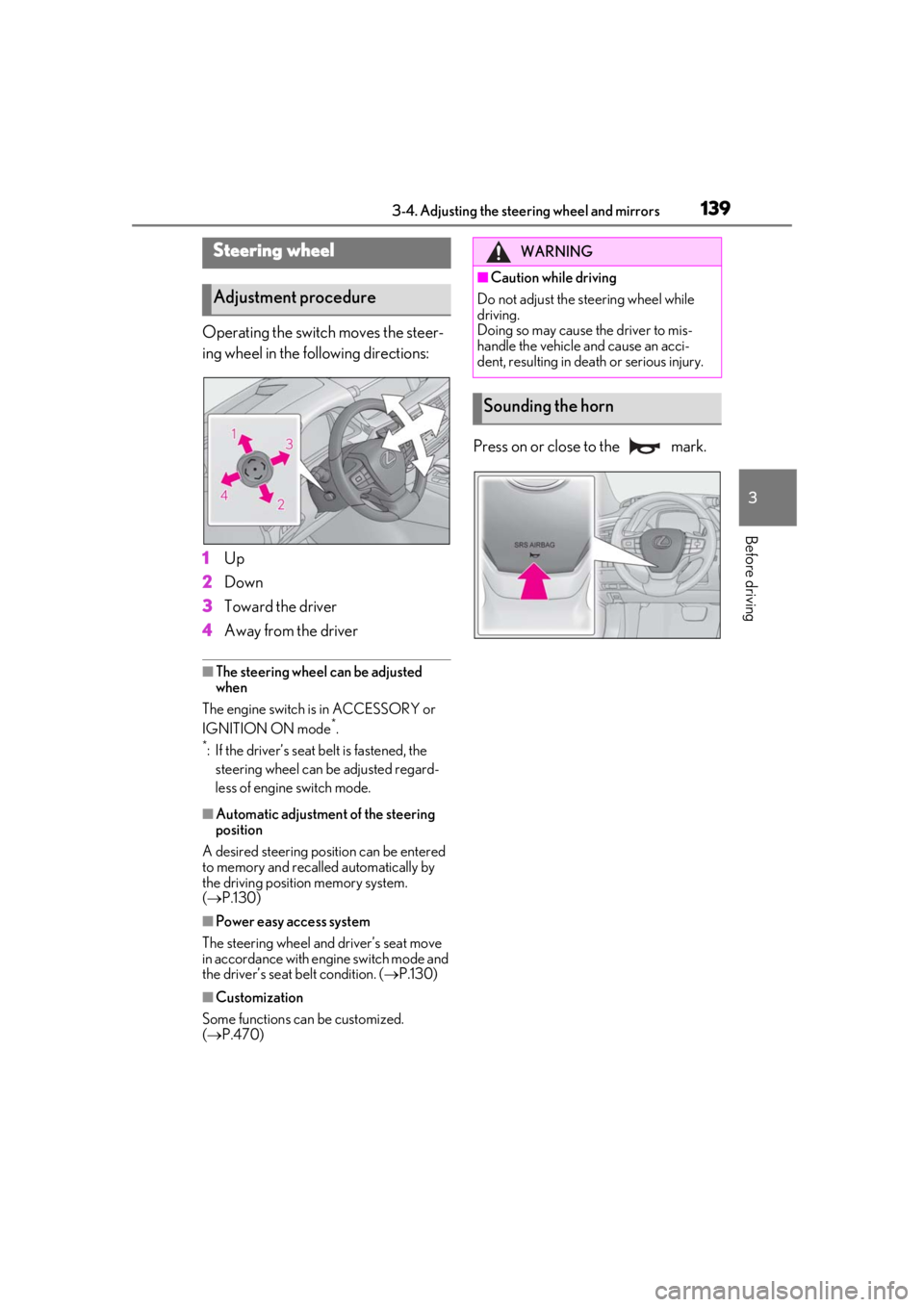
Operating the switch moves the steer-
ing wheel in the following directions:
1
Up
2
Down
3
Toward the driver
4
Away from the driver
■The steering wheel can be adjusted
when
The engine switch is in ACCESSORY or
IGNITION ON mode
*.
*: If the driver’s seat belt is fastened, the steering wheel can be adjusted regard-
less of engine switch mode.
■Automatic adjustment of the steering
position
A desired steering position can be entered
to memory and recalled automatically by
the driving position memory system.
( P.130)
■Power easy access system
The steering wheel and driver’s seat move
in accordance with engine switch mode and
the driver’s seat belt condition. ( P.130)
■Customization
Some functions can be customized.
( P.470)
Press on or close to the mark.
Steering wheel
Adjustment procedure
WARNING
■Caution while driving
Do not adjust the steering wheel while
driving.
Doing so may cause the driver to mis-
handle the vehicle and cause an acci-
dent, resulting in death or serious injury.
Sounding the horn
Page 142 of 516

1423-4. Adjusting the steering wheel and mirrors
nor “R”.
To set the mirror angle used when the vehi-
cle is reversing, adjust the mirror angle at a
desired position with the shift position in R.
The adjusted angle will be memorized and
the mirror will automatically tilt to the mem-
orized angle whenever the shift position is
shifted to R from next time.
The memorized downward tilt position of
the mirror is linked to the normal position
(angle adjusted with the shift position in
other than R). Therefore, if the normal posi-
tion is changed after adjustment, the tilt
position will also change.
When the normal position is changed, read-
just the angle in reversing.
■Using the switch
Press the switch to fold the mirrors.
Press it again to extend them to the original
position.
■Setting automatic mode
Automatic mode allows the folding or
extending of the mirrors to be linked to locking/unlocking of the doors.
Press the “AUTO” switch to set auto-
matic mode.
The indicator will come on.
Pressing the switch once more will return
to manual mode.
■When disconnecting and reconnecting
battery terminals
The automatic folding/extending mirror
function will return to off as default. To turn
the function on, press the switch again to
select on.
■Using automatic mode in cold weather
When automatic mode is used in cold
weather, the door mirror could freeze up
and automatic stowing and return may not
be possible. In this case, remove any ice and
snow from the door mirror, then either
operate the mirror using manual mode or
move the mirror by hand.
■Customization
Some functions can be customized.
( P.470)
WARNING
■When the mirror defoggers are oper-
ating
Do not touch the rear view mirror sur-
faces, as they can become very hot and
burn you.
Folding and extending the mir-
rors
WARNING
■When a mirror is moving
To avoid personal injury and mirror mal-
function, be careful not to get your hand
caught by the moving mirror.
A
Page 153 of 516
153
4
4
Driving
Driving
.4-1. Before drivingDriving the vehicle ..................... 154
Cargo and luggage .................... 161
Vehicle load limits ...................... 163
Trailer towing ............................... 163
Dinghy towing ............................. 164
4-2. Driving procedures Engine (ignition) switch ........... 165
Automatic transmission........... 169
Turn signal lever.......................... 175
Parking brake .............................. 176
Brake Hold.................................... 178
4-3. Operating the lights and wipers Headlight switch ......................... 180
AHB (Automatic High Beam) ......................................................... 183
Windshield wipers and washer ......................................................... 185
4-4. Refueling Opening the fuel tank cap...... 190
4-5. Using the driving support sys- tems
Lexus Safety System + A......... 192
Lexus Safety System + 2.0 ..... 199
PCS (Pre-Collision System) (vehi- cles with Lexus Safety System +
A) .................................................. 205
PCS (Pre-Collision System) (vehi- cles with Lexus Safety System +
2.0)................................................ 216FCTA (Front Cross Traffic Alert)
....................................................... 223
LTA (Lane Tracing Assist) .... 226
RSA (Road Sign Assist).......... 238
Dynamic radar cruise control with full-speed range........................ 241
BSM (Blind Spot Monitor) ..... 251
PKSA (Parking Support Alert) ....................................................... 257
Intuitive parking assist ............. 259
RCTA (Rear cross traffic alert) function....................................... 266
RCD (Rear Camera Detection) function....................................... 270
PKSB (Parking Support Brake) ....................................................... 273
Parking Support Brake function (static objects) ......................... 279
Parking Support Brake function (rear-crossing vehicles) ...... 285
Parking Support Brake function (rear pedestrians) .................. 289
Driving mode select switch .. 292
Electronically modulated air sus- pension ....................................... 294
Driving assist systems.............. 297
4-6. Driving tips Winter driving tips .................... 303