tire pressure LEXUS LS500 2021 Owners Manual
[x] Cancel search | Manufacturer: LEXUS, Model Year: 2021, Model line: LS500, Model: LEXUS LS500 2021Pages: 520, PDF Size: 9.81 MB
Page 1 of 520

LS500_U
1
2
3
4
5
6
7
8
9
Pictorial indexSearch by illustration
For safety
and securityMake sure to read through them
(Main topics: Child seat, theft deterrent system)
Vehicle status
information and
indicatorsReading driving-related information
(Main topics: Meters, multi-information display)
Before drivingOpening and closing the doors and windows,
adjustment before driving
(Main topics: Keys, doors, seats)
DrivingOperations and advice which are necessary for driving
(Main topics: Starting engine, refueling)
Interior featuresUsage of the interior features
(Main topics: Air conditioner, storage features)
Maintenance
and careCaring for your vehicle and maintenance procedures
(Main topics: Interior and exterior, light bulbs)
When trouble
arisesWhat to do in case of malfunction and emergency
(Main topics: Battery discharge, flat tire)
Vehicle
specificationsVehicle specifications, customizable features
(Main topics: Fuel, oil, tire inflation pressure)
For ownersReporting safety defects for U.S. owners, seat belt, SRS
airbag and headlight aim in structions for Canadian
owners
IndexSearch by symptom
Search alphabetically
Page 4 of 520

4TABLE OF CONTENTS
Trunk features................................349
5-6. Using the other interior features Other interior features .............. 352
Garage door opener.................. 360
6-1. Maintenance and care Cleaning and protecting the vehi-cle exterior ................................... 368
Cleaning and protecting the vehi- cle interior ..................................... 371
6-2. Maintenance Maintenance requirements ..... 374
General maintenance ................ 375
Emission inspection and mainte- nance (I/M) programs ............ 378
6-3. Do-it-yourself maintenance Do-it-yourself service precautions........................................................... 379
Hood................................................... 381
Positioning a floor jack................ 381
Engine compartment.................. 383
Battery ............................................... 391
Tires ................................................... 393
Replacing the tire ......................... 402
Tire inflation pressure ................. 406
Wheels.............................................. 407
Air conditioning filter..................409
Electronic key battery ................. 410
Checking and replacing fuses ............................................................ 412
Headlight aim.................................. 415
Light bulbs ........................................ 4167-1. Essential information
Emergency flashers ..................... 418
If your vehicle has to be stopped in an emergency ............................. 418
If the vehicle is trapped in rising water ............................................... 419
7-2. Steps to take in an emergency If your vehicle needs to be towed............................................................ 421
If you think something is wrong .......................................................... 425
Fuel pump shut off system ........ 426
If a warning light turns on or a warn- ing buzzer sounds...................... 427
If a warning messa ge is displayed
.......................................................... 436
If you have a flat tire .................... 438
If the engine will not start .......... 439
If you lose your keys...................... 441
If the fuel filler door cannot be opened ............................................ 441
If the electronic key does not oper- ate properly .................................. 442
If the vehicle battery is discharged .......................................................... 444
If your vehicle overheats ........... 449
If the vehicle becomes stuck ... 452
8-1. Specifications Maintenance data (fuel, oil level, etc.) ................................................. 456
Fuel information .
........................... 465
6Maintenance and care
7When trouble arises
8Vehicle specifications
Page 9 of 520

9
your Lexus dealer before you scrap
your vehicle.
Special handling may apply, See
www.dtsc.ca.gov/hazard-
ouswaste/perchlorate.
Your vehicle has components that may
contain perchlorate. These compo-
nents may include the airbags, seat belt
pretensioners, Pop Up Hood system,
wireless remote control batteries, and
the batteries in the tire pressure warn-
ing valve and transmitters.
Perchlorate Material
WARNING
■General precautions while driving
Driving under the infl uence: Never drive
your vehicle when un der the influence of
alcohol or drugs that have impaired your
ability to operate your vehicle. Alcohol
and certain drugs delay reaction time,
impair judgment and reduce coordina-
tion, which could lead to an accident that
could result in death or serious injury.
Defensive driving: Always drive defen-
sively. Anticipate mistakes that other
drivers or pedestrians might make and
be ready to avoid accidents.
Driver distraction: Always give your full
attention to driving. Anything that dis-
tracts the driver, such as adjusting con-
trols, talking on a cellular phone or
reading can result in a collision with
resulting death or serious injury to you,
your occupants or others.
■General precaution regarding chil-
dren’s safety
Never leave children unattended in the
vehicle, and never allow children to have
or use the key.
Children may be able to start the vehicle
or shift the vehicle into neutral. There is
also a danger that children may injure
themselves by playing with the windows,
the moon roof, or other features of the
vehicle. In addition, heat build-up or
extremely cold temperatures inside the
vehicle can be fatal to children.
Page 13 of 520
13Pictorial index
Precautions for winter season .....................................................................................P.309
To prevent freezing (windshield wiper de-icer)
*.................................................P.328
Precautions for car wash ............................................................................................... P.369
Fuel filler door ........................................................................................................ P.200
Refueling method .............................................................................................................P. 200
Fuel type/fuel tank capacity ...... ................................................................................... P.457
Tires.......................................................................................................................... .P.393
Tire size/inflation pressure ......................... .......................................................P.393, 462
Winter tires/tire chains ..................................................................................................P.309
Checking/rotation/tire pressure warning system.............................................. P.393
Coping with flat tires........................................................................................................P .438
Hood ........................................................................................................................... P.381
Opening ........................................................................................................................ ........ P.381
Engine compartment cover .........................................................................................P.384
Engine oil ..................................................................................................................... .........P.458
Coping with overheating ............................................................................................... P.449
Warning messages .......................................................................................................... P.436
Headlights/cornering lights ................................................................................P.190
Parking lights/daytime running lights...............................................................P.190
Turn signal lights ......................................................................................................P.185
Tail lights .................................................................................................................... P.190
Stop lights
Hill-start assist control ....................................................................................................P. 304
License plate lights .................................................................................................P.190
Back-up lights
Changing the shift position to R................................................................................... P.178
Side marker lights ...................................................................................................P.190
*:If equipped
Light bulbs of the exterior lights for driving
(Replacing method: P.416)
E
F
G
H
I
J
K
L
M
N
Page 38 of 520
381-1. For safe use
■PCS-linked Pop Up Hood operation
control
If the PCS (Pre-Collision System) deter-
mines that the possibility of a collision with a
pedestrian or bicyclist is high, the Pop Up
Hood will be prepared to operate.
■Pop Up Hood operational conditions
The Pop Up Hood will operate when the
vehicle detects an impact such as the fol-
lowing:
●The front bumper detects a frontal impact
equivalent to or grea ter than that of a
pedestrian while the vehicle being driven
within the operational speed range of
approximately 16 to 34 mph (25 to 55
km/h). (The system is operated by an
impact of threshold le vel or greater, even
in the case of a minor collision that may
not leave a trace on the front bumper.
Also, depending on the impact condi-
tions or vehicle speed, the system may
operate by a collision with a light or small
object or a small animal.)
●In other situations, such as the following
the system may operate when an impact
is applied to the lowe r part of the vehicle
or front bumper:
• Colliding with a curb
• Falling into a deep hole
•Landing hard
• Hitting the slope of a parking lot, an undulating road, a protruding object or
falling object
■Conditions under which the Pop Up
Hood may not operate properly
●If a pedestrian collides with the right or
left corner of the front bumper or the side
of the vehicle. As such impacts may be
difficult to detect, the system may not
operate.
●If the vehicle speed is not detected cor-
rectly, such as if the vehicle is sliding side-
ways, the system may not operate
properly.
■Conditions under which the Pop Up
Hood will not operate
The Pop Up Hood will not operate in the
following situations:
●Colliding with a lying person
●A frontal impact applied to the front
bumper while driving at speeds outside
of the operational speed range
●A side impact or rear impact
●A vehicle rollover (In some accident situ-
ations, the Pop Up Hood may operate.)
WARNING
■When the Pop Up Hood is operated
●Do not pull the hood lock release lever.
Doing so after the Pop Up Hood has
operated will further raise the hood
and may cause an injury. Do not drive
with the hood raised, as doing so may
block the driver’s vision, possibly caus-
ing an accident.
●Do not forcibly push down the hood.
As the popped up hood cannot be
lowered by hand, doing so may deform
the hood or cause an injury.
●If the Pop Up Hood has operated, have
it replaced by your Lexus dealer. If the
Pop Up Hood has operated, stop the
vehicle in a safe place and contact
your Lexus dealer.
●Do not touch the lifters immediately
after the Pop Up Hood has operated,
as the lifters may be hot and burn you.
NOTICE
■Pop Up Hood precautions
●Make sure to close the hood before
driving, as the system may not operate
properly if the hood is not fully closed.
●Make sure that all 4 tires are of the
specified size and inflated to the speci-
fied tire pressure. If tires of a different
size are used, the system may not
operate properly.
●If something has hit the area around
the front bumper, the sensors may be
damaged even if the Pop Up Hood has
not operated. Have the vehicle
inspected by your Lexus dealer.
Page 71 of 520

712-1. Instrument cluster
2
Vehicle status information and indicators
Warning lights inform the driver of mal-
functions in the indicated vehicle’s sys-
tems.
*1: These lights come on when the engine switch is turned to IGNITION ON
mode to indicate that a system check is
Warning lights
(U.S.A.)
Brake system warning light*1
( P.427)
(red)
(Canada)
Brake system warning light*1
( P.427)
(yellow)
Brake system warning light*1
( P.427)
High coolant temperature
warning light
*2 ( P.427)
Charging system warning
light
*2 ( P.428)
Low engine oil pressure warn-
ing light
*2 ( P.428)
(U.S.A.)
Malfunction indicator lamp*1
( P.428)
(Canada)
Malfunction indicator lamp*1
( P.428)
SRS warning light
*1 ( P.428)
Pop Up Hood warning light
*1
( P.429)
(U.S.A.)
ABS warning light*1 ( P.429)
(Canada)
ABS warning light*1 ( P.429)
Inappropriate pedal operation
warning light
*2 ( P.429)
(red)
Electric power steering system
warning light
*1 ( P.430)
(yellow)
Electric power st eering system
warning light
*1 ( P.430)
Low fuel level warning light
( P.430)
Driver’s and front passenger’s
seat belt re minder light
( P.430)
Rear passengers’ seat
belt reminder lights
(except F SPORT mod-
els) ( P.431)
Rear passengers’ seat belt
reminder lights (F SPORT mod-
els) ( P.431)
Tire pressure warning light
*1
( P.431)
(orange)
LTA indicator ( P.431)
(flashes)
RCD OFF indicator (if
equipped) ( P.432)
(flashes or
illuminates)PCS warning light*1 ( P.432)
Slip indicator
*1 ( P.432)
(flashes)
(U.S.A.)
Parking brake indicator
( P.433)
(flashes)
(Canada)
Parking brake indicator
( P.433)
(flashes)
Brake hold operated indicator*1
( P.433)
Page 84 of 520

842-1. Instrument cluster
/ : Select menu icons
/ : Change displayed con-
tent, scroll up/down the screen and
move the cursor up/down
Press: Enter/Set
Press and hold: Reset
Move the main meter
* and return
to the previous screen
Call sending/receiving and history
display
Linked with the hands-free system, sending
or receiving call is displayed. For details
regarding the hands-fr ee system, refer to
the “NAVIGATION AND MULTIMEDIA
SYSTEM OWNER’S MANUAL”.
*:F SPORT models
■Display items (except F SPORT
models)
Press or of the meter control
switch and select . Then press
or to display the following items:
Drive information 1
Drive information 2
Eco Driving Indicator
Boost gauge
Tire pressure ( P.395)
Display off
■Display items (F SPORT models)
Main meter in center position
Press or of the meter control
switch to display the following items:
Drive information 1
Drive information 2
Tire pressure ( P.395)
Gear positions
Units
Display off
Driving support system information
*
( P.87)
*: Can be selected when a driving support
system is enabled. ( P.238, 254)
Main meter moved to the right
Press or of the meter control
switch and select . Then press
or to display the following items:
Drive information 1
Drive information 2
Eco Driving Indicator
Boost gauge
G-force
Gear Position
Tire pressure ( P.395)
Display off
■Drive information 1/Drive infor-
mation 2
Displays drive information such as the
following:
Use the displayed values as a reference
only.
Drive information 1
• Current fuel consumption
• Average fuel economy (after reset)
Drive information 2
Content of driving information
A
B
C
D
Page 226 of 520
2264-5. Using the driving support systems
emerge from behind a vehicle or large
object
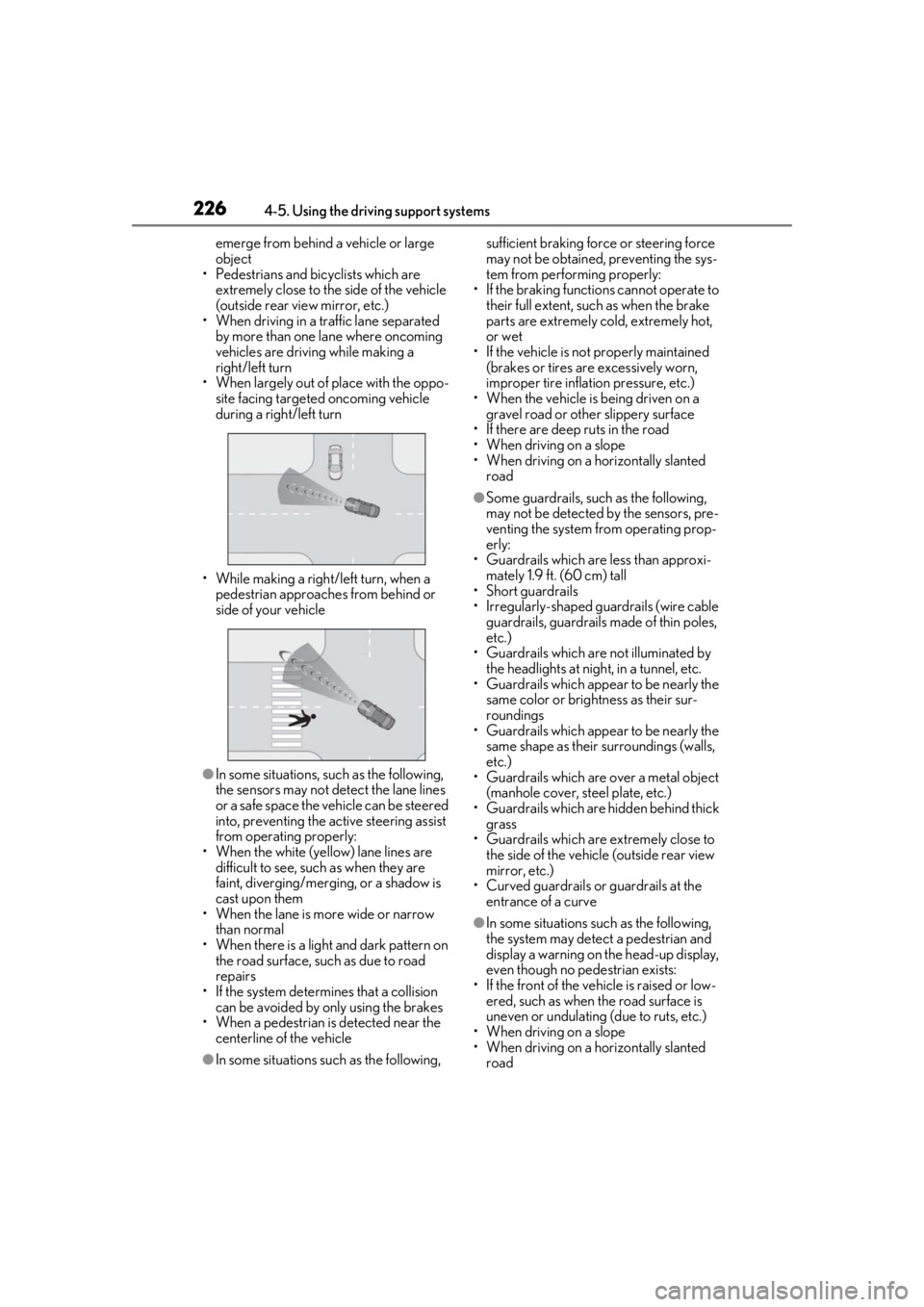
• Pedestrians and bicyclists which are
extremely close to the side of the vehicle
(outside rear view mirror, etc.)
• When driving in a tr affic lane separated
by more than one lane where oncoming
vehicles are driving while making a
right/left turn
• When largely out of place with the oppo- site facing targeted oncoming vehicle
during a right/left turn
• While making a right/left turn, when a pedestrian approaches from behind or
side of your vehicle
●In some situations, such as the following,
the sensors may not detect the lane lines
or a safe space the vehicle can be steered
into, preventing the ac tive steering assist
from operating properly:
• When the white (yellow) lane lines are difficult to see, such as when they are
faint, diverging/merging, or a shadow is
cast upon them
• When the lane is more wide or narrow
than normal
• When there is a light and dark pattern on the road surface, such as due to road
repairs
• If the system determines that a collision can be avoided by only using the brakes
• When a pedestrian is detected near the
centerline of the vehicle
●In some situations such as the following, sufficient braking forc
e or steering force
may not be obtained, preventing the sys-
tem from performing properly:
• If the braking functions cannot operate to their full extent, such as when the brake
parts are extremely cold, extremely hot,
or wet
• If the vehicle is not properly maintained (brakes or tires are excessively worn,
improper tire inflation pressure, etc.)
• When the vehicle is being driven on a gravel road or other slippery surface
• If there are deep ruts in the road
• When driving on a slope
• When driving on a horizontally slanted road
●Some guardrails, such as the following,
may not be detected by the sensors, pre-
venting the system from operating prop-
erly:
• Guardrails which are less than approxi- mately 1.9 ft. (60 cm) tall
• Short guardrails
• Irregularly-shaped gu ardrails (wire cable
guardrails, guardrails made of thin poles,
etc.)
• Guardrails which are not illuminated by the headlights at nigh t, in a tunnel, etc.
• Guardrails which appear to be nearly the
same color or brightness as their sur-
roundings
• Guardrails which appear to be nearly the
same shape as their surroundings (walls,
etc.)
• Guardrails which are over a metal object
(manhole cover, steel plate, etc.)
• Guardrails which are hidden behind thick grass
• Guardrails which are extremely close to the side of the vehicle (outside rear view
mirror, etc.)
• Curved guardrails or guardrails at the entrance of a curve
●In some situations su ch as the following,
the system may detect a pedestrian and
display a warning on the head-up display,
even though no pedestrian exists:
• If the front of the vehicle is raised or low- ered, such as when the road surface is
uneven or undulating (due to ruts, etc.)
• When driving on a slope
• When driving on a horizontally slanted road
Page 234 of 520
2344-5. Using the driving support systems
as heavy rain, fog, snow or a sandstorm
• When driving through steam or smoke
• When the surrounding area is dim, such as at dawn or dusk, or while at night or in
a tunnel, making a detectable object
appear to be nearly the same color as its
surroundings
• When driving in a place where the sur- rounding brightness changes suddenly,
such as at the entrance or exit of a tunnel
• After the engine has started the vehicle has not been driven for a certain amount
of time
• While making a left/right turn and for a few seconds after makin g a left/right turn
• While driving on a curve and for a few seconds after driving on a curve
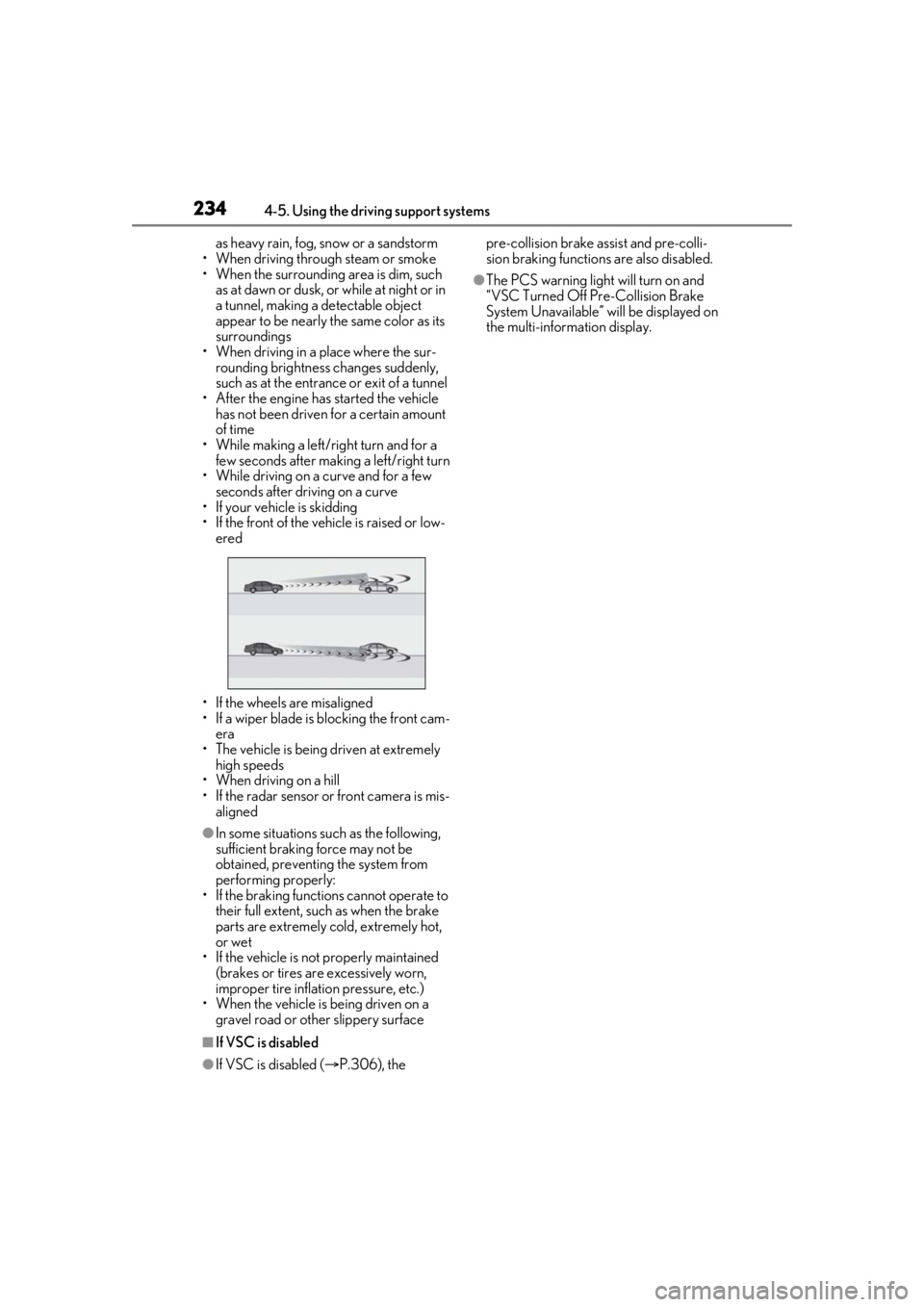
• If your vehicle is skidding
• If the front of the vehicle is raised or low-
ered
• If the wheels are misaligned
• If a wiper blade is blocking the front cam- era
• The vehicle is being driven at extremely high speeds
• When driving on a hill
• If the radar sensor or front camera is mis-
aligned
●In some situations such as the following,
sufficient braking force may not be
obtained, preventing the system from
performing properly:
• If the braking functions cannot operate to their full extent, such as when the brake
parts are extremely cold, extremely hot,
or wet
• If the vehicle is not properly maintained
(brakes or tires are excessively worn,
improper tire inflation pressure, etc.)
• When the vehicle is being driven on a gravel road or other slippery surface
■If VSC is disabled
●If VSC is disabled ( P.306), the pre-collision brake assist and pre-colli-
sion braking functions are also disabled.
●The PCS warning light will turn on and
“VSC Turned Off Pre-Collision Brake
System Unavailable” will be displayed on
the multi-information display.
Page 241 of 520
2414-5. Using the driving support systems
4
Driving
■Lane departure alert function
When the system determines that the
vehicle might depart from its lane or
course
*, a warning is displayed on the
multi-information display, and either a
warning buzzer will sound or the steer-
ing wheel will vibrate to alert the driver.
When the warning buzzer sounds or the
steering wheel vibrates, check the area
around your vehicle and carefully operate
the steering wheel to move the vehicle
back to the center of the lane.
Vehicle with BSM: When the system deter-
mines that the vehicle might depart from its
lane and that the po ssibility of a collision
with an overtaking vehicle in the adjacent
lane is high, the lane departure alert will
operate even if the turn signals are operat-
ing.
*: Boundary between asphalt and the side of the road, such as grass, soil, or a curb
WARNING
●The traffic lines are yellow (which may
be more difficult to recognize than
lines that are white).
●The white (yellow) lines cross over a
curb, etc.
●The vehicle is driven on a bright sur-
face, such as concrete.
●If the edge of the road is not clear or
straight.
●The vehicle is driven on a surface that
is bright due to reflected light, etc.
●The vehicle is driven in an area where
the brightness changes suddenly, such
as at the entrances and exits of tunnels,
etc.
●Light from the headlights of an oncom-
ing vehicle, the sun, etc. enters the
camera.
●The vehicle is driven on a slope.
●The vehicle is driven on a road which
tilts left or right, or a winding road.
●The vehicle is driven on an unpaved or
rough road.
●The traffic lane is excessively narrow
or wide.
●The vehicle is extremely tilted due to
carrying heavy luggage or having
improper tire pressure.
●The distance to the preceding vehicle
is extremely short.
●The vehicle is moving up and down a
large amount due to road conditions
during driving (poor roads or road
seams).
●When driving in a tunnel or at night
with the headlights off or when a head-
light is dim due to its lens being dirty or
it being misaligned.
●The vehicle is struck by a crosswind.
●The vehicle is affected by wind from a
vehicle driven in a nearby lane.
●The vehicle has just changed lanes or
crossed an intersection.
●Tires which differ by structure, manu-
facturer, brand or tread pattern are
used.
●When tires of a size other than speci-
fied are installed.
●Snow tires, etc. are equipped.
●The vehicle is being driven at
extremely high speeds.
Functions included in LTA system