oil LEXUS LS500H 2018 Owners Manual
[x] Cancel search | Manufacturer: LEXUS, Model Year: 2018, Model line: LS500H, Model: LEXUS LS500H 2018Pages: 528, PDF Size: 10.8 MB
Page 1 of 528

LS500h_OM_OM50F42U_(U) 1
2
3
4
5
6
7
8
9Pictorial index Search by illustration
For safety
and security Make sure to read through them
(Main topics: Child seat, theft deterrent system)
Vehicle status
information and
indicators Reading driving-related information
(Main topics: Meters, multi-information display)
Before driving Opening and closing the doors and windows,
adjustment before driving
(Main topics: Keys, doors, seats)
Driving Operations and advice which are necessary for driving
(Main topics: Starting hybrid system, refueling)
Interior features Usage of the interior features
(Main topics: Air conditioner, storage features)
Maintenance
and care Caring for your vehicle and maintenance procedures
(Main topics: Interior and exterior, light bulbs)
When trouble
arises What to do in case of malfunction and emergency
(Main topics: Battery discharge, flat tire)
Vehicle
specifications Vehicle specifications, customizable features
(Main topics: Fuel, oil, tire inflation pressure)
For owners Reporting safety defects for U.S. owners, seat belt and
SRS airbag instructions for Canadian owners
Index Search by symptom
Search alphabetically
Page 4 of 528
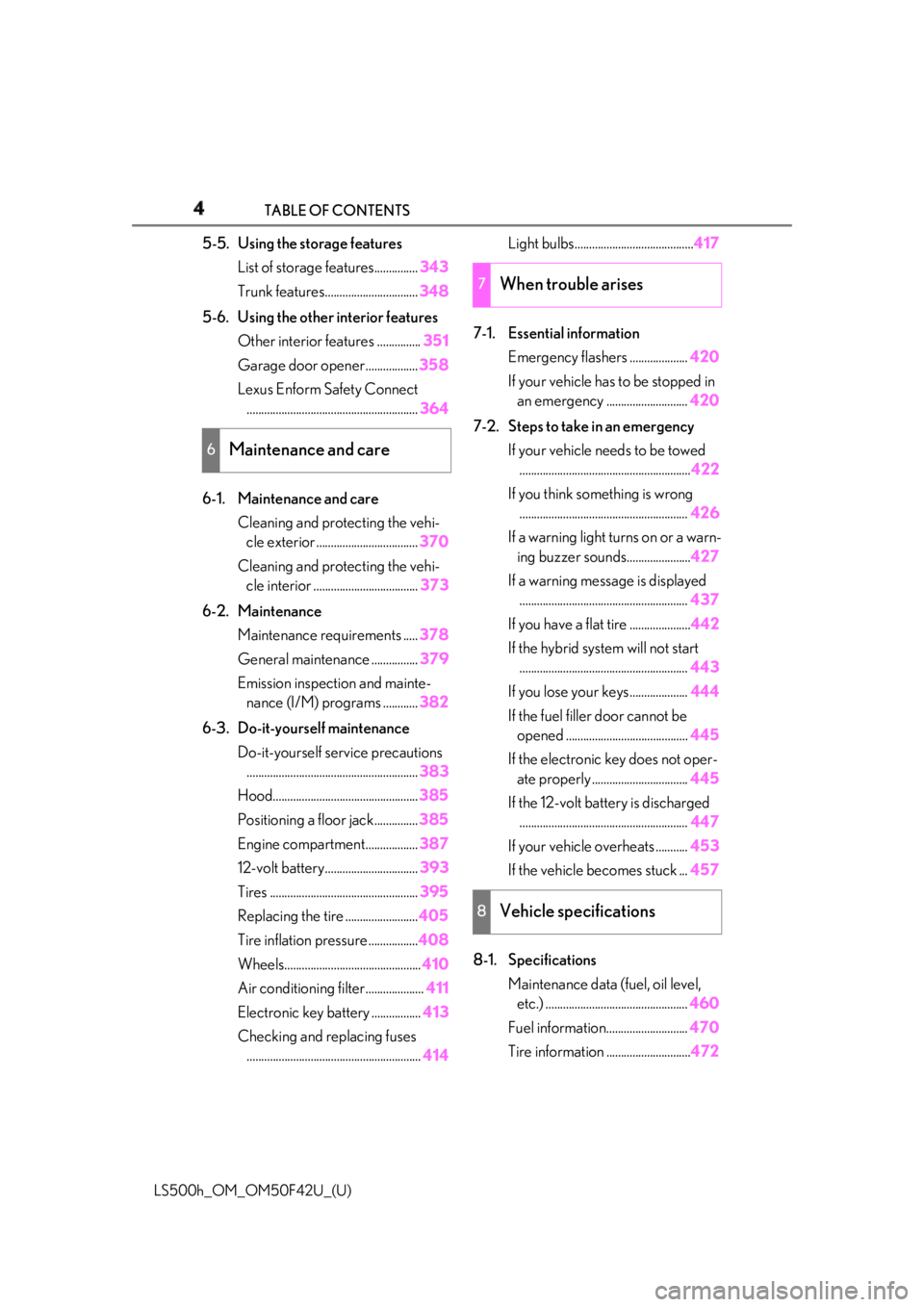
4 TABLE OF CONTENTS
LS500h_OM_OM50F42U_(U) 5-5. Using the storage features
List of storage features............... 343
Trunk features................................ 348
5-6. Using the other interior features
Other interior features ............... 351
Garage door opener.................. 358
Lexus Enform Safety Connect
........................................................... 364
6-1. Maintenance and care
Cleaning and protecting the vehi-
cle exterior ................................... 370
Cleaning and protecting the vehi-
cle interior .................................... 373
6-2. Maintenance
Maintenance requirements ..... 378
General maintenance ................ 379
Emission inspection and mainte-
nance (I/M) programs ............ 382
6-3. Do-it-yourself maintenance
Do-it-yourself service precautions
........................................................... 383
Hood.................................................. 385
Positioning a floor jack............... 385
Engine compartment.................. 387
12-volt battery................................ 393
Tires ................................................... 395
Replacing the tire ......................... 405
Tire inflation pressure ................. 408
Wheels............................................... 410
Air conditioning filter.................... 411
Electronic key battery ................. 413
Checking and replacing fuses
............................................................ 414 Light bulbs......................................... 417
7-1. Essential information
Emergency flashers .................... 420
If your vehicle has to be stopped in
an emergency ............................ 420
7-2. Steps to take in an emergency
If your vehicle needs to be towed
........................................................... 422
If you think something is wrong
.......................................................... 426
If a warning light turns on or a warn-
ing buzzer sounds...................... 427
If a warning messa ge is displayed
.......................................................... 437
If you have a flat tire ..................... 442
If the hybrid syst em will not start
.......................................................... 443
If you lose your keys.................... 444
If the fuel filler door cannot be
opened .......................................... 445
If the electronic key does not oper-
ate properly ................................. 445
If the 12-volt battery is discharged
.......................................................... 447
If your vehicle overheats ........... 453
If the vehicle becomes stuck ... 457
8-1. Specifications
Maintenance data (fuel, oil level,
etc.) ................................................. 460
Fuel information
. ........................... 470
Tire information ............................. 4726
Maintenance and care 7
When trouble arises
8
Vehicle specifications
Page 13 of 528
13Pictorial index
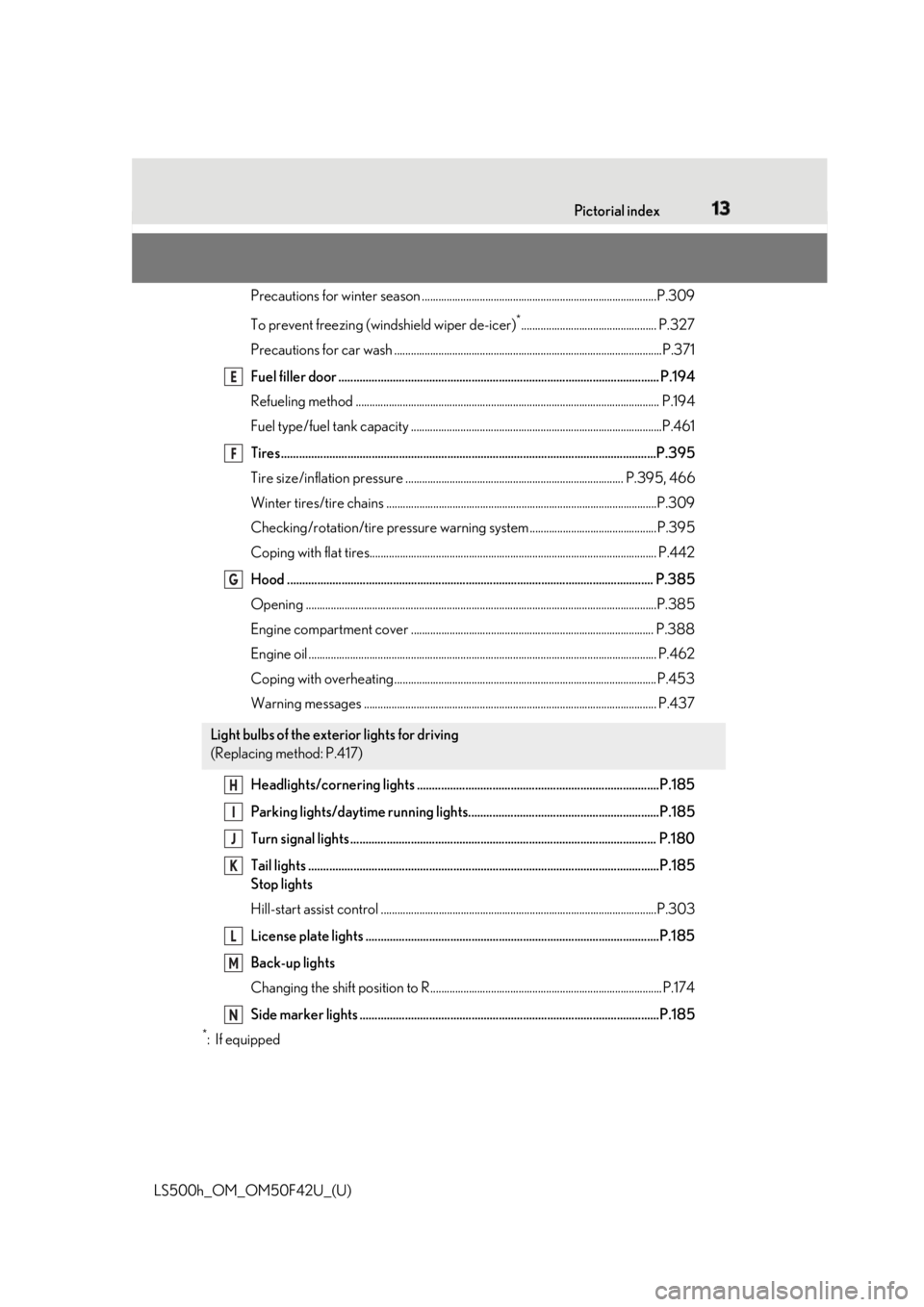
LS500h_OM_OM50F42U_(U) Precautions for winter season .. ...................................................................................P.309
To prevent freezing (windshield wiper de-icer) *
................................................. P.327
Precautions for car wash .................................................................................................P.371
Fuel filler door .......................................................................................................... P.194
Refueling method .............................................................................................................. P .194
Fuel type/fuel tank capacity ......... ..................................................................................P.461
Tires.......................................................................................................................... ..P.395
Tire size/inflation pressure ............................ ................................................... P.395, 466
Winter tires/tire chains ..................................................................................................P.309
Checking/rotation/tire pressure warning system..............................................P.395
Coping with flat tires........................................................................................................ P .442
Hood ......................................................................................................................... P. 385
Opening ........................................................................................................................ .......P.385
Engine compartment cover ........................................................................................ P.388
Engine oil ..................................................................................................................... ......... P.462
Coping with overheating ............................................................................................... P.453
Warning messages .......................................................................................................... P.437
Headlights/cornering lights ................................................................................P.185
Parking lights/daytime running lights...............................................................P.185
Turn signal lights ..................................................................................................... P.180
Tail lights .................................................................................................................... P.185
Stop lights
Hill-start assist control ....................................................................................................P. 303
License plate lights .................................................................................................P.185
Back-up lights
Changing the shift position to R....................................................................................P.174
Side marker lights ...................................................................................................P.185 *
:If equipped Light bulbs of the exterior lights for driving
(Replacing method: P.417) E
F
G
H
I
J
K
L
M
N
Page 73 of 528
732-1. Instrument cluster
LS500h_OM_OM50F42U_(U) 2
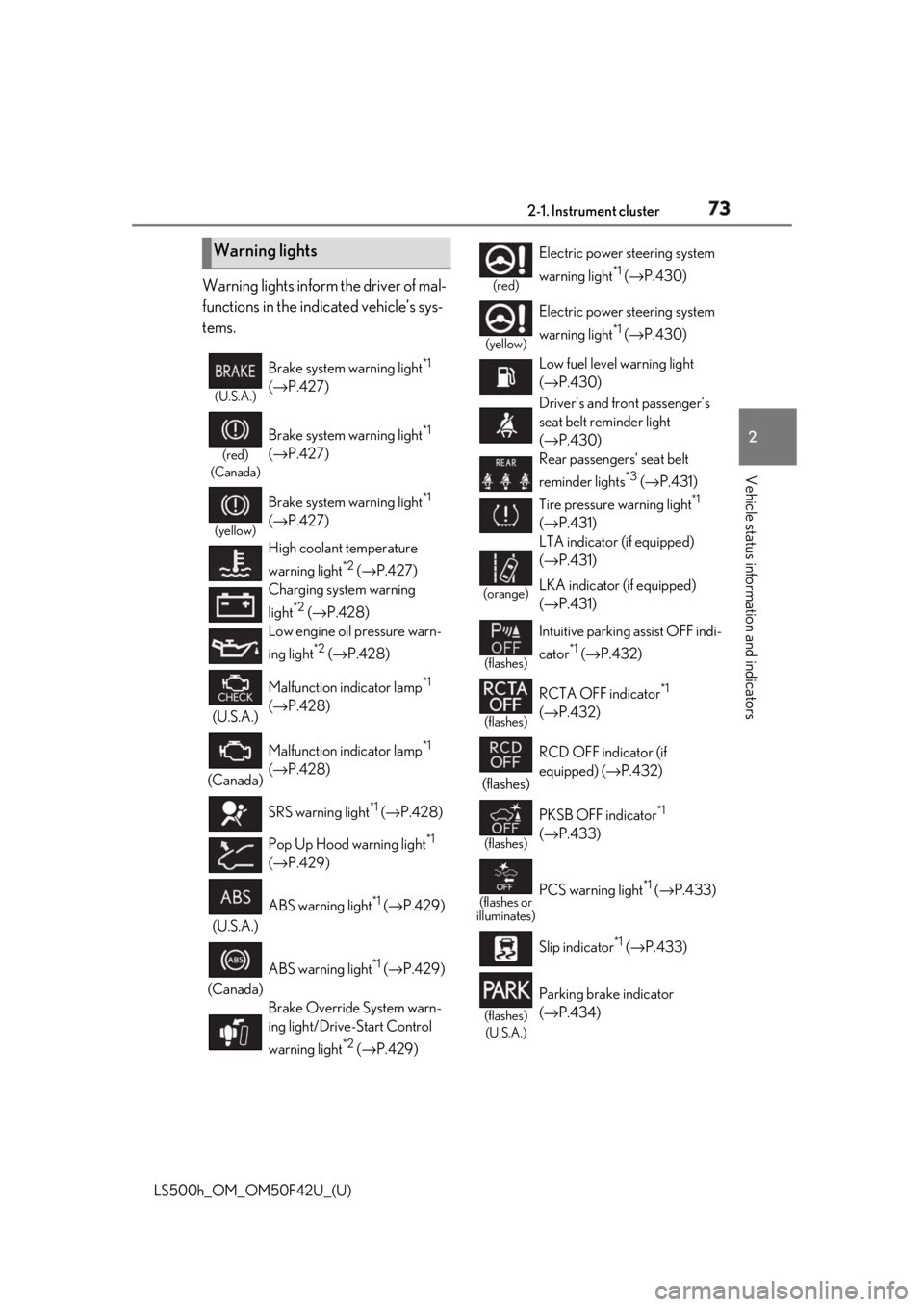
Vehicle status information and indicators Warning lights inform the driver of mal-
functions in the indicated vehicle’s sys-
tems.
Warning lights (U.S.A.)
Brake system warning light *1
( → P.427)(red)
(Canada)
Brake system warning light *1
( → P.427)(yellow)
Brake system warning light *1
( → P.427)
High coolant temperature
warning light *2
( → P.427)
Charging system warning
light *2
( → P.428)
Low engine oil pressure warn-
ing light *2
( → P.428)
(U.S.A.) Malfunction indicator lamp *1
( → P.428)
(Canada) Malfunction indicator lamp *1
( → P.428)
SRS warning light *1
( → P.428)
Pop Up Hood warning light *1
( → P.429)
(U.S.A.) ABS warning light *1
( → P.429)
(Canada) ABS warning light *1
( → P.429)
Brake Override System warn-
ing light/Drive-Start Control
warning light *2
( → P.429) (red)
Electric power steering system
warning light *1
( → P.430)(yellow)
Electric power steering system
warning light *1
( → P.430)
Low fuel level warning light
( → P.430)
Driver’s and front passenger’s
seat belt reminder light
( → P.430)
Rear passengers’ seat belt
reminder lights *3
( → P.431)
Tire pressure warning light *1
( → P.431)(orange)
LTA indicator (if equipped)
( → P.431)
LKA indicator (if equipped)
( → P.431)(flashes)
Intuitive parking assist OFF indi-
cator *1
( → P.432)
(flashes)
RCTA OFF indicator *1
( → P.432)
(flashes) RCD OFF indicator (if
equipped) ( → P.432)
(flashes)
PKSB OFF indicator *1
( → P.433)
(flashes or
illuminates)
PCS warning light *1
( → P.433)
Slip indicator *1
( → P.433)
(flashes)
(U.S.A.) Parking brake indicator
( → P.434)
Page 79 of 528
792-1. Instrument cluster
LS500h_OM_OM50F42U_(U) 2
Vehicle status information and indicators
■
Display items
Odometer Displays the total distance the vehicle has
been driven.
Trip meter A/trip meter B Displays the distance the vehicle has been
driven since the meter was last reset. Trip
meters A and B can be used to record and
display different distances independently.
Distance until next engine oil
change Displays the distance the vehicle can be
driven until an oil change is necessary.
■
Changing the display
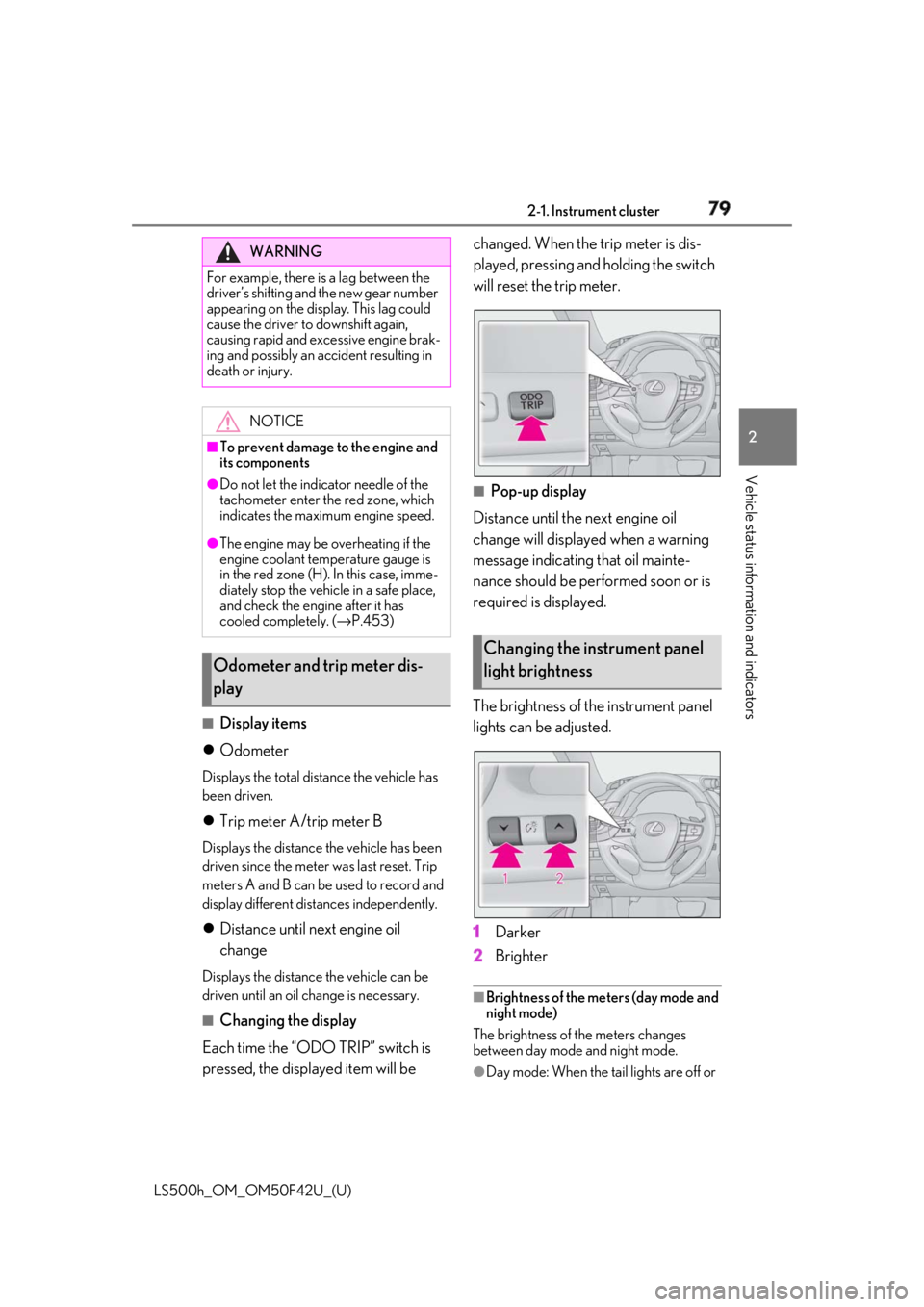
Each time the “ODO TRIP” switch is
pressed, the displayed item will be changed. When the trip meter is dis-
played, pressing and holding the switch
will reset the trip meter.
■
Pop-up display
Distance until the next engine oil
change will displayed when a warning
message indicating that oil mainte-
nance should be performed soon or is
required is displayed.
The brightness of the instrument panel
lights can be adjusted.
1 Darker
2 Brighter ■
Brightness of the meters (day mode and
night mode)
The brightness of the meters changes
between day mode and night mode.
●
Day mode: When the tail lights are off or WARNING
For example, there is a lag between the
driver’s shifting and the new gear number
appearing on the display. This lag could
cause the driver to downshift again,
causing rapid and excessive engine brak-
ing and possibly an accident resulting in
death or injury.
NOTICE■
To prevent damage to the engine and
its components●
Do not let the indicator needle of the
tachometer enter the red zone, which
indicates the maximum engine speed.●
The engine may be overheating if the
engine coolant temperature gauge is
in the red zone (H). In this case, imme-
diately stop the vehicle in a safe place,
and check the engine after it has
cooled completely. ( → P.453)
Odometer and trip meter dis-
play Changing the instrument panel
light brightness
Page 84 of 528
84 2-1. Instrument cluster
LS500h_OM_OM50F42U_(U) ■
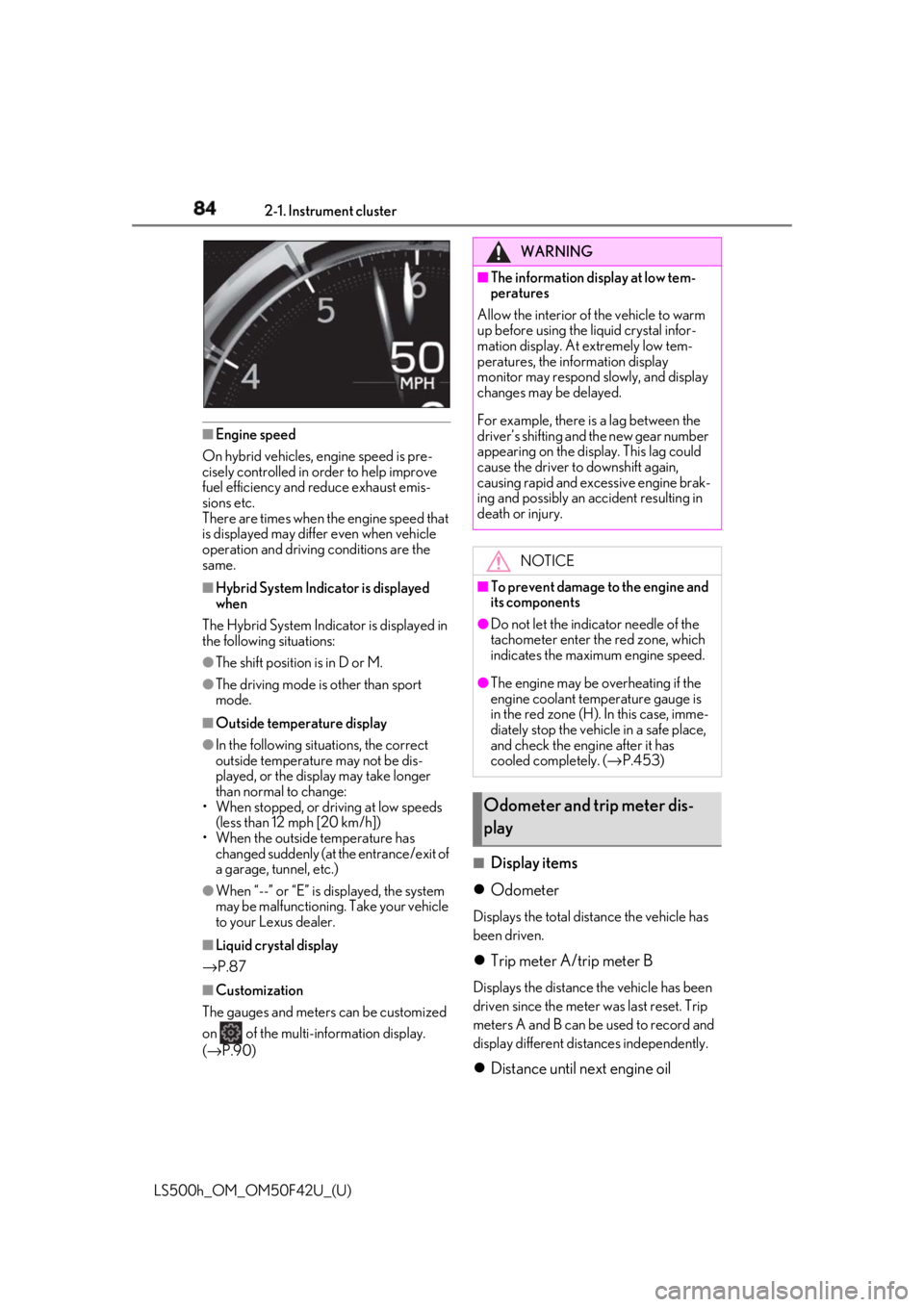
Engine speed
On hybrid vehicles, engine speed is pre-
cisely controlled in order to help improve
fuel efficiency and reduce exhaust emis-
sions etc.
There are times when the engine speed that
is displayed may differ even when vehicle
operation and driving conditions are the
same. ■
Hybrid System Indicator is displayed
when
The Hybrid System Indicator is displayed in
the following situations: ●
The shift position is in D or M.●
The driving mode is other than sport
mode.■
Outside temperature display●
In the following situations, the correct
outside temperature may not be dis-
played, or the display may take longer
than normal to change:
• When stopped, or driving at low speeds
(less than 12 mph [20 km/h])
• When the outside temperature has
changed suddenly (at the entrance/exit of
a garage, tunnel, etc.)
●
When “--” or “E” is displayed, the system
may be malfunctioning. Take your vehicle
to your Lexus dealer.
■
Liquid crystal display
→ P.87
■
Customization
The gauges and meters can be customized
on of the multi-information display.
( → P.90) ■
Display items
Odometer Displays the total distance the vehicle has
been driven.
Trip meter A/trip meter B Displays the distance the vehicle has been
driven since the meter was last reset. Trip
meters A and B can be used to record and
display different distances independently.
Distance until next engine oil WARNING■
The information display at low tem-
peratures
Allow the interior of the vehicle to warm
up before using the liquid crystal infor-
mation display. At extremely low tem-
peratures, the information display
monitor may respond slowly, and display
changes may be delayed.
For example, there is a lag between the
driver’s shifting and the new gear number
appearing on the display. This lag could
cause the driver to downshift again,
causing rapid and excessive engine brak-
ing and possibly an accident resulting in
death or injury.
NOTICE■
To prevent damage to the engine and
its components ●
Do not let the indicator needle of the
tachometer enter the red zone, which
indicates the maximum engine speed. ●
The engine may be overheating if the
engine coolant temperature gauge is
in the red zone (H). In this case, imme-
diately stop the vehicle in a safe place,
and check the engine after it has
cooled completely. ( → P.453)
Odometer and trip meter dis-
play
Page 85 of 528
852-1. Instrument cluster
LS500h_OM_OM50F42U_(U) 2
Vehicle status information and indicators change Displays the distance the vehicle can be
driven until an oil change is necessary.■
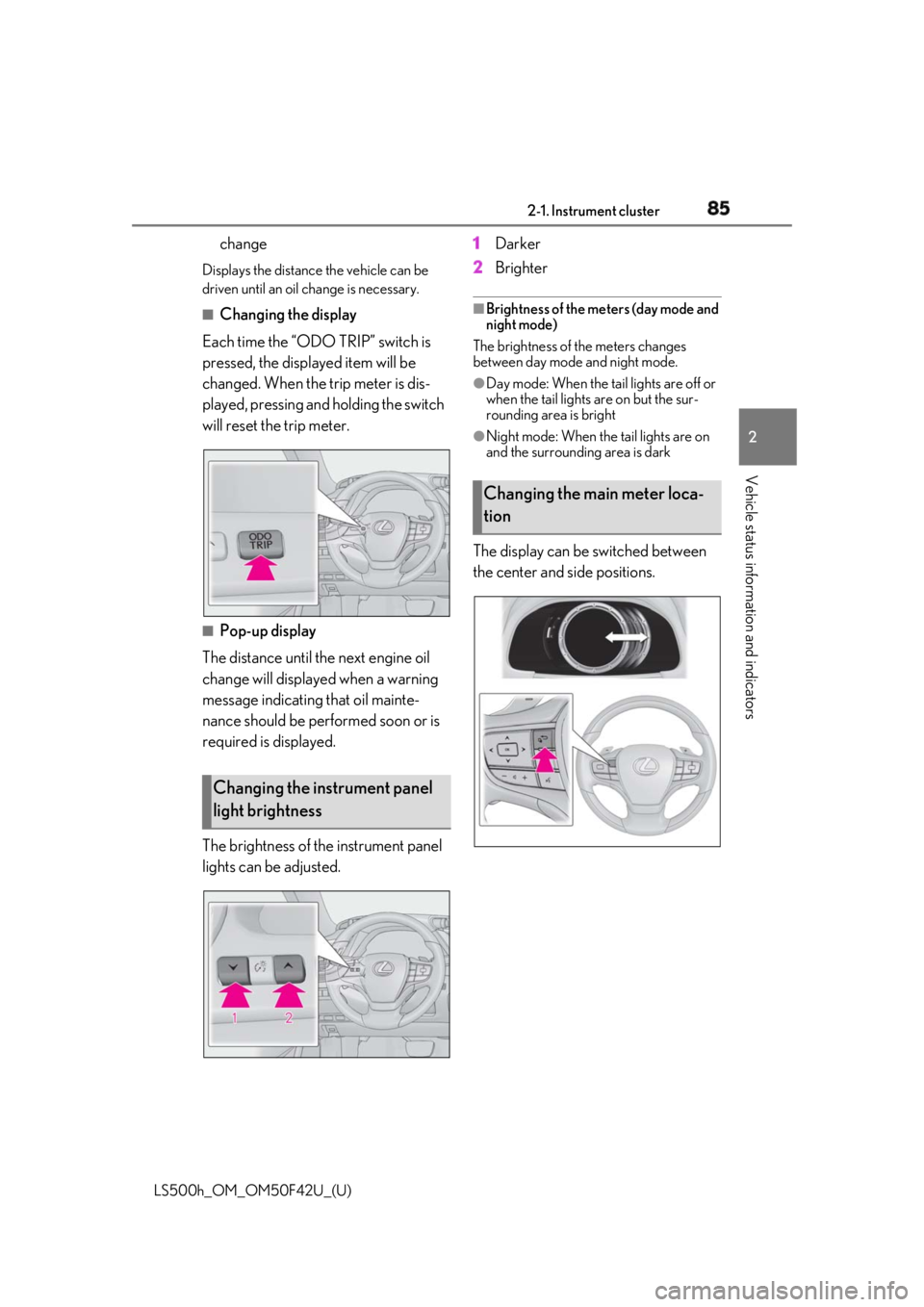
Changing the display
Each time the “ODO TRIP” switch is
pressed, the displayed item will be
changed. When the trip meter is dis-
played, pressing and holding the switch
will reset the trip meter.
■
Pop-up display
The distance until the next engine oil
change will displayed when a warning
message indicating that oil mainte-
nance should be performed soon or is
required is displayed.
The brightness of the instrument panel
lights can be adjusted. 1 Darker
2 Brighter ■
Brightness of the meters (day mode and
night mode)
The brightness of the meters changes
between day mode and night mode. ●
Day mode: When the tail lights are off or
when the tail lights are on but the sur-
rounding area is bright ●
Night mode: When the tail lights are on
and the surrounding area is dark
The display can be switched between
the center and side positions.
Changing the instrument panel
light brightness Changing the main meter loca-
tion
Page 121 of 528

1213-2. Opening, closing and locking the doors and trunk
LS500h_OM_OM50F42U_(U) 3
Before driving airport or other faci lity that generates
strong radio waves or electrical noise●
When carrying a portable radio, cellular
phone, cordless phone or other wireless
communication device●
When the electronic key is in contact
with, or is covered by the following metal-
lic objects
• Cards to which aluminum foil is attached
• Cigarette boxes that have aluminum foil
inside
• Metallic wallets or bags
•Coins
• Hand warmers made of metal
• Media such as CDs and DVDs ●
When other wireless ke ys (that emit radio
waves) are being used nearby●
When carrying the electronic key
together with the following devices that
emit radio waves
• Another vehicle’s electronic key or a
wireless key that emits radio waves
• Personal computers or personal digital
assistants (PDAs)
• Digital audio players
• Portable game systems ●
If window tint with a metallic content or
metallic objects are attached to the rear
window●
When the electronic key is placed near a
battery charger or electronic devices●
When the vehicle is parked in a pay park-
ing spot where radio waves are emitted.■
Note for the entry function●
Even when the electronic key is within the
effective range (detection areas), the sys-
tem may not operate properly in the fol-
lowing cases:
• The electronic key is too close to the win-
dow or outside door handle, near the
ground, or in a high place when the doors
are locked or unlocked.
• The electronic key is near the ground or
in a high place, or too close to the center
of the rear bumper when the trunk is
opened.
• The electronic key is on the instrument
panel, rear package tray or floor, or in the
door pockets or glove box when the
hybrid system is star ted or power switch modes are changed. ●
Do not leave the electronic key on top of
the instrument panel or near the door
pockets when exiting the vehicle.
Depending on the radio wave reception
conditions, it may be detected by the
antenna outside the cabin and the doors
will become lockable from the outside,
possibly trapping the electronic key
inside the vehicle. ●
As long as the electronic key is within the
effective range, the doors may be locked
or unlocked by anyone. However, only
the doors detecting the electronic key
can be used to unlock the vehicle. ●
Even if the electronic key is not inside the
vehicle, it may be po ssible to start the
hybrid system if the el ectronic key is near
the window. ●
The doors may unlock or lock if a large
amount of water splashes on the door
handle, such as in the rain or in a car
wash, when the electronic key is within
the effective range. (The doors will auto-
matically be locked after approximately
60 seconds if the doors are not opened
and closed.) ●
If the wireless remote control is used to
lock the doors when the electronic key is
near the vehicle, there is a possibility that
the door may not be unlocked by the
entry function. (Use the wireless remote
control to unlock the doors.) ●
Touching the door lock sensor while
wearing gloves may delay or prevent lock
operation. ●
When the lock operation is performed
using the lock sensor, recognition signals
will be shown up to two consecutive
times. After this, no recognition signals
will be given.
●
If the door handle becomes wet while the
electronic key is within the effective
range, the door may lock and unlock
repeatedly. In this case, follow the follow-
ing correction procedures to wash the
vehicle:
• Place the electronic key in a location 6 ft.
(2 m) or more away from the vehicle.
(Take care to ensure that the key is not
stolen.)
Page 163 of 528
1634-1. Before driving
LS500h_OM_OM50F42U_(U) 4
Driving NOTICE■
When driving the vehicle●
Do not depress the accelerator and
brake pedals at the same time during
driving, as this may restrain the hybrid
system output.●
Do not use the accelerator pedal or
depress the accelerator and brake
pedals at the same time to hold the
vehicle on a hill.■
When parking the vehicle
Always set the parking brake, and shift
the shift position to P. Failure to do so
may cause the vehicle to move or the
vehicle may accelerate suddenly if the
accelerator pedal is accidentally
depressed. ■
Avoiding damage to vehicle parts●
Do not turn the steering wheel fully in
either direction and hold it there for an
extended period of time.
Doing so may damage the power
steering motor.●
When driving over bumps in the road,
drive as slowly as possible to avoid
damaging the wheels, underside of the
vehicle, etc.
■
If you get a flat tire while driving
A flat or damaged ti re may cause the fol-
lowing situations. Hold the steering
wheel firmly and gradually depress the
brake pedal to slow down the vehicle.
●
It may be difficult to control your vehi-
cle.
●
The vehicle will make abnormal
sounds or vibrations.
●
The vehicle will lean abnormally.
Information on what to do in case of a flat
tire ( → P.442) ■
When encountering flooded roads
Do not drive on a road that has flooded
after heavy rain etc. Doing so may cause
the following serious damage to the vehi-
cle: ●
Engine stalling ●
Short in electrical components ●
Engine damage caused by water
immersion
In the event that you drive on a flooded
road and the vehicle is flooded, be sure
to have your Lexus dealer check the fol-
lowing: ●
Brake function ●
Changes in quantity and quality of oil
and fluid used for the engine, hybrid
transmission, transfer (AWD models),
differential, etc. ●
Lubricant condition for the propeller
shaft, bearings and suspension joints
(where possible), and the function of
all joints, bearings, etc.
If the shift control system is damaged by
flooding, it may not be possible to shift
the shift position to P, or from P to other
positions. In this case, contact your Lexus
dealer.
■
When parking the vehicle
Always set the parking brake, and shift
the shift position to P. Failure to do so
may cause the vehicle to move or the
vehicle may accelerate suddenly if the
accelerator pedal is accidentally
depressed.
Page 201 of 528
2014-5. Using the driving support systems
LS500h_OM_OM50F42U_(U) 4
Driving WARNING●
Do not subject a radar sensor or its
surrounding area on the front bumper
to a strong impact.
If a radar sensor is moved even slightly
off position, the system may malfunction
and vehicles may not be detected cor-
rectly.
In the following situations, have your
vehicle inspected by your Lexus dealer.
• If a radar sensor or its surrounding
area is subject to a strong impact
• If the area on the front bumper around
a radar sensor is scratched or dented,
or the front bumper has become par-
tially disengaged ●
Do not disassemble the radar sensors.●
Do not modify the radar sensors or
their surrounding area on the front
bumper.●
If a radar sensor or the front bumper
needs to be removed and installed, or
replaced, contact your Lexus dealer.●
Do not paint the front bumper any
color other than an official Lexus color.
■
To avoid malfunction of the camera
sensor
Observe the following precautions.
Otherwise, the camera sensor may not
operate properly, possibly leading to an
accident resulting in death or serious
injury.
●
Keep the windshield clean at all times.
• If the windshield is dirty or covered
with an oily film, water droplets, snow,
etc., clear the windshield.
• As some glass coating agents may
affect the detection performance of
the camera sensor, consult your Lexus
dealer when using a glass coating
agent. • If a glass coating agent is applied to the
windshield, it will still be necessary to
use the windshield wipers to remove
water droplets, etc. from the area of
the windshield in front of the camera
sensor.
• If the inner side of the windshield
where the camera sens or is installed is
dirty, contact your Lexus dealer. ●
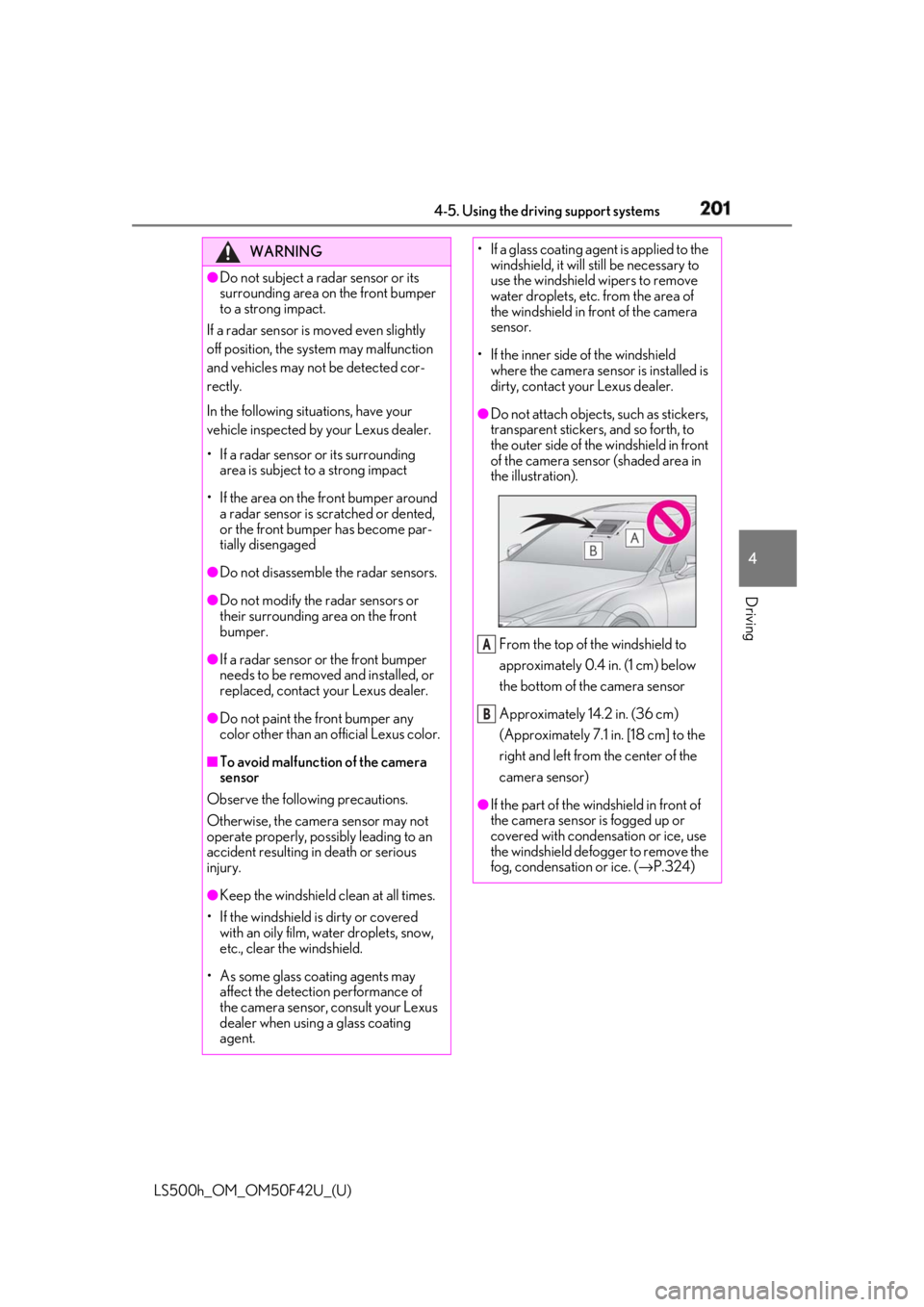
Do not attach objects, such as stickers,
transparent stickers, and so forth, to
the outer side of the windshield in front
of the camera sensor (shaded area in
the illustration).
From the top of the windshield to
approximately 0.4 in. (1 cm) below
the bottom of the camera sensor
Approximately 14.2 in. (36 cm)
(Approximately 7.1 in. [18 cm] to the
right and left from the center of the
camera sensor)
●
If the part of the wi ndshield in front of
the camera sensor is fogged up or
covered with condensation or ice, use
the windshield defogger to remove the
fog, condensation or ice. ( → P.324)A
B