wheel LEXUS LS500H 2019 Owners Manual
[x] Cancel search | Manufacturer: LEXUS, Model Year: 2019, Model line: LS500H, Model: LEXUS LS500H 2019Pages: 523, PDF Size: 15.79 MB
Page 464 of 523
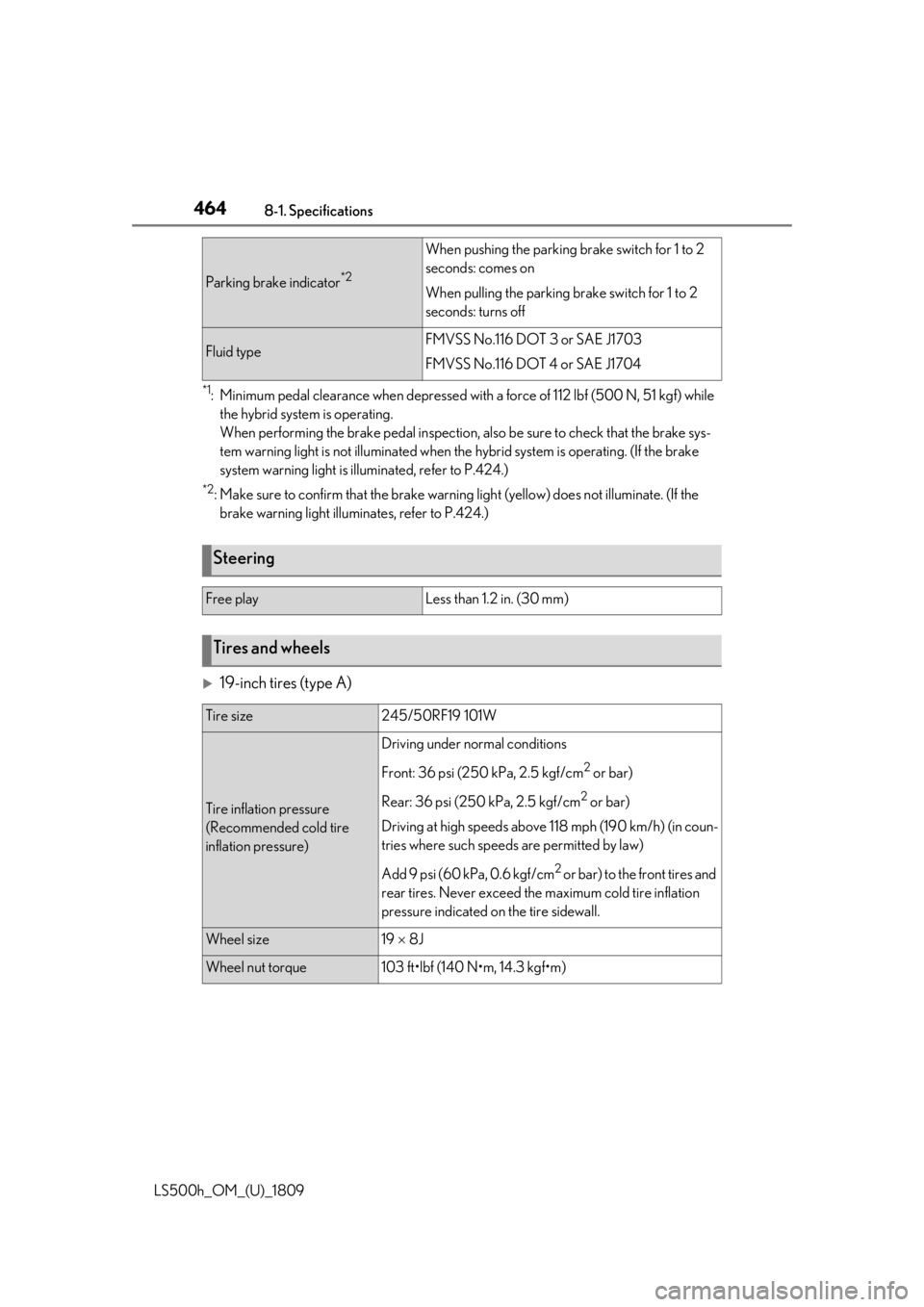
4648-1. Specifications
LS500h_OM_(U)_1809
*1: Minimum pedal clearance when depressed with a force of 112 lbf (500 N, 51 kgf) while
the hybrid system is operating.
When performing the brake pedal inspection, also be sure to check that the brake sys-
tem warning light is not illuminated when the hybrid system is operating. (If the brake
system warning light is illuminated, refer to P.424.)
*2: Make sure to confirm that the brake warning light (yellow) does not illuminate. (If the brake warning light illuminates, refer to P.424.)
19-inch tires (type A)
Parking brake indicator*2
When pushing the parking brake switch for 1 to 2
seconds: comes on
When pulling the parking brake switch for 1 to 2
seconds: turns off
Fluid typeFMVSS No.116 DOT 3 or SAE J1703
FMVSS No.116 DOT 4 or SAE J1704
Steering
Free playLess than 1.2 in. (30 mm)
Tires and wheels
Tire size245/50RF19 101W
Tire inflation pressure
(Recommended cold tire
inflation pressure)
Driving under normal conditions
Front: 36 psi (250 kPa, 2.5 kgf/cm
2 or bar)
Rear: 36 psi (250 kPa, 2.5 kgf/cm
2 or bar)
Driving at high speeds above 118 mph (190 km/h) (in coun-
tries where such speeds are permitted by law)
Add 9 psi (60 kPa, 0.6 kgf/cm
2 or bar) to the front tires and
rear tires. Never exceed the maximum cold tire inflation
pressure indicated on the tire sidewall.
Wheel size19 8J
Wheel nut torque103 ft•lbf (140 N•m, 14.3 kgf•m)
Page 465 of 523
4658-1. Specifications
LS500h_OM_(U)_1809
8
Vehicle specifications
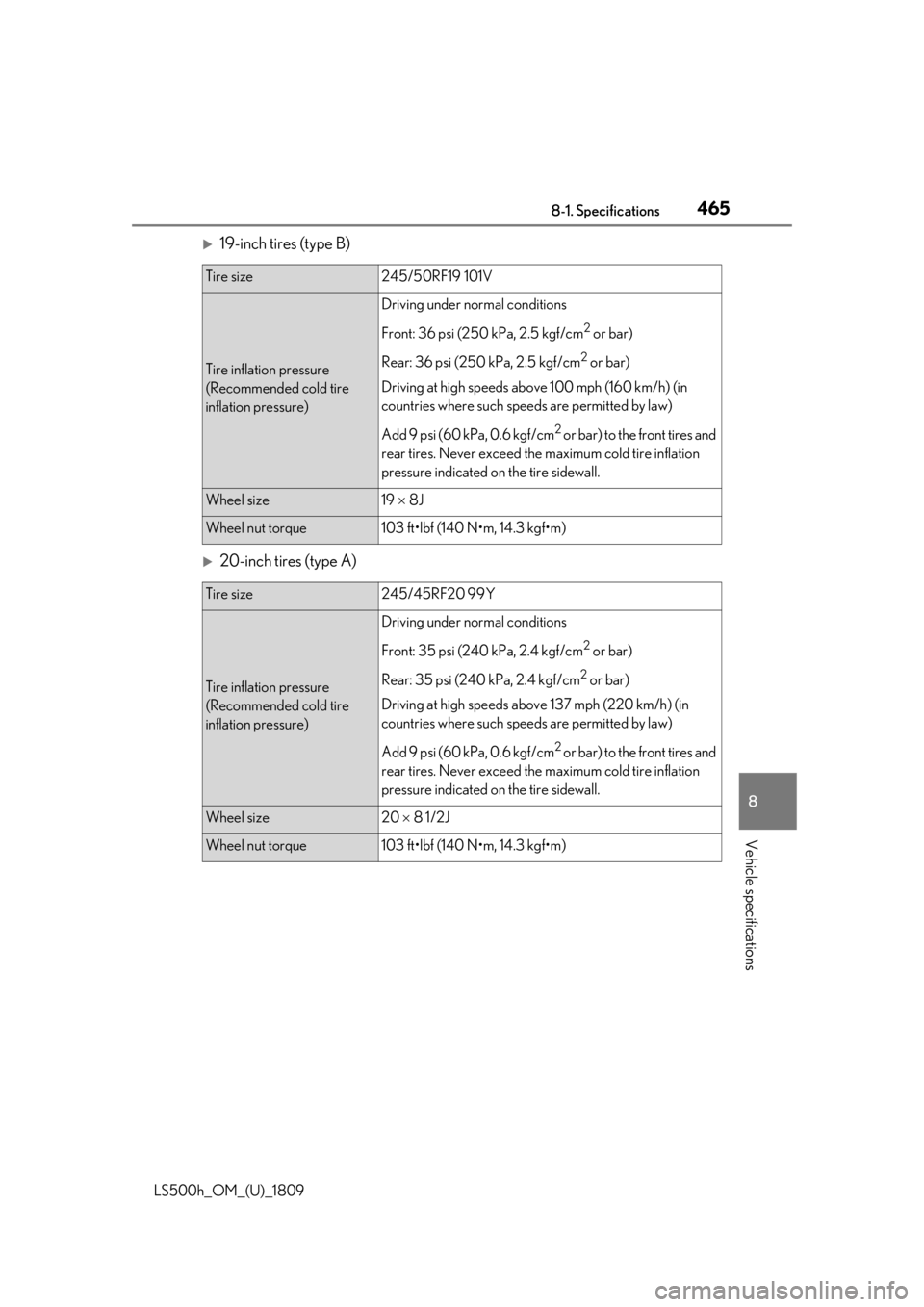
19-inch tires (type B)
20-inch tires (type A)
Tire size245/50RF19 101V
Tire inflation pressure
(Recommended cold tire
inflation pressure)
Driving under normal conditions
Front: 36 psi (250 kPa, 2.5 kgf/cm
2 or bar)
Rear: 36 psi (250 kPa, 2.5 kgf/cm
2 or bar)
Driving at high speeds above 100 mph (160 km/h) (in
countries where such speeds are permitted by law)
Add 9 psi (60 kPa, 0.6 kgf/cm
2 or bar) to the front tires and
rear tires. Never exceed the maximum cold tire inflation
pressure indicated on the tire sidewall.
Wheel size19 8J
Wheel nut torque103 ft•lbf (140 N•m, 14.3 kgf•m)
Tire size245/45RF20 99Y
Tire inflation pressure
(Recommended cold tire
inflation pressure)
Driving under normal conditions
Front: 35 psi (240 kPa, 2.4 kgf/cm
2 or bar)
Rear: 35 psi (240 kPa, 2.4 kgf/cm
2 or bar)
Driving at high speeds above 137 mph (220 km/h) (in
countries where such speeds are permitted by law)
Add 9 psi (60 kPa, 0.6 kgf/cm
2 or bar) to the front tires and
rear tires. Never exceed the maximum cold tire inflation
pressure indicated on the tire sidewall.
Wheel size20 8 1/2J
Wheel nut torque103 ft•lbf (140 N•m, 14.3 kgf•m)
Page 466 of 523
4668-1. Specifications
LS500h_OM_(U)_1809
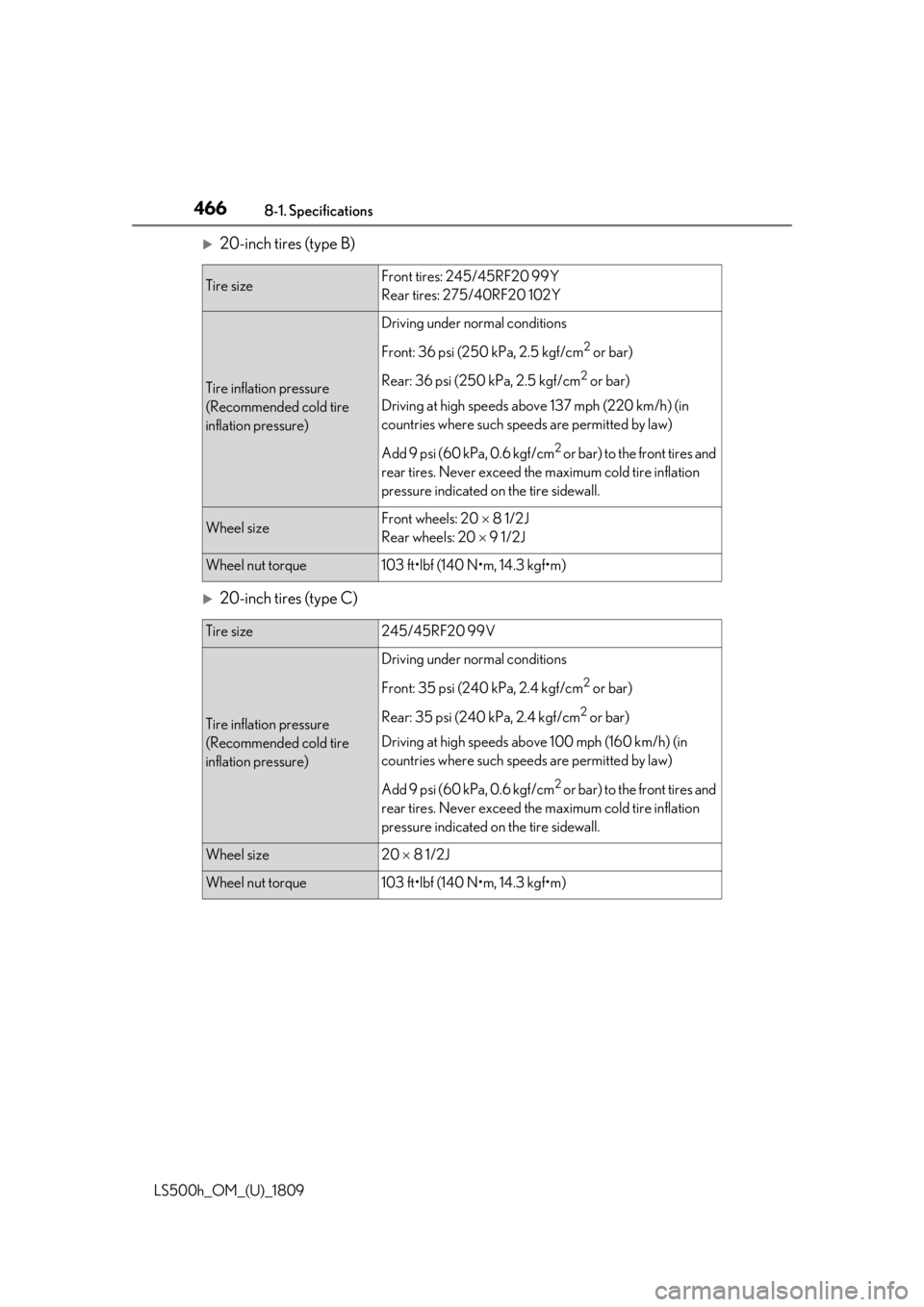
20-inch tires (type B)
20-inch tires (type C)
Tire sizeFront tires: 245/45RF20 99Y
Rear tires: 275/40RF20 102Y
Tire inflation pressure
(Recommended cold tire
inflation pressure)
Driving under normal conditions
Front: 36 psi (250 kPa, 2.5 kgf/cm
2 or bar)
Rear: 36 psi (250 kPa, 2.5 kgf/cm
2 or bar)
Driving at high speeds above 137 mph (220 km/h) (in
countries where such speeds are permitted by law)
Add 9 psi (60 kPa, 0.6 kgf/cm
2 or bar) to the front tires and
rear tires. Never exceed the maximum cold tire inflation
pressure indicated on the tire sidewall.
Wheel sizeFront wheels: 20 8 1/2J
Rear wheels: 20 9 1/2J
Wheel nut torque103 ft•lbf (140 N•m, 14.3 kgf•m)
Tire size245/45RF20 99V
Tire inflation pressure
(Recommended cold tire
inflation pressure)
Driving under normal conditions
Front: 35 psi (240 kPa, 2.4 kgf/cm
2 or bar)
Rear: 35 psi (240 kPa, 2.4 kgf/cm
2 or bar)
Driving at high speeds above 100 mph (160 km/h) (in
countries where such speeds are permitted by law)
Add 9 psi (60 kPa, 0.6 kgf/cm
2 or bar) to the front tires and
rear tires. Never exceed the maximum cold tire inflation
pressure indicated on the tire sidewall.
Wheel size20 8 1/2J
Wheel nut torque103 ft•lbf (140 N•m, 14.3 kgf•m)
Page 467 of 523
4678-1. Specifications
LS500h_OM_(U)_1809
8
Vehicle specifications
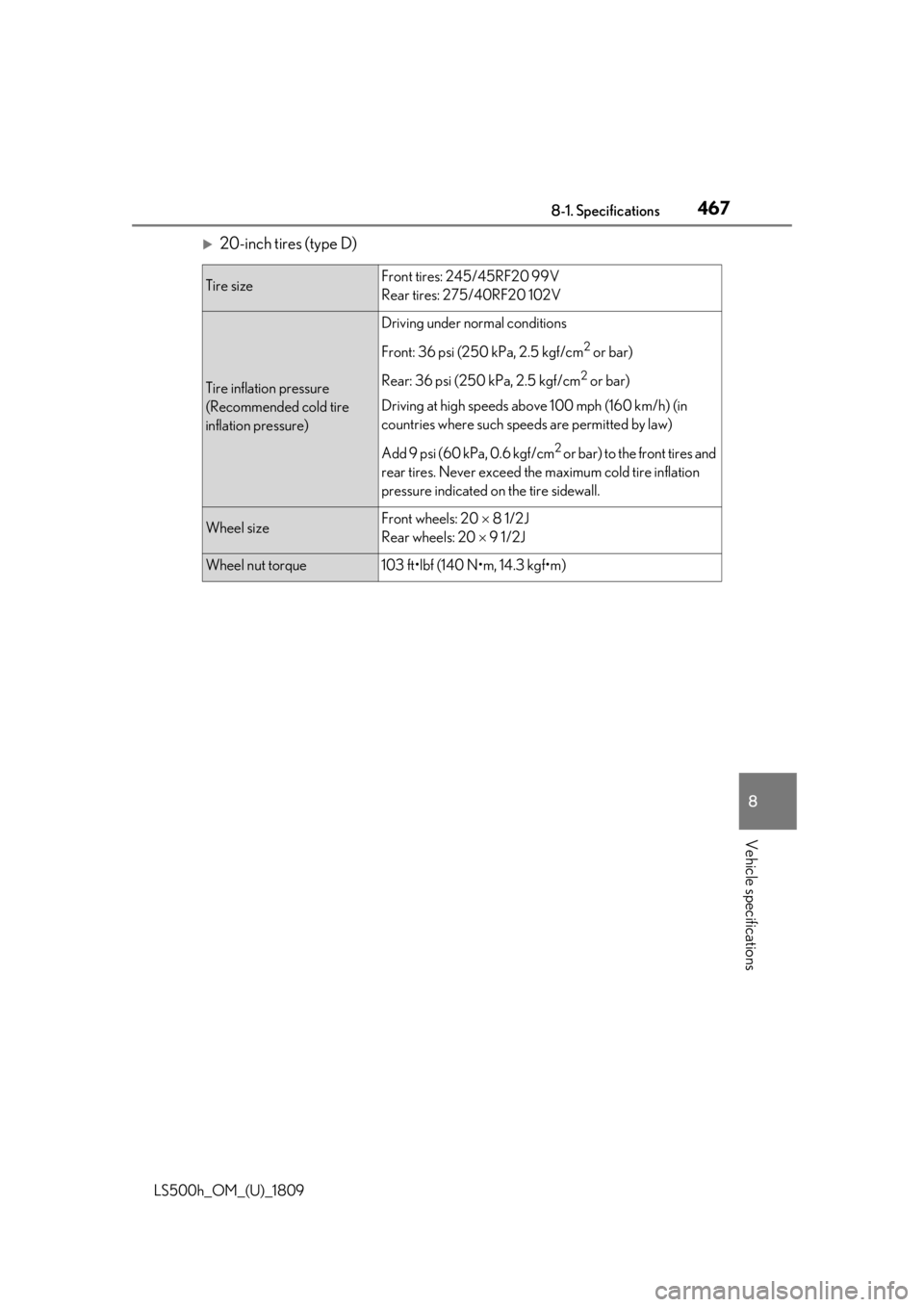
20-inch tires (type D)
Tire sizeFront tires: 245/45RF20 99V
Rear tires: 275/40RF20 102V
Tire inflation pressure
(Recommended cold tire
inflation pressure)
Driving under normal conditions
Front: 36 psi (250 kPa, 2.5 kgf/cm
2 or bar)
Rear: 36 psi (250 kPa, 2.5 kgf/cm
2 or bar)
Driving at high speeds above 100 mph (160 km/h) (in
countries where such speeds are permitted by law)
Add 9 psi (60 kPa, 0.6 kgf/cm
2 or bar) to the front tires and
rear tires. Never exceed the maximum cold tire inflation
pressure indicated on the tire sidewall.
Wheel sizeFront wheels: 20 8 1/2J
Rear wheels: 20 9 1/2J
Wheel nut torque103 ft•lbf (140 N•m, 14.3 kgf•m)
Page 471 of 523

4718-1. Specifications
LS500h_OM_(U)_1809
8
Vehicle specifications
An all season tire has “M+S” on the sidewall. A tire not marked “M+S” is a summer tire.
Type A
DOT symbol
*
Tire Identification Number (TIN)
Tire manufacturer’s identification
mark
Tire size code
Manufacturer’s optional tire type
code (3 or 4 letters)
Manufacturing week
Manufacturing year
*:The DOT symbol cert ifies that the tire
conforms to applicable Federal Motor
Vehicle Safety Standards.
Type B
DOT symbol
*
Tire Identification Number (TIN)
Tire manufacturer’s identification
mark
Manufacturer’s code
Manufacturing week
Manufacturing year
*: The DOT symbol certifies that the tire conforms to applicable Federal Motor
Vehicle Safety Standards.
■Typical tire size information
The illustration indicates typical tire
size.
Tire use (P = Passenger car, T =
Temporary use)
Section width (millimeters)
Aspect ratio (tire height to section
width)
Tire construction code (R = Radial,
D = Diagonal)
Run-flat tire code
Wheel diameter (inches)
Load index (2 digits or 3 digits)
Speed symbol (alphabet with one
Typical DOT and Tire Identifica-
tion Number (TIN)
A
B
C
D
E
F
G
A
Tire size
B
C
D
E
F
A
B
C
D
E
F
G
H
Page 472 of 523

4728-1. Specifications
LS500h_OM_(U)_1809
letter)
■Tire dimensionsSection width
Tire height
Wheel diameter
Bead
Sidewall
Shoulder
Tread
Belt
Inner liner
Reinforcing rubber
Carcass
Rim lines
Bead wires
Chafer This information has been prepared in
accordance with regulations issued by
the National Highway Traffic Safety
Administration of the U.S. Department
of Transportation.
It provides the purchasers and/or pro-
spective purchasers of Lexus vehicles
with information on uniform tire quality
grading.
Your Lexus dealer will help answer any
questions you may have as you read this
information.
■DOT quality grades
All passenger vehicle tires must con-
form to Federal Safety Requirements in
addition to these grades. Quality
grades can be found where applicable
on the tire sidewall between tread
shoulder and maximum section width.
For example: Treadwear 200 Traction AA
Temperature A
■Treadwear
The treadwear grade is a comparative
rating based on the wear rate of the tire
when tested under controlled condi-
tions on a specified government test
course.
For example, a tire graded 150 would wear
one and a half (1 - 1/2) times as well on the
government course as a tire graded 100.
The relative performance of tires depends
upon the actual conditions of their use.
Performance may differ significantly from
the norm due to variatio ns in driving habits,
service practices and differences in road
characteristics and climate.
Tire section names
A
B
C
A
B
C
D
E
F
G
H
I
J
K
Uniform Tire Quality Grading
Page 473 of 523

4738-1. Specifications
LS500h_OM_(U)_1809
8
Vehicle specifications
■Traction AA, A, B, C
The traction grades, from highest to
lowest, are AA, A, B and C, and they
represent the tire’s ability to stop on
wet pavement as measured under con-
trolled conditions on specified govern-
ment test surfaces of asphalt and
concrete.
A tire marked C may have poor traction
performance.
Warning: The traction grade assigned to
this tire is based on braking (straight
ahead) traction tests and does not include
cornering (turning) traction.
■Temperature A, B, C
The temperature grades are A (the
highest), B, and C, representing the
tire’s resistance to the generation of
heat and its ability to dissipate heat when tested under controlled condi-
tions on a specified indoor laboratory
test wheel.
Sustained high temperature can cause the
material of the tire to degenerate and
reduce tire life, and excessive temperature
can lead to sudd
en tire failure.
Grade C corresponds to a level of perfor-
mance which all passenger car tires must
meet under the Fede ral Motor Vehicle
Safety Standard No. 109.
Grades B and A represent higher levels of
performance on the laboratory test wheel
than the minimum required by law.
Warning: The temperature grades of a tire
assume that it is properly inflated and not
overloaded.
Excessive speed, unde rinflation, or exces-
sive loading, either separately or in combi-
nation, can cause heat buildup and
possible tire failure.
Glossary of tire terminology
Tire related termMeaning
Cold tire inflation pressure
Tire pressure when the vehicle has been parked for
three hours or more, or has not been driven more
than 1 mile or 1.5 km under that condition
Maximum inflation pressureThe maximum cold inflated pressure to which a tire
may be inflated, shown on the sidewall of the tire
Recommended inflation pressureCold tire inflation pressure recommended by a
manufacturer
Accessory weight
The combined weight (in excess of those standard
items which may be replaced) of hybrid transmis-
sion, power steering, power brakes, power win-
dows, power seats, radio and heater, to the extent
that these items are available as factory-installed
equipment (whether installed or not)
Page 474 of 523

4748-1. Specifications
LS500h_OM_(U)_1809
Curb weight
The weight of a motor vehicle with standard equip-
ment, including the maximum capacity of fuel, oil
and coolant, and if so equipped, air conditioning
and additional weight optional engine
Maximum loaded vehicle weight
The sum of:
(a) Curb weight
(b) Accessory weight
(c) Vehicle capacity weight
(d) Production options weight
Normal occupant weight
150 lb. (68 kg) times the number of occupants
specified in the second column of Table 1
* that fol-
lows
Occupant distributionDistribution of occupants in a vehicle as specified in
the third column of Table 1
* below
Production options weight
The combined weight of installed regular produc-
tion options weighing over 5 lb. (2.3 kg) in excess of
the standard items which they replace, not previ-
ously considered in curb weight or accessory
weight, including heavy duty brakes, ride levelers,
roof rack, heavy duty 12-volt battery, and special
trim
RimA metal support for a tire or a tire and tube assem-
bly upon which the tire beads are seated
Rim diameter (Wheel diameter)Nominal diameter of the bead seat
Rim size designationRim diameter and width
Rim type designationThe industry manufacturer’s designation for a rim
by style or code
Rim widthNominal distance between rim flanges
Vehicle capacity weight (Total load
capacity)The rated cargo and luggage load plus 150 lb. (68
kg) times the vehicle’s designated seating capacity
Vehicle maximum load on the tire
The load on an individual ti re that is determined by
distributing to each axle its share of the maximum
loaded vehicle weight, and dividing by two
Tire related termMeaning
Page 477 of 523
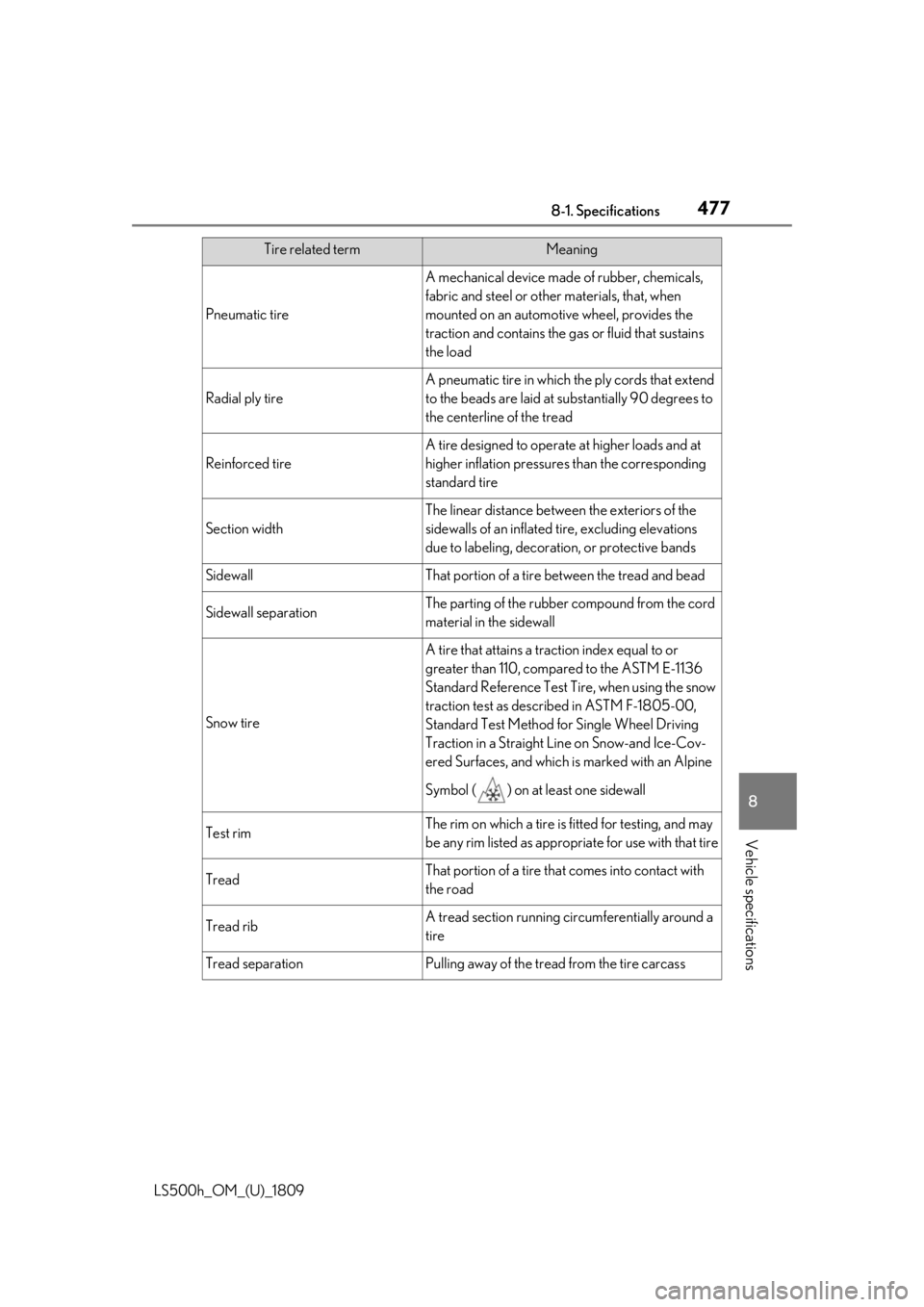
4778-1. Specifications
LS500h_OM_(U)_1809
8
Vehicle specifications
Pneumatic tire
A mechanical device made of rubber, chemicals,
fabric and steel or other materials, that, when
mounted on an automotive wheel, provides the
traction and contains the gas or fluid that sustains
the load
Radial ply tire
A pneumatic tire in which the ply cords that extend
to the beads are laid at su bstantially 90 degrees to
the centerline of the tread
Reinforced tire
A tire designed to operat e at higher loads and at
higher inflation pressures than the corresponding
standard tire
Section width
The linear distance between the exteriors of the
sidewalls of an inflated tire, excluding elevations
due to labeling, decoration, or protective bands
SidewallThat portion of a tire between the tread and bead
Sidewall separationThe parting of the rubber compound from the cord
material in the sidewall
Snow tire
A tire that attains a traction index equal to or
greater than 110, compared to the ASTM E-1136
Standard Referenc e Test Tire, when using the snow
traction test as described in ASTM F-1805-00,
Standard Test Method fo r Single Wheel Driving
Traction in a Straight Line on Snow-and Ice-Cov-
ered Surfaces, and which is marked with an Alpine
Symbol ( ) on at least one sidewall
Test rimThe rim on which a tire is fitted for testing, and may
be any rim listed as appropriate for use with that tire
TreadThat portion of a tire that comes into contact with
the road
Tread ribA tread section running ci rcumferentially around a
tire
Tread separationPulling away of the tread from the tire carcass
Tire related termMeaning
Page 478 of 523
4788-1. Specifications
LS500h_OM_(U)_1809
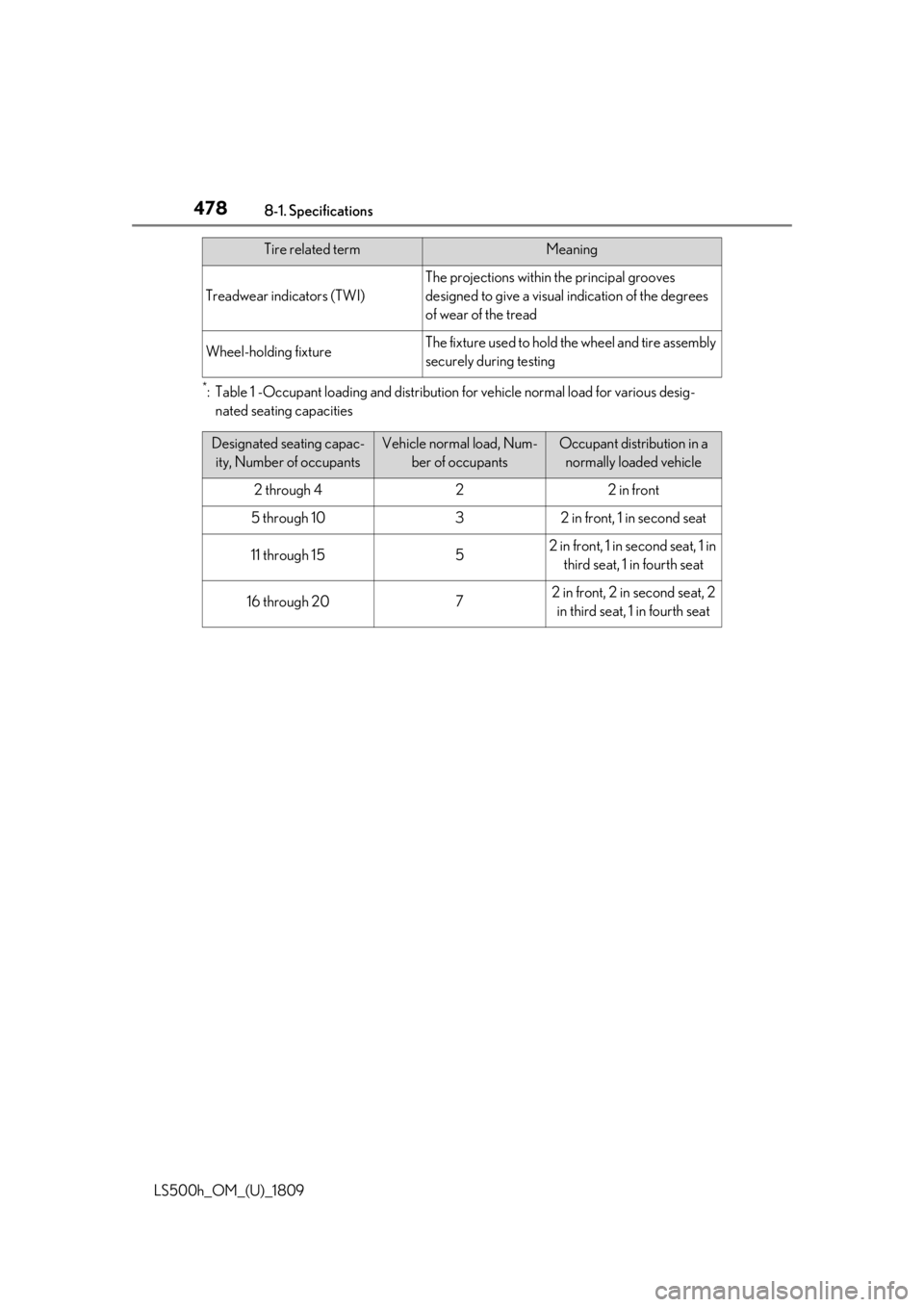
*: Table 1 -Occupant loading and distribution for vehicle normal load for various desig-nated seating capacities
Treadwear indicators (TWI)
The projections within the principal grooves
designed to give a visual indication of the degrees
of wear of the tread
Wheel-holding fixtureThe fixture used to hold the wheel and tire assembly
securely during testing
Tire related termMeaning
Designated seating capac- ity, Number of occupantsVehicle normal load, Num- ber of occupantsOccupant distribution in a normally loaded vehicle
2 through 422 in front
5 through 1032 in front, 1 in second seat
11 through 1552 in front, 1 in second seat, 1 in third seat, 1 in fourth seat
16 through 2072 in front, 2 in second seat, 2 in third seat, 1 in fourth seat