brake LEXUS LS500H 2020 Owners Manual
[x] Cancel search | Manufacturer: LEXUS, Model Year: 2020, Model line: LS500H, Model: LEXUS LS500H 2020Pages: 516, PDF Size: 10.38 MB
Page 440 of 516
4387-2. Steps to take in an emergency
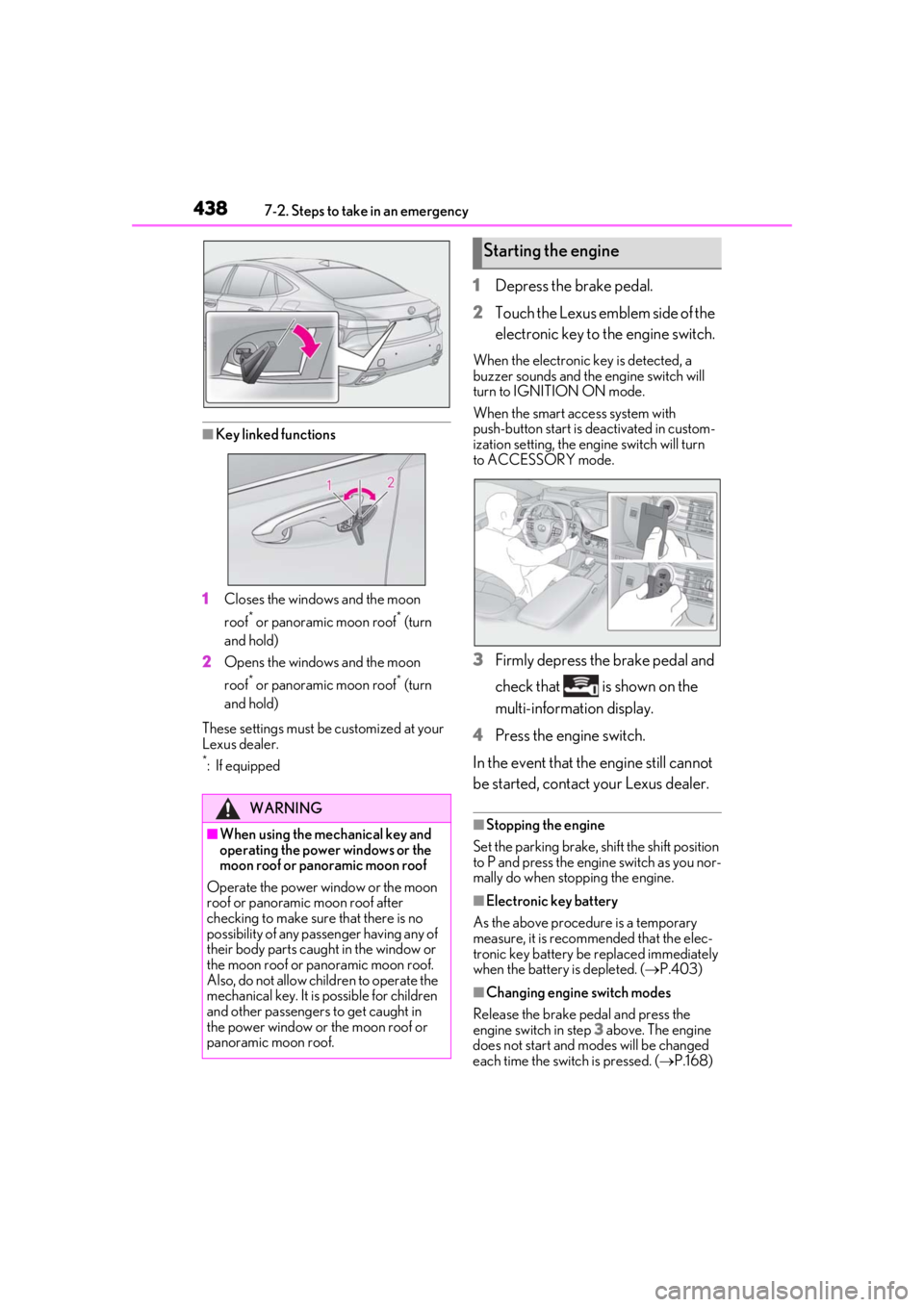
■Key linked functions
1
Closes the windows and the moon
roof
* or panoramic moon roof* (turn
and hold)
2
Opens the windows and the moon
roof
* or panoramic moon roof* (turn
and hold)
These settings must be customized at your
Lexus dealer.
*: If equipped
1Depress the brake pedal.
2
Touch the Lexus emblem side of the
electronic key to the engine switch.
When the electronic key is detected, a
buzzer sounds and the engine switch will
turn to IGNITION ON mode.
When the smart access system with
push-button start is deactivated in custom-
ization setting, the engine switch will turn
to ACCESSORY mode.
3Firmly depress the brake pedal and
check that is shown on the
multi-information display.
4
Press the engine switch.
In the event that the engine still cannot
be started, contact your Lexus dealer.
■Stopping the engine
Set the parking brake, shift the shift position
to P and press the engine switch as you nor-
mally do when stop ping the engine.
■Electronic key battery
As the above procedure is a temporary
measure, it is recommended that the elec-
tronic key battery be replaced immediately
when the battery is depleted. (P.403)
■Changing engine switch modes
Release the brake pe dal and press the
engine switch in step 3
above. The engine
does not start and modes will be changed
each time the switch is pressed. ( P.168)
WARNING
■When using the mechanical key and
operating the power windows or the
moon roof or panoramic moon roof
Operate the power window or the moon
roof or panoramic moon roof after
checking to make sure that there is no
possibility of any passenger having any of
their body parts caught in the window or
the moon roof or panoramic moon roof.
Also, do not allow ch ildren to operate the
mechanical key. It is possible for children
and other passengers to get caught in
the power window or the moon roof or
panoramic moon roof.
Starting the engine
Page 449 of 516
4477-2. Steps to take in an emergency
7
When trouble arises
1Stop the engine. Set the parking
brake and shift the shift position to
P.
2
Remove the mud, snow or sand
from around the rear wheels.
3
Place wood, stones or some other
material under the rear wheels to
help provide traction.
4
Restart the engine.
5
Shift the shift position to D or R and
release the parking brake. Then,
while exercising caution, depress
the accelerator pedal.
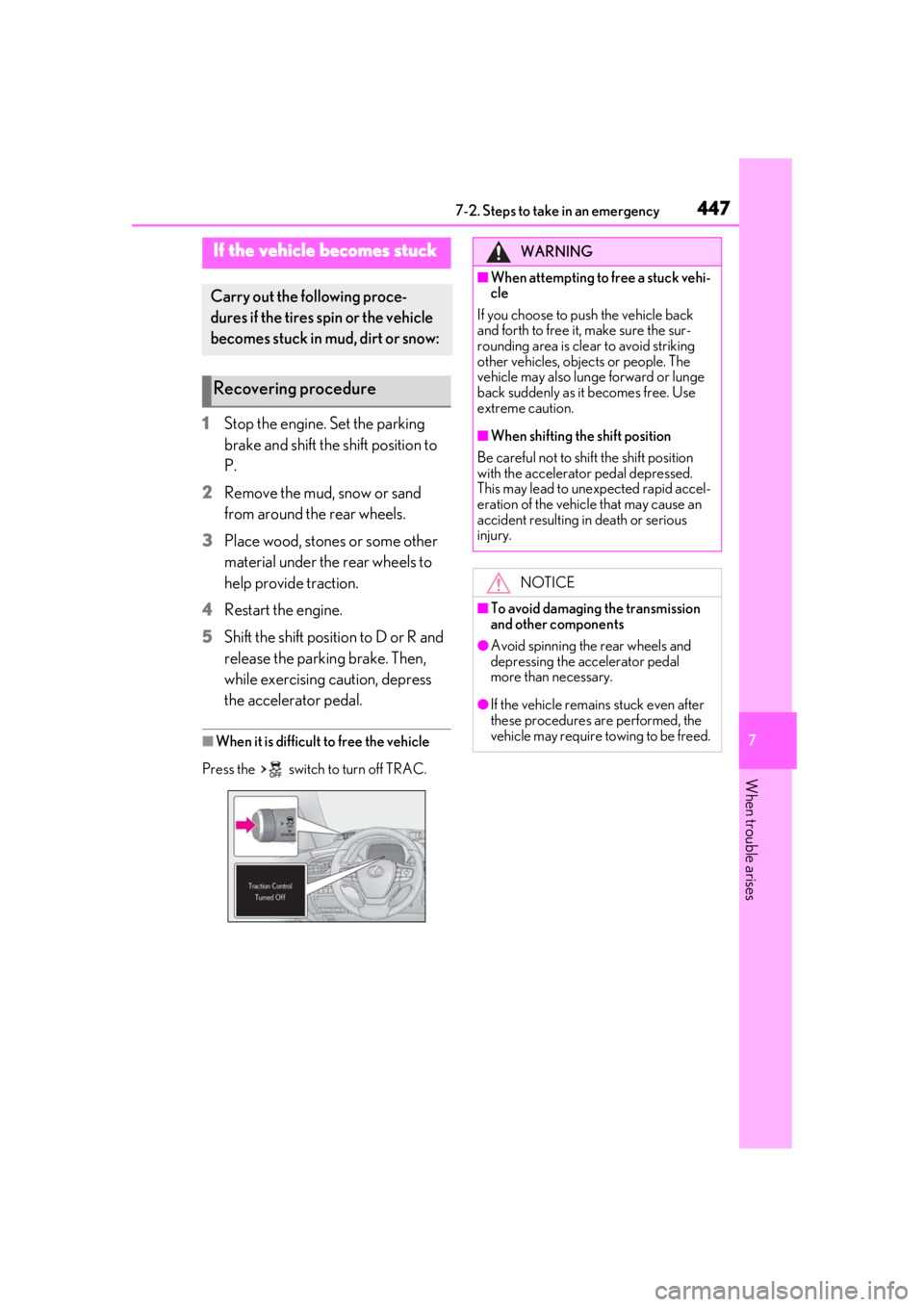
■When it is difficult to free the vehicle
Press the switch to turn off TRAC.
If the vehicle becomes stuck
Carry out the following proce-
dures if the tires spin or the vehicle
becomes stuck in mud, dirt or snow:
Recovering procedure
WARNING
■When attempting to free a stuck vehi-
cle
If you choose to push the vehicle back
and forth to free it, make sure the sur-
rounding area is clear to avoid striking
other vehicles, objects or people. The
vehicle may also lunge forward or lunge
back suddenly as it becomes free. Use
extreme caution.
■When shifting the shift position
Be careful not to shift the shift position
with the accelerator pedal depressed.
This may lead to un expected rapid accel-
eration of the vehicle that may cause an
accident resulting in death or serious
injury.
NOTICE
■To avoid damaging the transmission
and other components
●Avoid spinning the rear wheels and
depressing the accelerator pedal
more than necessary.
●If the vehicle remains stuck even after
these procedures are performed, the
vehicle may require towing to be freed.
Page 457 of 516
4558-1. Specifications
8
Vehicle specifications
matching quality to satisfy the above specification. Please contact your Lexus dealer for
further details.
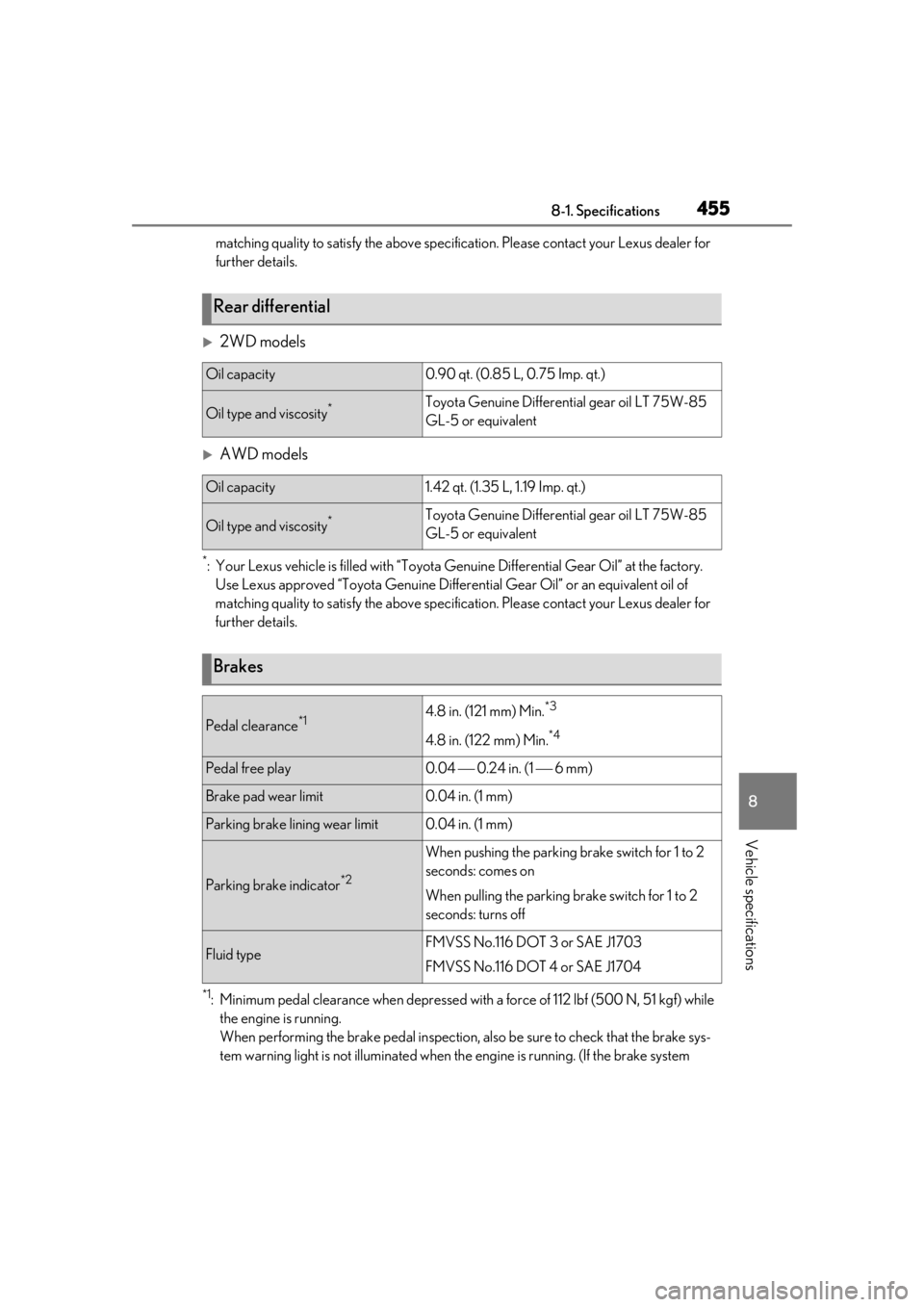
2WD models
AWD models
*: Your Lexus vehicle is filled with “Toyota Genu ine Differential Gear Oil” at the factory.
Use Lexus approved “Toyota Ge nuine Differential Gear Oil” or an equivalent oil of
matching quality to satisfy th e above specification. Please contact your Lexus dealer for
further details.
*1: Minimum pedal clearance when depressed with a force of 112 lbf (500 N, 51 kgf) while
the engine is running.
When performing the brake pedal inspection, also be sure to check that the brake sys-
tem warning light is not illuminated when th e engine is running. (If the brake system
Rear differential
Oil capacity0.90 qt. (0.85 L, 0.75 Imp. qt.)
Oil type and viscosity*Toyota Genuine Differential gear oil LT 75W-85
GL-5 or equivalent
Oil capacity1.42 qt. (1.35 L, 1.19 Imp. qt.)
Oil type and viscosity*Toyota Genuine Differential gear oil LT 75W-85
GL-5 or equivalent
Brakes
Pedal clearance*14.8 in. (121 mm) Min.*3
4.8 in. (122 mm) Min.*4
Pedal free play0.04 0.24 in. (1 6 mm)
Brake pad wear limit0.04 in. (1 mm)
Parking brake lining wear limit0.04 in. (1 mm)
Parking brake indicator*2
When pushing the parking brake switch for 1 to 2
seconds: comes on
When pulling the parking brake switch for 1 to 2
seconds: turns off
Fluid typeFMVSS No.116 DOT 3 or SAE J1703
FMVSS No.116 DOT 4 or SAE J1704
Page 458 of 516
4568-1. Specifications
warning light is illuminated, refer to P.419.)
*2: Make sure to confirm that the brake warning light (yellow) does not illuminate. (If the brake warning light illuminates, refer to P.419.)
*3: Vehicles without Lexus Safety System + A
*4: Vehicles with Lexus Safety System + A
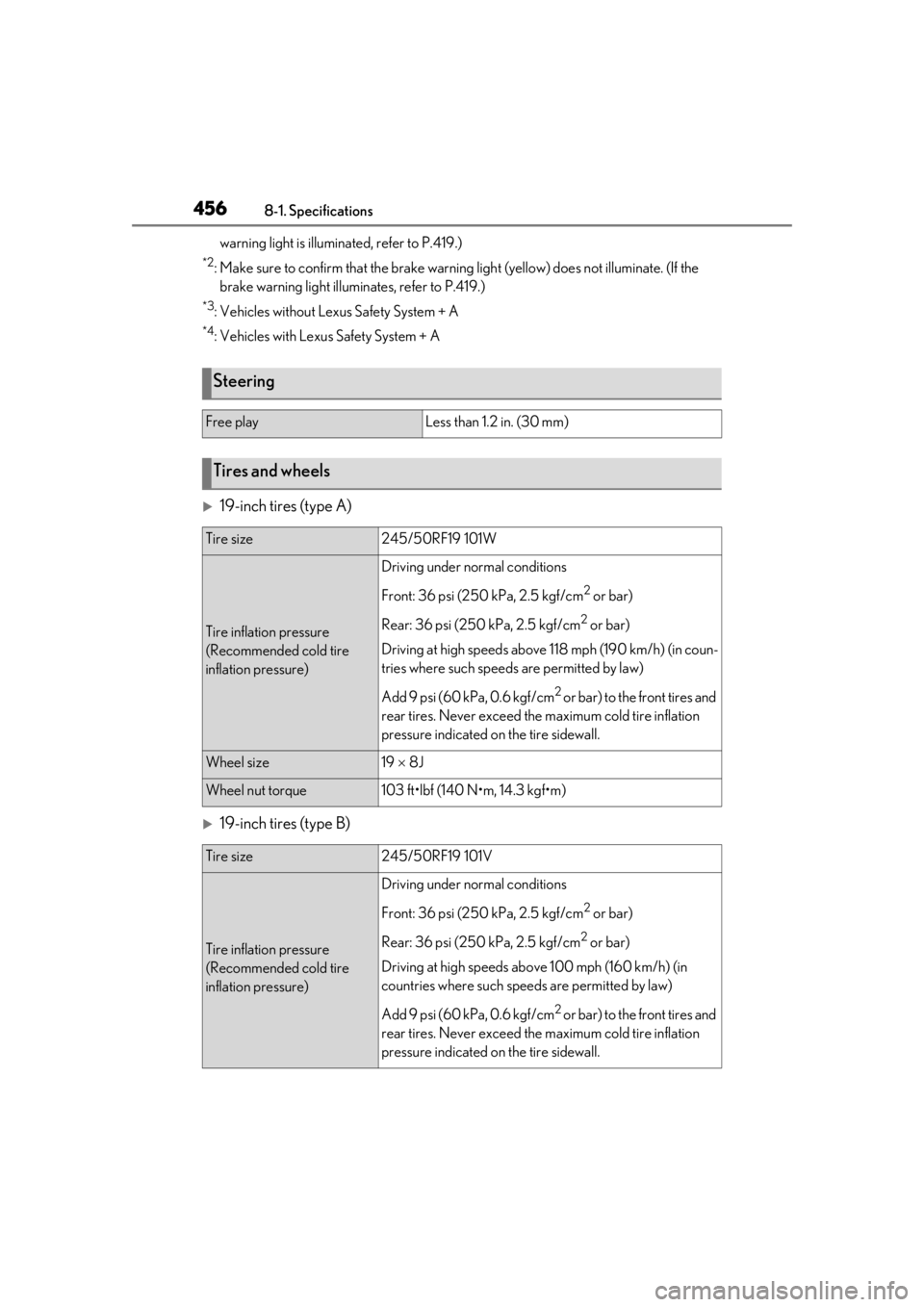
19-inch tires (type A)
19-inch tires (type B)
Steering
Free playLess than 1.2 in. (30 mm)
Tires and wheels
Tire size245/50RF19 101W
Tire inflation pressure
(Recommended cold tire
inflation pressure)
Driving under normal conditions
Front: 36 psi (250 kPa, 2.5 kgf/cm
2 or bar)
Rear: 36 psi (250 kPa, 2.5 kgf/cm
2 or bar)
Driving at high speeds above 118 mph (190 km/h) (in coun-
tries where such speeds are permitted by law)
Add 9 psi (60 kPa, 0.6 kgf/cm
2 or bar) to the front tires and
rear tires. Never exceed the maximum cold tire inflation
pressure indicated on the tire sidewall.
Wheel size19 8J
Wheel nut torque103 ft•lbf (140 N•m, 14.3 kgf•m)
Tire size245/50RF19 101V
Tire inflation pressure
(Recommended cold tire
inflation pressure)
Driving under normal conditions
Front: 36 psi (250 kPa, 2.5 kgf/cm
2 or bar)
Rear: 36 psi (250 kPa, 2.5 kgf/cm
2 or bar)
Driving at high speeds above 100 mph (160 km/h) (in
countries where such speeds are permitted by law)
Add 9 psi (60 kPa, 0.6 kgf/cm
2 or bar) to the front tires and
rear tires. Never exceed the maximum cold tire inflation
pressure indicated on the tire sidewall.
Page 466 of 516
4648-1. Specifications
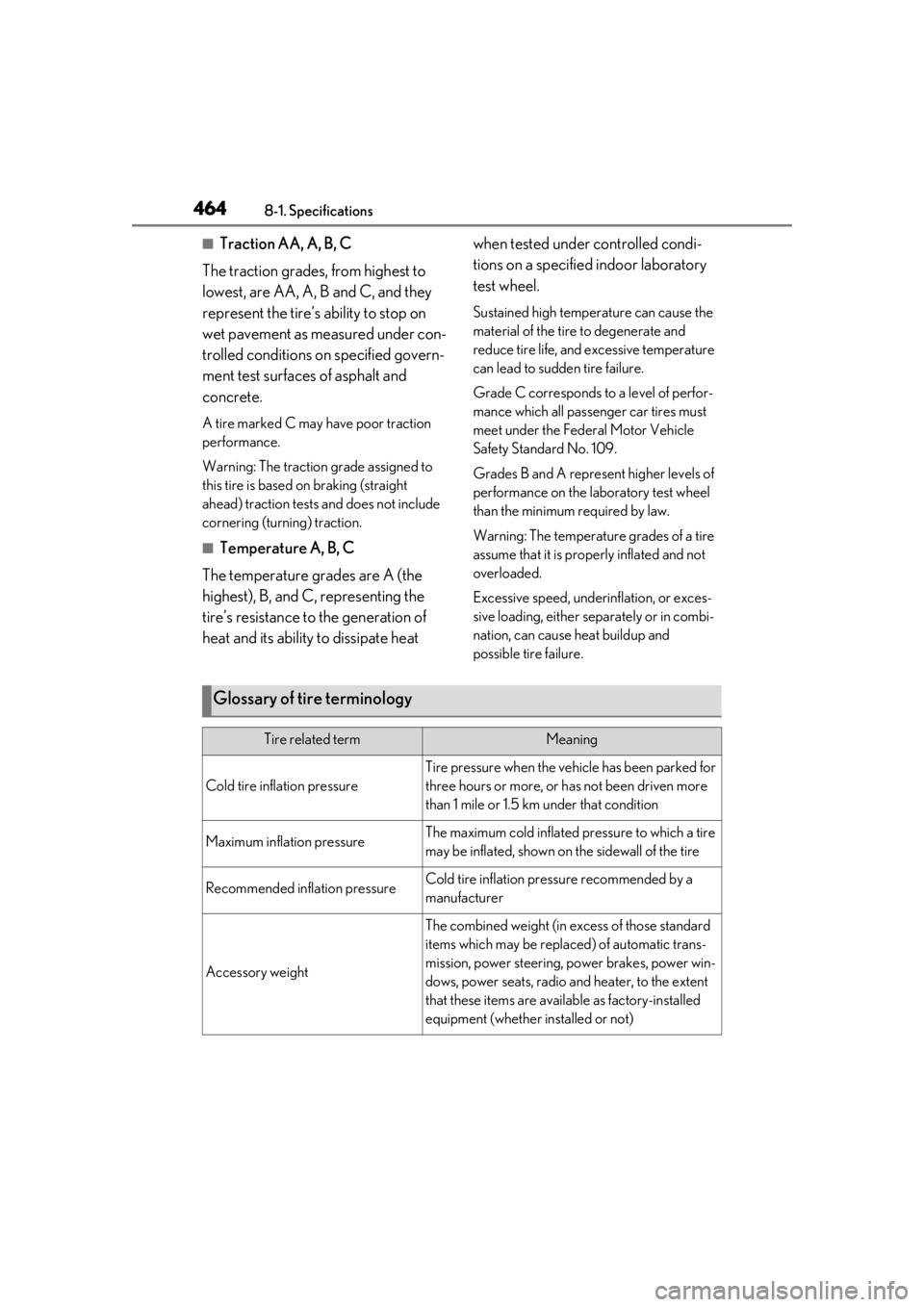
■Traction AA, A, B, C
The traction grades, from highest to
lowest, are AA, A, B and C, and they
represent the tire’s ability to stop on
wet pavement as measured under con-
trolled conditions on specified govern-
ment test surfaces of asphalt and
concrete.
A tire marked C may have poor traction
performance.
Warning: The traction grade assigned to
this tire is based on braking (straight
ahead) traction tests and does not include
cornering (turning) traction.
■Temperature A, B, C
The temperature grades are A (the
highest), B, and C, representing the
tire’s resistance to the generation of
heat and its ability to dissipate heat when tested under controlled condi-
tions on a specified indoor laboratory
test wheel.
Sustained high temperature can cause the
material of the tire to degenerate and
reduce tire life, and excessive temperature
can lead to sudd
en tire failure.
Grade C corresponds to a level of perfor-
mance which all passenger car tires must
meet under the Fede ral Motor Vehicle
Safety Standard No. 109.
Grades B and A represent higher levels of
performance on the laboratory test wheel
than the minimum required by law.
Warning: The temperature grades of a tire
assume that it is properly inflated and not
overloaded.
Excessive speed, unde rinflation, or exces-
sive loading, either separately or in combi-
nation, can cause heat buildup and
possible tire failure.
Glossary of tire terminology
Tire related termMeaning
Cold tire inflation pressure
Tire pressure when the vehicle has been parked for
three hours or more, or has not been driven more
than 1 mile or 1.5 km under that condition
Maximum inflation pressureThe maximum cold inflated pressure to which a tire
may be inflated, shown on the sidewall of the tire
Recommended inflation pressureCold tire inflation pressure recommended by a
manufacturer
Accessory weight
The combined weight (in excess of those standard
items which may be replaced) of automatic trans-
mission, power steering, power brakes, power win-
dows, power seats, radio and heater, to the extent
that these items are available as factory-installed
equipment (whether installed or not)
Page 467 of 516
4658-1. Specifications
8
Vehicle specifications
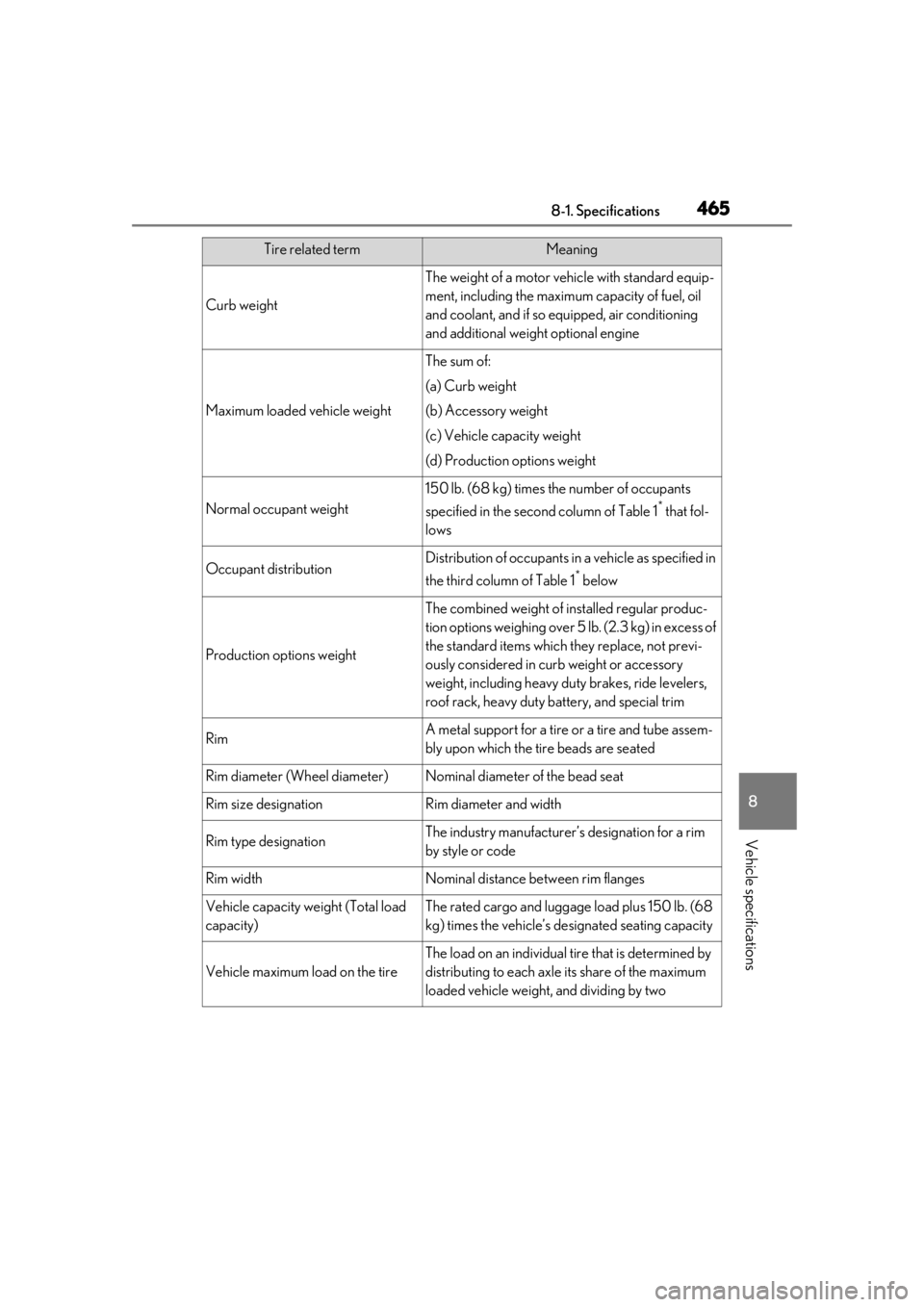
Curb weight
The weight of a motor vehicle with standard equip-
ment, including the maximum capacity of fuel, oil
and coolant, and if so equipped, air conditioning
and additional weight optional engine
Maximum loaded vehicle weight
The sum of:
(a) Curb weight
(b) Accessory weight
(c) Vehicle capacity weight
(d) Production options weight
Normal occupant weight
150 lb. (68 kg) times the number of occupants
specified in the second column of Table 1
* that fol-
lows
Occupant distributionDistribution of occupants in a vehicle as specified in
the third column of Table 1
* below
Production options weight
The combined weight of installed regular produc-
tion options weighing over 5 lb. (2.3 kg) in excess of
the standard items which they replace, not previ-
ously considered in curb weight or accessory
weight, including heavy duty brakes, ride levelers,
roof rack, heavy duty battery, and special trim
RimA metal support for a tire or a tire and tube assem-
bly upon which the tire beads are seated
Rim diameter (Wheel diameter)Nominal diameter of the bead seat
Rim size designationRim diameter and width
Rim type designationThe industry manufacturer’s designation for a rim
by style or code
Rim widthNominal distance between rim flanges
Vehicle capacity weight (Total load
capacity)The rated cargo and luggage load plus 150 lb. (68
kg) times the vehicle’s designated seating capacity
Vehicle maximum load on the tire
The load on an individual ti re that is determined by
distributing to each axle its share of the maximum
loaded vehicle weight, and dividing by two
Tire related termMeaning
Page 472 of 516
4708-2. Customization
8-2.Customization
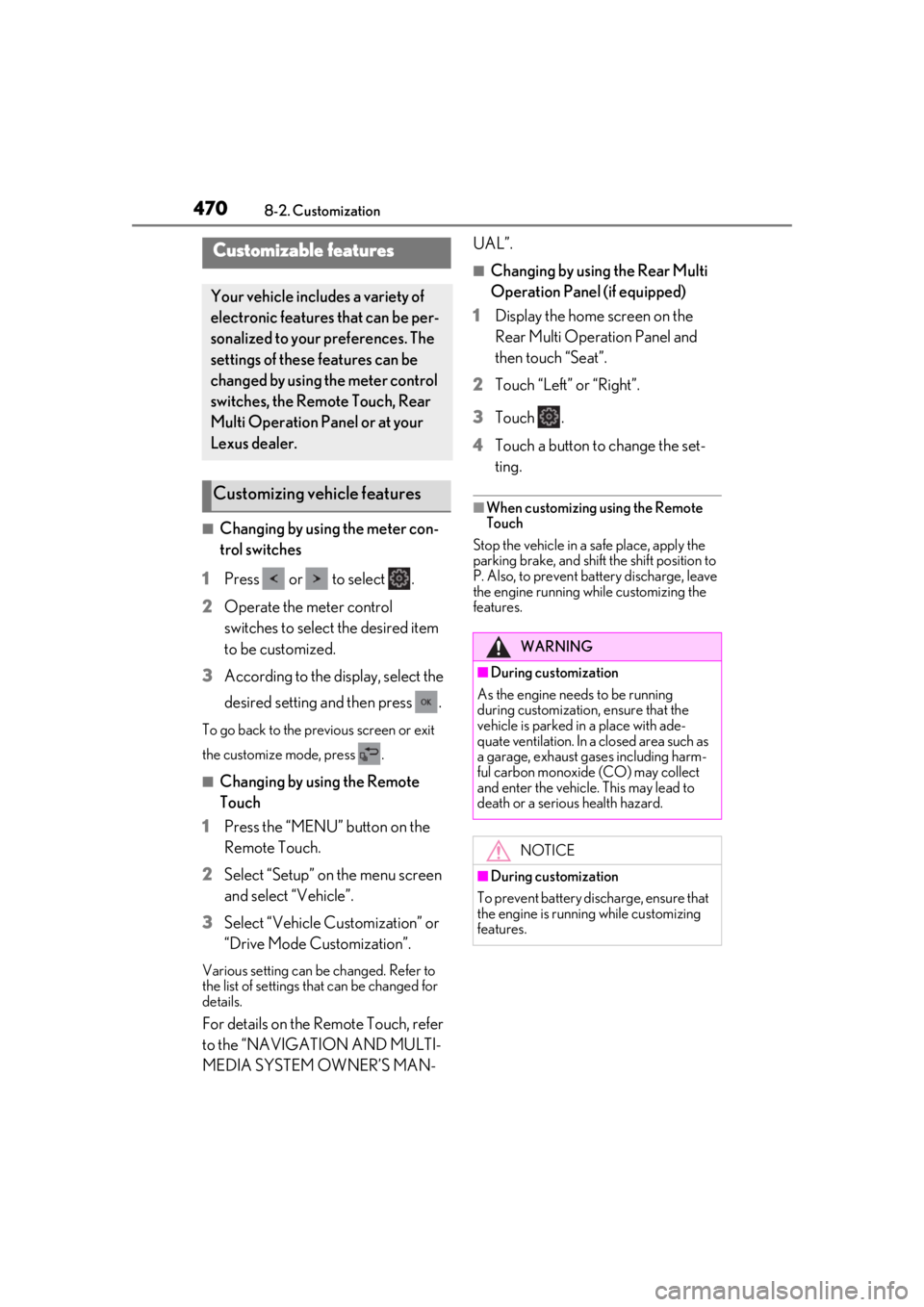
■Changing by using the meter con-
trol switches
1
Press or to select .
2
Operate the meter control
switches to select the desired item
to be customized.
3
According to the display, select the
desired setting and then press .
To go back to the previous screen or exit
the customize mode, press .
■Changing by using the Remote
Touch
1
Press the “MENU” button on the
Remote Touch.
2
Select “Setup” on the menu screen
and select “Vehicle”.
3
Select “Vehicle Customization” or
“Drive Mode Customization”.
Various setting can be changed. Refer to
the list of settings that can be changed for
details.
For details on the Remote Touch, refer
to the “NAVIGATION AND MULTI-
MEDIA SYSTEM OWNER’S MAN- UAL”.
■Changing by using the Rear Multi
Operation Panel (if equipped)
1
Display the home screen on the
Rear Multi Operation Panel and
then touch “Seat”.
2
Touch “Left” or “Right”.
3
Touch .
4
Touch a button to change the set-
ting.
■When customizing using the Remote
Touch
Stop the vehicle in a safe place, apply the
parking brake, and shift the shift position to
P. Also, to prevent battery discharge, leave
the engine running while customizing the
features.
Customizable features
Your vehicle includes a variety of
electronic features that can be per-
sonalized to your preferences. The
settings of these features can be
changed by using the meter control
switches, the Remote Touch, Rear
Multi Operation Panel or at your
Lexus dealer.
Customizing vehicle features
WARNING
■During customization
As the engine needs to be running
during customization, ensure that the
vehicle is parked in a place with ade-
quate ventilation. In a closed area such as
a garage, exhaust gases including harm-
ful carbon monoxide (CO) may collect
and enter the vehicle. This may lead to
death or a serious health hazard.
NOTICE
■During customization
To prevent battery discharge, ensure that
the engine is running while customizing
features.
Page 482 of 516
4808-2. Customization
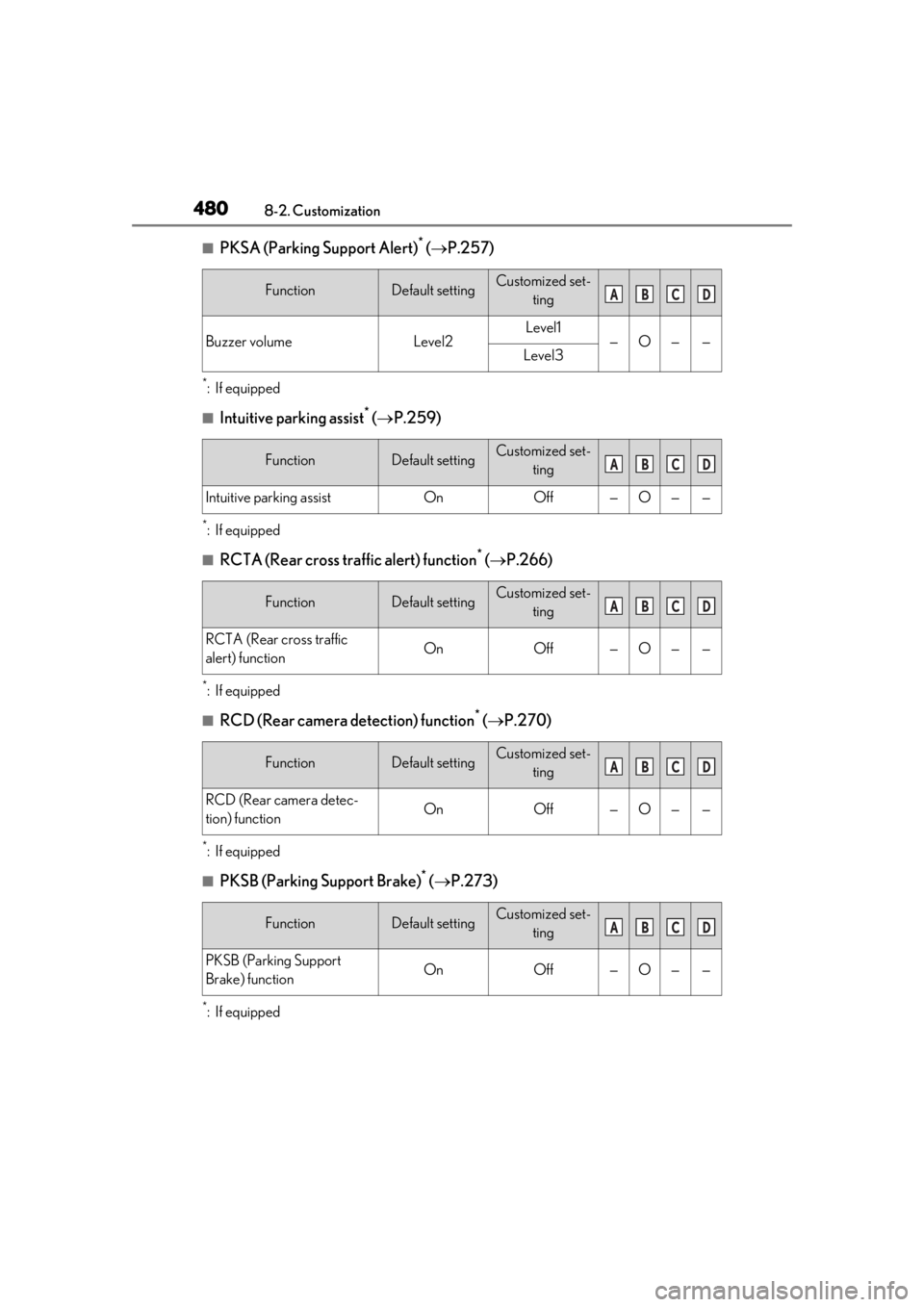
■PKSA (Parking Support Alert)* ( P.257)
*:If equipped
■Intuitive parking assist* ( P.259)
*:If equipped
■RCTA (Rear cross traffic alert) function* ( P.266)
*:If equipped
■RCD (Rear camera detection) function* ( P.270)
*:If equipped
■PKSB (Parking Support Brake)* ( P.273)
*:If equipped
FunctionDefault settingCustomized set-
ting
Buzzer volumeLevel2Level1—O——Level3
FunctionDefault settingCustomized set-ting
Intuitive parking assistOnOff—O——
FunctionDefault settingCustomized set-ting
RCTA (Rear cross traffic
alert) functionOnOff—O——
FunctionDefault settingCustomized set-ting
RCD (Rear camera detec-
tion) functionOnOff—O——
FunctionDefault settingCustomized set-ting
PKSB (Parking Support
Brake) functionOnOff—O——
ABCD
ABCD
ABCD
ABCD
ABCD
Page 486 of 516
4848-3. Initialization
8-3.Initialization
*:If equipped
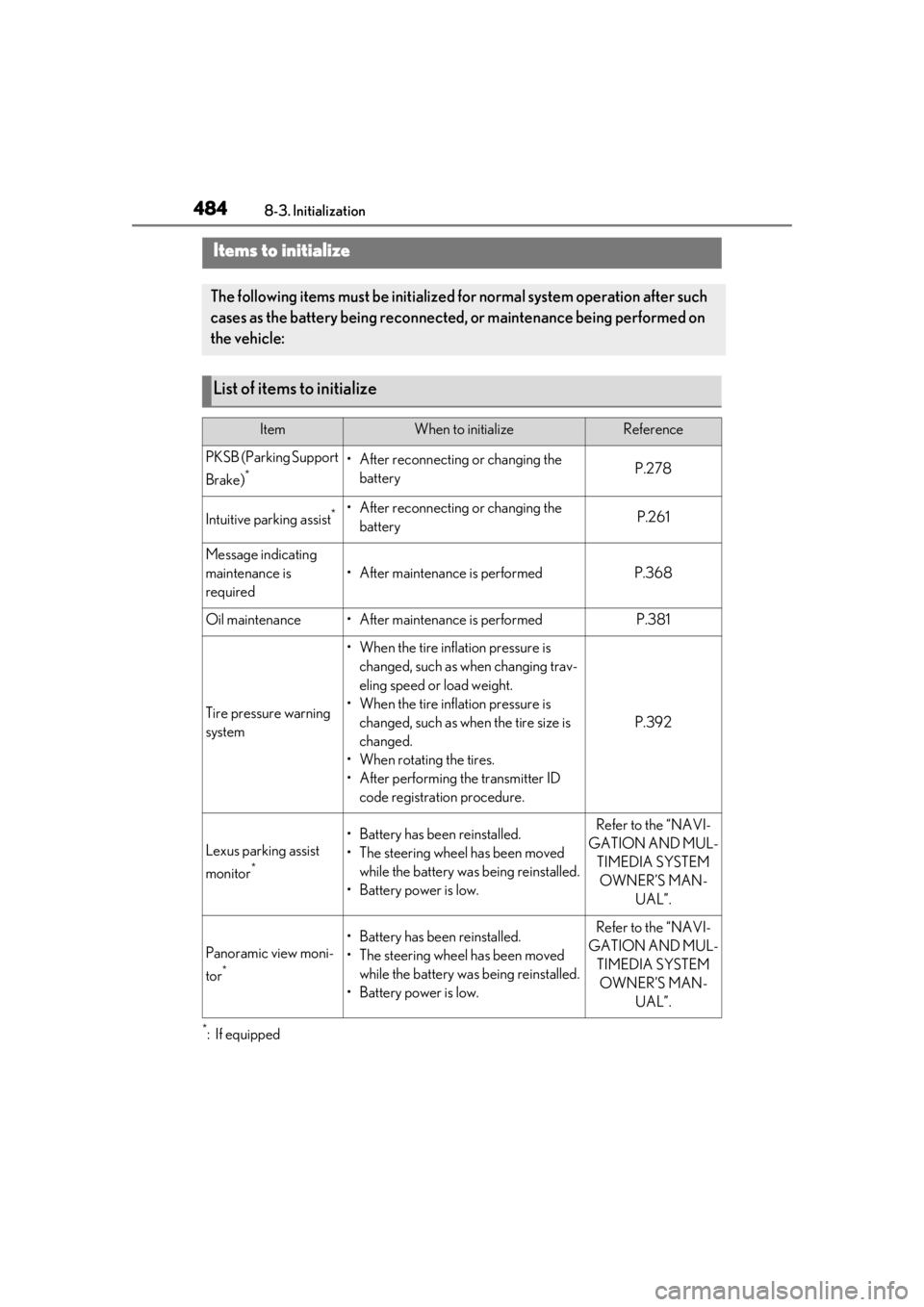
Items to initialize
The following items must be initialized for normal system operation after such
cases as the battery being reconnected, or maintenance being performed on
the vehicle:
List of items to initialize
ItemWhen to initializeReference
PKSB (Parking Support
Brake)
*• After reconnecting or changing the batteryP.278
Intuitive parking assist*• After reconnecting or changing the batteryP.261
Message indicating
maintenance is
required
• After maintenance is performedP.368
Oil maintenance• After maintenance is performedP.381
Tire pressure warning
system
• When the tire inflation pressure is changed, such as when changing trav-
eling speed or load weight.
• When the tire inflation pressure is changed, such as when the tire size is
changed.
• When rotating the tires.
• After performing the transmitter ID code registration procedure.
P.392
Lexus parking assist
monitor
*
• Battery has been reinstalled.
• The steering wheel has been moved while the battery was being reinstalled.
• Battery power is low.Refer to the “NAVI-
GATION AND MUL- TIMEDIA SYSTEM OWNER’S MAN- UAL”.
Panoramic view moni-
tor
*
• Battery has been reinstalled.
• The steering wheel has been moved while the battery was being reinstalled.
• Battery power is low.Refer to the “NAVI-
GATION AND MUL- TIMEDIA SYSTEM OWNER’S MAN- UAL”.
Page 498 of 516
496What to do if... (Troubleshooting)
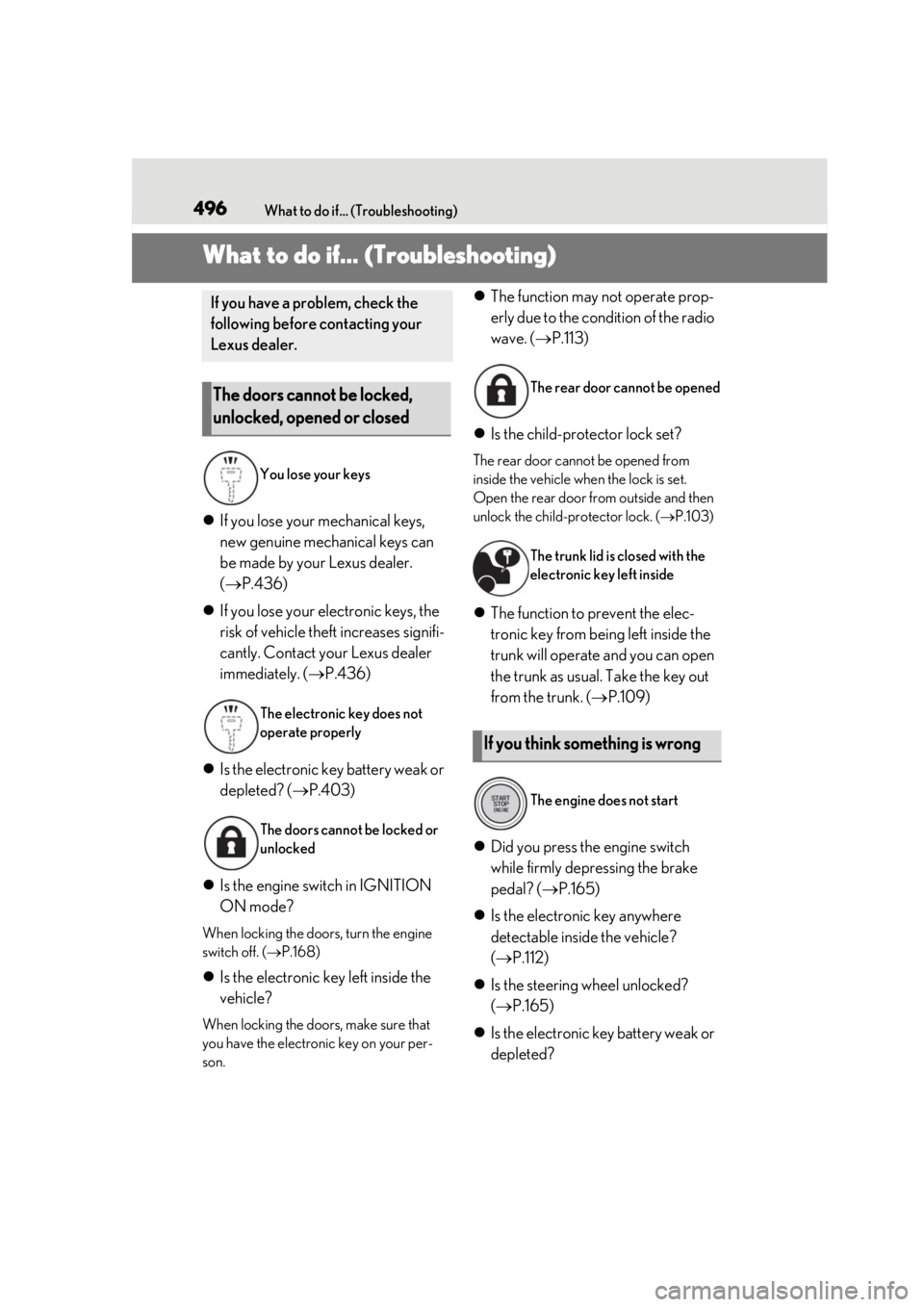
1-1.What to do if... (Troubleshooting)What to do if... (Troubleshooting)
If you lose your mechanical keys,
new genuine mechanical keys can
be made by your Lexus dealer.
( P.436)
If you lose your electronic keys, the
risk of vehicle theft increases signifi-
cantly. Contact your Lexus dealer
immediately. ( P.436)
Is the electronic key battery weak or
depleted? ( P.403)
Is the engine switch in IGNITION
ON mode?
When locking the doors, turn the engine
switch off. ( P.168)
Is the electronic key left inside the
vehicle?
When locking the doors, make sure that
you have the electronic key on your per-
son.
The function may not operate prop-
erly due to the condition of the radio
wave. ( P.113)
Is the child-protector lock set?
The rear door cannot be opened from
inside the vehicle when the lock is set.
Open the rear door from outside and then
unlock the child-protector lock. ( P.103)
The function to prevent the elec-
tronic key from being left inside the
trunk will operate and you can open
the trunk as usual. Take the key out
from the trunk. ( P.109)
Did you press the engine switch
while firmly depressing the brake
pedal? ( P.165)
Is the electronic key anywhere
detectable inside the vehicle?
( P.112)
Is the steering wheel unlocked?
( P.165)
Is the electronic key battery weak or
depleted?
If you have a problem, check the
following before contacting your
Lexus dealer.
The doors cannot be locked,
unlocked, opened or closed
You lose your keys
The electronic key does not
operate properly
The doors cannot be locked or
unlocked
The rear door cannot be opened
The trunk lid is closed with the
electronic key left inside
If you think something is wrong
The engine does not start