tow LEXUS LS600H 2017 User Guide
[x] Cancel search | Manufacturer: LEXUS, Model Year: 2017, Model line: LS600H, Model: LEXUS LS600H 2017Pages: 676, PDF Size: 35.25 MB
Page 106 of 676
1061-3. Theft deterrent system
LS600h/LS600hL_EE(OM50G20E)
●The intrusion sensor detects intruders or movement in the vehicle.
●The tilt sensor detects changes in ve hicle inclination, such as when the
vehicle is towed away.
This system is designed to deter an d prevent vehicle theft but does not
guarantee absolute security against all intrusions.
■Setting the intrusion sensor and tilt sensor
The intrusion sensor and tilt sensor will be set automatically when the
alarm is set. ( P. 103)
■Canceling the intrusion sensor and tilt sensor
If you are leaving pets or other moving things inside the vehicle, make
sure to stop the intrusion sensor and tilt sensor before setting the alarm,
as they will respond to movement inside the vehicle.
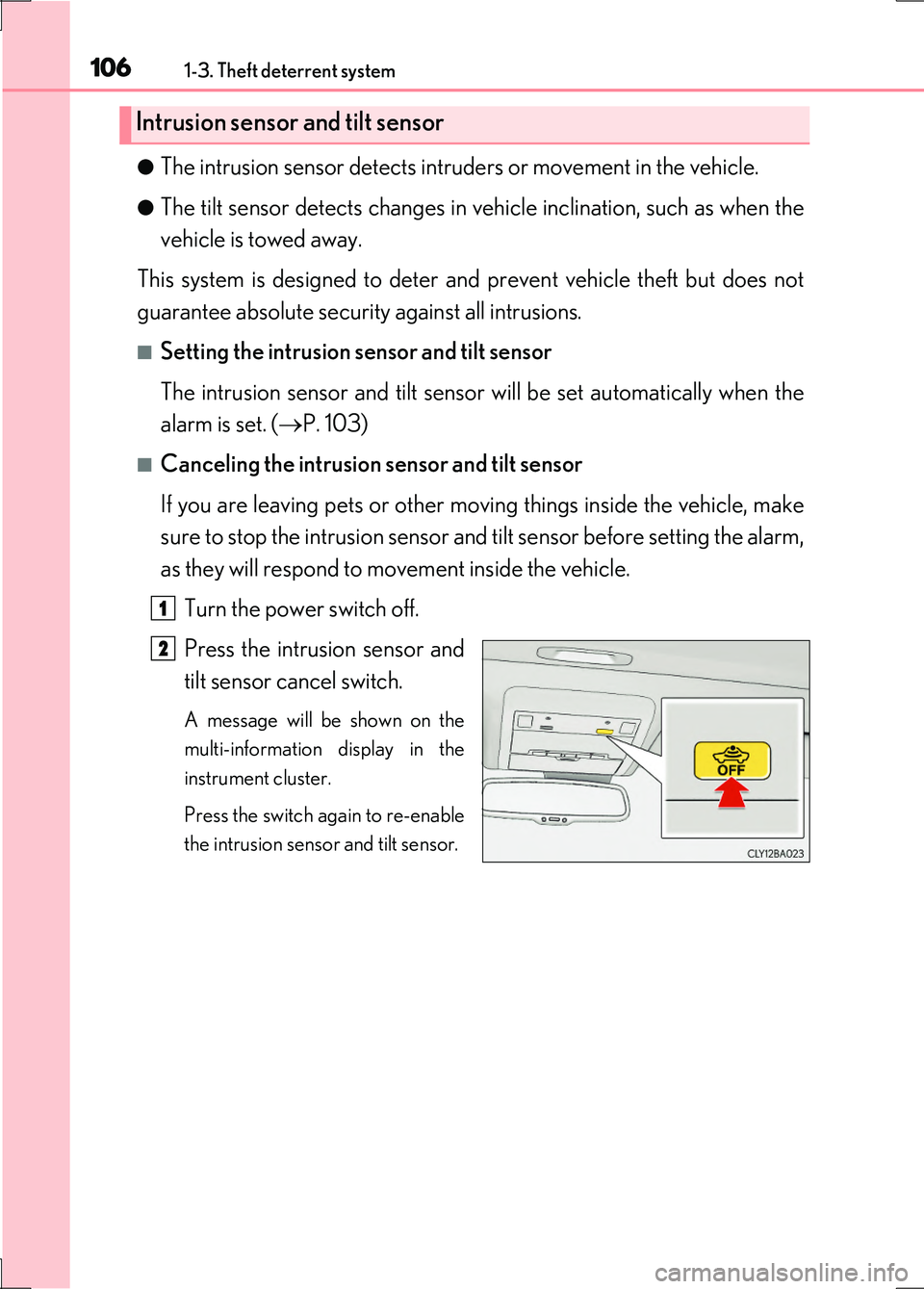
Turn the power switch off.
Press the intrusion sensor and
tilt sensor cancel switch.
A message will be shown on the
multi-information display in the
instrument cluster.
Press the switch again to re-enable
the intrusion sensor and tilt sensor.
Intrusion sensor and tilt sensor
1
2
Page 159 of 676
1593-2. Opening, closing and locking the doors and trunk
3
Operation of each component
LS600h/LS600hL_EE(OM50G20E)
■Conditions affecting operation
The smart entry & start system uses weak radio waves. In the following situations, the
communication between the electronic key and the vehicle may be affected, pre-
venting the smart entry & start system, wi reless remote control and immobilizer sys-
tem from operating properly. (Ways of coping: P. 603)
●When the electronic key battery is depleted
●Near a TV tower, electric power plant, gas station, radio station, large display, air-
port or other facility that generates strong radio waves or electrical noise
●When carrying a portable radio, cellular phone, cordless phone or other wireless
communication device
●When the electronic key is in contact with, or is covered by the following metallic
objects
• Cards to which aluminum foil is attached
• Cigarette boxes that have aluminum foil inside
• Metallic wallets or bags
•Coins
• Hand warmers made of metal
• Media such as CDs and DVDs
●When multiple electronic keys are in the vicinity
●When other wireless keys (that emit radio waves) are being used nearby
●When carrying the electronic key together with the following devices that emit
radio waves
• Another vehicle’s electronic key or a wireless key that emits radio waves
• Personal computers or personal digital assistants (PDAs)
• Digital audio players
• Portable game systems
●If window tint with a metallic content or metallic objects are attached to the rear
window
Page 193 of 676
1933-3. Adjusting the seats
3
Operation of each component
LS600h/LS600hL_EE(OM50G20E)
CAUTION
■When using the front passenger ottoman (if equipped)
●Do not operate the front passenger ottoman when the vehicle is moving.
Failure to do so may cause death or serious injury in the event of sudden braking
or a collision.
●Do not sit on the front passenge r ottoman of the passenger seat.
Doing so may cause seat belts to be worn improperly, which may lead to serious
injury or death in the event of sudden braking or a collision.
●Do not step on the front passenger ottoman.
Doing so could damage the front passenge r ottoman, or could cause you to seri-
ously injure yourself by falling over.
●Stow the front passenger ottoman when yo u get in or out of the vehicle or when
the front passenger ottoman is not in use to avoid stumbling over it.
●Do not allow anyone to put their hands or feet under the passenger seat when
stowing the front passenger ottoman.
NOTICE
■Operating the front passenger’s seat from the driver’s seat or rear seat
Before operating the front passenger’s seat, make sure that there is no luggage or
any other objects on the seat or in the footwell that could prevent its operation.
Such items may result in excess force being applied, causing damage to the seat
and/or the luggage.
■To prevent a front passenger ottoman malfunction (if equipped)
●Do not place any objects in the front passenger footwell that could prevent the
operation of the front passenger ottoman.
●Do not place heavy luggage on the front passenger ottoman.
●Do not place anything under the front passenger ottoman when in use.
There is a possibility that something may get caught and cause damages when
stowing the front passenger ottoman.
Page 205 of 676
2053-3. Adjusting the seats
3
Operation of each component
LS600h/LS600hL_EE(OM50G20E)
CAUTION
■Power rear seats
●Seat adjustment
To reduce the risk of sliding under the lap belt during a collision, do not recline the
seat more than necessary.
If the seat is too reclined, the lap belt may slide past the hips and apply restraint
forces directly to the abdomen, or yo ur neck may contact the shoulder belt,
increasing the risk of death or serious injury in the event of an accident.
Adjustments should not be made while driving as the seat may unexpectedly
move and cause the driver to lose control of the vehicle.
●When adjusting the seat position and ottoman angle (vehicles with relaxation
seat)
Keep sufficient footwell space to prevent your feet from being caught by the front
seat.
●When returning the rear seats to the neutral position
To avoid injuring the rear passengers, wait until they have gotten out of the vehicle
before operating the switch.
●Using the ottoman (vehicles with relaxation seat)
• Do not sit on the ottoman.
If someone sits on the ottoman, the seat belt cannot be fitted properly, and
they may be thrown from the seat, resulting in death or serious injury in the
event of an accident or sudden braking.
• When getting in or out of the vehicle, retract the ottoman. If the ottoman is not
retracted, it may cause a fall, resulting in injury.
• Do not operate the ottoman when the vehicle is moving.
• Do not allow anyone to put their hands or feet under the passenger seat when
stowing the ottoman.
■Using the pelvic support seat with seat vibrator and rear seat relaxation system
●Those who are pregnant, have recently given birth, or suffer from ailments requir-
ing rest (heart disease etc.) should consult a doctor before use.
●Do not allow children to use the pelvic support seat vibration function or the rear
seat relaxation function.
●Do not use immediately after consuming a meal or alcohol, or for an extended
period of time.
●If you feel sick while using the pelvic support seat vibration function or the rear
seat relaxation function, immediately discontinue use.
Page 208 of 676
2083-3. Adjusting the seats
LS600h/LS600hL_EE(OM50G20E)
■Recall procedure
Check that the shift lever is in P.
Turn the power switch to ON mode.
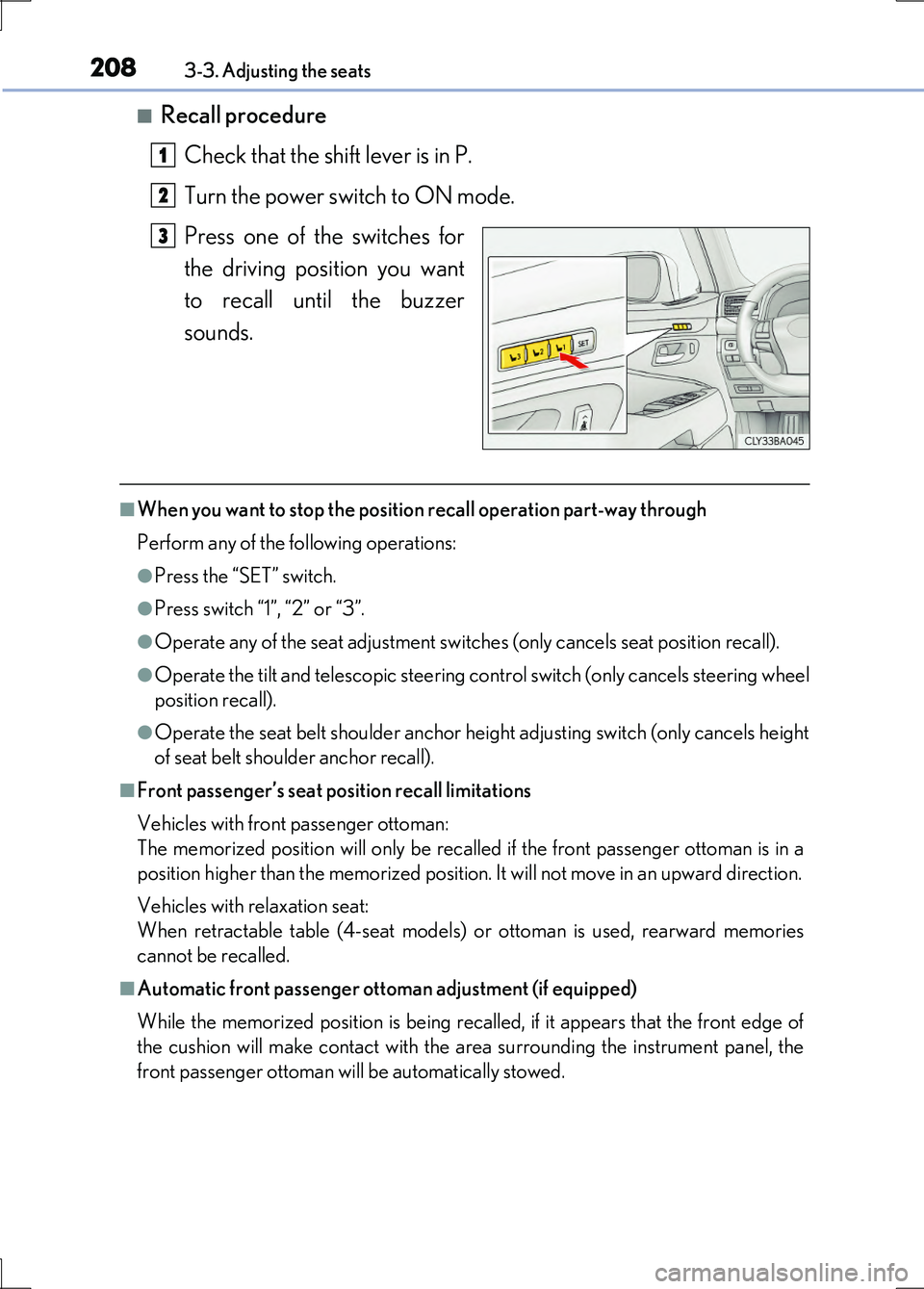
Press one of the switches for
the driving position you want
to recall until the buzzer
sounds.
■When you want to stop the position recall operation part-way through
Perform any of the following operations:
●Press the “SET” switch.
●Press switch “1”, “2” or “3”.
●Operate any of the seat adjustment switches (only cancels seat position recall).
●Operate the tilt and telescopic steering control switch (only cancels steering wheel
position recall).
●Operate the seat belt shoulder anchor height adjusting switch (only cancels height
of seat belt shoulder anchor recall).
■Front passenger’s seat position recall limitations
Vehicles with front passenger ottoman:
The memorized position will only be recalled if the front passenger ottoman is in a
position higher than the memorized position. It will not move in an upward direction.
Vehicles with relaxation seat:
When retractable table (4-seat models) or ottoman is used, rearward memories
cannot be recalled.
■Automatic front passenger ottoman adjustment (if equipped)
While the memorized position is being recalled, if it appears that the front edge of
the cushion will make contact with the area surrounding the instrument panel, the
front passenger ottoman will be automatically stowed.
1
2
3
Page 216 of 676
2163-3. Adjusting the seats
LS600h/LS600hL_EE(OM50G20E)
■Removing the head restraints
For removal and installation of the head restraint, ask any authorized Lexus dealer or
repairer, or another duly qualified and equipped professional.
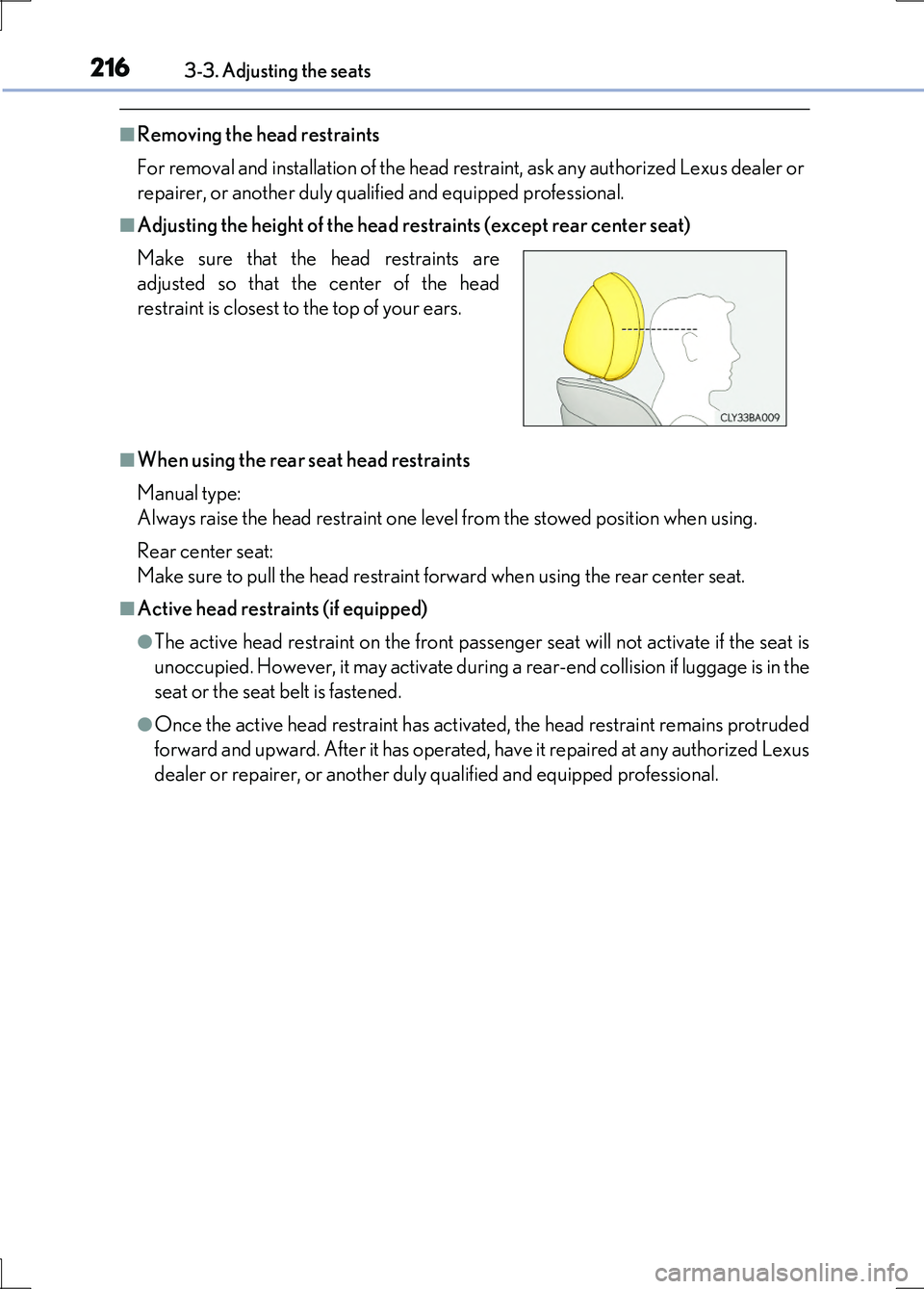
■Adjusting the height of the head restraints (except rear center seat)
■When using the rear seat head restraints
Manual type:
Always raise the head restraint one level from the stowed position when using.
Rear center seat:
Make sure to pull the head restraint forward when using the rear center seat.
■Active head restraints (if equipped)
●The active head restraint on the front passenger seat will not activate if the seat is
unoccupied. However, it may activate during a rear-end collision if luggage is in the
seat or the seat belt is fastened.
●Once the active head restraint has activated, the head restraint remains protruded
forward and upward. After it has operated, have it repaired at any authorized Lexus
dealer or repairer, or another duly qualified and equipped professional.
Make sure that the head restraints are
adjusted so that the center of the head
restraint is closest to the top of your ears.
Page 218 of 676
218
LS600h/LS600hL_EE(OM50G20E)
3-4. Adjusting the steering wheel and mirrors
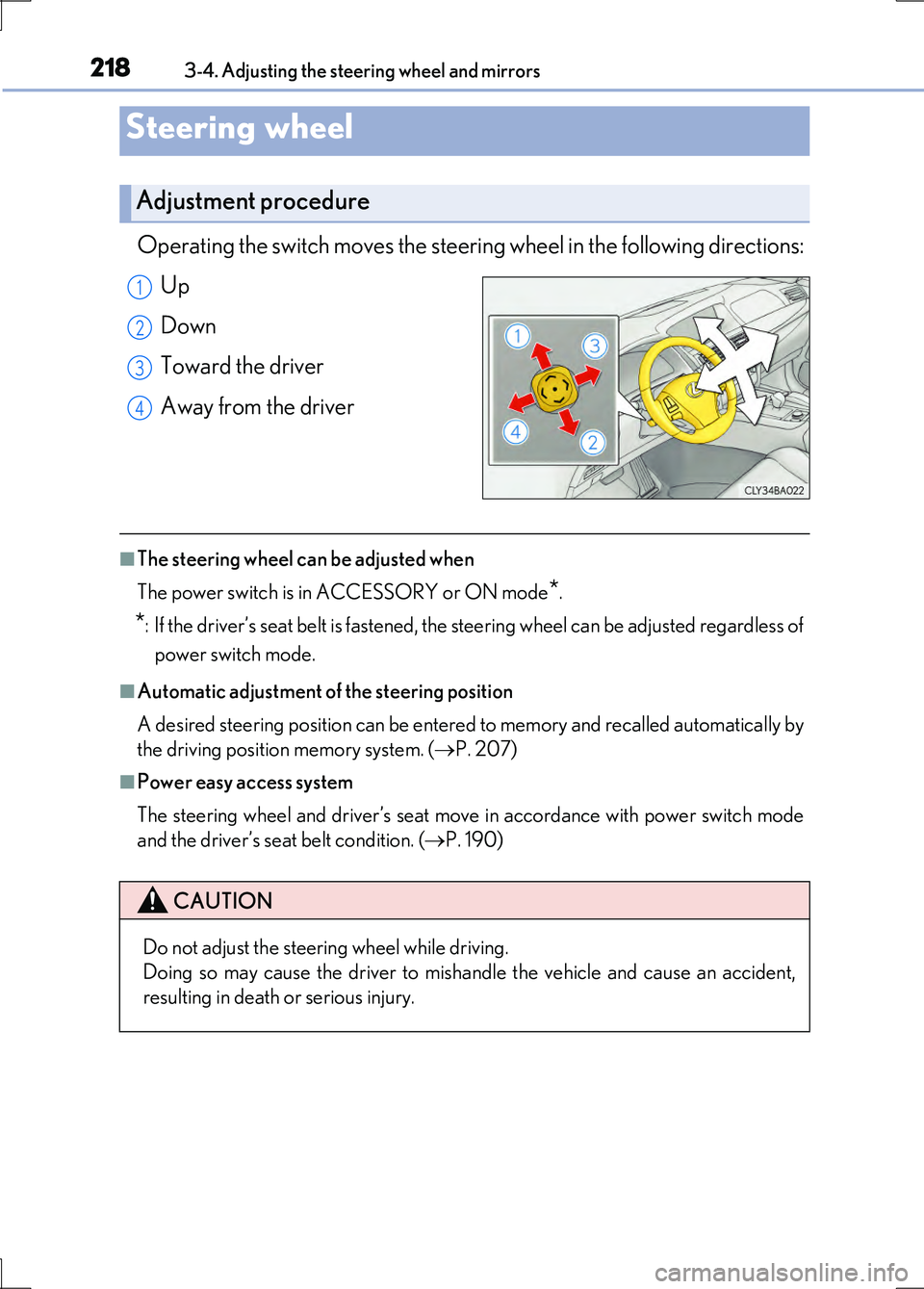
Operating the switch moves the steering wheel in the following directions:
Up
Down
Toward the driver
Away from the driver
■The steering wheel can be adjusted when
The power switch is in ACCESSORY or ON mode*.
*: If the driver’s seat belt is fastened, the steering wheel can be adjusted regardless of
power switch mode.
■Automatic adjustment of the steering position
A desired steering position can be entered to memory and recalled automatically by
the driving position memory system. ( P. 207)
■Power easy access system
The steering wheel and driver’s seat move in accordance with power switch mode
and the driver’s seat belt condition. ( P. 190)
Steering wheel
Adjustment procedure
1
2
3
4
CAUTION
Do not adjust the steering wheel while driving.
Doing so may cause the driver to mishandle the vehicle and cause an accident,
resulting in death or serious injury.
Page 223 of 676
2233-4. Adjusting the steering wheel and mirrors
3
Operation of each component
LS600h/LS600hL_EE(OM50G20E)
When the mirror select switch is in the “L” or “R” position, the outside rear
view mirrors will automatically angle downwards when the vehicle is
reversing in order to give a better view of the ground.
To disable this function, move the mirror select switch to the neutral posi-
tion (between “L” and “R”).
■Adjusting the mirror angle when the vehicle is reversing
With the shift lever in R, adjust the mirror angle at a desired position.
The adjusted angle will be memorized and the mirror will automatically tilt to
the memorized angle whenever the shift lever is shifted to R from next time.
The memorized downward tilt position of the mirror is linked to the normal
position (angle adjusted with the shift lever in other than R). Therefore, if the
normal position is changed after adjustment, the tilt position will also change.
When the normal position is changed, readjust the angle in reversing.
■Mirror angle can be adjusted when
The power switch is in ACCESSORY or ON mode.
■When the mirrors are fogged up
The outside rear view mirrors can be cleared using the mirror defoggers. Turn on the
rear window defogger to turn on the outside rear view mirror defoggers. ( P. 425)
■Automatic adjustment of the mirror angle
A desired mirror face angle can be entered to memory and recalled automatically
by the driving position memory. ( P. 207)
■Auto anti-glare function
When the anti-glare inside rear view mirror is set to automatic mode, the outside
rear view mirrors will activate in conjunction with the anti-glare inside rear view mir-
ror to reduce reflected light. ( P. 219)
■Using automatic mode in cold weather
When automatic mode is used in cold weather, the door mirror could freeze up and
automatic stowing and return may not be possible. In this event, remove any ice and
snow from the door mirror, then either operate the mirror using manual mode or
move the mirror by hand.
Linked mirror function when reversing
Page 233 of 676
233
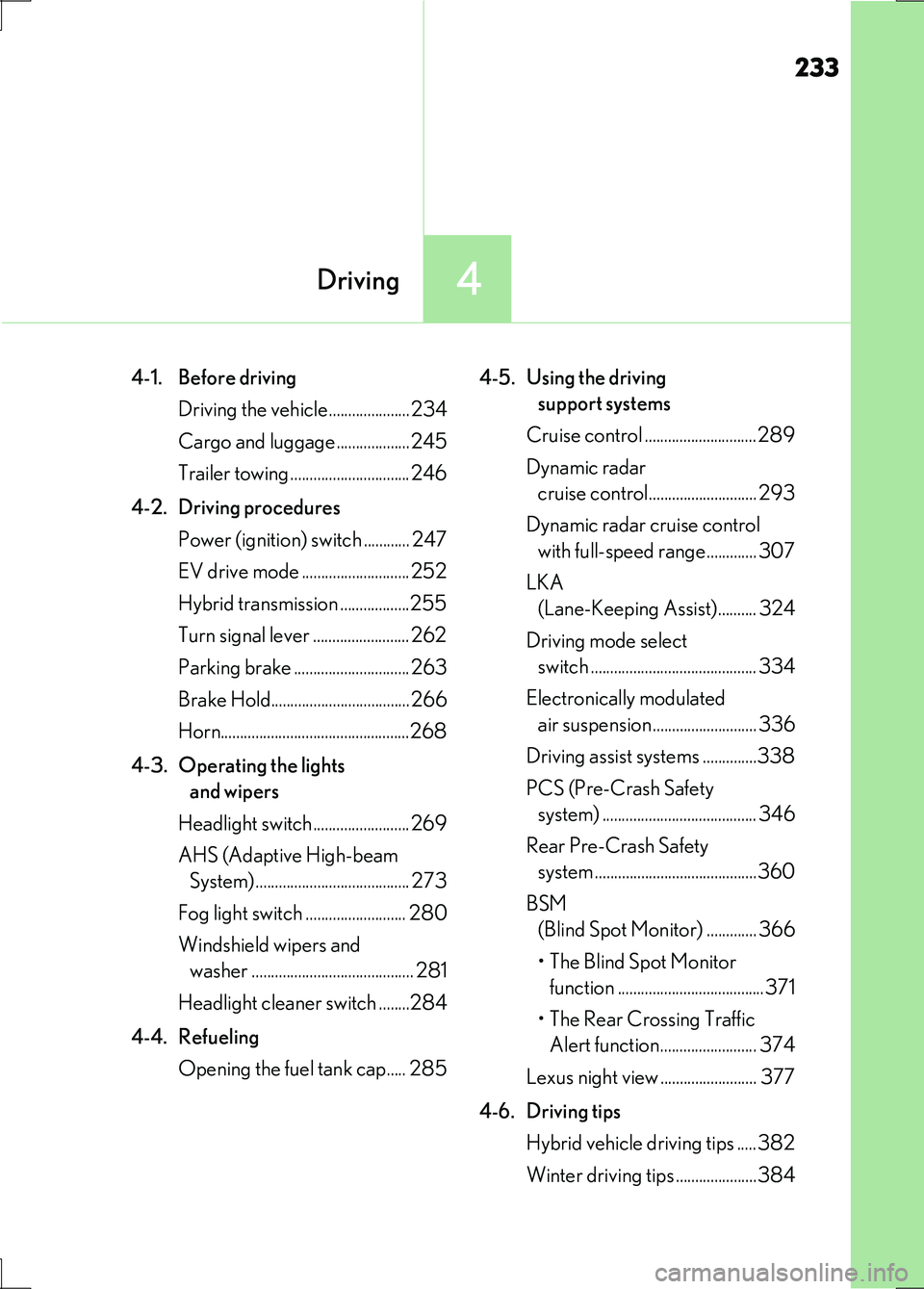
4Driving
LS600h/LS600hL_EE(OM50G20E)
4-1. Before driving
Driving the vehicle..................... 234
Cargo and luggage ...................245
Trailer towing ............................... 246
4-2. Driving procedures
Power (ignition) switch ............ 247
EV drive mode ............................ 252
Hybrid transmission ..................255
Turn signal lever ......................... 262
Parking brake .............................. 263
Brake Hold.................................... 266
Horn.................................................268
4-3. Operating the lights
and wipers
Headlight switch ......................... 269
AHS (Adaptive High-beam
System)........................................ 273
Fog light switch .......................... 280
Windshield wipers and
washer .......................................... 281
Headlight cleaner switch ........284
4-4. Refueling
Opening the fuel tank cap..... 285
4-5. Using the driving
support systems
Cruise control .............................289
Dynamic radar
cruise control............................ 293
Dynamic radar cruise control
with full-speed range............. 307
LKA
(Lane-Keeping Assist).......... 324
Driving mode select
switch ........................................... 334
Electronically modulated
air suspension ........................... 336
Driving assist systems ..............338
PCS (Pre-Crash Safety
system) ........................................ 346
Rear Pre-Crash Safety
system ..........................................360
BSM
(Blind Spot Monitor) ............. 366
•The Blind Spot Monitor
function ......................................371
• The Rear Crossing Traffic
Alert function......................... 374
Lexus night view ......................... 377
4-6. Driving tips
Hybrid vehicle driving tips .....382
Winter driving tips .....................384
Page 245 of 676
2454-1. Before driving
4
Driving
LS600h/LS600hL_EE(OM50G20E)
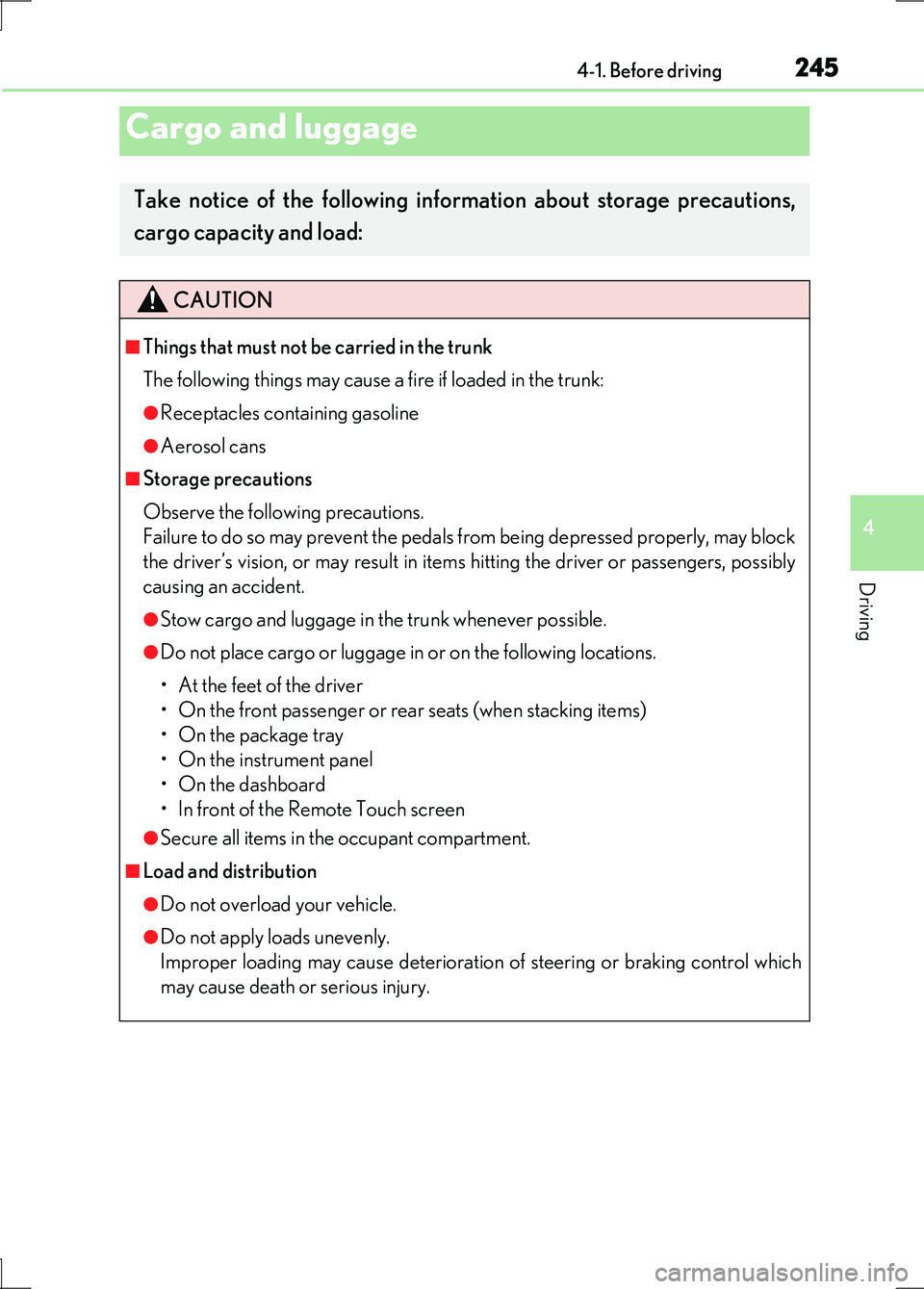
Cargo and luggage
Take notice of the following information about storage precautions,
cargo capacity and load:
CAUTION
■Things that must not be carried in the trunk
The following things may cause a fire if loaded in the trunk:
●Receptacles containing gasoline
●Aerosol cans
■Storage precautions
Observe the following precautions.
Failure to do so may prevent the pedals from being depressed properly, may block
the driver’s vision, or may result in items hitting the driver or passengers, possibly
causing an accident.
●Stow cargo and luggage in the trunk whenever possible.
●Do not place cargo or luggage in or on the following locations.
• At the feet of the driver
• On the front passenger or rear seats (when stacking items)
• On the package tray
• On the instrument panel
• On the dashboard
• In front of the Remote Touch screen
●Secure all items in the occupant compartment.
■Load and distribution
●Do not overload your vehicle.
●Do not apply loads unevenly.
Improper loading may cause deterioration of steering or braking control which
may cause death or serious injury.