engine LEXUS LS600H 2017 Owner's Manual
[x] Cancel search | Manufacturer: LEXUS, Model Year: 2017, Model line: LS600H, Model: LEXUS LS600H 2017Pages: 676, PDF Size: 35.25 MB
Page 254 of 676

2544-2. Driving procedures
LS600h/LS600hL_EE(OM50G20E)
CAUTION
■Caution while driving
When driving in EV drive mode, pay special attention to the area around the vehi-
cle. Because there is no engine noise, pedestrians, people riding bicycles or other
people and vehicles in the area may not be aware of the vehicle starting off or
approaching them, so take extra care while driving.
Page 255 of 676
2554-2. Driving procedures
4
Driving
LS600h/LS600hL_EE(OM50G20E)
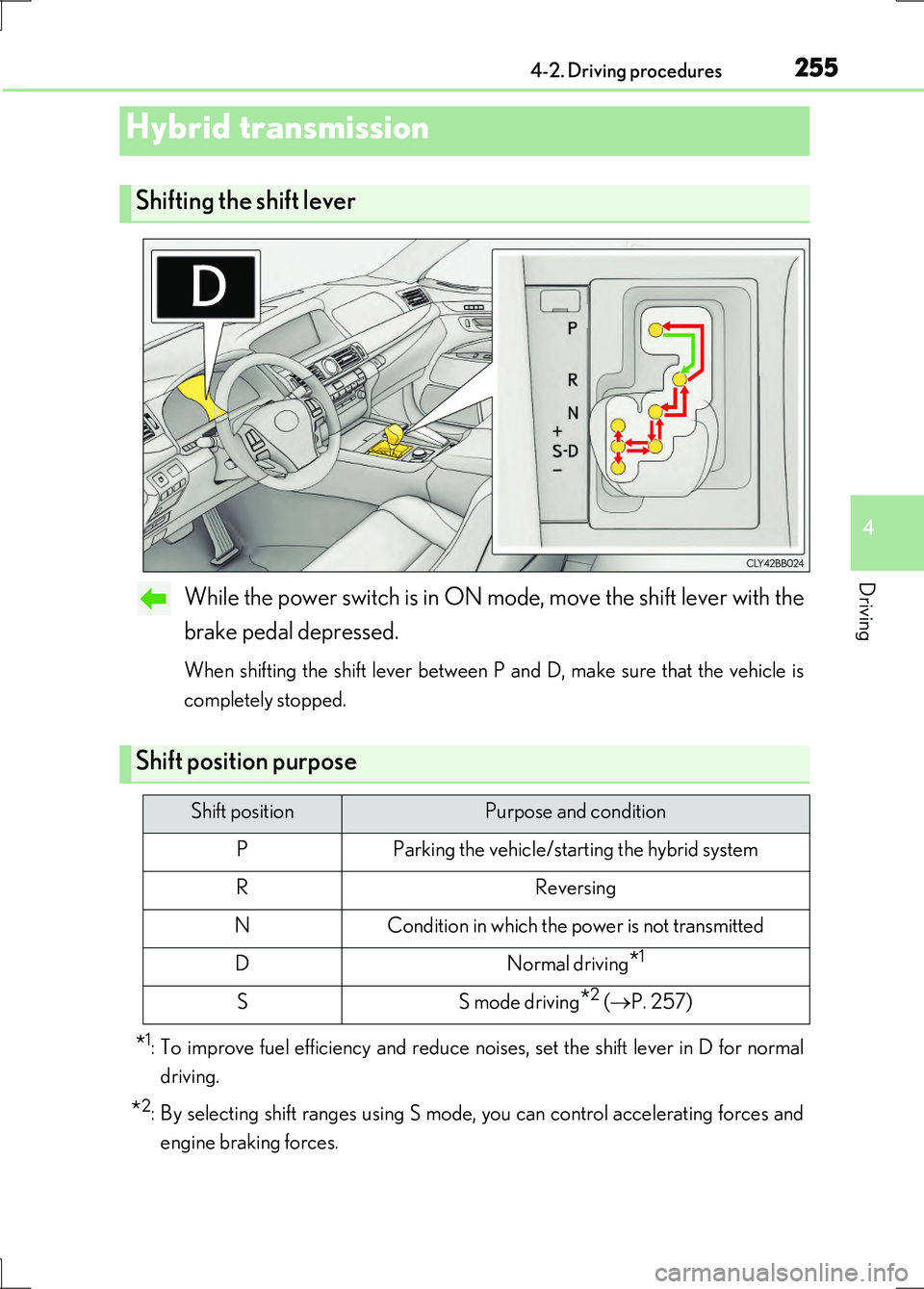
While the power switch is in ON mode, move the shift lever with the
brake pedal depressed.
When shifting the shift lever between P and D, make sure that the vehicle is
completely stopped.
*1: To improve fuel efficiency and reduce noises, set the shift lever in D for normal
driving.
*2: By selecting shift ranges using S mode, you can control accelerating forces and
engine braking forces.
Hybrid transmission
Shifting the shift lever
Shift position purpose
Shift positionPurpose and condition
PParking the vehicle/starting the hybrid system
RReversing
NCondition in which the power is not transmitted
DNormal driving*1
SS mode driving*2 ( P. 257)
Page 256 of 676
2564-2. Driving procedures
LS600h/LS600hL_EE(OM50G20E)
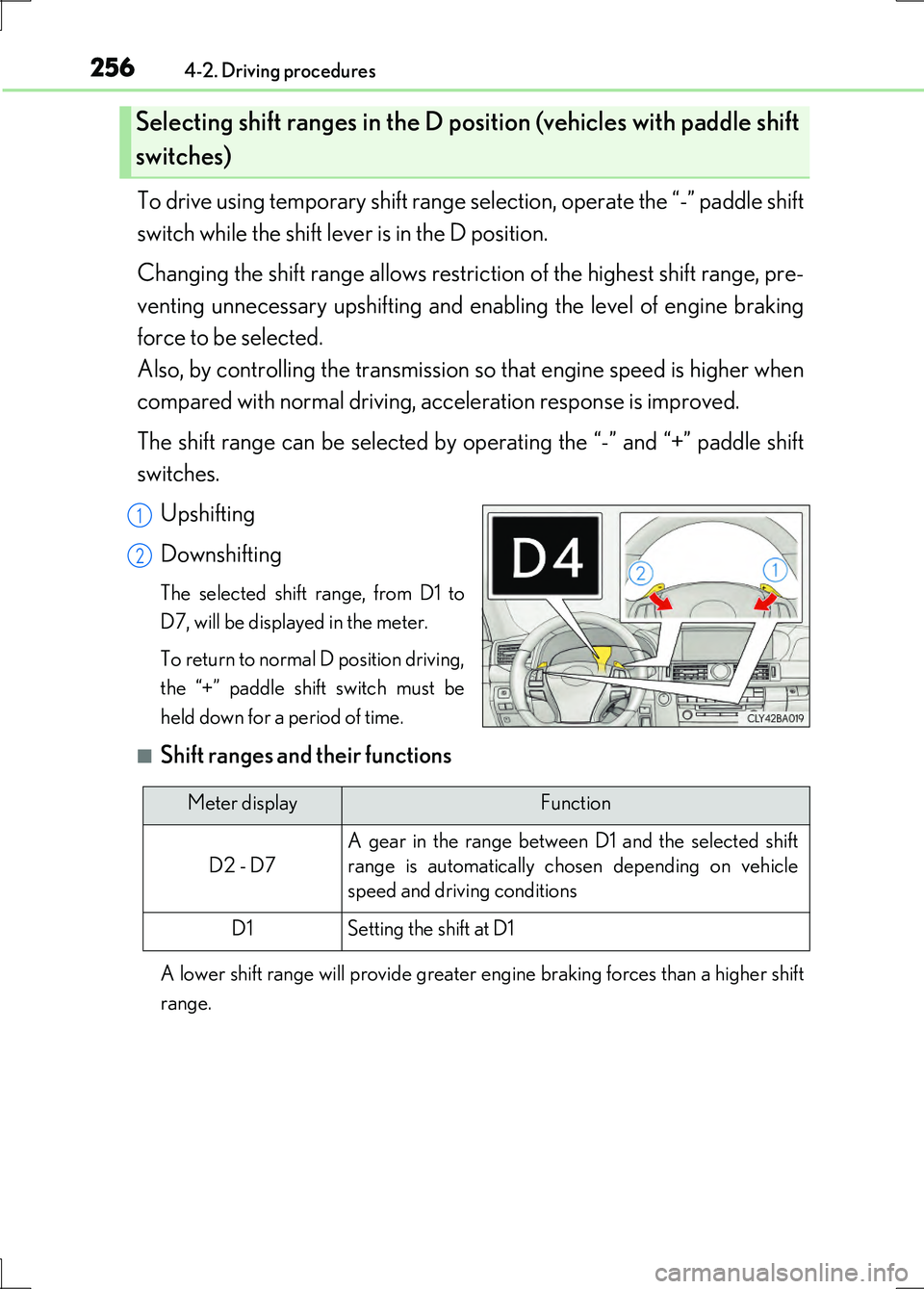
To drive using temporary shift range selection, operate the “-” paddle shift
switch while the shift lever is in the D position.
Changing the shift range allows restri ction of the highest shift range, pre-
venting unnecessary upshifting and en abling the level of engine braking
force to be selected.
Also, by controlling the transmission so that engine speed is higher when
compared with normal driving, acceleration response is improved.
The shift range can be selected by operating the “-” and “+” paddle shift
switches.
Upshifting
Downshifting
The selected shift range, from D1 to
D7, will be displayed in the meter.
To return to normal D position driving,
the “+” paddle shift switch must be
held down for a period of time.
■Shift ranges and their functions
A lower shift range will provide greater engine braking forces than a higher shift
range.
Selecting shift ranges in the D position (vehicles with paddle shift
switches)
1
2
Meter displayFunction
D2 - D7
A gear in the range between D1 and the selected shift
range is automatically chosen depending on vehicle
speed and driving conditions
D1Setting the shift at D1
Page 257 of 676
2574-2. Driving procedures
4
Driving
LS600h/LS600hL_EE(OM50G20E)
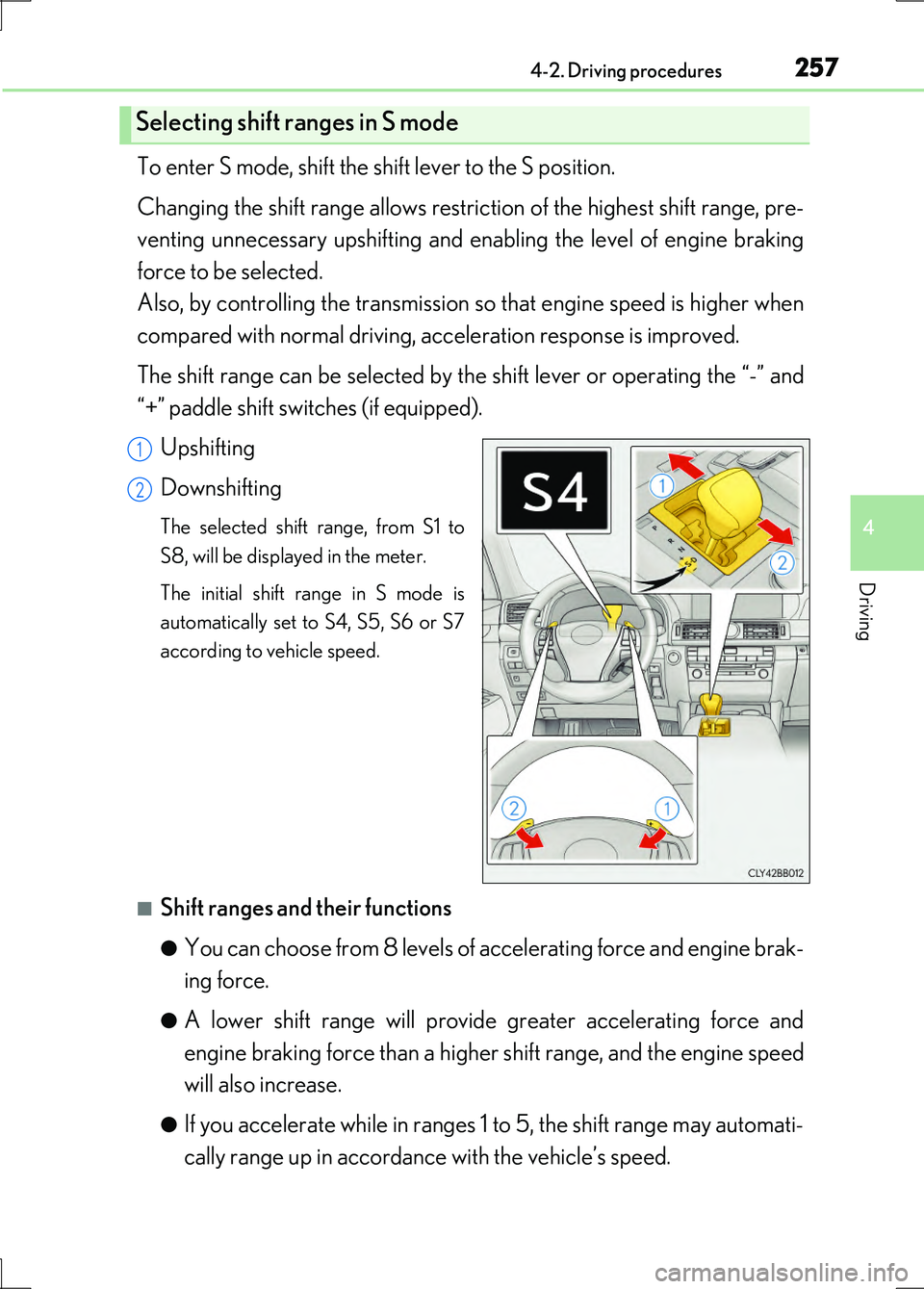
To enter S mode, shift the shift lever to the S position.
Changing the shift range allows restri ction of the highest shift range, pre-
venting unnecessary upshifting and en abling the level of engine braking
force to be selected.
Also, by controlling the transmission so that engine speed is higher when
compared with normal driving, acceleration response is improved.
The shift range can be selected by the shift lever or operating the “-” and
“+” paddle shift switches (if equipped).
Upshifting
Downshifting
The selected shift range, from S1 to
S8, will be displayed in the meter.
The initial shift range in S mode is
automatically set to S4, S5, S6 or S7
according to vehicle speed.
■Shift ranges and their functions
●You can choose from 8 levels of accelerating force and engine brak-
ing force.
●A lower shift range will provide greater accelerating force and
engine braking force than a higher shift range, and the engine speed
will also increase.
●If you accelerate while in ranges 1 to 5, the shift range may automati-
cally range up in accordance with the vehicle’s speed.
Selecting shift ranges in S mode
1
2
Page 258 of 676
2584-2. Driving procedures
LS600h/LS600hL_EE(OM50G20E)
■Sport mode/Comfort mode/Eco drive mode
P. 334
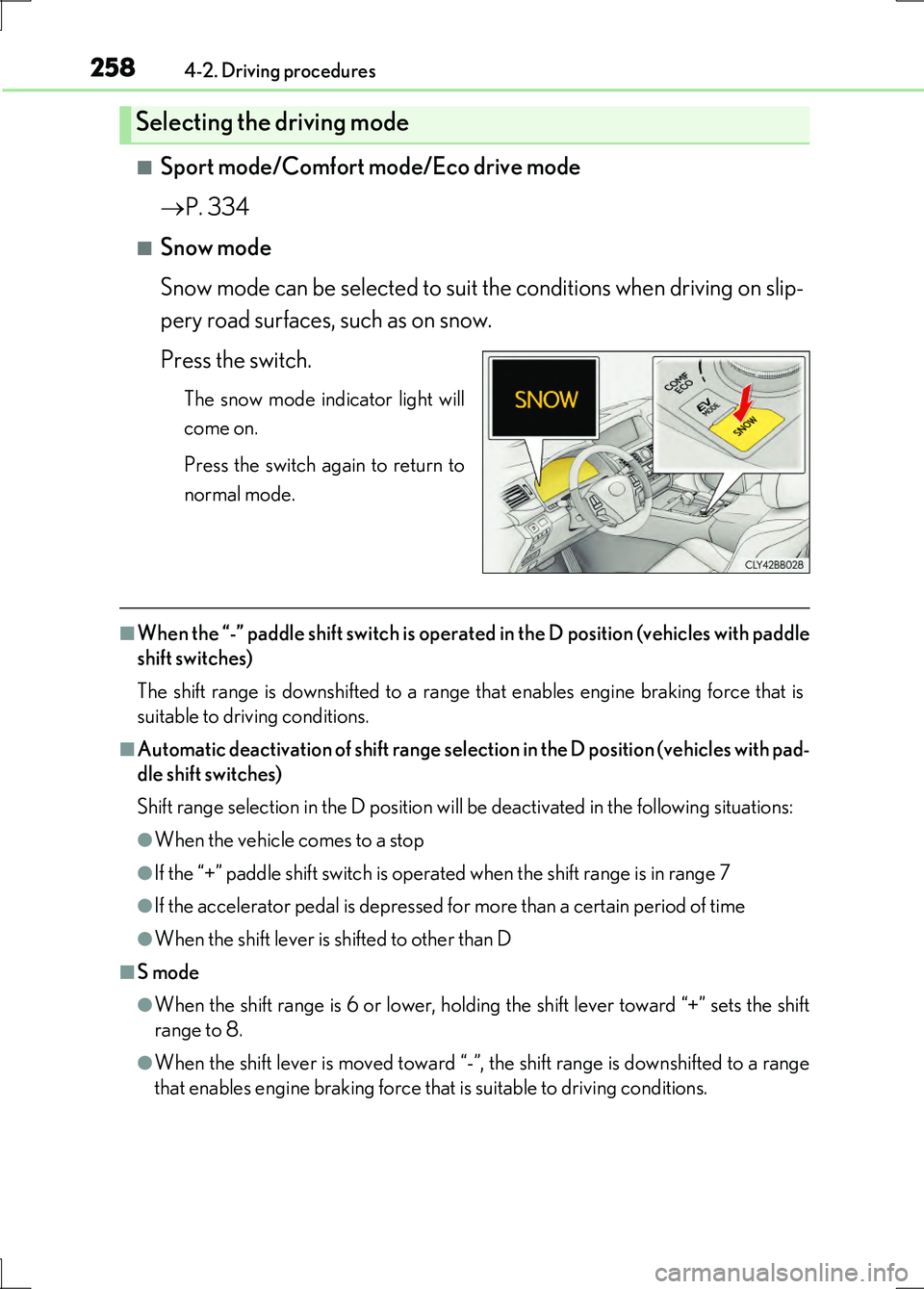
■Snow mode
Snow mode can be selected to suit the conditions when driving on slip-
pery road surfaces, such as on snow.
Press the switch.
The snow mode indicator light will
come on.
Press the switch again to return to
normal mode.
■When the “-” paddle shift switch is operated in the D position (vehicles with paddle
shift switches)
The shift range is downshifted to a range that enables engine braking force that is
suitable to driving conditions.
■Automatic deactivation of shift range select ion in the D position (vehicles with pad-
dle shift switches)
Shift range selection in the D position will be deactivated in the following situations:
●When the vehicle comes to a stop
●If the “+” paddle shift switch is operated when the shift range is in range 7
●If the accelerator pedal is depressed for more than a certain period of time
●When the shift lever is shifted to other than D
■S mode
●When the shift range is 6 or lower, holdin g the shift lever toward “+” sets the shift
range to 8.
●When the shift lever is moved toward “-”, the shift range is downshifted to a range
that enables engine braking force that is suitable to driving conditions.
Selecting the driving mode
Page 259 of 676
2594-2. Driving procedures
4
Driving
LS600h/LS600hL_EE(OM50G20E)
■Downshifting restrictions warning buzzer
To help ensure safety and driving performance, downshifting operation may some-
times be restricted. In some circumstances, downshifting may not be possible even
when the shift lever or paddle shift switch (if equipped) is operated. (A buzzer will
sound twice.)
■When driving with cruise control, dynamic radar cruise control or dynamic radar
cruise control with full speed range activated
Even when performing the following actions with the intent of enabling engine brak-
ing, engine braking will not activate because cruise control, dynamic radar cruise
control or dynamic radar cruise control with full speed range will not be canceled.
●While driving in D or S mode, downshifting to 7, 6, 5 or 4. ( P. 289, 293, 307)
●When switching the driving mode to sport mode while driving in D position.
( P. 334)
■Snow mode automatic deactivation
Snow mode is automatically deactivated if th e power switch is turned off after driving
in snow mode.
■Shift lock system
The shift lock system is a system to prevent accidental operation of the shift lever in
starting.
The shift lever can be shifted from P only when the power switch is in ON mode and
the brake pedal is being depressed.
■If the shift lever cannot be shifted from P
First, check whether the brake pedal is being depressed.
If the shift lever cannot be shifted with your foot on the brake pedal, there may be a
problem with the shift lock system. Have the vehicle inspected by any authorized
Lexus dealer or repairer, or another duly qualified and equipped professional imme-
diately.
The following steps may be used as an emergency measure to ensure that the shift
lever can be shifted.
Releasing the shift lock:
Turn the power switch to ON mode ( P. 248) and check that the parking brake is
set.
Turn the power switch off.
Depress the brake pedal.
1
2
3
Page 261 of 676
2614-2. Driving procedures
4
Driving
LS600h/LS600hL_EE(OM50G20E)
CAUTION
■When driving on slippery road surfaces
Be careful of downshifting and sudden acceleration, as this could result in the vehi-
cle skidding to the side or spinning.
■To prevent an accident when releasing the shift lock
Before pressing the shift lock override button, make sure to set the parking brake
and depress the brake pedal.
If the accelerator pedal is accidentally depressed instead of the brake pedal when
the shift lock override button is pressed and the shift lever is shifted out of P, the
vehicle may suddenly start, possibly leading to an accident resulting in death or
serious injury.
NOTICE
■Hybrid battery (traction battery) charge
If the shift lever is in N, the hybrid battery (traction battery) will not be charged
even when the engine is running. Therefore, if the vehicle is left with the shift lever
in N for a long period of time, the hybrid battery (traction battery) will discharge,
and this may result in the vehicle not being able to start.
Page 342 of 676
3424-5. Using the driving support systems
LS600h/LS600hL_EE(OM50G20E)
■Hill-start assist control is operational when
●The system has detected that the vehicle is moving backward.
●The shift lever is in the D or S position.
●The brake pedal is not depressed.
■VGRS is disabled when
VGRS may stop operating in the following situations.
In this event, the steering wheel may move from its straight forward position, but it
will return when the system restarts.
●When the steering wheel is operated for an extended period of time while the vehi-
cle is stopped or is moving very slowly
●When the steering wheel has been held fully to the left or right
●When the 12-volt battery is low or the voltage temporarily drops
The center position of the steering wheel may change when VGRS is disabled. How-
ever, the position will return to normal after VGRS is reactivated.
■Sounds and vibrations caused by the ABS, brake assist, TRC, VSC, hill-start assist
control and VGRS systems
●A sound may be heard from the engine compartment when the brake pedal is
depressed repeatedly, when the hybrid system is started or just after the vehicle
begins to move. This sound does not indicate that a malfunction has occurred in
any of these systems.
●Any of the following conditions may occur when the above systems are operating.
None of these indicates that a malfunction has occurred.
• Vibrations may be felt through the vehicle body and steering.
• A motor sound may be heard after the vehicle comes to a stop.
●The steering wheel may be moved slightly or a sound may be heard when the
hybrid system is started or stopped. None of these indicate that a malfunction has
occurred.
■EPS operation sound
When the steering wheel is operated, a motor sound (whirring sound) may be heard.
This does not indicate a malfunction.
■Reactivation of the TRC/VSC systems
Even after the TRC/VSC systems have been turned off, turning the hybrid system off
and then on again will automatically reactivate the TRC/VSC systems.
Page 383 of 676
3834-6. Driving tips
4
Driving
LS600h/LS600hL_EE(OM50G20E)
■Air conditioning
Use the air conditioning only when necessary. Doing so can help con-
trol excessive gasoline consumption.
In summer: In high temperatures, use the recirculated air mode. Doing
so will help to reduce the burden on the air conditioner and reduce fuel
consumption as well.
In winter: Because the gasoline engine will not automatically cut out
until the gasoline engine and the interior of the vehicle are warm, it will
consume fuel. Also, fuel consumption can be improved by avoiding
overuse of the heater.
■Checking tire inflation pressure
Make sure to check the tire inflation pressure frequently. Improper tire
inflation pressure can cause poor fuel consumption.
Also, as snow tires can cause large amounts of friction, their use on dry
roads can lead to poor fuel consumption. Use a tire that is appropriate
for the season.
■Luggage
Carrying heavy luggage can lead to poor fuel consumption. Avoid car-
rying unnecessary luggage. Installing a large roof rack can also cause
poor fuel consumption.
■Warming up before driving
Since the gasoline engine starts up and cuts out automatically when
cold, warming up the engine is unnecessary. Moreover, frequently driv-
ing short distances will cause the engi ne to repeatedly warm up, which
can lead to poor fuel consumption.
Page 384 of 676
3844-6. Driving tips
LS600h/LS600hL_EE(OM50G20E)
●Use fluids that are appropriate to the prevailing outside temperatures.
•Engine oil
• Engine/power control unit coolant
•Washer fluid
●Have a service technician inspect the condition of the 12-volt battery.
●Have the vehicle fitted with four snow tires or purchase a set of tire
chains for the rear tires.
Ensure that all tires are the specified size and brand, and that chains match the
size of the tires.
Winter driving tips
Carry out the necessary preparations and inspections before driving
the vehicle in winter. Always drive the vehicle in a manner appropriate
to the prevailing weather conditions.
Preparation for winter