engine oil LEXUS LX470 2007 User Guide
[x] Cancel search | Manufacturer: LEXUS, Model Year: 2007, Model line: LX470, Model: LEXUS LX470 2007Pages: 426, PDF Size: 10.95 MB
Page 296 of 426
278
4-3. Do-it-yourself maintenance
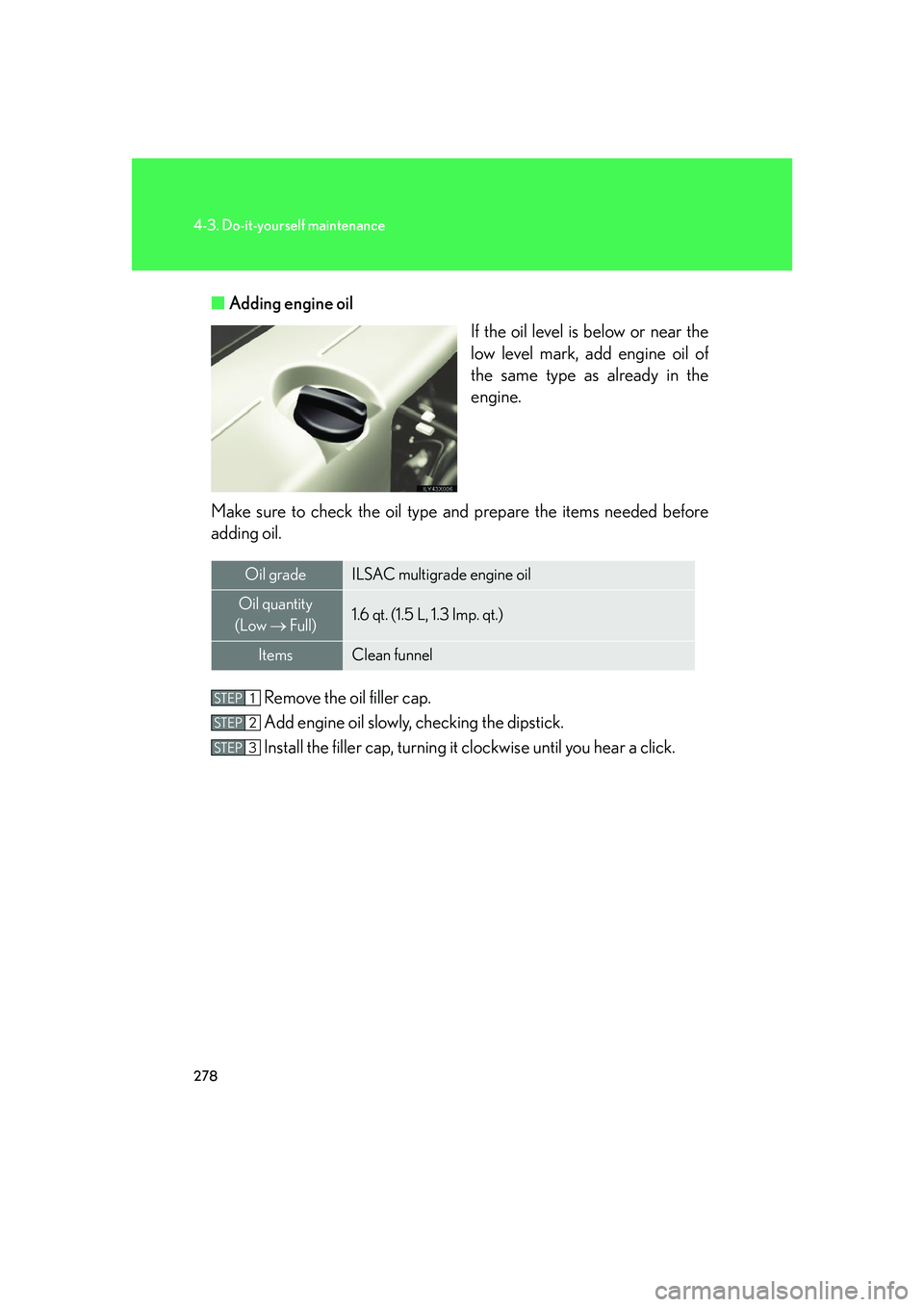
■Adding engine oil
If the oil level is below or near the
low level mark, add engine oil of
the same type as already in the
engine.
Make sure to check th e oil type and prepare the items needed before
adding oil.
Remove the oil filler cap.
Add engine oil slowly, checking the dipstick.
Install the filler cap, turning it clockwise until you hear a click.
Oil gradeILSAC multigrade engine oil
Oil quantity
(Low Full)1.6 qt. (1.5 L, 1.3 Imp. qt.)
ItemsClean funnel
STEP1
STEP2
STEP3
Page 298 of 426

280
4-3. Do-it-yourself maintenance
■Engine oil consumption
●The amount of engine oil consumed depends on the oil viscosity, the quality of
the oil and the way the vehicle is driven.
●More oil is consumed under driving conditions such as high speeds and fre-
quent acceleration and deceleration.
●A new engine consumes more oil.
●When judging the amount of oil consumpt ion, keep in mind that the oil may
have become diluted, making it difficult to judge the true level accurately.
●Oil consumption: Max. 1.1 qt./600 miles, 0.9 lmp.qt./600 miles (1.0 L per 1000
km). If the vehicle consumes more than this amount, contact your Lexus dealer.
■Resetting the engine oil main tenance data (U.S.A. only)
Perform the following steps:
Turn the ignition key to the “LOCK” position with the odometer reading
shown.
Turn the ignition key to the “ON” position with the “ODO/TRIP” knob
held down.
Keep pressing the knob for longer th an 7 seconds after the ignition key is
in “ON” position.
After the above operation, the engine oil replacement reminder light goes off.
If the system fails to reset, the light wi ll remain flashing. In this case, return to
and try again.
STEP1
STEP2
STEP3
STEP1
Page 299 of 426
281
4-3. Do-it-yourself maintenance
4
Maintenance and care
CAUTION
■Used engine oil
●Used engine oil contains potentially harmful contaminants which may cause skin
disorders such as inflammation or skin cancer, so care should be taken to avoid
prolonged and repeated contact. To remove used engine oil from your skin, wash
thoroughly with soap and water.
●Dispose of used oil and filters only in a safe and acceptable manner. Do not dis-
pose of used oil and filters in househol d trash, in sewers or onto the ground.
Call your Lexus dealer, service station or auto parts store for information con-
cerning recycling or disposal.
●Do not leave used engine oil within the reach of children.
NOTICE
■To prevent serious engine damage
Check the oil level on regular basis.
■When replacing the engine oil
●Be careful not to spill engine oil on the vehicle components.
●Avoid overfilling, or the engine could be damaged.
●Check the oil level on the dipstick every time you refill the vehicle.
●Be sure the engine oil filler cap is properly retightened.
Page 351 of 426

5
When trouble arises
333
5-1. Essential information
If you think something is wrong
If you notice any of the following symptoms, your vehicle probably needs
adjustment or repair. Contact your Lexus dealer as soon as possible.
■Visible symptoms
●Fluid leaks under the vehicle
(Water dripping from the air conditioning after use is normal.)
● Flat-looking tires or uneven tire wear
● Engine coolant temper ature gauge needle continually points
higher than normal
● Engine oil pressure gauge continually points lower than normal
● Voltmeter continually points higher or lower than normal
■ Audible symptoms
●Changes in exhaust sound
● Excessive tire squeal when cornering
● Strange noises related to the suspension system
● Pinging or other noises related to the engine
■ Operational symptoms
●Engine missing, stumbling or running rough
● Appreciable loss of power
● Vehicle pulls heavily to one side when braking
● Vehicle pulls heavily to one side when driving on a level road
● Loss of brake effectiveness, sp ongy feeling, pedal almost touches
the floor
Page 359 of 426

5
When trouble arises
341
5-2. Steps to take in an emergency
*: Driver's seat belt reminder buzzer:
The driver’s seat belt reminder sounds to alert the driver that his or her seat belt
is not fastened. The buzzer sounds for about 4 to 8 seconds, unless the driver
fastens the belt.
Engine oil replacement
reminder light
Illuminates for about 3 sec-
onds and then flashes for
about 12 seconds: Indicates
that the engine oil is scheduled
to be changed.
Check and the engine oil, and
change if necessary.
Comes on and remains on:
Indicates that the engine oil
should be changed.Check and change the engine
oil.
Page 361 of 426

5
When trouble arises
343
5-2. Steps to take in an emergency
■When the tire pressure warning light comes on
Check the tire inflation pressure and adjust to the appropriate level. Pushing the tire
pressure warning reset switch does not turn off the tire pressure warning light.
■The tire pressure warning light may come on due to natural causes
The tire pressure warning light may come on due to natural causes such as natural
air leaks or tire inflation pressure changes caused by temperature. In this case,
adjusting the tire inflation pressure will turn off the warning light.
■If the tire pressure warning system is inoperative
The tire pressure warning system may become inoperative in the following condi-
tions:
(When the condition becomes normal, the system will work properly.)
●If tires not equipped with tire pressure warning valves and transmitters are used.
●If the ID code on the tire pressure warning valves and transmitters is not regis-
tered.
●If electronic devices or facilities using similar radio wave frequencies are nearby.
●If a radio set at similar frequencies is in use in the vehicle.
●If a window tint that affects the radio wave signals is installed.
●If the tire pressure warning select switch is set to a different tire setting.
●If there is a lot of snow or ice on the vehicle, in particular around the wheels or
wheel housings.
●If non-genuine Lexus wheels are used.
●If tire chains are used.
●If the spare tire is in a location subject to poor radio wave signal reception.
●If the tire inflation pressure is 73 psi (500 kPa, 5.1 kgf/cm2 or bar) or higher.
■If the tire pressure warning light blinks
If the tire pressure warning light blinks when the ignition key is turned to the “ON”
position, have it checked by your Lexus dealer.
■Changing the engine oil (U.S.A. only)
Make sure to reset oil change system
Page 389 of 426

371
6-1. Specifications
6
Vehicle specifications
Lubrication system
*: 5W-30 is an oil that provides optimal levels of fuel efficiency.
Oil viscosity:
● The 5W portion of the oil viscosity rating indicates the characteristic of
the oil which allows cold startability . Oils with a lower value before the W
allow for easier starting of the engine in cold weather.
● The 30 in 5W-30 indicates the oil viscosity when the oil is as its operating
temperature. An oil with a higher viscosity may be better suited if the
vehicle is operated at high speeds, or under extreme load condition.
Oil capacity
(drain and refill)
with filter
without filter7.2 qt. (6.8 L, 6.0 lmp.qt.)
6.8 qt. (6.4 L, 5.6 lmp.qt.)
Oil gradeILSAC multigrade engine oil
Recommended oil
viscosity
Use Lexus approved “Toyota Genuine Motor Oil” or
equivalent to satisfy the above grade and viscosity.
Outside temperature
Page 392 of 426

374
6-1. Specifications
Automatic transmission
Tr a n s f e r
Brakes
*1: Minimum pedal clearance when depressed with a force of 110 lbf (490 N, 50kgf) while the engine is running.
*2: Parking brake pedal travel when pulled wi th a force of 44 lbf (196 N, 20 kgf).
Fluid capacity
Drain and refill
3.2 qt. (3.0 L, 2.6 lmp.qt.)
Fluid typeToyota Genuine ATF WS
NOTICE
Using transmission fluid other than “Toyota Genuine ATF WS” may cause deteriora-
tion in shift quality, locking up of your tr ansmission accompanied by vibration, and ulti-
mately damage the transm ission of your vehicle.
Oil capacity1.4 qt. (1.3 L, 1.1 lmp.qt.)
Oil typeHypoid gear oil API GL-4 or GL-5
Recommended oil viscositySAE75W-90
Pe d a l c l e a r a n c e *14.57 in. (116 mm) Min.
Pedal free play0.04 0.24 in. (1.0 6.0 mm)
Brake pad wear limit0.04 in. (1.0 mm)
Parking brake lining wear limit0.04 in. (1.0 mm)
Parking brake adjustment *24 6 clicks
Fluid typeSAE J1703 or FMVSS No. 116 DOT 3
Page 404 of 426

386
6-1. Specifications
Warning: The temperature grades for this tire are established for a tire that
is properly inflated and not overloaded.
Excessive speed, underinflation, or excessive loading, either separately or in
combination, can cause heat buildup and possible tire failure.
Glossary of tire terminology
Tire related termMeaning
Accessory weight
The combined weight (in excess of those standard
items which may be replaced) of automatic transmis-
sion, power steering, power brakes, power windows,
power seats, radio and heater, to the extent that these
items are available as factory-installed equipment
(whether installed or not)
Cold tire inflation pres-
sure
Tire inflation pressure when the vehicle has been
parked for three hours or more, or has not been
driven more than 1 mile or 1.5 km under that condi-
tion
Curb weight
The weight of a motor vehicle with standard equip-
ment, including the maximum capacity of fuel, oil and
coolant, and if so equipp ed, air conditioning and
additional weight optional engine
Maximum inflation pres-
sureThe maximum cold inflation pressure to which a tire
may be inflated, shown on the sidewall of the tire
Maximum loaded vehicle
weight
The sum of:
(a) Curb weight
(b) Accessory weight
(c) Vehicle capacity weight
(d) Production options weight
Normal occupant weight150 lb. (68 kg) times the number of occupants speci-
fied in the second column of Table 1
* that follows
Page 411 of 426

393
6
Vehicle specifications
6-3. Initialization
Items to initialize
ItemWhen to initializeReference
Moon roof• After reconnecting or changing the battery
• After changing a fuseP. 4 2
Variable gear ratio
steeringP. 1 4 4
Engine oil maintenance
data• After changing engine oilP. 2 8 0
Tire pressure warning
system
• When rotating the tires on vehicles differing with front and rear tire infla-
tion pressures.
• When changing the tire inflation pressure by changing traveling speed
or load weight, etc.
• When changing the tire size.
P. 2 9 4
The following items must be initialized for normal system operation in cases
such as after the battery is reconnected, or maintenance is performed on
the vehicle.