oil LEXUS LX470 2007 User Guide
[x] Cancel search | Manufacturer: LEXUS, Model Year: 2007, Model line: LX470, Model: LEXUS LX470 2007Pages: 426, PDF Size: 10.95 MB
Page 292 of 426

274
4-3. Do-it-yourself maintenance
CAUTION
The engine compartment contains many mechanisms and fluids that may move sud-
denly, become hot, or become electrically energized. To avoid death or serious injury.
■When working on the engine compartment
●Keep hands, clothing, and tools away from the moving fan and engine drive belt.
●Be careful not to touch the engine, inverter, radiator, exhaust manifold, etc. right
after driving as they may be hot. Oil and other fluids may also be hot.
●Do not leave anything that may burn easily, such as paper or rags, in the engine
compartment.
●Do not smoke, cause sparks or expose an open flame to fuel or the battery. Fuel
and battery fumes are flammable.
●Be extremely cautious when working on the battery. It contains poisonous and
corrosive sulfuric acid.
■When working near the electric cooling fan or radiator grille
Be sure the ignition is off. With the ignition in on, the electric cooling fan may auto-
matically start to run if the air conditioning is on and/or if the coolant temperature is
high.
( P. 2 8 3 )
■When working on or under the vehicle
●Do not get under the vehicle with just the jack supporting it.
Always use automotive jack stands or other solid supports.
●Use eye protection to prevent flying or falling material, fluid spray, etc. from get-
ting in your eyes.
NOTICE
■If you remove the air cleaner filter
Driving with the air cleaner filter removed may cause excessive engine wear due to
dirt in the air. Also a backfire could cause a fire in the engine compartment.
Page 294 of 426

276
4-3. Do-it-yourself maintenance
Engine compartment
Engine oil filler cap(P. 2 7 8 )
Engine oil level dipstick (P. 277)
Brake fluid reservoir (P. 2 8 4 )
Fuse box ( P. 311)
Battery ( P. 2 8 8 )Washer fluid tank
(P. 2 9 1 )
Condenser ( P. 283)
Radiator ( P. 283)
Engine coolant reservoir (P. 2 8 2 )
Power steering fluid reservoir (P. 2 8 6 )
Suspension fluid reservoir (P. 2 8 7 )
Page 295 of 426
277
4-3. Do-it-yourself maintenance
4
Maintenance and care
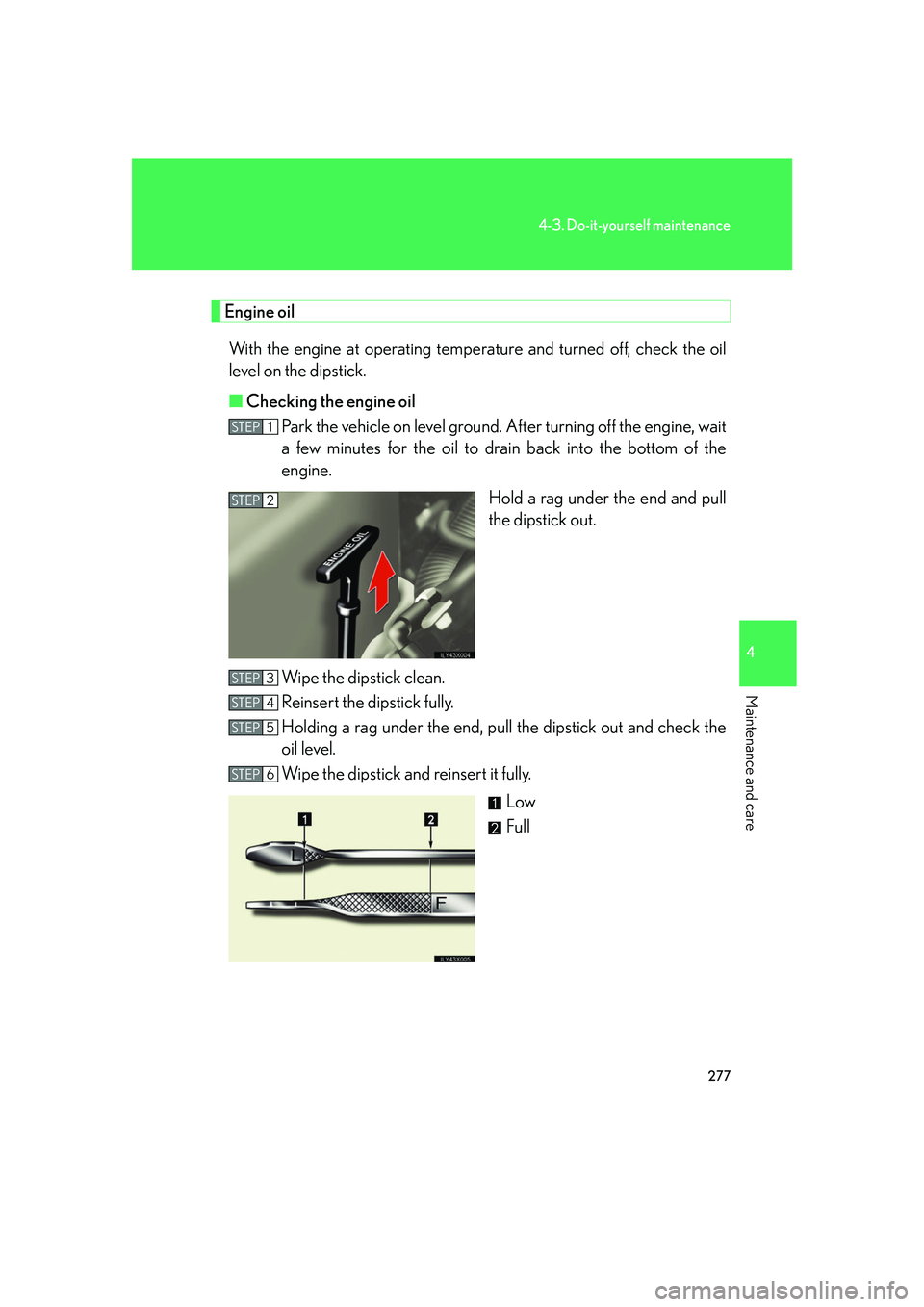
Engine oilWith the engine at operating temperat ure and turned off, check the oil
level on the dipstick.
■ Checking the engine oil
Park the vehicle on level ground . After turning off the engine, wait
a few minutes for the oil to drain back into the bottom of the
engine.
Hold a rag under the end and pull
the dipstick out.
Wipe the dipstick clean.
Reinsert the dipstick fully.
Holding a rag under the end, pull the dipstick out and check the
oil level.
Wipe the dipstick and reinsert it fully.
Low
Full
STEP1
STEP2
STEP3
STEP4
STEP5
STEP6
Page 296 of 426
278
4-3. Do-it-yourself maintenance
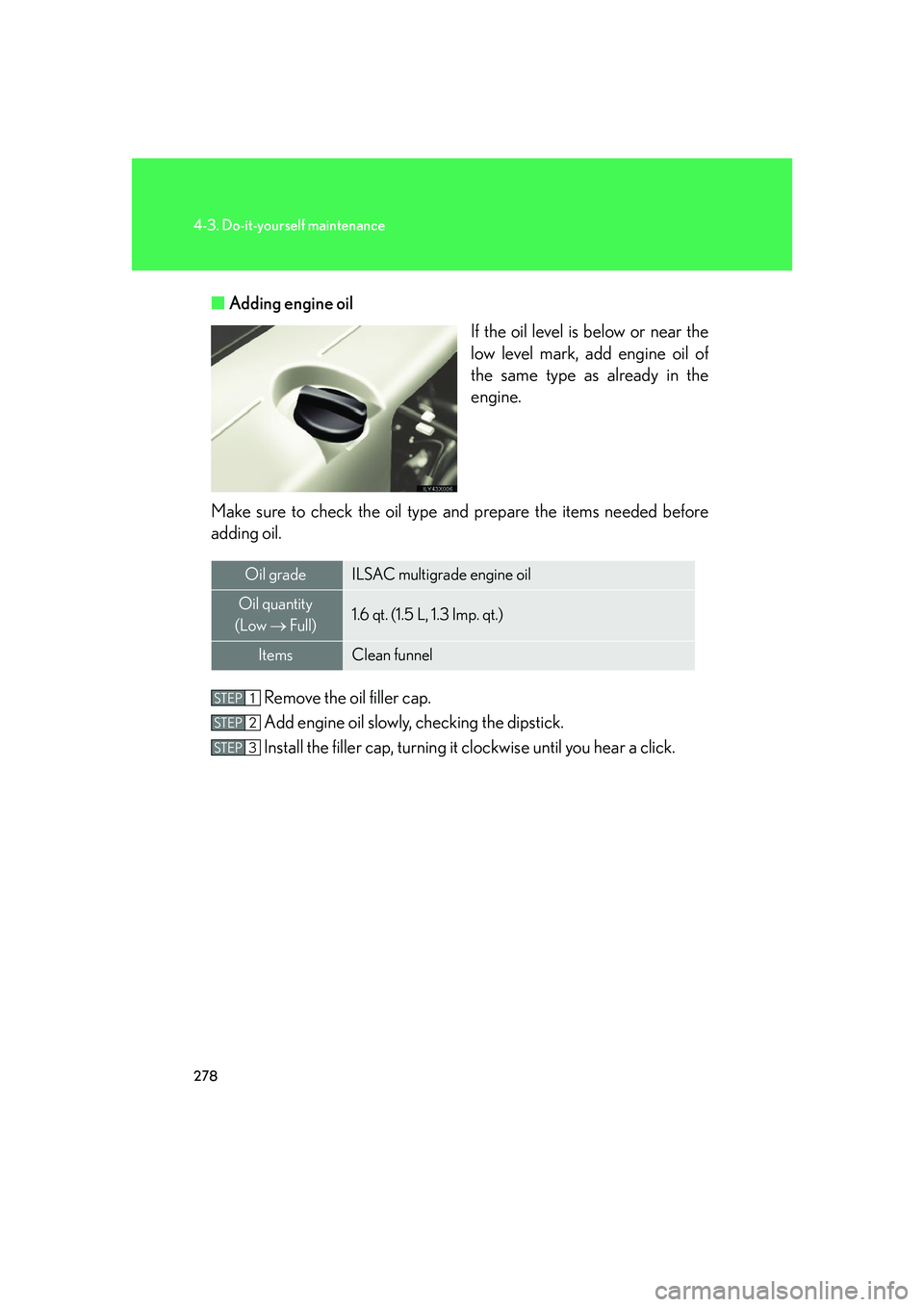
■Adding engine oil
If the oil level is below or near the
low level mark, add engine oil of
the same type as already in the
engine.
Make sure to check th e oil type and prepare the items needed before
adding oil.
Remove the oil filler cap.
Add engine oil slowly, checking the dipstick.
Install the filler cap, turning it clockwise until you hear a click.
Oil gradeILSAC multigrade engine oil
Oil quantity
(Low Full)1.6 qt. (1.5 L, 1.3 Imp. qt.)
ItemsClean funnel
STEP1
STEP2
STEP3
Page 297 of 426

279
4-3. Do-it-yourself maintenance
4
Maintenance and care
■Recommended viscosity
SAE 5W-30 is the best choice for
good fuel economy and good
starting in cold weather.
*: If SAE 5W-30 is not available,SAE 10W-30 may be used.
However, it should be replaced
with SAE 5W-30 at the next oil
change.
■ How to read oil container labels
Some oil containers are labeled wi th ILSAC certification marks that
help you to select the proper oil.
Outside temperature
Page 298 of 426

280
4-3. Do-it-yourself maintenance
■Engine oil consumption
●The amount of engine oil consumed depends on the oil viscosity, the quality of
the oil and the way the vehicle is driven.
●More oil is consumed under driving conditions such as high speeds and fre-
quent acceleration and deceleration.
●A new engine consumes more oil.
●When judging the amount of oil consumpt ion, keep in mind that the oil may
have become diluted, making it difficult to judge the true level accurately.
●Oil consumption: Max. 1.1 qt./600 miles, 0.9 lmp.qt./600 miles (1.0 L per 1000
km). If the vehicle consumes more than this amount, contact your Lexus dealer.
■Resetting the engine oil main tenance data (U.S.A. only)
Perform the following steps:
Turn the ignition key to the “LOCK” position with the odometer reading
shown.
Turn the ignition key to the “ON” position with the “ODO/TRIP” knob
held down.
Keep pressing the knob for longer th an 7 seconds after the ignition key is
in “ON” position.
After the above operation, the engine oil replacement reminder light goes off.
If the system fails to reset, the light wi ll remain flashing. In this case, return to
and try again.
STEP1
STEP2
STEP3
STEP1
Page 299 of 426
281
4-3. Do-it-yourself maintenance
4
Maintenance and care
CAUTION
■Used engine oil
●Used engine oil contains potentially harmful contaminants which may cause skin
disorders such as inflammation or skin cancer, so care should be taken to avoid
prolonged and repeated contact. To remove used engine oil from your skin, wash
thoroughly with soap and water.
●Dispose of used oil and filters only in a safe and acceptable manner. Do not dis-
pose of used oil and filters in househol d trash, in sewers or onto the ground.
Call your Lexus dealer, service station or auto parts store for information con-
cerning recycling or disposal.
●Do not leave used engine oil within the reach of children.
NOTICE
■To prevent serious engine damage
Check the oil level on regular basis.
■When replacing the engine oil
●Be careful not to spill engine oil on the vehicle components.
●Avoid overfilling, or the engine could be damaged.
●Check the oil level on the dipstick every time you refill the vehicle.
●Be sure the engine oil filler cap is properly retightened.
Page 308 of 426

290
4-3. Do-it-yourself maintenance
CAUTION
■Chemicals in the battery
A battery contains poisonous and corrosive sulfuric acid and may produce hydro-
gen gas which is flammable and explosive. To reduce the risk of death or serious
injury, take the following precautions while working on or near battery:
●Do not cause sparks by touching the battery terminals with tools.
●Do not smoke or light a match near the battery.
●Avoid contact with eyes, skin and clothes.
●Never inhale or swallow electrolyte.
●Wear protective safety glasses when working near the battery.
●Keep children away from the battery.
■Where to safety charge the battery
Always charge the battery in an open area. Do not charge the battery in a garage or
closed room where there is not sufficient ventilation.
■How to recharge the battery
Only perform a slow charge (5A or less). The battery may explode if charged at a
quicker rate.
■Emergency measures regarding electrolyte
●If electrolyte gets in your eyes
Flush your eyes with clean water for at least 15 minutes and get immediate medi-
cal attention. If possible, continue to apply water with a sponge or cloth while
traveling to the nearest medical facility.
●If electrolyte gets on your skin
Wash the affected area thoroughly. If you feel pain or a burning sensation, seek
medical attention immediately.
●If electrolyte gets on your clothes
It can soak through clothing on to your skin. Immediately take off the clothing and
follow the procedure above if necessary.
●If you accidentally swallow electrolyte
Drink a large quantity of water or milk. Fo llow with milk of magnesia, beaten raw
egg or vegetable oil. Get emerge ncy medical attention immediately.
Page 351 of 426

5
When trouble arises
333
5-1. Essential information
If you think something is wrong
If you notice any of the following symptoms, your vehicle probably needs
adjustment or repair. Contact your Lexus dealer as soon as possible.
■Visible symptoms
●Fluid leaks under the vehicle
(Water dripping from the air conditioning after use is normal.)
● Flat-looking tires or uneven tire wear
● Engine coolant temper ature gauge needle continually points
higher than normal
● Engine oil pressure gauge continually points lower than normal
● Voltmeter continually points higher or lower than normal
■ Audible symptoms
●Changes in exhaust sound
● Excessive tire squeal when cornering
● Strange noises related to the suspension system
● Pinging or other noises related to the engine
■ Operational symptoms
●Engine missing, stumbling or running rough
● Appreciable loss of power
● Vehicle pulls heavily to one side when braking
● Vehicle pulls heavily to one side when driving on a level road
● Loss of brake effectiveness, sp ongy feeling, pedal almost touches
the floor
Page 359 of 426

5
When trouble arises
341
5-2. Steps to take in an emergency
*: Driver's seat belt reminder buzzer:
The driver’s seat belt reminder sounds to alert the driver that his or her seat belt
is not fastened. The buzzer sounds for about 4 to 8 seconds, unless the driver
fastens the belt.
Engine oil replacement
reminder light
Illuminates for about 3 sec-
onds and then flashes for
about 12 seconds: Indicates
that the engine oil is scheduled
to be changed.
Check and the engine oil, and
change if necessary.
Comes on and remains on:
Indicates that the engine oil
should be changed.Check and change the engine
oil.