trailer LEXUS LX470 2007 User Guide
[x] Cancel search | Manufacturer: LEXUS, Model Year: 2007, Model line: LX470, Model: LEXUS LX470 2007Pages: 426, PDF Size: 10.95 MB
Page 183 of 426

165
2-5. Driving information
2
When driving
CAUTION
■To avoid accident or injury
●The total trailer weight (trailer weight plus the weight of cargo) must not exceed
6500 lb. (2948 kg).
●If a trailer and cargo weight over 2000 lb. (907 kg), use a sway control device
with sufficient capacity.
●The gross combined weight (sum of your vehicle weight plus its load and the total
trailer weight) must not exceed 12400 lb. (5625 kg).
●Do not exceed the trailer hitch assembly weight, gross vehicle weight, gross axle
weight and trailer tongue load capacities.
●Never load more weight in the back than in the front of the trailer. About 60% of
the load should be in the front half of the trailer, and the remaining 40% in the
rear.
●Set the vehicle height to the “LO” mode an d turn off the active height control sus-
pension to prevent the vehicle heig ht from automatically changing.
●The tow hitch receiver installed on your vehicle must never be used on another
vehicle.
■Hitches
●If you wish to install a trailer hitch, contact your Lexus dealer.
●Use only a hitch that conforms to the total trailer weight requirement.
●Follow the directions supplied by the hitch manufacturer.
●Lubricate the hitch ball with a light coat of grease.
●Remove the trailer hitch whenever you are not towing a trailer. After removing
the hitch, seal any mounting hole in the vehicle body to prevent entry of any sub-
stances into the vehicle.
■When towing a trailer
●If the total trailer weight exceeds 1000 lb . (453 kg), trailer brakes are required.
●Never tap into your vehicle’s hydraulic system, as this will lower the vehicle’s brak-
ing effectiveness.
●Never tow a trailer without using a safety chain securely attached to both the
trailer and the vehicle. If damage occurs to the coupling unit or hitch ball, there is
danger of the trailer wandering into another lane.
Page 184 of 426

166
2-5. Driving information
Trailer towing tipsYour vehicle will handle differently when towing a trailer. The 3 main
causes of vehicle-trailer accidents are driver error, excessive speed and
improper trailer loading. Keep the following in mind when towing.
● Before starting out, check the trailer lights and the vehicle-trailer con-
nections. Recheck after driving a short distance.
● Practice turning, stopping and reversing with the trailer attached in an
area away from traffic until you be come accustomed to the feel of the
vehicle.
NOTICE
■When installing a trailer hitch
●Use only the position recommended by your Lexus dealer. Do not install the
trailer hitch on the bumper; this may cause body damage.
●Do not use axle-mounted hitches, as they can cause damage to the axle housing,
wheel bearings, wheels or tires.
■Brakes
Lexus recommends trailers with brakes that conform to all applicable federal and
state/provincial regulations.
■Safety chain
A safety chain must always be used between the towing vehicle and the trailer.
Leave sufficient slack in the chain for turns. The chain should cross under the trailer
tongue to prevent the tongue from droppi ng to the ground in the case that it
becomes damaged or separated. For the correct safety chain installation proce-
dure, ask your Lexus dealer.
■Do not directly splice trailer lights
Directly splicing trailer lights may dama ge your vehicle’s electrical system and
cause a malfunction.
Page 185 of 426

167
2-5. Driving information
2
When driving
●Reversing with a trailer attached is difficult and requires practice Grip
the bottom of the steering wheel and move your hand to the left to
move the trailer to the left. Move yo ur hand to the right to move the
trailer to right. (This is generally opposite to reversing without a trailer
attached.) Avoid sharp or prolon ged turning. Have someone guide
you when reversing to reduce the risk of an accident.
● As stopping distance is increased when towing a trailer, vehicle-to-
vehicle distance should be increas ed. For each 10 mph (16 km/h) of
speed, allow at least one vehicle and trailer length.
● Avoid sudden braking as you may sk id, resulting in jackknifing and loss
of control. This is especially true on wet or slippery surfaces.
● Avoid jerky starts or sudden acceleration.
● Avoid jerky steering and sharp turn s, and slow down before making
turns.
● Note that when making a turn, the tr ailer wheels will be closer than the
vehicle wheels to the inside of th e turn. Compensate by making a
larger than normal turning radius.
● Crosswinds and rough roads will ad versely affect handling of your
vehicle and trailer, causing sway. Peri odically check the rear to prepare
for being passed by large trucks or buses, which may cause your vehi-
cle and trailer to sway. If swaying occurs, firmly grip the steering wheel,
reduce speed immediately but gradually, and steer straight ahead.
Never increase speed. If you make no extreme correction with the
steering or brakes, your vehi cle and trailer will stabilize.
● Take care when passing other vehi cles. Passing requires considerable
distance. After passing a vehicle, do not forget the length of your
trailer, and be sure you have plenty of room before changing lanes.
● In order to maintain efficient eng ine braking and electrical charging
performance, do not use overdrive. Transmission shift range position
must be in 4.
Page 186 of 426
![LEXUS LX470 2007 User Guide 168
2-5. Driving information
●Due to the added load of the trailer, your vehicle’s engine may overheat
on hot days (at temperatures over 85
F[30C] when driving up a long
or steep grade. If](/img/36/58005/w960_58005-185.png "LEXUS LX470 2007 User Guide 168
2-5. Driving information
●Due to the added load of the trailer, your vehicle’s engine may overheat
on hot days (at temperatures over 85
F[30C] when driving up a long
or steep grade. If")
168
2-5. Driving information
●Due to the added load of the trailer, your vehicle’s engine may overheat
on hot days (at temperatures over 85
F[30C] when driving up a long
or steep grade. If the engine coolant temperature gauge indicates
overheating, immediately turn off th e air conditioning (if in use), pull
your vehicle off the road and stop in a safe spot. (
P. 363)
● Always place wheel blocks under both the vehicle and the trailer
wheels when parking. Apply the pa rking brake firmly, and put the
transmission in P. Avoid parking on a slope, but if unavoidable, do so
only after performing the following:
Apply the brakes and keep them applied.
Have someone place wheel blocks under both the vehicle and
trailer wheels.
When the wheel blocks are in pl ace, release the brakes slowly
until the blocks absorb the load.
Apply the parking brake firmly.
Shift into “P” and turn off the engine.
● When restarting after parking on a slope:
With the transmission in the “P” position, start the engine. Be sure
to keep the brake pedal pressed.
Shift into 3, 2, 1, or “R” position (if reversing).
Release the parking brake and br ake pedal, and slowly pull or
back away from the wheel blocks. Stop and apply the brakes.
Have someone retrieve the blocks.
STEP1STEP1
STEP2STEP2
STEP1STEP3STEP3
STEP1STEP4
STEP1STEP5STEP5
STEP1STEP1
STEP2STEP2
STEP1STEP3STEP3
STEP1STEP4
Page 187 of 426

169
2-5. Driving information
2
When driving
CAUTION
■To avoid an accident
●Do not exceed 45 mph (72 km/h) or the posted towing speed limit, whichever is
lower. A instability (swaying) of the towing vehicle-trailer combination increases
as speed increases, exceeding 45 mph (72 km/h) may cause loss of control.
●Slow down and downshift before descending steep or long downhill grades. Do
not make sudden downshifts.
●Avoid holding the brake pedal down too long or applying the brakes too fre-
quently.
This could cause the brakes to overheat and result in reduced braking efficiency.
Page 332 of 426

314
4-3. Do-it-yourself maintenance
Fuse layout and amperage ratings■ Engine compartment
FuseAmpereCircuit
1ABS NO.240Anti-lock brake system
2ABS NO.150Anti-lock brake system
3AHC50Active height control suspension
(AHC)
4WIP-S7. 5No circuit
5TOW I N G30Trailer lights
6MIR HTR15Outside rear view mirror defogger
7RR HTR10Rear air conditioning system
8HAZ-TRN15Emergency flashers, Turn signal lights
Page 333 of 426
315
4-3. Do-it-yourself maintenance
4
Maintenance and care
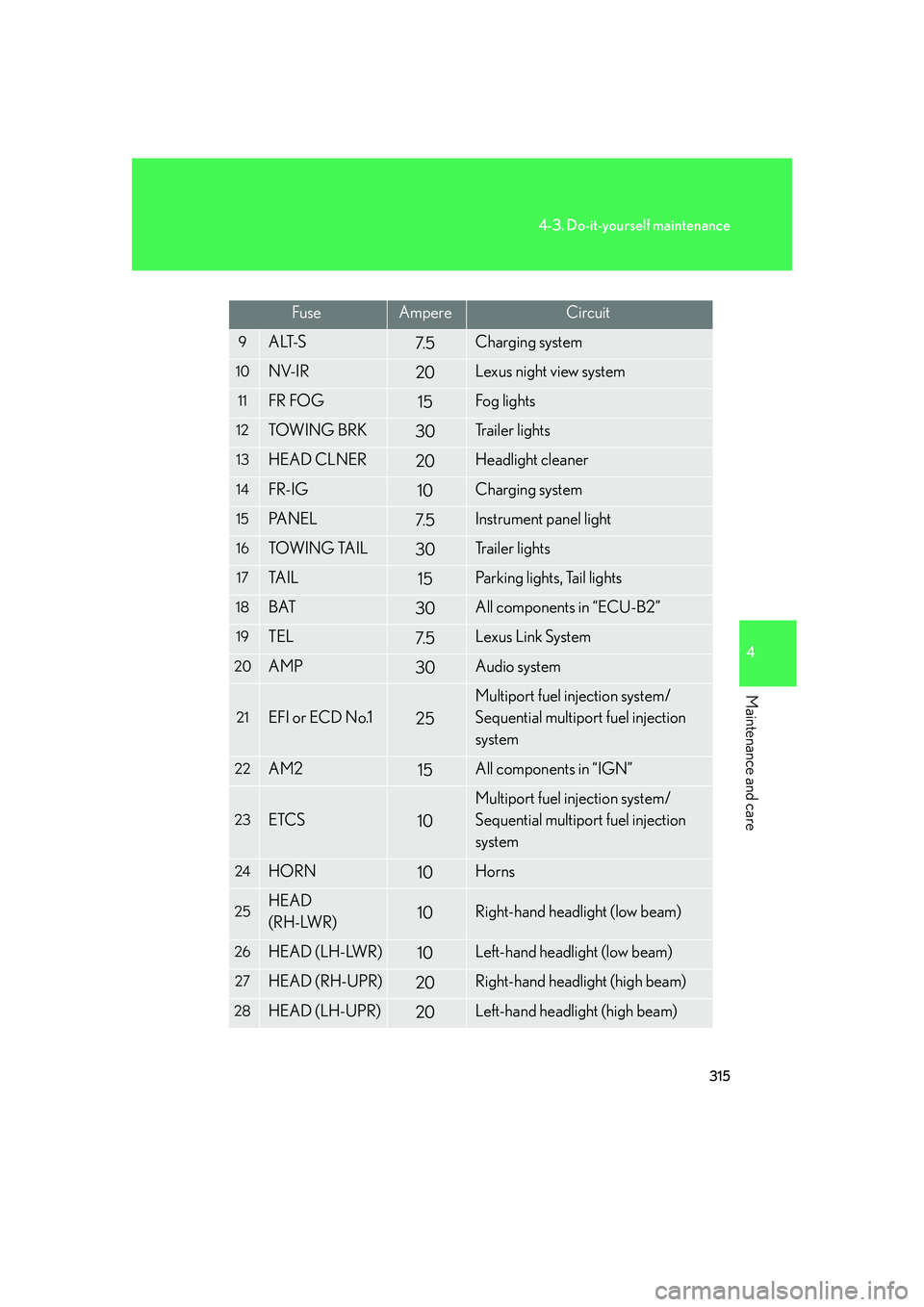
FuseAmpereCircuit
9ALT-S7. 5Charging system
10NV-IR20Lexus night view system
11FR FOG15Fog lights
12TOWING BRK30Trailer lights
13HEAD CLNER20Headlight cleaner
14FR-IG10Charging system
15PA N E L7. 5Instrument panel light
16TOW I N G TA I L30Trailer lights
17TA I L15Parking lights, Tail lights
18BAT30All components in “ECU-B2”
19TEL7. 5Lexus Link System
20AMP30Audio system
21EFI or ECD No.125
Multiport fuel injection system/
Sequential multiport fuel injection
system
22AM215All components in “IGN”
23ETCS10
Multiport fuel injection system/
Sequential multiport fuel injection
system
24HORN10Horns
25HEAD
(RH-LWR)10Right-hand headlight (low beam)
26HEAD (LH-LWR)10Left-hand headlight (low beam)
27HEAD (RH-UPR)20Right-hand headlight (high beam)
28HEAD (LH-UPR)20Left-hand headlight (high beam)
Page 337 of 426
319
4-3. Do-it-yourself maintenance
4
Maintenance and care
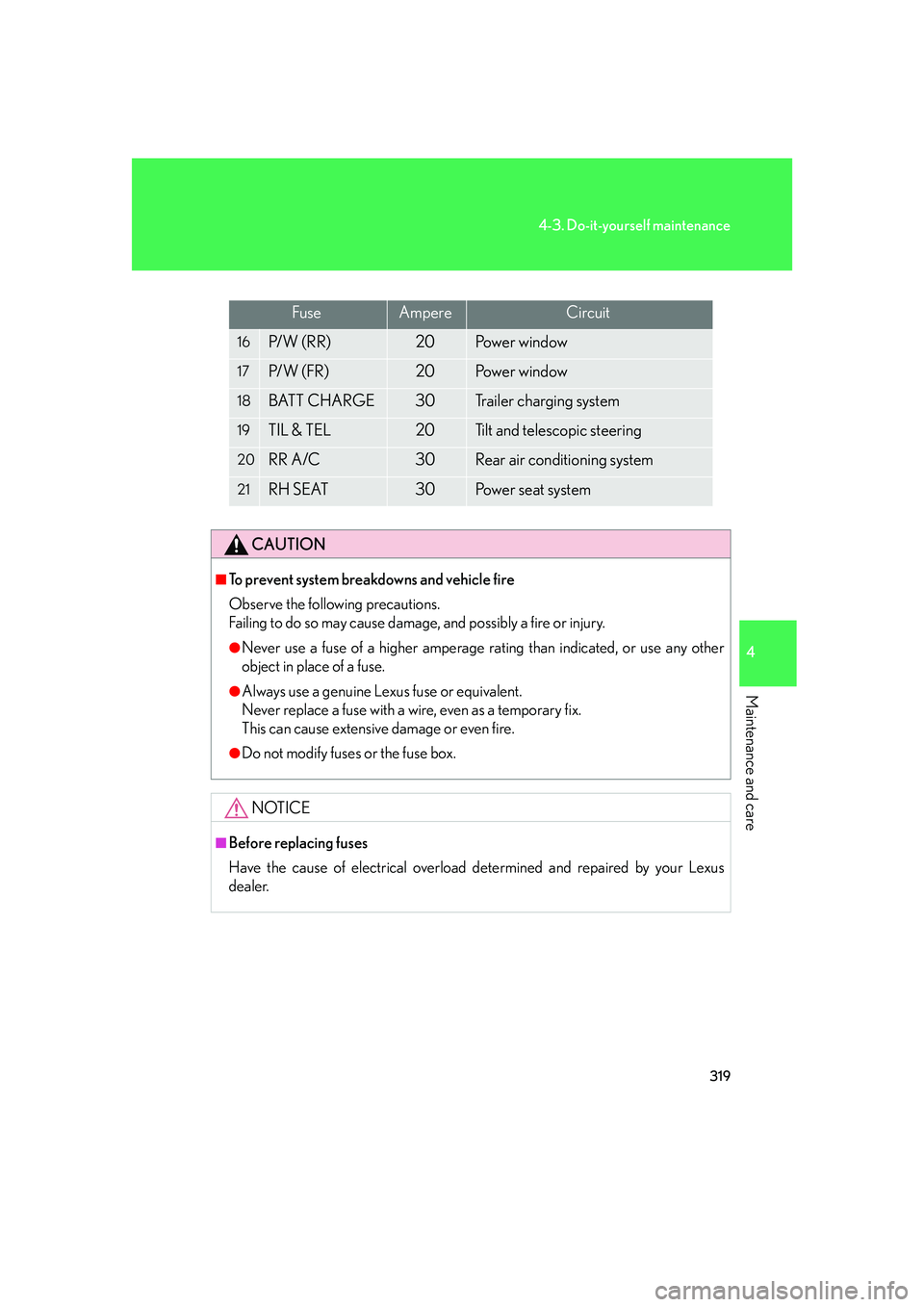
FuseAmpereCircuit
16P/W (RR)20Po w e r w i n d o w
17P/ W ( F R )20Po w e r w i n d o w
18BATT CHARGE30Trailer charging system
19TIL & TEL20Tilt and telescopic steering
20RR A/C30Rear air conditioning system
21RH SEAT30Power seat system
CAUTION
■To prevent system breakdowns and vehicle fire
Observe the following precautions.
Failing to do so may cause damage, and possibly a fire or injury.
●Never use a fuse of a higher amperage rating than indicated, or use any other
object in place of a fuse.
●Always use a genuine Lexus fuse or equivalent.
Never replace a fuse with a wire, even as a temporary fix.
This can cause extensive damage or even fire.
●Do not modify fuses or the fuse box.
NOTICE
■Before replacing fuses
Have the cause of electrical overload determined and repaired by your Lexus
dealer.
Page 386 of 426

368
6-1. Specifications
Maintenance data
Dimensions and weight
*: Unladen vehicle
Overall length192.5 in. (4890 mm)
Overall width76.4 in. (1940 mm)
Overall height *72.8 in. (1850 mm)
Wheelbase112.2 in. (2850 mm)
Tr e a dFront63.8 in. (1620 mm)
Rear63.6 in. (1615 mm)
Vehicle capacity weight
(Occupants + luggage)1200 lb. (545 kg)
Towing capacity
(trailer weight + cargo weight)6500 lb. (2948 kg)
Page 394 of 426

376
6-1. Specifications
Tires and wheels
Ti r e s i z eP275/60R18 111H
Tire inflation pressure
(Recommended cold tire inflation
pressure)
Normal driving
Front tires:
29 psi (200 kPa, 2.0 kgf/cm
2 or bar)
Rear tires:
32 psi (220 kPa, 2.2 kgf/cm
2 or bar)
Spare tire:
32 psi (220 kPa, 2.2 kgf/cm
2 or bar)
Trailer towing Front tires:
32 psi (220 kPa, 2.2 kgf/cm
2 or bar)
Rear tires:
35 psi (240 kPa, 2.4 kgf/cm
2 or bar)
Spare tire:
35 psi (240 kPa, 2.4 kgf/cm
2 or bar)
Wheel size18 8 J
Wheel nut torque97 ft•lbf (131 N•m, 13.4 kgf•m)