roof LEXUS LX470 2007 Owner's Manual
[x] Cancel search | Manufacturer: LEXUS, Model Year: 2007, Model line: LX470, Model: LEXUS LX470 2007Pages: 426, PDF Size: 10.95 MB
Page 78 of 426

60
1-7. Safety information
■When to contact your Lexus dealer
In the following cases, contact your Lexus dealer as soon as possible. Do not dis-
connect the battery cables before contacting your Lexus dealer.
●Any of the SRS airbags have been inflated.
●The front of the vehicle is damaged or
deformed, or the vehicle was involved in an
accident that was not severe enough to
cause the SRS airbags to inflate.
●A portion of the doors is damaged or
deformed, or the vehicle was involved in an
accident that was not severe enough to
cause the SRS side airbags and curtain
shield airbags to inflate.
●The pad section of the steering wheel or
dashboard is scratched, cracked or other-
wise damaged.
●The surface of the seats with the side air-
bag is scratched, cracked, or otherwise
damaged.
●The portion of the front, center and rear pil-
lar garnish, or roof interior containing the
curtain shield airbags is scratched, cracked
or otherwise damaged.
Page 81 of 426

63
1-7. Safety information
1
Before driving
CAUTION
■SRS airbag precautions
●Do not sit on the edge of the seat or lean
against the dashboard.
●Do not allow a child to sit on the knees of a
front passenger while the vehicle is moving.
●Do not drive the vehicle while the driver or
passenger have items resting on their
knees.
●Do not lean against the door, the roof side
rail or the front, center and rear pillars.
●Do not allow anyone to kneel on the front
passenger seat toward the door or put their
head or hands outside the vehicle.
Page 82 of 426

64
1-7. Safety information
CAUTION
■SRS airbag precautions
●Do not use seat accessories which cover the front seat as they may interfere with
inflation of the front passenger airbag.
●Do not use seat accessories which cover the parts where the SRS side airbags
inflate as they may interfere with inflation of the airbags.
●Do not strike or apply significant levels of force to the area of the SRS airbag
components shown on P. 55. Doing so ca n cause the SRS airbags to malfunction.
●Do not touch any of the component parts immediately after the SRS airbags have
deployed (inflated) as they may be hot.
●If breathing becomes difficult after the SRS airbag has deployed, open a door or
window to allow fresh air in, or leave the vehicle if it is safe to do so. Wash off any
residue as soon as possible to prevent skin irritation.
●If the areas where the SRS airbags are stored, such as the steering wheel pad and
front pillar garnish, are damaged or cracked, have them replaced by your Lexus
dealer.
●Do not attach anything to or lean anything
against areas such as the dashboard or
steering wheel pad. These items can
become projectiles when SRS driver and
front passenger airbags deploy.
●Do not attach anything to areas such as the
door, windshield glass, side door glass,
front, center and roof side garnish, roof
interior or assist grip.
●Do not hang coat hangers or other hard
objects on the coat hooks. All of these
items could become projectiles and seri-
ously injure or kill you, should the SRS cur-
tain shield airbag deploy.
Page 83 of 426
65
1-7. Safety information
1
Before driving
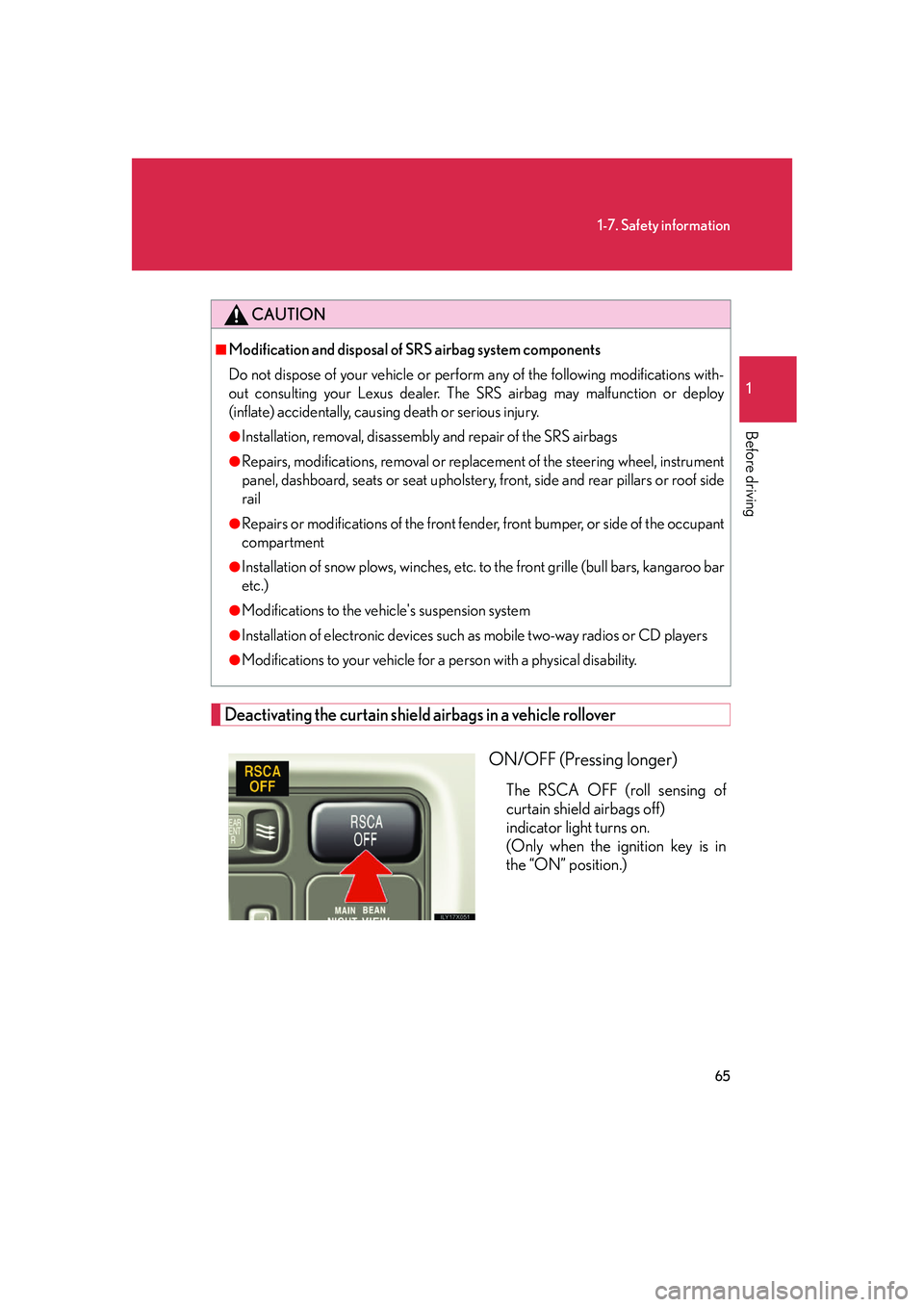
Deactivating the curtain shield airbags in a vehicle rollover
ON/OFF (Pressing longer)
The RSCA OFF (roll sensing of
curtain shield airbags off)
indicator light turns on.
(Only when the ignition key is in
the “ON” position.)
CAUTION
■Modification and disposal of SRS airbag system components
Do not dispose of your vehicle or perfor m any of the following modifications with-
out consulting your Lexus dealer. The SRS airbag may malfunction or deploy
(inflate) accidentally, causing death or serious injury.
●Installation, removal, disassembly and repair of the SRS airbags
●Repairs, modifications, removal or replace ment of the steering wheel, instrument
panel, dashboard, seats or seat upholstery, front, side and rear pillars or roof side
rail
●Repairs or modifications of the front fend er, front bumper, or side of the occupant
compartment
●Installation of snow plows, winches, etc. to the front grille (bull bars, kangaroo bar
etc.)
●Modifications to the vehi cle's suspension system
●Installation of electronic devices such as mobile two-way radios or CD players
●Modifications to your vehicle for a person with a physical disability.
Page 92 of 426

74
1-7. Safety information
CAUTION
■Child restraint precautions
●For effective protection in automobile accidents and sudden stops, a child must
be properly restrained, using a seat belt or child restraint system depending on
the age and size of the child. Holding a child in your arms is not a substitute for a
child restraint system. In an accident, th e child can be crushed against the wind-
shield, or between you and the vehicle's interior.
●Lexus strongly urges the use of a proper child restraint system that conforms to
the size of the child, installed on the rear seat. According to accident statistics, the
child is safer when properly restrained in the rear seat than in the front seat.
●Never install a rear-facing child restraint system on the front passenger seat even
if the AIRBAG OFF indicator light illuminat es. In the event of an accident, the
force of the rapid inflation of the front passenger airbag can cause death or seri-
ous injury to the child if the rear-facing child restraint system is installed on the
front passenger seat.
●A forward-facing child restraint system shou ld allowed to be installed on the front
passenger seat only when it is unavoidable. Always move the seat as far back as
possible even if th e AIRBAG OFF indicator light i lluminates, because the front
passenger airbag could inflate with considerable speed and force. Otherwise,
the child may be killed or seriously injured.
●Do not use the seat belt extender when installing a child restraint system on the
front or rear passenger seat. If installing a child restraint system with the seat belt
extender connected to the seat belt, the seat belt will not securely hold the child
restraint system, which could cause death or serious injury to the child or other
passengers in the event of collision.
●Do not allow the child to lean his/her head or any part of his/her body against the
door or the area of the seat, front pillar or roof side rail from which the side air-
bags or curtain shield airbags deploy even if the child is seated in the child
restraint system. It is dangerous if the side airbags and curtain shield airbags
inflate, and the impact could cause death or serious injury to the child.
●Make sure you have complied with all inst allation instructions provided by the
child restraint manufacturer and that the sy stem is properly secured. If it is not
secured properly, it may cause death or seri ous injury to the child in the event of a
sudden stop or accident.
Page 165 of 426

147
2-5. Driving information
2
When driving
CAUTION
■Off-road vehicle precautions
Always observe the following precautions to help minimize the risk of serious per-
sonal injury or damage to your vehicle:
●In a rollover crash, an unbelted person is significantly more likely to die than a
person wearing a seat belt. Therefore, the driver and all passengers should fasten
their seat belts whenever the vehicle is moving.
●Avoid sharp turns or abrupt maneuvers, if at all possible.
Failure to operate this vehicle correctly may result in loss of control or vehicle roll-
over causing death or serious injury.
●Loading cargo on the roof luggage carrier will make the center of the vehicle
gravity higher. Avoid high speeds, sudden starts, sharp turns, sudden braking or
abrupt maneuvers, otherwise it may result in loss of control or vehicle rollover
due to failure to operate this vehicle correctly.
●Always slow down in gusty crosswinds. Because of its profile and higher center of
gravity, your vehicle is more sensitive to side winds than an ordinary passenger
car. Slowing down will allow you to have better control.
●Do not drive horizontally across steep slop es. Driving straight up or straight down
is preferred. Your vehicle (or any similar off-road vehicle) can tip over sideways
much more easily than forward or backward.
Page 262 of 426

244
3-5. Other interior features
Wait a few seconds until the compass direction is displayed.
The calibration is complete.
■Circling calibration
If “C” appears on the display, drive
the vehicle at 5 mph (8 km/h) or
less in a circle until a direction is
displayed.
If there is not enough space to
drive in a circle, drive around the
block until the direction is dis-
played.
STEP4
■Conditions unfavorable to correct operation
The compass may not show the correct direction in the following conditions:
●The vehicle is stopped immediately after turning.
●The vehicle is on an inclined surface.
●The vehicle is in a place where the earth's magnetic field is subject to interfer-
ence by artificial magnetic fields (underground car park/parking lot, under a
steel tower, between buildings, roof car pa rk/parking lot, near an intersection,
near a large vehicle, etc.).
●The vehicle has become magnetized.
(There is a magnet or metal object near the inside rear view mirror.)
●The battery has been disconnected.
●A door is open.
Page 263 of 426

245
3-5. Other interior features
3
Interior features
CAUTION
■While driving
Do not adjust the display.
Be sure to adjust the display only when the vehicle is stopped.
■When doing the circling calibration
Be sure to secure a wide space, and watch out for people and vehicles in the neigh-
borhood. Do not violate any local traffic rules while performing circling calibration.
NOTICE
■To avoid the compass malfunctions
Do not place magnets or any metal objects near the inside rear view mirror.
Doing this may cause a malfunction of the compass sensor.
■To ensure normal operation of the compass
●Do not perform circling calibration of the compass in a place where the earth's
magnetic field is subject to interference by artificial magnetic fields.
●During calibration, do not operate elec tric systems (moon roof, power windows,
etc.) as they may interfere with the calibration.
Page 274 of 426

256
3-5. Other interior features
■Speech recognition information
The Lexus Link speech recognition systems use speech technology that is designed
to understand a wide range of speakers of American English. However, the technol-
ogy may not work as well if a regional or ethnic accent is encountered. If the speech
recognition system does not work properly, refer to the following.
●The system does not recognize your command properly if noise is preset. Per-
form the following to improve voice command recognition.
• Turn down or off the air conditioning system.
• Slow down to reduce wind noise.
• Close the windows and the moon roof to block outside noise.
• Have all occupants be quiet so that the system does not recognize their con- versation as a command.
●When to speak
Say a command within 5 seconds after the system prompts you to speak.
●How to speak
• Speak forcefully and clearly.
• Speak calmly and naturally.
• The driver should speak while facing forward, and the passenger should speak facing the inside rear view mirror.
• Avoid speaking with a rising intonati on. Use a flat or falling intonation.
●Tips for one-word commands
• The system recognizes only one word at a time for personal calling. (There
are some exceptions, such as “Advanced services” and “My number”.)
• When inputting the security codes or voice-activated keypad number, you
must say them one digit at a time. When inputting a phone number, the
speech recognition system can recogniz e 7, 10, and 11-digit numbers as well
as the number 911.
Page 276 of 426

258
3-5. Other interior features
■Lexus Link transceiver antenna
●Use only the supplied or an approved antenna. Unauthorized antennas, modifi-
cations, or attachments could damage the Lexus Link System and may violate
FCC regulations.
CAUTION
■FCC WARNING
Changes or modifications in construction not expressly approved by the party
responsible for compliance could void the user's authority to operate the equip-
ment.
Radio Frequency Exposure. This device is approved for Mobile Application only
and, to comply with applicable FCC radi o frequency exposure regulations, must be
used with a distance of at least 7.9 in. (20 cm) between the antenna and the body of
any person at all time during use.
■Caution regarding interference with electronic devices
Persons using medical devices such as a pacemaker should not touch or come in
close contact with the antenna while the vehicle ignition is on. Otherwise, the cellu-
lar signals may cause a malfunction in the medical devices.
NOTICE
■To avoid damage to the system
●Do not touch the antenna unless necessary, as this may affect transceiver quality
and may cause the unit to operate at a higher power level than necessary.
●Make sure the antenna is removed before driving through an automatic car wash.
■To ensure the Lexus Link System functions correctly
Be sure to reattach the Lexus Link transceiver antenna.
●Before using an automatic car wash,
disconnect the antenna by unscrewing
it from the roof mount.
When you remove the antenna, make
sure the ignition is turned off.