battery LEXUS LX470 2007 Owner's Guide
[x] Cancel search | Manufacturer: LEXUS, Model Year: 2007, Model line: LX470, Model: LEXUS LX470 2007Pages: 426, PDF Size: 10.95 MB
Page 327 of 426

309
4-3. Do-it-yourself maintenance
4
Maintenance and care
Wireless remote control battery
Replace the battery with a new one if it is discharged.
■You will need the following items:
●Small Phillips-head sc rewdriver
● Lithium battery (CR2016)
■ Replacing the battery
Remove the screw and cover.
Push the cover in the arrow
direction.
Remove the module.
Open the case cover and
remove the depleted battery.
Insert a new battery with the “+”
terminal facing up.
STEP1
STEP2
STEP3
Page 328 of 426

310
4-3. Do-it-yourself maintenance
■If the wireless remote control battery is discharged
The following symptoms may occur.
●The wireless remote control will not function properly.
●The operational range is reduced.
●The indicator light on the wireless remote control is dimmed or does not come
on.
■Use a CR2016 lithium battery
●Batteries can be purchased at your Lexus dealer, jewelers or camera stores.
●Replace only with the same or equivalent type recommended by a Lexus dealer.
●Dispose of used batteries according to the local laws.
CAUTION
■Removed battery and other parts
Keep away from children.
These parts are small and if swallowed by a child they can cause choking.
NOTICE
■For normal operation after replacing the battery
Observe the following precautions to prevent accidents.
●Always work with dry hands. Moisture may cause the battery to rust.
●Do not touch or move any other components inside the electronic key.
●Do not bend the battery terminals.
●Take care not to lose the screws.
Page 345 of 426

When trouble arises5
327
5-1. Essential information............ 328If your vehicle needs to be towed .......................................... 328
If you think something is wrong .......................................... 333
Fuel pump shut off system ..... 334
Event data recorder ................. 335
5-2. Steps to take in an emergency............................ 337
If a warning light turns on or a warning buzzer sounds...
......... 337
If you have a flat tire.................. 346
If the engine will not start ....... 357
If the shift lever cannot be shifted from P........................... 358
If you lose your keys ................. 359
If the battery is discharged .... 360
If your vehicle overheats ........ 363
If the vehicle becomes stuck ............................................ 366
Page 375 of 426

5
When trouble arises
357
5-2. Steps to take in an emergency
If the engine will not start
If the engine will not start even though correct starting procedures are
being followed (
P. 95), consider each of the following points.
■The engine will not start when the starter motor operates nor-
mally.
One of the following may be the cause of the problem.
●There may not be sufficient fuel in the vehicle’s tank.
Add fuel to the vehicle.
● The engine may be flooded.
Try to restart the engine once more following correct starting
procedures. ( P. 9 5 )
● There may be a malfunction in the engine immobilizer system.
( P. 4 7 )
■ The starter motor turn over slowly, the interior lights and head-
lights are dim, or the horn does not sound or sounds at a low vol-
ume.
One of the following may be the cause of the problem.
● The battery may be discharged. ( P. 360)
● The battery terminal connections may be loose or corroded.
■ The starter motor does not turn over, the interior lights and head-
lights do not turn on, or the horn does not sound.
One of the following may be the cause of the problem.
● One or both of the battery terminals may be disconnected.
● The battery may be discharged. ( P. 360)
Contact your Lexus dealer if the problem cannot be repaired, or if
repair procedures are unknown.
Page 378 of 426

360
5-2. Steps to take in an emergency
If the battery is discharged
The following procedures may be used to start the engine if the battery is
discharged.
You can call your Lexus dealer, Roadside Assistance or Lexus Customer
Service.
If you have a set of jumper (or booster) cables and a second vehicle
with a 12 volt battery, you can jump start your Lexus following the steps
below.
Connecting the jumper cables.
If required, remove all vent plugs from the booster battery. Lay a
cloth over the open vents on the booster battery. (This helps reduce
the explosion hazard, personal injuries and burns.)
Positive (+) battery terminal on your vehicle.
Positive (+) battery terminal on the second vehicle.
Negative (-) battery terminal on the second vehicle.
Connect the jumper cable to ground on your vehicles as shown in
the illustration. Start the engine of the second vehicle. Increase the engine
speed slightly and maintain at that level for approximately 5
minutes to recharge the battery of your vehicle.
STEP1
STEP2
Page 379 of 426

5
When trouble arises
361
5-2. Steps to take in an emergency
■Avoiding a discharged battery
●Turn off the headlights and the audio system while the engine is turned off.
●Turn off any unnecessary electrical compon ents when the vehicle is running at a
low speed for an extended period, such as in heavy traffic, etc.
■When the battery is removed or discharged
The following systems must be initialized.
●Moon roof (P. 4 2 )
●Variable gear ratio steering (P. 144)
CAUTION
■Avoiding battery fires or explosions
Observe the following precautions to prevent accidentally igniting the flammable
gas that may be emitted from the battery.
●Make sure the jumper cable is connected to the correct terminal and that it is not
unintentionally in contact with any pa rt other than the intended terminal.
●Do not allow the jumper cables to come into contact with the “+” and “-” termi-
nals.
●Do not allow open flame or use matches, cigarette lighters or smoke near the
battery.
Maintain the engine sp eed of the second vehicle and start your
vehicle’s engine.
Once the vehicle’s engine ha s started, remove the jumper
cables in the exact reverse ord er in which they were con-
nected.
Once the engine starts, have the ve hicle checked at your Lexus dealer
as soon as possible.STEP3
STEP4
Page 380 of 426

362
5-2. Steps to take in an emergency
CAUTION
■Battery precautions
The battery contains poisonous and corrosive acidic electrolyte, while related parts
contain lead and lead compounds. Observe the following precautions when han-
dling the battery:
●When working with the battery, always wear safety glasses and take care not to
allow any battery fluids (acid) to come into contact with skin, clothing or the vehi-
cle body.
●Do not lean over the battery.
●If the battery fluid comes into contact with the skin or eyes, immediately wash the
affected area with water and seek medical attention.
Place a wet sponge or cloth over the affected area until medical attention can be
received.
●Always wash your hands after handling the battery support, terminals, and other
battery-related parts.
●Do not allow children near the battery.
NOTICE
■To prevent damaging the vehicle
Do not pull- or push-start the vehicle, because the three-way catalytic converter
may overheat and become a fire hazard.
■When handling jumper cables
Be careful that the jumper cables do not become tangled in the cooling fan or any
of the belts when connectin g or disconnecting them.
Page 391 of 426
373
6-1. Specifications
6
Vehicle specifications
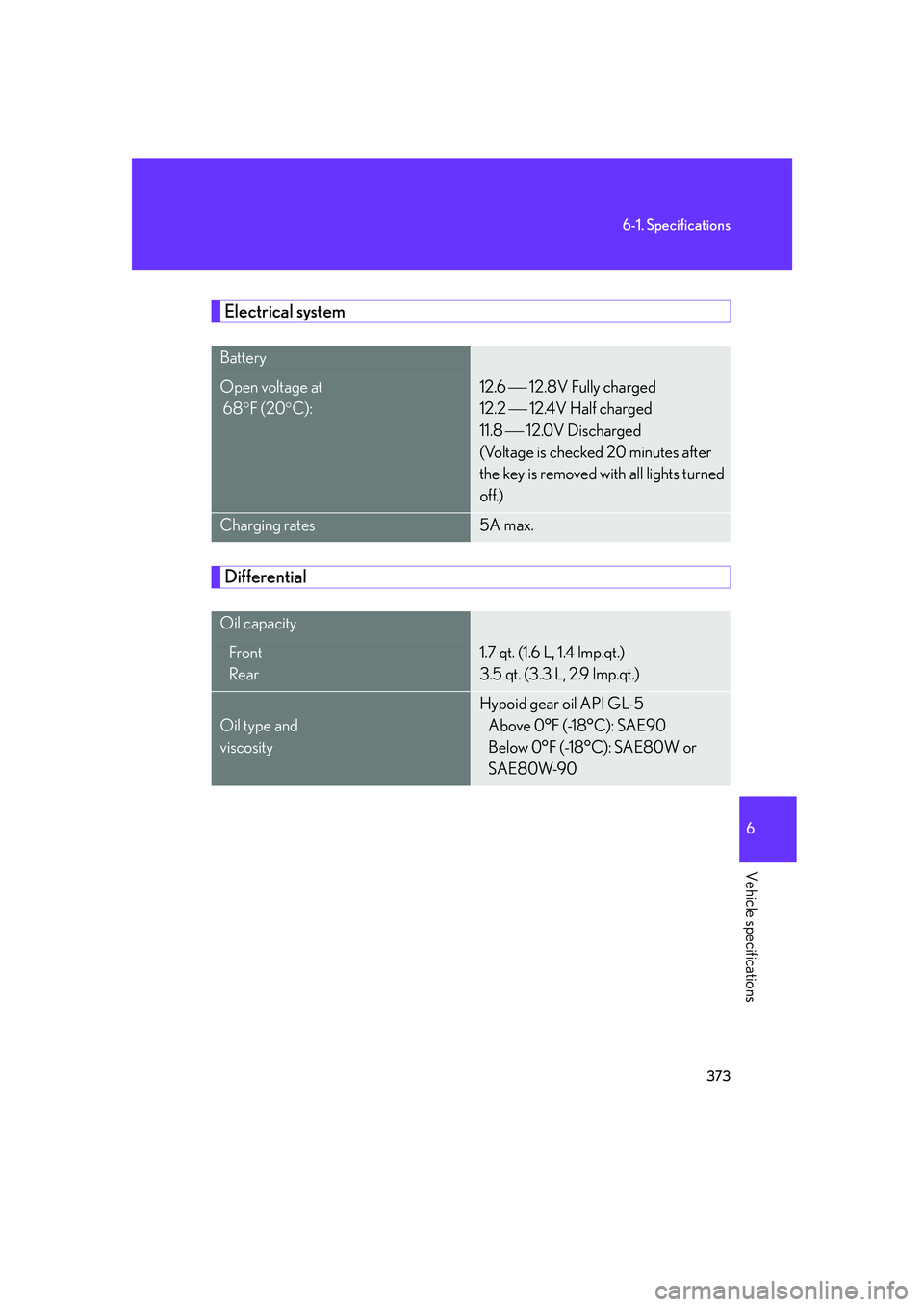
Electrical system
Differential
Battery
Open voltage at
68F (20 C):12.6 12.8V Fully charged
12.2 12.4V Half charged
11.8 12.0V Discharged
(Voltage is checked 20 minutes after
the key is removed with all lights turned
off.)
Charging rates5A max.
Oil capacity
Front
Rear1.7 qt. (1.6 L, 1.4 lmp.qt.)
3.5 qt. (3.3 L, 2.9 lmp.qt.)
Oil type and
viscosity
Hypoid gear oil API GL-5 Above 0°F (-18°C): SAE90
Below 0°F (-18°C): SAE80W or
SAE80W-90
Page 405 of 426

387
6-1. Specifications
6
Vehicle specifications
Tire related termMeaning
Production options
weight
The combined weight of installed regular production
options weighing over 5 lb. (2.3 kg) in excess of the
standard items which they replace, not previously
considered in curb weight or accessory weight,
including heavy duty brakes, ride levelers, roof rack,
heavy duty battery, and special trim
Vehicle capacity weight
(Total load capacity)The rated cargo and luggage load plus 150 lb. (68
kg) times the vehicle's designated seating capacity
Intended outboard side-
wall
(a) The sidewall that contains a whitewall, bears white lettering, or bear s manufacturer, brand,
and/or model name molding that is higher or
deeper than the same molding on the other side-
wall of the tire, or
(b) The outward facing sidewall of asymmetrical tire that has a particular side that must always face
outward when mounted on a vehicle
Occupant distributionDistribution of occupants in a vehicle as specified in
the third column of Table 1
* below
Recommended inflation
pressureCold tire inflation pressure recommended by a man-
ufacturer.
RimA metal support for a tire or a tire and tube assembly
upon which the tire beads are seated
Rim diameter
(Wheel diameter)Nominal diameter of the bead seat
Rim size designationRim diameter and width
Rim type designationThe industry manufacturer's designation for a rim by
style or code
Rim widthNominal distance between rim flanges
Page 411 of 426

393
6
Vehicle specifications
6-3. Initialization
Items to initialize
ItemWhen to initializeReference
Moon roof• After reconnecting or changing the battery
• After changing a fuseP. 4 2
Variable gear ratio
steeringP. 1 4 4
Engine oil maintenance
data• After changing engine oilP. 2 8 0
Tire pressure warning
system
• When rotating the tires on vehicles differing with front and rear tire infla-
tion pressures.
• When changing the tire inflation pressure by changing traveling speed
or load weight, etc.
• When changing the tire size.
P. 2 9 4
The following items must be initialized for normal system operation in cases
such as after the battery is reconnected, or maintenance is performed on
the vehicle.