brake light LEXUS LX470 2007 Owners Manual
[x] Cancel search | Manufacturer: LEXUS, Model Year: 2007, Model line: LX470, Model: LEXUS LX470 2007Pages: 426, PDF Size: 10.95 MB
Page 2 of 426
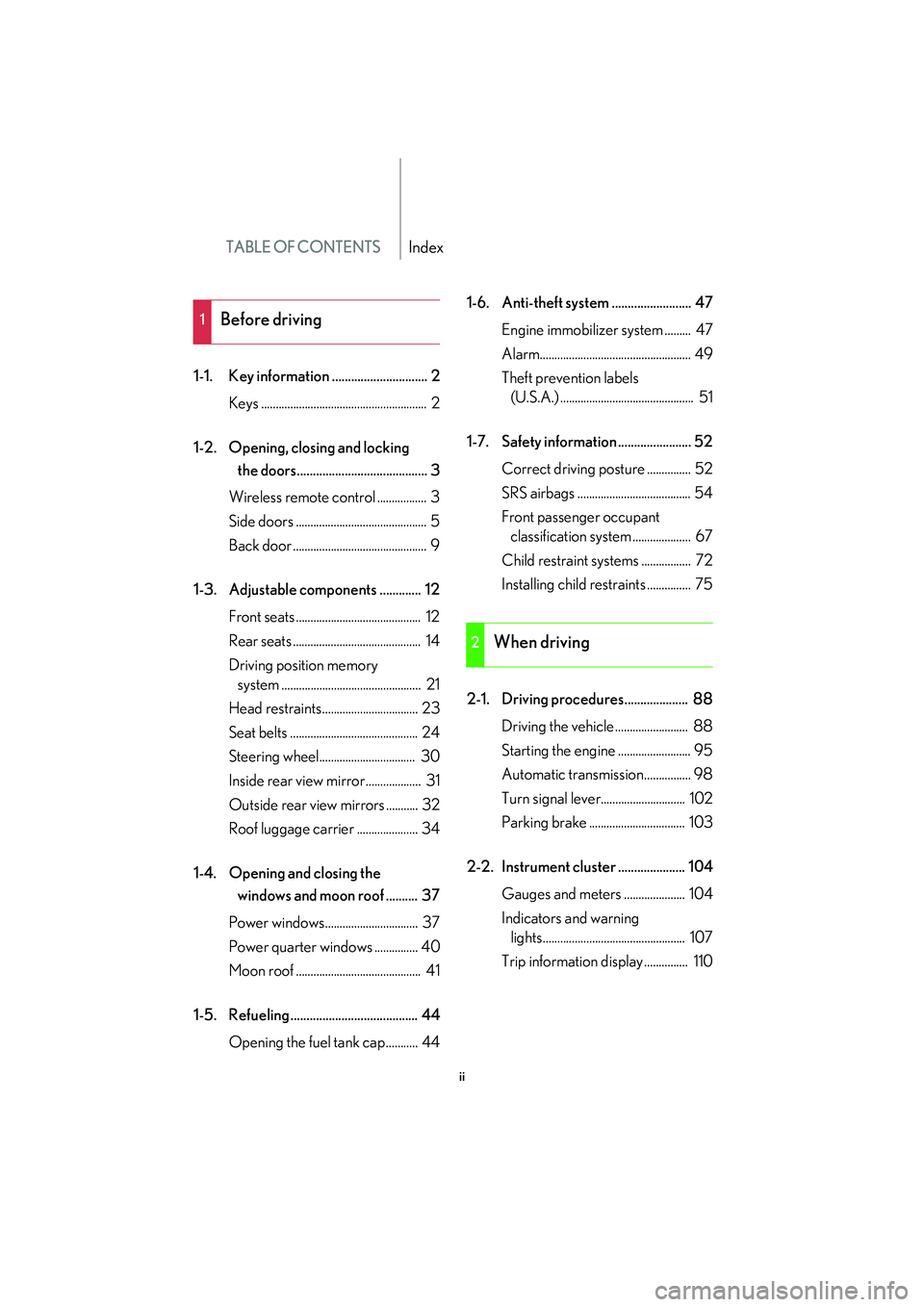
TABLE OF CONTENTSIndex
ii
1-1. Key information .............................. 2Keys ......................................................... 2
1-2. Opening, closing and locking the doors......................................... 3
Wireless remote control ................. 3
Side doors ............................................. 5
Back door .............................................. 9
1-3. Adjustable components ............. 12 Front seats ........................................... 12
Rear seats ............................................ 14
Driving position memory system ................................................ 21
Head restraints................................. 23
Seat belts ............................................ 24
Steering wheel................................. 30
Inside rear view mirror ................... 31
Outside rear view mirrors ........... 32
Roof luggage carrier ..................... 34
1-4. Opening and closing the windows and moon roof .......... 37
Power windows................................ 37
Power quarter windows ............... 40
Moon roof ........................................... 41
1-5. Refueling ........................................ 44 Opening the fuel tank cap ........... 44 1-6. Anti-theft system ......................... 47
Engine immobilizer system ......... 47
Alarm.................................................... 49
Theft prevention labels (U.S.A.) .............................................. 51
1-7. Safety information ....................... 52 Correct driving posture ............... 52
SRS airbags ....................................... 54
Front passenger occupant classification system .................... 67
Child restraint sy stems ................. 72
Installing child restraints ............... 75
2-1. Driving procedures.................... 88 Driving the vehicle ......................... 88
Starting the engine ......................... 95
Automatic transmission................ 98
Turn signal lever............................. 102
Parking brake ................................. 103
2-2. Instrument cluster ..................... 104 Gauges and meters ..................... 104
Indicators and warning lights................................................. 107
Trip information display ............... 110
1Before driving
2When driving
Page 105 of 426
When driving2
87
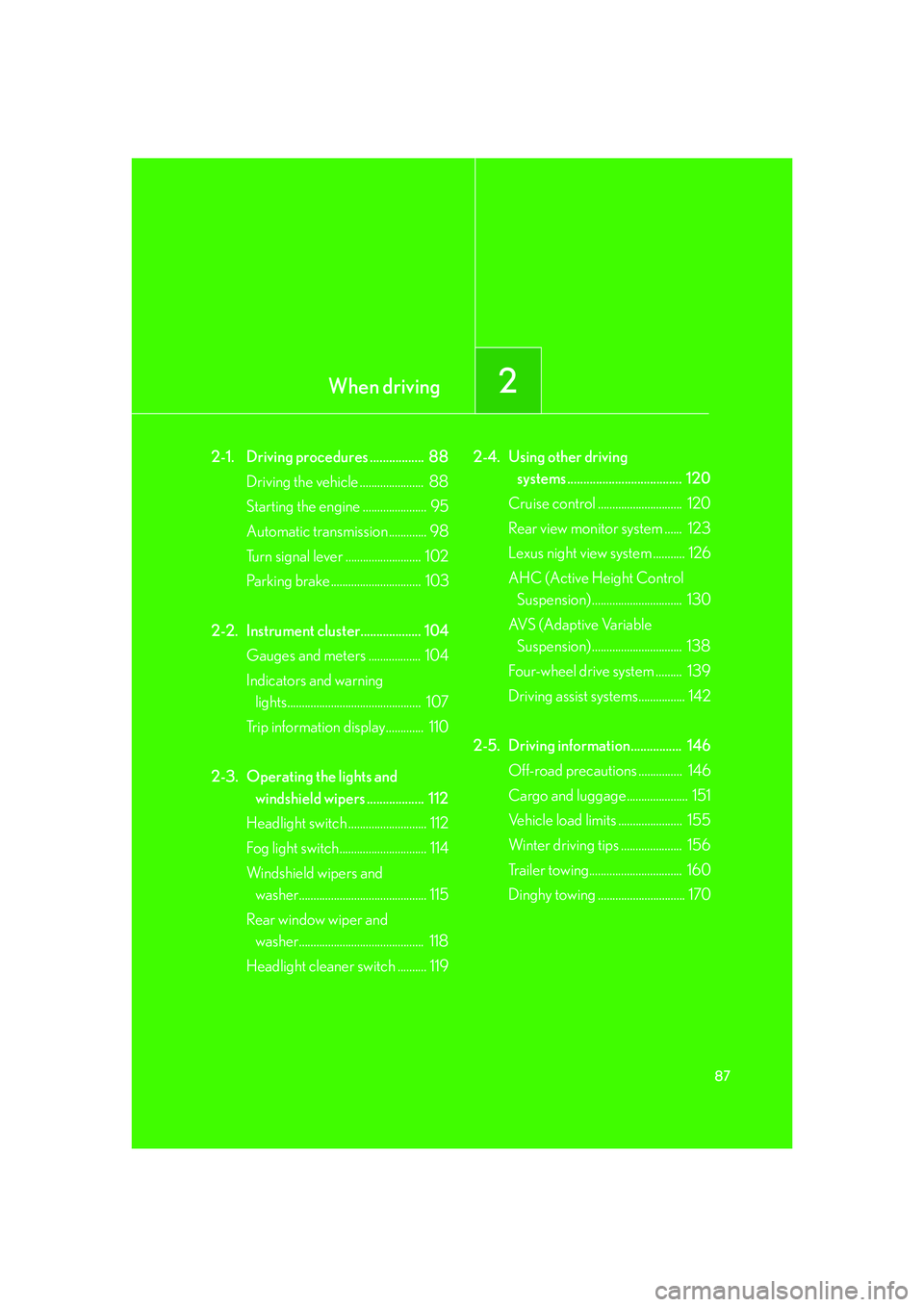
2-1. Driving procedures ................. 88Driving the vehicle ...................... 88
Starting the engine ...................... 95
Automatic transmission ............. 98
Turn signal lever .......................... 102
Parking brake ............................... 103
2-2. Instrument cluster................... 104 Gauges and meters .................. 104
Indicators and warning lights.............................................. 107
Trip information display............. 110
2-3. Operating the lights and windshield wipers .................. 112
Headlight switch ........................... 112
Fog light switch.............................. 114
Windshield wipers and washer............................................ 115
Rear window wiper and washer........................................... 118
Headlight cleaner switch .......... 119 2-4. Using other driving
systems .................................... 120
Cruise control ............................. 120
Rear view monitor system ...... 123
Lexus night view system ........... 126
AHC (Active Height Control Suspension) ............................... 130
AVS (Adaptive Variable Suspension) ............................... 138
Four-wheel drive system ......... 139
Driving assist systems................ 142
2-5. Driving information................ 146 Off-road precautions ............... 146
Cargo and luggage..................... 151
Vehicle load limits ...................... 155
Winter driving tips ..................... 156
Trailer towing................................ 160
Dinghy towing .............................. 170
Page 110 of 426
92
2-1. Driving procedures
CAUTION
■When shifting the shift lever
Be careful not to shift the shift lever with the accelerator pedal depressed.
This may lead to unexpected rapid acceleration of the vehicle that may cause an
accident and result in death or serious injury.
■When the vehicle is stopped
●Do not race the engine.
If the vehicle is in any gear other than “P” or “N” the vehicle may accelerate sud-
denly and unexpectedly, and may cause an accident.
●Do not leave the vehicle with the engine running for a long time.
If such a situation cannot be avoided, park the vehicle in an open space and
check that exhaust fumes do not enter the vehicle interior.
●Always keep a foot on the brake pedal while the engine is running to prevent an
accident caused by the vehicle moving.
■When the vehicle is parked
●Do not leave glasses, cigarette lighters, spray cans, or soft drink cans in the vehi-
cle when it is in the sun.
Failure to do so may result in the following:
• Gas may leak from a cigarette lighter or spray can, and may lead to a fire.
• The temperature inside the vehicle may cause the plastic lenses and plastic material of eye glasses to deform or crack.
• Soft drink cans may fracture, causing the contents to spray over the interior of the vehicle, and may also cause a short circuit in the vehicle's electrical com-
ponents.
●Always apply the parking brake, shift the shift lever to “P”, stop the engine and
lock the vehicle.
Do not leave the vehicle unattend ed while the engine is running.
●Do not touch the exhaust pipe while the engine is running or immediately after
turning the engine off.
Doing so may cause burns.
●Do not leave the engine running in an area with snow build up, or where snow is
expected to fall.
Exhaust gases may enter the vehicle and cause gas poisoning.
Page 131 of 426
113
2-3. Operating the lights and windshield wipers
2
When driving
■Daytime running light system
To make your vehicle more visible to other drivers, the headlights turn on automati-
cally (at a reduced intensity) whenever the engine is started and the parking brake
is released. Daytime running lights are not designed for use at night.
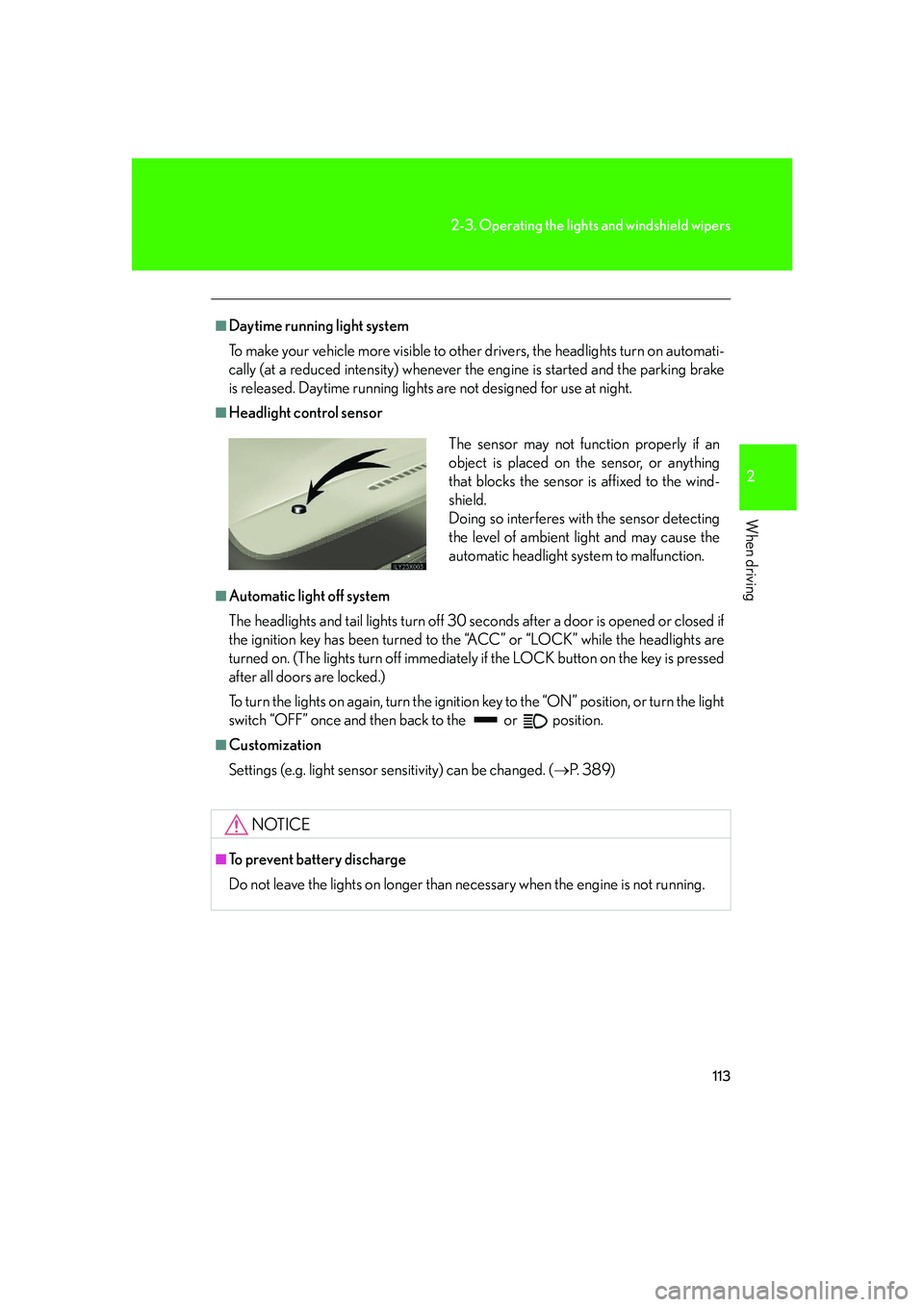
■Headlight control sensor
■Automatic light off system
The headlights and tail lights turn off 30 seconds after a door is opened or closed if
the ignition key has been turned to the “ACC” or “LOCK” while the headlights are
turned on. (The lights turn off immediately if the LOCK button on the key is pressed
after all doors are locked.)
To turn the lights on again, turn the ignition key to the “ON” position, or turn the light
switch “OFF” once and then back to the or position.
■Customization
Settings (e.g. light sensor sensitivity) can be changed. ( P. 3 8 9 )
NOTICE
■To prevent battery discharge
Do not leave the lights on longer than necessary when the engine is not running.
The sensor may not function properly if an
object is placed on the sensor, or anything
that blocks the sensor is affixed to the wind-
shield.
Doing so interferes with the sensor detecting
the level of ambient light and may cause the
automatic headlight system to malfunction.
Page 139 of 426
121
2-4. Using other driving systems
2
When driving
■Cruise control can be set when
●The shift lever is in the “D” or “4”.
●Vehicle speed is between approximately 25 mph (40 km/h) and 125 mph
(200 km/h).
■Accelerating
The vehicle can be accelerated normally. After acceleration, the set speed
resumes.
■Automatic cruise control cancelation
The set speed is automatically canceled in any of the following situations.
●Actual vehicle speed falls more than 10 mph (16 km/h) below the preset vehicle
speed
●Actual vehicle speed is below 25 mph (40 km/h)
●VSC is activated
■If the cruise control indicator light flashes
Turn the “ON-OFF” button off once, and then reactivate the system.
If the cruise control speed cannot be set or if the cruise control cancels immediately
after being activated, there may be a malfun ction in the cruise control system. Have
the vehicle inspected by your Lexus dealer.
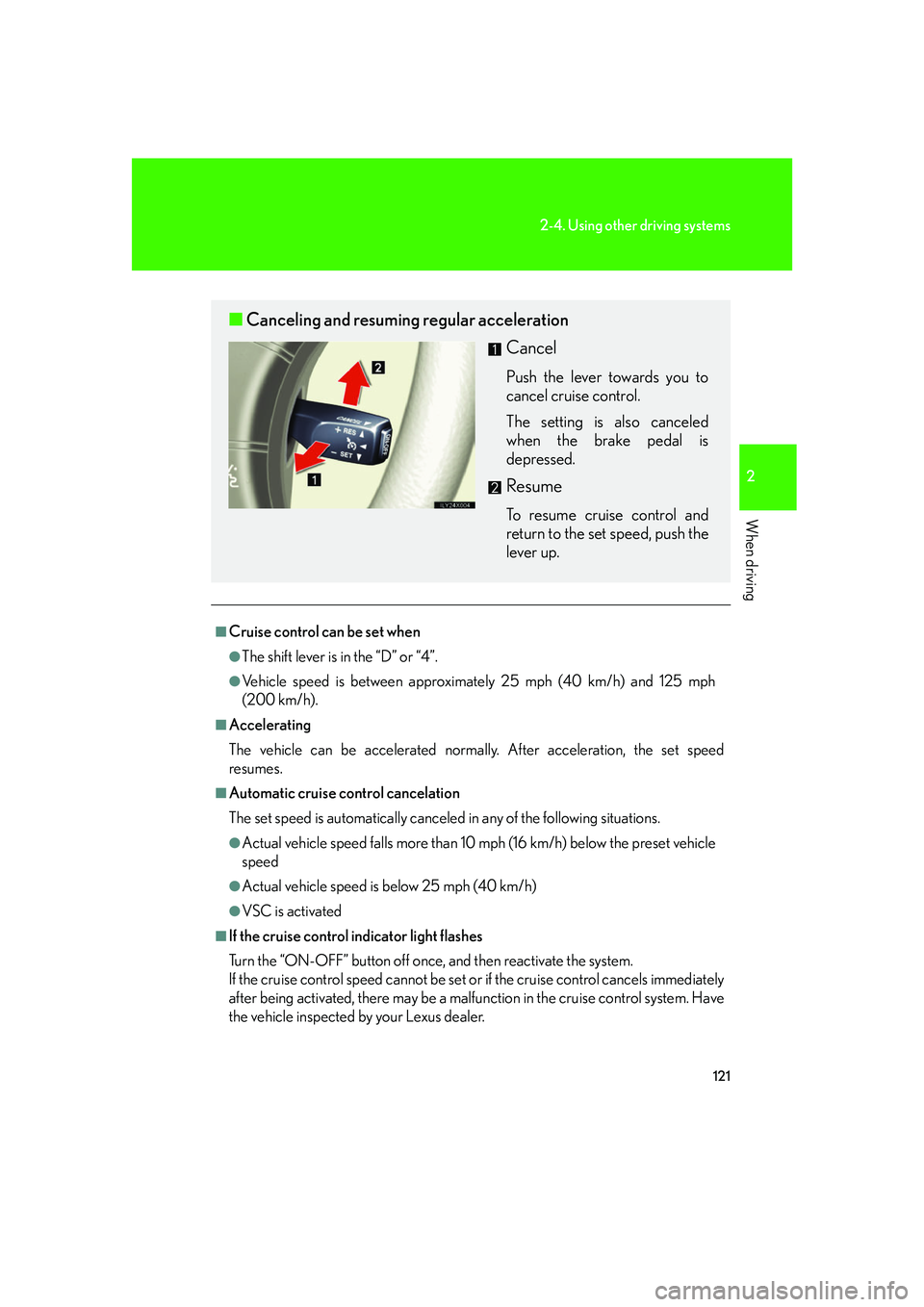
■ Canceling and resuming regular acceleration
Cancel
Push the lever towards you to
cancel cruise control.
The setting is also canceled
when the brake pedal is
depressed.
Resume
To resume cruise control and
return to the set speed, push the
lever up.
Page 152 of 426

134
2-4. Using other driving systems
■If the vehicle height does not change
If the vehicle is loaded too heavily, or the undercarriage has come into contact with
the road surface, the vehicle height cannot be raised/lowered. In this case, the indi-
cator lights will change as follows:
●The current mode indicator light will turn off, and the target mode indicator light
will begin flashing.
●The target mode indicator light will turn off, and the original mode indicator light
will be lit once more. (The vehicle height does not change.)
■In the following cases AHC will not operate
●The brake pedal has been depressed for longer than 5 seconds while the vehi-
cle is stopped.
●The suspension fluid temperature is lower than -22°F (-30°C).
●Driving on bumpy roads which may cause the suspension to fully elongate.
●If the steering wheel is abruptly turned more than 3/4 of a revolution with the
center differential lock system activated.
■Cold weather operation
It may take longer for the vehicle height to change if the suspension fluid tempera-
ture drops below -5°F (-15°C).
AHC does not operate when the suspension fluid temperature drops below -22°F
(-30°C).
●In this case, the selected height mode indicator light will flash when the height
mode select switch is pressed, however the vehicle height will not change.
Once the engine has warmed the suspension fluid to within normal operating
limits, AHC will begin operating and the vehicle height will automatically
change to the selected mode.
●When the suspension fluid is around -22°F (-30°C), the vehicle height may not
be able to be raised, even if AHC is operating. In this case, push “ ▼” then “▲ ”
on the height mode select switch after further warming the engine to select the
desired vehicle height.
Page 158 of 426
140
2-4. Using other driving systems
■Advice for driving on slippery roads in “L” (low speed position)
●If you shift the four-wheel drive control lever to “L” and the shift lever to “2” while
driving in steep off-road areas, the output of the brake can be controlled effec-
tively by the active traction control system, which assists the driver to control the
driving power of 4 wheels.
●Use the “L” position of the shift lever for maximum power and traction when
your wheels get stuck or when you drive down a steep incline. In the following
cases, the output of the brake can be co ntrolled by the active traction control
system if the engine speed is un der 3,000 rpm (normally under 3,000 rpm
when the wheels get unstuck).
• The four-wheel drive control lever in the “L” position and the shift lever in the
“L” position or the shift lever in the “D”, “4”, “3” or “2” with the transmission
downshifting to first gear.
• The four-wheel drive control lever in the “L” position and the shift lever in the
“R” position.
■The center differential lock/unlock button can be operated when
●The ignition key is in the “ON” position, and
●The four-wheel drive control lever is in the “H” or “L” position.
■Locking /unlocking the center differential
●When the center differential is locked, VSC (vehicle stability control) is auto-
matically turned off. (Center differenti al lock and “VSC OFF” indicator light
come on.)
●When the operation is not completed, th e center differential lock indicator
blinks. If the indicator light does not go off when unlocking the center differen-
tial, drive straight ahead while accelerating or decelerating, or drive in reverse.
●The center differential lock system operation is not completed within 5 seconds
while the cruise control system is set, cancel the cruise control system.
Page 160 of 426

142
2-4. Using other driving systems
Driving assist systems
When the VSC system is operatingIf the vehicle is in danger of slip-
ping, the slip indicator light flashes
and buzzer sounds to indicate that
the VSC systems have been
engaged.
To help enhance driving safety and performance, the following systems
operate automatically in response to various driving situations. Be aware,
however, that these systems are supplementary and should not be relied
upon too heavily when operating the vehicle.
■ABS (Anti-lock Brake System)
Restrains the vehicle from slipping when driving on slick road surfaces or
in the event of sudden braking.
■BA (Brake Assist)
Generates an increased level of braking force after the brake pedal is
depressed, when the system detects a panic stop situation.
■VSC (Vehicle Stability Control)
Helps the driver to control skidding when swerving suddenly or turning on
slippery road surfaces.
■ TRAC (Active Traction Control)
Maintains drive power and prevents the 4 wheels from spinning when
starting the vehicle or accelerating on slippery roads.
■VGRS (Variable Gear Ratio Steering)
Adjusts the wheel turning angle in accordance with the vehicle speed and
steering wheel movement.
Page 162 of 426
144
2-4. Using other driving systems
■Sounds and vibrations caused by the ABS, BA, VSC, TRAC and VGRS systems
●A sound may be heard from the engine compartment when the engine is
started or just after the vehicle begins to move. This sound does not indicate that
a malfunction has occurred in any of these systems.
●Any of the following conditions may occur when the above systems are operat-
ing. None of these indicates that a malfunction has occurred.
• Vibrations may be felt through the vehicle body and steering.
• A motor sound may be heard after the vehicle comes to a stop.
• The brake pedal may pulsate slightly after the ABS is activated.
• The brake pedal may move down slightly after the ABS is activated.
■VGRS is disabled in the following situations
●During stopping or the steering wheel has been moved for a long time while
driving at lower speeds.
●After the engine is restarted at less than -22°F (-30°C).
●If you disconnect the batter y with the steering wheel turned, the center position
of the steering wheel could be slightly and temporary changed. To initialize the
VGRS, drive for a short while.
Page 183 of 426

165
2-5. Driving information
2
When driving
CAUTION
■To avoid accident or injury
●The total trailer weight (trailer weight plus the weight of cargo) must not exceed
6500 lb. (2948 kg).
●If a trailer and cargo weight over 2000 lb. (907 kg), use a sway control device
with sufficient capacity.
●The gross combined weight (sum of your vehicle weight plus its load and the total
trailer weight) must not exceed 12400 lb. (5625 kg).
●Do not exceed the trailer hitch assembly weight, gross vehicle weight, gross axle
weight and trailer tongue load capacities.
●Never load more weight in the back than in the front of the trailer. About 60% of
the load should be in the front half of the trailer, and the remaining 40% in the
rear.
●Set the vehicle height to the “LO” mode an d turn off the active height control sus-
pension to prevent the vehicle heig ht from automatically changing.
●The tow hitch receiver installed on your vehicle must never be used on another
vehicle.
■Hitches
●If you wish to install a trailer hitch, contact your Lexus dealer.
●Use only a hitch that conforms to the total trailer weight requirement.
●Follow the directions supplied by the hitch manufacturer.
●Lubricate the hitch ball with a light coat of grease.
●Remove the trailer hitch whenever you are not towing a trailer. After removing
the hitch, seal any mounting hole in the vehicle body to prevent entry of any sub-
stances into the vehicle.
■When towing a trailer
●If the total trailer weight exceeds 1000 lb . (453 kg), trailer brakes are required.
●Never tap into your vehicle’s hydraulic system, as this will lower the vehicle’s brak-
ing effectiveness.
●Never tow a trailer without using a safety chain securely attached to both the
trailer and the vehicle. If damage occurs to the coupling unit or hitch ball, there is
danger of the trailer wandering into another lane.